Material handling equipments
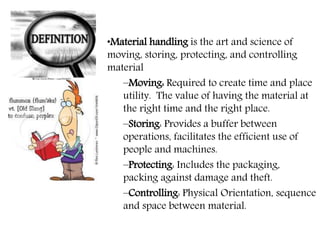
•Material handling is the art and science of
moving, storing, protecting, and controlling
material
–Moving: Required to create time and place
utility. The value of having the material at
the right time and the right place.
–Storing: Provides a buffer between
operations, facilitates the efficient use of
people and machines.
–Protecting: Includes the packaging,
packing against damage and theft.
–Controlling: Physical Orientation, sequence
and space between material.
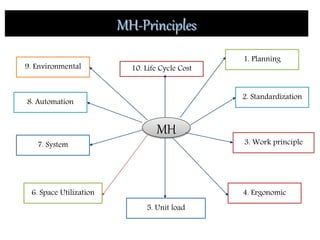
MH-Principles
MH
1. Planning
2. Standardization
3. Work principle
4. Ergonomic
5. Unit load
6. Space Utilization
7. System
8. Automation
9. Environmental 10. Life Cycle Cost
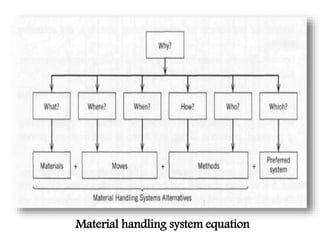
Material handling system equation
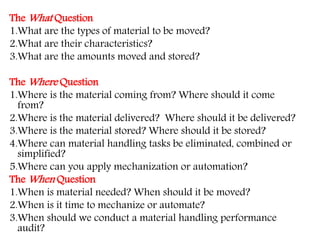
The What Question
1.What are the types of material to be moved?
2.What are their characteristics?
3.What are the amounts moved and stored?
The Where Question
1.Where is the material coming from? Where should it come
from?
2.Where is the material delivered? Where should it be delivered?
3.Where is the material stored? Where should it be stored?
4.Where can material handling tasks be eliminated, combined or
simplified?
5.Where can you apply mechanization or automation?
The When Question
1.When is material needed? When should it be moved?
2.When is it time to mechanize or automate?
3.When should we conduct a material handling performance
audit?
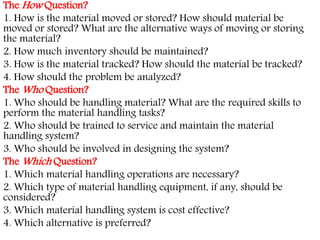
The How Question?
1. How is the material moved or stored? How should material be
moved or stored? What are the alternative ways of moving or storing
the material?
2. How much inventory should be maintained?
3. How is the material tracked? How should the material be tracked?
4. How should the problem be analyzed?
The Who Question?
1. Who should be handling material? What are the required skills to
perform the material handling tasks?
2. Who should be trained to service and maintain the material
handling system?
3. Who should be involved in designing the system?
The Which Question?
1. Which material handling operations are necessary?
2. Which type of material handling equipment, if any, should be
considered?
3. Which material handling system is cost effective?
4. Which alternative is preferred?
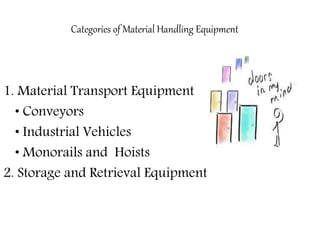
Categories of Material Handling Equipment
1. Material Transport Equipment
• Conveyors
• Industrial Vehicles
• Monorails and Hoists
2. Storage and Retrieval Equipment
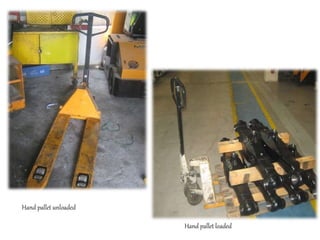
Hand pallet unloaded
Hand pallet loaded
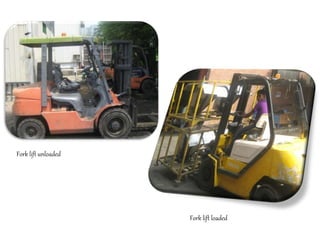
Fork lift unloaded
Fork lift loaded
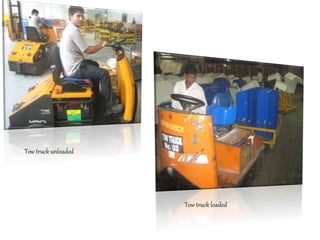
Tow truck unloaded
Tow truck loaded
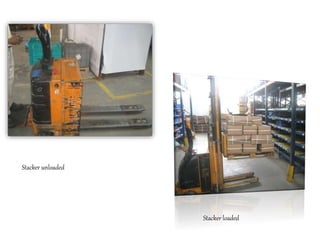
Stacker unloaded
Stacker loaded
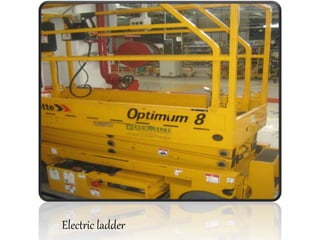
Electric ladder
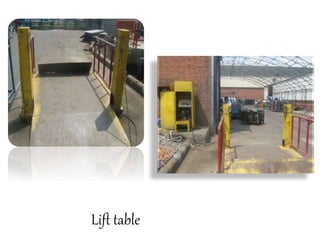
Lift table
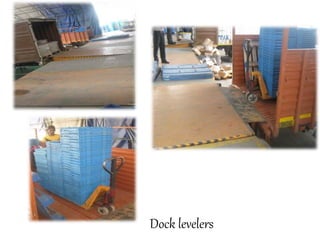
Dock levelers
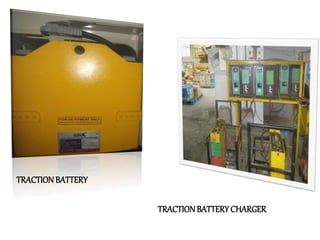
TRACTIONBATTERY
TRACTIONBATTERYCHARGER
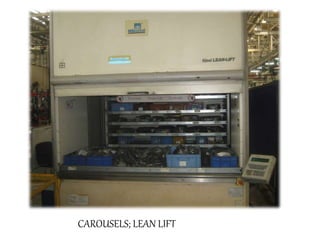
CAROUSELS; LEAN LIFT
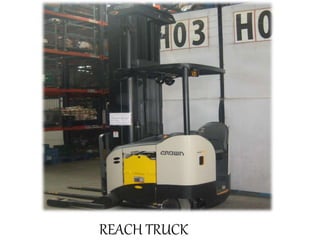
REACH TRUCK
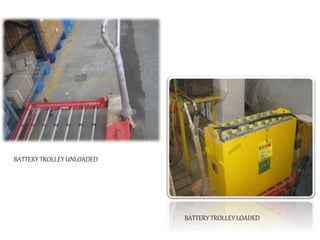
BATTERY TROLLEY UNLOADED
BATTERY TROLLEY LOADED
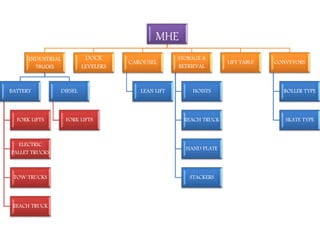
MHE
INDUSTRIAL
TRUCKS
BATTERY
FORK LIFTS
ELECTRIC
PALLET TRUCKS
TOW TRUCKS
REACH TRUCK
DIESEL
FORK LIFTS
DOCK
LEVELERS
CAROUSEL
LEAN LIFT
STORAGE &
RETRIEVAL
HOISTS
REACH TRUCK
HAND PLATE
STACKERS
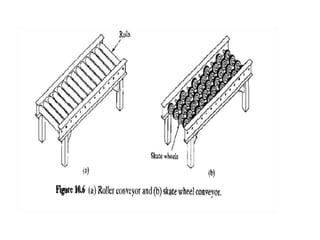
LIFT TABLE CONVEYORS
ROLLER TYPE
SKATE TYPE
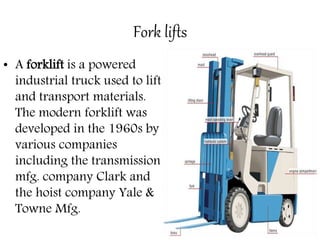
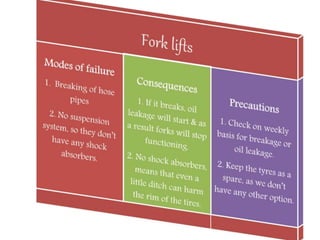
Fork lifts
• A forklift is a powered
industrial truck used to lift
and transport materials.
The modern forklift was
developed in the 1960s by
various companies
including the transmission
mfg. company Clark and
the hoist company Yale &
Towne Mfg.
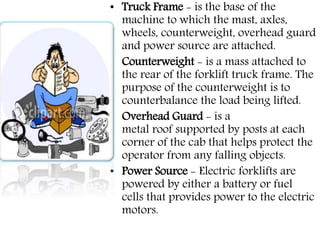
• Truck Frame - is the base of the
machine to which the mast, axles,
wheels, counterweight, overhead guard
and power source are attached.
• Counterweight - is a mass attached to
the rear of the forklift truck frame. The
purpose of the counterweight is to
counterbalance the load being lifted.
• Overhead Guard - is a
metal roof supported by posts at each
corner of the cab that helps protect the
operator from any falling objects.
• Power Source - Electric forklifts are
powered by either a battery or fuel
cells that provides power to the electric
motors.
• Tilt Cylinders - are hydraulic cylinders that are
mounted to the truck frame and the mast. The tilt
cylinders pivot the mast to assist in engaging a load.
• Mast - is the vertical assembly that does the work of
raising and lowering the load. It is made up of
interlocking rails that also provide lateral stability.
• Carriage - is the component to which the forks or
other attachments mount. It is mounted into and
moves up and down the mast rails by means of chains
or by being directly attached to the hydraulic cylinder.
• Tires - either solid for indoor use, or pneumatic for
outside use.
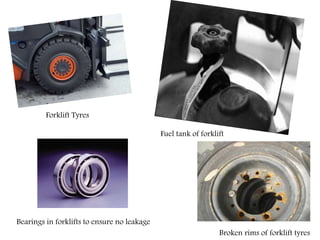
Forklift Tyres
Bearings in forklifts to ensure no leakage
Fuel tank of forklift
Broken rims of forklift tyres
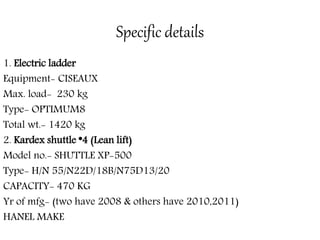
Specific details
1. Electric ladder
Equipment- CISEAUX
Max. load- 230 kg
Type- OPTIMUM8
Total wt.- 1420 kg
2. Kardex shuttle *4 (Lean lift)
Model no.- SHUTTLE XP-500
Type- H/N 55/N22D/18B/N75D13/20
CAPACITY- 470 KG
Yr of mfg- (two have 2008 & others have 2010,2011)
HANEL MAKE
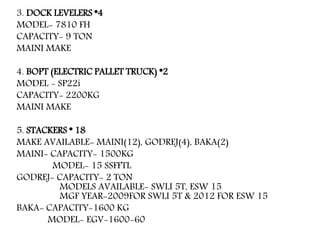
3. DOCK LEVELERS *4
MODEL- 7810 FH
CAPACITY- 9 TON
MAINI MAKE
4. BOPT (ELECTRIC PALLET TRUCK) *2
MODEL - SP22i
CAPACITY- 2200KG
MAINI MAKE
5. STACKERS * 18
MAKE AVAILABLE- MAINI(12), GODREJ(4), BAKA(2)
MAINI- CAPACITY- 1500KG
MODEL- 15 SSFFTL
GODREJ- CAPACITY- 2 TON
MODELS AVAILABLE- SWLI 5T, ESW 15
MGF YEAR-2009FOR SWLI 5T & 2012 FOR ESW 15
BAKA- CAPACITY-1600 KG
MODEL- EGV-1600-60
6. HAND PLATE *15
MODEL- PV 25
CAPACITY- 2500 KG
MAINI MAKE
7. LIFT TABLE
CAPACITY- 100O KG
8. TOW TRUCKS *10
MAKE AVAILABLE- MAINI(8), GODREJ (2)
MAINI- CAPACITY- 2000 KG
MODEL- TT20i
MFG YR.- 2012
9. FORK LIFTS *12
MAKE AVAILABLE- MITSUBISHI(1), VOLTAS(2),
HELI(1), GODREJ(2), TOYOTA(7)
MITSUBISHI- MODEL- FD 30ND
CAPACITY- 3TON
MFG. YEAR- 2006
TOYOTA- MODEL - 62- 8FD30
CAPACITY- 3 TON
How to maintain?
• Keep all moving parts well lubricated
• Check fluid levels regularly.
• Keep your forklift charged or fueled.
• Keep Forklift Gauges Functioning Properly.
• Keep Forklift Tires in Good Shape- If the tires use
air, ensure that the correct air pressure is maintained in
them. In case the tires are solid rubber ones, make sure
that there are not any gashes present.
When to use MHE’S?
Seek help:
1. When a load is too bulky to
properly grasp or lift
2. When you can’t see around
or over the load
3. When you can’t safely
handle the load
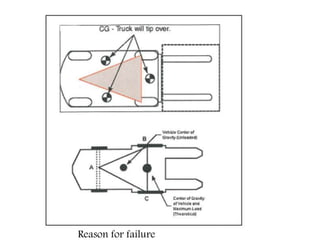
Reason for failure
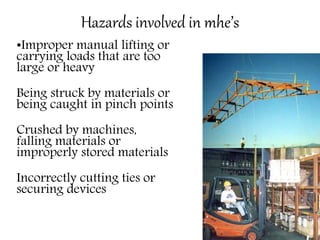
Hazards involved in mhe’s
•Improper manual lifting or
carrying loads that are too
large or heavy
Being struck by materials or
being caught in pinch points
Crushed by machines,
falling materials or
improperly stored materials
Incorrectly cutting ties or
securing devices
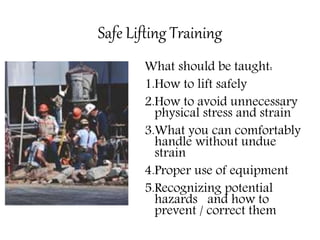
Safe Lifting Training
What should be taught:
1.How to lift safely
2.How to avoid unnecessary
physical stress and strain
3.What you can comfortably
handle without undue
strain
4.Proper use of equipment
5.Recognizing potential
hazards and how to
prevent / correct them
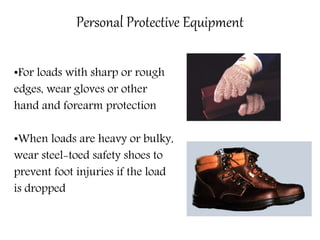
Personal Protective Equipment
•For loads with sharp or rough
edges, wear gloves or other
hand and forearm protection
•When loads are heavy or bulky,
wear steel-toed safety shoes to
prevent foot injuries if the load
is dropped
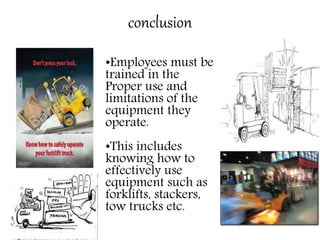
conclusion
•Employees must be
trained in the
Proper use and
limitations of the
equipment they
operate.
•This includes
knowing how to
effectively use
equipment such as
forklifts, stackers,
tow trucks etc.

Materialhandlingequipments 131116123721-phpapp01

  • 1.
  • 2.
    •Material handling isthe art and science of moving, storing, protecting, and controlling material –Moving: Required to create time and place utility. The value of having the material at the right time and the right place. –Storing: Provides a buffer between operations, facilitates the efficient use of people and machines. –Protecting: Includes the packaging, packing against damage and theft. –Controlling: Physical Orientation, sequence and space between material.
  • 3.
    MH-Principles MH 1. Planning 2. Standardization 3.Work principle 4. Ergonomic 5. Unit load 6. Space Utilization 7. System 8. Automation 9. Environmental 10. Life Cycle Cost
  • 4.
  • 5.
    The What Question 1.Whatare the types of material to be moved? 2.What are their characteristics? 3.What are the amounts moved and stored? The Where Question 1.Where is the material coming from? Where should it come from? 2.Where is the material delivered? Where should it be delivered? 3.Where is the material stored? Where should it be stored? 4.Where can material handling tasks be eliminated, combined or simplified? 5.Where can you apply mechanization or automation? The When Question 1.When is material needed? When should it be moved? 2.When is it time to mechanize or automate? 3.When should we conduct a material handling performance audit?
  • 6.
    The How Question? 1.How is the material moved or stored? How should material be moved or stored? What are the alternative ways of moving or storing the material? 2. How much inventory should be maintained? 3. How is the material tracked? How should the material be tracked? 4. How should the problem be analyzed? The Who Question? 1. Who should be handling material? What are the required skills to perform the material handling tasks? 2. Who should be trained to service and maintain the material handling system? 3. Who should be involved in designing the system? The Which Question? 1. Which material handling operations are necessary? 2. Which type of material handling equipment, if any, should be considered? 3. Which material handling system is cost effective? 4. Which alternative is preferred?
  • 7.
    Categories of MaterialHandling Equipment 1. Material Transport Equipment • Conveyors • Industrial Vehicles • Monorails and Hoists 2. Storage and Retrieval Equipment
  • 8.
  • 9.
  • 10.
  • 11.
  • 12.
  • 13.
  • 14.
  • 15.
  • 16.
  • 17.
  • 18.
  • 20.
    MHE INDUSTRIAL TRUCKS BATTERY FORK LIFTS ELECTRIC PALLET TRUCKS TOWTRUCKS REACH TRUCK DIESEL FORK LIFTS DOCK LEVELERS CAROUSEL LEAN LIFT STORAGE & RETRIEVAL HOISTS REACH TRUCK HAND PLATE STACKERS LIFT TABLE CONVEYORS ROLLER TYPE SKATE TYPE
  • 21.
    Fork lifts • Aforklift is a powered industrial truck used to lift and transport materials. The modern forklift was developed in the 1960s by various companies including the transmission mfg. company Clark and the hoist company Yale & Towne Mfg.
  • 22.
    • Truck Frame- is the base of the machine to which the mast, axles, wheels, counterweight, overhead guard and power source are attached. • Counterweight - is a mass attached to the rear of the forklift truck frame. The purpose of the counterweight is to counterbalance the load being lifted. • Overhead Guard - is a metal roof supported by posts at each corner of the cab that helps protect the operator from any falling objects. • Power Source - Electric forklifts are powered by either a battery or fuel cells that provides power to the electric motors.
  • 23.
    • Tilt Cylinders- are hydraulic cylinders that are mounted to the truck frame and the mast. The tilt cylinders pivot the mast to assist in engaging a load. • Mast - is the vertical assembly that does the work of raising and lowering the load. It is made up of interlocking rails that also provide lateral stability. • Carriage - is the component to which the forks or other attachments mount. It is mounted into and moves up and down the mast rails by means of chains or by being directly attached to the hydraulic cylinder. • Tires - either solid for indoor use, or pneumatic for outside use.
  • 25.
    Forklift Tyres Bearings inforklifts to ensure no leakage Fuel tank of forklift Broken rims of forklift tyres
  • 26.
    Specific details 1. Electricladder Equipment- CISEAUX Max. load- 230 kg Type- OPTIMUM8 Total wt.- 1420 kg 2. Kardex shuttle *4 (Lean lift) Model no.- SHUTTLE XP-500 Type- H/N 55/N22D/18B/N75D13/20 CAPACITY- 470 KG Yr of mfg- (two have 2008 & others have 2010,2011) HANEL MAKE
  • 27.
    3. DOCK LEVELERS*4 MODEL- 7810 FH CAPACITY- 9 TON MAINI MAKE 4. BOPT (ELECTRIC PALLET TRUCK) *2 MODEL - SP22i CAPACITY- 2200KG MAINI MAKE 5. STACKERS * 18 MAKE AVAILABLE- MAINI(12), GODREJ(4), BAKA(2) MAINI- CAPACITY- 1500KG MODEL- 15 SSFFTL GODREJ- CAPACITY- 2 TON MODELS AVAILABLE- SWLI 5T, ESW 15 MGF YEAR-2009FOR SWLI 5T & 2012 FOR ESW 15 BAKA- CAPACITY-1600 KG MODEL- EGV-1600-60
  • 28.
    6. HAND PLATE*15 MODEL- PV 25 CAPACITY- 2500 KG MAINI MAKE 7. LIFT TABLE CAPACITY- 100O KG 8. TOW TRUCKS *10 MAKE AVAILABLE- MAINI(8), GODREJ (2) MAINI- CAPACITY- 2000 KG MODEL- TT20i MFG YR.- 2012
  • 29.
    9. FORK LIFTS*12 MAKE AVAILABLE- MITSUBISHI(1), VOLTAS(2), HELI(1), GODREJ(2), TOYOTA(7) MITSUBISHI- MODEL- FD 30ND CAPACITY- 3TON MFG. YEAR- 2006 TOYOTA- MODEL - 62- 8FD30 CAPACITY- 3 TON
  • 30.
    How to maintain? •Keep all moving parts well lubricated • Check fluid levels regularly. • Keep your forklift charged or fueled. • Keep Forklift Gauges Functioning Properly. • Keep Forklift Tires in Good Shape- If the tires use air, ensure that the correct air pressure is maintained in them. In case the tires are solid rubber ones, make sure that there are not any gashes present.
  • 31.
    When to useMHE’S? Seek help: 1. When a load is too bulky to properly grasp or lift 2. When you can’t see around or over the load 3. When you can’t safely handle the load
  • 32.
  • 33.
    Hazards involved inmhe’s •Improper manual lifting or carrying loads that are too large or heavy Being struck by materials or being caught in pinch points Crushed by machines, falling materials or improperly stored materials Incorrectly cutting ties or securing devices
  • 34.
    Safe Lifting Training Whatshould be taught: 1.How to lift safely 2.How to avoid unnecessary physical stress and strain 3.What you can comfortably handle without undue strain 4.Proper use of equipment 5.Recognizing potential hazards and how to prevent / correct them
  • 35.
    Personal Protective Equipment •Forloads with sharp or rough edges, wear gloves or other hand and forearm protection •When loads are heavy or bulky, wear steel-toed safety shoes to prevent foot injuries if the load is dropped
  • 36.
    conclusion •Employees must be trainedin the Proper use and limitations of the equipment they operate. •This includes knowing how to effectively use equipment such as forklifts, stackers, tow trucks etc.