Definition
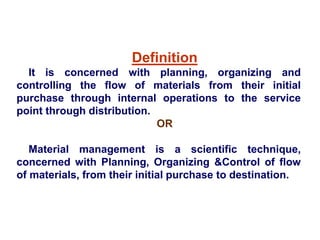
It is concerned with planning, organizing and
controlling the flow of materials from their initial
purchase through internal operations to the service
point through distribution.
OR
Material management is a scientific technique,
concerned with Planning, Organizing &Control of flow
of materials, from their initial purchase to destination.
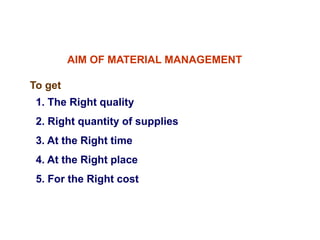
AIM OF MATERIAL MANAGEMENT
To get
1. The Right quality
2. Right quantity of supplies
3. At the Right time
4. At the Right place
5. For the Right cost
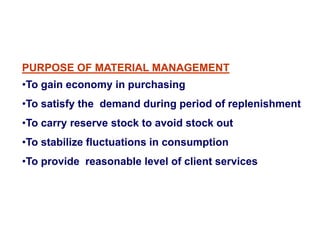
PURPOSE OF MATERIAL MANAGEMENT
•To gain economy in purchasing
•To satisfy the demand during period of replenishment
•To carry reserve stock to avoid stock out
•To stabilize fluctuations in consumption
•To provide reasonable level of client services
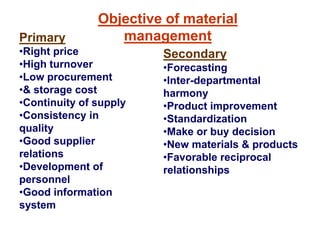
Primary
•Right price
•High turnover
•Low procurement
•& storage cost
•Continuity of supply
•Consistency in
quality
•Good supplier
relations
•Development of
personnel
•Good information
system
Objective of material
management
Secondary
•Forecasting
•Inter-departmental
harmony
•Product improvement
•Standardization
•Make or buy decision
•New materials & products
•Favorable reciprocal
relationships
Four basic needs of Material
management
1. To have adequate materials on hand when needed
2. To pay the lowest possible prices, consistent with
quality and value requirement for purchases
materials
3. To minimize the inventory investment
4. To operate efficiently
Storage
• Store must be of adequate space
• Materials must be stored in an appropriate place
• in a correct way
• Group wise & alphabetical arrangement helps in
• identification & retrieval
• First-in, first-out principle to be followed
• Monitor expiry date
• Follow two bin or double shelf system, to avoid
• Stock outs
• Reserve bin should contain stock that will cover
• lead time and a small safety stock
Inventory control
It means stocking adequate number and
kind of stores, so that the materials are
available whenever required and wherever
required. Scientific inventory control results
in optimal balance
Functions of inventory control
•To provide maximum supply service,
consistent with maximum efficiency &
optimum investment.
•To provide cushion between forecasted &
actual demand for a material
Economic order of quantity
EOQ = Average Monthly Consumption X Lead Time [in
months] + Buffer Stock – Stock on hand
CARRYING
COST
PURCHASING
COST
ECONOMIC ORDER OF
QUANTITY(EOQ)
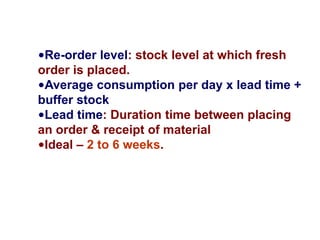
•Re-order level: stock level at which fresh
order is placed.
•Average consumption per day x lead time +
buffer stock
•Lead time: Duration time between placing
an order & receipt of material
•Ideal – 2 to 6 weeks.
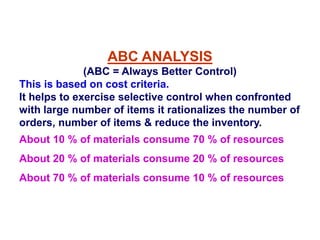
ABC ANALYSIS
(ABC = Always Better Control)
This is based on cost criteria.
It helps to exercise selective control when confronted
with large number of items it rationalizes the number of
orders, number of items & reduce the inventory.
About 10 % of materials consume 70 % of resources
About 20 % of materials consume 20 % of resources
About 70 % of materials consume 10 % of resources
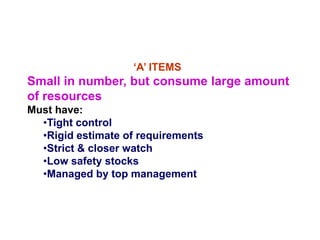
‘A’ ITEMS
Small in number, but consume large amount
of resources
Must have:
•Tight control
•Rigid estimate of requirements
•Strict & closer watch
•Low safety stocks
•Managed by top management
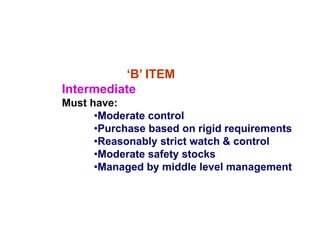
‘B’ ITEM
Intermediate
Must have:
•Moderate control
•Purchase based on rigid requirements
•Reasonably strict watch & control
•Moderate safety stocks
•Managed by middle level management
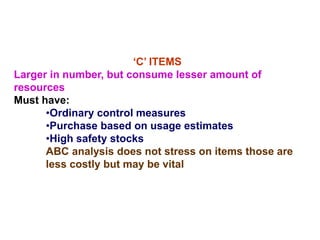
‘C’ ITEMS
Larger in number, but consume lesser amount of
resources
Must have:
•Ordinary control measures
•Purchase based on usage estimates
•High safety stocks
ABC analysis does not stress on items those are
less costly but may be vital
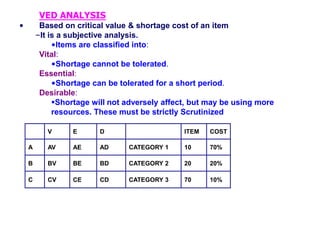
VED ANALYSIS
• Based on critical value & shortage cost of an item
–It is a subjective analysis.
•Items are classified into:
Vital:
•Shortage cannot be tolerated.
Essential:
•Shortage can be tolerated for a short period.
Desirable:
Shortage will not adversely affect, but may be using more
resources. These must be strictly Scrutinized
V E D ITEM COST
A AV AE AD CATEGORY 1 10 70%
B BV BE BD CATEGORY 2 20 20%
C CV CE CD CATEGORY 3 70 10%
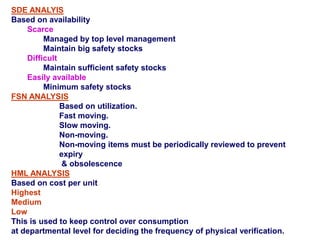
SDE ANALYIS
Based on availability
Scarce
Managed by top level management
Maintain big safety stocks
Difficult
Maintain sufficient safety stocks
Easily available
Minimum safety stocks
FSN ANALYSIS
Based on utilization.
Fast moving.
Slow moving.
Non-moving.
Non-moving items must be periodically reviewed to prevent
expiry
& obsolescence
HML ANALYSIS
Based on cost per unit
Highest
Medium
Low
This is used to keep control over consumption
at departmental level for deciding the frequency of physical verification.
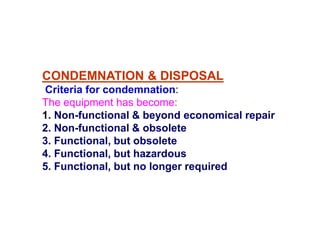
CONDEMNATION & DISPOSAL
Criteria for condemnation:
The equipment has become:
1. Non-functional & beyond economical repair
2. Non-functional & obsolete
3. Functional, but obsolete
4. Functional, but hazardous
5. Functional, but no longer required
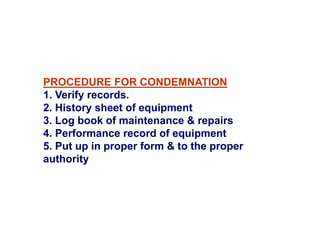
PROCEDURE FOR CONDEMNATION
1. Verify records.
2. History sheet of equipment
3. Log book of maintenance & repairs
4. Performance record of equipment
5. Put up in proper form & to the proper
authority
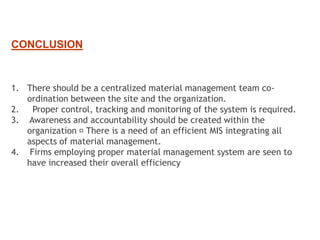
CONCLUSION
1. There should be a centralized material management team co-
ordination between the site and the organization.
2. Proper control, tracking and monitoring of the system is required.
3. Awareness and accountability should be created within the
organization There is a need of an efficient MIS integrating all
aspects of material management.
4. Firms employing proper material management system are seen to
have increased their overall efficiency
Please Give any
suggestion

Material managemet ppt

  • 1.
    Definition It is concernedwith planning, organizing and controlling the flow of materials from their initial purchase through internal operations to the service point through distribution. OR Material management is a scientific technique, concerned with Planning, Organizing &Control of flow of materials, from their initial purchase to destination.
  • 2.
    AIM OF MATERIALMANAGEMENT To get 1. The Right quality 2. Right quantity of supplies 3. At the Right time 4. At the Right place 5. For the Right cost
  • 3.
    PURPOSE OF MATERIALMANAGEMENT •To gain economy in purchasing •To satisfy the demand during period of replenishment •To carry reserve stock to avoid stock out •To stabilize fluctuations in consumption •To provide reasonable level of client services
  • 4.
    Primary •Right price •High turnover •Lowprocurement •& storage cost •Continuity of supply •Consistency in quality •Good supplier relations •Development of personnel •Good information system Objective of material management Secondary •Forecasting •Inter-departmental harmony •Product improvement •Standardization •Make or buy decision •New materials & products •Favorable reciprocal relationships
  • 5.
    Four basic needsof Material management 1. To have adequate materials on hand when needed 2. To pay the lowest possible prices, consistent with quality and value requirement for purchases materials 3. To minimize the inventory investment 4. To operate efficiently
  • 6.
    Storage • Store mustbe of adequate space • Materials must be stored in an appropriate place • in a correct way • Group wise & alphabetical arrangement helps in • identification & retrieval • First-in, first-out principle to be followed • Monitor expiry date • Follow two bin or double shelf system, to avoid • Stock outs • Reserve bin should contain stock that will cover • lead time and a small safety stock
  • 7.
    Inventory control It meansstocking adequate number and kind of stores, so that the materials are available whenever required and wherever required. Scientific inventory control results in optimal balance
  • 8.
    Functions of inventorycontrol •To provide maximum supply service, consistent with maximum efficiency & optimum investment. •To provide cushion between forecasted & actual demand for a material
  • 9.
    Economic order ofquantity EOQ = Average Monthly Consumption X Lead Time [in months] + Buffer Stock – Stock on hand CARRYING COST PURCHASING COST ECONOMIC ORDER OF QUANTITY(EOQ)
  • 10.
    •Re-order level: stocklevel at which fresh order is placed. •Average consumption per day x lead time + buffer stock •Lead time: Duration time between placing an order & receipt of material •Ideal – 2 to 6 weeks.
  • 11.
    ABC ANALYSIS (ABC =Always Better Control) This is based on cost criteria. It helps to exercise selective control when confronted with large number of items it rationalizes the number of orders, number of items & reduce the inventory. About 10 % of materials consume 70 % of resources About 20 % of materials consume 20 % of resources About 70 % of materials consume 10 % of resources
  • 12.
    ‘A’ ITEMS Small innumber, but consume large amount of resources Must have: •Tight control •Rigid estimate of requirements •Strict & closer watch •Low safety stocks •Managed by top management
  • 13.
    ‘B’ ITEM Intermediate Must have: •Moderatecontrol •Purchase based on rigid requirements •Reasonably strict watch & control •Moderate safety stocks •Managed by middle level management
  • 14.
    ‘C’ ITEMS Larger innumber, but consume lesser amount of resources Must have: •Ordinary control measures •Purchase based on usage estimates •High safety stocks ABC analysis does not stress on items those are less costly but may be vital
  • 15.
    VED ANALYSIS • Basedon critical value & shortage cost of an item –It is a subjective analysis. •Items are classified into: Vital: •Shortage cannot be tolerated. Essential: •Shortage can be tolerated for a short period. Desirable: Shortage will not adversely affect, but may be using more resources. These must be strictly Scrutinized V E D ITEM COST A AV AE AD CATEGORY 1 10 70% B BV BE BD CATEGORY 2 20 20% C CV CE CD CATEGORY 3 70 10%
  • 16.
    SDE ANALYIS Based onavailability Scarce Managed by top level management Maintain big safety stocks Difficult Maintain sufficient safety stocks Easily available Minimum safety stocks FSN ANALYSIS Based on utilization. Fast moving. Slow moving. Non-moving. Non-moving items must be periodically reviewed to prevent expiry & obsolescence HML ANALYSIS Based on cost per unit Highest Medium Low This is used to keep control over consumption at departmental level for deciding the frequency of physical verification.
  • 17.
    CONDEMNATION & DISPOSAL Criteriafor condemnation: The equipment has become: 1. Non-functional & beyond economical repair 2. Non-functional & obsolete 3. Functional, but obsolete 4. Functional, but hazardous 5. Functional, but no longer required
  • 18.
    PROCEDURE FOR CONDEMNATION 1.Verify records. 2. History sheet of equipment 3. Log book of maintenance & repairs 4. Performance record of equipment 5. Put up in proper form & to the proper authority
  • 19.
    CONCLUSION 1. There shouldbe a centralized material management team co- ordination between the site and the organization. 2. Proper control, tracking and monitoring of the system is required. 3. Awareness and accountability should be created within the organization There is a need of an efficient MIS integrating all aspects of material management. 4. Firms employing proper material management system are seen to have increased their overall efficiency
  • 20.