Synthesis Of Composite
Material For Wind
Turbine
By -
GROUP-1
(Pratyay Bhattacharya
Debanita Das
Krishna Mohan Mishra)
Contents
• Introduction
• Structural composite material.
• Glass
• Carbon fibre reinforced material
• Aramide
• Basalt fibre
• Resins
• Natural materials
• Nano composits
• Biocomposits
• Self healing composits
Introduction
•A composite material is a material made from two or
more constituent materials with significantly
different physical or chemical properties that, when
combined, produce a material with characteristics
different from the individual components.
•Composite (Matrix + Reinforcement)
•Discontinuous phase - Reinforcement
•Continuous phase – Matrix
•Reinforcements
– Principal load bearing member.
Composite
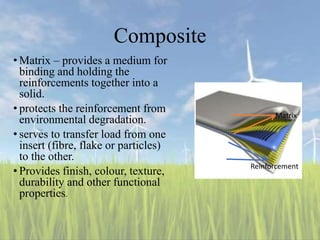
• Matrix – provides a medium for
binding and holding the
reinforcements together into a
solid.
• protects the reinforcement from
environmental degradation.
• serves to transfer load from one
insert (fibre, flake or particles)
to the other.
• Provides finish, colour, texture,
durability and other functional
properties.
Matrix
Reinforcement
Wind Turbine
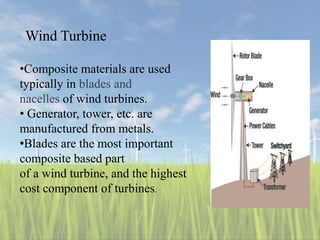
•Composite materials are used
typically in blades and
nacelles of wind turbines.
• Generator, tower, etc. are
manufactured from metals.
•Blades are the most important
composite based part
of a wind turbine, and the highest
cost component of turbines.
Why composite for wind energy ??
•High material stiffness is needed to maintain
optimal aerodynamic performance.
•Low density is needed to reduce gravity
forces and improve efficiency.
•Long-fatigue life is needed to reduce material
degradation – 20 year life = 108-109 cycles.
Structural Composite Materials
•Reinforcement
Glass – low cost, high specific strength, modest
specific stiffness
Carbon- high cost but with high specific strength and
stiffness
Others- Aramide, Basalt, etc
•Resins
Epoxies
Vinyl/Poly ester
Thermoplastic
Glass
•Vacuum infused glass/epoxy composites
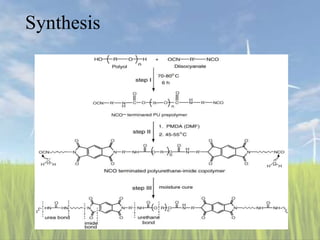
•Poly(urethane imide)
Glass composite
Synthesis
Carbon fibre reinforced
• Carbon fiber is, exactly what it sounds like — fiber made
of carbon. But, these fibers are only a base. What is commonly
referred to as carbon fiber is a material consisting of very thin
filaments of carbon atoms. When bound together with plastic
polymer resin by heat, pressure or in a vacuum a composite
material is formed that is both strong and lightweight.
• Carbon fibre reinforced silicon carbide matrix (Cf-SiC)
composites are potential candidates for applications for high
specific strength with suitable fracture toughness at elevated
temperatures
• Water-soluble colloidal silica (silica, 40 wt.%), sucrose
(C12H22O11), boric acid (H3BO3) and zirconium
oxychloride (ZrOCl2.8H2O) have been used as raw materials
for achieving silica, carbon, boron oxide (B2O3) and
zirconium dioxide (ZrO2), respectively. The following
stoichiometric reactions are involved with the preparation of
the different types of powder mixtures consisting of SiC,
ZrC, ZrB2 and ZrO2.
Synthesis
Aramide
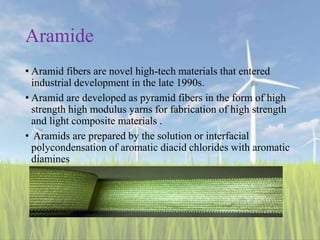
• Aramid fibers are novel high-tech materials that entered
industrial development in the late 1990s.
• Aramid are developed as pyramid fibers in the form of high
strength high modulus yarns for fabrication of high strength
and light composite materials .
• Aramids are prepared by the solution or interfacial
polycondensation of aromatic diacid chlorides with aromatic
diamines
Synthesis
Kevlar
•Kevlar Fiber
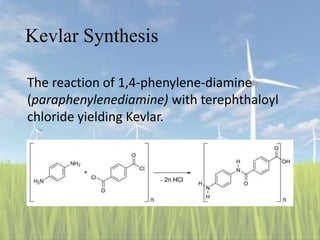
•Kevlar is a material formed by combining
paraphenylenediamine and terephthaloyl chloride.
Aromatic polyamide (aramid) threads are the result.
Kevlar Synthesis
The reaction of 1,4-phenylene-diamine
(paraphenylenediamine) with terephthaloyl
chloride yielding Kevlar.
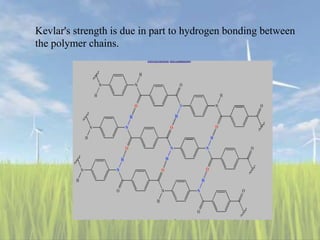
Kevlar's strength is due in part to hydrogen bonding between
the polymer chains.
Basalt fibre
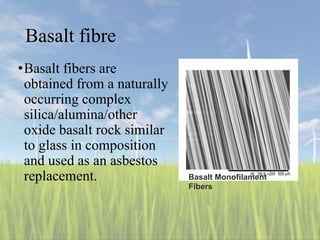
•Basalt fibers are
obtained from a naturally
occurring complex
silica/alumina/other
oxide basalt rock similar
to glass in composition
and used as an asbestos
replacement. Basalt Monofilament
Fibers
Synthesis
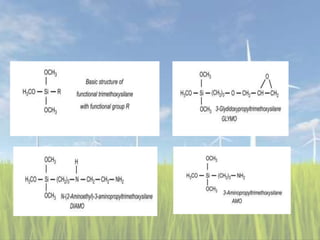
Schematic drawing of the action of silane-based coupling agents on the interface of
basalt fiber surface and the polymer matrix in a fiber-reinforced composite material
Resins
•Epoxies
•Vinyl resin
•Polyester resin
Bisphenol -A Epoxy Resin
DGEBA/BADGE- Bisphenol A Diglycidyl Ether
Epoxy -epoxy resins are
largely employed in
composites and
adhesives needed to
produce wind rotor
blades and other
structural elements.
Bonding Agent
Vinyl Ester Resin
•Epoxy vinyl ester resins (VER) are an important
class of high-performance thermoset molding resins.
•They are produced by the addition of α - β
unsaturated carboxylic acids to epoxy resins.
•The two main types of epoxy resins are bisphenol A
diglycidyl ether (DGEBA) and epoxy phenol
novolac (EPN). These resins form durable laminates
and coatings when fully cured (cross-linked).
•Vinyl ester are attracting much interest by blade
engineer.
Synthesis
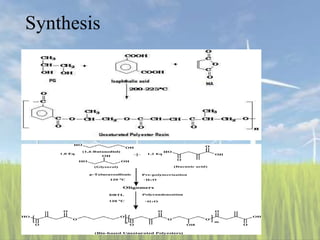
Poly-Ester Resin
• Polyester resins are the most economical resin systems used in
engineering applications, but with limited use in high performance
composites.
• Linear unsaturated polyesters are prepared commercially by the reaction
of a saturated diol with a mixture of an unsaturated dibasic acid and a
“modifying”dibasic acid (or corresponding anhydrides).
• Reactive ingredients
i. Diols -propylene glycol -Diethylene glycol -Neopentylene glycol -
Ethylene glycol
ii. Unsaturated acids and anhydrides -maleic anhydride -pthalic
anhydride(modifying anhydride)
iii. Cross linking monomer -styrene
Synthesis
Natural material
• Mostly glass and carbon fiber-reinforced plastics (i.e., GFRP and CFRP,
respectively) have been used for the production of large scale wind turbine
rotor blades. The use of glass and carbon fiber is no more attractive to the
rotor blade manufacturers, because the cost of these materials is high and the
use of these materials causes environmental hazards. These attributes of
synthetic fibers stimulate researchers to develop alternative materials for
wind turbine rotor blades.
• Plant fibers offer several economical, technical and ecological advantages
over synthetic fibers in reinforcing polymer composites. Due to the relative
abundance, low cost of raw material, low density, high specific properties,
and positive environmental profile of plant fibers like flax, hemp, coir, abaca,
alpaca, bamboo and jute; they have been marketed as prospective substitutes
to traditional composite reinforcements, specifically E-glass. As 87% of the
8.7 million tone global fiber reinforced plastic (FRP) market is based on E-
glass composites (GFRPs)[4], Natural fibers and their composites have a
great opportunity for development and market capture.
Natural fiber reinforced polymer
• Hybrid Bamboo/Jute Fiber-reinforced Composite with
Polyester Matrix as a Sustainable Green Material for Wind
Turbine Blades
• The matrix used to fabricate composite was general-purpose
polyester resin with methyl ethyl ketone peroxide catalyst
Nanocomposite
• Loos, Manas-Zloczower and colleagues developed various wind
turbine blades with secondary carbon nanoparticles reinforcement
(vinyl ester, thermoplasts, epoxy composites containing CNTs) and
demonstrated that the incorporation of small amount of carbon
nanotubes/CNT can increase the lifetime up to 1500%
• Koratkar and colleagues studied graphene as a secondary
reinforcement for the nanomodification of wind turbine composites,
and showed experimentally that the graphene reinforcement is very
promising in the development of stronger, long-life turbine blades for
the wind industry. Merugula and colleagues estimated theoretically
that the addition of 1–5 wt % of carbon nanofibers (CNF) to the
interfaces of glass fiber reinforced epoxy composites for blades in 2
MW and 5 MW turbines leads to improved tensile stress and modulus,
and allows 20% weight reduction of the blades, leading to the
increased lifetime.
Bio-composite
• Glass, carbon or aramid fibre-reinforced polymer (FRP) composites have
replaced many metallic components in the various manufacturing sectors.
• Due to the several environmental issues, the attention of the researchers
and technologist has shifted on the utilization of natural biodegradable
materials.
• Plant fibres offer several economical, technical and ecological advantages
over synthetic fibres in reinforcing polymer composites
• The currently used materials glass, Kevlar, carbon is non biodegradable.
For prevention of this large waste research effort has been made for
developing biodegradable materials.
• Due to the relative abundance, low cost of raw material, low density, high
specific properties, and positive
• environmental profile of plant fibers like flax, hemp, coir, abaca, alpaca,
bamboo and jute; they have been marketed as prospective substitutes to
traditional composite reinforcements, specifically E-glass. As 87% of the
8.7 million tone global fibre reinforced plastic (FRP) market is based on
E-glass composites (GFRPs)[4], Natural fibers and their composites have
a great opportunity for development and market capture.
Synthesis
• A novel bio-composite of poly (3-hydroxybutyrate-co-3-
hydroxyhexanoate) (PHBH)/acetylated cellulose nanocrystals
(ACN/PHBH) was prepared by solution-casting after surface
modification of cellulose nanocrystals (CNCs).
Self Healing Polymer
• Artificial or synthetically-created substances that have the
built-in ability to automatically repair damage to themselves
without any external diagnosis of the problem or human
intervention.
• Proposed in 1980s as a means of healing invisible micro
cracks.
Material used
• There are several constituent materials which, when combined
function as self healing material system:
• Healing Agent: Dicyclopentadiene (DCPD)
• Microcapsule shell: Urea–formaldehyde (UF) (mean 166μm
diameter)
• Chemical Catalyst: Bis(tricyclohexylphosphine) bensylidine
ruthenium (IV)
• Flexiblizer: Heloxy 71, Shell Chemical Company used to improve
• toughness and crack growth stability.
• Polymer Matrix: Epoxy Polymer Matrix EPON 828
Mechanism
‼THANK YOU ‼

Material for wind turbine

  • 1.
    Synthesis Of Composite MaterialFor Wind Turbine By - GROUP-1 (Pratyay Bhattacharya Debanita Das Krishna Mohan Mishra)
  • 2.
    Contents • Introduction • Structuralcomposite material. • Glass • Carbon fibre reinforced material • Aramide • Basalt fibre • Resins • Natural materials • Nano composits • Biocomposits • Self healing composits
  • 3.
    Introduction •A composite materialis a material made from two or more constituent materials with significantly different physical or chemical properties that, when combined, produce a material with characteristics different from the individual components. •Composite (Matrix + Reinforcement) •Discontinuous phase - Reinforcement •Continuous phase – Matrix •Reinforcements – Principal load bearing member.
  • 4.
    Composite • Matrix –provides a medium for binding and holding the reinforcements together into a solid. • protects the reinforcement from environmental degradation. • serves to transfer load from one insert (fibre, flake or particles) to the other. • Provides finish, colour, texture, durability and other functional properties. Matrix Reinforcement
  • 5.
    Wind Turbine •Composite materialsare used typically in blades and nacelles of wind turbines. • Generator, tower, etc. are manufactured from metals. •Blades are the most important composite based part of a wind turbine, and the highest cost component of turbines.
  • 6.
    Why composite forwind energy ?? •High material stiffness is needed to maintain optimal aerodynamic performance. •Low density is needed to reduce gravity forces and improve efficiency. •Long-fatigue life is needed to reduce material degradation – 20 year life = 108-109 cycles.
  • 7.
    Structural Composite Materials •Reinforcement Glass– low cost, high specific strength, modest specific stiffness Carbon- high cost but with high specific strength and stiffness Others- Aramide, Basalt, etc •Resins Epoxies Vinyl/Poly ester Thermoplastic
  • 8.
    Glass •Vacuum infused glass/epoxycomposites •Poly(urethane imide) Glass composite
  • 9.
  • 10.
    Carbon fibre reinforced •Carbon fiber is, exactly what it sounds like — fiber made of carbon. But, these fibers are only a base. What is commonly referred to as carbon fiber is a material consisting of very thin filaments of carbon atoms. When bound together with plastic polymer resin by heat, pressure or in a vacuum a composite material is formed that is both strong and lightweight.
  • 11.
    • Carbon fibrereinforced silicon carbide matrix (Cf-SiC) composites are potential candidates for applications for high specific strength with suitable fracture toughness at elevated temperatures • Water-soluble colloidal silica (silica, 40 wt.%), sucrose (C12H22O11), boric acid (H3BO3) and zirconium oxychloride (ZrOCl2.8H2O) have been used as raw materials for achieving silica, carbon, boron oxide (B2O3) and zirconium dioxide (ZrO2), respectively. The following stoichiometric reactions are involved with the preparation of the different types of powder mixtures consisting of SiC, ZrC, ZrB2 and ZrO2.
  • 12.
  • 13.
    Aramide • Aramid fibersare novel high-tech materials that entered industrial development in the late 1990s. • Aramid are developed as pyramid fibers in the form of high strength high modulus yarns for fabrication of high strength and light composite materials . • Aramids are prepared by the solution or interfacial polycondensation of aromatic diacid chlorides with aromatic diamines
  • 14.
  • 15.
    Kevlar •Kevlar Fiber •Kevlar isa material formed by combining paraphenylenediamine and terephthaloyl chloride. Aromatic polyamide (aramid) threads are the result.
  • 16.
    Kevlar Synthesis The reactionof 1,4-phenylene-diamine (paraphenylenediamine) with terephthaloyl chloride yielding Kevlar.
  • 17.
    Kevlar's strength isdue in part to hydrogen bonding between the polymer chains.
  • 18.
    Basalt fibre •Basalt fibersare obtained from a naturally occurring complex silica/alumina/other oxide basalt rock similar to glass in composition and used as an asbestos replacement. Basalt Monofilament Fibers
  • 19.
    Synthesis Schematic drawing ofthe action of silane-based coupling agents on the interface of basalt fiber surface and the polymer matrix in a fiber-reinforced composite material
  • 21.
  • 22.
    Bisphenol -A EpoxyResin DGEBA/BADGE- Bisphenol A Diglycidyl Ether Epoxy -epoxy resins are largely employed in composites and adhesives needed to produce wind rotor blades and other structural elements.
  • 23.
  • 24.
    Vinyl Ester Resin •Epoxyvinyl ester resins (VER) are an important class of high-performance thermoset molding resins. •They are produced by the addition of α - β unsaturated carboxylic acids to epoxy resins. •The two main types of epoxy resins are bisphenol A diglycidyl ether (DGEBA) and epoxy phenol novolac (EPN). These resins form durable laminates and coatings when fully cured (cross-linked). •Vinyl ester are attracting much interest by blade engineer.
  • 25.
  • 26.
    Poly-Ester Resin • Polyesterresins are the most economical resin systems used in engineering applications, but with limited use in high performance composites. • Linear unsaturated polyesters are prepared commercially by the reaction of a saturated diol with a mixture of an unsaturated dibasic acid and a “modifying”dibasic acid (or corresponding anhydrides). • Reactive ingredients i. Diols -propylene glycol -Diethylene glycol -Neopentylene glycol - Ethylene glycol ii. Unsaturated acids and anhydrides -maleic anhydride -pthalic anhydride(modifying anhydride) iii. Cross linking monomer -styrene
  • 27.
  • 28.
    Natural material • Mostlyglass and carbon fiber-reinforced plastics (i.e., GFRP and CFRP, respectively) have been used for the production of large scale wind turbine rotor blades. The use of glass and carbon fiber is no more attractive to the rotor blade manufacturers, because the cost of these materials is high and the use of these materials causes environmental hazards. These attributes of synthetic fibers stimulate researchers to develop alternative materials for wind turbine rotor blades. • Plant fibers offer several economical, technical and ecological advantages over synthetic fibers in reinforcing polymer composites. Due to the relative abundance, low cost of raw material, low density, high specific properties, and positive environmental profile of plant fibers like flax, hemp, coir, abaca, alpaca, bamboo and jute; they have been marketed as prospective substitutes to traditional composite reinforcements, specifically E-glass. As 87% of the 8.7 million tone global fiber reinforced plastic (FRP) market is based on E- glass composites (GFRPs)[4], Natural fibers and their composites have a great opportunity for development and market capture.
  • 29.
    Natural fiber reinforcedpolymer • Hybrid Bamboo/Jute Fiber-reinforced Composite with Polyester Matrix as a Sustainable Green Material for Wind Turbine Blades • The matrix used to fabricate composite was general-purpose polyester resin with methyl ethyl ketone peroxide catalyst
  • 30.
    Nanocomposite • Loos, Manas-Zloczowerand colleagues developed various wind turbine blades with secondary carbon nanoparticles reinforcement (vinyl ester, thermoplasts, epoxy composites containing CNTs) and demonstrated that the incorporation of small amount of carbon nanotubes/CNT can increase the lifetime up to 1500% • Koratkar and colleagues studied graphene as a secondary reinforcement for the nanomodification of wind turbine composites, and showed experimentally that the graphene reinforcement is very promising in the development of stronger, long-life turbine blades for the wind industry. Merugula and colleagues estimated theoretically that the addition of 1–5 wt % of carbon nanofibers (CNF) to the interfaces of glass fiber reinforced epoxy composites for blades in 2 MW and 5 MW turbines leads to improved tensile stress and modulus, and allows 20% weight reduction of the blades, leading to the increased lifetime.
  • 32.
    Bio-composite • Glass, carbonor aramid fibre-reinforced polymer (FRP) composites have replaced many metallic components in the various manufacturing sectors. • Due to the several environmental issues, the attention of the researchers and technologist has shifted on the utilization of natural biodegradable materials. • Plant fibres offer several economical, technical and ecological advantages over synthetic fibres in reinforcing polymer composites • The currently used materials glass, Kevlar, carbon is non biodegradable. For prevention of this large waste research effort has been made for developing biodegradable materials. • Due to the relative abundance, low cost of raw material, low density, high specific properties, and positive • environmental profile of plant fibers like flax, hemp, coir, abaca, alpaca, bamboo and jute; they have been marketed as prospective substitutes to traditional composite reinforcements, specifically E-glass. As 87% of the 8.7 million tone global fibre reinforced plastic (FRP) market is based on E-glass composites (GFRPs)[4], Natural fibers and their composites have a great opportunity for development and market capture.
  • 33.
    Synthesis • A novelbio-composite of poly (3-hydroxybutyrate-co-3- hydroxyhexanoate) (PHBH)/acetylated cellulose nanocrystals (ACN/PHBH) was prepared by solution-casting after surface modification of cellulose nanocrystals (CNCs).
  • 34.
    Self Healing Polymer •Artificial or synthetically-created substances that have the built-in ability to automatically repair damage to themselves without any external diagnosis of the problem or human intervention. • Proposed in 1980s as a means of healing invisible micro cracks.
  • 35.
    Material used • Thereare several constituent materials which, when combined function as self healing material system: • Healing Agent: Dicyclopentadiene (DCPD) • Microcapsule shell: Urea–formaldehyde (UF) (mean 166μm diameter) • Chemical Catalyst: Bis(tricyclohexylphosphine) bensylidine ruthenium (IV) • Flexiblizer: Heloxy 71, Shell Chemical Company used to improve • toughness and crack growth stability. • Polymer Matrix: Epoxy Polymer Matrix EPON 828
  • 36.
  • 37.