Master Seminar Presentation
on
E-Business
By: Shubham
H-2018-24-MBA
 Introduction to e-business
 E-business vs. e-commerce
 Applications of e-business
 Why e-business
 E-business models
 Drawbacks of e-business
 Conclusion
 References
Introduction to E-Business
E-business (electronic business) is the conduct of
business processes with the help internet. These e-
business processes include:
 Buying and selling goods and services
Servicing customers
Processing payments
Collaborating with business partners
Sharing information
Recruiting
Applications of E-Business
Electronic business is any information system or
application that empowers business processes.
Today this is mostly done with web technologies.
Applications can be divided into three categories:
1) Internal business systems
2) Enterprise communication and collaboration
3) Electronic commerce
Cont….
Internal business system:
Customer relationship management
Enterprise resource planning
Document management system
Cont….
Enterprise communication and collaboration
Content Management system
E mail
Voice mail
Web mail
Web conferencing
Cont….
Electronic commerce
Online transaction processing
Supply chain management
E-marketing
Electronic fund transfer
E-Business Models
Business to Consumer
The B2C model involves transactions between business
organizations and consumers. It applies to any business
organization that sells its products or services to
consumers over the internet.
Example: flipkart, myntra etc.
Business to Business(B2B)
This model describes commerce transactions between
businesses, such as between a manufacturer and a
wholesaler and a retailer.
Example: manufacturing concerns
Consumer to Business(C2B)
The C2B model involves a transaction that is conducted
between consumer and a business organization. In this
case the consumer is the seller and organization is the
buyer.
Example: www.Monster.Com, www.Naukri.Com
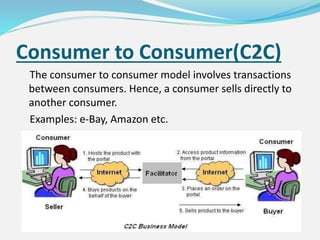
Consumer to Consumer(C2C)
The consumer to consumer model involves transactions
between consumers. Hence, a consumer sells directly to
another consumer.
Examples: e-Bay, Amazon etc.
Why E-business?
Global Reach.
Personalization.
 Interactivity.
Right-time and integrated marketing.
Cost Saving
More working hours
Drawbacks of E-Business
Sectoral Limitations
Question of safety
System Up gradation
Lack of Personal Touch
Highly Competitive
Conclusion and Findings
 Need of the current and future period
 The internet represents a completely new and profitable
way to do business, provided that all the requirements
needed are met.
 The internet is a parallel online world where all the
resources are not fully exploited and where consumers
may gain advantages. Here, companies may increase their
profits further and users may find the desired product or
service easily without the hassle of shopping around.
References
 www.slideshare.com
 www.researchgate.net
 www.toppr.com
 www.techopedia.com
 www.youtube.com
 www.wikipedia.org
Master seminar presentation(shubham)

Master seminar presentation(shubham)

  • 1.
  • 2.
     Introduction toe-business  E-business vs. e-commerce  Applications of e-business  Why e-business  E-business models  Drawbacks of e-business  Conclusion  References
  • 3.
    Introduction to E-Business E-business(electronic business) is the conduct of business processes with the help internet. These e- business processes include:  Buying and selling goods and services Servicing customers Processing payments Collaborating with business partners Sharing information Recruiting
  • 5.
    Applications of E-Business Electronicbusiness is any information system or application that empowers business processes. Today this is mostly done with web technologies. Applications can be divided into three categories: 1) Internal business systems 2) Enterprise communication and collaboration 3) Electronic commerce
  • 6.
    Cont…. Internal business system: Customerrelationship management Enterprise resource planning Document management system
  • 7.
    Cont…. Enterprise communication andcollaboration Content Management system E mail Voice mail Web mail Web conferencing
  • 8.
    Cont…. Electronic commerce Online transactionprocessing Supply chain management E-marketing Electronic fund transfer
  • 9.
  • 10.
    Business to Consumer TheB2C model involves transactions between business organizations and consumers. It applies to any business organization that sells its products or services to consumers over the internet. Example: flipkart, myntra etc.
  • 11.
    Business to Business(B2B) Thismodel describes commerce transactions between businesses, such as between a manufacturer and a wholesaler and a retailer. Example: manufacturing concerns
  • 12.
    Consumer to Business(C2B) TheC2B model involves a transaction that is conducted between consumer and a business organization. In this case the consumer is the seller and organization is the buyer. Example: www.Monster.Com, www.Naukri.Com
  • 13.
    Consumer to Consumer(C2C) Theconsumer to consumer model involves transactions between consumers. Hence, a consumer sells directly to another consumer. Examples: e-Bay, Amazon etc.
  • 14.
    Why E-business? Global Reach. Personalization. Interactivity. Right-time and integrated marketing. Cost Saving More working hours
  • 15.
    Drawbacks of E-Business SectoralLimitations Question of safety System Up gradation Lack of Personal Touch Highly Competitive
  • 16.
    Conclusion and Findings Need of the current and future period  The internet represents a completely new and profitable way to do business, provided that all the requirements needed are met.  The internet is a parallel online world where all the resources are not fully exploited and where consumers may gain advantages. Here, companies may increase their profits further and users may find the desired product or service easily without the hassle of shopping around.
  • 17.
    References  www.slideshare.com  www.researchgate.net www.toppr.com  www.techopedia.com  www.youtube.com  www.wikipedia.org