Grow Your Own Food? Of Course You Can!  (Part 1) Lee Young, Extension Educator, and Deb Andrus, Master Gardener Site  Soils  Planting  Watering  Techniques
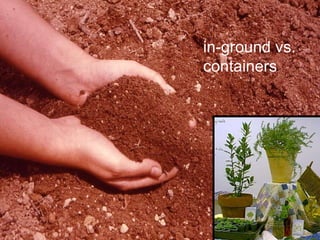
in-ground vs. containers
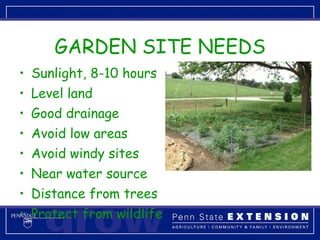
GARDEN SITE NEEDS Sunlight, 8-10 hours Level land Good drainage Avoid low areas Avoid windy sites Near water source Distance from trees Protect from wildlife
Soil: a mixture of  weathered minerals  and  decaying organic matter , covering the earth in a thin layer.  When combined with  air and water , soil provides mechanical support and nutrients for plants.
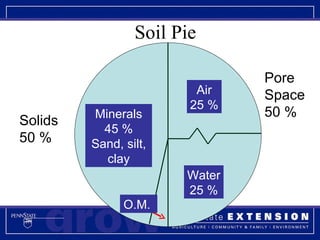
Soil Pie Solids 50 % Pore  Space 50 %  Minerals 45 % Sand, silt, clay Air 25 % Water 25 % O.M.
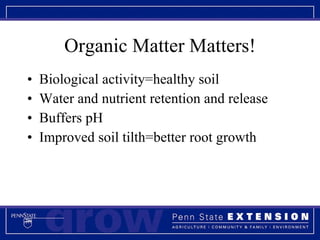
Organic Matter Matters! Biological activity=healthy soil Water and nutrient retention and release Buffers pH Improved soil tilth=better root growth
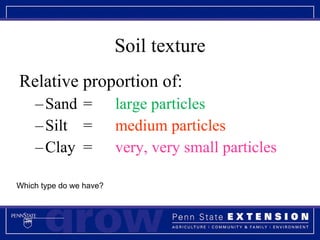
Soil texture Relative proportion of:  Sand =  large particles Silt =  medium particles Clay = very, very small particles Which type do we have?
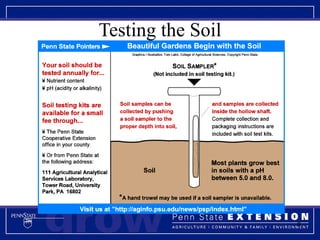
Testing the Soil
 
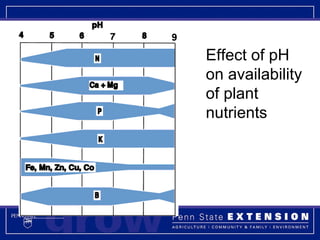
Effect of pH on availability of plant nutrients
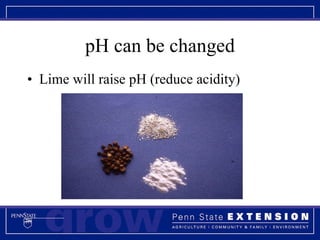
pH can be changed Lime will raise pH (reduce acidity)
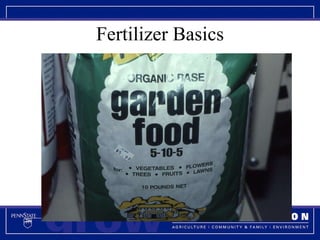
Fertilizer Basics
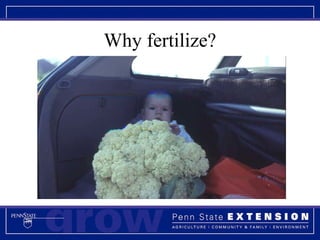
Why fertilize?
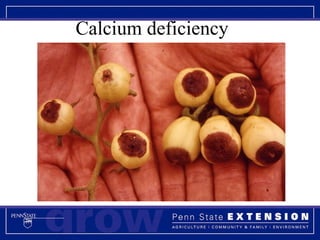
Calcium deficiency
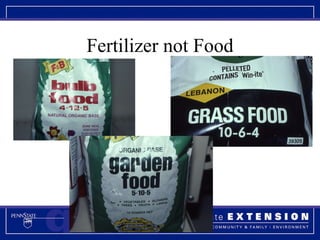
Fertilizer not Food
Fertilizer basics A  fertilizer  supplies one or more “essential nutrients”.  Not “Plant Food” Plants make their own food…
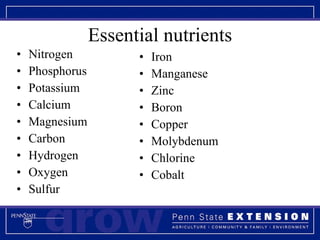
Essential nutrients Nitrogen Phosphorus Potassium Calcium Magnesium Carbon  Hydrogen Oxygen Sulfur Iron Manganese Zinc Boron Copper Molybdenum Chlorine Cobalt
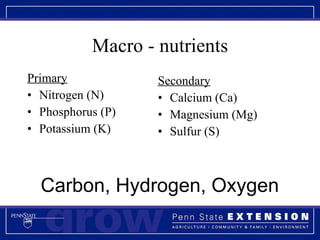
Macro - nutrients Primary Nitrogen (N) Phosphorus (P) Potassium (K) Secondary Calcium (Ca) Magnesium (Mg) Sulfur (S) Carbon, Hydrogen, Oxygen
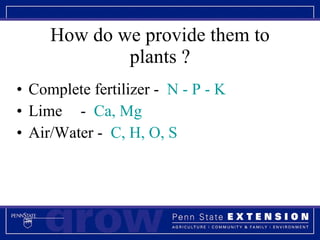
How do we provide them to plants ? Complete fertilizer -  N - P - K Lime  -  Ca, Mg Air/Water -  C, H, O, S
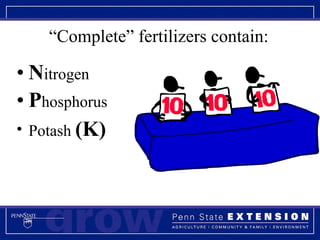
“ Complete” fertilizers contain: N itrogen P hosphorus Potash  (K)
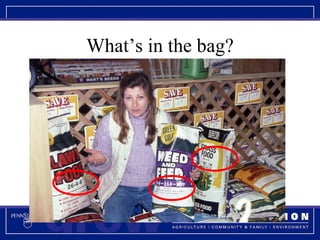
What’s in the bag?
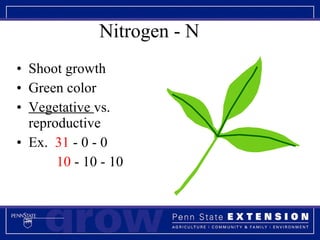
Nitrogen - N Shoot growth Green color Vegetative  vs. reproductive Ex.  31  - 0 - 0 10  - 10 - 10
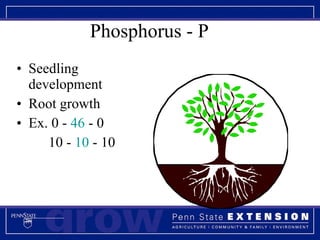
Phosphorus - P Seedling development Root growth Ex. 0 -  46  - 0 10 -  10  - 10
Potassium - K Regulates water movement Affects drought, disease, cold hardiness Ex. 0 - 0 -  50 10 - 10 -  10
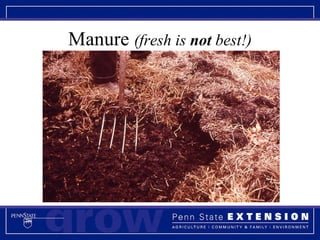
Manure  (fresh is  not  best!)
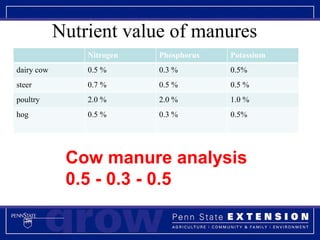
Nutrient value of manures Cow manure analysis  0.5 - 0.3 - 0.5 Nitrogen Phosphorus Potassium dairy cow 0.5 % 0.3 % 0.5% steer 0.7 % 0.5 % 0.5 % poultry 2.0 % 2.0 % 1.0 % hog 0.5 % 0.3 % 0.5%
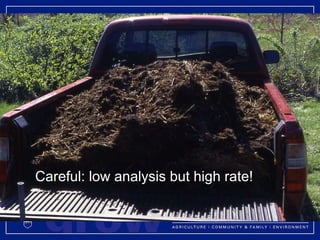
Careful: low analysis but high rate!
Ball Park recommendations
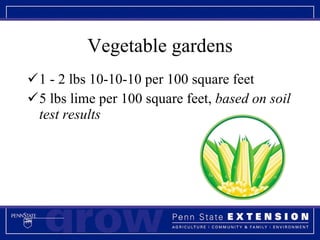
Vegetable gardens 1 - 2 lbs 10-10-10 per 100 square feet 5 lbs lime per 100 square feet,  based on soil test results
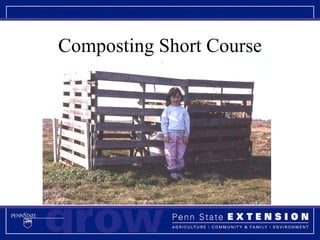
Composting Short Course
Recipe for compost Mix equal proportions of  green stuff  and   brown stuff Add a shovel full of  black stuff Mix well Wait Stir occasionally
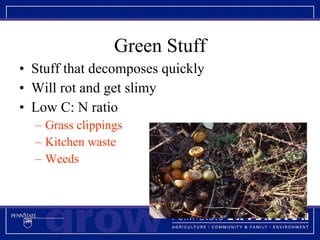
Green Stuff Stuff that decomposes quickly Will rot and get slimy Low C: N ratio Grass clippings Kitchen waste Weeds
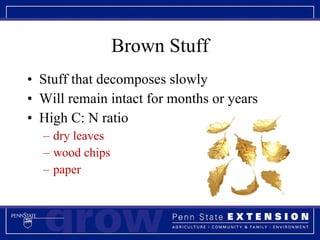
Brown Stuff Stuff that decomposes slowly Will remain intact for months or years High C: N ratio dry leaves wood chips paper
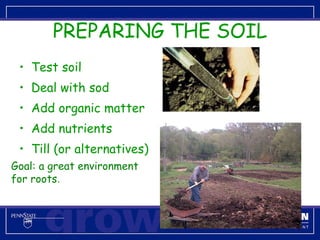
PREPARING THE SOIL Test soil Deal with sod Add organic matter Add nutrients Till (or alternatives) Goal: a great environment for roots .
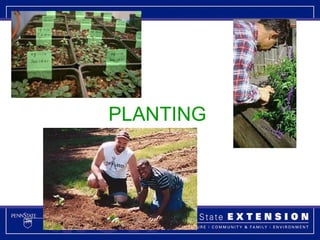
PLANTING
IRRIGATION Why? Aids in seed emergence Reduces soil crusting Improves germination and plant stand Reduces wilting Increase fruit size  Prevents premature ripening of peas, beans and sweet corn Improves quality of yield
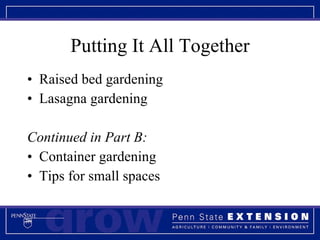
IRRIGATION, cont. What should you know? 1 inch of rain per week 65-130 gallons of water per 100 square feet or 2-3 gallons per foot square A.M. watering preferred Know critical watering period
Putting It All Together Raised bed gardening Lasagna gardening Continued in Part B: Container gardening Tips for small spaces
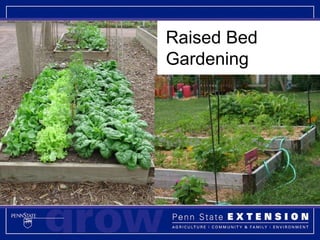
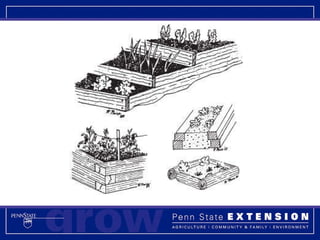
Raised Bed Gardening
Reasons to Used Raised Beds Ease of use Higher yields Improved soil conditions Warms up quicker in spring Better drainage Soil does not compact Less maintenance once established
 
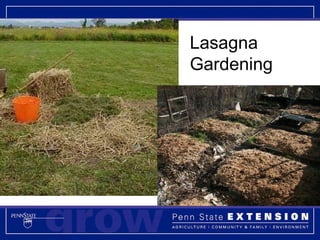
Lasagna Gardening
Lasagna Gardening A time-saving organic method of gardening first developed by Patricia Lanza. It requires no digging, no tilling and no sod removal.
Lasagna Gardening Select site. Put down a layer of cardboard or newspaper; wet thoroughly. More layers: shredded leaves, kitchen waste (no fat, bones or oil), straw, composted manure, grass clippings Water each layer Build to height of 18-24 inches Let cook for 6-8 months.
Grow Your Own Food A

  • 1.
    Grow Your OwnFood? Of Course You Can! (Part 1) Lee Young, Extension Educator, and Deb Andrus, Master Gardener Site Soils Planting Watering Techniques
  • 2.
  • 3.
    GARDEN SITE NEEDSSunlight, 8-10 hours Level land Good drainage Avoid low areas Avoid windy sites Near water source Distance from trees Protect from wildlife
  • 4.
    Soil: a mixtureof weathered minerals and decaying organic matter , covering the earth in a thin layer. When combined with air and water , soil provides mechanical support and nutrients for plants.
  • 5.
    Soil Pie Solids50 % Pore Space 50 % Minerals 45 % Sand, silt, clay Air 25 % Water 25 % O.M.
  • 6.
    Organic Matter Matters!Biological activity=healthy soil Water and nutrient retention and release Buffers pH Improved soil tilth=better root growth
  • 7.
    Soil texture Relativeproportion of: Sand = large particles Silt = medium particles Clay = very, very small particles Which type do we have?
  • 8.
  • 9.
  • 10.
    Effect of pHon availability of plant nutrients
  • 11.
    pH can bechanged Lime will raise pH (reduce acidity)
  • 12.
  • 13.
  • 14.
  • 15.
  • 16.
    Fertilizer basics A fertilizer supplies one or more “essential nutrients”. Not “Plant Food” Plants make their own food…
  • 17.
    Essential nutrients NitrogenPhosphorus Potassium Calcium Magnesium Carbon Hydrogen Oxygen Sulfur Iron Manganese Zinc Boron Copper Molybdenum Chlorine Cobalt
  • 18.
    Macro - nutrientsPrimary Nitrogen (N) Phosphorus (P) Potassium (K) Secondary Calcium (Ca) Magnesium (Mg) Sulfur (S) Carbon, Hydrogen, Oxygen
  • 19.
    How do weprovide them to plants ? Complete fertilizer - N - P - K Lime - Ca, Mg Air/Water - C, H, O, S
  • 20.
    “ Complete” fertilizerscontain: N itrogen P hosphorus Potash (K)
  • 21.
  • 22.
    Nitrogen - NShoot growth Green color Vegetative vs. reproductive Ex. 31 - 0 - 0 10 - 10 - 10
  • 23.
    Phosphorus - PSeedling development Root growth Ex. 0 - 46 - 0 10 - 10 - 10
  • 24.
    Potassium - KRegulates water movement Affects drought, disease, cold hardiness Ex. 0 - 0 - 50 10 - 10 - 10
  • 25.
    Manure (freshis not best!)
  • 26.
    Nutrient value ofmanures Cow manure analysis 0.5 - 0.3 - 0.5 Nitrogen Phosphorus Potassium dairy cow 0.5 % 0.3 % 0.5% steer 0.7 % 0.5 % 0.5 % poultry 2.0 % 2.0 % 1.0 % hog 0.5 % 0.3 % 0.5%
  • 27.
    Careful: low analysisbut high rate!
  • 28.
  • 29.
    Vegetable gardens 1- 2 lbs 10-10-10 per 100 square feet 5 lbs lime per 100 square feet, based on soil test results
  • 30.
  • 31.
    Recipe for compostMix equal proportions of green stuff and brown stuff Add a shovel full of black stuff Mix well Wait Stir occasionally
  • 32.
    Green Stuff Stuffthat decomposes quickly Will rot and get slimy Low C: N ratio Grass clippings Kitchen waste Weeds
  • 33.
    Brown Stuff Stuffthat decomposes slowly Will remain intact for months or years High C: N ratio dry leaves wood chips paper
  • 34.
    PREPARING THE SOILTest soil Deal with sod Add organic matter Add nutrients Till (or alternatives) Goal: a great environment for roots .
  • 35.
  • 36.
    IRRIGATION Why? Aidsin seed emergence Reduces soil crusting Improves germination and plant stand Reduces wilting Increase fruit size Prevents premature ripening of peas, beans and sweet corn Improves quality of yield
  • 37.
    IRRIGATION, cont. Whatshould you know? 1 inch of rain per week 65-130 gallons of water per 100 square feet or 2-3 gallons per foot square A.M. watering preferred Know critical watering period
  • 38.
    Putting It AllTogether Raised bed gardening Lasagna gardening Continued in Part B: Container gardening Tips for small spaces
  • 39.
  • 40.
    Reasons to UsedRaised Beds Ease of use Higher yields Improved soil conditions Warms up quicker in spring Better drainage Soil does not compact Less maintenance once established
  • 41.
  • 42.
  • 43.
    Lasagna Gardening Atime-saving organic method of gardening first developed by Patricia Lanza. It requires no digging, no tilling and no sod removal.
  • 44.
    Lasagna Gardening Selectsite. Put down a layer of cardboard or newspaper; wet thoroughly. More layers: shredded leaves, kitchen waste (no fat, bones or oil), straw, composted manure, grass clippings Water each layer Build to height of 18-24 inches Let cook for 6-8 months.

Editor's Notes

  • #4 Observe shading patterns What is a potential hazard? Black WAlnut tree Lead paint- old building site What do you think of this site? shade, low area
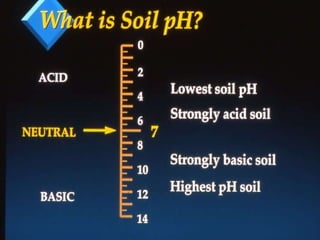
  • #9 First and foremost, get a soil test: pH, P, K, lime, Mg Should be done in fall if possible to apply lime in fall. $6 kit from Extension office, results mailed to homeowner Need a representative sample: several cores at same depth: stratification of soil especially top 1 inch. pH is probably single most important factor. N is not tested for because N is rapidly transformed in soils
  • #35 nutrients according to soil test types of organic matter: compost, manure
  • #36 How do you decide if you plant seeds or transplants? Days to harvest
  • #38 Critical watering period chart in manual example melons- flowering fruit development