By :  Group  5  MAS AIRLINES VS AIR ASIA
EXECUTIVE SUMMARY The purpose of this study is to  evaluate the financial performance of two main airline operators in Malaysia  namely  Malaysia Airlines  and  Air Asia . The airline industry is a large and growing industry. In the past years, air travel has been growing by 6% a year and scheduled airlines carried more than 1 billion passengers in 2008.  Also in this study,  both the companies’ challenges and prospective are discussed Further discussed in this study is the financial analysis of both MAS Airlines and Air Asia on its  profitability and liquidity ratios  to evaluate the businesses’ performance.  Conclusion   and recommendation  on which company  investors should invest  in constructed using the ratios valuation are then deliberated in the final section of the report
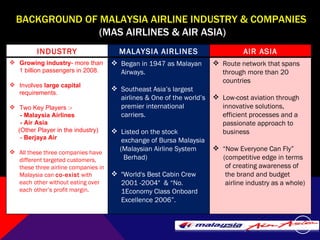
BACKGROUND OF MALAYSIA AIRLINE INDUSTRY & COMPANIES  (MAS AIRLINES & AIR ASIA) INDUSTRY MALAYSIA AIRLINES AIR ASIA Growing industry - more than 1 billion passengers in 2008. Involves  large capital  requirements. Two Key Players  :-  - Malaysia Airlines - Air Asia  (Other Player in the industry)  -  Berjaya Air All these three companies have different targeted customers, these three airline companies in Malaysia can  co-exist  with each other without eating over each other’s profit margin.  B egan in 1947 as Malayan Airways.  Southeast Asia’s largest airlines & One of the world’s premier international carriers. Listed on the stock exchange of Bursa Malaysia  (Malaysian Airline System  Berhad) "World's Best Cabin Crew 2001 -2004"  & “No. 1Economy Class Onboard Excellence 2006”. Route network that spans through more than 20 countries   Low-cost aviation through innovative solutions, efficient processes and a passionate approach to business “ Now Everyone Can Fly” (competitive edge in terms  of creating awareness of  the brand and budget  airline industry as a whole)
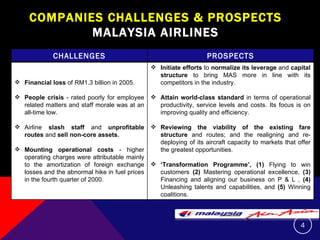
COMPANIES CHALLENGES & PROSPECTS  MALAYSIA AIRLINES CHALLENGES PROSPECTS Financial loss  of RM1.3 billion in 2005. People crisis  - rated poorly for employee related matters and staff morale was at an all-time low.  Airline  slash staff  and  unprofitable routes  and  sell non-core assets.  Mounting operational costs  - higher operating charges were attributable mainly to the amortization of foreign exchange losses and the abnormal hike in fuel prices in the fourth quarter of 2000. I nitiate efforts  to  normalize its leverage  and  capital structure  to bring MAS more in line with its competitors in the industry. Attain world-class standard  in terms of operational productivity, service levels and costs. Its focus is on improving quality and efficiency. Reviewing the viability of the existing fare structure  and routes; and the realigning and re-deploying of its aircraft capacity to markets that offer the greatest opportunities.  ‘ Transformation Programme’, (1)  Flying to win customers  (2)  Mastering operational excellence,  (3)  Financing and aligning our business on P & L ,  (4)  Unleashing talents and capabilities, and  (5)  Winning coalitions.
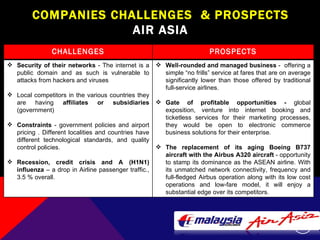
COMPANIES CHALLENGES  & PROSPECTS AIR ASIA CHALLENGES PROSPECTS Security of their networks  -  The internet is a public domain and as such is vulnerable to attacks from hackers and viruses Local competitors in the various countries they are having  affiliates or subsidiaries  (government) Constraints  - government policies and airport pricing . Different localities and countries have different technological standards, and quality control policies. Recession, credit crisis and A (H1N1) influenza  – a drop in Airline passenger traffic., 3.5 % overall. Well-rounded and managed business  -  offering a simple “no frills” service at fares that are on average significantly lower than those offered by traditional full-service airlines.  Gate of profitable opportunities -  global exposition, venture into internet booking and ticketless services for their marketing processes, they would be open to electronic commerce business solutions for their enterprise. The replacement of its aging Boeing B737 aircraft with the Airbus A320 aircraft  - opportunity to stamp its dominance as the ASEAN airline. With its unmatched network connectivity, frequency and full-fledged Airbus operation along with its low cost operations and low-fare model, it will enjoy a substantial edge over its competitors.
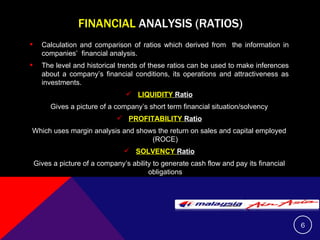
FINANCIAL  ANALYSIS (RATIOS) Calculation and comparison of ratios which derived from  the information in companies’  financial analysis. The level and historical trends of these ratios can be used to make inferences about a company’s financial conditions, its operations and attractiveness as investments. LIQUIDITY  Ratio Gives a picture of a company’s short term financial situation/solvency PROFITABILITY  Ratio Which uses margin analysis and shows the return on sales and capital employed (ROCE) SOLVENCY  Ratio Gives a picture of a company’s ability to generate cash flow and pay its financial obligations
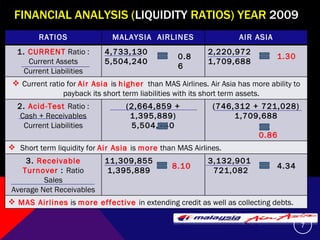
FINANCIAL ANALYSIS ( LIQUIDITY  RATIOS) YEAR  2009 0.86 1.30 8.10 4.34 RATIOS MALAYSIA  AIRLINES AIR ASIA 1.  CURRENT  Ratio : Current Assets Current Liabilities 4,733,130 5,504,240 2,220,972 1,709,688 Current ratio for  Air Asia  is  higher   than MAS Airlines. Air Asia has more ability to payback its short term liabilities with its short term assets. 2.  Acid-Test   Ratio : Cash + Receivables Current Liabilities (2,664,859 + 1,395,889) 5,504,240 0.74 (746,312 + 721,028) 1,709,688 0.86 Short term liquidity for  Air Asia  is  more  than MAS Airlines. 3.  Receivable Turnover  :  Ratio Sales Average Net Receivables 11,309,855 1,395,889 3,132,901 721,082 MAS Airlines  is  more effective  in extending credit as well as collecting debts.
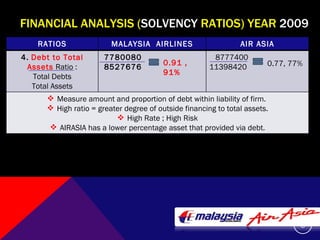
FINANCIAL ANALYSIS ( SOLVENCY  RATIOS) YEAR  2009 0.91 , 91% 0.77, 77% RATIOS MALAYSIA  AIRLINES AIR ASIA 4.   Debt to Total Assets  Ratio : Total Debts Total Assets 7780080 8527676 8777400 11398420 Measure amount and proportion of debt within liability of firm.  High ratio = greater degree of outside financing to total assets. High Rate ; High Risk AIRASIA has a lower percentage asset that provided via debt.
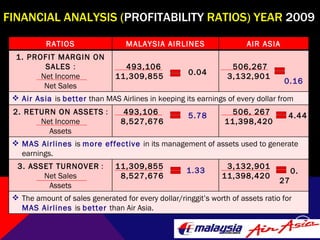
FINANCIAL ANALYSIS ( PROFITABILITY  RATIOS) YEAR  2009 0.04 0.16 5.78 4.44 1.33 0. 27 RATIOS MALAYSIA AIRLINES AIR ASIA 1. PROFIT MARGIN ON SALES   : Net Income Net Sales 493,106 11,309,855  506,267 3,132,901 Air Asia  is  better  than MAS Airlines in keeping its earnings of every dollar from sales, 2. RETURN ON ASSETS  : Net Income Assets 493,106 8,527,676 506, 267 11,398,420 MAS Airlines  is  more effective  in its management of assets used to generate earnings. 3. ASSET TURNOVER  : Net Sales Assets 11,309,855 8,527,676 3,132,901 11,398,420 The amount of sales generated for every dollar/ringgit’s worth of assets ratio for  MAS Airlines  is  better  than Air Asia.
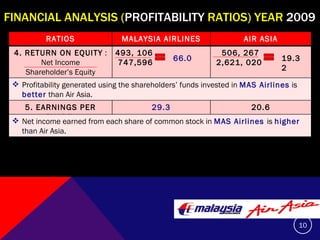
FINANCIAL ANALYSIS ( PROFITABILITY  RATIOS) YEAR  2009 66.0 19.32 RATIOS MALAYSIA AIRLINES AIR ASIA 4. RETURN ON EQUITY  : Net Income Shareholder’s Equity 493, 106 747,596 506, 267 2,621, 020 Profitability generated using the shareholders’ funds invested in  MAS Airlines  is  better  than Air Asia. 5. EARNINGS PER SHARE  29.3 20.6 Net income earned from each share of common stock in  MAS Airlines  is  higher  than Air Asia.
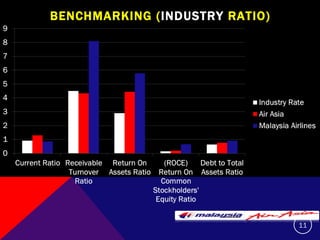
BENCHMARKING ( INDUSTRY  RATIO)
CONCLUSION & RECOMMENDATION  Both  MAS Airlines  and  Air Asia future strategy  are  in line with the program to lower costs, keeping fares competitive, increasing revenue, and delivering five-star products and services. Overall,  MAS  has  performed well in the current year of 2009  and it has a good prospect in the Malaysian Airline Industry. These are evidenced by the results in  LIQUIDITY, PROFITABILITY & SOLVENCY RATIOS  of the company which is more favourable as compared to Air Asia and the Industry rate as a whole. Furthermore, MAS Airlines is a  Government- linked company (GLC).   For having such important connection with the government, MAS could  take advantage in running its operations to be more effective and efficient . Therefore, it is recommended that prospective investors should invest in  MAS Airline  to expect  considerable returns.
THANK  YOU  FOR YOUR ATTENTION  

Mas x airasia

  • 1.
    By : Group 5 MAS AIRLINES VS AIR ASIA
  • 2.
    EXECUTIVE SUMMARY Thepurpose of this study is to evaluate the financial performance of two main airline operators in Malaysia namely Malaysia Airlines and Air Asia . The airline industry is a large and growing industry. In the past years, air travel has been growing by 6% a year and scheduled airlines carried more than 1 billion passengers in 2008. Also in this study, both the companies’ challenges and prospective are discussed Further discussed in this study is the financial analysis of both MAS Airlines and Air Asia on its profitability and liquidity ratios to evaluate the businesses’ performance. Conclusion and recommendation on which company investors should invest in constructed using the ratios valuation are then deliberated in the final section of the report
  • 3.
    BACKGROUND OF MALAYSIAAIRLINE INDUSTRY & COMPANIES (MAS AIRLINES & AIR ASIA) INDUSTRY MALAYSIA AIRLINES AIR ASIA Growing industry - more than 1 billion passengers in 2008. Involves large capital requirements. Two Key Players :- - Malaysia Airlines - Air Asia (Other Player in the industry) - Berjaya Air All these three companies have different targeted customers, these three airline companies in Malaysia can co-exist with each other without eating over each other’s profit margin. B egan in 1947 as Malayan Airways. Southeast Asia’s largest airlines & One of the world’s premier international carriers. Listed on the stock exchange of Bursa Malaysia (Malaysian Airline System Berhad) "World's Best Cabin Crew 2001 -2004" & “No. 1Economy Class Onboard Excellence 2006”. Route network that spans through more than 20 countries Low-cost aviation through innovative solutions, efficient processes and a passionate approach to business “ Now Everyone Can Fly” (competitive edge in terms of creating awareness of the brand and budget airline industry as a whole)
  • 4.
    COMPANIES CHALLENGES &PROSPECTS MALAYSIA AIRLINES CHALLENGES PROSPECTS Financial loss of RM1.3 billion in 2005. People crisis - rated poorly for employee related matters and staff morale was at an all-time low. Airline slash staff and unprofitable routes and sell non-core assets. Mounting operational costs - higher operating charges were attributable mainly to the amortization of foreign exchange losses and the abnormal hike in fuel prices in the fourth quarter of 2000. I nitiate efforts to normalize its leverage and capital structure to bring MAS more in line with its competitors in the industry. Attain world-class standard in terms of operational productivity, service levels and costs. Its focus is on improving quality and efficiency. Reviewing the viability of the existing fare structure and routes; and the realigning and re-deploying of its aircraft capacity to markets that offer the greatest opportunities. ‘ Transformation Programme’, (1) Flying to win customers (2) Mastering operational excellence, (3) Financing and aligning our business on P & L , (4) Unleashing talents and capabilities, and (5) Winning coalitions.
  • 5.
    COMPANIES CHALLENGES & PROSPECTS AIR ASIA CHALLENGES PROSPECTS Security of their networks - The internet is a public domain and as such is vulnerable to attacks from hackers and viruses Local competitors in the various countries they are having affiliates or subsidiaries (government) Constraints - government policies and airport pricing . Different localities and countries have different technological standards, and quality control policies. Recession, credit crisis and A (H1N1) influenza – a drop in Airline passenger traffic., 3.5 % overall. Well-rounded and managed business - offering a simple “no frills” service at fares that are on average significantly lower than those offered by traditional full-service airlines. Gate of profitable opportunities - global exposition, venture into internet booking and ticketless services for their marketing processes, they would be open to electronic commerce business solutions for their enterprise. The replacement of its aging Boeing B737 aircraft with the Airbus A320 aircraft - opportunity to stamp its dominance as the ASEAN airline. With its unmatched network connectivity, frequency and full-fledged Airbus operation along with its low cost operations and low-fare model, it will enjoy a substantial edge over its competitors.
  • 6.
    FINANCIAL ANALYSIS(RATIOS) Calculation and comparison of ratios which derived from the information in companies’ financial analysis. The level and historical trends of these ratios can be used to make inferences about a company’s financial conditions, its operations and attractiveness as investments. LIQUIDITY Ratio Gives a picture of a company’s short term financial situation/solvency PROFITABILITY Ratio Which uses margin analysis and shows the return on sales and capital employed (ROCE) SOLVENCY Ratio Gives a picture of a company’s ability to generate cash flow and pay its financial obligations
  • 7.
    FINANCIAL ANALYSIS (LIQUIDITY RATIOS) YEAR 2009 0.86 1.30 8.10 4.34 RATIOS MALAYSIA AIRLINES AIR ASIA 1. CURRENT Ratio : Current Assets Current Liabilities 4,733,130 5,504,240 2,220,972 1,709,688 Current ratio for Air Asia is higher than MAS Airlines. Air Asia has more ability to payback its short term liabilities with its short term assets. 2. Acid-Test Ratio : Cash + Receivables Current Liabilities (2,664,859 + 1,395,889) 5,504,240 0.74 (746,312 + 721,028) 1,709,688 0.86 Short term liquidity for Air Asia is more than MAS Airlines. 3. Receivable Turnover : Ratio Sales Average Net Receivables 11,309,855 1,395,889 3,132,901 721,082 MAS Airlines is more effective in extending credit as well as collecting debts.
  • 8.
    FINANCIAL ANALYSIS (SOLVENCY RATIOS) YEAR 2009 0.91 , 91% 0.77, 77% RATIOS MALAYSIA AIRLINES AIR ASIA 4. Debt to Total Assets Ratio : Total Debts Total Assets 7780080 8527676 8777400 11398420 Measure amount and proportion of debt within liability of firm. High ratio = greater degree of outside financing to total assets. High Rate ; High Risk AIRASIA has a lower percentage asset that provided via debt.
  • 9.
    FINANCIAL ANALYSIS (PROFITABILITY RATIOS) YEAR 2009 0.04 0.16 5.78 4.44 1.33 0. 27 RATIOS MALAYSIA AIRLINES AIR ASIA 1. PROFIT MARGIN ON SALES : Net Income Net Sales 493,106 11,309,855 506,267 3,132,901 Air Asia is better than MAS Airlines in keeping its earnings of every dollar from sales, 2. RETURN ON ASSETS : Net Income Assets 493,106 8,527,676 506, 267 11,398,420 MAS Airlines is more effective in its management of assets used to generate earnings. 3. ASSET TURNOVER : Net Sales Assets 11,309,855 8,527,676 3,132,901 11,398,420 The amount of sales generated for every dollar/ringgit’s worth of assets ratio for MAS Airlines is better than Air Asia.
  • 10.
    FINANCIAL ANALYSIS (PROFITABILITY RATIOS) YEAR 2009 66.0 19.32 RATIOS MALAYSIA AIRLINES AIR ASIA 4. RETURN ON EQUITY : Net Income Shareholder’s Equity 493, 106 747,596 506, 267 2,621, 020 Profitability generated using the shareholders’ funds invested in MAS Airlines is better than Air Asia. 5. EARNINGS PER SHARE 29.3 20.6 Net income earned from each share of common stock in MAS Airlines is higher than Air Asia.
  • 11.
  • 12.
    CONCLUSION & RECOMMENDATION Both MAS Airlines and Air Asia future strategy are in line with the program to lower costs, keeping fares competitive, increasing revenue, and delivering five-star products and services. Overall, MAS has performed well in the current year of 2009 and it has a good prospect in the Malaysian Airline Industry. These are evidenced by the results in LIQUIDITY, PROFITABILITY & SOLVENCY RATIOS of the company which is more favourable as compared to Air Asia and the Industry rate as a whole. Furthermore, MAS Airlines is a Government- linked company (GLC). For having such important connection with the government, MAS could take advantage in running its operations to be more effective and efficient . Therefore, it is recommended that prospective investors should invest in MAS Airline to expect considerable returns.
  • 13.
    THANK YOU FOR YOUR ATTENTION 