An analysis by MBR Consulting:
Mahendra Karki, Brandi Lunn
& Rodrigo Marquez del Rio
Now everyone can fly
Why are we here today?
Why does someone choose AirAsia over a competitor?
The price. The connectivity. The innovative ways to keep fares low.
How do we value AirAsia?
❏ tangible assets valued at US $3 billion
❏ intangible assets valued at US $2 million
Core competencies?
Cost management, Network & Planning management, Ability to drive change & innovation.
Areas for improvement?
Crisis management, missing out on key segments, CRM & making low fares lower.
2
Company Profile
3
Who is AirAsia?
❏ Founded December 20, 1993 and Headquartered in Malaysia.
❏ Positioned as Low Fare, No Frills airline servicing SE Asian market with
short- to long-haul flights.
❏ Strategies used to support low-cost business model:
❏ High aircraft utilization: high frequency and high turnaround of flights (average: 25
minutes).
❏ Low Fare, No Frills: no frequent flyer miles, no airport lounges, guests have choice of paying
for inflight meals, snacks. Tickets cost 40-60% less than Full Service Carriers.
❏ Point-to-Point Network: all flights are nonstop, eliminating the need for human resources,
physical infrastructure and facilities at transit locations.
4
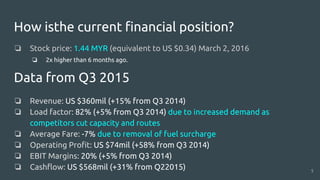
How isthe current financial position?
❏ Stock price: 1.44 MYR (equivalent to US $0.34) March 2, 2016
❏ 2x higher than 6 months ago.
❏ Revenue: US $360mil (+15% from Q3 2014)
❏ Load factor: 82% (+5% from Q3 2014) due to increased demand as
competitors cut capacity and routes
❏ Average Fare: -7% due to removal of fuel surcharge
❏ Operating Profit: US $74mil (+58% from Q3 2014)
❏ EBIT Margins: 20% (+5% from Q3 2014)
❏ Cashflow: US $568mil (+31% from Q22015)
Data from Q3 2015
5
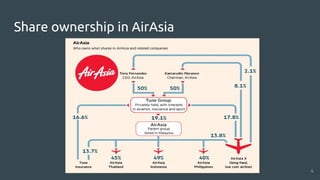
Share ownership in AirAsia
6
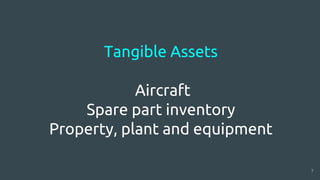
Tangible Assets
Aircraft
Spare part inventory
Property, plant and equipment
7
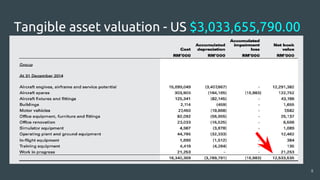
Tangible asset valuation - US $3,033,655,790.00
8
Intangible Assets
Intellectual property
Goodwill
Brand recognition
9
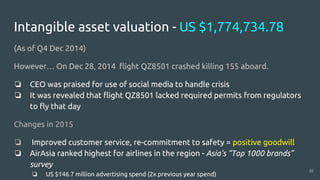
Intangible asset valuation - US $1,774,734.78
(As of Q4 Dec 2014)
However… On Dec 28, 2014 flight QZ8501 crashed killing 155 aboard.
❏ CEO was praised for use of social media to handle crisis
❏ It was revealed that flight QZ8501 lacked required permits from regulators
to fly that day
Changes in 2015
❏ Improved customer service, re-commitment to safety = positive goodwill
❏ AirAsia ranked highest for airlines in the region - Asia’s “Top 1000 brands”
survey
❏ US $146.7 million advertising spend (2x previous year spend)
10
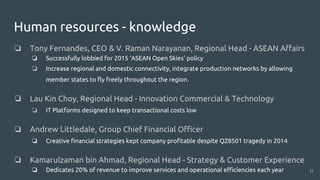
Human resources - knowledge
❏ Tony Fernandes, CEO & V. Raman Narayanan, Regional Head - ASEAN Affairs
❏ Successfully lobbied for 2015 ‘ASEAN Open Skies’ policy
❏ Increase regional and domestic connectivity, integrate production networks by allowing
member states to fly freely throughout the region.
❏ Lau Kin Choy, Regional Head - Innovation Commercial & Technology
❏ IT Platforms designed to keep transactional costs low
❏ Andrew Littledale, Group Chief Financial Officer
❏ Creative financial strategies kept company profitable despite QZ8501 tragedy in 2014
❏ Kamarulzaman bin Ahmad, Regional Head - Strategy & Customer Experience
❏ Dedicates 20% of revenue to improve services and operational efficiencies each year 11
12
Core competencies
Linkages between
Resources & Capabilities
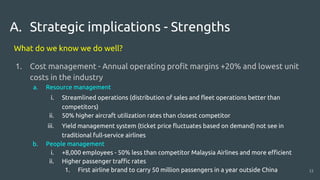
A. Strategic implications - Strengths
What do we know we do well?
1. Cost management - Annual operating profit margins +20% and lowest unit
costs in the industry
a. Resource management
i. Streamlined operations (distribution of sales and fleet operations better than
competitors)
ii. 50% higher aircraft utilization rates than closest competitor
iii. Yield management system (ticket price fluctuates based on demand) not see in
traditional full-service airlines
b. People management
i. +8,000 employees - 50% less than competitor Malaysia Airlines and more efficient
ii. Higher passenger traffic rates
1. First airline brand to carry 50 million passengers in a year outside China 13
1.
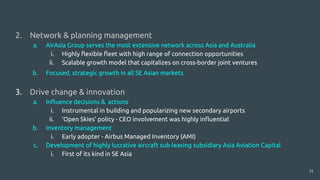
2. Network & planning management
a. AirAsia Group serves the most extensive network across Asia and Australia
i. Highly flexible fleet with high range of connection opportunities
ii. Scalable growth model that capitalizes on cross-border joint ventures
b. Focused, strategic growth in all SE Asian markets
3. Drive change & innovation
a. Influence decisions & actions
i. Instrumental in building and popularizing new secondary airports
ii. ‘Open Skies’ policy - CEO involvement was highly influential
b. Inventory management
i. Early adopter - Airbus Managed Inventory (AMI)
c. Development of highly lucrative aircraft sub-leasing subsidiary Asia Aviation Capital
i. First of its kind in SE Asia
14
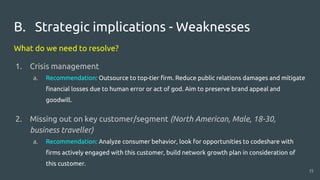
B. Strategic implications - Weaknesses
What do we need to resolve?
1. Crisis management
a. Recommendation: Outsource to top-tier firm. Reduce public relations damages and mitigate
financial losses due to human error or act of god. Aim to preserve brand appeal and
goodwill.
2. Missing out on key customer/segment (North American, Male, 18-30,
business traveller)
a. Recommendation: Analyze consumer behavior, look for opportunities to codeshare with
firms actively engaged with this customer, build network growth plan in consideration of
this customer.
15
1.
2.
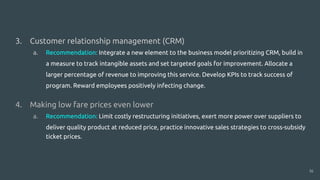
3. Customer relationship management (CRM)
a. Recommendation: Integrate a new element to the business model prioritizing CRM, build in
a measure to track intangible assets and set targeted goals for improvement. Allocate a
larger percentage of revenue to improving this service. Develop KPIs to track success of
program. Reward employees positively infecting change.
4. Making low fare prices even lower
a. Recommendation: Limit costly restructuring initiatives, exert more power over suppliers to
deliver quality product at reduced price, practice innovative sales strategies to cross-subsidy
ticket prices.
16
This concludes analysis of Internal Environment
We open the floor for questions, comments and feedback.
MBR Consulting thanks you for your time
Mahendra Karki
Brandi Lunn
& Rodrigo Marquez del Rio
17

Air asia march 3 16

  • 1.
    An analysis byMBR Consulting: Mahendra Karki, Brandi Lunn & Rodrigo Marquez del Rio Now everyone can fly
  • 2.
    Why are wehere today? Why does someone choose AirAsia over a competitor? The price. The connectivity. The innovative ways to keep fares low. How do we value AirAsia? ❏ tangible assets valued at US $3 billion ❏ intangible assets valued at US $2 million Core competencies? Cost management, Network & Planning management, Ability to drive change & innovation. Areas for improvement? Crisis management, missing out on key segments, CRM & making low fares lower. 2
  • 3.
  • 4.
    Who is AirAsia? ❏Founded December 20, 1993 and Headquartered in Malaysia. ❏ Positioned as Low Fare, No Frills airline servicing SE Asian market with short- to long-haul flights. ❏ Strategies used to support low-cost business model: ❏ High aircraft utilization: high frequency and high turnaround of flights (average: 25 minutes). ❏ Low Fare, No Frills: no frequent flyer miles, no airport lounges, guests have choice of paying for inflight meals, snacks. Tickets cost 40-60% less than Full Service Carriers. ❏ Point-to-Point Network: all flights are nonstop, eliminating the need for human resources, physical infrastructure and facilities at transit locations. 4
  • 5.
    How isthe currentfinancial position? ❏ Stock price: 1.44 MYR (equivalent to US $0.34) March 2, 2016 ❏ 2x higher than 6 months ago. ❏ Revenue: US $360mil (+15% from Q3 2014) ❏ Load factor: 82% (+5% from Q3 2014) due to increased demand as competitors cut capacity and routes ❏ Average Fare: -7% due to removal of fuel surcharge ❏ Operating Profit: US $74mil (+58% from Q3 2014) ❏ EBIT Margins: 20% (+5% from Q3 2014) ❏ Cashflow: US $568mil (+31% from Q22015) Data from Q3 2015 5
  • 6.
  • 7.
    Tangible Assets Aircraft Spare partinventory Property, plant and equipment 7
  • 8.
    Tangible asset valuation- US $3,033,655,790.00 8
  • 9.
  • 10.
    Intangible asset valuation- US $1,774,734.78 (As of Q4 Dec 2014) However… On Dec 28, 2014 flight QZ8501 crashed killing 155 aboard. ❏ CEO was praised for use of social media to handle crisis ❏ It was revealed that flight QZ8501 lacked required permits from regulators to fly that day Changes in 2015 ❏ Improved customer service, re-commitment to safety = positive goodwill ❏ AirAsia ranked highest for airlines in the region - Asia’s “Top 1000 brands” survey ❏ US $146.7 million advertising spend (2x previous year spend) 10
  • 11.
    Human resources -knowledge ❏ Tony Fernandes, CEO & V. Raman Narayanan, Regional Head - ASEAN Affairs ❏ Successfully lobbied for 2015 ‘ASEAN Open Skies’ policy ❏ Increase regional and domestic connectivity, integrate production networks by allowing member states to fly freely throughout the region. ❏ Lau Kin Choy, Regional Head - Innovation Commercial & Technology ❏ IT Platforms designed to keep transactional costs low ❏ Andrew Littledale, Group Chief Financial Officer ❏ Creative financial strategies kept company profitable despite QZ8501 tragedy in 2014 ❏ Kamarulzaman bin Ahmad, Regional Head - Strategy & Customer Experience ❏ Dedicates 20% of revenue to improve services and operational efficiencies each year 11
  • 12.
  • 13.
    A. Strategic implications- Strengths What do we know we do well? 1. Cost management - Annual operating profit margins +20% and lowest unit costs in the industry a. Resource management i. Streamlined operations (distribution of sales and fleet operations better than competitors) ii. 50% higher aircraft utilization rates than closest competitor iii. Yield management system (ticket price fluctuates based on demand) not see in traditional full-service airlines b. People management i. +8,000 employees - 50% less than competitor Malaysia Airlines and more efficient ii. Higher passenger traffic rates 1. First airline brand to carry 50 million passengers in a year outside China 13
  • 14.
    1. 2. Network &planning management a. AirAsia Group serves the most extensive network across Asia and Australia i. Highly flexible fleet with high range of connection opportunities ii. Scalable growth model that capitalizes on cross-border joint ventures b. Focused, strategic growth in all SE Asian markets 3. Drive change & innovation a. Influence decisions & actions i. Instrumental in building and popularizing new secondary airports ii. ‘Open Skies’ policy - CEO involvement was highly influential b. Inventory management i. Early adopter - Airbus Managed Inventory (AMI) c. Development of highly lucrative aircraft sub-leasing subsidiary Asia Aviation Capital i. First of its kind in SE Asia 14
  • 15.
    B. Strategic implications- Weaknesses What do we need to resolve? 1. Crisis management a. Recommendation: Outsource to top-tier firm. Reduce public relations damages and mitigate financial losses due to human error or act of god. Aim to preserve brand appeal and goodwill. 2. Missing out on key customer/segment (North American, Male, 18-30, business traveller) a. Recommendation: Analyze consumer behavior, look for opportunities to codeshare with firms actively engaged with this customer, build network growth plan in consideration of this customer. 15
  • 16.
    1. 2. 3. Customer relationshipmanagement (CRM) a. Recommendation: Integrate a new element to the business model prioritizing CRM, build in a measure to track intangible assets and set targeted goals for improvement. Allocate a larger percentage of revenue to improving this service. Develop KPIs to track success of program. Reward employees positively infecting change. 4. Making low fare prices even lower a. Recommendation: Limit costly restructuring initiatives, exert more power over suppliers to deliver quality product at reduced price, practice innovative sales strategies to cross-subsidy ticket prices. 16
  • 17.
    This concludes analysisof Internal Environment We open the floor for questions, comments and feedback. MBR Consulting thanks you for your time Mahendra Karki Brandi Lunn & Rodrigo Marquez del Rio 17