Doing business in India:
              some reflections
& suggestions

          Achal Raghavan
     Strategy & Business Excellence Consultant
                 Bangalore, India
          achalraghavan@yahoo.co.in
           www.achalraghavan.com


                                                 1
A note of caution

   My views are based on my 30+ years of work
    experience – in MNC’s and Indian cos.
   Many generalizations – please handle with
    care!
       Look for this symbol:     Caution:
                                Generalization!


                                                  2
Contents
   Introduction
   India: Vision 2020
   India strategy
   Strategy implementation
   Understanding Indian org. culture
   The Cultural Orientations Model
   Some suggestions
   Discussions


                                        3
Introduction

   Economy: Consistent growth at 6-8%
    likely to be maintained
   Broad policy directions unlikely to change
    – regardless of which Government is in
    power
   A land of opportunity – but need to
    understand the culture, the people and
    the ecosystem
   Very diverse market; generalizations are
    likely to be wrong

                                                 4
India: Vision 2020
 The vision and the journey
 “Making a successful transition to the
  knowledge economy – agriculture,
  industry and services”
 Recommended reading
       India 2020: A vision for the new millenium
              APJ Abdul Kalam and Y S Rajan, Penguin India
        2002
       India’s new opportunity 2020: Report of the
        High Level Strategic Group
                          All India Management Association (AIMA),
        with BCG

                                                               5
India strategy


   Best left to individual companies and
    businesses
   But just one friendly tip (next slide)


                                             6
India strategy: a friendly tip
    Treat your India strategy like a jazz
     tune, or an Indian “raga”


                  Caution:
                Generalization!


                                             7
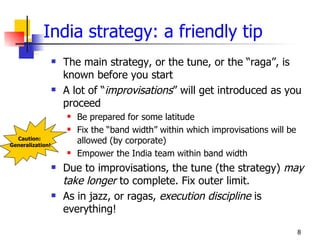
India strategy: a friendly tip
                     The main strategy, or the tune, or the “raga”, is
                      known before you start
                     A lot of “improvisations” will get introduced as you
                      proceed
                         Be prepared for some latitude
                         Fix the “band width” within which improvisations will be
  Caution:
Generalization!
                          allowed (by corporate)
                         Empower the India team within band width
                     Due to improvisations, the tune (the strategy) may
                      take longer to complete. Fix outer limit.
                     As in jazz, or ragas, execution discipline is
                      everything!

                                                                                     8
Strategy implementation
    The Balanced Scorecard – Kaplan and Norton


              Financial


               Customer


                Process


                 People               Focus area for today


                                                             9
Strategy implementation
                                                          Caution:
                                                        Generalization!


   Maximize involvement of parent org. executives at
    project stage
       Short term postings by rotation (as development
        assignment)
       Functional “buddy system”
   Ensure diversity at senior & middle levels
       India is no longer a “hardship posting”
       Many MNC’s in India are virtually 100% Indian
   Create “two-way traffic” of people (between India
    and global org.)
       A great way to ensure alignment and global thinking; and
        leverage Indian talent globally
   Be prepared to compete for talent
                                                                    10
Understanding Indian org. culture
   Very comfortable with clear, defined
    structures
   Less effective in matrix organizations –
    though this is changing
   Seniority still matters in brick-and-mortar cos.
    – though merit is beginning to win, esp. in
    new/ young industries
   Public “face” crucial at the individual level;
    one-to-one meetings far more effective on
    performance issues
                                          Caution:
                                        Generalization!


                                                          11
Understanding Indian org. culture
   Tremendous capacity for hard work and
    creativity – coupled with some reluctance
    to use systems and processes 100%
   This also is changing, with ISO and other
    certifications taking hold
   IT, manufacturing and pharma industries
    are leading the way in systems discipline

                                       Caution:
                                     Generalization!


                                                       12
Ethics and governance
   Communicate company ethics policy clearly
       Written documentation
       Workshops
       Sign-offs
   Implement consistently
   Provide “secure-but-open” communication
    channel and process for raising and
    resolving issues
   Show visible top management commitment


                                           13
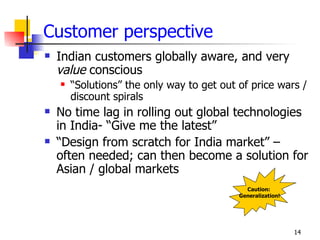
Customer perspective
   Indian customers globally aware, and very
    value conscious
       “Solutions” the only way to get out of price wars /
        discount spirals
   No time lag in rolling out global technologies
    in India- “Give me the latest”
   “Design from scratch for India market” –
    often needed; can then become a solution for
    Asian / global markets
                                              Caution:
                                            Generalization!


                                                              14
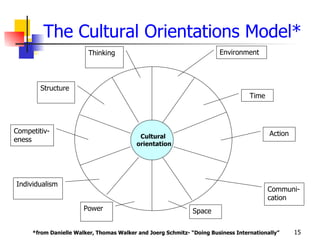
The Cultural Orientations Model*
                        Thinking                                       Environment


        Structure
                                                                                  Time


Competitiv-                                                                              Action
                                           Cultural
eness
                                          orientation


Individualism
                                                                                         Communi-
                                                                                         cation
                       Power                                  Space

     *from Danielle Walker, Thomas Walker and Joerg Schmitz- “Doing Business Internationally”     15
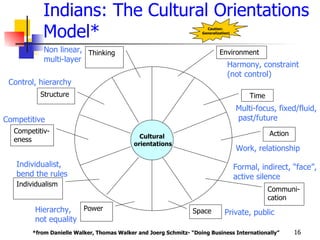
Indians: The Cultural Orientations
           Model*                                                     Caution:
                                                                    Generalization!


            Non linear, Thinking                                             Environment
            multi-layer
                                                                                 Harmony, constraint
                                                                                 (not control)
 Control, hierarchy
          Structure                                                                       Time
                                                                                      Multi-focus, fixed/fluid,
Competitive                                                                           past/future
  Competitiv-                                                                                    Action
                                              Cultural
  eness
                                            orientations
                                                                                      Work, relationship

   Individualist,                                                                     Formal, indirect, “face”,
   bend the rules                                                                     active silence
   Individualism
                                                                                                 Communi-
                                                                                                 cation
        Hierarchy,   Power                                       Space          Private, public
        not equality
        *from Danielle Walker, Thomas Walker and Joerg Schmitz- “Doing Business Internationally”          16
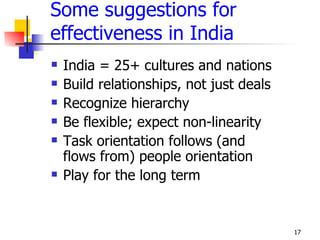
Some suggestions for
effectiveness in India
   India = 25+ cultures and nations
   Build relationships, not just deals
   Recognize hierarchy
   Be flexible; expect non-linearity
   Task orientation follows (and
    flows from) people orientation
   Play for the long term


                                          17
Wish you all success!


                        18
Thank you!


             19

Doing Business In India(Ver3)

  • 1.
    Doing business inIndia: some reflections & suggestions Achal Raghavan Strategy & Business Excellence Consultant Bangalore, India achalraghavan@yahoo.co.in www.achalraghavan.com 1
  • 2.
    A note ofcaution  My views are based on my 30+ years of work experience – in MNC’s and Indian cos.  Many generalizations – please handle with care!  Look for this symbol: Caution: Generalization! 2
  • 3.
    Contents  Introduction  India: Vision 2020  India strategy  Strategy implementation  Understanding Indian org. culture  The Cultural Orientations Model  Some suggestions  Discussions 3
  • 4.
    Introduction  Economy: Consistent growth at 6-8% likely to be maintained  Broad policy directions unlikely to change – regardless of which Government is in power  A land of opportunity – but need to understand the culture, the people and the ecosystem  Very diverse market; generalizations are likely to be wrong 4
  • 5.
    India: Vision 2020 The vision and the journey “Making a successful transition to the knowledge economy – agriculture, industry and services”  Recommended reading  India 2020: A vision for the new millenium APJ Abdul Kalam and Y S Rajan, Penguin India 2002  India’s new opportunity 2020: Report of the High Level Strategic Group All India Management Association (AIMA), with BCG 5
  • 6.
    India strategy  Best left to individual companies and businesses  But just one friendly tip (next slide) 6
  • 7.
    India strategy: afriendly tip  Treat your India strategy like a jazz tune, or an Indian “raga” Caution: Generalization! 7
  • 8.
    India strategy: afriendly tip  The main strategy, or the tune, or the “raga”, is known before you start  A lot of “improvisations” will get introduced as you proceed  Be prepared for some latitude  Fix the “band width” within which improvisations will be Caution: Generalization! allowed (by corporate)  Empower the India team within band width  Due to improvisations, the tune (the strategy) may take longer to complete. Fix outer limit.  As in jazz, or ragas, execution discipline is everything! 8
  • 9.
    Strategy implementation The Balanced Scorecard – Kaplan and Norton Financial Customer Process People Focus area for today 9
  • 10.
    Strategy implementation Caution: Generalization!  Maximize involvement of parent org. executives at project stage  Short term postings by rotation (as development assignment)  Functional “buddy system”  Ensure diversity at senior & middle levels  India is no longer a “hardship posting”  Many MNC’s in India are virtually 100% Indian  Create “two-way traffic” of people (between India and global org.)  A great way to ensure alignment and global thinking; and leverage Indian talent globally  Be prepared to compete for talent 10
  • 11.
    Understanding Indian org.culture  Very comfortable with clear, defined structures  Less effective in matrix organizations – though this is changing  Seniority still matters in brick-and-mortar cos. – though merit is beginning to win, esp. in new/ young industries  Public “face” crucial at the individual level; one-to-one meetings far more effective on performance issues Caution: Generalization! 11
  • 12.
    Understanding Indian org.culture  Tremendous capacity for hard work and creativity – coupled with some reluctance to use systems and processes 100%  This also is changing, with ISO and other certifications taking hold  IT, manufacturing and pharma industries are leading the way in systems discipline Caution: Generalization! 12
  • 13.
    Ethics and governance  Communicate company ethics policy clearly  Written documentation  Workshops  Sign-offs  Implement consistently  Provide “secure-but-open” communication channel and process for raising and resolving issues  Show visible top management commitment 13
  • 14.
    Customer perspective  Indian customers globally aware, and very value conscious  “Solutions” the only way to get out of price wars / discount spirals  No time lag in rolling out global technologies in India- “Give me the latest”  “Design from scratch for India market” – often needed; can then become a solution for Asian / global markets Caution: Generalization! 14
  • 15.
    The Cultural OrientationsModel* Thinking Environment Structure Time Competitiv- Action Cultural eness orientation Individualism Communi- cation Power Space *from Danielle Walker, Thomas Walker and Joerg Schmitz- “Doing Business Internationally” 15
  • 16.
    Indians: The CulturalOrientations Model* Caution: Generalization! Non linear, Thinking Environment multi-layer Harmony, constraint (not control) Control, hierarchy Structure Time Multi-focus, fixed/fluid, Competitive past/future Competitiv- Action Cultural eness orientations Work, relationship Individualist, Formal, indirect, “face”, bend the rules active silence Individualism Communi- cation Hierarchy, Power Space Private, public not equality *from Danielle Walker, Thomas Walker and Joerg Schmitz- “Doing Business Internationally” 16
  • 17.
    Some suggestions for effectivenessin India  India = 25+ cultures and nations  Build relationships, not just deals  Recognize hierarchy  Be flexible; expect non-linearity  Task orientation follows (and flows from) people orientation  Play for the long term 17
  • 18.
    Wish you allsuccess! 18
  • 19.