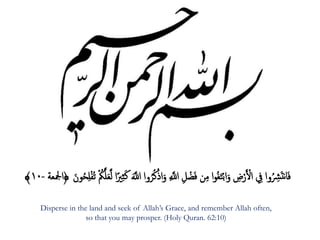
‫أ‬ ُ‫ُك‬‫ه‬‫ل‬َ‫ع‬‫ه‬‫ل‬ ‫ا‬ً‫ري‬ِ‫ث‬َ‫ك‬ َ‫ه‬‫اَّلل‬ ‫وا‬ُ‫ر‬ُ‫ك‬‫أ‬‫اذ‬َ‫و‬ ِ ‫ه‬‫اَّلل‬ ِ‫ل‬ ‫أ‬‫ض‬َ‫ف‬ ‫ن‬ِ‫م‬ ‫ا‬‫و‬ُ‫غ‬َ‫ت‬‫أ‬‫ب‬‫ا‬َ‫و‬ ِ‫ض‬‫أ‬‫ر‬َ ‫أ‬‫اْل‬ ِ‫ِف‬ ‫وا‬ُ ِ‫ِش‬َ‫ت‬‫ن‬‫ا‬َ‫ف‬َ‫ون‬ُ‫ح‬ِ‫ل‬‫أ‬‫ف‬ُ‫ت‬‫﴿امجلعة‬-10﴾
Disperse in the land and seek of Allah‟s Grace, and remember Allah often,
so that you may prosper. (Holy Quran. 62:10)
By:
Mehdi Rastegary
Head of R&D– Sina Portsand Marine Services Co.
Batoul Dehdashti
MBA Graduate
International Conference on
New Challenges in Management and Business: Organization and Leadership
Dubai – 2nd May 2016
Ethics and Professional Ethics in Business
Administration: An Islamic Approach
Page : 3 Ethics and Professional Ethics in Business Administration: An Islamic Approach By : Mehdi Rastegary
Batoul Dehdashti
Place of Business in Modern Economy
• Within te past 400 years, the Economy of in human
societies have been exceedingly depending on
businesses.
• Business has transformed to be the main vessel of
conducting commerce, industry, trade, and professional
works.
• In terms of global economy, businesses provide the
ground for supply of food, energy, clothes, health
services, education and training, construction, welfare
services, and all other required elements for modern life.
• Nowadays, development of business and level of its
facilitation in the society is among the most important
indicators of economic development of nations and
their competitiveness.
International Conference on
New Challenges in Management and Business: Organization and Leadership
Dubai – 2nd May 2016
Role of Business Administrator in Modern Society
 The business Administrators, as the individuals in charge of
management of a business:
• Should be trusted by the owners of the business administered by them
• Represent their business in the society by their traits, behaviors, speaking,
and even appearance.
• Their decisions have critical impacts on preservation of the rights, interests,
and convenience of their business stakeholders ( including the staff, owners,
suppliers, customers and clients, consumers, neighbors, the coming
generations , etc.).
• Their job requires handling and solving sophisticated, unstructured
problems.
• They are usually lodged in the top levels of organizations (and higher classes
of the society) and their traits and behaviors are usually adopted as
standards or benchmarks by their staff and the society.
• They should develop the organizational culture and shape the corporate
values and norms.
 Accordingly, we can say that Business Administrator's job:
• generates considerable value to individuals and society
• demands great knowledge and skills
• is charged with great ethical responsibility.
 The add-up of these three attributes requires Business
Administration to be developed as a profession; a fact that
has been disregarded to the day. profession
Page : 4
Ethics and Professional Ethics in Business Administration: An Islamic Approach
By : Mehdi Rastegary
Batoul Dehdashti
International Conference on
New Challenges in Management and Business: Organization and Leadership
Dubai – 2nd May 2016
Page : 5
Ethics and Professional Ethics in Business Administration: An Islamic Approach
By : Mehdi Rastegary
Batoul Dehdashti
International Conference on
New Challenges in Management and Business: Organization and Leadership
Dubai – 2nd May 2016
Professionalism
 According to D. Soccia, professions are characterized by
following attributes ( Soccia, D., 2007):
• They require extensive training of an intellectual character..
• Their services are vital to society‟s well-being.
• Their practitioners usually have a high degree of autonomy in deciding
how to carry out their job.
• Practitioners must undergo a process of certification or licensing by the
state in order to be eligible to carry out certain tasks or provide certain
services.
• Professionals are usually organized in “societies” that promulgate “ethics
codes.”
 Yet, two sets of myths have been coined to prevent the
professional developments in „Management‟ and „Business
Administration‟ occupations:
• Myths that underestimate the necessity of education for obtaining the
needed Wisdom, Knowledge and Skills as competences for Business
Administration.
• Myths that propose demoralization of businesses and their administration
process.
 profession
Page : 6
Ethics and Professional Ethics in Business Administration: An Islamic Approach
By : Mehdi Rastegary
Batoul Dehdashti
International Conference on
New Challenges in Management and Business: Organization and Leadership
Dubai – 2nd May 2016
Anti-professionalism in Business Administration : First
MYTH
Within the past 200 years, under their understandable cynicism,
many Business owners used to urge that :
• The capabilities needed to administer a business are intrinsic. And can not
be learned.
• Or, they are only learned by experience in administering businesses, and
can not be educated.
 By the first half of 20th century, many managers and scholars
came to shape and complement the body of management
knowledge ( including figures like F.W.Taylor, H.Fayol,
M.P.Follet, E. Mayo, L.Gulick, L.Urwick, D.McGregor, and
many more).
 And in the early decades of 20th century, Schools of
Management were established throughout the world to transfer
the knowledge of Management to those in need of it..
 After more than a century of establishment of Business
Schools and organizing tens of thousands of MBA
courses in worldwide level, today it is widely accepted that
a large part of knowledge and skills needed for
management and business administration can be learned
by education. Therefore The First MYTH is actually
dismissed.
Page : 7
Ethics and Professional Ethics in Business Administration: An Islamic Approach
By : Mehdi Rastegary
Batoul Dehdashti
International Conference on
New Challenges in Management and Business: Organization and Leadership
Dubai – 2nd May 2016
Anti-professionalism in Business Administration : Second
MYTH
 The other myth stems from the belief to demoralization of
business.
 This was foremost theorized by Adam Smith (entitled as
the Prophet of modern Economy). In his book, Wealth of
Nations (1776), he proposes that:
• Economic activity is driven by the interests of those involved in them,
and not by moral virtues.
• In description of the markets, he substitutes the Will of God ( as the
most determining power in Human life) with a „Hidden Hand‟ that
balances the demands and supplies.
• He describes „Man‟ as a „bargaining animal‟.
 This was seen as a green light to enter into a new era in
which the modern economy is built on pillars of greed. The
myth was driven very further in theory and practice by the
owners of this economy.
 The Business Demoralization Myth has been the
default principle of nearly any economic activity
throughout the world in the past 250 years. One of its
consequences has been frailty in professionalization of
Business Administrator’s job.
Page : 8
Ethics and Professional Ethics in Business Administration: An Islamic Approach
By : Mehdi Rastegary
Batoul Dehdashti
International Conference on
New Challenges in Management and Business: Organization and Leadership
Dubai – 2nd May 2016
Anti-professionalism in Business Administration : MYTH
No.2
 The consequences of believing and practicing this myth has
been tragic:
• Businesses have been designed to protect the wealth of the rich and
increase it.
• Many of the colossal businesses and industries emerged to the harm
of the individuals, societies, and environment ( by causing moral
corruption, pollution, wastages, perversions,
• Most of such businesses and industries focused on induction of false
and demands in people ( e.g. profanity, hedonism, violence, addictions,
greed, wilderness, aggressiveness, ruthlessness, etc.)
• The moral degradation of societies led to greater disproportion in
distribution of wealth in the national and international levels; these
went on a negative loop in strengthening one another.
 The palpable harms to humanity and the planet are incalculable,
including:
Numerous wars (as boosting businesses) with severe casualties and
destruction.
Gradual annihilation of basic social life constructs ( like family)
Overconsumption of natural resources (specially the non-
renewable ones).
Limitless pollution of the environment.
Ruining the basic ethical principles that ensured the well-being (
and welfare) of humans (in form of individuals and societies) in this
life and their afterlife, and substituting it with permissivim,
utililitarianism.
Page : 9
Ethics and Professional Ethics in Business Administration: An Islamic Approach
By : Mehdi Rastegary
Batoul Dehdashti
International Conference on
New Challenges in Management and Business: Organization and Leadership
Dubai – 2nd May 2016
Anti-professionalism in Business Administration : MYTH No.2
 For demoralization of business, it was most necessary to demoralize the
job of the business administrator who was the leader, protector, and
developer of the business.
 In this sense, they introduced a new order which was founded by
introduction of Capitalism as a new faith, heralded by Adam Smith‟s
prophecy. In this new faith:
• The individual and his/her interests are the pivot of the world.
• Interests (specially in form of Profit) are worshipped and consecrated as the ultimate
goal of activity (and life).
• Morality is senseless, especially in terms of protecting or maximizing one‟s interests.
• Every thing and every one is good and valuable as long as it serves one‟s interests,
and bad ( or worthless) if contradicting ( or not contributing to) them. Egoism is the
evaluation reference.
• Any thing that can contribute towards one‟s interest is permitted ( in terms of one‟s
conscience). This is legally also promoted by „Rule of Law‟ and maximum
deregulation of citizens‟ actions.
• Omnipotence of God is substituted by MARKET powers.
• „Man‟ is reduced to the level of a „bargaining animal‟.
• Politics is organized as „Laissez-Faire‟ to protect individuals from any kind of
initiation of force .
 As apparently seen in the past century, principles like „rule of law‟ and
„Laissez-Faire‟ has been used to serve the rich individuals, rather than all
citizens.
Faith in Capitalism and its consequences
 As cited, faith in Capitalism has caused several grave
problems in the world, including:
• Historical rise of systemic fraud in the business world.
• Extreme gap between the wealth of 1-percent top-rich
people with the wealth of the rest of the population of the
world.
• Development of Blood Businesses in the global war machine
context.
• Vanishing of the basic constructs of the human society.
• Supremacy of cults and sects in the human world.
• Dominance of poverty, hunger, war and suffering on the
majority of the world population.
• Entering into Anthropocene Age and unprecedented damage
to environment.
• Severe engineering trends to form the coming generations
towards more mundane life
• Consolidation of secularity in minds and lives of the majority
of human beings and their alienation with the roots of
morality.
• Raise of misleading, and non-balanced alternative spiritual
schools to fill the blank place of religion in humans‟ life.
• etc.
Page : 10
Ethics and Professional Ethics in Business Administration: An Islamic Approach
By : Mehdi Rastegary
Batoul Dehdashti
International Conference on
New Challenges in Management and Business: Organization and Leadership
Dubai – 2nd May 2016
(b)
(a) OXFAM report on (a) Global distribution of
wealth between 2000-2014 (b) Projection of
global distribution of wealth to the end of 2010s
(Hardoon,D.,2015)
Percentage of births to unmarried women in developed
countries between 1980-2007 (Ventura, S.J., 2009)
Page : 11
Ethics and Professional Ethics in Business Administration: An Islamic Approach
By : Mehdi Rastegary
Batoul Dehdashti
International Conference on
New Challenges in Management and Business: Organization and Leadership
Dubai – 2nd May 2016
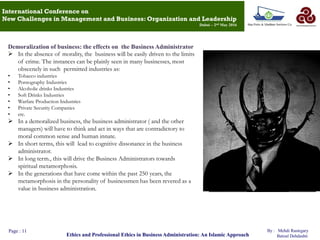
Demoralization of business: the effects on the Business Administrator
 In the absence of morality, the business will be easily driven to the limits
of crime. The instances can be plainly seen in many businesses, most
obscenely in such permitted industries as:
• Tobacco industries
• Pornography Industries
• Alcoholic drinks Industries
• Soft Drinks Industries
• Warfare Production Industries
• Private Security Companies
• etc.
 In a demoralized business, the business administrator ( and the other
managers) will have to think and act in ways that are contradictory to
moral common sense and human innate.
 In short terms, this will lead to cognitive dissonance in the business
administrator.
 In long term., this will drive the Business Administrators towards
spiritual metamorphosis.
 In the generations that have come within the past 250 years, the
metamorphosis in the personality of businessmen has been revered as a
value in business administration.
Page : 12
Ethics and Professional Ethics in Business Administration: An Islamic Approach
By : Mehdi Rastegary
Batoul Dehdashti
International Conference on
New Challenges in Management and Business: Organization and Leadership
Dubai – 2nd May 2016
Professional Ethics in Business Administration
 Professional Ethics is a set of professional rules and
protocols that are derived from ethical principles and are
accepted in a worldwide level.
 They adjust the behaviors of the practitioners of
profession in their workplace and are seen as standard and
a guidance for interaction with people and institutes in
terms of their profession.
 Professional ethics serves two main purposes:
• providing the maximum level of credibility between the
practitioners and stakeholders of a profession.
• provide a standard behavioral pattern throughout the
practitioners of the profession.
 In the capitalist mindset, credibility of the Business
Administrator is not seen as a needed qualification of this
job to ensure infinite freedom to serve the greed .
 In terms of behavioral standards, the values that shall be
complied by business administrator are targeted towards
maximization of profit with no requirements to
commitment to morality.
 It is imperative to set ethical standards in Business
Administration job to lead it towards the true benefits
of the individuals, the society and her coming
generations.
Will Professionalism in Business Administration
guarantee morality in Business?
 Even if professional ethical standards are set in Business
Administration, development of morality will be weak
because:
• such protocols in the businesses will be classified as symbolic
values in most firms, and will eventually act on the „Attitude‟
level, and will not penetrate and act in the „values‟ level.
• commitment to such standards will requires overlooking
existing colossal profits and benefits, which will be a great
impediment to their practice.
• Therefore, setting and implementation of ethical standards
can not guarantee the consolidation of morality into the „Basic
Underlying Assumptions‟ of the firm, and it can most
optimistically penetrate to the “Artifacts‟ and “Espoused
Values‟ levels of it.
 In order to instill morality to business, a cultural
change is necessary in the firms and the society
levels.
 Moreover, first of all we should determine which
ethics school is being referred to?
Page : 13
Ethics and Professional Ethics in Business Administration: An Islamic Approach
By : Mehdi Rastegary
Batoul Dehdashti
International Conference on
New Challenges in Management and Business: Organization and Leadership
Dubai – 2nd May 2016
The professional ethics will not penetrate
into the levels of Values and Beliefs.
Articrafts
Espoused Values
Basic
Underlying
Assumptions
Three levels of Organizational Culture (Schine, E.H., 2004)
Anticipated Business Ethics
penetration
Optimistic View
More Optimistic View
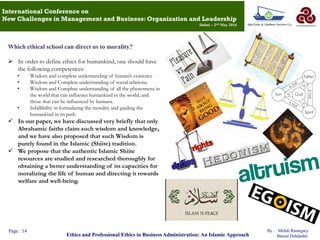
Which ethical school can direct us to morality?
 In order to define ethics for humankind, one should have
the following competences:
• Wisdom and complete understanding of human‟s existence
• Wisdom and Complete understanding of social relations.
• Wisdom and Complete understanding of all the phenomena in
the world that can influence humankind in the world, and
those that can be influenced by humans.
• Infallibility in formulating the morality and guiding the
humankind in its path.
 In our paper, we have discussed very briefly that only
Abrahamic faiths claim such wisdom and knowledge,
and we have also proposed that such Wisdom is
purely found in the Islamic (Shiite) tradition.
 We propose that the authentic Islamic Shiite
resources are studied and researched thoroughly for
obtaining a better understanding of its capacities for
moralizing the life of human and directing it towards
welfare and well-being.
Page : 14
Ethics and Professional Ethics in Business Administration: An Islamic Approach
By : Mehdi Rastegary
Batoul Dehdashti
International Conference on
New Challenges in Management and Business: Organization and Leadership
Dubai – 2nd May 2016
Gratitude from
Allah Almighty
and asking for
Beatitude
Contribution of
part of one’s
earnings to Imam
(Proof of God)
Business
Administrator
Earning
Righteous
Livelihood for
one’s Family
Due Allocation
and
Consumption of
Halal Earnings
Acountability for
generating
Haram (evil) in
the world
Delivery of
rights of the
Business
Owners
Delivery of rights
of the customers
Responsibility
towards coming
Generations
Responsibility
towards welfare
and wellbeing of
Employees
Responsibility
towards
dependents of
one’s business
Responsibility
towards the
poor, needy,
neighbor, and
any living thing
or resources that
is affected
Page : 15
Ethics and Professional Ethics in Business Administration: An Islamic Approach
By : Mehdi Rastegary
Batoul Dehdashti
International Conference on
New Challenges in Management and Business: Organization and Leadership
Dubai – 2nd May 2016
Business Administration : the Islamic (Shiite) Scope
 In Islam, any efforts of a person to provide the
livelihood of one‟s family ( and own) is revered like
pure prayers to Allah Almighty.
 Among those who work, the businessman is esteemed
like a glorified friend of Allah Almighty.
 A businessman is particularly responsible about the
way of earning his livelihood ( and fortune), its
allocation and consumption:
• He is responsible in front of Allah Almighty and his proof
in the world.
• He is responsible before all other humans that are
depending on, or affected by his business.
• He is responsible for all resources or beings used in terms
of making his earnings.
 A (Shiite) Muslim is raised on such moral
teachings by his/her religion.
Business Administration : the Islamic (Shiite) view
 Modernization of Islamic societies have been entailed by
replacements of the traditional economy-related institutions
with the modern ones; including:
• Corporations against shops
• Banks against exchange firms
• Financial markets against Bazaars.
• Universities against Seminaries
• and so on.
 Development of the modern institutions have been syncretic,
and thus their functions are not domesticated.
 Nowadays, both set of traditional and so-called modern
institutions are functioning in the society; though both are
different with what they are originally meant to be.
 This has messed up the business models in Islamic societies;
and extensive work is needed to obtain the best achievable value
out of this juxtaposition.
 In this regard, the authors present a Quranic model to
outline the way to moralize Business Administrators’ job.
Page : 16
Ethics and Professional Ethics in Business Administration: An Islamic Approach
By : Mehdi Rastegary
Batoul Dehdashti
International Conference on
New Challenges in Management and Business: Organization and Leadership
Dubai – 2nd May 2016
Page : 17
Ethics and Professional Ethics in Business Administration: An Islamic Approach
By : Mehdi Rastegary
Batoul Dehdashti
International Conference on
New Challenges in Management and Business: Organization and Leadership
Dubai – 2nd May 2016
Business Administrator’s Faith (BAF) model
 According to 103rd Surah in Quran, Human being is in
permanent loss except those who:
• Came to believe in Allah Almighty
• And did virtuous acts
• And invited to rectitude.
• And invited to patience
 A virtuous action is a an action that consists of:
• Pure will for nearance to GOD
• Balance in conformation
• Appropriate timing
• Continuation of practice
 Business Administrator‟s Faith (BAF) model inaugurates the
virtuous acts of the business Administrator on the pillars of:
• Faith in GOD
• Rectitude
• Patience
• Continuation of practice
 These three factors interact with each other in three realms:
Divine Creation, Personal Life, and Career Realms.
Business Administrator’s Faith (BAF) model
 The Virtuous Action in the Business Administrator‟s
Career life will simultaneously and synergistically
inaugurate:
 Sustainable Development through:
• Economic Production
• Contribution to Social Justice
• And Environmental Protection.
 Personal Worldly Gains:
• Wealth
• Fame
• and Power
 Spiritual Gains:
• Development of Purity and Decency
• Proliferation of Real Values and Virtues
• Approach to Eternal Salvation
 This model relies on personal development of individuals
in a society that is relying on Divine Beatitude and is a
field for proliferation of good .
Page : 18
Ethics and Professional Ethics in Business Administration: An Islamic Approach
By : Mehdi Rastegary
Batoul Dehdashti
International Conference on
New Challenges in Management and Business: Organization and Leadership
Dubai – 2nd May 2016
Page : 19
Ethics and Professional Ethics in Business Administration: An Islamic Approach
By : Mehdi Rastegary
Batoul Dehdashti
International Conference on
New Challenges in Management and Business: Organization and Leadership
Dubai – 2nd May 2016
Business Administrator’s Faith (BAF) Model
The BAF model can be used to:
 professionalize and moralize the business administration
job by outlining the KPIs of moralization of BA job for
planning, monitoring and control, and reporting the
performance of the Business Administrator.
 define the expectations of the society from the business
administrator in his career
 Educate the BAs and plan for their spiritual growth
 evaluate the business administrator‟s success in the career
realm.
By practical experience of morality in each business unit, the
individuals and societies will be convinced of:
 The real benefits of moral business practice in short-run
and long-run ( in comparison to the greed-centered model).
 More businesses will join to the „Business Moralization
Movement‟.
 This is where an all-encompassing model like BAF
will be most helpful in highlighting the humane values
in business.
Page : 20
Ethics and Professional Ethics in Business Administration: An Islamic Approach
By : Mehdi Rastegary
Batoul Dehdashti
International Conference on
New Challenges in Management and Business: Organization and Leadership
Dubai – 2nd May 2016
Conclusion
We discussed that:
 Business is the vessel of modern economy and
human life in this world.
 Business administration is a knowledge-
demanding, and value-adding job that is charged
with moral responsibility, and it needs to be
professionalized.
 Two myths have obstructed the BA
professionalization :
• Myths that underestimate the necessity of
education for obtaining the needed Wisdom,
Knowledge and Skills as competences for Business
Administration.
• Myths that propose demoralization of businesses
and their administration process.
 The first set of myths have been largely dismissed
by formation of Management Knowledge, and
establishment of Management Schools.
 The second set of myths has been preserved and
strengthened as a founding pillar of Capitalistic
ideology.
Page : 21
Ethics and Professional Ethics in Business Administration: An Islamic Approach
By : Mehdi Rastegary
Batoul Dehdashti
International Conference on
New Challenges in Management and Business: Organization and Leadership
Dubai – 2nd May 2016
Conclusion
We further discussed that:
 Some harms of demoralization of business:
• to the individuals, societies and the world .
• to the Business Administrator .
 Professionalization of Business Administration is a
positive, and necessary step towards moralization of
business, but it is not solely adequate as it will not
provide the needed penetration of moral values in the
life of humans and organizations.
 In both professionalization and moralization trends, it is
necessary to select an appropraite school of ethics, and
refer to it correctly:
• In our paper we have discussed that Islamic (Shiite)
Ethics is the right choice.
• We have proposed further studies in this regard.
• We also provided the different aspects of engagement in
a Business Administration job for an individual in the
light of Islamic Ethics teachings.
Conclusion
 In light of Glorious Quran‟s wisdom, we introduced
Business Administrator‟s Faith (BAF) model that is
focused on inauguration of Virtuous Acts of the
Business Administrator and their worldly,
developmental, and spiritual effects in the world.
 We discussed that BAF model can be used for
outlining the KPIs of moralization of BA job for
planning, monitoring and control, and reporting the
performance of the BA person to the all stakeholders
of a business firm in terms of professionalization and
moralization of the business administration job in a
business unit.
 It can also be used for defining the expectations of
the society from the BA, education of BAs for Spiritual
growth of them, evaluation of the BA‟s success in his
career, and promotion and inviting the society to join
the Business Moralization Movement.
Page : 22
Ethics and Professional Ethics in Business Administration: An Islamic Approach
By : Mehdi Rastegary
Batoul Dehdashti
International Conference on
New Challenges in Management and Business: Organization and Leadership
Dubai – 2nd May 2016
Many Thanks for your kind attention

BAF-M.Rastegary-24042016-presentation

  • 1.
    ‫أ‬ ُ‫ُك‬‫ه‬‫ل‬َ‫ع‬‫ه‬‫ل‬ ‫ا‬ً‫ري‬ِ‫ث‬َ‫ك‬َ‫ه‬‫اَّلل‬ ‫وا‬ُ‫ر‬ُ‫ك‬‫أ‬‫اذ‬َ‫و‬ ِ ‫ه‬‫اَّلل‬ ِ‫ل‬ ‫أ‬‫ض‬َ‫ف‬ ‫ن‬ِ‫م‬ ‫ا‬‫و‬ُ‫غ‬َ‫ت‬‫أ‬‫ب‬‫ا‬َ‫و‬ ِ‫ض‬‫أ‬‫ر‬َ ‫أ‬‫اْل‬ ِ‫ِف‬ ‫وا‬ُ ِ‫ِش‬َ‫ت‬‫ن‬‫ا‬َ‫ف‬َ‫ون‬ُ‫ح‬ِ‫ل‬‫أ‬‫ف‬ُ‫ت‬‫﴿امجلعة‬-10﴾ Disperse in the land and seek of Allah‟s Grace, and remember Allah often, so that you may prosper. (Holy Quran. 62:10)
  • 2.
    By: Mehdi Rastegary Head ofR&D– Sina Portsand Marine Services Co. Batoul Dehdashti MBA Graduate International Conference on New Challenges in Management and Business: Organization and Leadership Dubai – 2nd May 2016 Ethics and Professional Ethics in Business Administration: An Islamic Approach
  • 3.
    Page : 3Ethics and Professional Ethics in Business Administration: An Islamic Approach By : Mehdi Rastegary Batoul Dehdashti Place of Business in Modern Economy • Within te past 400 years, the Economy of in human societies have been exceedingly depending on businesses. • Business has transformed to be the main vessel of conducting commerce, industry, trade, and professional works. • In terms of global economy, businesses provide the ground for supply of food, energy, clothes, health services, education and training, construction, welfare services, and all other required elements for modern life. • Nowadays, development of business and level of its facilitation in the society is among the most important indicators of economic development of nations and their competitiveness. International Conference on New Challenges in Management and Business: Organization and Leadership Dubai – 2nd May 2016
  • 4.
    Role of BusinessAdministrator in Modern Society  The business Administrators, as the individuals in charge of management of a business: • Should be trusted by the owners of the business administered by them • Represent their business in the society by their traits, behaviors, speaking, and even appearance. • Their decisions have critical impacts on preservation of the rights, interests, and convenience of their business stakeholders ( including the staff, owners, suppliers, customers and clients, consumers, neighbors, the coming generations , etc.). • Their job requires handling and solving sophisticated, unstructured problems. • They are usually lodged in the top levels of organizations (and higher classes of the society) and their traits and behaviors are usually adopted as standards or benchmarks by their staff and the society. • They should develop the organizational culture and shape the corporate values and norms.  Accordingly, we can say that Business Administrator's job: • generates considerable value to individuals and society • demands great knowledge and skills • is charged with great ethical responsibility.  The add-up of these three attributes requires Business Administration to be developed as a profession; a fact that has been disregarded to the day. profession Page : 4 Ethics and Professional Ethics in Business Administration: An Islamic Approach By : Mehdi Rastegary Batoul Dehdashti International Conference on New Challenges in Management and Business: Organization and Leadership Dubai – 2nd May 2016
  • 5.
    Page : 5 Ethicsand Professional Ethics in Business Administration: An Islamic Approach By : Mehdi Rastegary Batoul Dehdashti International Conference on New Challenges in Management and Business: Organization and Leadership Dubai – 2nd May 2016 Professionalism  According to D. Soccia, professions are characterized by following attributes ( Soccia, D., 2007): • They require extensive training of an intellectual character.. • Their services are vital to society‟s well-being. • Their practitioners usually have a high degree of autonomy in deciding how to carry out their job. • Practitioners must undergo a process of certification or licensing by the state in order to be eligible to carry out certain tasks or provide certain services. • Professionals are usually organized in “societies” that promulgate “ethics codes.”  Yet, two sets of myths have been coined to prevent the professional developments in „Management‟ and „Business Administration‟ occupations: • Myths that underestimate the necessity of education for obtaining the needed Wisdom, Knowledge and Skills as competences for Business Administration. • Myths that propose demoralization of businesses and their administration process.  profession
  • 6.
    Page : 6 Ethicsand Professional Ethics in Business Administration: An Islamic Approach By : Mehdi Rastegary Batoul Dehdashti International Conference on New Challenges in Management and Business: Organization and Leadership Dubai – 2nd May 2016 Anti-professionalism in Business Administration : First MYTH Within the past 200 years, under their understandable cynicism, many Business owners used to urge that : • The capabilities needed to administer a business are intrinsic. And can not be learned. • Or, they are only learned by experience in administering businesses, and can not be educated.  By the first half of 20th century, many managers and scholars came to shape and complement the body of management knowledge ( including figures like F.W.Taylor, H.Fayol, M.P.Follet, E. Mayo, L.Gulick, L.Urwick, D.McGregor, and many more).  And in the early decades of 20th century, Schools of Management were established throughout the world to transfer the knowledge of Management to those in need of it..  After more than a century of establishment of Business Schools and organizing tens of thousands of MBA courses in worldwide level, today it is widely accepted that a large part of knowledge and skills needed for management and business administration can be learned by education. Therefore The First MYTH is actually dismissed.
  • 7.
    Page : 7 Ethicsand Professional Ethics in Business Administration: An Islamic Approach By : Mehdi Rastegary Batoul Dehdashti International Conference on New Challenges in Management and Business: Organization and Leadership Dubai – 2nd May 2016 Anti-professionalism in Business Administration : Second MYTH  The other myth stems from the belief to demoralization of business.  This was foremost theorized by Adam Smith (entitled as the Prophet of modern Economy). In his book, Wealth of Nations (1776), he proposes that: • Economic activity is driven by the interests of those involved in them, and not by moral virtues. • In description of the markets, he substitutes the Will of God ( as the most determining power in Human life) with a „Hidden Hand‟ that balances the demands and supplies. • He describes „Man‟ as a „bargaining animal‟.  This was seen as a green light to enter into a new era in which the modern economy is built on pillars of greed. The myth was driven very further in theory and practice by the owners of this economy.  The Business Demoralization Myth has been the default principle of nearly any economic activity throughout the world in the past 250 years. One of its consequences has been frailty in professionalization of Business Administrator’s job.
  • 8.
    Page : 8 Ethicsand Professional Ethics in Business Administration: An Islamic Approach By : Mehdi Rastegary Batoul Dehdashti International Conference on New Challenges in Management and Business: Organization and Leadership Dubai – 2nd May 2016 Anti-professionalism in Business Administration : MYTH No.2  The consequences of believing and practicing this myth has been tragic: • Businesses have been designed to protect the wealth of the rich and increase it. • Many of the colossal businesses and industries emerged to the harm of the individuals, societies, and environment ( by causing moral corruption, pollution, wastages, perversions, • Most of such businesses and industries focused on induction of false and demands in people ( e.g. profanity, hedonism, violence, addictions, greed, wilderness, aggressiveness, ruthlessness, etc.) • The moral degradation of societies led to greater disproportion in distribution of wealth in the national and international levels; these went on a negative loop in strengthening one another.  The palpable harms to humanity and the planet are incalculable, including: Numerous wars (as boosting businesses) with severe casualties and destruction. Gradual annihilation of basic social life constructs ( like family) Overconsumption of natural resources (specially the non- renewable ones). Limitless pollution of the environment. Ruining the basic ethical principles that ensured the well-being ( and welfare) of humans (in form of individuals and societies) in this life and their afterlife, and substituting it with permissivim, utililitarianism.
  • 9.
    Page : 9 Ethicsand Professional Ethics in Business Administration: An Islamic Approach By : Mehdi Rastegary Batoul Dehdashti International Conference on New Challenges in Management and Business: Organization and Leadership Dubai – 2nd May 2016 Anti-professionalism in Business Administration : MYTH No.2  For demoralization of business, it was most necessary to demoralize the job of the business administrator who was the leader, protector, and developer of the business.  In this sense, they introduced a new order which was founded by introduction of Capitalism as a new faith, heralded by Adam Smith‟s prophecy. In this new faith: • The individual and his/her interests are the pivot of the world. • Interests (specially in form of Profit) are worshipped and consecrated as the ultimate goal of activity (and life). • Morality is senseless, especially in terms of protecting or maximizing one‟s interests. • Every thing and every one is good and valuable as long as it serves one‟s interests, and bad ( or worthless) if contradicting ( or not contributing to) them. Egoism is the evaluation reference. • Any thing that can contribute towards one‟s interest is permitted ( in terms of one‟s conscience). This is legally also promoted by „Rule of Law‟ and maximum deregulation of citizens‟ actions. • Omnipotence of God is substituted by MARKET powers. • „Man‟ is reduced to the level of a „bargaining animal‟. • Politics is organized as „Laissez-Faire‟ to protect individuals from any kind of initiation of force .  As apparently seen in the past century, principles like „rule of law‟ and „Laissez-Faire‟ has been used to serve the rich individuals, rather than all citizens.
  • 10.
    Faith in Capitalismand its consequences  As cited, faith in Capitalism has caused several grave problems in the world, including: • Historical rise of systemic fraud in the business world. • Extreme gap between the wealth of 1-percent top-rich people with the wealth of the rest of the population of the world. • Development of Blood Businesses in the global war machine context. • Vanishing of the basic constructs of the human society. • Supremacy of cults and sects in the human world. • Dominance of poverty, hunger, war and suffering on the majority of the world population. • Entering into Anthropocene Age and unprecedented damage to environment. • Severe engineering trends to form the coming generations towards more mundane life • Consolidation of secularity in minds and lives of the majority of human beings and their alienation with the roots of morality. • Raise of misleading, and non-balanced alternative spiritual schools to fill the blank place of religion in humans‟ life. • etc. Page : 10 Ethics and Professional Ethics in Business Administration: An Islamic Approach By : Mehdi Rastegary Batoul Dehdashti International Conference on New Challenges in Management and Business: Organization and Leadership Dubai – 2nd May 2016 (b) (a) OXFAM report on (a) Global distribution of wealth between 2000-2014 (b) Projection of global distribution of wealth to the end of 2010s (Hardoon,D.,2015) Percentage of births to unmarried women in developed countries between 1980-2007 (Ventura, S.J., 2009)
  • 11.
    Page : 11 Ethicsand Professional Ethics in Business Administration: An Islamic Approach By : Mehdi Rastegary Batoul Dehdashti International Conference on New Challenges in Management and Business: Organization and Leadership Dubai – 2nd May 2016 Demoralization of business: the effects on the Business Administrator  In the absence of morality, the business will be easily driven to the limits of crime. The instances can be plainly seen in many businesses, most obscenely in such permitted industries as: • Tobacco industries • Pornography Industries • Alcoholic drinks Industries • Soft Drinks Industries • Warfare Production Industries • Private Security Companies • etc.  In a demoralized business, the business administrator ( and the other managers) will have to think and act in ways that are contradictory to moral common sense and human innate.  In short terms, this will lead to cognitive dissonance in the business administrator.  In long term., this will drive the Business Administrators towards spiritual metamorphosis.  In the generations that have come within the past 250 years, the metamorphosis in the personality of businessmen has been revered as a value in business administration.
  • 12.
    Page : 12 Ethicsand Professional Ethics in Business Administration: An Islamic Approach By : Mehdi Rastegary Batoul Dehdashti International Conference on New Challenges in Management and Business: Organization and Leadership Dubai – 2nd May 2016 Professional Ethics in Business Administration  Professional Ethics is a set of professional rules and protocols that are derived from ethical principles and are accepted in a worldwide level.  They adjust the behaviors of the practitioners of profession in their workplace and are seen as standard and a guidance for interaction with people and institutes in terms of their profession.  Professional ethics serves two main purposes: • providing the maximum level of credibility between the practitioners and stakeholders of a profession. • provide a standard behavioral pattern throughout the practitioners of the profession.  In the capitalist mindset, credibility of the Business Administrator is not seen as a needed qualification of this job to ensure infinite freedom to serve the greed .  In terms of behavioral standards, the values that shall be complied by business administrator are targeted towards maximization of profit with no requirements to commitment to morality.  It is imperative to set ethical standards in Business Administration job to lead it towards the true benefits of the individuals, the society and her coming generations.
  • 13.
    Will Professionalism inBusiness Administration guarantee morality in Business?  Even if professional ethical standards are set in Business Administration, development of morality will be weak because: • such protocols in the businesses will be classified as symbolic values in most firms, and will eventually act on the „Attitude‟ level, and will not penetrate and act in the „values‟ level. • commitment to such standards will requires overlooking existing colossal profits and benefits, which will be a great impediment to their practice. • Therefore, setting and implementation of ethical standards can not guarantee the consolidation of morality into the „Basic Underlying Assumptions‟ of the firm, and it can most optimistically penetrate to the “Artifacts‟ and “Espoused Values‟ levels of it.  In order to instill morality to business, a cultural change is necessary in the firms and the society levels.  Moreover, first of all we should determine which ethics school is being referred to? Page : 13 Ethics and Professional Ethics in Business Administration: An Islamic Approach By : Mehdi Rastegary Batoul Dehdashti International Conference on New Challenges in Management and Business: Organization and Leadership Dubai – 2nd May 2016 The professional ethics will not penetrate into the levels of Values and Beliefs. Articrafts Espoused Values Basic Underlying Assumptions Three levels of Organizational Culture (Schine, E.H., 2004) Anticipated Business Ethics penetration Optimistic View More Optimistic View
  • 14.
    Which ethical schoolcan direct us to morality?  In order to define ethics for humankind, one should have the following competences: • Wisdom and complete understanding of human‟s existence • Wisdom and Complete understanding of social relations. • Wisdom and Complete understanding of all the phenomena in the world that can influence humankind in the world, and those that can be influenced by humans. • Infallibility in formulating the morality and guiding the humankind in its path.  In our paper, we have discussed very briefly that only Abrahamic faiths claim such wisdom and knowledge, and we have also proposed that such Wisdom is purely found in the Islamic (Shiite) tradition.  We propose that the authentic Islamic Shiite resources are studied and researched thoroughly for obtaining a better understanding of its capacities for moralizing the life of human and directing it towards welfare and well-being. Page : 14 Ethics and Professional Ethics in Business Administration: An Islamic Approach By : Mehdi Rastegary Batoul Dehdashti International Conference on New Challenges in Management and Business: Organization and Leadership Dubai – 2nd May 2016
  • 15.
    Gratitude from Allah Almighty andasking for Beatitude Contribution of part of one’s earnings to Imam (Proof of God) Business Administrator Earning Righteous Livelihood for one’s Family Due Allocation and Consumption of Halal Earnings Acountability for generating Haram (evil) in the world Delivery of rights of the Business Owners Delivery of rights of the customers Responsibility towards coming Generations Responsibility towards welfare and wellbeing of Employees Responsibility towards dependents of one’s business Responsibility towards the poor, needy, neighbor, and any living thing or resources that is affected Page : 15 Ethics and Professional Ethics in Business Administration: An Islamic Approach By : Mehdi Rastegary Batoul Dehdashti International Conference on New Challenges in Management and Business: Organization and Leadership Dubai – 2nd May 2016 Business Administration : the Islamic (Shiite) Scope  In Islam, any efforts of a person to provide the livelihood of one‟s family ( and own) is revered like pure prayers to Allah Almighty.  Among those who work, the businessman is esteemed like a glorified friend of Allah Almighty.  A businessman is particularly responsible about the way of earning his livelihood ( and fortune), its allocation and consumption: • He is responsible in front of Allah Almighty and his proof in the world. • He is responsible before all other humans that are depending on, or affected by his business. • He is responsible for all resources or beings used in terms of making his earnings.  A (Shiite) Muslim is raised on such moral teachings by his/her religion.
  • 16.
    Business Administration :the Islamic (Shiite) view  Modernization of Islamic societies have been entailed by replacements of the traditional economy-related institutions with the modern ones; including: • Corporations against shops • Banks against exchange firms • Financial markets against Bazaars. • Universities against Seminaries • and so on.  Development of the modern institutions have been syncretic, and thus their functions are not domesticated.  Nowadays, both set of traditional and so-called modern institutions are functioning in the society; though both are different with what they are originally meant to be.  This has messed up the business models in Islamic societies; and extensive work is needed to obtain the best achievable value out of this juxtaposition.  In this regard, the authors present a Quranic model to outline the way to moralize Business Administrators’ job. Page : 16 Ethics and Professional Ethics in Business Administration: An Islamic Approach By : Mehdi Rastegary Batoul Dehdashti International Conference on New Challenges in Management and Business: Organization and Leadership Dubai – 2nd May 2016
  • 17.
    Page : 17 Ethicsand Professional Ethics in Business Administration: An Islamic Approach By : Mehdi Rastegary Batoul Dehdashti International Conference on New Challenges in Management and Business: Organization and Leadership Dubai – 2nd May 2016 Business Administrator’s Faith (BAF) model  According to 103rd Surah in Quran, Human being is in permanent loss except those who: • Came to believe in Allah Almighty • And did virtuous acts • And invited to rectitude. • And invited to patience  A virtuous action is a an action that consists of: • Pure will for nearance to GOD • Balance in conformation • Appropriate timing • Continuation of practice  Business Administrator‟s Faith (BAF) model inaugurates the virtuous acts of the business Administrator on the pillars of: • Faith in GOD • Rectitude • Patience • Continuation of practice  These three factors interact with each other in three realms: Divine Creation, Personal Life, and Career Realms.
  • 18.
    Business Administrator’s Faith(BAF) model  The Virtuous Action in the Business Administrator‟s Career life will simultaneously and synergistically inaugurate:  Sustainable Development through: • Economic Production • Contribution to Social Justice • And Environmental Protection.  Personal Worldly Gains: • Wealth • Fame • and Power  Spiritual Gains: • Development of Purity and Decency • Proliferation of Real Values and Virtues • Approach to Eternal Salvation  This model relies on personal development of individuals in a society that is relying on Divine Beatitude and is a field for proliferation of good . Page : 18 Ethics and Professional Ethics in Business Administration: An Islamic Approach By : Mehdi Rastegary Batoul Dehdashti International Conference on New Challenges in Management and Business: Organization and Leadership Dubai – 2nd May 2016
  • 19.
    Page : 19 Ethicsand Professional Ethics in Business Administration: An Islamic Approach By : Mehdi Rastegary Batoul Dehdashti International Conference on New Challenges in Management and Business: Organization and Leadership Dubai – 2nd May 2016 Business Administrator’s Faith (BAF) Model The BAF model can be used to:  professionalize and moralize the business administration job by outlining the KPIs of moralization of BA job for planning, monitoring and control, and reporting the performance of the Business Administrator.  define the expectations of the society from the business administrator in his career  Educate the BAs and plan for their spiritual growth  evaluate the business administrator‟s success in the career realm. By practical experience of morality in each business unit, the individuals and societies will be convinced of:  The real benefits of moral business practice in short-run and long-run ( in comparison to the greed-centered model).  More businesses will join to the „Business Moralization Movement‟.  This is where an all-encompassing model like BAF will be most helpful in highlighting the humane values in business.
  • 20.
    Page : 20 Ethicsand Professional Ethics in Business Administration: An Islamic Approach By : Mehdi Rastegary Batoul Dehdashti International Conference on New Challenges in Management and Business: Organization and Leadership Dubai – 2nd May 2016 Conclusion We discussed that:  Business is the vessel of modern economy and human life in this world.  Business administration is a knowledge- demanding, and value-adding job that is charged with moral responsibility, and it needs to be professionalized.  Two myths have obstructed the BA professionalization : • Myths that underestimate the necessity of education for obtaining the needed Wisdom, Knowledge and Skills as competences for Business Administration. • Myths that propose demoralization of businesses and their administration process.  The first set of myths have been largely dismissed by formation of Management Knowledge, and establishment of Management Schools.  The second set of myths has been preserved and strengthened as a founding pillar of Capitalistic ideology.
  • 21.
    Page : 21 Ethicsand Professional Ethics in Business Administration: An Islamic Approach By : Mehdi Rastegary Batoul Dehdashti International Conference on New Challenges in Management and Business: Organization and Leadership Dubai – 2nd May 2016 Conclusion We further discussed that:  Some harms of demoralization of business: • to the individuals, societies and the world . • to the Business Administrator .  Professionalization of Business Administration is a positive, and necessary step towards moralization of business, but it is not solely adequate as it will not provide the needed penetration of moral values in the life of humans and organizations.  In both professionalization and moralization trends, it is necessary to select an appropraite school of ethics, and refer to it correctly: • In our paper we have discussed that Islamic (Shiite) Ethics is the right choice. • We have proposed further studies in this regard. • We also provided the different aspects of engagement in a Business Administration job for an individual in the light of Islamic Ethics teachings.
  • 22.
    Conclusion  In lightof Glorious Quran‟s wisdom, we introduced Business Administrator‟s Faith (BAF) model that is focused on inauguration of Virtuous Acts of the Business Administrator and their worldly, developmental, and spiritual effects in the world.  We discussed that BAF model can be used for outlining the KPIs of moralization of BA job for planning, monitoring and control, and reporting the performance of the BA person to the all stakeholders of a business firm in terms of professionalization and moralization of the business administration job in a business unit.  It can also be used for defining the expectations of the society from the BA, education of BAs for Spiritual growth of them, evaluation of the BA‟s success in his career, and promotion and inviting the society to join the Business Moralization Movement. Page : 22 Ethics and Professional Ethics in Business Administration: An Islamic Approach By : Mehdi Rastegary Batoul Dehdashti International Conference on New Challenges in Management and Business: Organization and Leadership Dubai – 2nd May 2016
  • 23.
    Many Thanks foryour kind attention