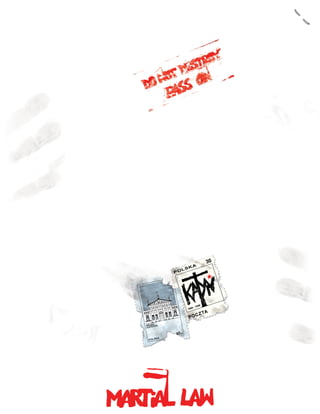
While under Communist
leadership, nearly every aspect
of life in Poland was closely
monitored by the government.
The Main Office for the Control
of the Press, Publications,
and Public Performances
(GUKPIW) maintained control
not only on the content of
published materials, but access
to photocopiers, printing
machines, and other printing
supplies, such as paper and
ink. This strict oversight
forced those members of Polish
society fighting against
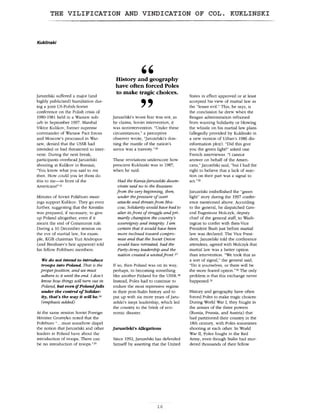
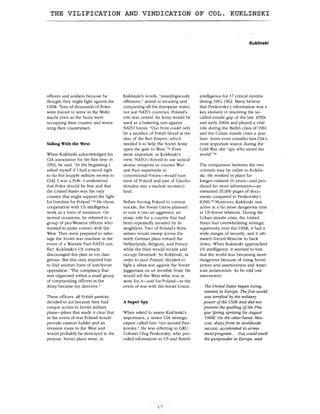
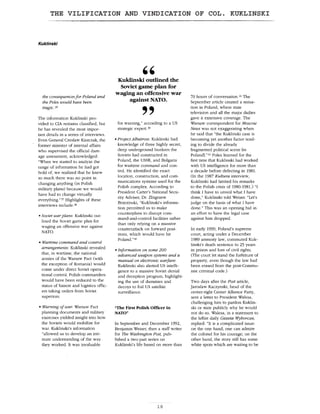
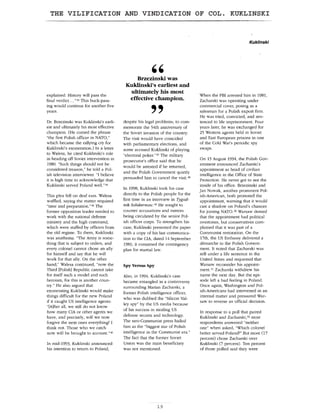
Communist rule to turn to more
creative ways to get their
message across.
Just as their parents
and grandparents had done for
decades, the members of the
The graphic design and layout of this booklet was inspired
by, and is reminiscent of, the style used by the Polish
underground press.
workers’ rights and human rights’ groups throughout Poland turned to
the underground press to keep their movement alive. These publications,
printed illegally, both domestically and abroad, kept the public
apprised of upcoming strikes and other news relating to democratic
movement, as well as the names and addresses of those to whom political
prisoners could turn for help. In addition, the underground press in
Poland served as a venue for the free-flow of ideas, otherwise snuffed
out at the hands of government censors.
SPONSORS
The National Clandestine Service (NCS) operates as the clandestine arm of
the CIA, and serves as the national authority for the coordination, deconfliction,
and evaluation of clandestine human intelligence operations across the Intelligence
Community. The NCS supports our country's security and foreign policy interests by
conducting clandestine activities to collect information that is not obtainable
through other means. The NCS also conducts counterintelligence and special
activities as authorized by the President.
The Historical Collections Division (HCD) of the Office of Information
Management Services is responsible for executing the CIA’s Historical Review
Program. This program seeks to identify, collect, and review for possible release to
the public significant historical information. The mission of HCD is to:
Provide an accurate, objective understanding of the information and
intelligence that has helped shape the foundation of major US policy
decisions.
Improve access to lessons learned, presenting historical material to
emphasize the scope and context of past actions.
Improve current decision-making and analysis by facilitating reflection on
the impacts and effects arising from past decisions.
Uphold Agency leadership commitments to openness, while protecting the
national security interests of the US.
Provide the American public with valuable insight into the workings of
their Government.
The History Staff in the CIA Center for the Study of Intelligence fosters
understanding of the Agency's history and its relationship to today's intelligence
challenges by communicating instructive historical insights to the CIA workforce,
other US Government agencies, and the public. CIA historians research topics on all
aspects of Agency activities and disseminate their knowledge through publications,
courses, briefings, and Web-based products. They also work with other Intelligence
Community historians on publication and education projects that highlight
interagency approaches to intelligence issues. Lastly, the CIA History Staff
conducts an ambitious program of oral history interviews that are invaluable for
preserving institutional memories that are not captured in the documentary record.
•
•
•
•
•
TABLE OF CONTENTS
Overview ............................................ 1
Timeline ............................................ 3
The Vilification and Vindication of
Colonel Kuklinski by Benjamin B. Fischer ........... 11
Texas A&M University Memorial Ceremony ............. 27
Statement on the Death of Col. Kuklinski ........... 33
OVERVIEW

Documents Provided By Col. Ryszard Kuklinski Regarding
Planning for and Implementation of Martial Law in Poland on
13 December 1981
Between July 1980 and December 13, 1981, Poland stumbled
through the most serious political crisis faced by a Warsaw Pact
member since the Prague Spring in Czechoslovakia in 1968. The
resolution of this crisis through the declaration of martial law by
the Polish authorities provided only a temporary respite. The rise and
suppression of the trade union Solidarity, followed by the inability
of Polish communist authorities to restore political credibility or
economic activity, were key developments that created the conditions
that led to the eventual collapse of the Warsaw Pact by the end of the
decade.
On one side was a Polish society deeply disenchanted with its
political system and the mismanagement of its economy that resulted
in increased deprivation in the late 1970’s. Initial strikes in
July and August 1980 protesting relatively mild increases in meat
prices escalated as workers vowed not to accept near-term promises
by the authorities. For the first time in post-war Poland, workers
were joined by intellectuals bent on changing the broader political
system. The meteoric and chaotic rise of Solidarity resulted in a mass
movement with increasing determination to pursue fundamental change.
Facing this unprecedented development was a communist party
apparatus with limited support, even from its members, and one that
was lulled into lethargy by the vain hope of restoring calm with the
time-tested tactic of buying off the opposition. Senior political
and military authorities were averse to using force in the early
months because of the memories of the deaths of shipyard workers
during the uprisings in the Gdansk shipyards in December 1970. As
events spiraled out of control during the 18 months of the crisis,
powers that be engaged in lengthy discussions of whether, when, and
how Polish authorities could impose order through martial law. This
discussion was strongly influenced by the hard line taken by Soviet
political and military leaders who continually and arrogantly pushed
Polish authorities to immediately resort to force. Soviet officials
not so subtly tried to intimidate Polish authorities by implying that
they would use both their own forces in addition to other Warsaw Pact
forces to restore order (if necessary).
OVERVIEW

Partly out of consideration for self preservation and partly
as a result of intense Soviet pressure, Polish authorities slowly
and sometimes grudgingly proceeded with operational planning to
introduce martial law. These plans, including all the required legal
documentation, were essentially completed by the fall of 1981.
In 1972, Ryszard Kuklinski, a senior officer on the Polish
General Staff, volunteered his services to the United States at a time
of increased friction between the Soviet Bloc and the Free World (see
the book A Secret Life by Benjamin Weiser). Over the coming years,
Kuklinski provided the CIA with thousands of pieces of key information
regarding the Warsaw Pact. During the Polish crisis he continued to
provide such information and also provided information and commentary
regarding internal Polish developments and Soviet pressures. Located on
the DVD are the declassified documents. A description of the documents
follow:
1 document from 1977 outlining governmental tasks in the
event of a threat to national security
18 documents in which Kuklinski reports information and
impressions gained from his close contacts on the Polish
General Staff and from contact with Soviet officers
42 reports which relay various official documents to which
Kuklinski had access, including many of the planning
documents
16 reports based on Kuklinski’s information and thoughts
disseminated after the declaration of martial law
2 assessments provided by the CIA’s Directorate of
Intelligence on the status of preparations for martial law
1 report, prepared by Kuklinski in the United States in
1983, in which he provides his thoughts regarding General
Jaruzelski
•
•
•
•
•
•
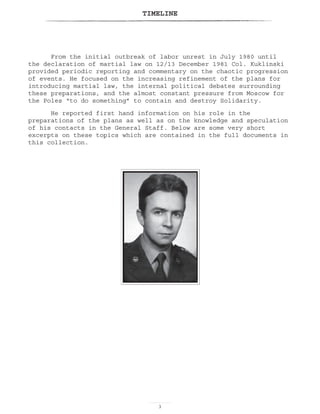
TIMELINE

From the initial outbreak of labor unrest in July 1980 until
the declaration of martial law on 12/13 December 1981 Col. Kuklinski
provided periodic reporting and commentary on the chaotic progression
of events. He focused on the increasing refinement of the plans for
introducing martial law, the internal political debates surrounding
these preparations, and the almost constant pressure from Moscow for
the Poles “to do something” to contain and destroy Solidarity.
He reported first hand information on his role in the
preparations of the plans as well as on the knowledge and speculation
of his contacts in the General Staff. Below are some very short
excerpts on these topics which are contained in the full documents in
this collection.
TIMELINE
AUGUST
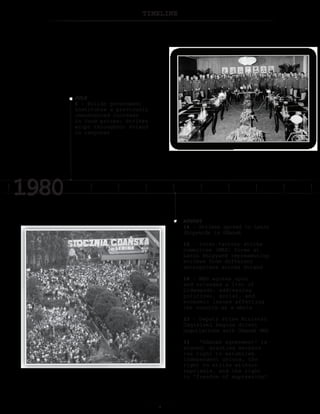
14 – Strikes spread to Lenin
Shipyards in Gdansk
16 – Inter-factory strike
committee (MKS) forms at
Lenin Shipyard representing
strikes from different
enterprises across Poland
18 – MKS agrees upon
and releases a list of
21demands, addressing
political, social, and
economic issues affecting
the country as a whole
23 – Deputy Prime Minister
Jagielski begins direct
negotiations with Gdansk MKS
31 – “Gdansk agreement” is
signed, granting workers
the right to establish
independent unions, the
right to strike without
reprisals, and the right
to “freedom of expression”
JULY
6 – Polish government
institutes a previously
unannounced increase
in food prices; Strikes
erupt throughout Poland
in response
TIMELINE
OCTOBER
30 – First Secretary
Kania and Polish Prime
Minister Josef Pinkowski
make an “emergency” trip
to Moscow to meet with
Soviet leadership
SEPTEMBER
6 - Stanislaw Kania named First
Secretary of the Polish United
Workers Party
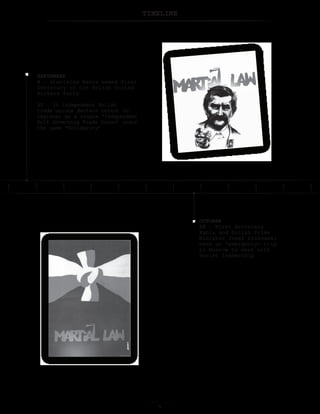
17 – 35 independent Polish
trade unions declare intent to
register as a single “Independent
Self-Governing Trade Union” under
the name “Solidarity”
TIMELINE
FEBRUARY
9 – Wojciech Jaruzelski appointed Prime
Minister of Poland
11 – “Along with the envisioned changes in
the Government, headed by the appointment
of Jaruzelski as Prime Minister…there were
hurried preparations being carried out to
consider the introduction of Martial Law.
24 - ... In January during a confidential
meeting with Brezhnev, Kania was given the
ultimate warning — to eliminate the threat of
counterrevolution in Poland ... the majority
of the junior officer cadre and the troops
in the Polish military sided with the spirit
of the Solidarnosc movement ... the senior
officer cadre was divided ..., Jaruzelski
convinced the Soviets that the Polish problems
can be peacefully resolved.
30 - ... the probability of Soviet
intervention at this time is considered less
than at the beginning of December 1980....
The decisive factor here is the unified,
unequivocal and hard line position of the
West as well as the defensive and determined
preparation for such an eventuality on the
part of the Polish population.”
JANUARY
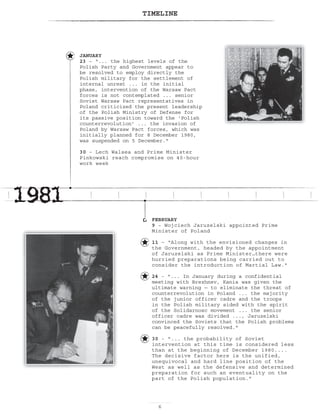
23 – “... the highest levels of the
Polish Party and Government appear to
be resolved to employ directly the
Polish military for the settlement of
internal unrest ... in the initial
phase, intervention of the Warsaw Pact
forces is not contemplated ... senior
Soviet Warsaw Pact representatives in
Poland criticized the present leadership
of the Polish Ministry of Defense for
its passive position toward the 'Polish
counterrevolution' ... the invasion of
Poland by Warsaw Pact forces, which was
initially planned for 8 December 1980,
was suspended on 5 December.
30 – Lech Walsea and Prime Minister
Pinkowski reach compromise on 40-hour
work week
TIMELINE
APRIL
2 – “... Polish documents dealing with the
introduction of the state of Martial Law were
translated into Russian by the Polish Ministry
of Internal Affairs, and Premier Jaruzelski
was to have presented these documents in
his meeting with Brezhnev ... on 28 March,
with the agreement of Kania and Jaruzelski,
approximately 30 leading functionaries of
the KGB, the Soviet Ministry of Defense
and GOSPLAN arrived in Warsaw to act as
consultants on Martial Law.
29 – ... on 11 April Jaruzelski visited the
Polish General Staff to become personally
acquainted with the draft plans in case it
was necessary to introduce Martial Law, which
he was then to present to Marshal Kalikow at
the 13 April meeting. Jaruzelski was depressed
by the content of the documentation on Martial
Law and stated that he was not familiar
with the documentation on which the Polish
General Staff had been working for several
months, but that he felt that he finally had
to familiarize himself with their content.
Jaruzelski stated that in the darkest recesses
of his mind he could find no place for the
thought that they could introduce such a
thing as Martial Law in Poland ... he did
not wish to be Prime Minister when it became
necessary to sign the documentation for the
implementation of Martial Law.
MARCH
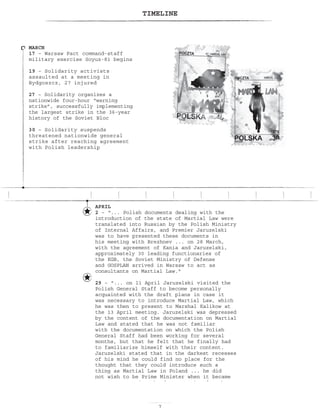
17 – Warsaw Pact command-staff
military exercise Soyuz-81 begins
19 – Solidarity activists
assaulted at a meeting in
Bydgoszcz, 27 injured
27 – Solidarity organizes a
nationwide four-hour “warning
strike”, successfully implementing
the largest strike in the 36-year
history of the Soviet Bloc
30 – Solidarity suspends
threatened nationwide general
strike after reaching agreement
with Polish leadership
TIMELINE
JULY
14—20 – Polish communists hold emergency party
congress; Centrists prevail
17 – ... Jaruzelski's position on Martial Law
... is also influenced by his own origins and
personality traits. Jaruzelski was stunned by
the scale of violence, abuses and moral decay
of the Party and Government, which has led to an
economic collapse.... (But) Jaruzelski currently
says: 'We are not the only ones responsible
for the events of the last ten months.' Even
more importantly is Jaruzelski's and his
closest associates' conviction that the present
postulates of Solidarnosc ... lead directly
to the dismantling of Government structures,
which in turn would open the way for taking
the authority out of the hands of the Polish
United Workers' Party Against this background,
there has been a significant stiffening of
Jaruzelski's attitude and his readiness to
implement Martial Law.
JUNE
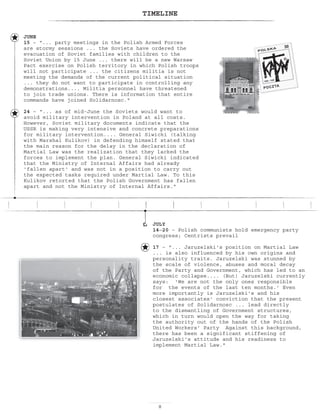
15 – “... party meetings in the Polish Armed Forces
are stormy sessions ... the Soviets have ordered the
evacuation of Soviet families with children to the
Soviet Union by 15 June ... there will be a new Warsaw
Pact exercise on Polish territory in which Polish troops
will not participate ... the citizens militia is not
meeting the demands of the current political situation
... they do not want to participate in controlling any
demonstrations.... Militia personnel have threatened
to join trade unions. There is information that entire
commands have joined Solidarnosc.
24 – “... as of mid-June the Soviets would want to
avoid military intervention in Poland at all costs.
However, Soviet military documents indicate that the
USSR is making very intensive and concrete preparations
for military intervention.... General Siwicki (talking
with Marshal Kulikov) in defending himself stated that
the main reason for the delay in the declaration of
Martial Law was the realization that they lacked the
forces to implement the plan. General Siwicki indicated
that the Ministry of Internal Affairs had already
'fallen apart' and was not in a position to carry out
the expected tasks required under Martial Law. To this
Kulikov retorted that the Polish Government has fallen
apart and not the Ministry of Internal Affairs.
TIMELINE
SEPTEMBER
5 – Solidarity holds its first National Congress; calls for other Soviet
Bloc nations to form independent trade unions
9 - There has been an additional hardening in Jaruzelski's position
toward Solidarnosc ... everything points to the fact that in the event
of a more serious conflict, Jaruzelski will no longer be concerned
regarding the declaration of Martial Law.... Marshal Kukikov has put
increasing pressure on Jaruzelski to introduce Soviet military advisors
in the Polish Armed Forces down to the military district level ... the
Soviets consider that the re-election of Kania to the position of First
Secretary of the Polish United Workers' Party was a great disaster.
11 – “On 9 September, General of Arms Florian Siwicki, after
consultation with Jarzuelski, informed a select group of the Polish
General Staff that Poland was approaching the institution of the state
of Martial Law. Source indicated that this could happen as early as
next week.... If the implementation of Martial law is unsuccessful,
the question raised in the Polish General Staff was whether they would
receive help ...
18 – ... Kania will not listen to any solutions which would require
the use of force.... Jaruzelski, possibly under the influence of the
Soviets and conservatives of the Polish Party and Government, has
changed his position and currently favors a more decisive solution
to the problem. So far, he is not openly opposing Kania; however, the
change in his position is apparent.... Minister of Internal Affairs
Kiszczak is pressing for an immediate and surprise declaration of
Martial Law.... The Ministry of Internal Affairs has infiltrated the
leadership elements of Solidarnosc and has a good grasp of what their
plans are.
AUGUST
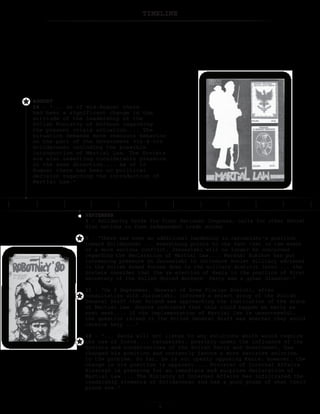
14 – ... as of mid-August there
had been a significant change in the
attitude of the leadership of the
Polish Ministry of Defense regarding
the present crisis situation.... The
situation demands more resolute behavior
on the part of the Government vis-à-vis
Solidarnosc including the possible
introduction of Martial Law. The Soviets
are also asserting considerable pressure
in the same direction.... As of 12
August there has been no political
decision regarding the introduction of
Martial Law.
10
TIMELINE
DECEMBER
12 – Communications between
Poland and Western Europe
and the United States are
cut, and the Polish border is
closed
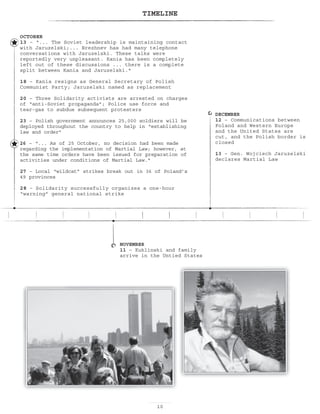
13 – Gen. Wojciech Jaruzelski
declares Martial Law
NOVEMBER
11 – Kuklinski and family
arrive in the Untied States
OCTOBER
13 – “... The Soviet leadership is maintaining contact
with Jaruzelski;... Brezhnev has had many telephone
conversations with Jaruzelski. These talks were
reportedly very unpleasant. Kania has been completely
left out of these discussions ... there is a complete
split between Kania and Jaruzelski.
18 – Kania resigns as General Secretary of Polish
Communist Party; Jaruzelski named as replacement
20 – Three Solidarity activists are arrested on charges
of “anti-Soviet propaganda”; Police use force and
tear-gas to subdue subsequent protesters
23 – Polish government announces 25,000 soldiers will be
deployed throughout the country to help in “establishing
law and order”
26 – “... As of 25 October, no decision had been made
regarding the implementation of Martial Law; however, at
the same time orders have been issued for preparation of
activities under conditions of Martial Law.
27 – Local “wildcat” strikes break out in 36 of Poland’s
49 provinces
28 – Solidarity successfully organizes a one-hour
“warning” general national strike
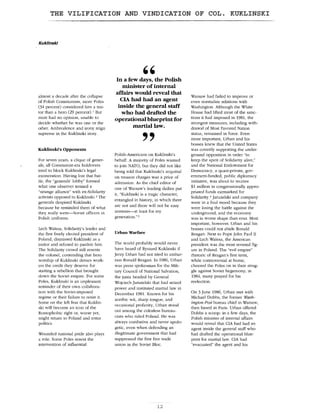
The Vilification and Vindication of Col. Kuklinski
11
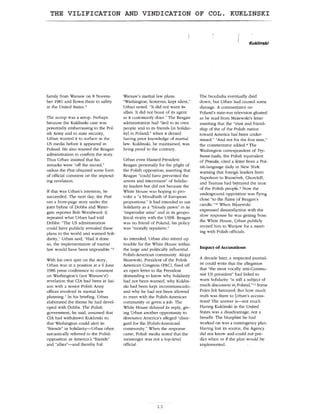
The Vilification and Vindication of Col. Kuklinski
12
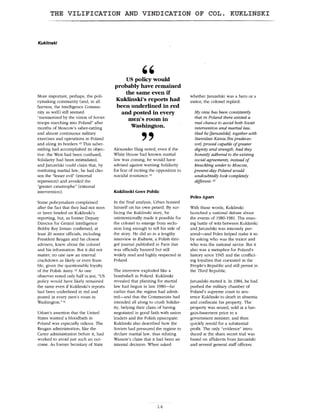
The Vilification and Vindication of Col. Kuklinski
13
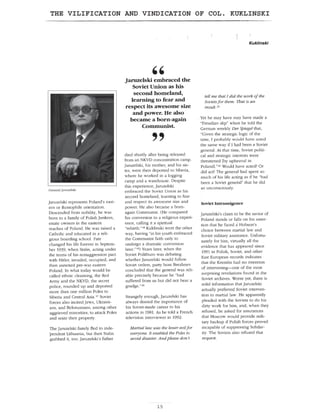
The Vilification and Vindication of Col. Kuklinski
14
The Vilification and Vindication of Col. Kuklinski
15
The Vilification and Vindication of Col. Kuklinski
16
The Vilification and Vindication of Col. Kuklinski
17
The Vilification and Vindication of Col. Kuklinski
18
The Vilification and Vindication of Col. Kuklinski
19
The Vilification and Vindication of Col. Kuklinski
20
The Vilification and Vindication of Col. Kuklinski
21
The Vilification and Vindication of Col. Kuklinski
22
The Vilification and Vindication of Col. Kuklinski
23
The Vilification and Vindication of Col. Kuklinski
24
The Vilification and Vindication of Col. Kuklinski
25
26
TEXAS AM UNIVERSITY MEMORIAL CEREMONY
27
TRANSCRIPT
US INTELLIGENCE AND THE END OF THE COLD WAR
TEXAS AM UNIVERSITY
MEMORIAL CEREMONY
SATURDAY, 20 NOVEMBER 1999
SPEAKERS: Program narrator, Chaplain of Texas AM Corps of Cadets Jeremiah
Ebeling, Colonel Richard Kuklinski, Director of Central Intelligence George Tenet,
former President George Bush.
CHAPLAIN: Bow your heads with me please.
Dear heavenly Father, you are an awesome guide. We humbly come before you this
afternoon in gratitude for your eternal presence and loving concern for our lives. We give
you praise for your beautiful creation, and we acknowledge that everything that is comes
from you.
We are thankful to live in a country where we may freely worship your name and live full
lives that are holy and pleasing in your sight.
Today we honor the men and women who have boldly fought to give us this freedom. We
thank you for their courage and the hope that they ignite in us through their fearless
service to the country.
Father, we pray that you would lift them up today and let their lives be a testimony of
your powerful hand and that, like your son Jesus Christ, sacrifice their lives to bring you
honor and glory.
These things we ask with the hope and faith that comes from knowing you.
In your precious and holy name, amen.
NARRATOR: Ladies and gentlemen, the Director of Central Intelligence, Mr. George
Tenet.
GEORGE TENET: Good afternoon.
We come to this memorial service with fresh grief in our hearts for the young lives lost in
a sudden and terrible accident. This week was supposed to be one of joyous anticipation
here at Texas AM. Instead it has ended in tragedy.
TEXAS AM UNIVERSITY MEMORIAL CEREMONY
28
It is truly heartrending when lives, so full of promise, are cut short before their time. We
can only pray that the families and friends of those who died will derive some comfort in
the way the people of College Station have come together as one extended family to
embrace them in their sorrow.
I would ask that we all bow our heads in a moment of silent prayer for those students and
their families.
Thank you.
We in the intelligence community know what it is like to lose a member of our extended
family. On all too many occasions we, too, have come together in grief. Our work, by its
very nature, entails great risks - risks that our people willingly accept for the sake of our
country. But accepting the risks does not ease our sadness at the loss of colleagues and
friends or soften the pain of their loved ones. So it is especially fitting that we bring this
conference to a close by turning our thoughts to the brave men and women who perished
in the silent intelligence struggle that helped keep the Cold War from becoming hot -
those who risked and lost their lives in order to obtain the precious information upon
which so many critical national security decisions were made.
These gallant patriots made the ultimate sacrifice knowingly, selflessly and anonymously
to defend and secure the freedoms that we and people everywhere hold dear.
In the headquarters lobby of the Central Intelligence Agency there is a granite wall
carved with rows of stars. Each star in that silent constellation represents an American
intelligence officer killed in the line of duty since the Agency was established in the early
years of the Cold War. Even to this day many of the names and stories behind the stars
cannot be told. Those silent stars speak powerfully of service and sacrifice, of patriotism
and purpose, of our intelligence mission and its meaning - not just to Americans, but to
people throughout the world who serve the cause of peace and freedom.
Of course, we know that there are far more casualties than there are stars on our wall at
the Central Intelligence Agency. Throughout our intelligence and national security
communities there are other memorials honoring the American civilians and military
personnel who fell to secure our freedoms. And we honor as well the many valiant men
and women who fell in service to our allies as they stood with us in defense of the Free
World.
As we pay homage to all those heroes, we think also of their loved ones. For each of the
fallen was someone's beloved parent, husband, wife, brother, sister or child. Someone
who left a grieving family behind - a family who in their deep sorrow often bore the
burden of silence as well.
There is another group of Cold War heroes to whom we all owe an everlasting debt of
gratitude. They are the extraordinary men and women from behind the Iron Curtain who
helped us. They are the patriots from across Central and Eastern Europe and the Soviet
TEXAS AM UNIVERSITY MEMORIAL CEREMONY
29
Union who passionately wanted the yoke of oppression to be lifted from their homelands.
They wanted their children to live in a world of possibility where hope was not a waste of
time.
In yearning for these things they were like most of their countrymen -- ordinary people
who dearly loved their families and their native lands and who wanted to see a better
future for them. But these courageous men and women were extraordinary because they
chose to act. They chose to work for the West. Their honor and their convictions gave
them the fortitude to follow their conscience down a very lonely path into mortal danger.
One of these extraordinary heroes spoke for all of them when he wrote, and I quote, I
consider that my place during these troubled times is on the front line. I must remain on
this front line in order to be your eyes and ears. God grant only that my modest efforts be
useful in the fight for our high ideals for mankind. Please believe that your soldier shall
take a worthy position among his comrades who fight for justice.
Those words were written by Colonel Oleg Penkovsky, a highly placed Soviet
intelligence officer. He was President Kennedy's most secure source during the Berlin
crisis of 1961 and 1962 and also during the Cuban missile crisis. The intelligence
Penkovsky provided, together with the imagery from our U-2 overflights, gave President
Kennedy the confidence he needed to go eyeball-to-eyeball with Nikita Khrushchev and
make him blink.
The fallen patriots whose memories we honor today - American, allied, and those from
the oppressed nations living in the shadow of the Wall - gave their lives in the sacred
cause of liberty and peace, not in some cynical exercise in moral equivalency. This was
not a game of spy versus spy. It was a deadly contest between Freedom and Tyranny.
These noble men and women worked silently and at grave risk for the day when the
Berlin Wall would fall and totalitarian despotism would give way to democratic
freedoms. Tragically, they did not live to see that joyous day dawn, but they sleep in
God's peace, secure in the knowledge that their bravery advanced its dawning.
That is their legacy to us and to the generations that follow us. May we, who have the
power to live and act, be worthy of their sacrifice.
We are especially honored today to have with us a true hero of the Cold War. A man who
risked great danger to work for us, and who by the grace of God survived. It is in great
measure due to the bravery and sacrifice of patriots like Colonel Ryszard Kuklinski that
his own native Poland, and the other once captive nations of Central and Eastern Europe
and the former Soviet Union, are now free.
It is my honor to introduce him to you now. Colonel Kuklinski, will you please come
forward?
TEXAS AM UNIVERSITY MEMORIAL CEREMONY
30
COLONEL KUKLINSKI: As one of many soldiers who served on the front line
during those troubled times, I am deeply honored to represent my many anonymous
comrades who served on both sides of the front line.
I am pleased that our long, hard struggle has brought peace, freedom and
democracy not only to my country but to many other people as well.
NARRATOR: Ladies and gentlemen, President George Bush.
PRESIDENT BUSH: Thank you all very much. I'm very proud to be participating in this
solemn and wonderful ceremony. And let me just identify on Barbara's behalf, my behalf,
on behalf of the entire Bush family with the remarks made by the Director about the
Aggie family.
And to Colonel Kuklinski, let me simply say Barbara and I are just back from a free
Poland. And I wish everybody here on this marvelous campus and all the guests from
outside could just feel what has taken place in Poland thanks to the courage of so many
people. Certainly Colonel Kuklinski and so many, many others. It is a wonderful thing,
and we must never underestimate the power of freedom.
I want to salute our DCI, George Tenet, who's doing a superb job heading our
intelligence community. I’d also like to thank my former DCI compatriots for being with
us here today. And all of you.
This is really a day that's long overdue. A chance when the CIA finally has a chance to
express its open gratitude to the Americans and non-citizens alike who gave their lives in
the clandestine service to the cause of freedom.
We spent this week reflecting upon the role of intelligence in the Cold War -- the most
protracted and dangerous conflict of the 20th Century. This conference has been based on
large measure on what secret analyses in the national intelligence estimates and other
documents generated by the intelligence community for me and my senior advisors,
including the President's Daily Brief that I received most of the 1460 days that I served as
Commander-in-Chief. And I can assure you that our team fully appreciated the value of
the final CIA product that we received.
We understood the hours of hard work, hardship, and indeed danger that went into every
word on every page. We never lost sight of the fact that this intelligence was made secret
because of the sources and methods used by the Directors of Central Intelligence and our
intelligence community to collect the most tightly-held secrets of our adversaries. We
never forgot that those secret sources were the brave men and women of our armed forces
and civilian agencies, our equally brave allies, and finally, the most daring of all, the
agents who worked behind the Iron Curtain to give us those last critical pieces of the
puzzle used in ending the Cold War.
TEXAS AM UNIVERSITY MEMORIAL CEREMONY
3131
TEXAS AM UNIVERSITY MEMORIAL CEREMONY
It was almost 2500 years ago that the Chinese military theorist Sun Tsu stressed the
importance of intelligence in his book called The Art of War. In that same book he also
noted that to win 100 battles is not the acme of skill. To subdue the enemy without
fighting is the acme of skill.
We thank God that that Cold War was won without a shot being fired between the
superpowers. We thank God that a nuclear holocaust was averted. We also take heart that
the hopes and dreams of those Germans standing at the Wall ten years ago this month or
the men and women peacefully marching through the streets of Prague, or demonstrating
their courage in Warsaw, Gdansk and Krakow that those were realized. And that such
was to be, is thanks in no small way to the selfless service and sacrifice of every single
person in the intelligence community.
Today the superpower conflict is behind us, but the need for first-rate intelligence has not
diminished. I believe our country has a moral obligation to continue building on the hard
work and the vigilant dedication of those who gave us this safer, freer world.
Being here today I can't help but call to mind the poet's words, To save your world you
asked this man to die. Would this man, could he see you now, ask why?
No, the mission is not finished. For as long as freedom is imperiled anywhere, our duty is
not complete, so this dangerous hard work must go on. And as someone who was
privileged to serve as DCI, I was proud to stand with those heroic, indispensable, often
anonymous, men and women who gave the full measure of devotion to duty.
It's an honor to stand here and honor those who gave their lives that we might be free.
Thank you very, very much.
32
TEXAS AM UNIVERSITY MEMORIAL CEREMONY
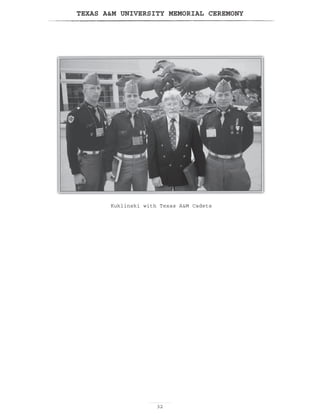
Kuklinski with Texas AM Cadets
STATEMENT ON THE DEATH OF COL. KUKLINSKI
33
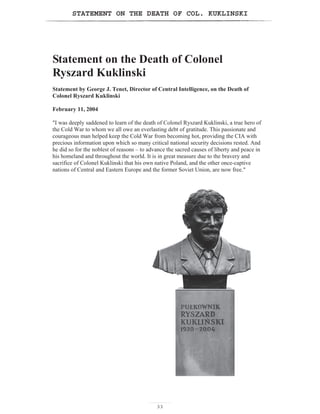
Statement on the Death of Colonel
Ryszard Kuklinski
Statement by George J. Tenet, Director of Central Intelligence, on the Death of
Colonel Ryszard Kuklinski
February 11, 2004
I was deeply saddened to learn of the death of Colonel Ryszard Kuklinski, a true hero of
the Cold War to whom we all owe an everlasting debt of gratitude. This passionate and
courageous man helped keep the Cold War from becoming hot, providing the CIA with
precious information upon which so many critical national security decisions rested. And
he did so for the noblest of reasons – to advance the sacred causes of liberty and peace in
his homeland and throughout the world. It is in great measure due to the bravery and
sacrifice of Colonel Kuklinski that his own native Poland, and the other once-captive
nations of Central and Eastern Europe and the former Soviet Union, are now free.
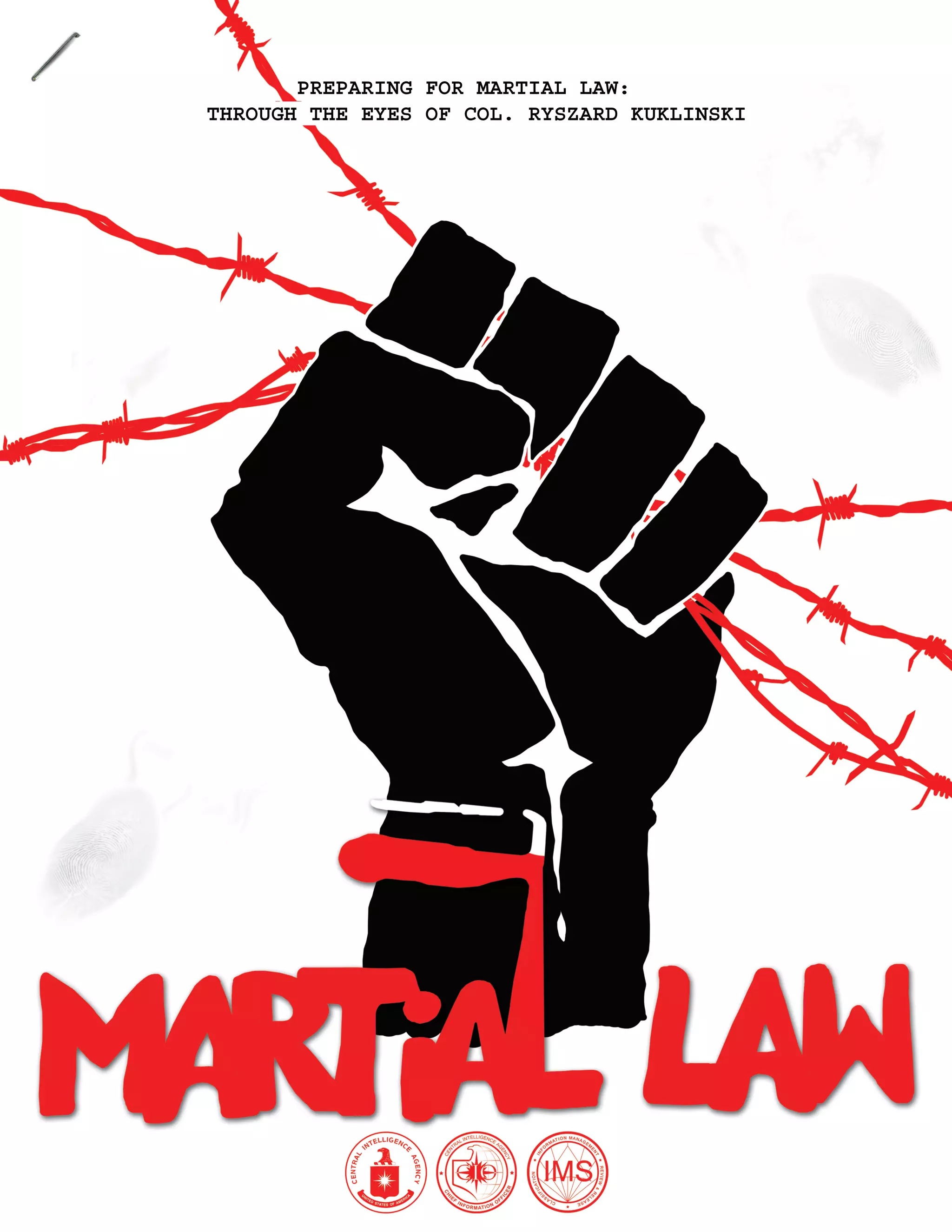
Martial law
Martial law

Martial law

  • 2.
    While under Communist leadership,nearly every aspect of life in Poland was closely monitored by the government. The Main Office for the Control of the Press, Publications, and Public Performances (GUKPIW) maintained control not only on the content of published materials, but access to photocopiers, printing machines, and other printing supplies, such as paper and ink. This strict oversight forced those members of Polish society fighting against Communist rule to turn to more creative ways to get their message across. Just as their parents and grandparents had done for decades, the members of the The graphic design and layout of this booklet was inspired by, and is reminiscent of, the style used by the Polish underground press. workers’ rights and human rights’ groups throughout Poland turned to the underground press to keep their movement alive. These publications, printed illegally, both domestically and abroad, kept the public apprised of upcoming strikes and other news relating to democratic movement, as well as the names and addresses of those to whom political prisoners could turn for help. In addition, the underground press in Poland served as a venue for the free-flow of ideas, otherwise snuffed out at the hands of government censors.
  • 4.
    SPONSORS The National ClandestineService (NCS) operates as the clandestine arm of the CIA, and serves as the national authority for the coordination, deconfliction, and evaluation of clandestine human intelligence operations across the Intelligence Community. The NCS supports our country's security and foreign policy interests by conducting clandestine activities to collect information that is not obtainable through other means. The NCS also conducts counterintelligence and special activities as authorized by the President. The Historical Collections Division (HCD) of the Office of Information Management Services is responsible for executing the CIA’s Historical Review Program. This program seeks to identify, collect, and review for possible release to the public significant historical information. The mission of HCD is to: Provide an accurate, objective understanding of the information and intelligence that has helped shape the foundation of major US policy decisions. Improve access to lessons learned, presenting historical material to emphasize the scope and context of past actions. Improve current decision-making and analysis by facilitating reflection on the impacts and effects arising from past decisions. Uphold Agency leadership commitments to openness, while protecting the national security interests of the US. Provide the American public with valuable insight into the workings of their Government. The History Staff in the CIA Center for the Study of Intelligence fosters understanding of the Agency's history and its relationship to today's intelligence challenges by communicating instructive historical insights to the CIA workforce, other US Government agencies, and the public. CIA historians research topics on all aspects of Agency activities and disseminate their knowledge through publications, courses, briefings, and Web-based products. They also work with other Intelligence Community historians on publication and education projects that highlight interagency approaches to intelligence issues. Lastly, the CIA History Staff conducts an ambitious program of oral history interviews that are invaluable for preserving institutional memories that are not captured in the documentary record. • • • • •
  • 5.
    TABLE OF CONTENTS Overview............................................ 1 Timeline ............................................ 3 The Vilification and Vindication of Colonel Kuklinski by Benjamin B. Fischer ........... 11 Texas A&M University Memorial Ceremony ............. 27 Statement on the Death of Col. Kuklinski ........... 33
  • 6.
    OVERVIEW Documents Provided ByCol. Ryszard Kuklinski Regarding Planning for and Implementation of Martial Law in Poland on 13 December 1981 Between July 1980 and December 13, 1981, Poland stumbled through the most serious political crisis faced by a Warsaw Pact member since the Prague Spring in Czechoslovakia in 1968. The resolution of this crisis through the declaration of martial law by the Polish authorities provided only a temporary respite. The rise and suppression of the trade union Solidarity, followed by the inability of Polish communist authorities to restore political credibility or economic activity, were key developments that created the conditions that led to the eventual collapse of the Warsaw Pact by the end of the decade. On one side was a Polish society deeply disenchanted with its political system and the mismanagement of its economy that resulted in increased deprivation in the late 1970’s. Initial strikes in July and August 1980 protesting relatively mild increases in meat prices escalated as workers vowed not to accept near-term promises by the authorities. For the first time in post-war Poland, workers were joined by intellectuals bent on changing the broader political system. The meteoric and chaotic rise of Solidarity resulted in a mass movement with increasing determination to pursue fundamental change. Facing this unprecedented development was a communist party apparatus with limited support, even from its members, and one that was lulled into lethargy by the vain hope of restoring calm with the time-tested tactic of buying off the opposition. Senior political and military authorities were averse to using force in the early months because of the memories of the deaths of shipyard workers during the uprisings in the Gdansk shipyards in December 1970. As events spiraled out of control during the 18 months of the crisis, powers that be engaged in lengthy discussions of whether, when, and how Polish authorities could impose order through martial law. This discussion was strongly influenced by the hard line taken by Soviet political and military leaders who continually and arrogantly pushed Polish authorities to immediately resort to force. Soviet officials not so subtly tried to intimidate Polish authorities by implying that they would use both their own forces in addition to other Warsaw Pact forces to restore order (if necessary).
  • 7.
    OVERVIEW Partly out ofconsideration for self preservation and partly as a result of intense Soviet pressure, Polish authorities slowly and sometimes grudgingly proceeded with operational planning to introduce martial law. These plans, including all the required legal documentation, were essentially completed by the fall of 1981. In 1972, Ryszard Kuklinski, a senior officer on the Polish General Staff, volunteered his services to the United States at a time of increased friction between the Soviet Bloc and the Free World (see the book A Secret Life by Benjamin Weiser). Over the coming years, Kuklinski provided the CIA with thousands of pieces of key information regarding the Warsaw Pact. During the Polish crisis he continued to provide such information and also provided information and commentary regarding internal Polish developments and Soviet pressures. Located on the DVD are the declassified documents. A description of the documents follow: 1 document from 1977 outlining governmental tasks in the event of a threat to national security 18 documents in which Kuklinski reports information and impressions gained from his close contacts on the Polish General Staff and from contact with Soviet officers 42 reports which relay various official documents to which Kuklinski had access, including many of the planning documents 16 reports based on Kuklinski’s information and thoughts disseminated after the declaration of martial law 2 assessments provided by the CIA’s Directorate of Intelligence on the status of preparations for martial law 1 report, prepared by Kuklinski in the United States in 1983, in which he provides his thoughts regarding General Jaruzelski • • • • • •
  • 8.
    TIMELINE From the initialoutbreak of labor unrest in July 1980 until the declaration of martial law on 12/13 December 1981 Col. Kuklinski provided periodic reporting and commentary on the chaotic progression of events. He focused on the increasing refinement of the plans for introducing martial law, the internal political debates surrounding these preparations, and the almost constant pressure from Moscow for the Poles “to do something” to contain and destroy Solidarity. He reported first hand information on his role in the preparations of the plans as well as on the knowledge and speculation of his contacts in the General Staff. Below are some very short excerpts on these topics which are contained in the full documents in this collection.
  • 9.
    TIMELINE AUGUST 14 – Strikesspread to Lenin Shipyards in Gdansk 16 – Inter-factory strike committee (MKS) forms at Lenin Shipyard representing strikes from different enterprises across Poland 18 – MKS agrees upon and releases a list of 21demands, addressing political, social, and economic issues affecting the country as a whole 23 – Deputy Prime Minister Jagielski begins direct negotiations with Gdansk MKS 31 – “Gdansk agreement” is signed, granting workers the right to establish independent unions, the right to strike without reprisals, and the right to “freedom of expression” JULY 6 – Polish government institutes a previously unannounced increase in food prices; Strikes erupt throughout Poland in response
  • 10.
    TIMELINE OCTOBER 30 – FirstSecretary Kania and Polish Prime Minister Josef Pinkowski make an “emergency” trip to Moscow to meet with Soviet leadership SEPTEMBER 6 - Stanislaw Kania named First Secretary of the Polish United Workers Party 17 – 35 independent Polish trade unions declare intent to register as a single “Independent Self-Governing Trade Union” under the name “Solidarity”
  • 11.
    TIMELINE FEBRUARY 9 – WojciechJaruzelski appointed Prime Minister of Poland 11 – “Along with the envisioned changes in the Government, headed by the appointment of Jaruzelski as Prime Minister…there were hurried preparations being carried out to consider the introduction of Martial Law. 24 - ... In January during a confidential meeting with Brezhnev, Kania was given the ultimate warning — to eliminate the threat of counterrevolution in Poland ... the majority of the junior officer cadre and the troops in the Polish military sided with the spirit of the Solidarnosc movement ... the senior officer cadre was divided ..., Jaruzelski convinced the Soviets that the Polish problems can be peacefully resolved. 30 - ... the probability of Soviet intervention at this time is considered less than at the beginning of December 1980.... The decisive factor here is the unified, unequivocal and hard line position of the West as well as the defensive and determined preparation for such an eventuality on the part of the Polish population.” JANUARY 23 – “... the highest levels of the Polish Party and Government appear to be resolved to employ directly the Polish military for the settlement of internal unrest ... in the initial phase, intervention of the Warsaw Pact forces is not contemplated ... senior Soviet Warsaw Pact representatives in Poland criticized the present leadership of the Polish Ministry of Defense for its passive position toward the 'Polish counterrevolution' ... the invasion of Poland by Warsaw Pact forces, which was initially planned for 8 December 1980, was suspended on 5 December. 30 – Lech Walsea and Prime Minister Pinkowski reach compromise on 40-hour work week
  • 12.
    TIMELINE APRIL 2 – “...Polish documents dealing with the introduction of the state of Martial Law were translated into Russian by the Polish Ministry of Internal Affairs, and Premier Jaruzelski was to have presented these documents in his meeting with Brezhnev ... on 28 March, with the agreement of Kania and Jaruzelski, approximately 30 leading functionaries of the KGB, the Soviet Ministry of Defense and GOSPLAN arrived in Warsaw to act as consultants on Martial Law. 29 – ... on 11 April Jaruzelski visited the Polish General Staff to become personally acquainted with the draft plans in case it was necessary to introduce Martial Law, which he was then to present to Marshal Kalikow at the 13 April meeting. Jaruzelski was depressed by the content of the documentation on Martial Law and stated that he was not familiar with the documentation on which the Polish General Staff had been working for several months, but that he felt that he finally had to familiarize himself with their content. Jaruzelski stated that in the darkest recesses of his mind he could find no place for the thought that they could introduce such a thing as Martial Law in Poland ... he did not wish to be Prime Minister when it became necessary to sign the documentation for the implementation of Martial Law. MARCH 17 – Warsaw Pact command-staff military exercise Soyuz-81 begins 19 – Solidarity activists assaulted at a meeting in Bydgoszcz, 27 injured 27 – Solidarity organizes a nationwide four-hour “warning strike”, successfully implementing the largest strike in the 36-year history of the Soviet Bloc 30 – Solidarity suspends threatened nationwide general strike after reaching agreement with Polish leadership
  • 13.
    TIMELINE JULY 14—20 – Polishcommunists hold emergency party congress; Centrists prevail 17 – ... Jaruzelski's position on Martial Law ... is also influenced by his own origins and personality traits. Jaruzelski was stunned by the scale of violence, abuses and moral decay of the Party and Government, which has led to an economic collapse.... (But) Jaruzelski currently says: 'We are not the only ones responsible for the events of the last ten months.' Even more importantly is Jaruzelski's and his closest associates' conviction that the present postulates of Solidarnosc ... lead directly to the dismantling of Government structures, which in turn would open the way for taking the authority out of the hands of the Polish United Workers' Party Against this background, there has been a significant stiffening of Jaruzelski's attitude and his readiness to implement Martial Law. JUNE 15 – “... party meetings in the Polish Armed Forces are stormy sessions ... the Soviets have ordered the evacuation of Soviet families with children to the Soviet Union by 15 June ... there will be a new Warsaw Pact exercise on Polish territory in which Polish troops will not participate ... the citizens militia is not meeting the demands of the current political situation ... they do not want to participate in controlling any demonstrations.... Militia personnel have threatened to join trade unions. There is information that entire commands have joined Solidarnosc. 24 – “... as of mid-June the Soviets would want to avoid military intervention in Poland at all costs. However, Soviet military documents indicate that the USSR is making very intensive and concrete preparations for military intervention.... General Siwicki (talking with Marshal Kulikov) in defending himself stated that the main reason for the delay in the declaration of Martial Law was the realization that they lacked the forces to implement the plan. General Siwicki indicated that the Ministry of Internal Affairs had already 'fallen apart' and was not in a position to carry out the expected tasks required under Martial Law. To this Kulikov retorted that the Polish Government has fallen apart and not the Ministry of Internal Affairs.
  • 14.
    TIMELINE SEPTEMBER 5 – Solidarityholds its first National Congress; calls for other Soviet Bloc nations to form independent trade unions 9 - There has been an additional hardening in Jaruzelski's position toward Solidarnosc ... everything points to the fact that in the event of a more serious conflict, Jaruzelski will no longer be concerned regarding the declaration of Martial Law.... Marshal Kukikov has put increasing pressure on Jaruzelski to introduce Soviet military advisors in the Polish Armed Forces down to the military district level ... the Soviets consider that the re-election of Kania to the position of First Secretary of the Polish United Workers' Party was a great disaster. 11 – “On 9 September, General of Arms Florian Siwicki, after consultation with Jarzuelski, informed a select group of the Polish General Staff that Poland was approaching the institution of the state of Martial Law. Source indicated that this could happen as early as next week.... If the implementation of Martial law is unsuccessful, the question raised in the Polish General Staff was whether they would receive help ... 18 – ... Kania will not listen to any solutions which would require the use of force.... Jaruzelski, possibly under the influence of the Soviets and conservatives of the Polish Party and Government, has changed his position and currently favors a more decisive solution to the problem. So far, he is not openly opposing Kania; however, the change in his position is apparent.... Minister of Internal Affairs Kiszczak is pressing for an immediate and surprise declaration of Martial Law.... The Ministry of Internal Affairs has infiltrated the leadership elements of Solidarnosc and has a good grasp of what their plans are. AUGUST 14 – ... as of mid-August there had been a significant change in the attitude of the leadership of the Polish Ministry of Defense regarding the present crisis situation.... The situation demands more resolute behavior on the part of the Government vis-à-vis Solidarnosc including the possible introduction of Martial Law. The Soviets are also asserting considerable pressure in the same direction.... As of 12 August there has been no political decision regarding the introduction of Martial Law.
  • 15.
    10 TIMELINE DECEMBER 12 – Communicationsbetween Poland and Western Europe and the United States are cut, and the Polish border is closed 13 – Gen. Wojciech Jaruzelski declares Martial Law NOVEMBER 11 – Kuklinski and family arrive in the Untied States OCTOBER 13 – “... The Soviet leadership is maintaining contact with Jaruzelski;... Brezhnev has had many telephone conversations with Jaruzelski. These talks were reportedly very unpleasant. Kania has been completely left out of these discussions ... there is a complete split between Kania and Jaruzelski. 18 – Kania resigns as General Secretary of Polish Communist Party; Jaruzelski named as replacement 20 – Three Solidarity activists are arrested on charges of “anti-Soviet propaganda”; Police use force and tear-gas to subdue subsequent protesters 23 – Polish government announces 25,000 soldiers will be deployed throughout the country to help in “establishing law and order” 26 – “... As of 25 October, no decision had been made regarding the implementation of Martial Law; however, at the same time orders have been issued for preparation of activities under conditions of Martial Law. 27 – Local “wildcat” strikes break out in 36 of Poland’s 49 provinces 28 – Solidarity successfully organizes a one-hour “warning” general national strike
  • 16.
    The Vilification andVindication of Col. Kuklinski 11
  • 17.
    The Vilification andVindication of Col. Kuklinski 12
  • 18.
    The Vilification andVindication of Col. Kuklinski 13
  • 19.
    The Vilification andVindication of Col. Kuklinski 14
  • 20.
    The Vilification andVindication of Col. Kuklinski 15
  • 21.
    The Vilification andVindication of Col. Kuklinski 16
  • 22.
    The Vilification andVindication of Col. Kuklinski 17
  • 23.
    The Vilification andVindication of Col. Kuklinski 18
  • 24.
    The Vilification andVindication of Col. Kuklinski 19
  • 25.
    The Vilification andVindication of Col. Kuklinski 20
  • 26.
    The Vilification andVindication of Col. Kuklinski 21
  • 27.
    The Vilification andVindication of Col. Kuklinski 22
  • 28.
    The Vilification andVindication of Col. Kuklinski 23
  • 29.
    The Vilification andVindication of Col. Kuklinski 24
  • 30.
    The Vilification andVindication of Col. Kuklinski 25
  • 31.
  • 32.
    TEXAS AM UNIVERSITYMEMORIAL CEREMONY 27 TRANSCRIPT US INTELLIGENCE AND THE END OF THE COLD WAR TEXAS AM UNIVERSITY MEMORIAL CEREMONY SATURDAY, 20 NOVEMBER 1999 SPEAKERS: Program narrator, Chaplain of Texas AM Corps of Cadets Jeremiah Ebeling, Colonel Richard Kuklinski, Director of Central Intelligence George Tenet, former President George Bush. CHAPLAIN: Bow your heads with me please. Dear heavenly Father, you are an awesome guide. We humbly come before you this afternoon in gratitude for your eternal presence and loving concern for our lives. We give you praise for your beautiful creation, and we acknowledge that everything that is comes from you. We are thankful to live in a country where we may freely worship your name and live full lives that are holy and pleasing in your sight. Today we honor the men and women who have boldly fought to give us this freedom. We thank you for their courage and the hope that they ignite in us through their fearless service to the country. Father, we pray that you would lift them up today and let their lives be a testimony of your powerful hand and that, like your son Jesus Christ, sacrifice their lives to bring you honor and glory. These things we ask with the hope and faith that comes from knowing you. In your precious and holy name, amen. NARRATOR: Ladies and gentlemen, the Director of Central Intelligence, Mr. George Tenet. GEORGE TENET: Good afternoon. We come to this memorial service with fresh grief in our hearts for the young lives lost in a sudden and terrible accident. This week was supposed to be one of joyous anticipation here at Texas AM. Instead it has ended in tragedy.
  • 33.
    TEXAS AM UNIVERSITYMEMORIAL CEREMONY 28 It is truly heartrending when lives, so full of promise, are cut short before their time. We can only pray that the families and friends of those who died will derive some comfort in the way the people of College Station have come together as one extended family to embrace them in their sorrow. I would ask that we all bow our heads in a moment of silent prayer for those students and their families. Thank you. We in the intelligence community know what it is like to lose a member of our extended family. On all too many occasions we, too, have come together in grief. Our work, by its very nature, entails great risks - risks that our people willingly accept for the sake of our country. But accepting the risks does not ease our sadness at the loss of colleagues and friends or soften the pain of their loved ones. So it is especially fitting that we bring this conference to a close by turning our thoughts to the brave men and women who perished in the silent intelligence struggle that helped keep the Cold War from becoming hot - those who risked and lost their lives in order to obtain the precious information upon which so many critical national security decisions were made. These gallant patriots made the ultimate sacrifice knowingly, selflessly and anonymously to defend and secure the freedoms that we and people everywhere hold dear. In the headquarters lobby of the Central Intelligence Agency there is a granite wall carved with rows of stars. Each star in that silent constellation represents an American intelligence officer killed in the line of duty since the Agency was established in the early years of the Cold War. Even to this day many of the names and stories behind the stars cannot be told. Those silent stars speak powerfully of service and sacrifice, of patriotism and purpose, of our intelligence mission and its meaning - not just to Americans, but to people throughout the world who serve the cause of peace and freedom. Of course, we know that there are far more casualties than there are stars on our wall at the Central Intelligence Agency. Throughout our intelligence and national security communities there are other memorials honoring the American civilians and military personnel who fell to secure our freedoms. And we honor as well the many valiant men and women who fell in service to our allies as they stood with us in defense of the Free World. As we pay homage to all those heroes, we think also of their loved ones. For each of the fallen was someone's beloved parent, husband, wife, brother, sister or child. Someone who left a grieving family behind - a family who in their deep sorrow often bore the burden of silence as well. There is another group of Cold War heroes to whom we all owe an everlasting debt of gratitude. They are the extraordinary men and women from behind the Iron Curtain who helped us. They are the patriots from across Central and Eastern Europe and the Soviet
  • 34.
    TEXAS AM UNIVERSITYMEMORIAL CEREMONY 29 Union who passionately wanted the yoke of oppression to be lifted from their homelands. They wanted their children to live in a world of possibility where hope was not a waste of time. In yearning for these things they were like most of their countrymen -- ordinary people who dearly loved their families and their native lands and who wanted to see a better future for them. But these courageous men and women were extraordinary because they chose to act. They chose to work for the West. Their honor and their convictions gave them the fortitude to follow their conscience down a very lonely path into mortal danger. One of these extraordinary heroes spoke for all of them when he wrote, and I quote, I consider that my place during these troubled times is on the front line. I must remain on this front line in order to be your eyes and ears. God grant only that my modest efforts be useful in the fight for our high ideals for mankind. Please believe that your soldier shall take a worthy position among his comrades who fight for justice. Those words were written by Colonel Oleg Penkovsky, a highly placed Soviet intelligence officer. He was President Kennedy's most secure source during the Berlin crisis of 1961 and 1962 and also during the Cuban missile crisis. The intelligence Penkovsky provided, together with the imagery from our U-2 overflights, gave President Kennedy the confidence he needed to go eyeball-to-eyeball with Nikita Khrushchev and make him blink. The fallen patriots whose memories we honor today - American, allied, and those from the oppressed nations living in the shadow of the Wall - gave their lives in the sacred cause of liberty and peace, not in some cynical exercise in moral equivalency. This was not a game of spy versus spy. It was a deadly contest between Freedom and Tyranny. These noble men and women worked silently and at grave risk for the day when the Berlin Wall would fall and totalitarian despotism would give way to democratic freedoms. Tragically, they did not live to see that joyous day dawn, but they sleep in God's peace, secure in the knowledge that their bravery advanced its dawning. That is their legacy to us and to the generations that follow us. May we, who have the power to live and act, be worthy of their sacrifice. We are especially honored today to have with us a true hero of the Cold War. A man who risked great danger to work for us, and who by the grace of God survived. It is in great measure due to the bravery and sacrifice of patriots like Colonel Ryszard Kuklinski that his own native Poland, and the other once captive nations of Central and Eastern Europe and the former Soviet Union, are now free. It is my honor to introduce him to you now. Colonel Kuklinski, will you please come forward?
  • 35.
    TEXAS AM UNIVERSITYMEMORIAL CEREMONY 30 COLONEL KUKLINSKI: As one of many soldiers who served on the front line during those troubled times, I am deeply honored to represent my many anonymous comrades who served on both sides of the front line. I am pleased that our long, hard struggle has brought peace, freedom and democracy not only to my country but to many other people as well. NARRATOR: Ladies and gentlemen, President George Bush. PRESIDENT BUSH: Thank you all very much. I'm very proud to be participating in this solemn and wonderful ceremony. And let me just identify on Barbara's behalf, my behalf, on behalf of the entire Bush family with the remarks made by the Director about the Aggie family. And to Colonel Kuklinski, let me simply say Barbara and I are just back from a free Poland. And I wish everybody here on this marvelous campus and all the guests from outside could just feel what has taken place in Poland thanks to the courage of so many people. Certainly Colonel Kuklinski and so many, many others. It is a wonderful thing, and we must never underestimate the power of freedom. I want to salute our DCI, George Tenet, who's doing a superb job heading our intelligence community. I’d also like to thank my former DCI compatriots for being with us here today. And all of you. This is really a day that's long overdue. A chance when the CIA finally has a chance to express its open gratitude to the Americans and non-citizens alike who gave their lives in the clandestine service to the cause of freedom. We spent this week reflecting upon the role of intelligence in the Cold War -- the most protracted and dangerous conflict of the 20th Century. This conference has been based on large measure on what secret analyses in the national intelligence estimates and other documents generated by the intelligence community for me and my senior advisors, including the President's Daily Brief that I received most of the 1460 days that I served as Commander-in-Chief. And I can assure you that our team fully appreciated the value of the final CIA product that we received. We understood the hours of hard work, hardship, and indeed danger that went into every word on every page. We never lost sight of the fact that this intelligence was made secret because of the sources and methods used by the Directors of Central Intelligence and our intelligence community to collect the most tightly-held secrets of our adversaries. We never forgot that those secret sources were the brave men and women of our armed forces and civilian agencies, our equally brave allies, and finally, the most daring of all, the agents who worked behind the Iron Curtain to give us those last critical pieces of the puzzle used in ending the Cold War.
  • 36.
    TEXAS AM UNIVERSITYMEMORIAL CEREMONY 3131 TEXAS AM UNIVERSITY MEMORIAL CEREMONY It was almost 2500 years ago that the Chinese military theorist Sun Tsu stressed the importance of intelligence in his book called The Art of War. In that same book he also noted that to win 100 battles is not the acme of skill. To subdue the enemy without fighting is the acme of skill. We thank God that that Cold War was won without a shot being fired between the superpowers. We thank God that a nuclear holocaust was averted. We also take heart that the hopes and dreams of those Germans standing at the Wall ten years ago this month or the men and women peacefully marching through the streets of Prague, or demonstrating their courage in Warsaw, Gdansk and Krakow that those were realized. And that such was to be, is thanks in no small way to the selfless service and sacrifice of every single person in the intelligence community. Today the superpower conflict is behind us, but the need for first-rate intelligence has not diminished. I believe our country has a moral obligation to continue building on the hard work and the vigilant dedication of those who gave us this safer, freer world. Being here today I can't help but call to mind the poet's words, To save your world you asked this man to die. Would this man, could he see you now, ask why? No, the mission is not finished. For as long as freedom is imperiled anywhere, our duty is not complete, so this dangerous hard work must go on. And as someone who was privileged to serve as DCI, I was proud to stand with those heroic, indispensable, often anonymous, men and women who gave the full measure of devotion to duty. It's an honor to stand here and honor those who gave their lives that we might be free. Thank you very, very much.
  • 37.
    32 TEXAS AM UNIVERSITYMEMORIAL CEREMONY Kuklinski with Texas AM Cadets
  • 38.
    STATEMENT ON THEDEATH OF COL. KUKLINSKI 33 Statement on the Death of Colonel Ryszard Kuklinski Statement by George J. Tenet, Director of Central Intelligence, on the Death of Colonel Ryszard Kuklinski February 11, 2004 I was deeply saddened to learn of the death of Colonel Ryszard Kuklinski, a true hero of the Cold War to whom we all owe an everlasting debt of gratitude. This passionate and courageous man helped keep the Cold War from becoming hot, providing the CIA with precious information upon which so many critical national security decisions rested. And he did so for the noblest of reasons – to advance the sacred causes of liberty and peace in his homeland and throughout the world. It is in great measure due to the bravery and sacrifice of Colonel Kuklinski that his own native Poland, and the other once-captive nations of Central and Eastern Europe and the former Soviet Union, are now free.