Joan Bird & John Bird
Editors
C I A A N A L Y S I S O F T H E W A R S A W P A C T F O R C E S : T H E I M P O R T A N C E O F C L A N D E S T I N E R E P O R T I N G
Tableof Contents
Essay One ✯
CIA Analysis of the Warsaw Pact Forces: Te Importance of Clandestine Reporting i
Table of Contents ii
Scope Note 1
Introduction 2
Frequently Used Acronyms 3
Te Warsaw Treaty 4
Te Statute of Unifed Command 6
Chapter I: Early Khrushchev Period (1955–60) 9
Organizing and Managing the Warsaw Pact 10
Intelligence Sources and Analysis in the Early Years 11
Chapter II: Te Berlin Crisis – Col. Oleg Penkovskiy and
Warsaw Pact Preparations for Associated Military Operations (1958–61) 13
Intelligence Sources and Analysis 14
Chapter III: Soviet Debate on Military Doctrine and Strategy:
Te Contribution of Clandestine Source, Col. Oleg Penkovskiy (1955–64) 17
USSR Developments and the Warsaw Pact 17
Intelligence Sources and Analysis 18
Chapter IV: New Insights into the Warsaw Pact Forces and Doctrine –
Te Cuban Missile Crisis (1962) 21
Khrushchev’s Gamble Provides an Intelligence Bonanza 21
Intelligence Sources and Analysis 21
Chapter V: New Estimates of the Soviet Ground Forces (1963–68) 25
Defning the Problem 25
Revising the Estimates of the Strength of Soviet – Warsaw Pact Forces 25
Clarifying the Estimate of Capabilities and Mobilization of Soviet – Warsaw Pact Forces 27
Chapter VI: Turmoil in the Soviet Sphere (1962–68) 29
Te Demise of Khrushchev 29
Te Brezhnev-Kosygin Team 30
Managing the Warsaw Pact 30
Intelligence Sources and Analysis 30
Chapter VII: Clandestine Reporting and the Analysis and Estimates (1970–85) 33
Soviet-Warsaw Pact Developments and MBFR 33
Managing the Warsaw Pact 33
Intelligence Sources and Analysis 34
Essay Two ✯
How Much is Enough? by Alain C. Enthoven 36
C I A A N A L Y S I S O F T H E W A R S A W P A C T F O R C E S : T H E I M P O R T A N C E O F C L A N D E S T I N E R E P O R T I N G
ScopeNote
Tis study focuses on the contribution of clandestine source
reporting to the production of fnished intelligence on the Warsaw
Pact’smilitarydoctrine,strategy,capabilities,andintentionsduring
the period 1955–85. It examines products of CIA and national
intelligence estimates (NIEs) of the Intelligence Community (IC)
writlarge.Itincludesmorethan1,000declassifedCIAclandestine
reports and CIA fnished intelligence publications. Some of the
fnished intelligence publications were produced after 1985, but
none of the clandestine reports. Although the focus of the study is
on the contributions of clandestine human sources,the clandestine
and covert technical operations such as the U-2 and satellite
reconnaissance programs yielded a treasure trove of information
that was incorporated in CIA’s analysis. Chapter V illustrates
the special signifcance of those reconnaissance programs for the
solution of some important problems in the 1960s but those
programs yielded essential information throughout the thirty year
period studied.
Te analytical reports featured in the study are generally the
results of long-term research using all sources of information.
With some exceptions,the study excludes CIAcurrent intelligence
reporting. Nor does it address intelligence on Warsaw Pact
naval forces or Soviet strategic forces, the great contributions of
signals intelligence (SIGINT), or intelligence from the US Army,
Navy, or Air Force. Te services’ intelligence components played
important roles, for example, as the principal contributors to the
military-focused NIEs for the period 1955–61,with the exception
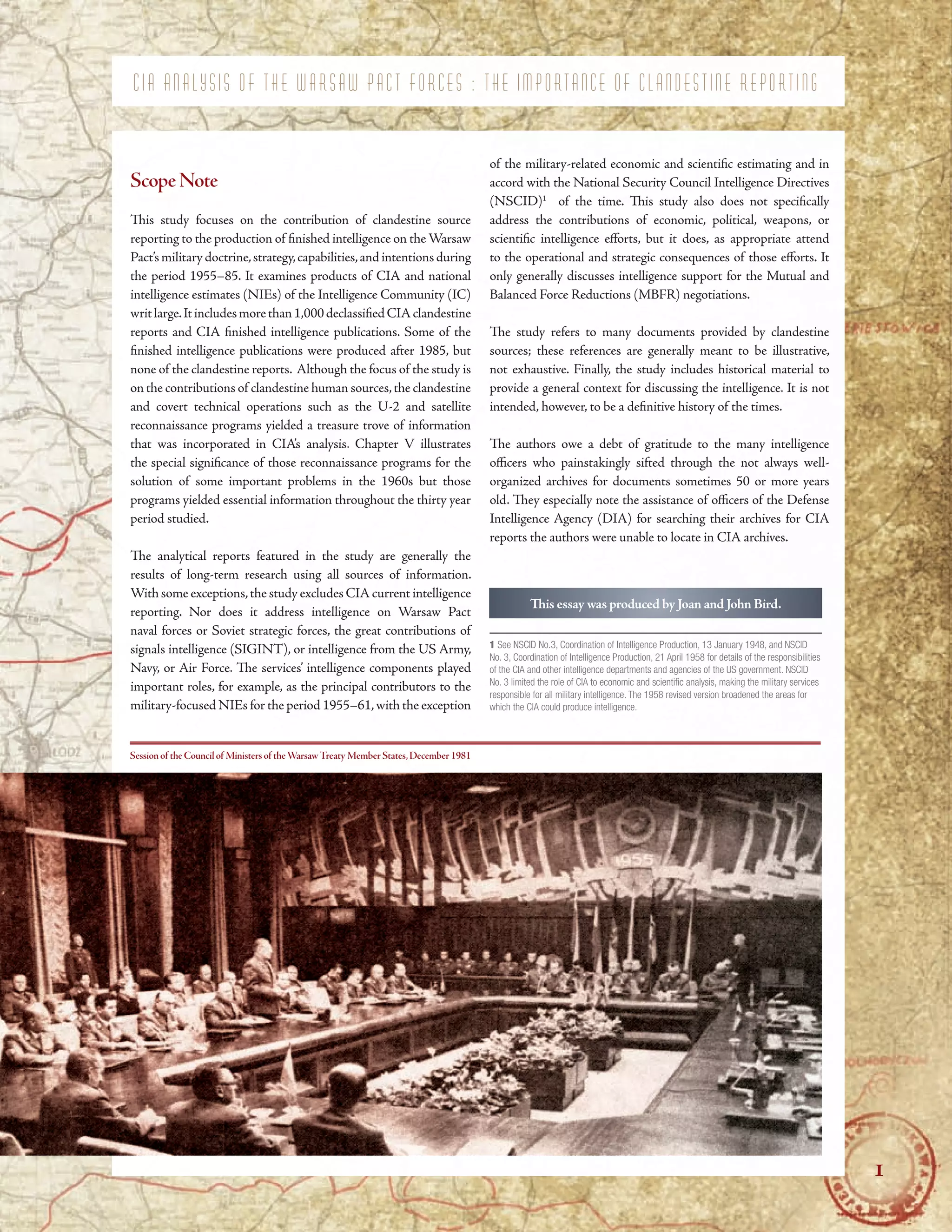
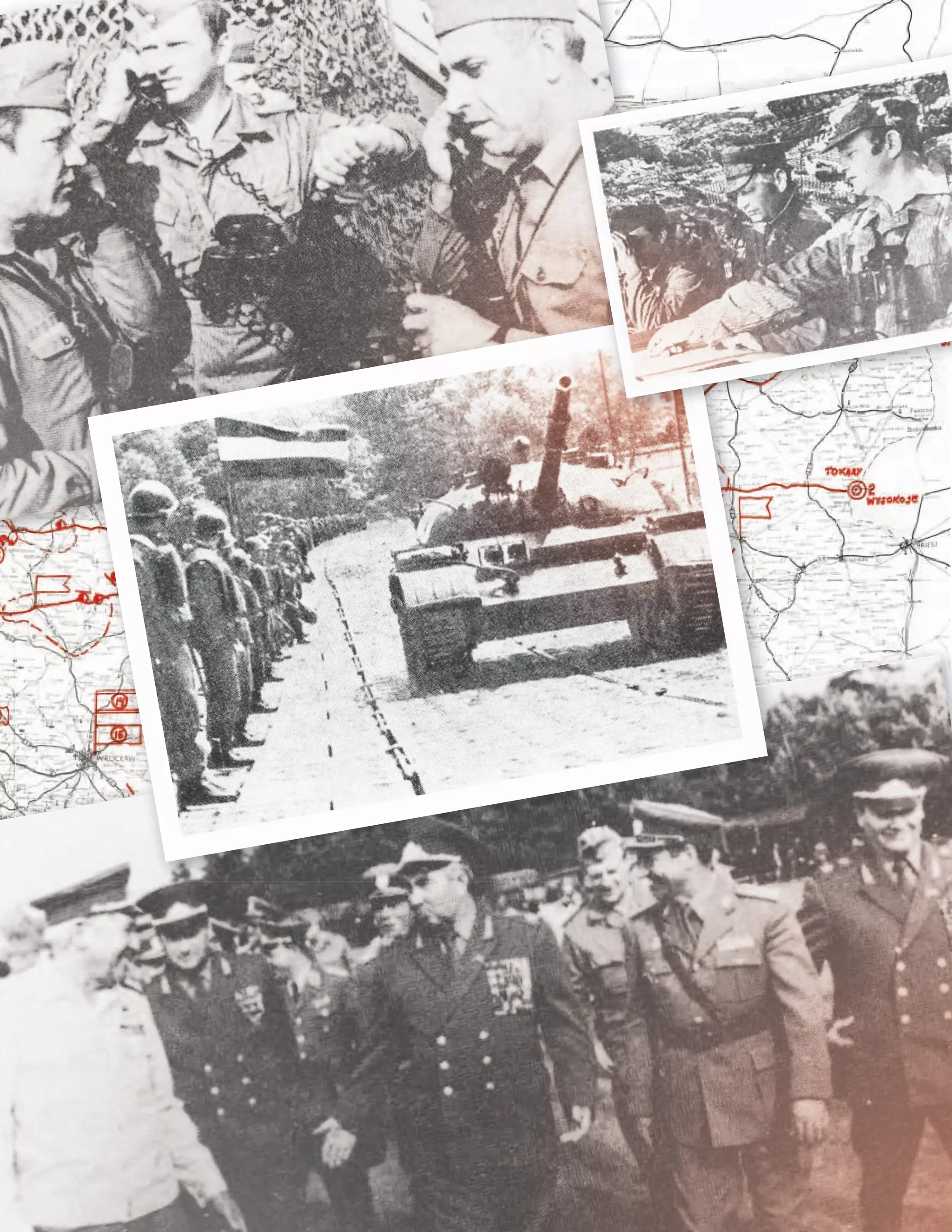
Session of the Council of Ministers of theWarsawTreaty Member States,December 1981
of the military-related economic and scientifc estimating and in
accord with the National Security Council Intelligence Directives
(NSCID)1
of the time. Tis study also does not specifcally
address the contributions of economic, political, weapons, or
scientifc intelligence eforts, but it does, as appropriate attend
to the operational and strategic consequences of those eforts. It
only generally discusses intelligence support for the Mutual and
Balanced Force Reductions (MBFR) negotiations.
Te study refers to many documents provided by clandestine
sources; these references are generally meant to be illustrative,
not exhaustive. Finally, the study includes historical material to
provide a general context for discussing the intelligence. It is not
intended, however, to be a defnitive history of the times.
Te authors owe a debt of gratitude to the many intelligence
ofcers who painstakingly sifted through the not always well-
organized archives for documents sometimes 50 or more years
old. Tey especially note the assistance of ofcers of the Defense
Intelligence Agency (DIA) for searching their archives for CIA
reports the authors were unable to locate in CIA archives.
Tis essay was produced by Joan and John Bird.
1 See NSCID No.3, Coordination of Intelligence Production, 13 January 1948, and NSCID
No. 3, Coordination of Intelligence Production, 21 April 1958 for details of the responsibilities
of the CIA and other intelligence departments and agencies of the US government. NSCID
No. 3 limited the role of CIA to economic and scientifc analysis, making the military services
responsible for all military intelligence. The 1958 revised version broadened the areas for
which the CIA could produce intelligence.
1
1
C I A A N A L Y S I S O F T H E W A R S A W P A C T F O R C E S : T H E I M P O R T A N C E O F C L A N D E S T I N E R E P O R T I N G
Introduction
Te Soviet Union established itself as a threat to the West by
its military occupation of Poland and other eastern European
countries at the end of World War II and through the unsuccessful
attempts by its armed proxies to capture Greece and South
Korea. Its unceasing attempts to subvert governments throughout
Western Europe and America, and later through the “wars of
national liberation” cast a shadow over everyday life in the West.
Te massive Soviet armed forces stationed in central Europe stood
behind its political ofensives such as the Berlin Crises. Te West
countered with the formation of NATO and the acceptance into
NATO,and rebuilding of,West Germany.During the same period
that the West welcomed West Germany into NATO, the Soviets
established – through the Warsaw Treaty of May 1955 – a formal
military bloc of Communist nations.
Tis study continues CIA’s efort to provide the public with a
more detailed record of the intelligence derived from clandestine
human and technical sources that was provided to US
policymakers and used to assess the political and military balances
and confrontations in Central Europe between the Warsaw Pact
and NATO during the Cold War. Finished intelligence2
, based
on human and technical sources, was the basis for personal
briefngs of the President, Vice President, Secretary of Defense,
Secretary of State, and other cabinet members, and for broader
distribution through NIEs. It is the opinion of the authors that
the information considerably aided US eforts to preserve the
peace at a bearable cost.
Tis study showcases the importance of clandestine source
reporting to CIA’s analysis of the Warsaw Pact forces. Tis efort
complements the CIA’s release of the “Caesar” series of studies3
and other signifcant CIA documents in 2007; and releases by
other IC agencies.It also complements ongoing projects,including
those of the Wilson Center of the Smithsonian Institution and
NATO that reexamine the Cold War in light of newly available
documentation released by several former members of the
Warsaw Pact.
Te clandestine reports by the predecessor organizations of CIA’s
current National Clandestine Service (NCS) are representative
of those that at the time made especially valuable contributions
to understanding the history, plans, and intentions of the Warsaw
Pact.Many of these documents are being released for the frst time.
Te clandestine source documents do not represent a complete
record of contemporary intelligence collection. Tere was much
information made available from émigrés and defectors as well as
from imagery and SIGINT that was essential in the estimative
process but is not the focus of this study.
Te study includes NIEs that CIA has previously released. It
also includes fnished intelligence documents produced by the
CIA’s Directorate of Intelligence (DI), some previously released,
and the clandestinely obtained information upon which those
reports were largely based. Te DI reports were selected in
part because they were the detailed basis of CIA contributions
to NIEs that focused on the military aspects of the Warsaw
Pact. Te DI fnished intelligence reports also provided the
background for future current intelligence. Appended to this
study is a collection of declassifed intelligence documents
relating to the Warsaw Pact’s military forces, operational
planning, and capabilities. Although many of the documents
were released in past years, new reviews have provided for the
restoration of text previously redacted. All of the documents
selected for this study are available on the attached DVD, on
CIA’s website at http://www.foia.cia.gov/special_collections.asp
or from the CIA Records Search Tool (CREST) located at the
NationalArchivesandRecordsAdministration(NARA),College
Park, MD or contact us at HistoricalCollections@UCIA.gov.
Te fnished intelligence during this period seldom linked the
specifc clandestine or other sources of evidence to the analysis
based on their information. For example, the early intelligence
documents often described clandestine sources only in the most
general fashion. Rules to protect sources, especially the human
agents, rarely allowed analysts to acknowledge a clandestine
source, openly evaluate a source’s reliability, or describe a source’s
access to the information. Only in publications of extremely
limited distribution, for as few as a handful of recipients, were
these rules relaxed. Tey changed little until the 1980s, when
analysts could provide evaluations that included some sense of
the source’s reliability and access.
Te study lists in the Catalogue of Documents on the DVD
important clandestine and covert source reports and fnished
intelligence publications by chapter. Tese documents are
generally arrayed chronologically according to the dates of
dissemination within the IC, not the dates of publication by the
Soviets that sometimes were years earlier.
All of our Historical Collections are available
on the CIA Library Publication page located
at https://www.cia.gov/library/publications/
historical-collection-publications/ or contact us at
HistoricalCollections@UCIA.gov.
2 Finished Intelligence is the CIA term for the product resulting from the collection, processing, integration, analysis, evaluation, and interpretation of available all source information. 3 The Caesar
Studies are analytic monographs and reference aids produced by the DI through the 1950s to the mid-1970s. They provided in-depth research on Soviet internal politics primarily intended to give
insight on select political and economic issues and CIA analytic thinking of the period.
2
C I A A N A L Y S I S O F T H E W A R S A W P A C T F O R C E S : T H E I M P O R T A N C E O F C L A N D E S T I N E R E P O R T I N G
FrequentlyUsedAcronyms
CPSU/CC Communist Party of the Soviet Union Central Committee
CSI Center for the Study of Intelligence
DCI Director of Central Intelligence
DIA Defense Intelligence Agency
DI Directorate of Intelligence (CIA)
DO Directorate of Operations, 1973–2005 (CIA)
DP Directorate of Plans, 1950s–1973 (CIA)
FBIS Foreign Broadcast Information Service
FRG Federal Republic of Germany (West Germany)
FRUS Foreign Relations of the United States (A US Department of State History Series)
GDR German Democratic Republic (East Germany)
IC Intelligence Community
MBFR Mutual and Balanced Force Reductions
NARA National Archives and Records Administration
NCS National Clandestine Service, 2005–present (CIA)
NIC National Intelligence Council, established December 1979 (DCI)
NIC/WC National Indications Center/Watch Committee, pre-1979 (DCI)
NIE National Intelligence Estimate
NPIC National Photographic Interpretation Center
NSCID National Security Council Intelligence Directive
NSC National Security Council
NSWP Non-Soviet Warsaw Pact [countries]
NTM National Technical Means
OCI Ofce of Current Intelligence (CIA)
OER Ofce of Economic Research (CIA)
ONE Ofce of National Estimates (CIA)
OPA Ofce of Political Analysis (CIA)
ORR Ofce of Research and Reports (CIA)
OSR Ofce of Strategic Research (CIA)
PCC Political Consultative Committee (Warsaw Treaty Organization)
SOVA Ofce of Soviet Analysis (CIA)
SHAPE Supreme Headquarters Allied Powers Europe
SIGINT Signals Intelligence
SNIE Special National Intelligence Estimate
SRS Senior Research Staf
TO&E Table of Organization and Equipment
WMD Weapons of Mass Destruction
3
its allies and had modeled it after the 1949 North Atlantic
C I A A N A L Y S I S O F T H E W A R S A W P A C T F O R C E S : T H E I M P O R T A N C E O F C L A N D E S T I N E R E P O R T I N G
TeWarsawTreaty
Te founding document of the Warsaw Pact organization
was signed in Warsaw on 14 May 1955, and came into
force on 6 June 1955. At the time, CIA analysts judged
that Moscow had drafted the treaty without consulting
its allies and had modeled it after the 1949 North Atlantic
Treaty (sometimes referred to as the Washington Treaty) that
established NATO. CIA analysis showed that some clauses of
theWarsawTreaty appeared to be almost direct translations from
the Washington Treaty and that both had similar provisions,
for example, for joint action in case one of the signatories was
attacked, recognition of the ultimate authority of the UN, and
settlement of all disputes without use or threat of force. Te
combined military command seemed to be a facsimile of NATO’s
Supreme Headquarters Allied Powers Europe (SHAPE).4
Te
treaty apparently was not crafted to override existing bilateral
treaties of mutual assistance,friendship,and cooperation between
Moscow and its allies, which were the basis for addressing Soviet
security concerns in Europe at that time. CIA analysts believed
that the Warsaw Treaty was set up primarily as a bargaining chip
to obtain the dissolution of NATO. Te following text of the
treaty does not include the signature blocks.
Treaty of Friendship, Cooperation, and Mutual Assistance
between the People’s Republic of Albania, the People’s Republic
of Bulgaria, the Hungarian People’s Republic, the German
DemocraticRepublic,thePolishPeople’sRepublic,theRomanian
Socialist Republic, the Union of Soviet Socialist Republics, and
the Czechoslovak Republic.5
Te Contracting Parties
Reafrming their desire to create a system of collective security
in Europe based on the participation of all European States,
irrespective their social and political structure, whereby the
said States may be enabled to combine their eforts in the
interests of ensuring peace in Europe;
Taking into consideration, at the same time, the situation
that has come about in Europe as a result of the ratifcation
of the Paris Agreements, which provide for the constitution
of a new military group in the form of a “West European
Union”, with the participation of a remilitarized West
Germany and its inclusion in the North Atlantic bloc,
thereby increasing the danger of a new war and creating
a threat to the national security of peace-loving States;
Being convinced that in these circumstances the peace-loving
States of Europe must take the necessary steps to safeguard
their security and to promote the maintenance of peace
in Europe;
Being guided by the purposes and principles of the Charter of
the United Nations Organization;
In the interests of further strengthening and development of
friendship, co-operation and mutual assistance in accordance
with the principles of respect for the independence and
sovereignty of States and of non-intervention in their domestic
afairs;
Have resolved to conclude the present Treaty of Friendship,
Co-operation and Mutual Assistance and have appointed as
their plenipotentiaries: [not listed here]
who, having exhibited their full powers, found in good and due
form, have agreed as follows:
Article 1
Te Contracting Parties undertake, in accordance with the
Charter of the United Nations Organization, to refrain in their
international relations from the threat or use of force,and to settle
their international disputes by peaceful means in such a manner
that international peace and security are not endangered.
Article 2
Te Contracting Parties declare that they are prepared to
participate, in a spirit of sincere co-operation in all international
action for ensuring international peace and security, and will
devote their full eforts to the realization of these aims.
In this connexion, the Contracting Parties shall endeavor to
secure, in agreement with other states desiring to co-operate in
this matter, the adoption of efective measures for the general
reduction of armaments and the prohibition of atomic, hydrogen
and other weapons of mass destruction
Article 3
Te Contracting Parties shall consult together on all important
international questions involving their common interests, with a
view to strengthening international peace and security.
Whenever any one of the Contracting Parties considers that a
threat of armed attack on one or more of the States Parties to the
Treaty has arisen, they shall consult together immediately with a
view to providing for their joint defense and maintaining peace
and security.
4 A comparison of the Warsaw Treaty with the 1949 Washington Treaty establishing NATO can be found in a study prepared by the CIA’s Offce of Current Intelligence 22 years later, The Warsaw
Pact: Its Role in Soviet Bloc Affairs from Its Origin to the Present Day, A Study for the Jackson Subcommittee, 5 May 1966 (See the Catalogue of Documents, Chapter VI, Document VI-13, Annex
B, p B-1. 5 The text of the treaty was available through the FBIS Daily Report on 14 May 1955, but we do not have a copy of that report. The text of the treaty here is a UN English translation of the
text of the treaty as registered at the UN by Poland on 10 October 1955.
4
C I A A N A L Y S I S O F T H E W A R S A W P A C T F O R C E S : T H E I M P O R T A N C E O F C L A N D E S T I N E R E P O R T I N G
Article 4
In the event of an armed attack in Europe on one or more of
the States Parties to the Treaty by any state or group of States,
each State Party to the Treaty, shall, in the exercise of the right
of individual or collective self-defense, in accordance with Article
51 of the United Nations Charter, aford the State or States so
attackedimmediateassistance,individuallyandinagreementwith
the other States Parties to the Treaty, by all means it considers
necessary, including the use of armed force. Te States Parties
to the Treaty shall consult together immediately concerning the
joint measures necessary to restore and maintain international
peace and security.
Measures taken under this Article shall be reported to the
Security Council in accordance with the provisions of the United
Nations Charter. Tese measures shall be discontinued as soon
as the Security Council takes the necessary action to restore and
maintain international peace and security.
Article 5
Te Contracting Parties have agreed to establish a Unifed
Command, to which certain elements of their armed forces
shall be allocated by agreement between the parties, and which
shall act in accordance with jointly established principles. Te
Parties shall likewise take such other concerted action as may be
necessary to reinforce their defensive strength, in order to defend
the peaceful labour of their peoples, guarantee the inviolability
of their frontiers and territories and aford protection against
possible aggression.
Article 6
For the purpose of carrying out the consultations provided for in
the present Treaty between the States Parties thereto, and for the
consideration of matters arising in connexion with the application
of the present Treaty, a Political Consultative Committee shall
be established, in which each State Party to the Treaty shall be
represented by a member of the government or by some other
specially appointed representative.
Te Committee may establish such auxiliary organs as may prove
to be necessary.
Article 7
Te Contracting Parties undertake not to participate in any
coalitions or alliances and not to conclude any agreements the
purposes of which are incompatible with the purposes of the
present Treaty.
Te Contracting Parties declare that their obligations under
international treaties at present in force are not incompatible with
the provisions of the present Treaty.
Article 8
Te Contracting Parties declare that they will act in a spirit of
friendship and co-operation to promote the further development
and strengthening of the economic and cultural ties among them,
in accordance with the principles of respect for each other’s
independence and sovereignty and of non-intervention in each
other’s domestic afairs.
Article 9
Te present Treaty shall be open for accession by other States,
irrespective of their social and political structure, which express
their readiness, by participating in the present Treaty, to help in
combining the eforts of the peace-loving states to ensure the
peace and security of the peoples. Such accessions shall come
into efect with the consent of the States Parties to the Treaty
after the instruments of accession have been deposited with the
Government of the Polish People’s Republic.
Article 10
Te present Treaty shall be subject to ratifcation, and
the instruments of ratifcation shall be deposited with the
Government of the Polish People’s Republic.
Te Treaty shall come into force on the date of deposit of the last
instrument of ratifcation.Te Government of the Polish People’s
Republic shall inform the other States Parties to theTreaty of the
deposit of each instrument of ratifcation.
Article 11
Te present Treaty shall remain in force for twenty years. For
contracting Parties which do not, one year before the expiration
of that term, give notice of termination of the treaty to the
government of the Polish People’s Republic, the Treaty shall
remain in force for a further ten years.
In the event of the establishment of a system of collective security
in Europe and the conclusion for that purpose of a General
European Treaty concerning collective security, a goal which the
Contracting Parties shall steadfastly strive to achieve, the Treaty
shall cease to have efect as from the date on which the General
European Treaty comes into force.
Done at Warsaw,this fourteenth day of May 1955,in one copy,in
the Russian, Polish, Czech and German languages, all texts being
equally authentic. Certifed copies of the present Treaty shall be
transmitted by the Government of the Polish People’s Republic
to all other Parties to the Treaty.
In witness whereof the plenipotentiaries have signed the present
Treaty and afxed their seals.
5
C I A A N A L Y S I S O F T H E W A R S A W P A C T F O R C E S : T H E I M P O R T A N C E O F C L A N D E S T I N E R E P O R T I N G
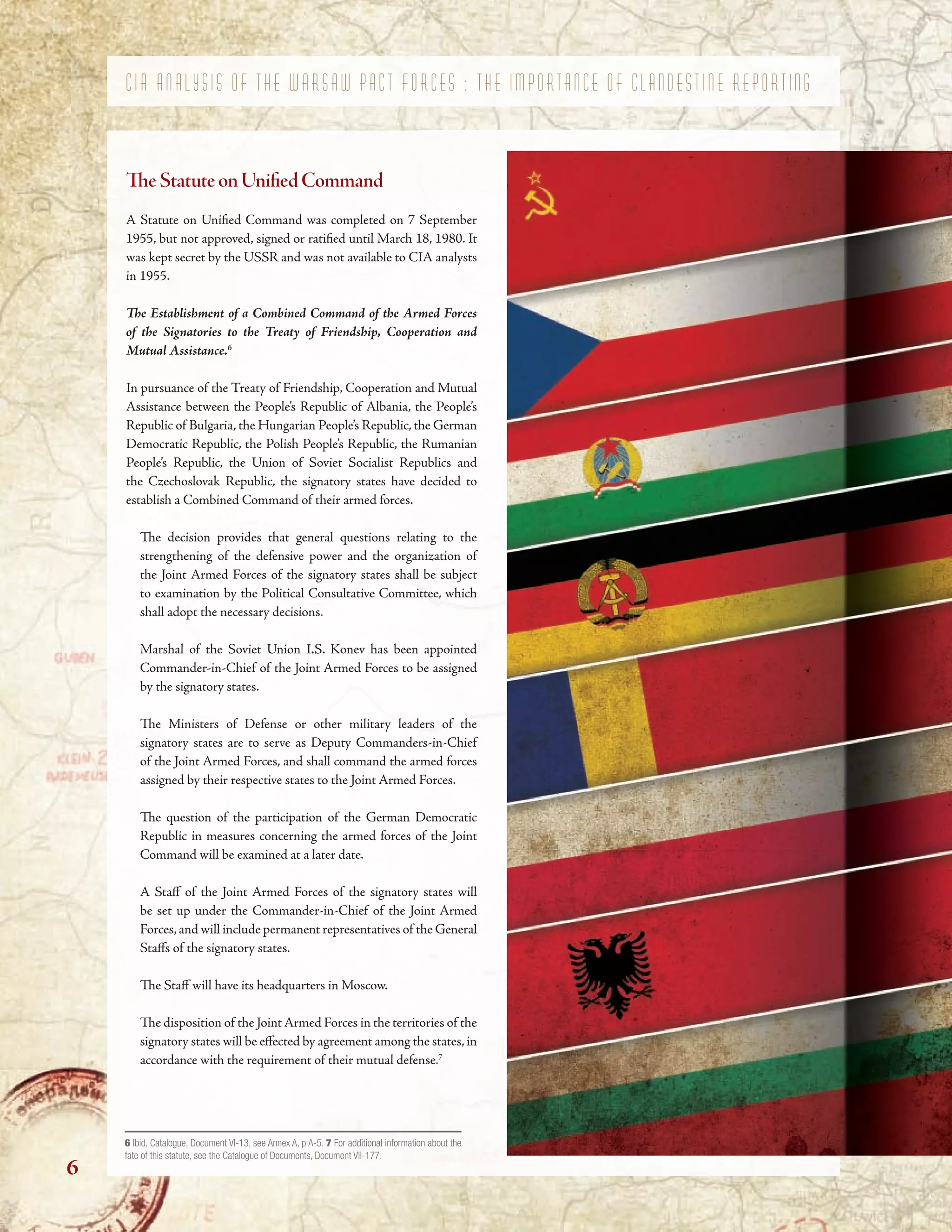
TeStatuteonUnifedCommand
A Statute on Unifed Command was completed on 7 September
1955, but not approved, signed or ratifed until March 18, 1980. It
was kept secret by the USSR and was not available to CIA analysts
in 1955.
Te Establishment of a Combined Command of the Armed Forces
of the Signatories to the Treaty of Friendship, Cooperation and
Mutual Assistance.6
In pursuance of the Treaty of Friendship, Cooperation and Mutual
Assistance between the People’s Republic of Albania, the People’s
Republic of Bulgaria, the Hungarian People’s Republic, the German
Democratic Republic, the Polish People’s Republic, the Rumanian
People’s Republic, the Union of Soviet Socialist Republics and
the Czechoslovak Republic, the signatory states have decided to
establish a Combined Command of their armed forces.
Te decision provides that general questions relating to the
strengthening of the defensive power and the organization of
the Joint Armed Forces of the signatory states shall be subject
to examination by the Political Consultative Committee, which
shall adopt the necessary decisions.
Marshal of the Soviet Union I.S. Konev has been appointed
Commander-in-Chief of the Joint Armed Forces to be assigned
by the signatory states.
Te Ministers of Defense or other military leaders of the
signatory states are to serve as Deputy Commanders-in-Chief
of the Joint Armed Forces, and shall command the armed forces
assigned by their respective states to the Joint Armed Forces.
Te question of the participation of the German Democratic
Republic in measures concerning the armed forces of the Joint
Command will be examined at a later date.
A Staf of the Joint Armed Forces of the signatory states will
be set up under the Commander-in-Chief of the Joint Armed
Forces,and will include permanent representatives of the General
Stafs of the signatory states.
Te Staf will have its headquarters in Moscow.
Te disposition of the Joint Armed Forces in the territories of the
signatory states will be efected by agreement among the states,in
accordance with the requirement of their mutual defense.7
6 Ibid, Catalogue, Document VI-13, see Annex A, p A-5. 7 For additional information about the
fate of this statute, see the Catalogue of Documents, Document VII-177.
6
7
C I A A N A L Y S I S O F T H E W A R S A W P A C T F O R C E S : T H E I M P O R T A N C E O F C L A N D E S T I N E R E P O R T I N G
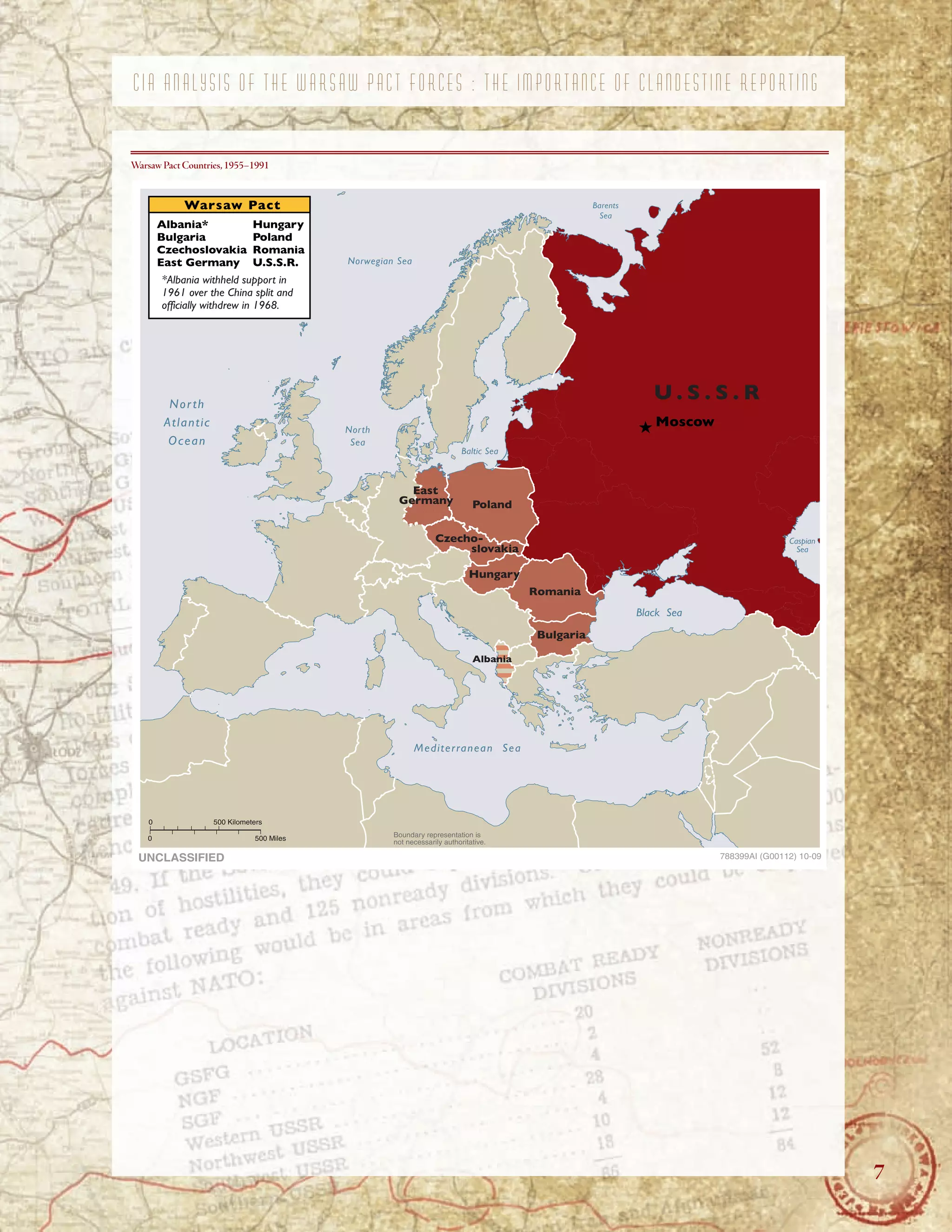
Warsaw Pact Countries,1955–1991
Warsaw Pact Barents
Sea
Albania* Hungary
Bulgaria Poland
Czechoslovakia Romania
East Germany U.S.S.R. Norwegian Sea
*Albania withheld support in
1961 over the China split and
officially withdrew in 1968.
North
Atlantic
Ocean
North
Sea
Baltic Sea
U . S . S . R
Moscow
East
Germany Poland
Czecho-
slovakia
Hungary
Albania
Romania
Bulgaria
Black Sea
Caspian
Sea
Mediterranean Sea
0 500 Kilometers
0 500 Miles
UNCLASSIFIED
Boundary representation is
not necessarily authoritative.
788399AI (G00112) 10-09
7
c h a p t e r i
Early Khrushchev Period (1955-1960)
Changes in Soviet relations with the West after the death of
Stalin and the consolidation of power by Nikita Khrushchev8
initially characterized this period. By deed and word Moscow
ofered prospects for détente. At the same time Khrushchev
attempted to bully the West by exploiting the purported strength
of Soviet military and economic superiority. Soviet actions
included the signing of the Vienna Agreement (known formally
as the Austrian State Treaty) freeing Austria of Soviet controls,
which contrasted with his threats to“bury”the West, and explicit
military confrontation over Berlin and Cuba between 1958 and
1962. Advances in military-related technologies as well as the
changing relationships between the Soviet and Western Blocs
also led to internal debates and changes in national military
strategies beginning frst in the West and later in and among the
Warsaw Pact countries and the Soviet Union.
Khrushchev’s policies afected Soviet internal,political,economic,
and military developments. Perhaps most important were his
responses to the looming disastrous economic efects of Stalin’s
legacy, the Sixth Five-Year Plan. To Khrushchev, Stalin’s military
programs alone required massive misallocation of economic
resources.Taken together with the overconcentration of resources
for development of heavy industry and inattention to agricultural
production, the economy must have looked to Khrushchev like a
train heading for a wreck. He instituted a major reorganization
of the bureaucracy to control the economy including huge new
agricultural programs, and substituted a new Seven-Year Plan for
the doomed Sixth Five-Year Plan.9
On 15 May 1955, the United States, United Kingdom, France,
and the Soviet Union signed the Vienna Agreement, which
provided for the withdrawal of the Soviet and Western forces
from Austria. Tis show of confdence on the part of the Soviets
was followed by Khrushchev’s August 1955 announcement of
a reduction of 640,000 men from the Soviet armed forces. In
May 1956 he called for another cutback of 1.2 million Soviet
troops. In 1957, in a climax to maneuvering by military and
political leadership for power, Khrushchev ousted Minister of
Defense Marshal Zhukov and reestablished party control of the
military. He also began retiring senior Soviet military ofcers
who disagreed with his policies. Khrushchev reorganized the
Soviet military10
and promoted those ofcers who supported
his pronouncements on the nature of a war with NATO. He
advocated military capabilities with which he believed wars
would be fought. Tese actions and his fxation on missiles and
planning for nuclear war took center stage by 1961 when a debate
took place among Soviet military ofcers that was refected in
special Top Secret Editions of Military Tought.11
Khrushchev later announced additional unilateral troop
reductions including one of 300,000 troops in January 1958 and
another of 1.2 million in January 1960 in a speech to the Supreme
Soviet. All of the proposed decreases were meant to serve several
purposes: to shift funds into the production of missiles and long-
range bombers;to lessen the burden of ground force requirements
on heavy industry; to free labor for productive purposes in
the civilian economy; and to bring international pressure on
the United States to cut its forces. Te aim of the reductions
proposed in 1960 and in the years immediately following
also may have been to compensate for the smaller numbers of
militarily acceptable men available to the armed services, because
of the low birth rate attendant to the tremendous losses sufered
during World War II (WWII).
8 Khrushchev became First Secretary of the CPSU/CC in March 1953 and Premier in March 1958. 9 The editors have drawn from the documents listed in the Catalogue of Documents for each
chapter for much of the material in the chapter essays. References in the essays to material drawn from documents listed in other chapters are noted in footnotes. 10 For more information on the
reorganization of the Soviet Army, see the Catalogue of Documents, Document VII-91, Organizational Development of the Soviet Ground Forces, 1957-1975, 7–14. 11 See FBIS Radio Propaganda
Reports addressing the debates among the military leadership that appeared in the open press following the death of Stalin in 1953. The debates also were addressed in secret and top secret
versions of the Soviet military journal, Military Thought that are addressed in Chapter III.
9
C I A A N A L Y S I S O F T H E W A R S A W P A C T F O R C E S : T H E I M P O R T A N C E O F C L A N D E S T I N E R E P O R T I N G
Organizing and Managing the Warsaw Pact
Te Twentieth CPSU Congress in February 1956, famous for
Khrushchev’s anti-Stalin speech, ushered in what would become
an era of many changes in Soviet–East European relations. Te
congresssetforthnewguidanceforcommunistgovernance,implicit
and explicit, and dissolved the COMINFORM12
to “facilitate
cooperation with the socialist parties” of the noncommunist
world. Te resulting policy vacuum in Eastern Europe persisted
though the fall of 1956 and probably was an important precipitant
of the Hungarian uprising and the riots in Poland. Intentionally
or not, Khrushchev’s condemnation of Stalinism unsettled the
communist governments of Eastern Europe, most of which were
run by unreconstructed Stalinists. Teir ousting from ofce was
accompanied by unintended disorder and some violent outbreaks
of worker discontent in Eastern Europe that the presence of Soviet
garrisons could not avert.Subsequent actions would illustrate that
Moscow’s guidance for communist governance notwithstanding,
the Warsaw Treaty was providing a new vehicle for establishing
Soviet authority over intra-Bloc relations. Moscow defned this
authority even to include “legitimizing” physical intervention, a
vehicle that the Soviets would soon use.
By midsummer 1956, riots in Poland threatened the future
integrity and success of the year-old Warsaw Pact. Te Soviets
mobilized and prepared forces in response, but the crisis was
resolved short of Soviet military intervention. Instead, the Soviets
employed those forces to suppress the far more serious situation
developing in Hungary, after the Hungarians forcibly removed
the remnants of the oppressive Stalinist regime and installed the
mildly communist one of Imre Nagy.Nagy opted to lead Hungary
out of the Warsaw Pact, treason in the eyes of the Soviets. After
the garrison of Soviet forces in Hungary initially took a beating at
the hands of the revolutionaries, the Soviets unleashed the forces
mobilized to intervene in Poland. Te bloody suppression that
ensued reimposed Soviet control. In a declaration on 30 October
1956, Moscow hypocritically stated its readiness to respect the
sovereignty of its Warsaw Pact allies even as the Soviets already
were in the process of violating Hungary’s.
Outweighing the promise of a common defense of the Bloc,
the Soviet military threat to Poland and the aggression
against Hungary represented the downside of the Warsaw
Treaty—that it was a formal mechanism for Soviet control.
Te rocky start for the Warsaw Pact was followed by the growing
estrangement of Albania and Romania,and problems with China.
Yugoslavia had already bolted from the Soviet orbit in 1948.
Nonetheless, the Soviets persevered, building the Warsaw
Treaty Organization into an ever-tightening device for controlling
its satellite allies, and a source of additional military power.
In broad general terms, the Soviet General Staf created the
Warsaw Pact military plans even though the Warsaw Treaty
provided formal arrangements for the Soviets and their East
European allies to share management of their combined military
forces.Contrary to theArticles of theWarsawTreaty,particularly
Article 5, Soviet planning for the Warsaw Pact initially called for
the forces of non-Soviet Warsaw Pact (NSWP) countries to
remain under nominal national control, with the intention that
the Soviets would closely direct all forces during a crisis or war.
Nonetheless,throughout the life of the Warsaw Pact,the NSWP
members, with varying degrees of success, resisted yielding
control of their own forces to Soviet unilateral command. Only
in the case of East German forces did the Soviets fully succeed.
During the 1950s CIA analysts assessed that the Warsaw Pact’s
forces were not integrated and jointly controlled and that only
the Soviets really managed them. Te IC in NIE 11-4-58, Main
Trends in Soviet Capabilities and Policies, 1958-1963, judged
it unlikely that Soviet planners would count on East European
forces to make an important contribution to Soviet military
operations except perhaps for air defense. Soviet preparations
for military contingencies associated with Moscow’s projected
aggressive moves against West Berlin in the summer of 1961
called for putting all NSWP forces into Soviet feld armies,clearly
a plan to subordinate the former to Soviet control.
After the dissolution of the Warsaw Pact, archival documents
from former members further illustrated their unequal treatment
during this period. In a 1956 classifed critique of the statute of
the Unifed Command, Polish Gen. Jan Drzewiecki complained,
“Te document in its present form grants the Supreme
Commander of the Unifed Armed Forces certain rights and
obligations, which contradict the idea of the independence and
sovereignty of the member states of the Warsaw Treaty.”13
In
a January 1957 Memorandum on Reform of the Warsaw
Pact, General Drzewiecki further stated, “Te authority of
the Supreme Commander [a Soviet ofcer] on questions of
leadership in combat and strategic training is incompatible with
the national character of the armies of the corresponding states.”14
In the latter half of the 1970s Col. Ryszard Kuklinski, a CIA
clandestine source, provided information revealing the NSWP
members fnally signed and ratifed the Statutes on 18 March
1978,except for the one on Unifed Command forWartime.Tat
one was not signed and ratifed until 1980.15
Clearly the Soviets
had not achieved their aims at legal control for decades.
12 COMINFORM was the acronym for the “Information Bureau of the Communist and Worker’s Parties” that was founded in 1947. Its purpose was to coordinate the foreign policy activities of the
East European communist parties under Soviet direction. 13 A Cardboard Castle? An Inside History of the Warsaw Pact 1955-1991, edited by Vojtech Mastny and Malcolm Byrne, Central European
University Press, Budapest, New York, p.84–86. 14 Ibid, 87–90. 15 See Chapter VII, page 35 for more details on the statutes. For the documents, see the Catalogue of Documents, Chapter 7,
Section, “Formal Mechanisms to Manage the Warsaw Pact,” page 185.
10
C I A A N A L Y S I S O F T H E W A R S A W P A C T F O R C E S : T H E I M P O R T A N C E O F C L A N D E S T I N E R E P O R T I N G
Intelligence Sources and Analysis in the Early Years
Te Western Allies shared military and policy information to a
limited extent with the Soviet Union during WWII, but even that
all but ceased when the war ended. By 1949, the Soviet Union
and its allies were concealing much of their military activities and
policy decisions from the outside world. Te police state that
Stalin established made recruiting human sources inside the USSR
extremely difcult16
and preventedWestern diplomats and military
attachés from traveling widely there. Tus, the central problem for
CIA analysts during this period of the Cold War in Europe was
the lack of direct and convincing evidence other than that derived
from SIGINT, defectors, and the media. Eforts to fll the gaps in
collectionwithphotographyandothersupportinginformationwere
of limited success.
In the early 1950s military analysts based their understanding of
Sovietmilitaryorganization,doctrine,capabilities,andtacticslargely
on evidence from World War II, SIGINT, information available
from the Soviet press, military attaché reporting, defector and
émigré debriefngs, and the observations of US military missions
in Austria and East Germany. Some German prisoners of the
Soviet Union from the WWII period and some Spanish émigrés
from the Spanish Civil War days who were returning to the West
provided valuable military-industrial information. For example, the
Germanprisoners,whohadworkedonHitler’smissileprogramand
were forced to help the Soviet program, relayed useful data about
Soviet missile programs. Most Soviet military émigrés or defectors,
however, were generally low level and the military defectors could
report only on their experiences in the military units where they
served—typically located in Austria or East Germany.
During the period 1955–59, CIA had only two productive
clandestinesourcesof Sovietmilitaryinformation.Onewasaspecial
project, the Berlin Tunnel Operation, which yielded invaluable
information, for example, about deployed military forces, Soviet
political-military relationships, and the tactical-level organization
and manning of Soviet forces in East Germany through most of
1955 until spring 1956.17
Te other was Major (later promoted to
Lt. Colonel) Pyotr Popov, the CIA’s frst high-quality clandestine
Soviet military source.
Popov served in place and reported on Soviet military policy,
doctrine, strategy, tactics and organization from 1953 until the late
1950s. Richard Helms testifed that “Lieutenant Colonel Pyotr
Popov, until he fell under suspicion, single-handedly supplied the
most valuable intelligence on Soviet military matters of any human
source available to the United States” during the period.18
He also
said Popov’s reporting had a“direct and signifcant infuence on the
military organization of the United States, its doctrine and tactics,
and permitted the Pentagon to save at least 500 million dollars in
its scientifc research program.”19
Te information and documents
he provided continued to inform the CIA analysis years after he
was arrested.
Popov provided the IC with unique classifed documentary and
semi-documentary information otherwise unavailable after the late
1940s, including extant Field Service Regulations of the Armed
Forces of the USSR and other manuals that provided new doctrine
and strategies for the armed forces.20
Te subjects of his reports
ranged from routine unit locations to nuclear warfare tactics,
strategicairoperations,andguidedmissiles.HesuppliedtheICwith
informationontheorganizationandfunctionsof theSovietGeneral
Staf and technical specifcations of Soviet Army conventional
weapons,includingthefrstinformationaboutnewweaponssuchas
the T-10 heavy tank and PT-76 amphibious light tank. Popov also
provided documents on Khrushchev’s reorganization of the Soviet
military and a number of unique and highly valuable classifed
documents of the Communist Party of the Soviet Union Central
Committee (CPSU/CC), including those concerning Soviet policy
toward Berlin. Te information Popov supplied was important
for understanding the Soviet political and military establishments
following the Stalinist years and at the startup of the Warsaw Pact.
And it provided a basis for understanding how the political and
military establishments of the satellite countries would operate with
the Soviet Union. Because of the tight control over disseminated
information from the Popov operation, analysts made no references
in fnished intelligence that might lead to his apprehension.
However, much later, a former ofcer in the CIA’s Directorate of
Plans (DP), William Hood, in his 1982 book, Mole,21
extensively
discussed Popov’s contribution.
According to CIA records, Popov also supplied copies of the Soviet
military publication, Military Tought.22
We know from the
author of a CIA study, Soviet Naval Strategy and the Efect on
the Development of the Naval Forces 1953-1963, that Military
Tought articles from the 1953–59 period were available for his
analysis. Analysts who participated in the 1963 CIA/DIA joint
study,discussedinChapterV,23
alsohadPopov-supplieddocuments
available to support their analysis. Te above testimony shows that
his eforts provided the IC with some of the best human-source
information on developing Soviet military tactics and doctrine
during the period.
16 For more information on the diffculties in recruiting Soviet human sources during the early years, see William Hood, Mole, The True Story of the First Russian Intelligence Offcer Recruited
by the CIA, (New York: W .W. Norton and Company, 1982). 17 For more information on the Berlin Tunnel project see Catalogue of Documents, Document I-34 the offcial Clandestine Services
History, The Berlin Tunnel Operation 1952-1956, 24 June 1968; for information on the intelligence derived from the Berlin Project, see Annex B, “Recapitulation of the Intelligence Derived”.
Also see Donald P. Steury, ed., On the Front Lines of the Cold War: Documents on the Intelligence War in Berlin, 1946 to 1961 (Washington, DC: Center for the Study of Intelligence, 1999).
18 See Richard Helms, with William Hood, A Look over My Shoulder A Life in the Central Intelligence Agency (New York: Random House, 2003), 105. 19 Ibid. Helms p.132. 20 See Catalogue of
Documents, Document III-11, Military Thought, Issue No.1, 1964, “The New Field Service Regulations of the Armed Forces of the USSR, for a discussion by Marshal Chuykov on the importance of
the Field Service Regulation Manuals for putting into effect new doctrine and strategies for the armed forces. 21 Hood, Mole. 22 NARA has available fourteen Russian-language issues of Military
Thought from the period 1953–58, when Popov was active. 23 For references to documents provided by Popov that aided the Joint CIA/DIA study, See the Catalogue of Documents, Document
V-13, p. 54, A Study of the Soviet Ground Forces, An Interim Report of the CIA-DIA Panel for a Special Study of the Soviet Ground Forces for Secretary McNamara, 21 August 1963.
11
c h a p t e r I i
Te Berlin Crisis—Col.Oleg Penkovskiy andWarsaw Pact
Preparations forAssociated Military Operations (1958–1961)
Te second Berlin crisis was a continuation of the disagreement
overthefutureof GermanyandBerlinthatcausedthefrstcrisisin
1948. Te seeds of both were sown in discussions during WWII
over who would eventually control Germany and Berlin. Te
Allied powers—the United States, Great Britain, and the Soviet
Union—agreed in 1944 on joint occupation and administration
of the country and its capital. Tis arrangement was formalized in
June 1945, after Germany had surrendered, and a fourth sector of
occupation was established for France. Te agreement provided
the three Western powers with the right of access to Berlin,
located deep within the Soviet-controlled part of Germany that
later became the German Democratic Republic (GDR).24
In an
attempttoabrogatetheagreementoverthecity,theSovietswalked
out of the frst Allied Control Council in 1948, declaring that the
Western powers no longer had any rights to administer Berlin. By
23 June, the Soviets had completely blocked deliveries of food and
other supplies over land to the three Western-controlled sectors
of the city. Tus began the frst Berlin crisis. Te Western powers
responded with a huge operation, known as the Berlin Airlift,
fying in 4,000 tons of supplies a day to the city until the Soviets
lifted the blockade in May 1949.
After the crisis subsided the Soviets continued to harass Allied
military truck convoys to West Berlin from West Germany. In the
meantime, the United States, France and the United Kingdom
began establishing a nucleus for a future German government
that eventually became the Federal Republic of Germany (FRG).
Khrushchev instigated a second crisis on 10 November 1958.
At the Friendship Meeting of the Peoples of the Soviet Union
and Poland, he delivered what was in efect an ultimatum calling
for a separate peace treaty with the GDR that would terminate
the Western powers’ right of access to West Berlin. After the
speech, relations between the United States and the Soviet
Union deteriorated sharply, and a series of political and military
confrontations over the status of Berlin followed. Te crisis
culminated in the building of the Berlin Wall in August 1961
and with US and Soviet armored forces facing of directly against
each other at Checkpoint Charlie on the border between East and
West Berlin. As in the crisis of 1948, the Soviets sought to force
the West to abandon control of the Western sectors of Berlin and
to stop the fow of East German refugees. CIA analysis judged
Khrushchev evidently also hoped that forcing theWestern powers
to recognize East Germany and leave Berlin would discredit the
United States as the defender of the West and eventually cause
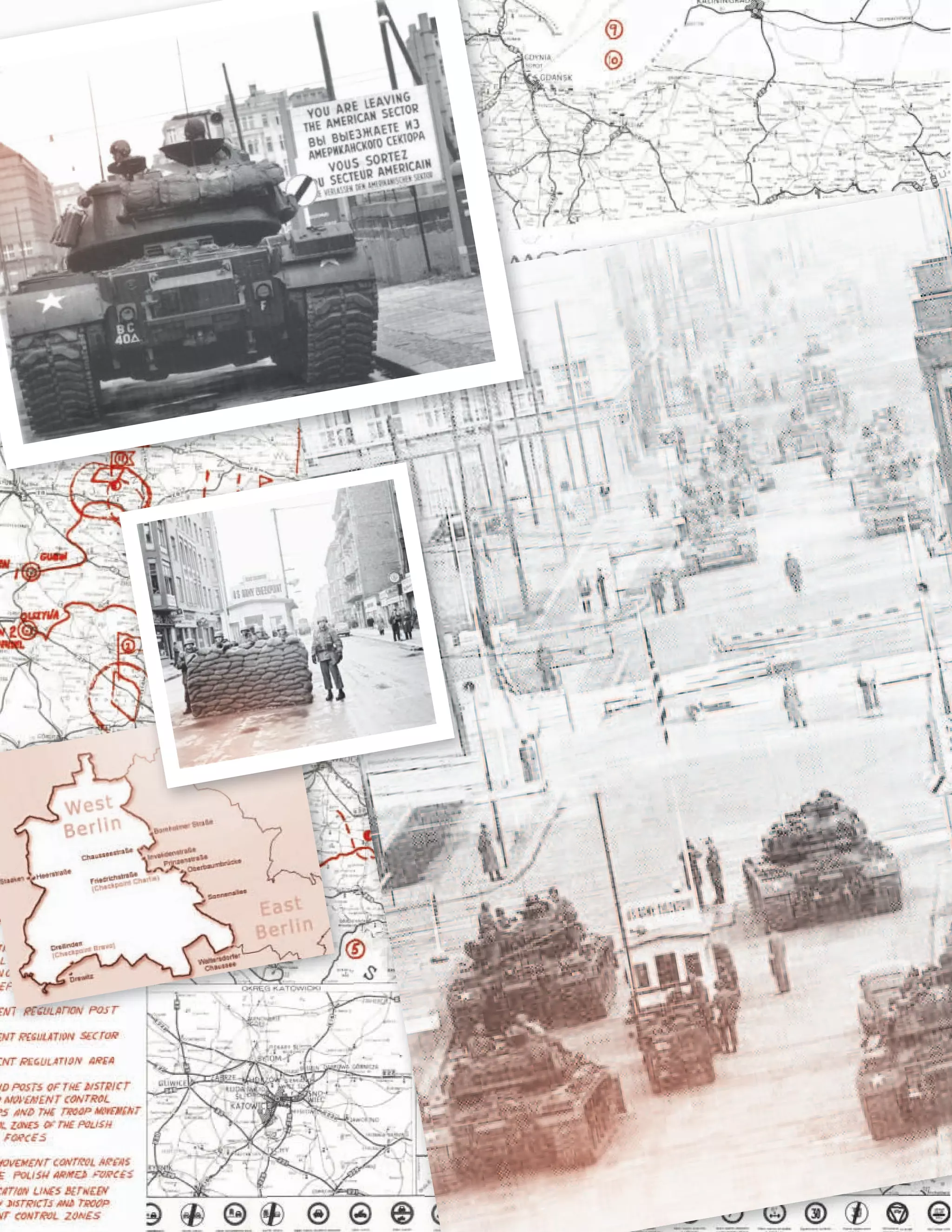
NATO to dissolve.
Te crisis proved to be an important milestone in the development
of both NATO and Warsaw Pact military thinking and planning.
Te strategic importance of what seemed to be overwhelmingly
strongSovietconventionalforcesfacingNATOinEuropebecame
starkly evident to the new US administration of John F. Kennedy.
Te attempted US responses to the crisis revealed the lack of
readiness of the Western forces and underscored the dangers to
the West of US reliance on the massive retaliation doctrine for
inter-Bloc confrontations short of general (total) war. Te crisis
was perhaps the greatest test of the solidarity and meaning of
NATO since the Berlin Airlift.25
It threatened to lead to direct
conventional military hostilities between NATO and the Warsaw
Pact ground forces that could easily escalate to nuclear warfare.
24 Op cit. On the Front Lines, Preface and Introduction, pp iii, v, 131-135. See also Foreign Relations of the United States (FRUS), 1948, Germany and Austria, Volume II, Chapter IV, “The Berlin
Crisis”, pages 867–1284, for more detailed information on this period of post-WWII Four Power occupation and administration of Germany and the ensuing crisis. The early FRUS volumes are
available through the Library website of the University of Wisconsin. 25 For a brief summary of the discussions in August 1961 of how Western countries saw future developments of the Berlin
situation and how they proposed to handle it, see Foreign Relations of the United States (FRUS) Vol. XIV, 372–73. The term, “Live Oak”, which appears in the FRUS discussion, was the code name
for Western Quadripartite Powers’ planning for a military confrontation within the larger context of NATO war planning.
13
’
C I A A N A L Y S I S O F T H E W A R S A W P A C T F O R C E S : T H E I M P O R T A N C E O F C L A N D E S T I N E R E P O R T I N G
Intelligence Sources and Analysis
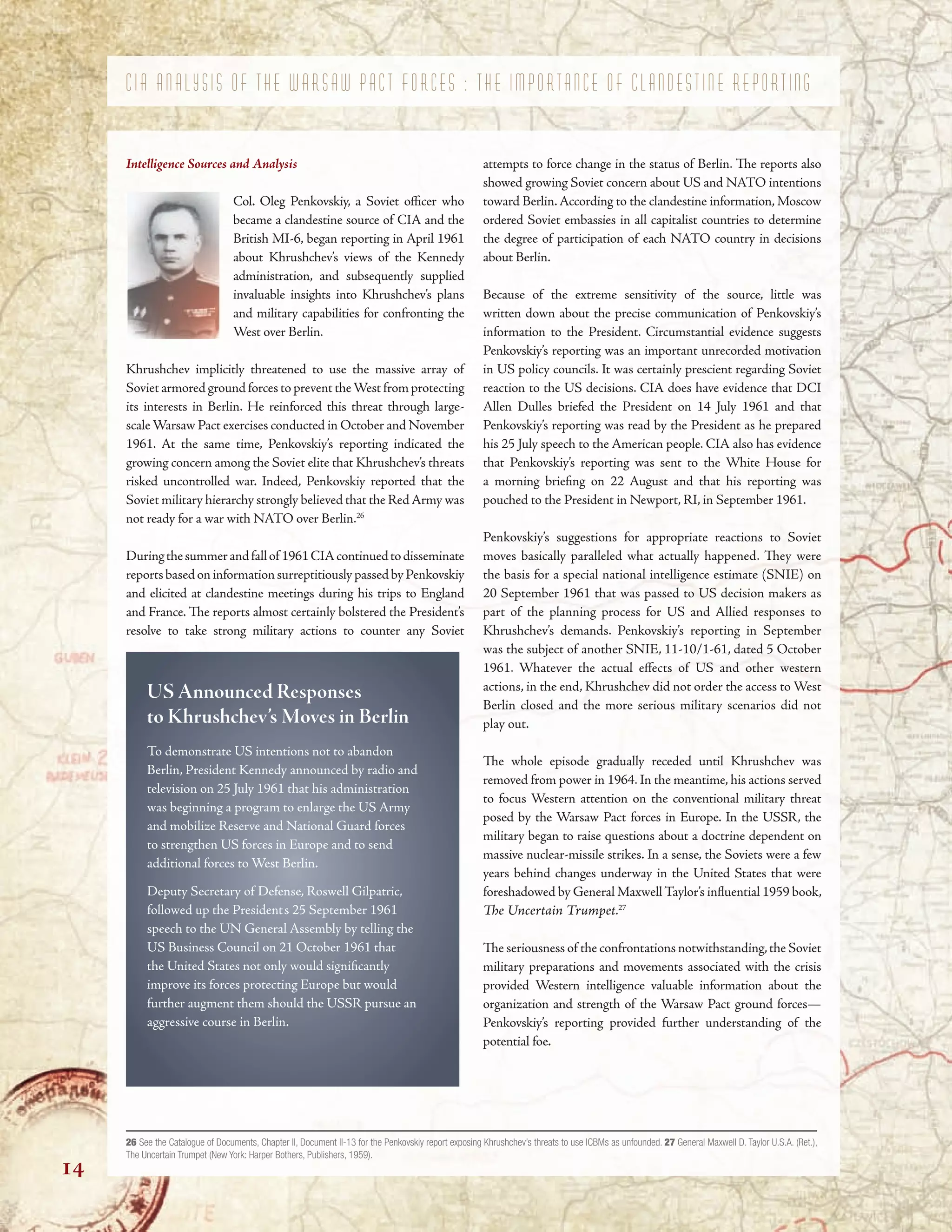
Col. Oleg Penkovskiy, a Soviet ofcer who
became a clandestine source of CIA and the
British MI-6, began reporting in April 1961
about Khrushchev’s views of the Kennedy
administration, and subsequently supplied
invaluable insights into Khrushchev’s plans
and military capabilities for confronting the
West over Berlin.
Khrushchev implicitly threatened to use the massive array of
Soviet armored ground forces to prevent theWest from protecting
its interests in Berlin. He reinforced this threat through large-
scale Warsaw Pact exercises conducted in October and November
1961. At the same time, Penkovskiy’s reporting indicated the
growing concern among the Soviet elite that Khrushchev’s threats
risked uncontrolled war. Indeed, Penkovskiy reported that the
Soviet military hierarchy strongly believed that the RedArmy was
not ready for a war with NATO over Berlin.26
Duringthesummerandfallof 1961CIAcontinuedtodisseminate
reportsbasedoninformationsurreptitiouslypassedbyPenkovskiy
and elicited at clandestine meetings during his trips to England
and France. Te reports almost certainly bolstered the President’s
resolve to take strong military actions to counter any Soviet
US Announced Responses
to Khrushchev’s Moves in Berlin
To demonstrate US intentions not to abandon
Berlin, President Kennedy announced by radio and
television on 25 July 1961 that his administration
was beginning a program to enlarge the US Army
and mobilize Reserve and National Guard forces
to strengthen US forces in Europe and to send
additional forces to West Berlin.
Deputy Secretary of Defense, Roswell Gilpatric,
followed up the Presidents 25 September 1961
speech to the UN General Assembly by telling the
US Business Council on 21 October 1961 that
the United States not only would signifcantly
improve its forces protecting Europe but would
further augment them should the USSR pursue an
aggressive course in Berlin.
attempts to force change in the status of Berlin. Te reports also
showed growing Soviet concern about US and NATO intentions
toward Berlin.According to the clandestine information, Moscow
ordered Soviet embassies in all capitalist countries to determine
the degree of participation of each NATO country in decisions
about Berlin.
Because of the extreme sensitivity of the source, little was
written down about the precise communication of Penkovskiy’s
information to the President. Circumstantial evidence suggests
Penkovskiy’s reporting was an important unrecorded motivation
in US policy councils. It was certainly prescient regarding Soviet
reaction to the US decisions. CIA does have evidence that DCI
Allen Dulles briefed the President on 14 July 1961 and that
Penkovskiy’s reporting was read by the President as he prepared
his 25 July speech to the American people. CIA also has evidence
that Penkovskiy’s reporting was sent to the White House for
a morning briefng on 22 August and that his reporting was
pouched to the President in Newport, RI, in September 1961.
Penkovskiy’s suggestions for appropriate reactions to Soviet
moves basically paralleled what actually happened. Tey were
the basis for a special national intelligence estimate (SNIE) on
20 September 1961 that was passed to US decision makers as
part of the planning process for US and Allied responses to
Khrushchev’s demands. Penkovskiy’s reporting in September
was the subject of another SNIE, 11-10/1-61, dated 5 October
1961. Whatever the actual efects of US and other western
actions, in the end, Khrushchev did not order the access to West
Berlin closed and the more serious military scenarios did not
play out.
Te whole episode gradually receded until Khrushchev was
removed from power in 1964. In the meantime, his actions served
to focus Western attention on the conventional military threat
posed by the Warsaw Pact forces in Europe. In the USSR, the
military began to raise questions about a doctrine dependent on
massive nuclear-missile strikes. In a sense, the Soviets were a few
years behind changes underway in the United States that were
foreshadowed by General MaxwellTaylor’s infuential 1959 book,
Te Uncertain Trumpet.27
Te seriousness of the confrontations notwithstanding,the Soviet
military preparations and movements associated with the crisis
provided Western intelligence valuable information about the
organization and strength of the Warsaw Pact ground forces—
Penkovskiy’s reporting provided further understanding of the
potential foe.
26 See the Catalogue of Documents, Chapter II, Document II-13 for the Penkovskiy report exposing Khrushchev’s threats to use ICBMs as unfounded. 27 General Maxwell D. Taylor U.S.A. (Ret.),
The Uncertain Trumpet (New York: Harper Bothers, Publishers, 1959).
14
C I A A N A L Y S I S O F T H E W A R S A W P A C T F O R C E S : T H E I M P O R T A N C E O F C L A N D E S T I N E R E P O R T I N G
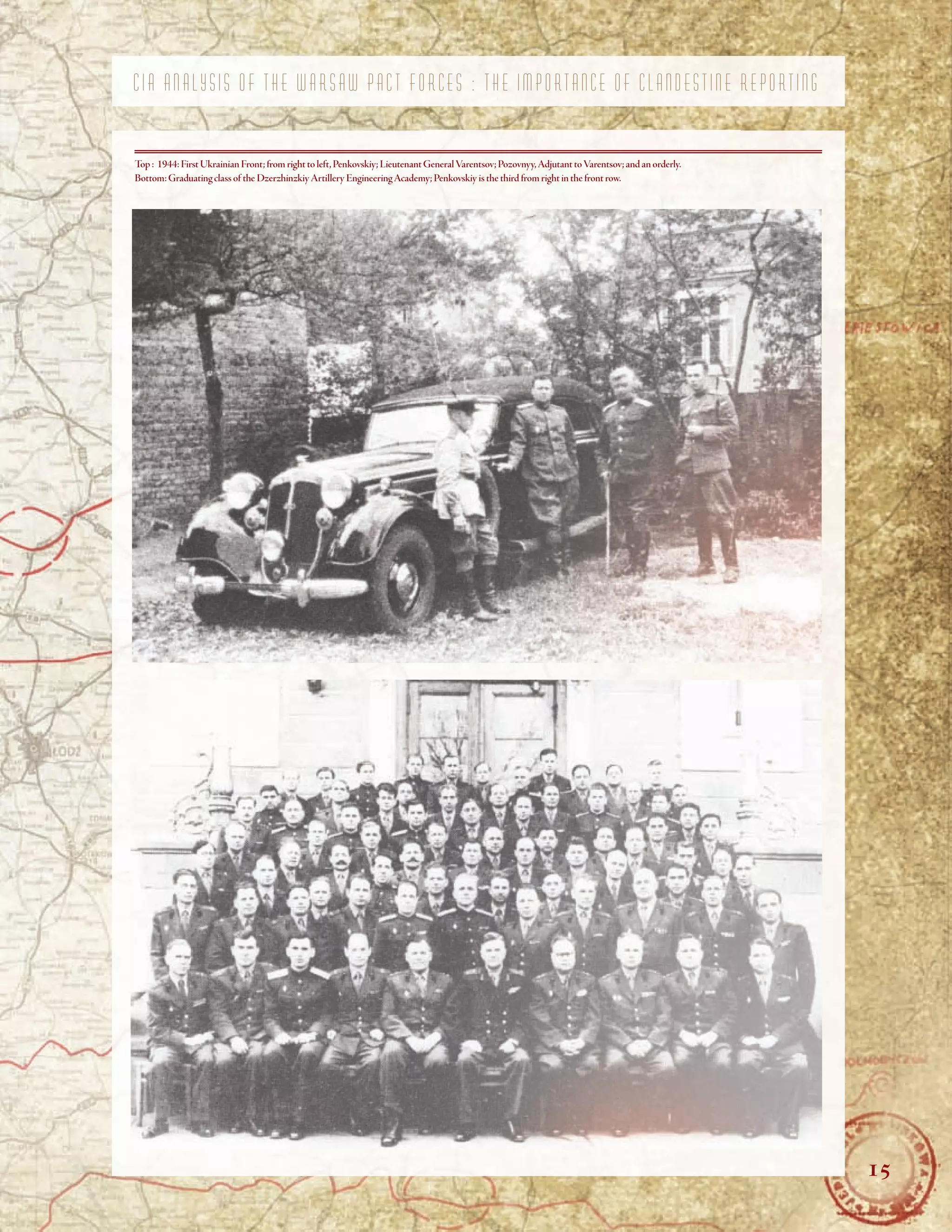
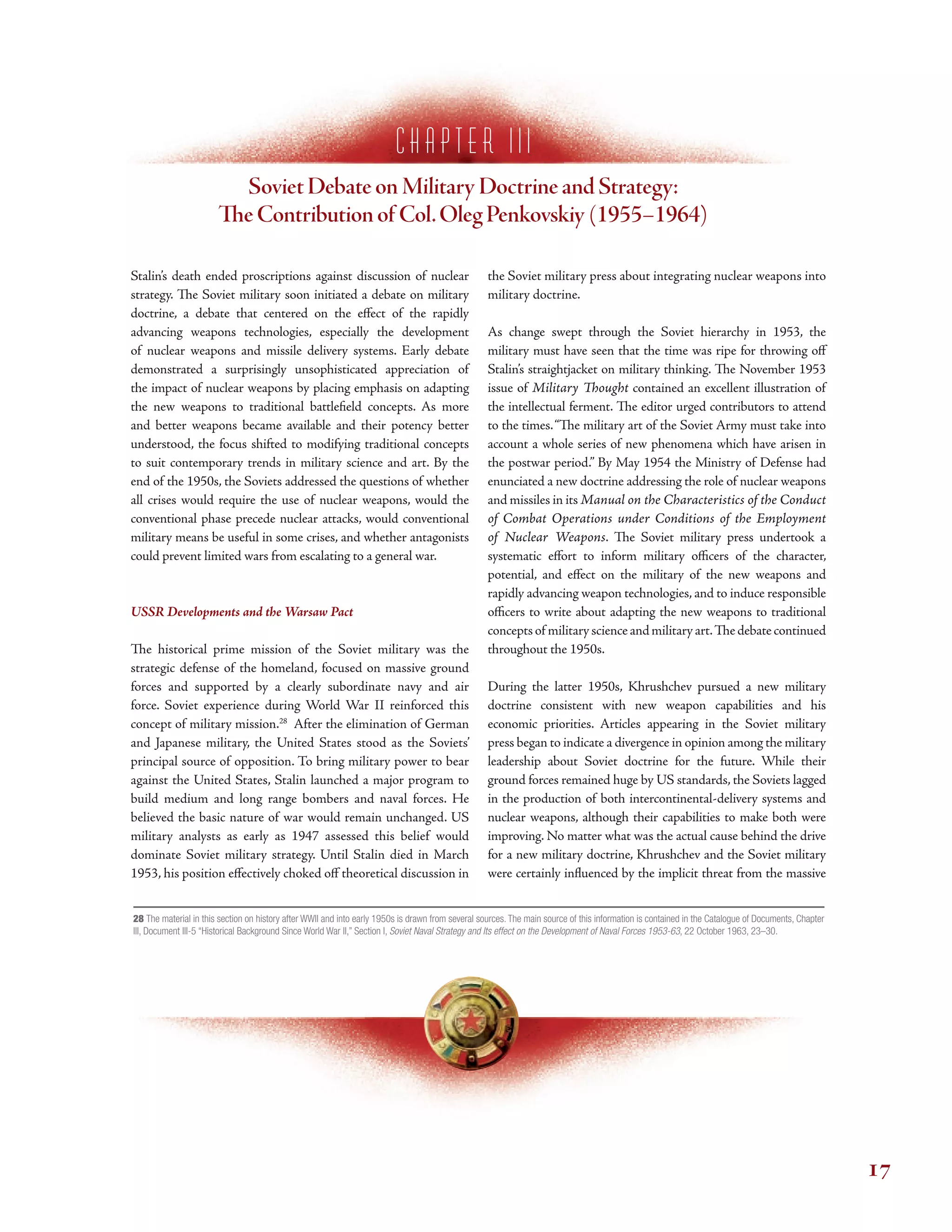
Top : 1944:First Ukrainian Front;from right to left,Penkovskiy;Lieutenant GeneralVarentsov;Pozovnyy,Adjutant toVarentsov;and an orderly.
Bottom:Graduating class of the DzerzhinzkiyArtillery EngineeringAcademy;Penkovskiy is the third from right in the front row.
15
“
’
”
‘
’
”
sets the theme for the entire series. In‘Te Teory
of Military Art Needs Review, found in the Top
Secret Military Tought Special Collection Issue
No.1, 1960, he discusses the need for a new Soviet
military doctrine based on the availability of
missiles to deliver weapons thousands of kilometers.
He describes how wars conducted with nuclear
weapons will reduce industrialized countries to
wastelands in a brief period, thus eliminating the
necessity of maintaining large ground forces.
“Te article by General of the Engineering-
Technical Service Makar F. Goryainov, titled
Nuclear Missile Armament and Some Principles
of Military Doctrine, Military Tought Special
Collection Issue No.2, 1960, compares the views of
Soviet, American and British generals on the roles
of nuclear weapons and missiles in war. Goryainov
states, for example, that the Americans require
nuclear weapons to be used in ways that minimize
radioactive contamination. In contrast, Goryainov
champions maximum radioactive contamination
of industrial and population centers to shorten the
duration of war and lessen the need for massive
ground troops.
*ThePenkovskiyPapers(NewYork:Doubleday&Company,Inc.,1965),243–45.
Penkovskiy’s Comments on Two
1960 Top Secret Articles from
Military Thought*
Lieutenant General Gastilovich [probably Col.
Gen A. I Gastilovich], deputy commandant of the
Military Academy of the General Staf (1958-64)
c h a p t e r I I i
Soviet Debate on Military Doctrine and Strategy:
Te Contribution of Col.Oleg Penkovskiy (1955–1964)
Stalin’s death ended proscriptions against discussion of nuclear
strategy. Te Soviet military soon initiated a debate on military
doctrine, a debate that centered on the efect of the rapidly
advancing weapons technologies, especially the development
of nuclear weapons and missile delivery systems. Early debate
demonstrated a surprisingly unsophisticated appreciation of
the impact of nuclear weapons by placing emphasis on adapting
the new weapons to traditional battlefeld concepts. As more
and better weapons became available and their potency better
understood, the focus shifted to modifying traditional concepts
to suit contemporary trends in military science and art. By the
end of the 1950s, the Soviets addressed the questions of whether
all crises would require the use of nuclear weapons, would the
conventional phase precede nuclear attacks, would conventional
military means be useful in some crises, and whether antagonists
could prevent limited wars from escalating to a general war.
USSR Developments and the Warsaw Pact
Te historical prime mission of the Soviet military was the
strategic defense of the homeland, focused on massive ground
forces and supported by a clearly subordinate navy and air
force. Soviet experience during World War II reinforced this
concept of military mission.28
After the elimination of German
and Japanese military, the United States stood as the Soviets’
principal source of opposition. To bring military power to bear
against the United States, Stalin launched a major program to
build medium and long range bombers and naval forces. He
believed the basic nature of war would remain unchanged. US
military analysts as early as 1947 assessed this belief would
dominate Soviet military strategy. Until Stalin died in March
1953, his position efectively choked of theoretical discussion in
the Soviet military press about integrating nuclear weapons into
military doctrine.
As change swept through the Soviet hierarchy in 1953, the
military must have seen that the time was ripe for throwing of
Stalin’s straightjacket on military thinking. Te November 1953
issue of Military Tought contained an excellent illustration of
the intellectual ferment. Te editor urged contributors to attend
to the times.“Te military art of the Soviet Army must take into
account a whole series of new phenomena which have arisen in
the postwar period.” By May 1954 the Ministry of Defense had
enunciated a new doctrine addressing the role of nuclear weapons
and missiles in its Manual on the Characteristics of the Conduct
of Combat Operations under Conditions of the Employment
of Nuclear Weapons. Te Soviet military press undertook a
systematic efort to inform military ofcers of the character,
potential, and efect on the military of the new weapons and
rapidly advancing weapon technologies, and to induce responsible
ofcers to write about adapting the new weapons to traditional
conceptsof militaryscienceandmilitaryart.Tedebatecontinued
throughout the 1950s.
During the latter 1950s, Khrushchev pursued a new military
doctrine consistent with new weapon capabilities and his
economic priorities. Articles appearing in the Soviet military
press began to indicate a divergence in opinion among the military
leadership about Soviet doctrine for the future. While their
ground forces remained huge by US standards, the Soviets lagged
in the production of both intercontinental-delivery systems and
nuclear weapons, although their capabilities to make both were
improving. No matter what was the actual cause behind the drive
for a new military doctrine, Khrushchev and the Soviet military
were certainly infuenced by the implicit threat from the massive
28 The material in this section on history after WWII and into early 1950s is drawn from several sources. The main source of this information is contained in the Catalogue of Documents, Chapter
III, Document III-5 “Historical Background Since World War II,” Section I, Soviet Naval Strategy and Its effect on the Development of Naval Forces 1953-63, 22 October 1963, 23–30.
17
’
“ ”
“ ”
”
of a doctrine that denigrated their signifcance. Penkovskiy
presented the West with the Soviet idealized view of military
doctrine as well as the practical consequence of contemporary
Sovietreality.Forexample,heexplainedtheSovietshaddeployed
no intercontinental ballistic missiles (ICBMs) in 1960 and
1961, despite statements implying they had massive numbers
of intercontinental strike systems. Penkovskiy’s information
on Khrushchev’s military contingency plan for the Berlin crisis
illustrated again the gap between the new doctrinal positions
and military realities in the early 1960s.
Intelligence Sources and Analysis
Te eforts of CIA to understand the Soviet–Warsaw Pact
forces increased steadily during this period, as Secretary of
Defense McNamara and other ofcials of the Kennedy and
Johnson administrations asked CIA to address a broader array
of questions about Soviet military capabilities. Analysts from
the DI’s Ofce of Research and Reports (ORR) and the DI
Research Staf in 1964 contributed to the frst NIE devoted
exclusively to Soviet and East European theater forces. CIA
29 The Soviets continued to publish a secret edition of Military Thought.
C I A A N A L Y S I S O F T H E W A R S A W P A C T F O R C E S : T H E I M P O R T A N C E O F C L A N D E S T I N E R E P O R T I N G
American nuclear forces, the accession of West Germany into
NATO, and a West German rearmament program. During this
period the Soviet military did reach an uneasy consensus on the
place of nuclear weapons in its operational doctrine. Te Field
Services Regulations issued on 2 March 1959—and passed to the
West by Penkovskiy in 1961—represented the culmination of the
line of military thought evident after the death of Stalin. Almost
as soon as it was published, however, it was overtaken by agitation
for a dramatically new direction in military theory.
Seeing the potential of the nuclear arms as a cheap and fexible
means of providing greater security and prominence for the
USSR, Khrushchev outlined a new military policy in his report
to the Supreme Soviet in January 1960.His plan in essence was to
rely mainly on nuclear-missile forces,to reduce military manpower
substantially, and to accelerate the retirement of older weapons.
Tis, he asserted, was the force structure best suited both to
advance Soviet political and economic interests, and to fght a
war when necessary. Khrushchev’s speech set of an impassioned
debate among the Soviet military in open-source and classifed
publications.
In 1960 the Soviets began publishing a Top Secret “Special
Collection” of Military Tought29
that had limited distribution.
It provided a forum for high-ranking military ofcers to debate
the problems of fghting a future war in the context of forces
equipped with a multitude of long-range nuclear weapons.
Under Khrushchev’s apparent tutelage, several well-placed Soviet
general ofcers proposed a doctrine for conquering Europe that
relied heavily on massive nuclear strikes. It assigned little role to
conventional ground forces or to the Warsaw Pact allies except
perhaps for air defense of the approaches to the Soviet Union.Te
more conservative elements of the military opposed much of this
new thinking. Tese“traditionalists” began to question reliance on
a military doctrine dependent almost solely on massive nuclear-
missile strikes and instead posited the need for large armored
forces as well. Beginning in 1961, Colonel Penkovskiy passed this
series of classifed articles to the West.
In addition to the Military Tought articles, Penkovskiy drew
on his ties to some of the most senior ofcers in the Ministry
of Defense and related organizations to supply priceless
commentary about Soviet intentions, Soviet military leadership
thinking on the character of war, Soviet and Warsaw Pact
capabilities, and the organization of Warsaw Pact forces for
war. He reported Soviet ofcers were concerned about the
readiness of the military to face a confrontation with the United
States and NATO that might result from Khrushchev’s threats
to sign a separate treaty with East Germany. He provided
invaluable insight into Khrushchev’s inclination to use a massive
concentration of conventional weapons, especially tanks, in
confrontations with the West, notwithstanding his championing
US Discussions
Following Dwight Eisenhowers inauguration in
January 1953, his administration reviewed the
US military and formulated a policy it called
the New Look. Tis policy sought to deter
communist aggression of any sort by threatening
prompt nuclear reprisal. Te resulting doctrine
of massive retaliation focused on the delivery, by
bombers and later by missiles, of hundreds, if not
thousands, of nuclear weapons against an enemy.
Accordingly, the United States sharply increased
the size and capability of its nuclear armed air
forces and drastically reduced resources allocated
to US ground forces. It also accorded low priority
in military doctrine and strategy to tactical air
forces that did not deliver nuclear weapons.*
In 1961, however, the Kennedy administration
shifted US doctrine toward a full spectrum of
nonnuclear and nuclear capabilities, especially
after the experience of the Berlin crisis.
* For more on this policy, see History of the Offce of the Secretary of
Defense, “Strategy , Money and the New Look, 1953-1956, Volume
III, Richard M. Leighton, Historical Offce of the Secretary of Defense,
Washington, D.C. 20001.
18
C I A A N A L Y S I S O F T H E W A R S A W P A C T F O R C E S : T H E I M P O R T A N C E O F C L A N D E S T I N E R E P O R T I N G
devoted more analytic resources to these issues, but not until
1967 did it establish the Ofce of Strategic Research (OSR)
in the DI to focus on military analysis of the Soviet–Warsaw
Pact forces, and other target military forces, capabilities,
and intentions.
During the same period CIA and other IC analysts gained two
new tools with which to develop estimates of Soviet military
capabilities and intentions:
→ Photography from the Corona satellite program supplied
information on force locations and new developments with
much greater accuracy than any previous system.
→ Clandestine reporting by Colonel Penkovskiy provided the
frst high-level insight into the development of Soviet military
hardware and strategy and a wealth of data about the military
establishment.
Analysts now could determine how the Soviets envisioned their
total force from intermediate-range ballistic missiles (IRBMs)
to infantry and tank regiments would operate against NATO
in Europe. Analysts began to understand, moreover, some of the
discontinuities that characterized developments in the Soviet
forces and as they were implied by Soviet military doctrine.
Penkovskiy’s clandestine reporting remained relevant long
after the KGB apprehended him in 1962 because much of it
represented the discussion by senior ofcers of major issues in
Soviet military thinking for the future development of weapons
and strategy. For more than 10 years, the IC continued to base
analyses on his reporting about Warsaw Pact plans, capabilities
and intentions about developments in Soviet strategic thought,
even as other, more circumstantial evidence became available.
When key East European clandestine sources began supplying
information in the late 1960s and early 1970s, the Penkovskiy
collection helped validate the relevance of the new evidence for
evaluating the Warsaw Pact, proving the enduring value of the
work of this remarkable Russian.
Documents written by Marshal of the Soviet Union R.Ya.Malinovskiy,obtained for the United States by Oleg Penkovskiy.
19
From Cold War International History Project, CWIHP.org, used with permission.
c h a p t e r I V
New Insights into theWarsaw Pact Forces and Doctrine –
Te Cuban Missile Crisis (1962)
Tis chapter highlights the importance of the clandestine
reporting before and during the Cuban Missile Crisis, the
relationship of the reporting to the general NATO–Warsaw
Pact equation, and the impact of analytic experience gained
during the crisis in evaluating the reporting.
Khrushchev’s Gamble Provides an Intelligence Bonanza
After the failure of his Berlin gambit and with the US advantage
in intercontinental attack capabilities growing, Khrushchev in
a break with precedent launched the frst major expeditionary
force outside the Soviet orbit since WWII. Te Soviet plans in
May 1962 called for the deploying to Cuba a large number of
strategic-range guided missiles with an integrated military force
to protect them.30
In their discussions of Soviet military doctrine in 1960–61, the
Soviets hotly contested the role of medium-range ballistic missiles
(MRBMs) and IRBMs in Soviet strategy and operations against
NATO. Most participants in the internal high-level military
debates posited the decisive importance of having those missiles to
destroy the enemy’s nuclear weapons located deep in the theater,
beyond the range of tactical aviation. Tey argued for leaving the
destruction of US-based nuclear delivery systems to the ICBMs
and long-range bombers of the Supreme High Command. Some
protagonists insisted that the nuclear forces, especially MRBMS
and IRBMs, could defeat NATO without much assistance
from the ground forces beyond some minor mopping up and
occupation tasks. By early 1962, the principals seemed to be
reaching a consensus that combining missile and conventional
land forces was the correct operational solution.
Te mix of forces involved in Khrushchev’s Cuban adventure—
missile, ground, air, air defense, coastal defense, and naval—
generally copied those deployed against NATO. Indeed, the
specifc forces sent to Cuba came from larger groupings in
the western USSR, whose contingent mission had been the
destruction of NATO in Europe. Te special Top Secret series
of Military Tought described various proposals to integrate
long-range missiles into theater war planning and utilize the
shorter range nuclear-armed rockets known as FROGs that were
deployed with the Soviet and other Warsaw Pact ground armies
in Europe. Te composition of the Soviet Group of Forces sent
to Cuba refected real preferences of the military leadership when
confronted with an unrehearsed potential combat situation.
Te deployment to Cuba of a virtual cross section of these forces
provided military intelligence analysts, for the frst time, an
important example of what Soviet forces looked like when they
were out of garrison and away from the supporting infrastructure
of their Warsaw Pact Allies. It also allowed analysts to factor out
other confusing aspects of military operations like mobilization.
Intelligence Sources and Analysis
Not evident in contemporary intelligence publications because of
its sensitivity was the real contribution of Col. Oleg Penkovskiy.
Even though he was unable to provide any information about
the actual Soviet deployment of forces to Cuba, he had already
delivered technical specifcations and detailed operational
information on the types of missiles that the USSR sent in the fall
of 1962. Penkovskiy had managed to photograph and pass highly
sensitive documents that proved invaluable during the crisis.Tey
were the source for most of the understanding analysts had of feld
30 See Mary S McAuliffe, ed., Cuban Missile Crisis 1962 (Washington, DC: Center for the Study of Intelligence, 1992) for many of the intelligence documents issued during the crisis period as
well as a sample of the clandestine reporting from the CIA’s Cuban sources. This study is available on CIA’s website, www.cia.gov. 31 FROG is the acronym for “Free Rocket over Ground,” the
name for large unguided missiles.
21
C I A A N A L Y S I S O F T H E W A R S A W P A C T F O R C E S : T H E I M P O R T A N C E O F C L A N D E S T I N E R E P O R T I N G
deployment and standard operating procedures for missile forces,
the time required to achieve diferent levels of readiness, and
the camoufage the Soviets prescribed to hide their forces, all of
which contributed to US response decisions during the Cuban
Missile Crisis.
Other information from Penkovskiy provided the basis for the
analytical judgments that allowed the United States to calculate
reaction times, capabilities, and limitations of the deployed Soviet
air defense missile systems. Te descriptions and the technical
specifcations of the“V-75” or SA-2, a surface-to-air missile, and
the discussions in the Top Secret 1960–61 special collection
Military Tought series about the limitations of the SA-2 and
the overall air defense organization disclosed critical Soviet
vulnerabilities to high-speed low-level air attack.Tis information
enabled US tactical reconnaissance planes to fy frequently over
Cuba and monitor the status of Soviet missile deployments and
other militarily important targets without the loss of a single
low fying reconnaissance aircraft. Tis information would have
been even more critical had the United States implemented
plans calling for more than 500 sorties in the frst day for the
neutralization or destruction of Soviet missiles, the invasion of
Cuba, and the destruction or capture of the Soviet ground and air
forces deployed there.32
After Khrushchev agreed to remove the
missiles and light bombers from Cuba, analysts relied on imagery,
clandestine reporting, and information from Cuban immigrants
to verify that no MRBMs remained and the agreement was met.33
In addition to the Military Tought articles, Penkovskiy supplied
invaluable commentary about general Soviet intentions,the Soviet
military leadership’s thoughts about the nature of war, Soviet and
Warsaw Pact military capabilities, and the organization of the
Warsaw Pact forces for war. All of this contributed to Kennedy’s
confdence in the judgments reached by the intelligence analysts.
Although Penkovskiy talked earlier with US intelligence ofcers
about Soviet military aid to Cuba following the April 1961 Bay
of Pigs disaster, he was unable to warn or give any details of the
buildup of forces in Cuba. Clandestine sources in Cuba, however,
supplied enough timely information about developments on
the ground to prompt the United States to launch the U-2
reconnaissance fights that yielded detailed, incontrovertible
evidence of the Soviet deployment.
In sum, there were three major types of human intelligence
sources during the Cuban Missile Crisis.
Te inside source, Colonel Oleg Penkovskiy, who provided
Soviet classifed documents that greatly helped military
analysts understand how the Soviets set up and conducted
missile operations.
Cuban refugees, who described being displaced from their
farms, and thus furnished clues about where Soviet deployed
the missiles.
Clandestine sources inside Cuba, who delivered information
that cued US fight plans for reconnaissance aircraft.
Cuban Missile Crisis,1962
SA-2Air Defense Missiles
32 See FRUS 1961-1963 Volume XI, p. 267, The Cuban Missile Crisis and Aftermath, Department of State, Washington, DC, 1996. 33 Ibid.
22
C I A A N A L Y S I S O F T H E W A R S A W P A C T F O R C E S : T H E I M P O R T A N C E O F C L A N D E S T I N E R E P O R T I N G
U-2 Overfights of Cuba,October 1962
23
c h a p t e r V
New Estimates of the Soviet Ground Forces (1963–1968)
In early 1963, Secretary of Defense McNamara wrote DCI John
McCone to convey his concern that US national intelligence
estimates about Soviet forces and capabilities34
were “causing
NATOAllies and manyAmericans to despair of the possibility of
achieving adequate non-nuclear forces.” Te Secretary of Defense
stated that he believed “the estimates of the strength of the Soviet
ground forces…contained in NIE 11-14-62 were overstated.”
Referring to the NIE, he wrote that he “could not understand
how the Soviets, with the resources available to them, could
have the number of ‘well-trained divisions equipped with the
excellent materiel’ that the IC was estimating they had, when the
United States could not aford even half that number of forces.”
McNamara requested the DCI and the Director of the Defense
Intelligence Agency (D/DIA) to reexamine the estimates. In the
spring of 1963, a team of CIA and DIA intelligence analysts was
formed to address these concerns and to produce a joint study.
Defning the Problem
According to the ofcer in charge of the CIA efort, Dr. Edward
Proctor, estimating the size and capabilities of Soviet forces in
general posed problems; a Soviet division, for example, was not
likeaUSdivision.35
Analystshadassessedthegroundforcesonthe
basis of captured Soviet documents, observations and statements
by defectors, and bits and pieces of additional information. Tey
had little opportunity to confrm the continued existence of many
of the units known in the time of Stalin.
Te 1962 estimate,36
based on the contributions of the US
Army and the new DIA, had described a Soviet force of some 80
combat-ready divisions, with an additional 65 divisions“requiring
substantial augmentation before commitment to combat.” It
also calculated that, given 30 days to mobilize before hostilities
began, the Soviets could expand their total forces to about 100
combat-ready divisions and 125 others less well prepared. Earlier
estimates had calculated a Soviet Army of 175 active divisions
and an additional 125 available in 30 days.37
It is no wonder the
Secretary of Defense wanted a better appraisal. Te joint team of
CIA and DIA analysts was instructed to discard all past positions
and to start from scratch to determine the number of divisions the
Soviets actually had in 1962. New intelligence from Penkovskiy
and satellite photography38
made possible a critical review and
revision of the previous estimates.
Revising the Estimates of the Strength
of Soviet–Warsaw Pact Forces
By the time the Secretary of Defense made his request for a new
study, the analysts had accumulated much information about
Soviet ground forces:
Te reductions39
and reorganizations in the 1950s provided
insight into the modifcations of the organization of the combat
divisions of the ground forces to about 1960.
Information from Popov, Penkovskiy, and other sources of
military writings provided insights into the changes in the
ground forces on an aggregate level.
Te 1961 Berlin and 1962 Cuban crises provided additional
insights into the organization,size and operational planning for
the Warsaw Pact Ground Forces.
34 Ibid. Catalogue of Documents, Chapter V, Document V-13. p 3, reported that Soviet ground forces were defned to include “those Soviet military personnel performing functions similar to most
of those performed by the US Army with the principal exception of continental air defenses.” 35 Edward Proctor interview with John Bird, 22 April 2008. 36 See Catalogue of Documents, Chapter
V, Document V-8a for the 1962 NIE 11-14-62, Capabilities of Soviet Theater Forces. 37 See Catalogue of Documents, Chapter I, Document I-78, NIE 11-4-58, page 43. 38 Low-resolution satellite
photography began covering military installations in 1960. 39 See Catalogue of Documents, Chapter VI, Document VI-7, page 4, Caesar XXVI,Warsaw Pact Military Strategy: A Compromise in Soviet
Strategic Thinking, for a summary of various Soviet announcements of reductions in forces and reassignments from the Warsaw Pact countries during the period 1958–65.
25
C I A A N A L Y S I S O F T H E W A R S A W P A C T F O R C E S : T H E I M P O R T A N C E O F C L A N D E S T I N E R E P O R T I N G
Nonetheless, determining the details of the changes unit by unit
had still been beyond what the evidence would bear. Moreover,
because of the lack of specifc information about the Soviet
reorganizations of the early 1960s,analysts were less certain about
current organizational standards. In the words of the authors of
the Joint CIA-DIA Panel Study in 1963:“In the mid-1950s good
insights into divisional and other TO&Es [tables of organization
andequipment]wereobtainedfromclandestineanddocumentary
sources.Tus far,information of similar quality is not available for
the TO&Es of divisions reorganized since the 1960s.”40
Te Joint Study authors described the problem they needed
to address and the process they devised to accomplish the
assessments as they saw them at the time:
“For the assessment of the personnel strength of
the Soviet ground forces by unit or in the aggregate
there is no unique type of intelligence source that
has as yet become available. Te process is one
of gathering fragmentary bits of information in
print from which inferences can be drawn with
varying degrees of confdence. In general, the
statements that are made regarding the quality
of each source of information are applicable to
questions of Soviet personnel strengths. Attachés
and military liaison ofcers can gain general
appreciations of manning levels at the various
installations they observe, but the presence of
reservists in training or the co-location of units
usually obscures the meaningfulness of such
appreciations. In East Germany approximate
head counts could be made for small units when
such units were en route as units. Similarly,
defectors and repatriates, covert sources and
informants can provide reasonably trustworthy
indications with respect to the small units in
which they have served. However, more broadly
knowledgeable sources had been rare.”41
Te satellite photographic coverage of the whole USSR made
it possible for the frst time to ascertain the existence of most of
the division sized units in 1963. Questions did remain, however,
because of the rudimentary quality typical of the early satellite
photography.
In the Second Panel Report—on Soviet Ground forces—
completedin1965,theauthorsnotedthatforassessingproduction
and inventory of land armaments:
Te collective output from [all] sources [to 1963]
has proved disappointing in quality, timeliness
and comprehensiveness. In addition none of the
sources has provided consistent coverage over the
period since World War II. Tis situation is not
surprising in view of the nature of the problem.
Land combat equipment and ammunition
represent a wide variety of comparatively small
items. Production can be dispersed widely in a
number of diferent types of plants. Storage can
be accomplished in a variety of ways with little
difculty. Diferent models may appear identical
to all but trained observers.
Even Penkovskiy, with his access in the highest levels in the
Ministry of Defense, was unable to provide information on the
rates of production or inventories of land armaments.
Te CIA/DIA team analyzed each division of ground forces
by combining Penkovskiy’s information on the Soviet theory
of mobilization and peacetime readiness of forces with newly
available satellite photography. Even though the satellite photos
were of poor quality for this task, the classifed Soviet military
documents supplied by Penkovskiy and the evidence provided by
other human sources enabled the estimative process to proceed.
Te Joint Study concluded that:
With a high degree of confdence between 115–135 Soviet
ground forces divisions, including 22–45 cadre (skeleton)
divisions existed in the frst half of 1963.
Te total number could be as low as 100 or as high as 150.
Te cadre divisions had few troops but could be feshed out
with reservists in order to participate in a subsequent stage of
the war.
Te study found no basis for the 125 additional divisions to be
mobilized in 30 days mentioned in earlier estimates. Clearly,
however, the Soviet army was larger in many respects than the
ground forces of NATO but signifcantly smaller than the analysts
previously thought. Unanswered questions about the quality of
those forces remained. Nonetheless, the doctrinal discussions in
the documents Penkovskiy passed to the West put the seemingly
confusing picture of the whole ground forces’ establishment into
meaningful perspective.
40 This refers to the TO&Es Popov provided in the mid-1950, see Catalogue of Documents, Chapter I, Documents I-15, I-67, I-68, I-69, I-70, I-71, I-72. 41 Ibid. Catalogue of Documents, Chapter
V, Document V-13, page 55.
26
C I A A N A L Y S I S O F T H E W A R S A W P A C T F O R C E S : T H E I M P O R T A N C E O F C L A N D E S T I N E R E P O R T I N G
Clarifying the Estimate of Capabilities
and Mobilization of Soviet–Warsaw Pact Forces
After addressing the questions about the quantity of forces,
the next all-source analytic challenge was to understand the
qualitative distinctions between theory and practice. Secretary
McNamara again requested a CIA-DIA team of analysts
be brought together. Troughout 1967 and 1968, this team
sought better estimates of the capabilities of the Warsaw Pact
to mobilize forces and strengthen the area opposite NATO in
the central region of Europe. Te important question was how
well the Soviets could carry out the intentions described in their
writings—specifcally, how well the divisions were manned and
equipped and how well the rear echelons could transport and
supply war materiel to combat units in order to meet Soviet
requirements for a war with NATO.
Studying the 1962 Soviet expedition to Cuba increased the
confdence of military analysts in estimates of what a full regiment
might look like. Soviet Ministry of Defense classifed documents,
such as the 1959 Field Service Regulations of the Armed
Forces of the USSR and the 1962 draft of the revised version,
informed them on how the forces generally would be used. Pieces
of evidence about the process of mobilization and reinforcement,
found within numerous Soviet classifed documents copied by
Penkovskiy, provided an increasingly clear picture of the Soviet
forces aimed at NATO. Nonetheless, it was also clear that the
observations and other evidence of Soviet military units suggested
a gap between what the theoretical journals described and the
actual condition of typical Soviet units on the ground.
Te analysis improved signifcantly once high resolution imagery
from KH-7 satellites became available during the period 1965–
68. Analysts combined this information with the evidence from
human sources,reconstructed their view of the organization of the
Soviet divisions, and judged their actual size and readiness. Tere
were, of course, many more ingredients involved in the all-source
analysis, but the synergistic efects of the documentary and other
human source evidence with the new higher resolution imagery of
the KH-7 system constituted the basis of major improvements in
the analysis of Warsaw Pact ground forces. Tese improvements
were evident in the marked diferences, for example, between the
contributions to NIE 11-14-67 and NIE 11-14-68. Te latter
estimate contained a much more detailed assessment of the forces,
including their overall size and intended use in operations against
the West, than had existed since the end of WWII.
By 1969 the CIA assessed that military analysis during the
1960s had made strides in understanding Soviet capabilities for
conducting a war against NATO in the Central Region,but it had
not answered all of Secretary McNamara’s questions:
Major areas of uncertainty about the capabilities
of the Soviet ground forces remain. Te most
signifcant gap is in the understanding of service-
support organization and capabilities above
the level of the division. Te detailed study of
Soviet logistical capabilities requires diferent
methodologies than have been applied to the
study of the combat forces, and depends to a
greater degree on sources of information other
than overhead photography. Considerable
uncertainty also remains about the peacetime
personnel strengths of combat support units
inside the USSR.42
Te two studies, however, had not addressed the Soviet plan for
conducting a war with NATO in the Central Region of Europe.
Tat study did not occur until June 1968.
Warsaw pact general purpose forces available for early commitment in central Europe.From NIE 11-14-69 Soviet and East European General Purpose Force.4 December 1969.
42 See Catalogue of Documents, Chapter V, Document V-61. Warsaw Pact Ground Forces Facing NATO, CIA/DI/OSR Intelligence Report, September 1969.
27
c h a p t e r V I
Turmoil in the Soviet Sphere (1962–1968)
Te Demise of Khrushchev
Te Soviet Communist Party expelled Khrushchev from ofce
in October 1964. During his last two years in power, many of
his policies were halted or reversed. His tactics during the Berlin
crisis had failed to bring about control of West Berlin, and he
had to abandon his proposal for a separate peace treaty with East
Germany.43
Worse, the Berlin crisis drew the NATO countries
closer together and motivated the Western alliance to improve its
defenses. Khrushchev’s Cuban gamble, moreover, ended in retreat
when the United States forced him to remove the missiles. Tese
failures humiliated him and the other Soviet leaders and exposed
Soviet strategic inferiority to the world. Te hangover from the
two debacles would afect Soviet political and military policies
well into the following decades.
In the aftermath of the two crises many of Khrushchev’s foreign
policy goals tied to the German question obstructed his desire
to improve East-West relations, including favorable stability in
Europe. Although the USSR concluded the Limited Test Ban
Treaty with the United States and the United Kingdom in 1963,
further eforts to manage the race in strategic weapons and ground
forces and to obtain nonaggression agreements stalled. Had he
achieved these goals, Khrushchev could have pressed forward
with economic, agricultural, and resource allocation reforms at
home and could have perceived opportunities to infuence political
changes in Western Europe to Soviet advantage, including the
USSR’s relationship with West Germany.
During the same period, fallout from the Sino-Soviet dispute
caused Khrushchev political problems in Europe and military
problems along the border with China. China initiated a
propaganda and diplomatic campaign in Europe that used
Khrushchev’s plan to visit West Germany as evidence of Soviet
intent to “sell out” East Germany in favor of West Germany.
China also made claims to some Soviet territory, prompting
Soviet military concern about the need to move troops there
from Europe. Te latter threat had implications for Khrushchev’s
goals to reduce Soviet forces and reallocate resources. Khrushchev
seemed to calculate that the need to maintain forces in Europe
and also along the Sino-Soviet border would prevent him from
shifting resources to the nonmilitary sector. All of which added
urgency to achieving his objectives in Europe.
Internal Warsaw Pact issues also plagued the Soviets. Albania
severed diplomatic relations with the USSR in December 1961
and expelled Soviet naval ships from the base they occupied.
Romania began to take a separate road on foreign policy,especially
with West Germany, culminating in its recognition of the Federal
Republic of Germany two months after Khrushchev’s ouster.East
Germany feared that rapprochement betweenWest Germany and
Moscow would weaken the position of Moscow on consolidating
the status quo in Germany. Bonn made overtures to the Soviet
Union for recognition, but clandestine reports indicated that,
before dismissing Khrushchev, the Politburo cancelled a plan for
him to visit Bonn.
AccordingtoCIAanalysisatthetime,inadditiontothecontinuing
repercussionsfromhisfailedpoliciesonBerlinandCuba,themany
reported charges against Khrushchev at his “trial” by the CPSU
Central Committee included his personal mishandling of the
Sino-Soviet dispute,the total failure of his agriculture polices,and
the fostering of a personality cult. Te analysis also indicated that
an immediate reason for Khrushchev’s ouster was the fallout from
his continued mishandling of German afairs during the period
1963 and 1964 and the plans he had for a plenum he had called
for November 1964. Despite his removal, however, Soviet–West
German policy, problems with East European allies, and internal
problems raised during the fnal two years of Khrushchev’s tenure
did not change fundamentally until later in the decade.
43 The treaty was ratifed in September 1964. Moscow had settled for a Friendship and Mutual Assistance Treaty as a panacea for East Germany in place of the unattainable Peace Treaty in June
1964, about four months prior to Khrushchev’s ouster. The treaty was ratifed in September 1964.
29
NATO. Both achievements protected Soviet vital interests. these sources to work for the West. Some were extraordinarily
C I A A N A L Y S I S O F T H E W A R S A W P A C T F O R C E S : T H E I M P O R T A N C E O F C L A N D E S T I N E R E P O R T I N G
Te Brezhnev-Kosygin Team
Following the selection of Brezhnev as general secretary and
Kosygin as premier to succeed Khrushchev in 1964, CIA
analysts characterized the new“collective” leadership as cautious
and conservative, one consumed by internal debates and political
maneuvering to consolidate their positions. Astutely and in
contrast to his predecessor, Brezhnev relied on the military for
advice on strategic defense policy issues.His policies emphasized
persistent international dangers, such as the 1966 US military
expansion in Vietnam. He backed the military on the utility
of conventional forces and supported increasing the strategic
forces. He defended the interests of the military by buttressing
investment in heavy industry and the defense sector of the Soviet
economy. In contrast, apparently out of optimism on long-term
international trends, Kosygin pursued policies that the military
leadership opposed. He supported arms control talks, increased
trade with the West, and more investment in agriculture and
non-military industry.
Managing the Warsaw Pact
In 1966, Brezhnev moved to reorganize the military of the
Warsaw Pact by focusing on the 1955 Statute of Unifed
Command and the creation of new military institutions. Te
NSWP members, however, had resisted agreeing to the full set
of statutes because they granted the Soviets virtual control over
the NSWP forces.
Te Political Consultative Committee (PCC) of the Warsaw
Pact continued to work on the Statutes to the Warsaw Pact
Treaty. At a meeting in Budapest in March 1969, all member
states except Romania adopted four statutes. Te statutes
established the Unifed Armed Forces and Unifed Command
of the Warsaw Pact for Peace Time, the Committee of Defense
Ministers, the Military Council, and the Unifed Air Defense
System, as well as the Staf and Technical Committee of the
Combined Armed Forces. However, the members failed to agree
on a Statute of Unifed Command of the Warsaw Pact for War
Time and did not announce the content or implementation
of the statutes. In the mid-1970s, a well-placed clandestine
source provided information about the content, approval, and
ratifcation of the statutes.
Te Soviets’ difculties with managing their Warsaw Pact
allies notwithstanding, by the end of the 1960s CIA analysts
retrospectively assessed that Brezhnev could look at the foreign
policy of his frst years as a success. Te Soviet leadership kept
large, well-equipped forces in Czechoslovakia, Poland, and East
Germany. It also maintained its alliance with the East Europeans,
whose territories and forces bufered the Soviet Union from
Intelligence Sources and Analysis
Te early years of the Brezhnev-Kosygin regime coincided
with one of the driest periods for clandestinely obtained Soviet
military information. From Penkovskiy’s apprehension in 1962
until the Soviet-Warsaw Pact invasion of Czechoslovakia in
1968, the IC lacked any important clandestine sources of Soviet
military information. As events unfolded, some classifed Soviet
military documents from Penkovskiy that indicated doctrinal
changes provided the basis for understanding the rationale for
changes in doctrine and forces revealed in the open press and
by other intelligence sources. For example, satellite photography
supplied information about the quantity and quality of Soviet
forces that was consistent with Penkovskiy’s reporting and
ultimately improved the IC’s military estimates.
Even so, intelligence collection and analysis during the 1960s
sufered from a number of shortcomings. Te IC did not know
at the beginning of the decade how the Soviets would conduct
war with the West, how well they were prepared for such a war,
how well their divisions were manned and equipped, how well
their rear services transportation capabilities matched wartime
requirements, and how well their supplies of war materiel
matched their perceptions of the requirements of war with
NATO. Moreover, while the Penkovskiy documents provided
signifcant insights into Soviet thinking about operations and
mobilization, they neither revealed contingency plans for war
with NATO nor supplied a sufcient guide for the changes
in the military organization and planning of the Warsaw Pact
coincident with Brezhnev’s initiatives.
Other clandestine information, however, did corroborate
circumstantial or less comprehensive information about the
organization and operation of forces in the war planning of the
Warsaw Pact. Te new information greatly clarifed, for example,
the changed roles of NSWP forces in these plans. Finished
intelligence produced in 1968 was based on this information.
Still,the Penkovskiy documents provided the broader theoretical
basis for extrapolating from a basic war plan of the Warsaw Pact
against NATO to conditions diferent from those assumed in
that plan. When the Czech crisis was peaking in August 1968,
analytical breakthroughs at the time and some excellent analysis
and material from FBIS laid the foundation for concluding that
the Soviets were preparing a force to invade Czechoslovakia
that was larger than any amassed theretofore in peacetime. Te
Soviet and other Warsaw Pact nations’ gross violation of Czech
sovereignty followed.
After the invasion of Czechoslovakia, excellent military sources
virtually fooded out of Warsaw Pact countries, and the CIA
clandestine service recruited many of them. Dissatisfaction with
the communist regimes controlling the Pact countries inspired
30
”
“
“
”
’
’ ”
“ ”
’
“ ”
“ ”
-
-
”
C I A A N A L Y S I S O F T H E W A R S A W P A C T F O R C E S : T H E I M P O R T A N C E O F C L A N D E S T I N E R E P O R T I N G
well placed. Te most important was Col. Ryszard Kuklinski of with Western observations of the Group of Soviet Forces in
the Polish General Staf, who began his plans to work with the East Germany (GSFG) and the more theoretical and predictive
UnitedStatesataboutthistimeandultimatelyestablishedcontact military discussions in special editions of Military Tought
in 1972. Kuklinski and other sources provided information between 1960 and 1962, allowed analysts to extrapolate from
on the Warsaw Pact that corroborated and expanded upon the documentary materials of the early 1960s to the status of
Penkovskiy’s reporting. Te new information, when combined the Warsaw Pact forces and doctrine in late 1960s and beyond.
KeyStatementsonSovereignty
andCommunistIndependence*
Soviet-Yugoslav Declaration (Pravda, 3
June 1955)“Te two governments decided
to proceed from the following principles:
Respect for sovereignty, independence,
integrity, and equality among states in mutual
relations and relations with other countries…
Adherence to the principle of mutual respect
and noninterference in internal afairs for
any reason whatsoever, be it for economic,
political, or ideological nature, since questions
of international order, of diferent social
systems, and diferent forms of development
of socialism are the exclusive business of the
peoples of the respective countries.
General Secretary Brezhnev (Pravda, 13
November 1968): It is known, comrades,
that there are common laws governing socialist
construction, a deviation from which might
lead to a deviation from socialism as such.And
when the internal and external forces hostile
to socialism seek to reverse the development of
any socialist country toward the restoration of
the capitalist order, when a threat to the cause
of socialism in that country emerges, a threat
to the security of the socialist community as
a whole exists; this is no longer a problem of
the people of that country but also a common
problem, a concern for all socialist states.
It goes without saying that such an action
as military aid to a fraternal country to cut
short a threat to the socialist order is an
extraordinary enforced step; it can be sparked
of only by direct actions of the enemies of
socialism inside the country and beyond its
boundaries, actions creating a threat to the
common interest of the camp of socialism.
Soviet-Yugoslav Joint Declarations (Pravda,
19 March 1988):“Te USSR and SFRY
underscore the historical role and abiding
value of the universal principles contained
in the Belgrade (1955) and Moscow (1956)
declarations, and in particular: mutual respect
for independence, sovereignty, and territorial
integrity, equality, and impermissibility of
interference in internal afairs under any
pretext whatever…
“Te USSR and SFRY confrm their
commitment to the policy of peace and
independence of peoples and countries, to
their equal rights and the equal security of
all countries irrespective of their size and
potential, sociopolitical system. Te ideas
by which they are guided and the forms and
character of their associations with other
states, or their geographical position…
“Te sides attach special signifcance to
the strict observance of the UN Charter,
the Helsinki Final Act, other fundamental
international legal documents prohibiting
aggression, the violation of borders, the seizure
of other countries territories, all forms of the
threat or use of force, and interference in other
countries internal afairs on whatever pretext.
Te“BrezhnevDoctrine”
Brezhnev, at a July 1968 meeting with the
Czech leadership, claimed a common Warsaw
Pact responsibility for Czech defense.After
the invasion the Soviets issued a proclamation
known as the Brezhnev Doctrine that
claimed Moscows right to intervene when,
in its opinion, socialism in any country of
its commonwealth might be in danger (See
Brezhnev in Pravda, 13 November
1968 above)
Te following two documents were released at
the end of the Cold War.
At a 24 July 1968 meeting in Budapest
the Soviets told the Hungarians to begin
preparations to invade Czechoslovakia.
Tis was revealed in a memorandum of a
conversation between Hungarian and Soviet
military ofcials on the state of the fnal
military planning for the invasion–code
named Operation Danube.**
On 17 August 1968 at the conclusion of
a three day meeting, the Soviet Politburo
decided to intervene in Czechoslovakia with
military force and unanimously approved a
resolution to that end. Te invasion took place
20/21 August 1968. Te Resolution and
attachments were released at the end of the
Cold War.***
* See “Gorbachev Renounces Brezhnev Doctrine during Yugoslav
Visit, FBIS Trends, 6 April 1988 pages 11-1
** In 1968 CIA analysts did not know about the July 1968 meeting.
The information was not revealed until after the end of the Cold War,
reported in Mastny and Byrne, A Cardboard Castle, xxxii.
*** For text of the memorandum,see Document No.62 in The Prague
Spring ’68, National Security Archive Documents Reader, compiled
and edited by Jaromir Navratil, The Prague Spring Foundation,
(Budapest: Central European University Press, 1998). Ibid. For text of
the resolution and accompanying documents, see Document No. 88
31
31
31
c h a p t e r V I I
Clandestine Reporting and theAnalysis and Estimates
of theWarsaw Pact (1970–1985)
Soviet-Warsaw Pact Developments and MBFR
Troughout the 1960s and into the 1980s, the decisiveness of
strategic nuclear weapons was undisputed among Soviet military
theorists.However,by the late 1960s and early 1970s discussions
relating to the evolution of military doctrine elaborated on the
increased probability that nuclear weapons would not be used in
the initial or even later stages of a war with NATO in Europe.
As new doctrine for conventional war evolved, so did demands
for qualitative and quantitative changes for new weapons and
forces in Europe. Nonetheless, the Soviets were constrained by
the costs of building new divisions and armies opposite China,
investing heavily in strategic weapons and the Navy,and trying to
manage a foundering economy. In this context, even more than
in the 1960s, the NSWP forces were an increasingly important
component of the force opposite NATO in the central region of
Europe.As the Soviets strove to meet all their perceived require-
ments, they demanded their reluctant allies participate more in
the increased defense eforts. During this period the records of
Soviet successes and failures prodding their Warsaw Pact allies
to invest more in the military were often chronicled in clandes-
tine services’ disseminated intelligence information reports. Less
precise refections of the resulting strains appeared in various
open sources.
Te Soviets expanded and reequipped their ground forces to
address the problems posed by a strategy to fght a war only
with conventional weapons. Tey added tanks to the divisional
structure, expanded artillery units and outftted them with self-
propelled weapons, and deployed new antiaircraft and antitank
systems. Tey also expanded rear echelon support units. Finally,
they developed new operational doctrine and established the
Operational Maneuver Group as an important form of organi-
zation within plans for war in Europe. Clandestinely acquired
writings exposed the thinking behind these changes and foretold
much of what was to come.
By the 1970s, the Soviets also reacted to the potentially crippling
impact of NATO airpower on Soviet ability to execute their war
plan.44
Soviet classifed military theoretical journals and defec-
tor reports illustrated how the devastating efect of the Israeli
Air Force in the 1967 Middle East War and the dominance of
US tactical airpower in Vietnam seriously infuenced Soviet
military leaders. In response, the Soviets started developing new
operational-strategic doctrine, strategy, and plans for massive air
operations in Europe at the outset of hostilities. In the 1970s,
they began to deploy more capable tactical aircraft that partially
remedied the existing shortcomings in range, payload, and all-
weather capability.
Managing the Warsaw Pact
Te Warsaw Pact opened the 1980s with almost every member
having “approved” virtually all of the Warsaw Treaty Statutes
and having established new institutions to manage the alli-
ance. Only Romania had not signed and ratifed the statutes on
21 March 1978, and only the Statute on Unifed Command
for War Time had not been endorsed. Te Pact, again minus
Romania, fnally approved, signed, and ratifed that statute on
18 March 1980. Nonetheless, Soviet control of the alliance’s
forces continued to be a problem.
Te authors of NIE 12/11-83 judged that, in Soviet eyes, the
participation of East European forces would be crucial to success
in a war with NATO in Europe. Tey noted the Soviets had tak-
en a number of political and military actions to ensure coopera-
tion but did not entirely control the efectiveness of these actions
44 As reported in Chapters I and II, the Soviets, under Khrushchev, dramatically reduced the size of their tactical aviation forces in the late 1950s and early 1960s. At that time, Khrushchev and
his military supporters expressed little interest in traditional massive land forces and associated aviation. They posited nuclear-armed missiles and long-range bombers as the decisive weapons of
modern confict. They reduced the light or tactical bomber force, for example, to about one-sixth of its former size. Other tactical aviation also suffered considerable decrements.
33
C I A A N A L Y S I S O F T H E W A R S A W P A C T F O R C E S : T H E I M P O R T A N C E O F C L A N D E S T I N E R E P O R T I N G
and remained concerned. Te authors acknowledged they had
no concrete evidence on the reliability of the East European forc-
es. For the most part, they based their judgments on perceptions
of the probable views of the NSWP countries, observations of
precautionary actions by these countries, and estimates of prob-
able behavior of NSWP forces under various circumstances.
Troughout this period the Soviets faced a persistent problem.
Tey had to balance the policy of détente and the need for eco-
nomic reform in the USSR and the NSWP member countries
on the one hand against the political unrest in Eastern Europe
and the need to maintain Warsaw Pact security on the other.
Te Soviets remained apprehensive about Romania’s wayward
course and its potential to contaminate the other members of
the Warsaw Pact. Trouble was brewing again in Poland by the
mid-1970s, and warming relations between East and West
Germany posed potential problems for the Soviet Union. Te
Sino-Soviet dispute continued, and the Soviet puppet govern-
ment in Afghanistan was failing. While the 1970s had begun
with successful completion of the ABM Treaty and the SALT
I agreement, the Soviet arms control agenda started to unravel
a few years later. First, the United States cancelled the SALT II
negotiations, and the policy of détente went belly up as the in-
ternational community denounced Soviet military intervention
in Afghanistan. Moreover, in 1979, the US administration, with
concurrence of its NATO allies, moved to begin deployment of
intermediate-range nuclear weapons in Europe by 1983 to deter
or protect against potential Soviet nuclear attack.
Intelligence Sources and Analysis
In the years following the Soviet invasion of Czechoslovakia, the
quantity and fullness of clandestinely obtained information about
the Warsaw Pact military establishments increased at unprec-
edented rates. Tese new streams of reporting enabled analysts to
develop assessments about the extent of cooperation among the
Warsaw Pact members and the level of their future investment in
military equipment. Te Warsaw Pact war plans became clearer
through the mosaic of evidence gleaned bit by bit from the wealth
of classifed documents clandestinely obtained from several of the
Warsaw Pact members. Collection of technical intelligence blos-
somed as well, yielding a true bonanza for analysis and ultimately
for all defense-related policymakers in the US government. CIA
produced new assessments of Pact forces’ readiness, logistical ca-
pabilities, mobilization and reinforcement capabilities, peacetime
and wartime postures, and plans for wartime employment. Te
IC in general, especially DIA, also made good use of the mass of
evidence from the clandestine eforts. Many of the more impor-
tant CIA analytic publications are represented in the Catalogue
of Documents.
Te classifed theoretical articles often betrayed misgivings—
carefully—about the contemporary doctrine and strategy for
Soviet forces. Other documents—feld service manuals and Gen-
eral Staf Academy manuals and lectures—thoroughly described
extant operational and tactical doctrine. Another group of docu-
ments describing and critiquing major exercises provided insight
into the practical application of strategy and doctrine. Te quan-
tity and quality of all of these documents available from the end of
the 1960s to 1985 provided the frmest basis yet for analysis and
estimating Warsaw Pact military capabilities.
In the 1960s, much of the added impetus for producing more and
better intelligence on the Warsaw Pact forces came from the Sec-
retary of Defense, while in the early 1970s it came initially from
National Security Advisor Henry Kissinger and his staf. In the
1960s the IC had reached a consensus about the size of the War-
saw Pact ground forces in terms of divisions and their equipment.
Tere was not, however, enough known about above-division
support, especially service support, to provide the basis for much
more than gross extrapolations.In the 1970s the improved techni-
cal intelligence collection eforts yielded evidence of organization-
al and equipment changes in the deployed forces at all echelons
as well as in production of new armaments. Tose eforts and
clandestine reporting of change in Soviet military thinking and
of the demands being made by the Soviet leadership in Warsaw
Pact councils provided a broader and frmer basis for assessing the
rising conventional threat to NATO. Clandestine reporting pro-
vided a confdent basis for new force readiness studies clearly more
relevant than previously possible.
Trough clandestine reporting, CIA military analysts were able
to piece together the main elements of Soviet planning for a ma-
jor air operation at the outset of hostilities with NATO. Classi-
fed military journals indicated Soviet military thinkers were on
a quest for change in concepts for theater air operations as they
sought to evaluate the full signifcance of the successes of the
Israeli and US theater air operations. Later in the decade more
evidence became available indicating which changes were actually
incorporated in Soviet theater warfare doctrine for air operations.
Previously, the Soviets had mainly viewed their tactical air forces
as supporting the ground forces and delivering nuclear weapons.
Consistent with long-held doctrinal views, the generally limited
range and payloads of Soviet tactical aircraft as of 1970 restricted
their usefulness to areas relatively close to the battlefront. Opera-
tions to the depth of the theater were the preserve of the missile
forces and Long-Range Aviation, a strategic arm of the air forces
analogous to the US Strategic Air Command (SAC).
Soviet classifed writings refected an evolution in military think-
ing that ended in a consensus about how to conduct initial air
operations in the European theater, with the concept of a major
theater-wide strategic air operation involving all theater aviation.
Te new strategy called for tactical aviation and strategic bomb-
ers to carry out missions massively at the outset of hostilities that
were designed to achieve early air supremacy.Te strategy empha-
sized the importance of such an operation in nonnuclear warfare
when the Soviets saw their missiles, with limited payload and
accuracy, to be of little value beyond the immediate battle area.
Soviet aviation theorists also saw achievement of air supremacy
34
C I A A N A L Y S I S O F T H E W A R S A W P A C T F O R C E S : T H E I M P O R T A N C E O F C L A N D E S T I N E R E P O R T I N G
in the initial stage of confict as essential for the success of the
ground operations.
CIA analysis based on Soviet classifed writings and subsequent
information described an intellectual ferment. Te writings of air
operations theorists suggested a certain sense of desperation in-
herent in the Soviet Air Operation Plan. In contrast, articles by
Soviet ground forces ofcers refected a confdence that NATO
air forces would not make a critical diference in the outcome of a
war in Europe. Te latter view might have resulted from hubris or
merely refected the long-held primacy of ground forces doctrine
in Soviet military thinking. For whatever reason, Soviet air forces,
including Long-Range Aviation, were reorganized during the pe-
riod 1978–81.
During approximately the same time period, the US national
security establishment had added conventional arms control—
Mutual and Balanced Force Reductions (MBFR)—to interests
that required more of the IC than ever before. Policymakers de-
manded assessments of actual quantities of signature component
parts of the forces, not extrapolated estimates. And they wanted
more defnitive assessments of the qualitative aspects of forces
such as training, support, and materiel stocks. Interest in enhanc-
ing NATO defenses was also building. Some of the intelligence
collection and analysis produced in support of the MBFR efort
in efect overturned old assumptions about the Warsaw Pact
forces, revealing opportunities for improving NATO defenses.
Although there was political and military resistance among the
Western allies to the changed appraisals of the balance between
NATO and Warsaw Pact conventional forces, the IC’s increas-
ingly refned data and estimates during the 1970s provided
the foundation for major changes in the defense posture of the
United States and NATO allies. In particular, these new esti-
mates formed a basis for infuencing NATO eforts toward more
secure defenses against the Warsaw Pact massed tank forces.
Te changes in NATO equipment, force posture and mobiliza-
tion capabilities resonated with the Soviet military leadership and
had repercussions for the future, as foretold in clandestinely ob-
tained classifed reporting.
In the course of preparing the basic data for MBFR negotiating
positions, the NSC aggregated data on NATO from the Joint
Chiefs of Staf (JCS) and on the Warsaw Pact forces from CIA
and DIA and compared the two forces under several scenarios.
Tese eforts exposed shortcomings in information the IC had
not yet resolved. High-resolution satellite imagery was a great
advancement,especially for revealing the extent of deployed forces
and the technical characteristics (mensuration, etc.) of many
weapons systems,but it did not provide the kind of evidence need-
ed to support the more refned estimates required by the MBFR
efort.New clandestine sources in the 1970s,by contrast,did yield
a breakthrough in such evidence.
Te wealth of material provided by clandestine sources, especially
NSC staf, samples of which
are reproduced in this study.
Tat same evidence informed
the production of other com-
ponent agencies of the IC.
Intelligence studies produced
during the decade, based
on the increasing quantity
and quality of the collected
evidence, refected a growing
analytic sophistication and a
more comprehensive under-
standing of the Warsaw Pact
forces building fnally to the
watershed 1979 National In-
telligence Estimate: Warsaw
Pact Forces Opposite NATO
(NIE 11-14-79). Te DO
disseminated a virtual bliz-
zard of reports during the pe-
riod 1973–85, including more
than 100 just on Warsaw
Pact exercises. Te reports
also contained more than 60
documents, manuals, or lec-
ture notes from the USSR
General Staf Academy and
other higher military acad-
emies. Summaries of these
documents are located in the
Catalogue of Documents.
of new judgments about the logistical capabilities to support the
Pact’s ambitious war plans. Shortfalls in training and readiness
of Warsaw Pact forces became evident. Te evidence also illus-
trated the diferences in quality among the Warsaw Pact forces.
Te analysis of this evidence was refected in numerous formal
CIA publications and in unpublished replies to requests by the
Colonel Kuklinski, provided other insights. It formed the basis
35
C I A A N A L Y S I S O F T H E W A R S A W P A C T F O R C E S : T H E I M P O R T A N C E O F C L A N D E S T I N E R E P O R T I N G
36
Following is an excerpt from Chapter 4 of How Much is Enough?
byAlain C.Enthoven.
For the complete chapter see How Much is Enough? contained in the attached DVD.
© 1971, Alain C. Enthoven, K. Wayne Smith; 2005, Rand Corporation.
Reprinted with permission. All rights reserved.
C I A A N A L Y S I S O F T H E W A R S A W P A C T F O R C E S : T H E I M P O R T A N C E O F C L A N D E S T I N E R E P O R T I N G
Tis is an excerpt from Chapter 4 of How Much is Enough? by Alain C. Enthoven.
37
For the complete chapter see How Much is Enough? contained in the attached DVD.
C I A A N A L Y S I S O F T H E W A R S A W P A C T F O R C E S : T H E I M P O R T A N C E O F C L A N D E S T I N E R E P O R T I N G
How Much is Enough? Chapter 4 – NATO Strategy and Forces, pg. 132–156
38
C I A A N A L Y S I S O F T H E W A R S A W P A C T F O R C E S : T H E I M P O R T A N C E O F C L A N D E S T I N E R E P O R T I N G
How Much is Enough? Chapter 4 – NATO Strategy and Forces, pg. 132–156
39
C I A A N A L Y S I S O F T H E W A R S A W P A C T F O R C E S : T H E I M P O R T A N C E O F C L A N D E S T I N E R E P O R T I N G
How Much is Enough? Chapter 4 – NATO Strategy and Forces, pg. 132–156
40
C I A A N A L Y S I S O F T H E W A R S A W P A C T F O R C E S : T H E I M P O R T A N C E O F C L A N D E S T I N E R E P O R T I N G
How Much is Enough? Chapter 4 – NATO Strategy and Forces, pg. 132–156
41
C I A A N A L Y S I S O F T H E W A R S A W P A C T F O R C E S : T H E I M P O R T A N C E O F C L A N D E S T I N E R E P O R T I N G
How Much is Enough? Chapter 4 – NATO Strategy and Forces, pg. 132–156
42
C I A A N A L Y S I S O F T H E W A R S A W P A C T F O R C E S : T H E I M P O R T A N C E O F C L A N D E S T I N E R E P O R T I N G
How Much is Enough? Chapter 4 – NATO Strategy and Forces, pg. 132–156
43
C I A A N A L Y S I S O F T H E W A R S A W P A C T F O R C E S : T H E I M P O R T A N C E O F C L A N D E S T I N E R E P O R T I N G
How Much is Enough? Chapter 4 – NATO Strategy and Forces, pg. 132–156
44
C I A A N A L Y S I S O F T H E W A R S A W P A C T F O R C E S : T H E I M P O R T A N C E O F C L A N D E S T I N E R E P O R T I N G
How Much is Enough? Chapter 4 – NATO Strategy and Forces, pg. 132–156
45
C I A A N A L Y S I S O F T H E W A R S A W P A C T F O R C E S : T H E I M P O R T A N C E O F C L A N D E S T I N E R E P O R T I N G
How Much is Enough? Chapter 4 – NATO Strategy and Forces, pg. 132–156
46
C I A A N A L Y S I S O F T H E W A R S A W P A C T F O R C E S : T H E I M P O R T A N C E O F C L A N D E S T I N E R E P O R T I N G
How Much is Enough? Chapter 4 – NATO Strategy and Forces, pg. 132–156
47
C I A A N A L Y S I S O F T H E W A R S A W P A C T F O R C E S : T H E I M P O R T A N C E O F C L A N D E S T I N E R E P O R T I N G
How Much is Enough? Chapter 4 – NATO Strategy and Forces, pg. 132–156
48
C I A A N A L Y S I S O F T H E W A R S A W P A C T F O R C E S : T H E I M P O R T A N C E O F C L A N D E S T I N E R E P O R T I N G
How Much is Enough? Chapter 4 – NATO Strategy and Forces, pg. 132–156
49
C I A A N A L Y S I S O F T H E W A R S A W P A C T F O R C E S : T H E I M P O R T A N C E O F C L A N D E S T I N E R E P O R T I N G
How Much is Enough? Chapter 4 – NATO Strategy and Forces, pg. 132–156
50
C I A A N A L Y S I S O F T H E W A R S A W P A C T F O R C E S : T H E I M P O R T A N C E O F C L A N D E S T I N E R E P O R T I N G
How Much is Enough? Chapter 4 – NATO Strategy and Forces, pg. 132–156
51
C I A A N A L Y S I S O F T H E W A R S A W P A C T F O R C E S : T H E I M P O R T A N C E O F C L A N D E S T I N E R E P O R T I N G
How Much is Enough? Chapter 4 – NATO Strategy and Forces, pg. 132–156
Tis is an excerpt from Chapter 4 of How Much is Enough? by Alain C. Enthoven.
© 1971, Alain C. Enthoven, K. Wayne Smith; 2005, Rand Corporation.
Reprinted with permission. All rights reserved.
52
’
C I A A N A L Y S I S O F T H E W A R S A W P A C T F O R C E S : T H E I M P O R T A N C E O F C L A N D E S T I N E R E P O R T I N G
Acknowledgments
Te CIA Historical Collections Division gratefully acknowledges the following
for their courtesy and assistance in providing material for this collection:
National Security Agency for their thorough review and assistance toward
the declassifcation of documents for this study.
Defense Intelligence Agency for the assistance of (DIA) ofcers who searched
their archives for CIA reports not found in CIA archives.
National Geospatial Intelligence Agency for their thorough review and
assistance toward the declassifcation of documents for this study.
Alain C. Enthoven for granting permission to include in this study, the
chapter on“NATO Strategy and Forces” from his book – How Much Is
Enough: Shaping the Defense Program, 1961–1969.
We note the critical contribution to this project by the late James (Les)
Griggs (Colonel, US ARMY, Retired) who brought his deep knowledge of
the Warsaw Pact military to bear in evaluating and preparing for release the
complex documents in this study.
CIA’s Imaging and Publishing Support (IPS) graphic artists
John Bassett, Robert Karyshyn, and Mary Alexander.
Principal Contributors
A special thank you to those who searched for, located, reviewed and redacted
more than 1,000 classifed documents for the study:
John C. Guzzardo
James H. Noren
Anthony Williams
Terry A. Bender
and the two persons who initiated the project more than ten years ago:
Michael J. Sulick former Deputy Director of Operations
Herbert O. Briick former Chief of the Information and Review Group, IMS
Agency Disclaimer
All statements of facts, opinion, and analysis expressed in this booklet are those of the authors. Tey do not necessarily
refect ofcial positions or views of the Central Intelligence Agency or any other US Government entity, past or present.
Nothing in the contents should be construed as asserting or implying US Government endorsement of an articles
statements or interpretations.
53
C I A A N A L Y S I S O F T H E W A R S A W P A C T F O R C E S : T H E I M P O R T A N C E O F C L A N D E S T I N E R E P O R T I N G
Col Oleg Penkovskiy (top);Col Ryszard Kuklinski(middle right),Col Kuklinski assisting Minister of Defense of the Soviet Union
signing theWartime Statutes of theWarsaw Pact in 1979.(lower left);Maj (later Lt Col) Pyotr Popov (lower right)
54
C I A A N A L Y S I S O F T H E W A R S A W P A C T F O R C E S : T H E I M P O R T A N C E O F C L A N D E S T I N E R E P O R T I N G
55
C I A A N A L Y S I S O F T H E W A R S A W P A C T F O R C E S : T H E I M P O R T A N C E O F C L A N D E S T I N E R E P O R T I N G
Te Historical Collections Division (HCD) of CIA’s
Information Management Services is responsible for
executing the Agency’s Historical Review Program.
Tis program seeks to identify and declassify
collections of documents that detail the Agency’s
analysis and activities relating to historically signifcant
topics and events. HCD’s goals include increasing
the usability and accessibility of historical collections.
HCD also develops release events and partnerships to
highlight each collection and make it available to the
broadest audience possible.
Te mission of HCD is to:
Promote an accurate, objective understanding of
the information and intelligence that has helped
shape major US foreign policy decisions.
Broaden access to lessons-learned, presenting
historicalmaterialthatgivesgreaterunderstanding
to the scope and context of past actions.
Improve current decision-making and analysis by
facilitating refection on the impacts and efects
arising from past foreign policy decisions.
Showcase CIA’s contributions to national security
and provide the American public with valuable
insight into the workings of its government.
Demonstrate the CIA’s commitment to the Open
Government Initiative and its three core values:
Transparency, Participation, and Collaboration.
Te mission of the National War College is to
educate future leaders of the Armed Forces, State
Department, and other civilian agencies for high-
level policy, command, and staf responsibilities by
conducting a senior-level course of study in national
security strategy.
Te National War College (NWC) provides a single-
phase Joint Professional Military Education (JPME)
program for mid-career US military ofcers, civilian
US government ofcials, and foreign military ofcers.
We achieve our mission by ofering a professional,
rigorous, multi-disciplinary curriculum emphasizing
active-learning and immersion in a joint environment.
Tis joint experience is further enriched by the
inclusion of interagency and multinational partners
in all aspects of the program. Te NWC program
is accredited by the Middle States Commission
on Higher Education, and qualifed graduates are
awarded a Masters of National Security Strategy.
56
20
DVD Contents
TeHistoricalCollectionsDivisionandtheInformationReviewDivisionof the
Central Intelligence Agency’s Information Management Services has reviewed,
redacted, and released more than 1,000 documents highlighting CIA’s analysis
of the Warsaw Pact forces and the importance of clandestine reporting.Almost
all of those documents were previously classifed, some declassifed earlier
redacted with text now restored and released for this study. Te accompanying
DVD contains those documents as well as more than 500 previously released
declassifed documents, videos about the U-2 reconnaissance aircraft and
CORONA satellite programs, and a gallery of related photos. Te DVD also
contains the essays in this booklet.
Tis DVD will work on most computers
and the documents are in .PDF format.
Te material is organized into the following categories:
→ Te two essays printed in the booklet including the chapter 4 of Alain C.
Enthoven’s book How Much Is Enough? from which his essay is excerpted.;
→ Document Catalogue and Collection—Features intelligence assessments,
National Intelligence Estimates, high-level memos, DCI talking points, and
otherreporting. Tohelpputthismaterialinperspective,wehavealsoincluded
related non-CIA documents from the Ofce of the Secretary of Defense, the
National Security Council Staf and the Department of State and from the
Wilson Center’s Parallel History project replicating Soviet documents;
Previously released related declassifed documents;
→ Videos—flms showing some of the development of the U-2 reconnaissance
aircraft and the CORONA reconnaissance satellite programs;
→ Other Multimedia—includes a gallery of photos including clandestine
photos of Soviet maps showing variants of invasion plans used in a major
Warsaw Pact exercise.
Te Historical Review Program, part of the CIA Information Management Services,
identifes,collects,and produces historically relevant collections of declassifed documents.
Tese collections,centered on a theme or event,are joined with supporting analysis,essays,
video, audio, and photographs, and showcased in a booklet plus DVD, and made available
to historians, scholars, and the public.
All of our Historical Collections are available on the CIA Library Publication page located
at https://www.cia.gov/library/publications/historical-collection-publications/ or contact
us at HistoricalCollections@UCIA.gov.
Te Warsaw Pact contingency plan for war with NATO in the Central Region of Europe – as
revised by the Soviets in the early 1960s – assigns the initial ofensive missions to the forces
already deployed in East Germany, Czechoslovakia, and Poland. In addition, it gives both the
Czechs and Poles command over their own national forces.After the initial objectives have been
gained, Soviet forces in the western USSR would move quickly into the Central Region and
take over the ofensive against NATO.
Under the previous plan, the initial ofensive would have been conducted mainly by Soviet
forces, including those based in the western USSR, with the East European forces integrated
into Soviet-led Fronts. Tis concept, to be efective, required a high level of combat readiness
for the Soviet forces in the western USSR.Te reduction of Soviet ground force strength in the
early 1960’s probably made this plan infeasible and stimulated concurrent improvements in the
East European ground forces to permit them to assume greater responsibilities.
Warsaw Pact War Plan
for Central Region
of Europe
Summary
Intelligence Memorandum
Directorate of Intelligence
18 June 1968

Cia analysis-of-the-warsaw-pact-forces-the-importance-of-clandestine-reporting

  • 1.
    Joan Bird &John Bird Editors
  • 2.
    C I AA N A L Y S I S O F T H E W A R S A W P A C T F O R C E S : T H E I M P O R T A N C E O F C L A N D E S T I N E R E P O R T I N G Tableof Contents Essay One ✯ CIA Analysis of the Warsaw Pact Forces: Te Importance of Clandestine Reporting i Table of Contents ii Scope Note 1 Introduction 2 Frequently Used Acronyms 3 Te Warsaw Treaty 4 Te Statute of Unifed Command 6 Chapter I: Early Khrushchev Period (1955–60) 9 Organizing and Managing the Warsaw Pact 10 Intelligence Sources and Analysis in the Early Years 11 Chapter II: Te Berlin Crisis – Col. Oleg Penkovskiy and Warsaw Pact Preparations for Associated Military Operations (1958–61) 13 Intelligence Sources and Analysis 14 Chapter III: Soviet Debate on Military Doctrine and Strategy: Te Contribution of Clandestine Source, Col. Oleg Penkovskiy (1955–64) 17 USSR Developments and the Warsaw Pact 17 Intelligence Sources and Analysis 18 Chapter IV: New Insights into the Warsaw Pact Forces and Doctrine – Te Cuban Missile Crisis (1962) 21 Khrushchev’s Gamble Provides an Intelligence Bonanza 21 Intelligence Sources and Analysis 21 Chapter V: New Estimates of the Soviet Ground Forces (1963–68) 25 Defning the Problem 25 Revising the Estimates of the Strength of Soviet – Warsaw Pact Forces 25 Clarifying the Estimate of Capabilities and Mobilization of Soviet – Warsaw Pact Forces 27 Chapter VI: Turmoil in the Soviet Sphere (1962–68) 29 Te Demise of Khrushchev 29 Te Brezhnev-Kosygin Team 30 Managing the Warsaw Pact 30 Intelligence Sources and Analysis 30 Chapter VII: Clandestine Reporting and the Analysis and Estimates (1970–85) 33 Soviet-Warsaw Pact Developments and MBFR 33 Managing the Warsaw Pact 33 Intelligence Sources and Analysis 34 Essay Two ✯ How Much is Enough? by Alain C. Enthoven 36
  • 3.
    C I AA N A L Y S I S O F T H E W A R S A W P A C T F O R C E S : T H E I M P O R T A N C E O F C L A N D E S T I N E R E P O R T I N G C I A A N A L Y S I S O F T H E W A R S A W P A C T F O R C E S : T H E I M P O R T A N C E O F C L A N D E S T I N E R E P O R T I N G C I A A N A L Y S I S O F T H E W A R S A W P A C T F O R C E S : T H E I M P O R T A N C E O F C L A N D E S T I N E R E P O R T I N G ScopeNote Tis study focuses on the contribution of clandestine source reporting to the production of fnished intelligence on the Warsaw Pact’smilitarydoctrine,strategy,capabilities,andintentionsduring the period 1955–85. It examines products of CIA and national intelligence estimates (NIEs) of the Intelligence Community (IC) writlarge.Itincludesmorethan1,000declassifedCIAclandestine reports and CIA fnished intelligence publications. Some of the fnished intelligence publications were produced after 1985, but none of the clandestine reports. Although the focus of the study is on the contributions of clandestine human sources,the clandestine and covert technical operations such as the U-2 and satellite reconnaissance programs yielded a treasure trove of information that was incorporated in CIA’s analysis. Chapter V illustrates the special signifcance of those reconnaissance programs for the solution of some important problems in the 1960s but those programs yielded essential information throughout the thirty year period studied. Te analytical reports featured in the study are generally the results of long-term research using all sources of information. With some exceptions,the study excludes CIAcurrent intelligence reporting. Nor does it address intelligence on Warsaw Pact naval forces or Soviet strategic forces, the great contributions of signals intelligence (SIGINT), or intelligence from the US Army, Navy, or Air Force. Te services’ intelligence components played important roles, for example, as the principal contributors to the military-focused NIEs for the period 1955–61,with the exception Session of the Council of Ministers of theWarsawTreaty Member States,December 1981 of the military-related economic and scientifc estimating and in accord with the National Security Council Intelligence Directives (NSCID)1 of the time. Tis study also does not specifcally address the contributions of economic, political, weapons, or scientifc intelligence eforts, but it does, as appropriate attend to the operational and strategic consequences of those eforts. It only generally discusses intelligence support for the Mutual and Balanced Force Reductions (MBFR) negotiations. Te study refers to many documents provided by clandestine sources; these references are generally meant to be illustrative, not exhaustive. Finally, the study includes historical material to provide a general context for discussing the intelligence. It is not intended, however, to be a defnitive history of the times. Te authors owe a debt of gratitude to the many intelligence ofcers who painstakingly sifted through the not always well- organized archives for documents sometimes 50 or more years old. Tey especially note the assistance of ofcers of the Defense Intelligence Agency (DIA) for searching their archives for CIA reports the authors were unable to locate in CIA archives. Tis essay was produced by Joan and John Bird. 1 See NSCID No.3, Coordination of Intelligence Production, 13 January 1948, and NSCID No. 3, Coordination of Intelligence Production, 21 April 1958 for details of the responsibilities of the CIA and other intelligence departments and agencies of the US government. NSCID No. 3 limited the role of CIA to economic and scientifc analysis, making the military services responsible for all military intelligence. The 1958 revised version broadened the areas for which the CIA could produce intelligence. 1 1
  • 4.
    C I AA N A L Y S I S O F T H E W A R S A W P A C T F O R C E S : T H E I M P O R T A N C E O F C L A N D E S T I N E R E P O R T I N G Introduction Te Soviet Union established itself as a threat to the West by its military occupation of Poland and other eastern European countries at the end of World War II and through the unsuccessful attempts by its armed proxies to capture Greece and South Korea. Its unceasing attempts to subvert governments throughout Western Europe and America, and later through the “wars of national liberation” cast a shadow over everyday life in the West. Te massive Soviet armed forces stationed in central Europe stood behind its political ofensives such as the Berlin Crises. Te West countered with the formation of NATO and the acceptance into NATO,and rebuilding of,West Germany.During the same period that the West welcomed West Germany into NATO, the Soviets established – through the Warsaw Treaty of May 1955 – a formal military bloc of Communist nations. Tis study continues CIA’s efort to provide the public with a more detailed record of the intelligence derived from clandestine human and technical sources that was provided to US policymakers and used to assess the political and military balances and confrontations in Central Europe between the Warsaw Pact and NATO during the Cold War. Finished intelligence2 , based on human and technical sources, was the basis for personal briefngs of the President, Vice President, Secretary of Defense, Secretary of State, and other cabinet members, and for broader distribution through NIEs. It is the opinion of the authors that the information considerably aided US eforts to preserve the peace at a bearable cost. Tis study showcases the importance of clandestine source reporting to CIA’s analysis of the Warsaw Pact forces. Tis efort complements the CIA’s release of the “Caesar” series of studies3 and other signifcant CIA documents in 2007; and releases by other IC agencies.It also complements ongoing projects,including those of the Wilson Center of the Smithsonian Institution and NATO that reexamine the Cold War in light of newly available documentation released by several former members of the Warsaw Pact. Te clandestine reports by the predecessor organizations of CIA’s current National Clandestine Service (NCS) are representative of those that at the time made especially valuable contributions to understanding the history, plans, and intentions of the Warsaw Pact.Many of these documents are being released for the frst time. Te clandestine source documents do not represent a complete record of contemporary intelligence collection. Tere was much information made available from émigrés and defectors as well as from imagery and SIGINT that was essential in the estimative process but is not the focus of this study. Te study includes NIEs that CIA has previously released. It also includes fnished intelligence documents produced by the CIA’s Directorate of Intelligence (DI), some previously released, and the clandestinely obtained information upon which those reports were largely based. Te DI reports were selected in part because they were the detailed basis of CIA contributions to NIEs that focused on the military aspects of the Warsaw Pact. Te DI fnished intelligence reports also provided the background for future current intelligence. Appended to this study is a collection of declassifed intelligence documents relating to the Warsaw Pact’s military forces, operational planning, and capabilities. Although many of the documents were released in past years, new reviews have provided for the restoration of text previously redacted. All of the documents selected for this study are available on the attached DVD, on CIA’s website at http://www.foia.cia.gov/special_collections.asp or from the CIA Records Search Tool (CREST) located at the NationalArchivesandRecordsAdministration(NARA),College Park, MD or contact us at HistoricalCollections@UCIA.gov. Te fnished intelligence during this period seldom linked the specifc clandestine or other sources of evidence to the analysis based on their information. For example, the early intelligence documents often described clandestine sources only in the most general fashion. Rules to protect sources, especially the human agents, rarely allowed analysts to acknowledge a clandestine source, openly evaluate a source’s reliability, or describe a source’s access to the information. Only in publications of extremely limited distribution, for as few as a handful of recipients, were these rules relaxed. Tey changed little until the 1980s, when analysts could provide evaluations that included some sense of the source’s reliability and access. Te study lists in the Catalogue of Documents on the DVD important clandestine and covert source reports and fnished intelligence publications by chapter. Tese documents are generally arrayed chronologically according to the dates of dissemination within the IC, not the dates of publication by the Soviets that sometimes were years earlier. All of our Historical Collections are available on the CIA Library Publication page located at https://www.cia.gov/library/publications/ historical-collection-publications/ or contact us at HistoricalCollections@UCIA.gov. 2 Finished Intelligence is the CIA term for the product resulting from the collection, processing, integration, analysis, evaluation, and interpretation of available all source information. 3 The Caesar Studies are analytic monographs and reference aids produced by the DI through the 1950s to the mid-1970s. They provided in-depth research on Soviet internal politics primarily intended to give insight on select political and economic issues and CIA analytic thinking of the period. 2
  • 5.
    C I AA N A L Y S I S O F T H E W A R S A W P A C T F O R C E S : T H E I M P O R T A N C E O F C L A N D E S T I N E R E P O R T I N G FrequentlyUsedAcronyms CPSU/CC Communist Party of the Soviet Union Central Committee CSI Center for the Study of Intelligence DCI Director of Central Intelligence DIA Defense Intelligence Agency DI Directorate of Intelligence (CIA) DO Directorate of Operations, 1973–2005 (CIA) DP Directorate of Plans, 1950s–1973 (CIA) FBIS Foreign Broadcast Information Service FRG Federal Republic of Germany (West Germany) FRUS Foreign Relations of the United States (A US Department of State History Series) GDR German Democratic Republic (East Germany) IC Intelligence Community MBFR Mutual and Balanced Force Reductions NARA National Archives and Records Administration NCS National Clandestine Service, 2005–present (CIA) NIC National Intelligence Council, established December 1979 (DCI) NIC/WC National Indications Center/Watch Committee, pre-1979 (DCI) NIE National Intelligence Estimate NPIC National Photographic Interpretation Center NSCID National Security Council Intelligence Directive NSC National Security Council NSWP Non-Soviet Warsaw Pact [countries] NTM National Technical Means OCI Ofce of Current Intelligence (CIA) OER Ofce of Economic Research (CIA) ONE Ofce of National Estimates (CIA) OPA Ofce of Political Analysis (CIA) ORR Ofce of Research and Reports (CIA) OSR Ofce of Strategic Research (CIA) PCC Political Consultative Committee (Warsaw Treaty Organization) SOVA Ofce of Soviet Analysis (CIA) SHAPE Supreme Headquarters Allied Powers Europe SIGINT Signals Intelligence SNIE Special National Intelligence Estimate SRS Senior Research Staf TO&E Table of Organization and Equipment WMD Weapons of Mass Destruction 3
  • 6.
    its allies andhad modeled it after the 1949 North Atlantic C I A A N A L Y S I S O F T H E W A R S A W P A C T F O R C E S : T H E I M P O R T A N C E O F C L A N D E S T I N E R E P O R T I N G TeWarsawTreaty Te founding document of the Warsaw Pact organization was signed in Warsaw on 14 May 1955, and came into force on 6 June 1955. At the time, CIA analysts judged that Moscow had drafted the treaty without consulting its allies and had modeled it after the 1949 North Atlantic Treaty (sometimes referred to as the Washington Treaty) that established NATO. CIA analysis showed that some clauses of theWarsawTreaty appeared to be almost direct translations from the Washington Treaty and that both had similar provisions, for example, for joint action in case one of the signatories was attacked, recognition of the ultimate authority of the UN, and settlement of all disputes without use or threat of force. Te combined military command seemed to be a facsimile of NATO’s Supreme Headquarters Allied Powers Europe (SHAPE).4 Te treaty apparently was not crafted to override existing bilateral treaties of mutual assistance,friendship,and cooperation between Moscow and its allies, which were the basis for addressing Soviet security concerns in Europe at that time. CIA analysts believed that the Warsaw Treaty was set up primarily as a bargaining chip to obtain the dissolution of NATO. Te following text of the treaty does not include the signature blocks. Treaty of Friendship, Cooperation, and Mutual Assistance between the People’s Republic of Albania, the People’s Republic of Bulgaria, the Hungarian People’s Republic, the German DemocraticRepublic,thePolishPeople’sRepublic,theRomanian Socialist Republic, the Union of Soviet Socialist Republics, and the Czechoslovak Republic.5 Te Contracting Parties Reafrming their desire to create a system of collective security in Europe based on the participation of all European States, irrespective their social and political structure, whereby the said States may be enabled to combine their eforts in the interests of ensuring peace in Europe; Taking into consideration, at the same time, the situation that has come about in Europe as a result of the ratifcation of the Paris Agreements, which provide for the constitution of a new military group in the form of a “West European Union”, with the participation of a remilitarized West Germany and its inclusion in the North Atlantic bloc, thereby increasing the danger of a new war and creating a threat to the national security of peace-loving States; Being convinced that in these circumstances the peace-loving States of Europe must take the necessary steps to safeguard their security and to promote the maintenance of peace in Europe; Being guided by the purposes and principles of the Charter of the United Nations Organization; In the interests of further strengthening and development of friendship, co-operation and mutual assistance in accordance with the principles of respect for the independence and sovereignty of States and of non-intervention in their domestic afairs; Have resolved to conclude the present Treaty of Friendship, Co-operation and Mutual Assistance and have appointed as their plenipotentiaries: [not listed here] who, having exhibited their full powers, found in good and due form, have agreed as follows: Article 1 Te Contracting Parties undertake, in accordance with the Charter of the United Nations Organization, to refrain in their international relations from the threat or use of force,and to settle their international disputes by peaceful means in such a manner that international peace and security are not endangered. Article 2 Te Contracting Parties declare that they are prepared to participate, in a spirit of sincere co-operation in all international action for ensuring international peace and security, and will devote their full eforts to the realization of these aims. In this connexion, the Contracting Parties shall endeavor to secure, in agreement with other states desiring to co-operate in this matter, the adoption of efective measures for the general reduction of armaments and the prohibition of atomic, hydrogen and other weapons of mass destruction Article 3 Te Contracting Parties shall consult together on all important international questions involving their common interests, with a view to strengthening international peace and security. Whenever any one of the Contracting Parties considers that a threat of armed attack on one or more of the States Parties to the Treaty has arisen, they shall consult together immediately with a view to providing for their joint defense and maintaining peace and security. 4 A comparison of the Warsaw Treaty with the 1949 Washington Treaty establishing NATO can be found in a study prepared by the CIA’s Offce of Current Intelligence 22 years later, The Warsaw Pact: Its Role in Soviet Bloc Affairs from Its Origin to the Present Day, A Study for the Jackson Subcommittee, 5 May 1966 (See the Catalogue of Documents, Chapter VI, Document VI-13, Annex B, p B-1. 5 The text of the treaty was available through the FBIS Daily Report on 14 May 1955, but we do not have a copy of that report. The text of the treaty here is a UN English translation of the text of the treaty as registered at the UN by Poland on 10 October 1955. 4
  • 7.
    C I AA N A L Y S I S O F T H E W A R S A W P A C T F O R C E S : T H E I M P O R T A N C E O F C L A N D E S T I N E R E P O R T I N G Article 4 In the event of an armed attack in Europe on one or more of the States Parties to the Treaty by any state or group of States, each State Party to the Treaty, shall, in the exercise of the right of individual or collective self-defense, in accordance with Article 51 of the United Nations Charter, aford the State or States so attackedimmediateassistance,individuallyandinagreementwith the other States Parties to the Treaty, by all means it considers necessary, including the use of armed force. Te States Parties to the Treaty shall consult together immediately concerning the joint measures necessary to restore and maintain international peace and security. Measures taken under this Article shall be reported to the Security Council in accordance with the provisions of the United Nations Charter. Tese measures shall be discontinued as soon as the Security Council takes the necessary action to restore and maintain international peace and security. Article 5 Te Contracting Parties have agreed to establish a Unifed Command, to which certain elements of their armed forces shall be allocated by agreement between the parties, and which shall act in accordance with jointly established principles. Te Parties shall likewise take such other concerted action as may be necessary to reinforce their defensive strength, in order to defend the peaceful labour of their peoples, guarantee the inviolability of their frontiers and territories and aford protection against possible aggression. Article 6 For the purpose of carrying out the consultations provided for in the present Treaty between the States Parties thereto, and for the consideration of matters arising in connexion with the application of the present Treaty, a Political Consultative Committee shall be established, in which each State Party to the Treaty shall be represented by a member of the government or by some other specially appointed representative. Te Committee may establish such auxiliary organs as may prove to be necessary. Article 7 Te Contracting Parties undertake not to participate in any coalitions or alliances and not to conclude any agreements the purposes of which are incompatible with the purposes of the present Treaty. Te Contracting Parties declare that their obligations under international treaties at present in force are not incompatible with the provisions of the present Treaty. Article 8 Te Contracting Parties declare that they will act in a spirit of friendship and co-operation to promote the further development and strengthening of the economic and cultural ties among them, in accordance with the principles of respect for each other’s independence and sovereignty and of non-intervention in each other’s domestic afairs. Article 9 Te present Treaty shall be open for accession by other States, irrespective of their social and political structure, which express their readiness, by participating in the present Treaty, to help in combining the eforts of the peace-loving states to ensure the peace and security of the peoples. Such accessions shall come into efect with the consent of the States Parties to the Treaty after the instruments of accession have been deposited with the Government of the Polish People’s Republic. Article 10 Te present Treaty shall be subject to ratifcation, and the instruments of ratifcation shall be deposited with the Government of the Polish People’s Republic. Te Treaty shall come into force on the date of deposit of the last instrument of ratifcation.Te Government of the Polish People’s Republic shall inform the other States Parties to theTreaty of the deposit of each instrument of ratifcation. Article 11 Te present Treaty shall remain in force for twenty years. For contracting Parties which do not, one year before the expiration of that term, give notice of termination of the treaty to the government of the Polish People’s Republic, the Treaty shall remain in force for a further ten years. In the event of the establishment of a system of collective security in Europe and the conclusion for that purpose of a General European Treaty concerning collective security, a goal which the Contracting Parties shall steadfastly strive to achieve, the Treaty shall cease to have efect as from the date on which the General European Treaty comes into force. Done at Warsaw,this fourteenth day of May 1955,in one copy,in the Russian, Polish, Czech and German languages, all texts being equally authentic. Certifed copies of the present Treaty shall be transmitted by the Government of the Polish People’s Republic to all other Parties to the Treaty. In witness whereof the plenipotentiaries have signed the present Treaty and afxed their seals. 5
  • 8.
    C I AA N A L Y S I S O F T H E W A R S A W P A C T F O R C E S : T H E I M P O R T A N C E O F C L A N D E S T I N E R E P O R T I N G TeStatuteonUnifedCommand A Statute on Unifed Command was completed on 7 September 1955, but not approved, signed or ratifed until March 18, 1980. It was kept secret by the USSR and was not available to CIA analysts in 1955. Te Establishment of a Combined Command of the Armed Forces of the Signatories to the Treaty of Friendship, Cooperation and Mutual Assistance.6 In pursuance of the Treaty of Friendship, Cooperation and Mutual Assistance between the People’s Republic of Albania, the People’s Republic of Bulgaria, the Hungarian People’s Republic, the German Democratic Republic, the Polish People’s Republic, the Rumanian People’s Republic, the Union of Soviet Socialist Republics and the Czechoslovak Republic, the signatory states have decided to establish a Combined Command of their armed forces. Te decision provides that general questions relating to the strengthening of the defensive power and the organization of the Joint Armed Forces of the signatory states shall be subject to examination by the Political Consultative Committee, which shall adopt the necessary decisions. Marshal of the Soviet Union I.S. Konev has been appointed Commander-in-Chief of the Joint Armed Forces to be assigned by the signatory states. Te Ministers of Defense or other military leaders of the signatory states are to serve as Deputy Commanders-in-Chief of the Joint Armed Forces, and shall command the armed forces assigned by their respective states to the Joint Armed Forces. Te question of the participation of the German Democratic Republic in measures concerning the armed forces of the Joint Command will be examined at a later date. A Staf of the Joint Armed Forces of the signatory states will be set up under the Commander-in-Chief of the Joint Armed Forces,and will include permanent representatives of the General Stafs of the signatory states. Te Staf will have its headquarters in Moscow. Te disposition of the Joint Armed Forces in the territories of the signatory states will be efected by agreement among the states,in accordance with the requirement of their mutual defense.7 6 Ibid, Catalogue, Document VI-13, see Annex A, p A-5. 7 For additional information about the fate of this statute, see the Catalogue of Documents, Document VII-177. 6
  • 9.
    7 C I AA N A L Y S I S O F T H E W A R S A W P A C T F O R C E S : T H E I M P O R T A N C E O F C L A N D E S T I N E R E P O R T I N G Warsaw Pact Countries,1955–1991 Warsaw Pact Barents Sea Albania* Hungary Bulgaria Poland Czechoslovakia Romania East Germany U.S.S.R. Norwegian Sea *Albania withheld support in 1961 over the China split and officially withdrew in 1968. North Atlantic Ocean North Sea Baltic Sea U . S . S . R Moscow East Germany Poland Czecho- slovakia Hungary Albania Romania Bulgaria Black Sea Caspian Sea Mediterranean Sea 0 500 Kilometers 0 500 Miles UNCLASSIFIED Boundary representation is not necessarily authoritative. 788399AI (G00112) 10-09 7
  • 11.
    c h ap t e r i Early Khrushchev Period (1955-1960) Changes in Soviet relations with the West after the death of Stalin and the consolidation of power by Nikita Khrushchev8 initially characterized this period. By deed and word Moscow ofered prospects for détente. At the same time Khrushchev attempted to bully the West by exploiting the purported strength of Soviet military and economic superiority. Soviet actions included the signing of the Vienna Agreement (known formally as the Austrian State Treaty) freeing Austria of Soviet controls, which contrasted with his threats to“bury”the West, and explicit military confrontation over Berlin and Cuba between 1958 and 1962. Advances in military-related technologies as well as the changing relationships between the Soviet and Western Blocs also led to internal debates and changes in national military strategies beginning frst in the West and later in and among the Warsaw Pact countries and the Soviet Union. Khrushchev’s policies afected Soviet internal,political,economic, and military developments. Perhaps most important were his responses to the looming disastrous economic efects of Stalin’s legacy, the Sixth Five-Year Plan. To Khrushchev, Stalin’s military programs alone required massive misallocation of economic resources.Taken together with the overconcentration of resources for development of heavy industry and inattention to agricultural production, the economy must have looked to Khrushchev like a train heading for a wreck. He instituted a major reorganization of the bureaucracy to control the economy including huge new agricultural programs, and substituted a new Seven-Year Plan for the doomed Sixth Five-Year Plan.9 On 15 May 1955, the United States, United Kingdom, France, and the Soviet Union signed the Vienna Agreement, which provided for the withdrawal of the Soviet and Western forces from Austria. Tis show of confdence on the part of the Soviets was followed by Khrushchev’s August 1955 announcement of a reduction of 640,000 men from the Soviet armed forces. In May 1956 he called for another cutback of 1.2 million Soviet troops. In 1957, in a climax to maneuvering by military and political leadership for power, Khrushchev ousted Minister of Defense Marshal Zhukov and reestablished party control of the military. He also began retiring senior Soviet military ofcers who disagreed with his policies. Khrushchev reorganized the Soviet military10 and promoted those ofcers who supported his pronouncements on the nature of a war with NATO. He advocated military capabilities with which he believed wars would be fought. Tese actions and his fxation on missiles and planning for nuclear war took center stage by 1961 when a debate took place among Soviet military ofcers that was refected in special Top Secret Editions of Military Tought.11 Khrushchev later announced additional unilateral troop reductions including one of 300,000 troops in January 1958 and another of 1.2 million in January 1960 in a speech to the Supreme Soviet. All of the proposed decreases were meant to serve several purposes: to shift funds into the production of missiles and long- range bombers;to lessen the burden of ground force requirements on heavy industry; to free labor for productive purposes in the civilian economy; and to bring international pressure on the United States to cut its forces. Te aim of the reductions proposed in 1960 and in the years immediately following also may have been to compensate for the smaller numbers of militarily acceptable men available to the armed services, because of the low birth rate attendant to the tremendous losses sufered during World War II (WWII). 8 Khrushchev became First Secretary of the CPSU/CC in March 1953 and Premier in March 1958. 9 The editors have drawn from the documents listed in the Catalogue of Documents for each chapter for much of the material in the chapter essays. References in the essays to material drawn from documents listed in other chapters are noted in footnotes. 10 For more information on the reorganization of the Soviet Army, see the Catalogue of Documents, Document VII-91, Organizational Development of the Soviet Ground Forces, 1957-1975, 7–14. 11 See FBIS Radio Propaganda Reports addressing the debates among the military leadership that appeared in the open press following the death of Stalin in 1953. The debates also were addressed in secret and top secret versions of the Soviet military journal, Military Thought that are addressed in Chapter III. 9
  • 12.
    C I AA N A L Y S I S O F T H E W A R S A W P A C T F O R C E S : T H E I M P O R T A N C E O F C L A N D E S T I N E R E P O R T I N G Organizing and Managing the Warsaw Pact Te Twentieth CPSU Congress in February 1956, famous for Khrushchev’s anti-Stalin speech, ushered in what would become an era of many changes in Soviet–East European relations. Te congresssetforthnewguidanceforcommunistgovernance,implicit and explicit, and dissolved the COMINFORM12 to “facilitate cooperation with the socialist parties” of the noncommunist world. Te resulting policy vacuum in Eastern Europe persisted though the fall of 1956 and probably was an important precipitant of the Hungarian uprising and the riots in Poland. Intentionally or not, Khrushchev’s condemnation of Stalinism unsettled the communist governments of Eastern Europe, most of which were run by unreconstructed Stalinists. Teir ousting from ofce was accompanied by unintended disorder and some violent outbreaks of worker discontent in Eastern Europe that the presence of Soviet garrisons could not avert.Subsequent actions would illustrate that Moscow’s guidance for communist governance notwithstanding, the Warsaw Treaty was providing a new vehicle for establishing Soviet authority over intra-Bloc relations. Moscow defned this authority even to include “legitimizing” physical intervention, a vehicle that the Soviets would soon use. By midsummer 1956, riots in Poland threatened the future integrity and success of the year-old Warsaw Pact. Te Soviets mobilized and prepared forces in response, but the crisis was resolved short of Soviet military intervention. Instead, the Soviets employed those forces to suppress the far more serious situation developing in Hungary, after the Hungarians forcibly removed the remnants of the oppressive Stalinist regime and installed the mildly communist one of Imre Nagy.Nagy opted to lead Hungary out of the Warsaw Pact, treason in the eyes of the Soviets. After the garrison of Soviet forces in Hungary initially took a beating at the hands of the revolutionaries, the Soviets unleashed the forces mobilized to intervene in Poland. Te bloody suppression that ensued reimposed Soviet control. In a declaration on 30 October 1956, Moscow hypocritically stated its readiness to respect the sovereignty of its Warsaw Pact allies even as the Soviets already were in the process of violating Hungary’s. Outweighing the promise of a common defense of the Bloc, the Soviet military threat to Poland and the aggression against Hungary represented the downside of the Warsaw Treaty—that it was a formal mechanism for Soviet control. Te rocky start for the Warsaw Pact was followed by the growing estrangement of Albania and Romania,and problems with China. Yugoslavia had already bolted from the Soviet orbit in 1948. Nonetheless, the Soviets persevered, building the Warsaw Treaty Organization into an ever-tightening device for controlling its satellite allies, and a source of additional military power. In broad general terms, the Soviet General Staf created the Warsaw Pact military plans even though the Warsaw Treaty provided formal arrangements for the Soviets and their East European allies to share management of their combined military forces.Contrary to theArticles of theWarsawTreaty,particularly Article 5, Soviet planning for the Warsaw Pact initially called for the forces of non-Soviet Warsaw Pact (NSWP) countries to remain under nominal national control, with the intention that the Soviets would closely direct all forces during a crisis or war. Nonetheless,throughout the life of the Warsaw Pact,the NSWP members, with varying degrees of success, resisted yielding control of their own forces to Soviet unilateral command. Only in the case of East German forces did the Soviets fully succeed. During the 1950s CIA analysts assessed that the Warsaw Pact’s forces were not integrated and jointly controlled and that only the Soviets really managed them. Te IC in NIE 11-4-58, Main Trends in Soviet Capabilities and Policies, 1958-1963, judged it unlikely that Soviet planners would count on East European forces to make an important contribution to Soviet military operations except perhaps for air defense. Soviet preparations for military contingencies associated with Moscow’s projected aggressive moves against West Berlin in the summer of 1961 called for putting all NSWP forces into Soviet feld armies,clearly a plan to subordinate the former to Soviet control. After the dissolution of the Warsaw Pact, archival documents from former members further illustrated their unequal treatment during this period. In a 1956 classifed critique of the statute of the Unifed Command, Polish Gen. Jan Drzewiecki complained, “Te document in its present form grants the Supreme Commander of the Unifed Armed Forces certain rights and obligations, which contradict the idea of the independence and sovereignty of the member states of the Warsaw Treaty.”13 In a January 1957 Memorandum on Reform of the Warsaw Pact, General Drzewiecki further stated, “Te authority of the Supreme Commander [a Soviet ofcer] on questions of leadership in combat and strategic training is incompatible with the national character of the armies of the corresponding states.”14 In the latter half of the 1970s Col. Ryszard Kuklinski, a CIA clandestine source, provided information revealing the NSWP members fnally signed and ratifed the Statutes on 18 March 1978,except for the one on Unifed Command forWartime.Tat one was not signed and ratifed until 1980.15 Clearly the Soviets had not achieved their aims at legal control for decades. 12 COMINFORM was the acronym for the “Information Bureau of the Communist and Worker’s Parties” that was founded in 1947. Its purpose was to coordinate the foreign policy activities of the East European communist parties under Soviet direction. 13 A Cardboard Castle? An Inside History of the Warsaw Pact 1955-1991, edited by Vojtech Mastny and Malcolm Byrne, Central European University Press, Budapest, New York, p.84–86. 14 Ibid, 87–90. 15 See Chapter VII, page 35 for more details on the statutes. For the documents, see the Catalogue of Documents, Chapter 7, Section, “Formal Mechanisms to Manage the Warsaw Pact,” page 185. 10
  • 13.
    C I AA N A L Y S I S O F T H E W A R S A W P A C T F O R C E S : T H E I M P O R T A N C E O F C L A N D E S T I N E R E P O R T I N G Intelligence Sources and Analysis in the Early Years Te Western Allies shared military and policy information to a limited extent with the Soviet Union during WWII, but even that all but ceased when the war ended. By 1949, the Soviet Union and its allies were concealing much of their military activities and policy decisions from the outside world. Te police state that Stalin established made recruiting human sources inside the USSR extremely difcult16 and preventedWestern diplomats and military attachés from traveling widely there. Tus, the central problem for CIA analysts during this period of the Cold War in Europe was the lack of direct and convincing evidence other than that derived from SIGINT, defectors, and the media. Eforts to fll the gaps in collectionwithphotographyandothersupportinginformationwere of limited success. In the early 1950s military analysts based their understanding of Sovietmilitaryorganization,doctrine,capabilities,andtacticslargely on evidence from World War II, SIGINT, information available from the Soviet press, military attaché reporting, defector and émigré debriefngs, and the observations of US military missions in Austria and East Germany. Some German prisoners of the Soviet Union from the WWII period and some Spanish émigrés from the Spanish Civil War days who were returning to the West provided valuable military-industrial information. For example, the Germanprisoners,whohadworkedonHitler’smissileprogramand were forced to help the Soviet program, relayed useful data about Soviet missile programs. Most Soviet military émigrés or defectors, however, were generally low level and the military defectors could report only on their experiences in the military units where they served—typically located in Austria or East Germany. During the period 1955–59, CIA had only two productive clandestinesourcesof Sovietmilitaryinformation.Onewasaspecial project, the Berlin Tunnel Operation, which yielded invaluable information, for example, about deployed military forces, Soviet political-military relationships, and the tactical-level organization and manning of Soviet forces in East Germany through most of 1955 until spring 1956.17 Te other was Major (later promoted to Lt. Colonel) Pyotr Popov, the CIA’s frst high-quality clandestine Soviet military source. Popov served in place and reported on Soviet military policy, doctrine, strategy, tactics and organization from 1953 until the late 1950s. Richard Helms testifed that “Lieutenant Colonel Pyotr Popov, until he fell under suspicion, single-handedly supplied the most valuable intelligence on Soviet military matters of any human source available to the United States” during the period.18 He also said Popov’s reporting had a“direct and signifcant infuence on the military organization of the United States, its doctrine and tactics, and permitted the Pentagon to save at least 500 million dollars in its scientifc research program.”19 Te information and documents he provided continued to inform the CIA analysis years after he was arrested. Popov provided the IC with unique classifed documentary and semi-documentary information otherwise unavailable after the late 1940s, including extant Field Service Regulations of the Armed Forces of the USSR and other manuals that provided new doctrine and strategies for the armed forces.20 Te subjects of his reports ranged from routine unit locations to nuclear warfare tactics, strategicairoperations,andguidedmissiles.HesuppliedtheICwith informationontheorganizationandfunctionsof theSovietGeneral Staf and technical specifcations of Soviet Army conventional weapons,includingthefrstinformationaboutnewweaponssuchas the T-10 heavy tank and PT-76 amphibious light tank. Popov also provided documents on Khrushchev’s reorganization of the Soviet military and a number of unique and highly valuable classifed documents of the Communist Party of the Soviet Union Central Committee (CPSU/CC), including those concerning Soviet policy toward Berlin. Te information Popov supplied was important for understanding the Soviet political and military establishments following the Stalinist years and at the startup of the Warsaw Pact. And it provided a basis for understanding how the political and military establishments of the satellite countries would operate with the Soviet Union. Because of the tight control over disseminated information from the Popov operation, analysts made no references in fnished intelligence that might lead to his apprehension. However, much later, a former ofcer in the CIA’s Directorate of Plans (DP), William Hood, in his 1982 book, Mole,21 extensively discussed Popov’s contribution. According to CIA records, Popov also supplied copies of the Soviet military publication, Military Tought.22 We know from the author of a CIA study, Soviet Naval Strategy and the Efect on the Development of the Naval Forces 1953-1963, that Military Tought articles from the 1953–59 period were available for his analysis. Analysts who participated in the 1963 CIA/DIA joint study,discussedinChapterV,23 alsohadPopov-supplieddocuments available to support their analysis. Te above testimony shows that his eforts provided the IC with some of the best human-source information on developing Soviet military tactics and doctrine during the period. 16 For more information on the diffculties in recruiting Soviet human sources during the early years, see William Hood, Mole, The True Story of the First Russian Intelligence Offcer Recruited by the CIA, (New York: W .W. Norton and Company, 1982). 17 For more information on the Berlin Tunnel project see Catalogue of Documents, Document I-34 the offcial Clandestine Services History, The Berlin Tunnel Operation 1952-1956, 24 June 1968; for information on the intelligence derived from the Berlin Project, see Annex B, “Recapitulation of the Intelligence Derived”. Also see Donald P. Steury, ed., On the Front Lines of the Cold War: Documents on the Intelligence War in Berlin, 1946 to 1961 (Washington, DC: Center for the Study of Intelligence, 1999). 18 See Richard Helms, with William Hood, A Look over My Shoulder A Life in the Central Intelligence Agency (New York: Random House, 2003), 105. 19 Ibid. Helms p.132. 20 See Catalogue of Documents, Document III-11, Military Thought, Issue No.1, 1964, “The New Field Service Regulations of the Armed Forces of the USSR, for a discussion by Marshal Chuykov on the importance of the Field Service Regulation Manuals for putting into effect new doctrine and strategies for the armed forces. 21 Hood, Mole. 22 NARA has available fourteen Russian-language issues of Military Thought from the period 1953–58, when Popov was active. 23 For references to documents provided by Popov that aided the Joint CIA/DIA study, See the Catalogue of Documents, Document V-13, p. 54, A Study of the Soviet Ground Forces, An Interim Report of the CIA-DIA Panel for a Special Study of the Soviet Ground Forces for Secretary McNamara, 21 August 1963. 11
  • 15.
    c h ap t e r I i Te Berlin Crisis—Col.Oleg Penkovskiy andWarsaw Pact Preparations forAssociated Military Operations (1958–1961) Te second Berlin crisis was a continuation of the disagreement overthefutureof GermanyandBerlinthatcausedthefrstcrisisin 1948. Te seeds of both were sown in discussions during WWII over who would eventually control Germany and Berlin. Te Allied powers—the United States, Great Britain, and the Soviet Union—agreed in 1944 on joint occupation and administration of the country and its capital. Tis arrangement was formalized in June 1945, after Germany had surrendered, and a fourth sector of occupation was established for France. Te agreement provided the three Western powers with the right of access to Berlin, located deep within the Soviet-controlled part of Germany that later became the German Democratic Republic (GDR).24 In an attempttoabrogatetheagreementoverthecity,theSovietswalked out of the frst Allied Control Council in 1948, declaring that the Western powers no longer had any rights to administer Berlin. By 23 June, the Soviets had completely blocked deliveries of food and other supplies over land to the three Western-controlled sectors of the city. Tus began the frst Berlin crisis. Te Western powers responded with a huge operation, known as the Berlin Airlift, fying in 4,000 tons of supplies a day to the city until the Soviets lifted the blockade in May 1949. After the crisis subsided the Soviets continued to harass Allied military truck convoys to West Berlin from West Germany. In the meantime, the United States, France and the United Kingdom began establishing a nucleus for a future German government that eventually became the Federal Republic of Germany (FRG). Khrushchev instigated a second crisis on 10 November 1958. At the Friendship Meeting of the Peoples of the Soviet Union and Poland, he delivered what was in efect an ultimatum calling for a separate peace treaty with the GDR that would terminate the Western powers’ right of access to West Berlin. After the speech, relations between the United States and the Soviet Union deteriorated sharply, and a series of political and military confrontations over the status of Berlin followed. Te crisis culminated in the building of the Berlin Wall in August 1961 and with US and Soviet armored forces facing of directly against each other at Checkpoint Charlie on the border between East and West Berlin. As in the crisis of 1948, the Soviets sought to force the West to abandon control of the Western sectors of Berlin and to stop the fow of East German refugees. CIA analysis judged Khrushchev evidently also hoped that forcing theWestern powers to recognize East Germany and leave Berlin would discredit the United States as the defender of the West and eventually cause NATO to dissolve. Te crisis proved to be an important milestone in the development of both NATO and Warsaw Pact military thinking and planning. Te strategic importance of what seemed to be overwhelmingly strongSovietconventionalforcesfacingNATOinEuropebecame starkly evident to the new US administration of John F. Kennedy. Te attempted US responses to the crisis revealed the lack of readiness of the Western forces and underscored the dangers to the West of US reliance on the massive retaliation doctrine for inter-Bloc confrontations short of general (total) war. Te crisis was perhaps the greatest test of the solidarity and meaning of NATO since the Berlin Airlift.25 It threatened to lead to direct conventional military hostilities between NATO and the Warsaw Pact ground forces that could easily escalate to nuclear warfare. 24 Op cit. On the Front Lines, Preface and Introduction, pp iii, v, 131-135. See also Foreign Relations of the United States (FRUS), 1948, Germany and Austria, Volume II, Chapter IV, “The Berlin Crisis”, pages 867–1284, for more detailed information on this period of post-WWII Four Power occupation and administration of Germany and the ensuing crisis. The early FRUS volumes are available through the Library website of the University of Wisconsin. 25 For a brief summary of the discussions in August 1961 of how Western countries saw future developments of the Berlin situation and how they proposed to handle it, see Foreign Relations of the United States (FRUS) Vol. XIV, 372–73. The term, “Live Oak”, which appears in the FRUS discussion, was the code name for Western Quadripartite Powers’ planning for a military confrontation within the larger context of NATO war planning. 13
  • 16.
    ’ C I AA N A L Y S I S O F T H E W A R S A W P A C T F O R C E S : T H E I M P O R T A N C E O F C L A N D E S T I N E R E P O R T I N G Intelligence Sources and Analysis Col. Oleg Penkovskiy, a Soviet ofcer who became a clandestine source of CIA and the British MI-6, began reporting in April 1961 about Khrushchev’s views of the Kennedy administration, and subsequently supplied invaluable insights into Khrushchev’s plans and military capabilities for confronting the West over Berlin. Khrushchev implicitly threatened to use the massive array of Soviet armored ground forces to prevent theWest from protecting its interests in Berlin. He reinforced this threat through large- scale Warsaw Pact exercises conducted in October and November 1961. At the same time, Penkovskiy’s reporting indicated the growing concern among the Soviet elite that Khrushchev’s threats risked uncontrolled war. Indeed, Penkovskiy reported that the Soviet military hierarchy strongly believed that the RedArmy was not ready for a war with NATO over Berlin.26 Duringthesummerandfallof 1961CIAcontinuedtodisseminate reportsbasedoninformationsurreptitiouslypassedbyPenkovskiy and elicited at clandestine meetings during his trips to England and France. Te reports almost certainly bolstered the President’s resolve to take strong military actions to counter any Soviet US Announced Responses to Khrushchev’s Moves in Berlin To demonstrate US intentions not to abandon Berlin, President Kennedy announced by radio and television on 25 July 1961 that his administration was beginning a program to enlarge the US Army and mobilize Reserve and National Guard forces to strengthen US forces in Europe and to send additional forces to West Berlin. Deputy Secretary of Defense, Roswell Gilpatric, followed up the Presidents 25 September 1961 speech to the UN General Assembly by telling the US Business Council on 21 October 1961 that the United States not only would signifcantly improve its forces protecting Europe but would further augment them should the USSR pursue an aggressive course in Berlin. attempts to force change in the status of Berlin. Te reports also showed growing Soviet concern about US and NATO intentions toward Berlin.According to the clandestine information, Moscow ordered Soviet embassies in all capitalist countries to determine the degree of participation of each NATO country in decisions about Berlin. Because of the extreme sensitivity of the source, little was written down about the precise communication of Penkovskiy’s information to the President. Circumstantial evidence suggests Penkovskiy’s reporting was an important unrecorded motivation in US policy councils. It was certainly prescient regarding Soviet reaction to the US decisions. CIA does have evidence that DCI Allen Dulles briefed the President on 14 July 1961 and that Penkovskiy’s reporting was read by the President as he prepared his 25 July speech to the American people. CIA also has evidence that Penkovskiy’s reporting was sent to the White House for a morning briefng on 22 August and that his reporting was pouched to the President in Newport, RI, in September 1961. Penkovskiy’s suggestions for appropriate reactions to Soviet moves basically paralleled what actually happened. Tey were the basis for a special national intelligence estimate (SNIE) on 20 September 1961 that was passed to US decision makers as part of the planning process for US and Allied responses to Khrushchev’s demands. Penkovskiy’s reporting in September was the subject of another SNIE, 11-10/1-61, dated 5 October 1961. Whatever the actual efects of US and other western actions, in the end, Khrushchev did not order the access to West Berlin closed and the more serious military scenarios did not play out. Te whole episode gradually receded until Khrushchev was removed from power in 1964. In the meantime, his actions served to focus Western attention on the conventional military threat posed by the Warsaw Pact forces in Europe. In the USSR, the military began to raise questions about a doctrine dependent on massive nuclear-missile strikes. In a sense, the Soviets were a few years behind changes underway in the United States that were foreshadowed by General MaxwellTaylor’s infuential 1959 book, Te Uncertain Trumpet.27 Te seriousness of the confrontations notwithstanding,the Soviet military preparations and movements associated with the crisis provided Western intelligence valuable information about the organization and strength of the Warsaw Pact ground forces— Penkovskiy’s reporting provided further understanding of the potential foe. 26 See the Catalogue of Documents, Chapter II, Document II-13 for the Penkovskiy report exposing Khrushchev’s threats to use ICBMs as unfounded. 27 General Maxwell D. Taylor U.S.A. (Ret.), The Uncertain Trumpet (New York: Harper Bothers, Publishers, 1959). 14
  • 17.
    C I AA N A L Y S I S O F T H E W A R S A W P A C T F O R C E S : T H E I M P O R T A N C E O F C L A N D E S T I N E R E P O R T I N G Top : 1944:First Ukrainian Front;from right to left,Penkovskiy;Lieutenant GeneralVarentsov;Pozovnyy,Adjutant toVarentsov;and an orderly. Bottom:Graduating class of the DzerzhinzkiyArtillery EngineeringAcademy;Penkovskiy is the third from right in the front row. 15
  • 18.
    “ ’ ” ‘ ’ ” sets the themefor the entire series. In‘Te Teory of Military Art Needs Review, found in the Top Secret Military Tought Special Collection Issue No.1, 1960, he discusses the need for a new Soviet military doctrine based on the availability of missiles to deliver weapons thousands of kilometers. He describes how wars conducted with nuclear weapons will reduce industrialized countries to wastelands in a brief period, thus eliminating the necessity of maintaining large ground forces. “Te article by General of the Engineering- Technical Service Makar F. Goryainov, titled Nuclear Missile Armament and Some Principles of Military Doctrine, Military Tought Special Collection Issue No.2, 1960, compares the views of Soviet, American and British generals on the roles of nuclear weapons and missiles in war. Goryainov states, for example, that the Americans require nuclear weapons to be used in ways that minimize radioactive contamination. In contrast, Goryainov champions maximum radioactive contamination of industrial and population centers to shorten the duration of war and lessen the need for massive ground troops. *ThePenkovskiyPapers(NewYork:Doubleday&Company,Inc.,1965),243–45. Penkovskiy’s Comments on Two 1960 Top Secret Articles from Military Thought* Lieutenant General Gastilovich [probably Col. Gen A. I Gastilovich], deputy commandant of the Military Academy of the General Staf (1958-64)
  • 19.
    c h ap t e r I I i Soviet Debate on Military Doctrine and Strategy: Te Contribution of Col.Oleg Penkovskiy (1955–1964) Stalin’s death ended proscriptions against discussion of nuclear strategy. Te Soviet military soon initiated a debate on military doctrine, a debate that centered on the efect of the rapidly advancing weapons technologies, especially the development of nuclear weapons and missile delivery systems. Early debate demonstrated a surprisingly unsophisticated appreciation of the impact of nuclear weapons by placing emphasis on adapting the new weapons to traditional battlefeld concepts. As more and better weapons became available and their potency better understood, the focus shifted to modifying traditional concepts to suit contemporary trends in military science and art. By the end of the 1950s, the Soviets addressed the questions of whether all crises would require the use of nuclear weapons, would the conventional phase precede nuclear attacks, would conventional military means be useful in some crises, and whether antagonists could prevent limited wars from escalating to a general war. USSR Developments and the Warsaw Pact Te historical prime mission of the Soviet military was the strategic defense of the homeland, focused on massive ground forces and supported by a clearly subordinate navy and air force. Soviet experience during World War II reinforced this concept of military mission.28 After the elimination of German and Japanese military, the United States stood as the Soviets’ principal source of opposition. To bring military power to bear against the United States, Stalin launched a major program to build medium and long range bombers and naval forces. He believed the basic nature of war would remain unchanged. US military analysts as early as 1947 assessed this belief would dominate Soviet military strategy. Until Stalin died in March 1953, his position efectively choked of theoretical discussion in the Soviet military press about integrating nuclear weapons into military doctrine. As change swept through the Soviet hierarchy in 1953, the military must have seen that the time was ripe for throwing of Stalin’s straightjacket on military thinking. Te November 1953 issue of Military Tought contained an excellent illustration of the intellectual ferment. Te editor urged contributors to attend to the times.“Te military art of the Soviet Army must take into account a whole series of new phenomena which have arisen in the postwar period.” By May 1954 the Ministry of Defense had enunciated a new doctrine addressing the role of nuclear weapons and missiles in its Manual on the Characteristics of the Conduct of Combat Operations under Conditions of the Employment of Nuclear Weapons. Te Soviet military press undertook a systematic efort to inform military ofcers of the character, potential, and efect on the military of the new weapons and rapidly advancing weapon technologies, and to induce responsible ofcers to write about adapting the new weapons to traditional conceptsof militaryscienceandmilitaryart.Tedebatecontinued throughout the 1950s. During the latter 1950s, Khrushchev pursued a new military doctrine consistent with new weapon capabilities and his economic priorities. Articles appearing in the Soviet military press began to indicate a divergence in opinion among the military leadership about Soviet doctrine for the future. While their ground forces remained huge by US standards, the Soviets lagged in the production of both intercontinental-delivery systems and nuclear weapons, although their capabilities to make both were improving. No matter what was the actual cause behind the drive for a new military doctrine, Khrushchev and the Soviet military were certainly infuenced by the implicit threat from the massive 28 The material in this section on history after WWII and into early 1950s is drawn from several sources. The main source of this information is contained in the Catalogue of Documents, Chapter III, Document III-5 “Historical Background Since World War II,” Section I, Soviet Naval Strategy and Its effect on the Development of Naval Forces 1953-63, 22 October 1963, 23–30. 17
  • 20.
    ’ “ ” “ ” ” ofa doctrine that denigrated their signifcance. Penkovskiy presented the West with the Soviet idealized view of military doctrine as well as the practical consequence of contemporary Sovietreality.Forexample,heexplainedtheSovietshaddeployed no intercontinental ballistic missiles (ICBMs) in 1960 and 1961, despite statements implying they had massive numbers of intercontinental strike systems. Penkovskiy’s information on Khrushchev’s military contingency plan for the Berlin crisis illustrated again the gap between the new doctrinal positions and military realities in the early 1960s. Intelligence Sources and Analysis Te eforts of CIA to understand the Soviet–Warsaw Pact forces increased steadily during this period, as Secretary of Defense McNamara and other ofcials of the Kennedy and Johnson administrations asked CIA to address a broader array of questions about Soviet military capabilities. Analysts from the DI’s Ofce of Research and Reports (ORR) and the DI Research Staf in 1964 contributed to the frst NIE devoted exclusively to Soviet and East European theater forces. CIA 29 The Soviets continued to publish a secret edition of Military Thought. C I A A N A L Y S I S O F T H E W A R S A W P A C T F O R C E S : T H E I M P O R T A N C E O F C L A N D E S T I N E R E P O R T I N G American nuclear forces, the accession of West Germany into NATO, and a West German rearmament program. During this period the Soviet military did reach an uneasy consensus on the place of nuclear weapons in its operational doctrine. Te Field Services Regulations issued on 2 March 1959—and passed to the West by Penkovskiy in 1961—represented the culmination of the line of military thought evident after the death of Stalin. Almost as soon as it was published, however, it was overtaken by agitation for a dramatically new direction in military theory. Seeing the potential of the nuclear arms as a cheap and fexible means of providing greater security and prominence for the USSR, Khrushchev outlined a new military policy in his report to the Supreme Soviet in January 1960.His plan in essence was to rely mainly on nuclear-missile forces,to reduce military manpower substantially, and to accelerate the retirement of older weapons. Tis, he asserted, was the force structure best suited both to advance Soviet political and economic interests, and to fght a war when necessary. Khrushchev’s speech set of an impassioned debate among the Soviet military in open-source and classifed publications. In 1960 the Soviets began publishing a Top Secret “Special Collection” of Military Tought29 that had limited distribution. It provided a forum for high-ranking military ofcers to debate the problems of fghting a future war in the context of forces equipped with a multitude of long-range nuclear weapons. Under Khrushchev’s apparent tutelage, several well-placed Soviet general ofcers proposed a doctrine for conquering Europe that relied heavily on massive nuclear strikes. It assigned little role to conventional ground forces or to the Warsaw Pact allies except perhaps for air defense of the approaches to the Soviet Union.Te more conservative elements of the military opposed much of this new thinking. Tese“traditionalists” began to question reliance on a military doctrine dependent almost solely on massive nuclear- missile strikes and instead posited the need for large armored forces as well. Beginning in 1961, Colonel Penkovskiy passed this series of classifed articles to the West. In addition to the Military Tought articles, Penkovskiy drew on his ties to some of the most senior ofcers in the Ministry of Defense and related organizations to supply priceless commentary about Soviet intentions, Soviet military leadership thinking on the character of war, Soviet and Warsaw Pact capabilities, and the organization of Warsaw Pact forces for war. He reported Soviet ofcers were concerned about the readiness of the military to face a confrontation with the United States and NATO that might result from Khrushchev’s threats to sign a separate treaty with East Germany. He provided invaluable insight into Khrushchev’s inclination to use a massive concentration of conventional weapons, especially tanks, in confrontations with the West, notwithstanding his championing US Discussions Following Dwight Eisenhowers inauguration in January 1953, his administration reviewed the US military and formulated a policy it called the New Look. Tis policy sought to deter communist aggression of any sort by threatening prompt nuclear reprisal. Te resulting doctrine of massive retaliation focused on the delivery, by bombers and later by missiles, of hundreds, if not thousands, of nuclear weapons against an enemy. Accordingly, the United States sharply increased the size and capability of its nuclear armed air forces and drastically reduced resources allocated to US ground forces. It also accorded low priority in military doctrine and strategy to tactical air forces that did not deliver nuclear weapons.* In 1961, however, the Kennedy administration shifted US doctrine toward a full spectrum of nonnuclear and nuclear capabilities, especially after the experience of the Berlin crisis. * For more on this policy, see History of the Offce of the Secretary of Defense, “Strategy , Money and the New Look, 1953-1956, Volume III, Richard M. Leighton, Historical Offce of the Secretary of Defense, Washington, D.C. 20001. 18
  • 21.
    C I AA N A L Y S I S O F T H E W A R S A W P A C T F O R C E S : T H E I M P O R T A N C E O F C L A N D E S T I N E R E P O R T I N G devoted more analytic resources to these issues, but not until 1967 did it establish the Ofce of Strategic Research (OSR) in the DI to focus on military analysis of the Soviet–Warsaw Pact forces, and other target military forces, capabilities, and intentions. During the same period CIA and other IC analysts gained two new tools with which to develop estimates of Soviet military capabilities and intentions: → Photography from the Corona satellite program supplied information on force locations and new developments with much greater accuracy than any previous system. → Clandestine reporting by Colonel Penkovskiy provided the frst high-level insight into the development of Soviet military hardware and strategy and a wealth of data about the military establishment. Analysts now could determine how the Soviets envisioned their total force from intermediate-range ballistic missiles (IRBMs) to infantry and tank regiments would operate against NATO in Europe. Analysts began to understand, moreover, some of the discontinuities that characterized developments in the Soviet forces and as they were implied by Soviet military doctrine. Penkovskiy’s clandestine reporting remained relevant long after the KGB apprehended him in 1962 because much of it represented the discussion by senior ofcers of major issues in Soviet military thinking for the future development of weapons and strategy. For more than 10 years, the IC continued to base analyses on his reporting about Warsaw Pact plans, capabilities and intentions about developments in Soviet strategic thought, even as other, more circumstantial evidence became available. When key East European clandestine sources began supplying information in the late 1960s and early 1970s, the Penkovskiy collection helped validate the relevance of the new evidence for evaluating the Warsaw Pact, proving the enduring value of the work of this remarkable Russian. Documents written by Marshal of the Soviet Union R.Ya.Malinovskiy,obtained for the United States by Oleg Penkovskiy. 19
  • 22.
    From Cold WarInternational History Project, CWIHP.org, used with permission.
  • 23.
    c h ap t e r I V New Insights into theWarsaw Pact Forces and Doctrine – Te Cuban Missile Crisis (1962) Tis chapter highlights the importance of the clandestine reporting before and during the Cuban Missile Crisis, the relationship of the reporting to the general NATO–Warsaw Pact equation, and the impact of analytic experience gained during the crisis in evaluating the reporting. Khrushchev’s Gamble Provides an Intelligence Bonanza After the failure of his Berlin gambit and with the US advantage in intercontinental attack capabilities growing, Khrushchev in a break with precedent launched the frst major expeditionary force outside the Soviet orbit since WWII. Te Soviet plans in May 1962 called for the deploying to Cuba a large number of strategic-range guided missiles with an integrated military force to protect them.30 In their discussions of Soviet military doctrine in 1960–61, the Soviets hotly contested the role of medium-range ballistic missiles (MRBMs) and IRBMs in Soviet strategy and operations against NATO. Most participants in the internal high-level military debates posited the decisive importance of having those missiles to destroy the enemy’s nuclear weapons located deep in the theater, beyond the range of tactical aviation. Tey argued for leaving the destruction of US-based nuclear delivery systems to the ICBMs and long-range bombers of the Supreme High Command. Some protagonists insisted that the nuclear forces, especially MRBMS and IRBMs, could defeat NATO without much assistance from the ground forces beyond some minor mopping up and occupation tasks. By early 1962, the principals seemed to be reaching a consensus that combining missile and conventional land forces was the correct operational solution. Te mix of forces involved in Khrushchev’s Cuban adventure— missile, ground, air, air defense, coastal defense, and naval— generally copied those deployed against NATO. Indeed, the specifc forces sent to Cuba came from larger groupings in the western USSR, whose contingent mission had been the destruction of NATO in Europe. Te special Top Secret series of Military Tought described various proposals to integrate long-range missiles into theater war planning and utilize the shorter range nuclear-armed rockets known as FROGs that were deployed with the Soviet and other Warsaw Pact ground armies in Europe. Te composition of the Soviet Group of Forces sent to Cuba refected real preferences of the military leadership when confronted with an unrehearsed potential combat situation. Te deployment to Cuba of a virtual cross section of these forces provided military intelligence analysts, for the frst time, an important example of what Soviet forces looked like when they were out of garrison and away from the supporting infrastructure of their Warsaw Pact Allies. It also allowed analysts to factor out other confusing aspects of military operations like mobilization. Intelligence Sources and Analysis Not evident in contemporary intelligence publications because of its sensitivity was the real contribution of Col. Oleg Penkovskiy. Even though he was unable to provide any information about the actual Soviet deployment of forces to Cuba, he had already delivered technical specifcations and detailed operational information on the types of missiles that the USSR sent in the fall of 1962. Penkovskiy had managed to photograph and pass highly sensitive documents that proved invaluable during the crisis.Tey were the source for most of the understanding analysts had of feld 30 See Mary S McAuliffe, ed., Cuban Missile Crisis 1962 (Washington, DC: Center for the Study of Intelligence, 1992) for many of the intelligence documents issued during the crisis period as well as a sample of the clandestine reporting from the CIA’s Cuban sources. This study is available on CIA’s website, www.cia.gov. 31 FROG is the acronym for “Free Rocket over Ground,” the name for large unguided missiles. 21
  • 24.
    C I AA N A L Y S I S O F T H E W A R S A W P A C T F O R C E S : T H E I M P O R T A N C E O F C L A N D E S T I N E R E P O R T I N G deployment and standard operating procedures for missile forces, the time required to achieve diferent levels of readiness, and the camoufage the Soviets prescribed to hide their forces, all of which contributed to US response decisions during the Cuban Missile Crisis. Other information from Penkovskiy provided the basis for the analytical judgments that allowed the United States to calculate reaction times, capabilities, and limitations of the deployed Soviet air defense missile systems. Te descriptions and the technical specifcations of the“V-75” or SA-2, a surface-to-air missile, and the discussions in the Top Secret 1960–61 special collection Military Tought series about the limitations of the SA-2 and the overall air defense organization disclosed critical Soviet vulnerabilities to high-speed low-level air attack.Tis information enabled US tactical reconnaissance planes to fy frequently over Cuba and monitor the status of Soviet missile deployments and other militarily important targets without the loss of a single low fying reconnaissance aircraft. Tis information would have been even more critical had the United States implemented plans calling for more than 500 sorties in the frst day for the neutralization or destruction of Soviet missiles, the invasion of Cuba, and the destruction or capture of the Soviet ground and air forces deployed there.32 After Khrushchev agreed to remove the missiles and light bombers from Cuba, analysts relied on imagery, clandestine reporting, and information from Cuban immigrants to verify that no MRBMs remained and the agreement was met.33 In addition to the Military Tought articles, Penkovskiy supplied invaluable commentary about general Soviet intentions,the Soviet military leadership’s thoughts about the nature of war, Soviet and Warsaw Pact military capabilities, and the organization of the Warsaw Pact forces for war. All of this contributed to Kennedy’s confdence in the judgments reached by the intelligence analysts. Although Penkovskiy talked earlier with US intelligence ofcers about Soviet military aid to Cuba following the April 1961 Bay of Pigs disaster, he was unable to warn or give any details of the buildup of forces in Cuba. Clandestine sources in Cuba, however, supplied enough timely information about developments on the ground to prompt the United States to launch the U-2 reconnaissance fights that yielded detailed, incontrovertible evidence of the Soviet deployment. In sum, there were three major types of human intelligence sources during the Cuban Missile Crisis. Te inside source, Colonel Oleg Penkovskiy, who provided Soviet classifed documents that greatly helped military analysts understand how the Soviets set up and conducted missile operations. Cuban refugees, who described being displaced from their farms, and thus furnished clues about where Soviet deployed the missiles. Clandestine sources inside Cuba, who delivered information that cued US fight plans for reconnaissance aircraft. Cuban Missile Crisis,1962 SA-2Air Defense Missiles 32 See FRUS 1961-1963 Volume XI, p. 267, The Cuban Missile Crisis and Aftermath, Department of State, Washington, DC, 1996. 33 Ibid. 22
  • 25.
    C I AA N A L Y S I S O F T H E W A R S A W P A C T F O R C E S : T H E I M P O R T A N C E O F C L A N D E S T I N E R E P O R T I N G U-2 Overfights of Cuba,October 1962 23
  • 27.
    c h ap t e r V New Estimates of the Soviet Ground Forces (1963–1968) In early 1963, Secretary of Defense McNamara wrote DCI John McCone to convey his concern that US national intelligence estimates about Soviet forces and capabilities34 were “causing NATOAllies and manyAmericans to despair of the possibility of achieving adequate non-nuclear forces.” Te Secretary of Defense stated that he believed “the estimates of the strength of the Soviet ground forces…contained in NIE 11-14-62 were overstated.” Referring to the NIE, he wrote that he “could not understand how the Soviets, with the resources available to them, could have the number of ‘well-trained divisions equipped with the excellent materiel’ that the IC was estimating they had, when the United States could not aford even half that number of forces.” McNamara requested the DCI and the Director of the Defense Intelligence Agency (D/DIA) to reexamine the estimates. In the spring of 1963, a team of CIA and DIA intelligence analysts was formed to address these concerns and to produce a joint study. Defning the Problem According to the ofcer in charge of the CIA efort, Dr. Edward Proctor, estimating the size and capabilities of Soviet forces in general posed problems; a Soviet division, for example, was not likeaUSdivision.35 Analystshadassessedthegroundforcesonthe basis of captured Soviet documents, observations and statements by defectors, and bits and pieces of additional information. Tey had little opportunity to confrm the continued existence of many of the units known in the time of Stalin. Te 1962 estimate,36 based on the contributions of the US Army and the new DIA, had described a Soviet force of some 80 combat-ready divisions, with an additional 65 divisions“requiring substantial augmentation before commitment to combat.” It also calculated that, given 30 days to mobilize before hostilities began, the Soviets could expand their total forces to about 100 combat-ready divisions and 125 others less well prepared. Earlier estimates had calculated a Soviet Army of 175 active divisions and an additional 125 available in 30 days.37 It is no wonder the Secretary of Defense wanted a better appraisal. Te joint team of CIA and DIA analysts was instructed to discard all past positions and to start from scratch to determine the number of divisions the Soviets actually had in 1962. New intelligence from Penkovskiy and satellite photography38 made possible a critical review and revision of the previous estimates. Revising the Estimates of the Strength of Soviet–Warsaw Pact Forces By the time the Secretary of Defense made his request for a new study, the analysts had accumulated much information about Soviet ground forces: Te reductions39 and reorganizations in the 1950s provided insight into the modifcations of the organization of the combat divisions of the ground forces to about 1960. Information from Popov, Penkovskiy, and other sources of military writings provided insights into the changes in the ground forces on an aggregate level. Te 1961 Berlin and 1962 Cuban crises provided additional insights into the organization,size and operational planning for the Warsaw Pact Ground Forces. 34 Ibid. Catalogue of Documents, Chapter V, Document V-13. p 3, reported that Soviet ground forces were defned to include “those Soviet military personnel performing functions similar to most of those performed by the US Army with the principal exception of continental air defenses.” 35 Edward Proctor interview with John Bird, 22 April 2008. 36 See Catalogue of Documents, Chapter V, Document V-8a for the 1962 NIE 11-14-62, Capabilities of Soviet Theater Forces. 37 See Catalogue of Documents, Chapter I, Document I-78, NIE 11-4-58, page 43. 38 Low-resolution satellite photography began covering military installations in 1960. 39 See Catalogue of Documents, Chapter VI, Document VI-7, page 4, Caesar XXVI,Warsaw Pact Military Strategy: A Compromise in Soviet Strategic Thinking, for a summary of various Soviet announcements of reductions in forces and reassignments from the Warsaw Pact countries during the period 1958–65. 25
  • 28.
    C I AA N A L Y S I S O F T H E W A R S A W P A C T F O R C E S : T H E I M P O R T A N C E O F C L A N D E S T I N E R E P O R T I N G Nonetheless, determining the details of the changes unit by unit had still been beyond what the evidence would bear. Moreover, because of the lack of specifc information about the Soviet reorganizations of the early 1960s,analysts were less certain about current organizational standards. In the words of the authors of the Joint CIA-DIA Panel Study in 1963:“In the mid-1950s good insights into divisional and other TO&Es [tables of organization andequipment]wereobtainedfromclandestineanddocumentary sources.Tus far,information of similar quality is not available for the TO&Es of divisions reorganized since the 1960s.”40 Te Joint Study authors described the problem they needed to address and the process they devised to accomplish the assessments as they saw them at the time: “For the assessment of the personnel strength of the Soviet ground forces by unit or in the aggregate there is no unique type of intelligence source that has as yet become available. Te process is one of gathering fragmentary bits of information in print from which inferences can be drawn with varying degrees of confdence. In general, the statements that are made regarding the quality of each source of information are applicable to questions of Soviet personnel strengths. Attachés and military liaison ofcers can gain general appreciations of manning levels at the various installations they observe, but the presence of reservists in training or the co-location of units usually obscures the meaningfulness of such appreciations. In East Germany approximate head counts could be made for small units when such units were en route as units. Similarly, defectors and repatriates, covert sources and informants can provide reasonably trustworthy indications with respect to the small units in which they have served. However, more broadly knowledgeable sources had been rare.”41 Te satellite photographic coverage of the whole USSR made it possible for the frst time to ascertain the existence of most of the division sized units in 1963. Questions did remain, however, because of the rudimentary quality typical of the early satellite photography. In the Second Panel Report—on Soviet Ground forces— completedin1965,theauthorsnotedthatforassessingproduction and inventory of land armaments: Te collective output from [all] sources [to 1963] has proved disappointing in quality, timeliness and comprehensiveness. In addition none of the sources has provided consistent coverage over the period since World War II. Tis situation is not surprising in view of the nature of the problem. Land combat equipment and ammunition represent a wide variety of comparatively small items. Production can be dispersed widely in a number of diferent types of plants. Storage can be accomplished in a variety of ways with little difculty. Diferent models may appear identical to all but trained observers. Even Penkovskiy, with his access in the highest levels in the Ministry of Defense, was unable to provide information on the rates of production or inventories of land armaments. Te CIA/DIA team analyzed each division of ground forces by combining Penkovskiy’s information on the Soviet theory of mobilization and peacetime readiness of forces with newly available satellite photography. Even though the satellite photos were of poor quality for this task, the classifed Soviet military documents supplied by Penkovskiy and the evidence provided by other human sources enabled the estimative process to proceed. Te Joint Study concluded that: With a high degree of confdence between 115–135 Soviet ground forces divisions, including 22–45 cadre (skeleton) divisions existed in the frst half of 1963. Te total number could be as low as 100 or as high as 150. Te cadre divisions had few troops but could be feshed out with reservists in order to participate in a subsequent stage of the war. Te study found no basis for the 125 additional divisions to be mobilized in 30 days mentioned in earlier estimates. Clearly, however, the Soviet army was larger in many respects than the ground forces of NATO but signifcantly smaller than the analysts previously thought. Unanswered questions about the quality of those forces remained. Nonetheless, the doctrinal discussions in the documents Penkovskiy passed to the West put the seemingly confusing picture of the whole ground forces’ establishment into meaningful perspective. 40 This refers to the TO&Es Popov provided in the mid-1950, see Catalogue of Documents, Chapter I, Documents I-15, I-67, I-68, I-69, I-70, I-71, I-72. 41 Ibid. Catalogue of Documents, Chapter V, Document V-13, page 55. 26
  • 29.
    C I AA N A L Y S I S O F T H E W A R S A W P A C T F O R C E S : T H E I M P O R T A N C E O F C L A N D E S T I N E R E P O R T I N G Clarifying the Estimate of Capabilities and Mobilization of Soviet–Warsaw Pact Forces After addressing the questions about the quantity of forces, the next all-source analytic challenge was to understand the qualitative distinctions between theory and practice. Secretary McNamara again requested a CIA-DIA team of analysts be brought together. Troughout 1967 and 1968, this team sought better estimates of the capabilities of the Warsaw Pact to mobilize forces and strengthen the area opposite NATO in the central region of Europe. Te important question was how well the Soviets could carry out the intentions described in their writings—specifcally, how well the divisions were manned and equipped and how well the rear echelons could transport and supply war materiel to combat units in order to meet Soviet requirements for a war with NATO. Studying the 1962 Soviet expedition to Cuba increased the confdence of military analysts in estimates of what a full regiment might look like. Soviet Ministry of Defense classifed documents, such as the 1959 Field Service Regulations of the Armed Forces of the USSR and the 1962 draft of the revised version, informed them on how the forces generally would be used. Pieces of evidence about the process of mobilization and reinforcement, found within numerous Soviet classifed documents copied by Penkovskiy, provided an increasingly clear picture of the Soviet forces aimed at NATO. Nonetheless, it was also clear that the observations and other evidence of Soviet military units suggested a gap between what the theoretical journals described and the actual condition of typical Soviet units on the ground. Te analysis improved signifcantly once high resolution imagery from KH-7 satellites became available during the period 1965– 68. Analysts combined this information with the evidence from human sources,reconstructed their view of the organization of the Soviet divisions, and judged their actual size and readiness. Tere were, of course, many more ingredients involved in the all-source analysis, but the synergistic efects of the documentary and other human source evidence with the new higher resolution imagery of the KH-7 system constituted the basis of major improvements in the analysis of Warsaw Pact ground forces. Tese improvements were evident in the marked diferences, for example, between the contributions to NIE 11-14-67 and NIE 11-14-68. Te latter estimate contained a much more detailed assessment of the forces, including their overall size and intended use in operations against the West, than had existed since the end of WWII. By 1969 the CIA assessed that military analysis during the 1960s had made strides in understanding Soviet capabilities for conducting a war against NATO in the Central Region,but it had not answered all of Secretary McNamara’s questions: Major areas of uncertainty about the capabilities of the Soviet ground forces remain. Te most signifcant gap is in the understanding of service- support organization and capabilities above the level of the division. Te detailed study of Soviet logistical capabilities requires diferent methodologies than have been applied to the study of the combat forces, and depends to a greater degree on sources of information other than overhead photography. Considerable uncertainty also remains about the peacetime personnel strengths of combat support units inside the USSR.42 Te two studies, however, had not addressed the Soviet plan for conducting a war with NATO in the Central Region of Europe. Tat study did not occur until June 1968. Warsaw pact general purpose forces available for early commitment in central Europe.From NIE 11-14-69 Soviet and East European General Purpose Force.4 December 1969. 42 See Catalogue of Documents, Chapter V, Document V-61. Warsaw Pact Ground Forces Facing NATO, CIA/DI/OSR Intelligence Report, September 1969. 27
  • 31.
    c h ap t e r V I Turmoil in the Soviet Sphere (1962–1968) Te Demise of Khrushchev Te Soviet Communist Party expelled Khrushchev from ofce in October 1964. During his last two years in power, many of his policies were halted or reversed. His tactics during the Berlin crisis had failed to bring about control of West Berlin, and he had to abandon his proposal for a separate peace treaty with East Germany.43 Worse, the Berlin crisis drew the NATO countries closer together and motivated the Western alliance to improve its defenses. Khrushchev’s Cuban gamble, moreover, ended in retreat when the United States forced him to remove the missiles. Tese failures humiliated him and the other Soviet leaders and exposed Soviet strategic inferiority to the world. Te hangover from the two debacles would afect Soviet political and military policies well into the following decades. In the aftermath of the two crises many of Khrushchev’s foreign policy goals tied to the German question obstructed his desire to improve East-West relations, including favorable stability in Europe. Although the USSR concluded the Limited Test Ban Treaty with the United States and the United Kingdom in 1963, further eforts to manage the race in strategic weapons and ground forces and to obtain nonaggression agreements stalled. Had he achieved these goals, Khrushchev could have pressed forward with economic, agricultural, and resource allocation reforms at home and could have perceived opportunities to infuence political changes in Western Europe to Soviet advantage, including the USSR’s relationship with West Germany. During the same period, fallout from the Sino-Soviet dispute caused Khrushchev political problems in Europe and military problems along the border with China. China initiated a propaganda and diplomatic campaign in Europe that used Khrushchev’s plan to visit West Germany as evidence of Soviet intent to “sell out” East Germany in favor of West Germany. China also made claims to some Soviet territory, prompting Soviet military concern about the need to move troops there from Europe. Te latter threat had implications for Khrushchev’s goals to reduce Soviet forces and reallocate resources. Khrushchev seemed to calculate that the need to maintain forces in Europe and also along the Sino-Soviet border would prevent him from shifting resources to the nonmilitary sector. All of which added urgency to achieving his objectives in Europe. Internal Warsaw Pact issues also plagued the Soviets. Albania severed diplomatic relations with the USSR in December 1961 and expelled Soviet naval ships from the base they occupied. Romania began to take a separate road on foreign policy,especially with West Germany, culminating in its recognition of the Federal Republic of Germany two months after Khrushchev’s ouster.East Germany feared that rapprochement betweenWest Germany and Moscow would weaken the position of Moscow on consolidating the status quo in Germany. Bonn made overtures to the Soviet Union for recognition, but clandestine reports indicated that, before dismissing Khrushchev, the Politburo cancelled a plan for him to visit Bonn. AccordingtoCIAanalysisatthetime,inadditiontothecontinuing repercussionsfromhisfailedpoliciesonBerlinandCuba,themany reported charges against Khrushchev at his “trial” by the CPSU Central Committee included his personal mishandling of the Sino-Soviet dispute,the total failure of his agriculture polices,and the fostering of a personality cult. Te analysis also indicated that an immediate reason for Khrushchev’s ouster was the fallout from his continued mishandling of German afairs during the period 1963 and 1964 and the plans he had for a plenum he had called for November 1964. Despite his removal, however, Soviet–West German policy, problems with East European allies, and internal problems raised during the fnal two years of Khrushchev’s tenure did not change fundamentally until later in the decade. 43 The treaty was ratifed in September 1964. Moscow had settled for a Friendship and Mutual Assistance Treaty as a panacea for East Germany in place of the unattainable Peace Treaty in June 1964, about four months prior to Khrushchev’s ouster. The treaty was ratifed in September 1964. 29
  • 32.
    NATO. Both achievementsprotected Soviet vital interests. these sources to work for the West. Some were extraordinarily C I A A N A L Y S I S O F T H E W A R S A W P A C T F O R C E S : T H E I M P O R T A N C E O F C L A N D E S T I N E R E P O R T I N G Te Brezhnev-Kosygin Team Following the selection of Brezhnev as general secretary and Kosygin as premier to succeed Khrushchev in 1964, CIA analysts characterized the new“collective” leadership as cautious and conservative, one consumed by internal debates and political maneuvering to consolidate their positions. Astutely and in contrast to his predecessor, Brezhnev relied on the military for advice on strategic defense policy issues.His policies emphasized persistent international dangers, such as the 1966 US military expansion in Vietnam. He backed the military on the utility of conventional forces and supported increasing the strategic forces. He defended the interests of the military by buttressing investment in heavy industry and the defense sector of the Soviet economy. In contrast, apparently out of optimism on long-term international trends, Kosygin pursued policies that the military leadership opposed. He supported arms control talks, increased trade with the West, and more investment in agriculture and non-military industry. Managing the Warsaw Pact In 1966, Brezhnev moved to reorganize the military of the Warsaw Pact by focusing on the 1955 Statute of Unifed Command and the creation of new military institutions. Te NSWP members, however, had resisted agreeing to the full set of statutes because they granted the Soviets virtual control over the NSWP forces. Te Political Consultative Committee (PCC) of the Warsaw Pact continued to work on the Statutes to the Warsaw Pact Treaty. At a meeting in Budapest in March 1969, all member states except Romania adopted four statutes. Te statutes established the Unifed Armed Forces and Unifed Command of the Warsaw Pact for Peace Time, the Committee of Defense Ministers, the Military Council, and the Unifed Air Defense System, as well as the Staf and Technical Committee of the Combined Armed Forces. However, the members failed to agree on a Statute of Unifed Command of the Warsaw Pact for War Time and did not announce the content or implementation of the statutes. In the mid-1970s, a well-placed clandestine source provided information about the content, approval, and ratifcation of the statutes. Te Soviets’ difculties with managing their Warsaw Pact allies notwithstanding, by the end of the 1960s CIA analysts retrospectively assessed that Brezhnev could look at the foreign policy of his frst years as a success. Te Soviet leadership kept large, well-equipped forces in Czechoslovakia, Poland, and East Germany. It also maintained its alliance with the East Europeans, whose territories and forces bufered the Soviet Union from Intelligence Sources and Analysis Te early years of the Brezhnev-Kosygin regime coincided with one of the driest periods for clandestinely obtained Soviet military information. From Penkovskiy’s apprehension in 1962 until the Soviet-Warsaw Pact invasion of Czechoslovakia in 1968, the IC lacked any important clandestine sources of Soviet military information. As events unfolded, some classifed Soviet military documents from Penkovskiy that indicated doctrinal changes provided the basis for understanding the rationale for changes in doctrine and forces revealed in the open press and by other intelligence sources. For example, satellite photography supplied information about the quantity and quality of Soviet forces that was consistent with Penkovskiy’s reporting and ultimately improved the IC’s military estimates. Even so, intelligence collection and analysis during the 1960s sufered from a number of shortcomings. Te IC did not know at the beginning of the decade how the Soviets would conduct war with the West, how well they were prepared for such a war, how well their divisions were manned and equipped, how well their rear services transportation capabilities matched wartime requirements, and how well their supplies of war materiel matched their perceptions of the requirements of war with NATO. Moreover, while the Penkovskiy documents provided signifcant insights into Soviet thinking about operations and mobilization, they neither revealed contingency plans for war with NATO nor supplied a sufcient guide for the changes in the military organization and planning of the Warsaw Pact coincident with Brezhnev’s initiatives. Other clandestine information, however, did corroborate circumstantial or less comprehensive information about the organization and operation of forces in the war planning of the Warsaw Pact. Te new information greatly clarifed, for example, the changed roles of NSWP forces in these plans. Finished intelligence produced in 1968 was based on this information. Still,the Penkovskiy documents provided the broader theoretical basis for extrapolating from a basic war plan of the Warsaw Pact against NATO to conditions diferent from those assumed in that plan. When the Czech crisis was peaking in August 1968, analytical breakthroughs at the time and some excellent analysis and material from FBIS laid the foundation for concluding that the Soviets were preparing a force to invade Czechoslovakia that was larger than any amassed theretofore in peacetime. Te Soviet and other Warsaw Pact nations’ gross violation of Czech sovereignty followed. After the invasion of Czechoslovakia, excellent military sources virtually fooded out of Warsaw Pact countries, and the CIA clandestine service recruited many of them. Dissatisfaction with the communist regimes controlling the Pact countries inspired 30
  • 33.
    ” “ “ ” ’ ’ ” “ ” ’ “” “ ” - - ” C I A A N A L Y S I S O F T H E W A R S A W P A C T F O R C E S : T H E I M P O R T A N C E O F C L A N D E S T I N E R E P O R T I N G well placed. Te most important was Col. Ryszard Kuklinski of with Western observations of the Group of Soviet Forces in the Polish General Staf, who began his plans to work with the East Germany (GSFG) and the more theoretical and predictive UnitedStatesataboutthistimeandultimatelyestablishedcontact military discussions in special editions of Military Tought in 1972. Kuklinski and other sources provided information between 1960 and 1962, allowed analysts to extrapolate from on the Warsaw Pact that corroborated and expanded upon the documentary materials of the early 1960s to the status of Penkovskiy’s reporting. Te new information, when combined the Warsaw Pact forces and doctrine in late 1960s and beyond. KeyStatementsonSovereignty andCommunistIndependence* Soviet-Yugoslav Declaration (Pravda, 3 June 1955)“Te two governments decided to proceed from the following principles: Respect for sovereignty, independence, integrity, and equality among states in mutual relations and relations with other countries… Adherence to the principle of mutual respect and noninterference in internal afairs for any reason whatsoever, be it for economic, political, or ideological nature, since questions of international order, of diferent social systems, and diferent forms of development of socialism are the exclusive business of the peoples of the respective countries. General Secretary Brezhnev (Pravda, 13 November 1968): It is known, comrades, that there are common laws governing socialist construction, a deviation from which might lead to a deviation from socialism as such.And when the internal and external forces hostile to socialism seek to reverse the development of any socialist country toward the restoration of the capitalist order, when a threat to the cause of socialism in that country emerges, a threat to the security of the socialist community as a whole exists; this is no longer a problem of the people of that country but also a common problem, a concern for all socialist states. It goes without saying that such an action as military aid to a fraternal country to cut short a threat to the socialist order is an extraordinary enforced step; it can be sparked of only by direct actions of the enemies of socialism inside the country and beyond its boundaries, actions creating a threat to the common interest of the camp of socialism. Soviet-Yugoslav Joint Declarations (Pravda, 19 March 1988):“Te USSR and SFRY underscore the historical role and abiding value of the universal principles contained in the Belgrade (1955) and Moscow (1956) declarations, and in particular: mutual respect for independence, sovereignty, and territorial integrity, equality, and impermissibility of interference in internal afairs under any pretext whatever… “Te USSR and SFRY confrm their commitment to the policy of peace and independence of peoples and countries, to their equal rights and the equal security of all countries irrespective of their size and potential, sociopolitical system. Te ideas by which they are guided and the forms and character of their associations with other states, or their geographical position… “Te sides attach special signifcance to the strict observance of the UN Charter, the Helsinki Final Act, other fundamental international legal documents prohibiting aggression, the violation of borders, the seizure of other countries territories, all forms of the threat or use of force, and interference in other countries internal afairs on whatever pretext. Te“BrezhnevDoctrine” Brezhnev, at a July 1968 meeting with the Czech leadership, claimed a common Warsaw Pact responsibility for Czech defense.After the invasion the Soviets issued a proclamation known as the Brezhnev Doctrine that claimed Moscows right to intervene when, in its opinion, socialism in any country of its commonwealth might be in danger (See Brezhnev in Pravda, 13 November 1968 above) Te following two documents were released at the end of the Cold War. At a 24 July 1968 meeting in Budapest the Soviets told the Hungarians to begin preparations to invade Czechoslovakia. Tis was revealed in a memorandum of a conversation between Hungarian and Soviet military ofcials on the state of the fnal military planning for the invasion–code named Operation Danube.** On 17 August 1968 at the conclusion of a three day meeting, the Soviet Politburo decided to intervene in Czechoslovakia with military force and unanimously approved a resolution to that end. Te invasion took place 20/21 August 1968. Te Resolution and attachments were released at the end of the Cold War.*** * See “Gorbachev Renounces Brezhnev Doctrine during Yugoslav Visit, FBIS Trends, 6 April 1988 pages 11-1 ** In 1968 CIA analysts did not know about the July 1968 meeting. The information was not revealed until after the end of the Cold War, reported in Mastny and Byrne, A Cardboard Castle, xxxii. *** For text of the memorandum,see Document No.62 in The Prague Spring ’68, National Security Archive Documents Reader, compiled and edited by Jaromir Navratil, The Prague Spring Foundation, (Budapest: Central European University Press, 1998). Ibid. For text of the resolution and accompanying documents, see Document No. 88 31 31 31
  • 35.
    c h ap t e r V I I Clandestine Reporting and theAnalysis and Estimates of theWarsaw Pact (1970–1985) Soviet-Warsaw Pact Developments and MBFR Troughout the 1960s and into the 1980s, the decisiveness of strategic nuclear weapons was undisputed among Soviet military theorists.However,by the late 1960s and early 1970s discussions relating to the evolution of military doctrine elaborated on the increased probability that nuclear weapons would not be used in the initial or even later stages of a war with NATO in Europe. As new doctrine for conventional war evolved, so did demands for qualitative and quantitative changes for new weapons and forces in Europe. Nonetheless, the Soviets were constrained by the costs of building new divisions and armies opposite China, investing heavily in strategic weapons and the Navy,and trying to manage a foundering economy. In this context, even more than in the 1960s, the NSWP forces were an increasingly important component of the force opposite NATO in the central region of Europe.As the Soviets strove to meet all their perceived require- ments, they demanded their reluctant allies participate more in the increased defense eforts. During this period the records of Soviet successes and failures prodding their Warsaw Pact allies to invest more in the military were often chronicled in clandes- tine services’ disseminated intelligence information reports. Less precise refections of the resulting strains appeared in various open sources. Te Soviets expanded and reequipped their ground forces to address the problems posed by a strategy to fght a war only with conventional weapons. Tey added tanks to the divisional structure, expanded artillery units and outftted them with self- propelled weapons, and deployed new antiaircraft and antitank systems. Tey also expanded rear echelon support units. Finally, they developed new operational doctrine and established the Operational Maneuver Group as an important form of organi- zation within plans for war in Europe. Clandestinely acquired writings exposed the thinking behind these changes and foretold much of what was to come. By the 1970s, the Soviets also reacted to the potentially crippling impact of NATO airpower on Soviet ability to execute their war plan.44 Soviet classifed military theoretical journals and defec- tor reports illustrated how the devastating efect of the Israeli Air Force in the 1967 Middle East War and the dominance of US tactical airpower in Vietnam seriously infuenced Soviet military leaders. In response, the Soviets started developing new operational-strategic doctrine, strategy, and plans for massive air operations in Europe at the outset of hostilities. In the 1970s, they began to deploy more capable tactical aircraft that partially remedied the existing shortcomings in range, payload, and all- weather capability. Managing the Warsaw Pact Te Warsaw Pact opened the 1980s with almost every member having “approved” virtually all of the Warsaw Treaty Statutes and having established new institutions to manage the alli- ance. Only Romania had not signed and ratifed the statutes on 21 March 1978, and only the Statute on Unifed Command for War Time had not been endorsed. Te Pact, again minus Romania, fnally approved, signed, and ratifed that statute on 18 March 1980. Nonetheless, Soviet control of the alliance’s forces continued to be a problem. Te authors of NIE 12/11-83 judged that, in Soviet eyes, the participation of East European forces would be crucial to success in a war with NATO in Europe. Tey noted the Soviets had tak- en a number of political and military actions to ensure coopera- tion but did not entirely control the efectiveness of these actions 44 As reported in Chapters I and II, the Soviets, under Khrushchev, dramatically reduced the size of their tactical aviation forces in the late 1950s and early 1960s. At that time, Khrushchev and his military supporters expressed little interest in traditional massive land forces and associated aviation. They posited nuclear-armed missiles and long-range bombers as the decisive weapons of modern confict. They reduced the light or tactical bomber force, for example, to about one-sixth of its former size. Other tactical aviation also suffered considerable decrements. 33
  • 36.
    C I AA N A L Y S I S O F T H E W A R S A W P A C T F O R C E S : T H E I M P O R T A N C E O F C L A N D E S T I N E R E P O R T I N G and remained concerned. Te authors acknowledged they had no concrete evidence on the reliability of the East European forc- es. For the most part, they based their judgments on perceptions of the probable views of the NSWP countries, observations of precautionary actions by these countries, and estimates of prob- able behavior of NSWP forces under various circumstances. Troughout this period the Soviets faced a persistent problem. Tey had to balance the policy of détente and the need for eco- nomic reform in the USSR and the NSWP member countries on the one hand against the political unrest in Eastern Europe and the need to maintain Warsaw Pact security on the other. Te Soviets remained apprehensive about Romania’s wayward course and its potential to contaminate the other members of the Warsaw Pact. Trouble was brewing again in Poland by the mid-1970s, and warming relations between East and West Germany posed potential problems for the Soviet Union. Te Sino-Soviet dispute continued, and the Soviet puppet govern- ment in Afghanistan was failing. While the 1970s had begun with successful completion of the ABM Treaty and the SALT I agreement, the Soviet arms control agenda started to unravel a few years later. First, the United States cancelled the SALT II negotiations, and the policy of détente went belly up as the in- ternational community denounced Soviet military intervention in Afghanistan. Moreover, in 1979, the US administration, with concurrence of its NATO allies, moved to begin deployment of intermediate-range nuclear weapons in Europe by 1983 to deter or protect against potential Soviet nuclear attack. Intelligence Sources and Analysis In the years following the Soviet invasion of Czechoslovakia, the quantity and fullness of clandestinely obtained information about the Warsaw Pact military establishments increased at unprec- edented rates. Tese new streams of reporting enabled analysts to develop assessments about the extent of cooperation among the Warsaw Pact members and the level of their future investment in military equipment. Te Warsaw Pact war plans became clearer through the mosaic of evidence gleaned bit by bit from the wealth of classifed documents clandestinely obtained from several of the Warsaw Pact members. Collection of technical intelligence blos- somed as well, yielding a true bonanza for analysis and ultimately for all defense-related policymakers in the US government. CIA produced new assessments of Pact forces’ readiness, logistical ca- pabilities, mobilization and reinforcement capabilities, peacetime and wartime postures, and plans for wartime employment. Te IC in general, especially DIA, also made good use of the mass of evidence from the clandestine eforts. Many of the more impor- tant CIA analytic publications are represented in the Catalogue of Documents. Te classifed theoretical articles often betrayed misgivings— carefully—about the contemporary doctrine and strategy for Soviet forces. Other documents—feld service manuals and Gen- eral Staf Academy manuals and lectures—thoroughly described extant operational and tactical doctrine. Another group of docu- ments describing and critiquing major exercises provided insight into the practical application of strategy and doctrine. Te quan- tity and quality of all of these documents available from the end of the 1960s to 1985 provided the frmest basis yet for analysis and estimating Warsaw Pact military capabilities. In the 1960s, much of the added impetus for producing more and better intelligence on the Warsaw Pact forces came from the Sec- retary of Defense, while in the early 1970s it came initially from National Security Advisor Henry Kissinger and his staf. In the 1960s the IC had reached a consensus about the size of the War- saw Pact ground forces in terms of divisions and their equipment. Tere was not, however, enough known about above-division support, especially service support, to provide the basis for much more than gross extrapolations.In the 1970s the improved techni- cal intelligence collection eforts yielded evidence of organization- al and equipment changes in the deployed forces at all echelons as well as in production of new armaments. Tose eforts and clandestine reporting of change in Soviet military thinking and of the demands being made by the Soviet leadership in Warsaw Pact councils provided a broader and frmer basis for assessing the rising conventional threat to NATO. Clandestine reporting pro- vided a confdent basis for new force readiness studies clearly more relevant than previously possible. Trough clandestine reporting, CIA military analysts were able to piece together the main elements of Soviet planning for a ma- jor air operation at the outset of hostilities with NATO. Classi- fed military journals indicated Soviet military thinkers were on a quest for change in concepts for theater air operations as they sought to evaluate the full signifcance of the successes of the Israeli and US theater air operations. Later in the decade more evidence became available indicating which changes were actually incorporated in Soviet theater warfare doctrine for air operations. Previously, the Soviets had mainly viewed their tactical air forces as supporting the ground forces and delivering nuclear weapons. Consistent with long-held doctrinal views, the generally limited range and payloads of Soviet tactical aircraft as of 1970 restricted their usefulness to areas relatively close to the battlefront. Opera- tions to the depth of the theater were the preserve of the missile forces and Long-Range Aviation, a strategic arm of the air forces analogous to the US Strategic Air Command (SAC). Soviet classifed writings refected an evolution in military think- ing that ended in a consensus about how to conduct initial air operations in the European theater, with the concept of a major theater-wide strategic air operation involving all theater aviation. Te new strategy called for tactical aviation and strategic bomb- ers to carry out missions massively at the outset of hostilities that were designed to achieve early air supremacy.Te strategy empha- sized the importance of such an operation in nonnuclear warfare when the Soviets saw their missiles, with limited payload and accuracy, to be of little value beyond the immediate battle area. Soviet aviation theorists also saw achievement of air supremacy 34
  • 37.
    C I AA N A L Y S I S O F T H E W A R S A W P A C T F O R C E S : T H E I M P O R T A N C E O F C L A N D E S T I N E R E P O R T I N G in the initial stage of confict as essential for the success of the ground operations. CIA analysis based on Soviet classifed writings and subsequent information described an intellectual ferment. Te writings of air operations theorists suggested a certain sense of desperation in- herent in the Soviet Air Operation Plan. In contrast, articles by Soviet ground forces ofcers refected a confdence that NATO air forces would not make a critical diference in the outcome of a war in Europe. Te latter view might have resulted from hubris or merely refected the long-held primacy of ground forces doctrine in Soviet military thinking. For whatever reason, Soviet air forces, including Long-Range Aviation, were reorganized during the pe- riod 1978–81. During approximately the same time period, the US national security establishment had added conventional arms control— Mutual and Balanced Force Reductions (MBFR)—to interests that required more of the IC than ever before. Policymakers de- manded assessments of actual quantities of signature component parts of the forces, not extrapolated estimates. And they wanted more defnitive assessments of the qualitative aspects of forces such as training, support, and materiel stocks. Interest in enhanc- ing NATO defenses was also building. Some of the intelligence collection and analysis produced in support of the MBFR efort in efect overturned old assumptions about the Warsaw Pact forces, revealing opportunities for improving NATO defenses. Although there was political and military resistance among the Western allies to the changed appraisals of the balance between NATO and Warsaw Pact conventional forces, the IC’s increas- ingly refned data and estimates during the 1970s provided the foundation for major changes in the defense posture of the United States and NATO allies. In particular, these new esti- mates formed a basis for infuencing NATO eforts toward more secure defenses against the Warsaw Pact massed tank forces. Te changes in NATO equipment, force posture and mobiliza- tion capabilities resonated with the Soviet military leadership and had repercussions for the future, as foretold in clandestinely ob- tained classifed reporting. In the course of preparing the basic data for MBFR negotiating positions, the NSC aggregated data on NATO from the Joint Chiefs of Staf (JCS) and on the Warsaw Pact forces from CIA and DIA and compared the two forces under several scenarios. Tese eforts exposed shortcomings in information the IC had not yet resolved. High-resolution satellite imagery was a great advancement,especially for revealing the extent of deployed forces and the technical characteristics (mensuration, etc.) of many weapons systems,but it did not provide the kind of evidence need- ed to support the more refned estimates required by the MBFR efort.New clandestine sources in the 1970s,by contrast,did yield a breakthrough in such evidence. Te wealth of material provided by clandestine sources, especially NSC staf, samples of which are reproduced in this study. Tat same evidence informed the production of other com- ponent agencies of the IC. Intelligence studies produced during the decade, based on the increasing quantity and quality of the collected evidence, refected a growing analytic sophistication and a more comprehensive under- standing of the Warsaw Pact forces building fnally to the watershed 1979 National In- telligence Estimate: Warsaw Pact Forces Opposite NATO (NIE 11-14-79). Te DO disseminated a virtual bliz- zard of reports during the pe- riod 1973–85, including more than 100 just on Warsaw Pact exercises. Te reports also contained more than 60 documents, manuals, or lec- ture notes from the USSR General Staf Academy and other higher military acad- emies. Summaries of these documents are located in the Catalogue of Documents. of new judgments about the logistical capabilities to support the Pact’s ambitious war plans. Shortfalls in training and readiness of Warsaw Pact forces became evident. Te evidence also illus- trated the diferences in quality among the Warsaw Pact forces. Te analysis of this evidence was refected in numerous formal CIA publications and in unpublished replies to requests by the Colonel Kuklinski, provided other insights. It formed the basis 35
  • 38.
    C I AA N A L Y S I S O F T H E W A R S A W P A C T F O R C E S : T H E I M P O R T A N C E O F C L A N D E S T I N E R E P O R T I N G 36 Following is an excerpt from Chapter 4 of How Much is Enough? byAlain C.Enthoven. For the complete chapter see How Much is Enough? contained in the attached DVD. © 1971, Alain C. Enthoven, K. Wayne Smith; 2005, Rand Corporation. Reprinted with permission. All rights reserved.
  • 39.
    C I AA N A L Y S I S O F T H E W A R S A W P A C T F O R C E S : T H E I M P O R T A N C E O F C L A N D E S T I N E R E P O R T I N G Tis is an excerpt from Chapter 4 of How Much is Enough? by Alain C. Enthoven. 37 For the complete chapter see How Much is Enough? contained in the attached DVD.
  • 40.
    C I AA N A L Y S I S O F T H E W A R S A W P A C T F O R C E S : T H E I M P O R T A N C E O F C L A N D E S T I N E R E P O R T I N G How Much is Enough? Chapter 4 – NATO Strategy and Forces, pg. 132–156 38
  • 41.
    C I AA N A L Y S I S O F T H E W A R S A W P A C T F O R C E S : T H E I M P O R T A N C E O F C L A N D E S T I N E R E P O R T I N G How Much is Enough? Chapter 4 – NATO Strategy and Forces, pg. 132–156 39
  • 42.
    C I AA N A L Y S I S O F T H E W A R S A W P A C T F O R C E S : T H E I M P O R T A N C E O F C L A N D E S T I N E R E P O R T I N G How Much is Enough? Chapter 4 – NATO Strategy and Forces, pg. 132–156 40
  • 43.
    C I AA N A L Y S I S O F T H E W A R S A W P A C T F O R C E S : T H E I M P O R T A N C E O F C L A N D E S T I N E R E P O R T I N G How Much is Enough? Chapter 4 – NATO Strategy and Forces, pg. 132–156 41
  • 44.
    C I AA N A L Y S I S O F T H E W A R S A W P A C T F O R C E S : T H E I M P O R T A N C E O F C L A N D E S T I N E R E P O R T I N G How Much is Enough? Chapter 4 – NATO Strategy and Forces, pg. 132–156 42
  • 45.
    C I AA N A L Y S I S O F T H E W A R S A W P A C T F O R C E S : T H E I M P O R T A N C E O F C L A N D E S T I N E R E P O R T I N G How Much is Enough? Chapter 4 – NATO Strategy and Forces, pg. 132–156 43
  • 46.
    C I AA N A L Y S I S O F T H E W A R S A W P A C T F O R C E S : T H E I M P O R T A N C E O F C L A N D E S T I N E R E P O R T I N G How Much is Enough? Chapter 4 – NATO Strategy and Forces, pg. 132–156 44
  • 47.
    C I AA N A L Y S I S O F T H E W A R S A W P A C T F O R C E S : T H E I M P O R T A N C E O F C L A N D E S T I N E R E P O R T I N G How Much is Enough? Chapter 4 – NATO Strategy and Forces, pg. 132–156 45
  • 48.
    C I AA N A L Y S I S O F T H E W A R S A W P A C T F O R C E S : T H E I M P O R T A N C E O F C L A N D E S T I N E R E P O R T I N G How Much is Enough? Chapter 4 – NATO Strategy and Forces, pg. 132–156 46
  • 49.
    C I AA N A L Y S I S O F T H E W A R S A W P A C T F O R C E S : T H E I M P O R T A N C E O F C L A N D E S T I N E R E P O R T I N G How Much is Enough? Chapter 4 – NATO Strategy and Forces, pg. 132–156 47
  • 50.
    C I AA N A L Y S I S O F T H E W A R S A W P A C T F O R C E S : T H E I M P O R T A N C E O F C L A N D E S T I N E R E P O R T I N G How Much is Enough? Chapter 4 – NATO Strategy and Forces, pg. 132–156 48
  • 51.
    C I AA N A L Y S I S O F T H E W A R S A W P A C T F O R C E S : T H E I M P O R T A N C E O F C L A N D E S T I N E R E P O R T I N G How Much is Enough? Chapter 4 – NATO Strategy and Forces, pg. 132–156 49
  • 52.
    C I AA N A L Y S I S O F T H E W A R S A W P A C T F O R C E S : T H E I M P O R T A N C E O F C L A N D E S T I N E R E P O R T I N G How Much is Enough? Chapter 4 – NATO Strategy and Forces, pg. 132–156 50
  • 53.
    C I AA N A L Y S I S O F T H E W A R S A W P A C T F O R C E S : T H E I M P O R T A N C E O F C L A N D E S T I N E R E P O R T I N G How Much is Enough? Chapter 4 – NATO Strategy and Forces, pg. 132–156 51
  • 54.
    C I AA N A L Y S I S O F T H E W A R S A W P A C T F O R C E S : T H E I M P O R T A N C E O F C L A N D E S T I N E R E P O R T I N G How Much is Enough? Chapter 4 – NATO Strategy and Forces, pg. 132–156 Tis is an excerpt from Chapter 4 of How Much is Enough? by Alain C. Enthoven. © 1971, Alain C. Enthoven, K. Wayne Smith; 2005, Rand Corporation. Reprinted with permission. All rights reserved. 52
  • 55.
    ’ C I AA N A L Y S I S O F T H E W A R S A W P A C T F O R C E S : T H E I M P O R T A N C E O F C L A N D E S T I N E R E P O R T I N G Acknowledgments Te CIA Historical Collections Division gratefully acknowledges the following for their courtesy and assistance in providing material for this collection: National Security Agency for their thorough review and assistance toward the declassifcation of documents for this study. Defense Intelligence Agency for the assistance of (DIA) ofcers who searched their archives for CIA reports not found in CIA archives. National Geospatial Intelligence Agency for their thorough review and assistance toward the declassifcation of documents for this study. Alain C. Enthoven for granting permission to include in this study, the chapter on“NATO Strategy and Forces” from his book – How Much Is Enough: Shaping the Defense Program, 1961–1969. We note the critical contribution to this project by the late James (Les) Griggs (Colonel, US ARMY, Retired) who brought his deep knowledge of the Warsaw Pact military to bear in evaluating and preparing for release the complex documents in this study. CIA’s Imaging and Publishing Support (IPS) graphic artists John Bassett, Robert Karyshyn, and Mary Alexander. Principal Contributors A special thank you to those who searched for, located, reviewed and redacted more than 1,000 classifed documents for the study: John C. Guzzardo James H. Noren Anthony Williams Terry A. Bender and the two persons who initiated the project more than ten years ago: Michael J. Sulick former Deputy Director of Operations Herbert O. Briick former Chief of the Information and Review Group, IMS Agency Disclaimer All statements of facts, opinion, and analysis expressed in this booklet are those of the authors. Tey do not necessarily refect ofcial positions or views of the Central Intelligence Agency or any other US Government entity, past or present. Nothing in the contents should be construed as asserting or implying US Government endorsement of an articles statements or interpretations. 53
  • 56.
    C I AA N A L Y S I S O F T H E W A R S A W P A C T F O R C E S : T H E I M P O R T A N C E O F C L A N D E S T I N E R E P O R T I N G Col Oleg Penkovskiy (top);Col Ryszard Kuklinski(middle right),Col Kuklinski assisting Minister of Defense of the Soviet Union signing theWartime Statutes of theWarsaw Pact in 1979.(lower left);Maj (later Lt Col) Pyotr Popov (lower right) 54
  • 57.
    C I AA N A L Y S I S O F T H E W A R S A W P A C T F O R C E S : T H E I M P O R T A N C E O F C L A N D E S T I N E R E P O R T I N G 55
  • 58.
    C I AA N A L Y S I S O F T H E W A R S A W P A C T F O R C E S : T H E I M P O R T A N C E O F C L A N D E S T I N E R E P O R T I N G Te Historical Collections Division (HCD) of CIA’s Information Management Services is responsible for executing the Agency’s Historical Review Program. Tis program seeks to identify and declassify collections of documents that detail the Agency’s analysis and activities relating to historically signifcant topics and events. HCD’s goals include increasing the usability and accessibility of historical collections. HCD also develops release events and partnerships to highlight each collection and make it available to the broadest audience possible. Te mission of HCD is to: Promote an accurate, objective understanding of the information and intelligence that has helped shape major US foreign policy decisions. Broaden access to lessons-learned, presenting historicalmaterialthatgivesgreaterunderstanding to the scope and context of past actions. Improve current decision-making and analysis by facilitating refection on the impacts and efects arising from past foreign policy decisions. Showcase CIA’s contributions to national security and provide the American public with valuable insight into the workings of its government. Demonstrate the CIA’s commitment to the Open Government Initiative and its three core values: Transparency, Participation, and Collaboration. Te mission of the National War College is to educate future leaders of the Armed Forces, State Department, and other civilian agencies for high- level policy, command, and staf responsibilities by conducting a senior-level course of study in national security strategy. Te National War College (NWC) provides a single- phase Joint Professional Military Education (JPME) program for mid-career US military ofcers, civilian US government ofcials, and foreign military ofcers. We achieve our mission by ofering a professional, rigorous, multi-disciplinary curriculum emphasizing active-learning and immersion in a joint environment. Tis joint experience is further enriched by the inclusion of interagency and multinational partners in all aspects of the program. Te NWC program is accredited by the Middle States Commission on Higher Education, and qualifed graduates are awarded a Masters of National Security Strategy. 56
  • 59.
    20 DVD Contents TeHistoricalCollectionsDivisionandtheInformationReviewDivisionof the CentralIntelligence Agency’s Information Management Services has reviewed, redacted, and released more than 1,000 documents highlighting CIA’s analysis of the Warsaw Pact forces and the importance of clandestine reporting.Almost all of those documents were previously classifed, some declassifed earlier redacted with text now restored and released for this study. Te accompanying DVD contains those documents as well as more than 500 previously released declassifed documents, videos about the U-2 reconnaissance aircraft and CORONA satellite programs, and a gallery of related photos. Te DVD also contains the essays in this booklet. Tis DVD will work on most computers and the documents are in .PDF format. Te material is organized into the following categories: → Te two essays printed in the booklet including the chapter 4 of Alain C. Enthoven’s book How Much Is Enough? from which his essay is excerpted.; → Document Catalogue and Collection—Features intelligence assessments, National Intelligence Estimates, high-level memos, DCI talking points, and otherreporting. Tohelpputthismaterialinperspective,wehavealsoincluded related non-CIA documents from the Ofce of the Secretary of Defense, the National Security Council Staf and the Department of State and from the Wilson Center’s Parallel History project replicating Soviet documents; Previously released related declassifed documents; → Videos—flms showing some of the development of the U-2 reconnaissance aircraft and the CORONA reconnaissance satellite programs; → Other Multimedia—includes a gallery of photos including clandestine photos of Soviet maps showing variants of invasion plans used in a major Warsaw Pact exercise.
  • 60.
    Te Historical ReviewProgram, part of the CIA Information Management Services, identifes,collects,and produces historically relevant collections of declassifed documents. Tese collections,centered on a theme or event,are joined with supporting analysis,essays, video, audio, and photographs, and showcased in a booklet plus DVD, and made available to historians, scholars, and the public. All of our Historical Collections are available on the CIA Library Publication page located at https://www.cia.gov/library/publications/historical-collection-publications/ or contact us at HistoricalCollections@UCIA.gov. Te Warsaw Pact contingency plan for war with NATO in the Central Region of Europe – as revised by the Soviets in the early 1960s – assigns the initial ofensive missions to the forces already deployed in East Germany, Czechoslovakia, and Poland. In addition, it gives both the Czechs and Poles command over their own national forces.After the initial objectives have been gained, Soviet forces in the western USSR would move quickly into the Central Region and take over the ofensive against NATO. Under the previous plan, the initial ofensive would have been conducted mainly by Soviet forces, including those based in the western USSR, with the East European forces integrated into Soviet-led Fronts. Tis concept, to be efective, required a high level of combat readiness for the Soviet forces in the western USSR.Te reduction of Soviet ground force strength in the early 1960’s probably made this plan infeasible and stimulated concurrent improvements in the East European ground forces to permit them to assume greater responsibilities. Warsaw Pact War Plan for Central Region of Europe Summary Intelligence Memorandum Directorate of Intelligence 18 June 1968