~'✓ CENTER F
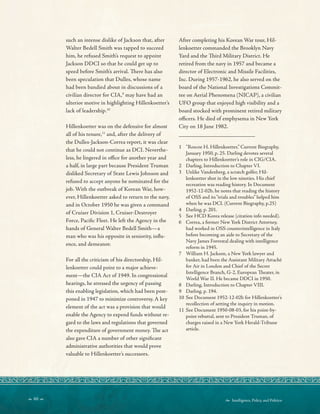
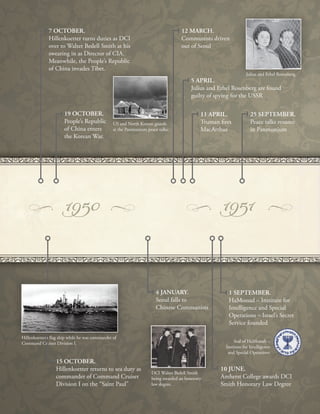
ORTHE
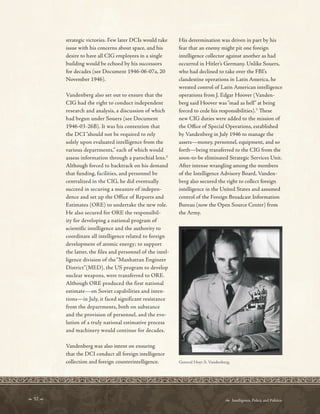
~  ' STUDY o, INTELLIGENCE
/p,.y;.:.~
H1$t_i)iICAL
ccTI.E.CTIONS
Released on 13 SEPTEMBER 2012 at
George Mason University, School of Public Policy
Arlington, VA

2


Intelligence,
Policy,
and
Politics:
t
&
Intelligence,
Policy,
and
Politics:
Te
DCI,
the
White
House,
and
Congress
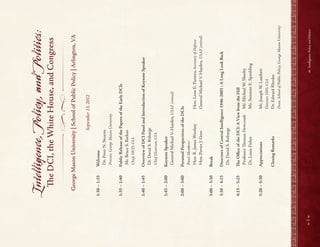
George
Mason
University
|
School
of
Public
Policy
|
Arlington,
VA
September
13,
2012
1:30
–
1:35
Welcome
Dr.
Peter
N.
Stearns
Provost,
George
Mason
University
1:35
–
1:40
Public
Release
of
the
Papers
of
the
Early
DCIs
Mr.
Bruce
S.
Barkan
Chief,
HCD,
CIA
1:40
–
1:45
Overview
of
DCI
Panel
and
Introduction
of
Keynote
Speaker
Dr.
David
S.
Robarge
Chief
Historian,
CIA
1:45
–
2:00
Keynote
Speaker
General
Michael
V.
Hayden,
USAF
(retired)
2:00
–
3:00
Personal
Perspectives
of
the
DCIs
Panel
Members:
Hon.
R.
James
Woolsey
Hon.
Leon
E.
Panetta,
Secretary
of
Defense
Hon.
Porter
J.
Goss
General
Michael
V.
Hayden,
USAF
(retired)
3:00
–
3:30
Break
3:30
–
4:15
Directors
of
Central
Intelligence
1946-2005
:
A
Long
Look
Back
Dr.
David
S.
Robarge
4:15
–
5:25
T
e
Of
ce
of
the
DCI:
A
View
from
the
Hill
Professor
T
omas
Newcomb
Mr.
Michael
W.
Sheehy
Dr.
Louis
Fisher
Ms.
Suzanne
E.
Spaulding
5:20
–
5:30
Appreciations
Mr.
Joseph
W.
Lambert
Director,
IMS,
CIA
Closing
Remarks
Dr.
Edward
Rhodes
Dean,
School
of
Public
Policy,
George
Mason
University
t
&
Table
of
Contents
Symposium
Partners
4
Speaker
Bios
6
Symposium
Overview:
Directors
of
Central
Intelligence,
1946-2005
11
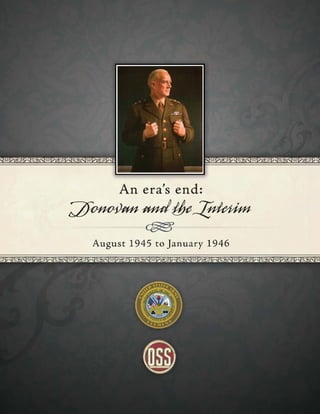
An
Era’s
End:
Donovan
and
the
Interim
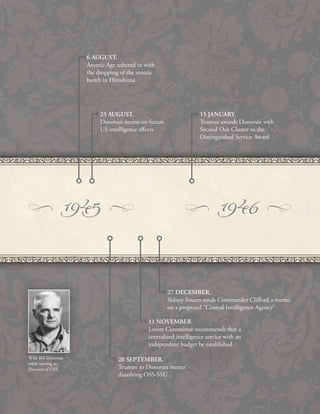
25
Timeline:
August
1945
–
January
1946
.
.
.
.
.
.
.
.
.
.
.
.
.
.
.
.
.
.
.
.
.
.
.
.
.
.
.
.
.
.
.
26
T
e
Creation
of
the
Central
Intelligence
Group
.
.
.
.
.
.
.
.
.
.
.
.
.
.
.
.
.
.
.
.
.
.
.
.
27
Letter
from
Truman
to
Donovan
.
.
.
.
.
.
.
.
.
.
.
.
.
.
.
.
.
.
.
.
.
.
.
.
.
.
.
.
.
.
.
.
.
.
.
.
.
39
Introducing
a
New
Path:
Sidney
W
Souers
41
Timeline:
22
January
1946
–
10
June
1946
.
.
.
.
.
.
.
.
.
.
.
.
.
.
.
.
.
.
.
.
.
.
.
.
.
.
.
.
42
Sidney
William
Souers:
6
January
1946
–
10
June
1946
.
.
.
.
.
.
.
.
.
.
.
.
.
.
.
.
.
43
Initial
Personnel
and
Organization
.
.
.
.
.
.
.
.
.
.
.
.
.
.
.
.
.
.
.
.
.
.
.
.
.
.
.
.
.
.
.
.
.
.
.
46
First
Steps:
Hoyt
S
Vandenberg
49
Timeline:
10
June
1946
–
1
May
1947
.
.
.
.
.
.
.
.
.
.
.
.
.
.
.
.
.
.
.
.
.
.
.
.
.
.
.
.
.
.
.
.
50
Hoyt
Sanford
Vandenberg:
10
June
1946
–
1
May
1947
.
.
.
.
.
.
.
.
.
.
.
.
.
.
.
.
.
51
Letter
from
Vandenberg
to
Donovan,
16
July
1946.
.
.
.
.
.
.
.
.
.
.
.
.
.
.
.
.
.
.
.
.
.
54
Holding
the
Line:
Roscoe
H
Hillenkoetter
55
Timeline:
1
May
1947
–
7
October
1950
.
.
.
.
.
.
.
.
.
.
.
.
.
.
.
.
.
.
.
.
.
.
.
.
.
.
.
.
.
.
56
Roscoe
Henry
Hillenkoetter:
1
May
1947
–
7
October
1950
.
.
.
.
.
.
.
.
.
.
.
.
.
58
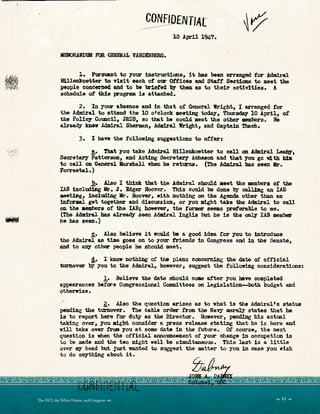
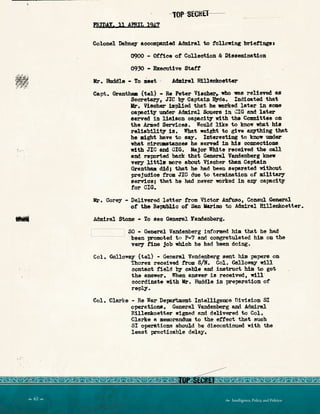
Memorandum
to
General
Vandenberg
regarding
Admiral
Hillenkoetter
brief
ng
Friday,
11
April
1947
.
.
.
.
.
.
.
.
.
.
.
.
.
.
.
.
.
.
.
.
.
.
.
.
.
.
.
.
.
.
.
.
.
.
.
.
.
.
61
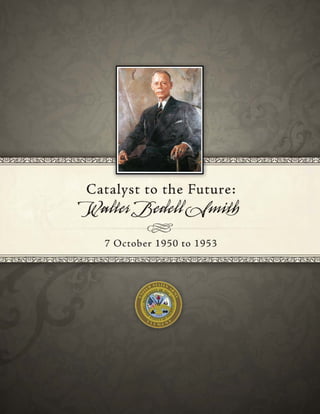
Catalyst
to
the
Future:
Walter
Bedell
Smith
63
Timeline:
7
October
1950-53
.
.
.
.
.
.
.
.
.
.
.
.
.
.
.
.
.
.
.
.
.
.
.
.
.
.
.
.
.
.
.
.
.
.
.
.
.
.
.
64
T
e
Signif
cance
of
Walter
Bedell
Smith
as
DCI,
1950-53
.
.
.
.
.
.
.
.
.
.
.
.
.
.
.
66
Letter
from
Roderick
R.
Allen,
Major
General,
USA
to
Smith,
6
October
1950
.
.
.
.
.
.
.
.
.
.
.
.
.
.
.
.
.
.
.
.
.
.
.
.
.
.
.
.
.
.
.
.
.
.
.
.
70
Letter
from
Harry
S.
Truman,
President
to
Smith,
16
January,
1953
.
.
.
.
.
.
.
71
Acknowledgements
72

3

Te
DCI,
the
White
House,
and
Congress

 4   Intelligence, Policy, and Politics:


~,,,., CENTE~FORTHE
-J,,STUDYoF INTEWGF.NCE
Te Historical Collections Division (HCD) of CIA’s Information Management Services is re-
sponsible for executing the Agency’s Historical Review Program. Tis program seeks to identify
and declassify collections of documents that detail the Agency’s analysis and activities relating to
historically signifcant topics and events. HCD’s goals include increasing the usability and acces-
sibility of historical collections. HCD also develops release events and partnerships to highlight
each collection and make it available to the broadest audience possible.
Te mission of HCD is to:
• Promote an accurate, objective understanding of the information and intelligence that has
helped shape major US foreign policy decisions.
• Broaden access to lessons-learned, presenting historical material that gives greater under-
standing to the scope and context of past actions.
• Improve current decision-making and analysis by facilitating refection on the impacts and
efects arising from past foreign policy decisions.
• Showcase CIA’s contributions to national security and provide the American public with valu-
able insight into the workings of its government.
• Demonstrate the CIA’s commitment to the Open Government Initiative and its three core
values: Transparency, Participation, and Collaboration.
Te History Staf in the CIA Center for the Study of Intelligence fosters understanding of the
Agency’s history and its relationship to today’s intelligence challenges by communicating instruc-
tive historical insights to the CIA workforce, other US Government agencies, and the public.
CIA historian research topics on all aspects of Agency activities and disseminate their knowledge
though publications, courses, briefngs and Web-based products. Tey also work with other
Intelligence Community historians on publication and education projects that highlight inter-
agency approaches to intelligence issues. Lastly, the CIA History Staf conducts an ambitious
program of oral history interviews that are invaluable for preserving institutional memories that
are not captured in the documentary record.
d
~
UNIVl!IISITY
School of
Public Policy
Te School of Public Policy at George Mason University prepares highly qualifed, astute policy
professionals who move rapidly into leadership positions in the private sector; not-for-profts;
state and federal governments; and international organizations. With its emphases on innova-
tion, diversity, ethics, and international perspectives, the School of Public Policy is among George
Mason University’s fastest-growing units.
When the School of Public Policy was founded in 1990, it was housed in trailers on the main
campus in Fairfax, Va. Twenty-two years later, it now lives in a brand-new, seven-story building
in Arlington, Va., with more than 60 full-time faculty and more than 950 full- and part-time
Master’s and PhD students.
In a short time, the School of Public Policy has been recognized as one of the largest and most
respected public policy schools in the country. It ofers students and working professionals a
comprehensive education that integrates real-world experience, problem-solving and applied
knowledge. Master’s students pursue degrees in Public Policy; Health and Medical Policy; Inter-
national Commerce and Policy; Organization Development and Knowledge Management; Peace
Operations; or Transportation Policy, Operations, and Logistics.
Students graduate with the methodological and communication skills needed to design and pro-
mote efective policies. And because solving complex policy challenges requires an interdisciplin-
ary approach, the School employs faculty members with backgrounds ranging from economics
to political science, anthropology, and law, representing expertise in diverse topic areas, including
transportation, economic development, national security, ethics, health care, global trade, educa-
tion, governance, and technology.
 5 
Te DCI, the White House, and Congress 

6


Intelligence,
Policy,
and
Politics:
t
&
Speaker
Biographies
Louis
Fisher,
PhD
Dr.
Louis
Fisher
is
the
Scholar
in
Residence
at
T
e
Constitution
Project,
headquartered
in
Washington,
D.C.
From
1970
to
2006,
he
worked
at
the
Library
of
Congress
as
Senior
Special-
ist
in
Separation
of
Powers
within
the
Congressional
Research
Service
(CRS)
and
from
2006
to
2010
served
as
the
Specialist
in
Constitutional
Law
within
the
Law
Library.
During
his
service
with
CRS,
he
was
the
research
director
for
the
House
Iran-Contra
Committee
and
wrote
major
sections
of
the
Committee’s
f
nal
report.
Dr.
Fisher
has
written
over
twenty
books
with
the
most
recent
being
Defending
Congress
and
the
Constitution
(2011).
His
writing
has
garnered
numerous
accolades
including
the
Louis
Brownlow
Book
Award
and
Neustadt
Book
Award.
In
2011
he
received
the
Walter
Beach
Pi
Sigma
Alpha
Award
from
the
National
Capital
Area
Political
Science
Association
for
strengthening
the
rela-
tionship
between
political
science
and
public
service.
In
2012
he
received
the
Hubert
H.
Hum-
phrey
Award
from
the
American
Political
Science
Association
in
recognition
of
notable
public
service
by
a
political
scientist.
Louis
Fisher
received
his
doctorate
in
political
science
from
the
New
School
for
Social
Research
(1967)
and
has
taught
at
Queens
College,
Georgetown
University,
American
University,
Catholic
University
of
America,
Indiana
University,
Johns
Hopkins
University
as
well
as
the
College
of
William
and
Mary
and
the
Catholic
University
of
America
Law
Schools.
Porter
J
Goss
Porter
J.
Goss
served
as
the
19th
and
last
Director
of
Central
Intelligence
from
September
24,
2004
until
April
21,
2005.
At
that
time,
he
became
the
f
rst
Director
of
the
Central
Intelligence
Agency
under
the
newly
signed
Intelligence
Reform
and
Terrorism
Prevention
Act.
He
contin-
ued
as
D/CIA
until
May
26,
2006.
Previously,
Mr.
Goss
served
as
the
Congressman
from
Southwest
Florida
for
almost
16
years.
He
was
Chairman
of
the
House
Permanent
Select
Committee
on
Intelligence
from
1997
until
his
nomination
as
DCI
in
August
2004.
He
served
for
almost
a
decade
as
a
member
of
the
commit-
tee
which
oversees
the
intelligence
community
and
authorizes
its
annual
budget.
During
the
107th
- - - - ------1@!3-- - - -
Congress, Mr. Goss co-chaired the joint congressional inquiry into the terrorist attacks of Septem-
ber 11, 2001. He was the second Director of Central Intelligence to have served in Congress.
In addition to Intelligence, Mr. Goss’ Congressional career focused on the environment, House
ethics, senior issues, health care reform and the Rules Committee. He was a leader on the Ever-
glade’s legislation and takes great pride in the passage of the Ricky Ray Bill which ofered relief
to victims who contracted HIV through a contaminated blood supply. Mr. Goss was awarded the
Distinguished Service Award in 2006.
Mr. Goss was a U.S. Army Intelligence ofcer from 1960 to 1962. He served as a clandestine
service ofcer with the Central Intelligence Agency from 1962 until 1972, when a serious illness
forced his retirement. While at the CIA, he completed assignments in Latin America, the Carib-
bean, and Europe.
After leaving the CIA, Mr. Goss and his family settled in Sanibel, Florida, where he was a small
business owner and co-founder of a local newspaper. He was an active leader in the incorpora-
tion of the City of Sanibel in 1974 and was elected its frst Mayor. From 1983 until 1988, Mr.
Goss was a member of the Lee County (Florida) Commission, serving as its chairman in 1985
and 1986.
Mr. Goss holds a Bachelor of Arts degree in classical Greek from Yale University, graduating with
high honors. He was born in Waterbury, Connecticut on November 26, 1938. He and his wife,
Mariel, have four children and 12 grandchildren.
Michael V Hayden
Michael V. Hayden is a Distinguished Visiting Professor with George Mason University’s School
of Public Policy. A retired U.S. Air Force four-star general, he is a former director of the Nation-
al Security Agency (1999–2005) and the Central Intelligence Agency (2006–09).
General Hayden has more than 20 years’ experience developing and implementing U.S. security
and foreign policy, having worked in the White House, U.S. embassies, and the Department of
Defense, as well as at the NSA and the CIA.
After earning a bachelor’s degree in history and a master’s degree in modern American history
from Duquesne University, Michael Hayden entered active duty in the U.S. Air Force. He has
taught American defense policy as part of the Air Force ROTC program at St. Michael’s College
in Winooski, Vermont.
General Hayden has appeared in the media on such shows as Charlie Rose, Meet the Press, Tis
Week, Nightline, and CNN’s Nightly News.
 7 
Te DCI, the White House, and Congress 
 8   Intelligence, Policy, and Politics:
- - --- -- -----<~------ - -
- - --- -- -----<~------ - -
Thomas M Newcomb
Tomas M. Newcomb is a Professor of Political Science and Criminal Justice at Heidelberg Uni-
versity in Ohio and is a member of the CIA Director’s Historical Review Panel. In 2005, Profes-
sor Newcomb retired from the White House as a Special Assistant to the President for National
Security Afairs. He previously served as a legal advisor to the U.S. Foreign Intelligence Surveillance
Court; an attorney in the Ofce of Intelligence Policy and Review at the Department of Justice;
a subcommittee staf director and counsel on the House Permanent Select Committee on Intel-
ligence (HPSCI); an attorney with CIA’s Ofce of General Counsel; a clandestine service ofcer
and (once) chief of station at fve CIA stations in Europe and Africa; and as a buck sergeant with
the 101st Airborne infantry in Vietnam. With spouse Dee Jackson, who retired after service at CIA
and HPSCI, he runs an agricultural folly called Dead Drop Vineyards on their farm in Ohio.
Professor Newcomb has a BA and JD from the University of Minnesota and practiced trial law
with Minneapolis-area frms before turning to public service.
Leon E Panetta
Leon E. Panetta was sworn in as the 23rd Secretary of Defense on July 1, 2011. Before joining
the Department of Defense, Secretary Panetta served as the Director of the Central Intelligence
Agency [D/CIA] from 2009 to 2011 where he led the Agency and managed human intelligence
and open-source collection programs on behalf of the Intelligence Community.
Before joining CIA, Secretary Panetta spent 10 years co-directing, with his wife, the Leon &
Sylvia Panetta Institute for Public Policy at California State University, Monterey Bay, a nonpar-
tisan, nonproft Institute promoting the value of public service. In 2006, he served as a member
of the Iraq Study Group, which conducted an independent assessment of the war in Iraq.
From July 1994 to January 1997, Secretary Panetta served as Chief of Staf to President William
Clinton. Earlier, he was Director of the Ofce of Management and Budget. From 1977 to 1993,
he represented California’s 16th (now 17th) Congressional District, rising to House Budget
Committee chairman during his fnal term.
Secretary Panetta served as a legislative assistant to Senator Tomas H. Kuchel [R-CA]; special
assistant to the Secretary of Health, Education and Welfare; director of the U.S. Ofce for Civil
Rights; and executive assistant to Mayor John Lindsay of New York. He also spent fve years in
private law practice.
- ----- - -----<~----- ---
- - - -------1~- - - - -
He served as an Army intelligence ofcer from 1964 to 1966 and received the Army Commenda-
tion Medal.
Secretary Panetta holds a Bachelor of Arts degree in political science, and a law degree, both
from Santa Clara University, California. He was born June 28, 1938 in Monterey, and lives in
Carmel Valley. Te Panettas have three grown sons and six grandchildren.
David Robarge, PhD
Dr. David Robarge received his Ph.D. in American History from Columbia University. After teach-
ing at Columbia and working on the staf of banker David Rockefeller, and at the Gannett Center
for Media Studies at Columbia, Dr. Robarge joined CIA in 1989 and worked as a political and
leadership analyst on the Middle East. He came to the History Staf in 1996 and was appointed
Chief Historian in June 2005. Dr. Robarge has published a classifed biography of DCI John Mc-
Cone and an unclassifed monograph on CIA’s supersonic reconnaissance aircraft, the A-12. His
articles and book reviews on Agency leadership, analysis, counterintelligence, technical collection,
and covert action have appeared in Studies in Intelligence, Intelligence and National Security, and the
Journal of Intelligence History. He has taught intelligence history at George Mason University and
Georgetown University and also has written a biography of Chief Justice John Marshall.
Michael W Sheehy
Michael W. Sheehy joined McBee Strategic in March of 2009, after more than thirty years of
service in the U.S. House of Representatives. For six years, Mr. Sheehy was the national security
advisor for Speaker of the House Nancy Pelosi. In that capacity, he served as the Speaker’s principal
advisor on all matters afecting the security of the United States including defense, foreign policy,
energy security, homeland security, and intelligence.
Prior to joining the Speaker’s staf, Mr. Sheehy served for thirteen years as Democratic staf direc-
tor and chief counsel on the House Permanent Select Committee on Intelligence where he was
responsible for the committee’s work in authorizing funding for, and overseeing the conduct of, the
nation’s intelligence activities. Before joining the Intelligence Committee, he was chief of staf for
Congressmen Richard Neal (D-MA) and Edward Boland (D-MA).
Mr. Sheehy served in the Navy for fve years before beginning his career on Capitol Hill. He holds a
B.A. from Marquette University and a J.D. from Georgetown University.
 9 
Te DCI, the White House, and Congress 
 10   Intelligence, Policy, and Politics:
- -----------<~------ --
- - - - -----,~-- - - -
Suzanne E Spaulding
Ms. Suzanne E. Spaulding is a recognized expert on national security issues, including intelligence,
homeland security, terrorism, critical infrastructure protection, cyber security, intelligence, law en-
forcement, foreign investment, biodefense, crisis management, and issues related to the threat from
chemical, biological, nuclear, or radiological weapons.
Developing her expertise over a career spanning 20 years, Ms. Spaulding has worked on national
security issues in the Executive Branch and for Congress. She served as the Executive Director of
two Congressionally-mandated commissions: the National Commission on Terrorism, chaired by
Ambassador L. Paul Bremer III, and the Commission to Assess the Organization of the Federal
Government to Combat the Proliferation of Weapons of Mass Destruction, chaired by former
Deputy Secretary of Defense and CIA Director John Deutch.
On Capitol Hill, Ms. Spaulding served as Legislative Director and Senior Counsel for Senator
Arlen Specter (R-PA), General Counsel for the Senate Select Committee on Intelligence, and
Minority Staf Director for the U.S. House of Representatives Permanent Select Committee on In-
telligence. She also spent time at the Central Intelligence Agency, where she was Assistant General
Counsel and the Legal Adviser to the Director of Central Intelligence’s Nonproliferation Center.
R James Woolsey
R. James Woolsey is Vice President at Booz Allen & Hamilton for Global Strategic Security and
former director of the U.S. Central Intelligence Agency. Previously, Mr. Woolsey was partner at
the law frm of Shea & Gardner.
He recently served as counsel for major corporations in both commercial arbitrations and the
negotiation of joint ventures and other agreements.
Besides serving as Director of Central Intelligence, Mr. Woolsey has served in the U.S. govern-
ment as Ambassador to the Negotiation on Conventional Armed Forces in Europe (CFE),
Vienna, 1989-1991, Under Secretary of the Navy, 1977-1979, and General Counsel to the U.S.
Senate Committee on Armed Services, 1970-73.
He was also appointed by the President as Delegate at Large to the U.S.-Soviet Strategic Arms
Reduction Talks (START) and Nuclear and Space Arms Talks (NST) in Geneva between 1983
and 1986.
During his military service in the U.S. Army, he served as an adviser on the U.S. Delegation to
the Strategic Arms Limitation Talks (SALT I), Helsinki and Vienna, from 1969 to 1970.
~
&
_________________________
Symposium
Overview
Directors
of
Central
Intelligence,
1946–2005
Dr.
David
Robarge
Originally
printed
in
the
Studies
in
Intelligence,
Vol
49,
No.
3,
2005.
For
nearly
six
decades,
the
director
of
central
intelligence
(DCI)
headed
the
world’s
most
important
intelligence
agency
and
oversaw
the
largest,
most
sophisticated,
and
most
productive
set
of
intelligence
services
ever
known.
From
1946
to
2005,
19
DCIs
served
through
10
changes
in
president;
scores
of
major
and
minor
wars,
civil
wars,
military
incursions,
and
other
armed
conf
icts;
two
energy
crises;
a
global
recession;
the
specter
of
nuclear
holocaust
and
the
pursuit
of
arms
control;
the
raising
of
the
Berlin
Wall
and
the
fall
of
the
Iron
Curtain;
the
proliferation
of
weapons
of
mass
destruction;
and
the
ar-
rival
of
international
terrorism
on
the
shores
of
America
and
the
war
against
it
overseas.
During
that
time,
the
DCIs
participated
in
or
oversaw
several
vital
contributions
that
intel-
ligence
made
to
US
national
security:
strategic
warning,
clandestine
collection,
independent
analysis,
overhead
reconnaissance,
support
to
warf
ghters
and
peacekeepers,
arms
control
verif
cation,
encouragement
of
democracy,
and
counterterrorism.
T
e
responsibilities
of
the
DCI
grew
logarithmically
after
January
1946,
when
President
Harry
Truman
whimsically
presented
the
f
rst
DCI,
Sidney
Souers,
with
a
black
hat,
black
cloak,
and
wooden
dagger
and
declared
him
the
“Director
of
Central-
ized
Snooping.”
1
At
that
time,
the
DCI
had
no
CIA
to
run,
no
independent
budget
or
personnel
to
manage,
no
authority
to
collect
foreign
secrets,
and
no
power
to
bring
about
a
consensus
among
agencies.
Maybe
that
is
why
Souers,
when
asked
not
long
after
his
appoint-
ment,
“What
do
you
want
to
do?”
replied,
“I
want
to
go
home.”
2
T
en
came
the
National
Security
Act
of
1947,
which
set
forth
a
description
of
the
DCI’s
job:
T
ere
is
a
Director
of
Central
Intelligence
who
shall
serve
as
head
of
the
United
States
intelligence
community…act
as
the
principal
adviser
to
the
President
for
intelligence
matters
related
to
the
national
security;
and…serve
as
head
of
the
Central
Intelligence
Agency.
Two
years
later,
the
Central
Intelligence
Agency
Act
laid
down
the
DCI’s
and
the
Agency’s
administrative
rubrics.
Over
the
next
several
decades,
the
DCI
would
directly
“Nineteen
DCIs
served
through
manage
thousands
of
10
changes
in
president,
scores
employees
and
bil-
of
wars,…a
global
recession,
the
lions
of
dollars,
and
specter
of
nuclear
holocaust,
would
have
an
impor-
and
the
arrival
of
international
tant
part
in
guiding
terrorism
on
US
shores.”
many
thousands
and
many
billions
more.

11

Te
DCI,
the
White
House,
and
Congress

 12   Intelligence, Policy, and Politics:
- - - -------1~ - - - -
“IT’S A VERY HARD JOB”
After John McCone was sworn in as DCI in
November 1961, President John Kennedy
shook his hand and gently warned him that he
was“now living on the bull’s eye, and I wel-
come you to that spot.”3
Te bull’s eye seems
an appropriate metaphor, considering how
often DCIs were the targets of recrimination
and attack. George H. W. Bush called the job
“the best…in Washington,”4
but arguably it
also was the toughest.
Te DCI really did not“direct” something
called“central intelligence.” He was respon-
sible for coordinating national collection and
analysis, but he lacked the
authority to do so, faced
“With no political, military, formidable competitors
or industrial base, the DCI in other agencies, and had
was‘the easiest man in no constituency to sup-
Washington to fre.’” port him. He had to walk
the knife’s edge between
politics and politicization,
and was the handy scapegoat for intelligence
missteps often committed or set in train years
before. And he had to deal with the reality
that, as Allen Dulles wrote,“Intelligence is
probably the least understood and most mis-
represented of the professions.”5
The purpose for establishing the position of
DCI and the CIA under law in 1947 was to
help avoid another Pearl Harbor surprise by
taking strategic intelligence functions from
the confines of separate departments and el-
evating them to the national level. The DCI
was to have been the only adviser to the pres-
ident with even a chance of presenting him
with unbiased, nondepartmental intelligence.
The seemingly straightforward phrases in the
National Security Act, however, only gave
the DCI the potential to be a leader of the
Intelligence Community. Whether a given
DCI came close to being one was a result of
the interplay of personalities, politics, and
world events. With line authority only over
the CIA, the DCI depended on his powers
of bureaucratic persuasion and, most vi-
tally, his political clout at the White House
to be heard and heeded. Richard Helms
often noted that the secretary of defense
was the second most powerful person in
Washington—except, perhaps for a few first
ladies—whereas the DCI was “the easiest
man in Washington to fire. I have no politi-
cal, military, or industrial base.”6
Moreover,
the DCI’s showcase product—national-level
analysis—often carried the implicit message,
“Mr. President, your policy is not working.”
Presidents often have unrealistic expecta-
tions about what the CIA’s espionage and
covert action capabilities can achieve, and
they usually did not appreciate hearing from
their DCIs that the world was complicated
and uncertain. No wonder R. James Woolsey
said his version of the job’s description could
be written very simply:“Not to be liked.”7
DCIs IN PROFILE
Allen Dulles once told Congress that the CIA
“should be directed by a relatively small but
elite corps of men with a passion for anonym-
ity and a willingness to stick at that particular
job.”8
While Dulles’s advice may be applicable
to the heads of the Agency’s directorates and
ofces, hardly any part of his statement was
borne out over the history of the DCI’s posi-
tion. Elite, yes; but neither small in number
nor anonymous—many were well known
in their various pursuits when they were
nominated. And even if they were willing to
stay for the long haul, few did. In late 1945,
an interdepartmental committee that was
developing a plan for a national-level intel-
ligence agency recommended that its director
be appointed for a long term, preferably not
less than six years.9
Testifying to Congress in
early 1947 about the proposed National Se-
curity Act, Dulles asserted that appointment
as DCI“should be somewhat comparable
to appointment to high judicial ofce, and
should be equally free from interference due
to political changes.”10
Te reality of a DCI’s tenure was otherwise.
Te average time they served was just over
three years, and only fve DCIs stayed at least
four. It is a tribute to the DCIs and all the
intelligence professionals they led under 11
administrations over nearly six decades that
they were able to accomplish as much as they
did despite all the bureaucratic disruptions.
Te frequency of these“regime changes” at the
CIA must further be considered in light of the
fact that most new DCIs had next to no time
to settle in and read in. Over half had to face
foreign policy or intelligence-related crises
within their frst month. Tese included: the
Chinese invasion of North Korea in 1950;
the death of Stalin in 1953; the US military
incursion into the Dominican Republic in
1965; France’s withdrawal from NATO and a
marked upsurge in the Cultural Revolution in
China in 1966; the Yom Kippur war and the
fall of the Allende regime in Chile in 1973;
the publication of the leaked Pike Committee
report in 1976; the breakdown in the SALT
II talks in 1977; a military coup attempt in
recently democratized Spain in 1981; the as-
sassination of the Lebanese prime minister in
1987; the ofcial breakup of the Soviet Union
in 1991; and a deadly terrorist attack in Egypt
in 2004.
In other instances, major events immediately
preceded the DCI’s arrival: the signing of the
Vietnam War peace accords in 1973 and the
terrorist shootings outside the CIA head-
quarters compound in 1993. Soon after his
appointment in 1950, Walter Bedell Smith
said,“I expect the worst and I am sure I won’t
be disappointed.”11
Most subsequent DCIs
likewise were not. Perhaps the best advice
they could have received from the presidents
who picked them was,“Be ready to hit the
ground running.”
Who were the DCIs? President Eisenhower
called the CIA“one of the most peculiar types
of operation[s] any government can have” and
said“it probably takes a strange kind of genius
to run it.”12
Whatever the validity of that char-
acterization, these are the salient demographic
facts about the 19 DCIs:”13
• Tey were born in 14 diferent states.
Most hailed from the Midwest (nine)
and the Northeast (seven). One was born
in the Southwest, one in the West, and
one overseas.
• Tey attended 21 diferent colleges, univer-
sities, and graduate or professional schools.
Eight fnished college, and ten others went
on for post-graduate degrees. One,“Beetle”
Smith, completed only high school. Con-
sidering that he ended his public service
with four stars and an ambassadorship, he
could be called the Horatio Alger of DCIs.
• Before their appointments, the DCIs came
from a variety of walks of life, some from
more than one. Six were from the military,
eight had been government ofcials and/
or lawyers, three had been businessmen,
and four came from politics, academe, or
journalism. All three branches of govern-
 13 
Te DCI, the White House, and Congress 
 14   Intelligence, Policy, and Politics:
	
	
ment were represented, as were three of
fve military services.
• Two-thirds of the DCIs had direct
experience with intelligence in military
or civilian life before their appointments.
One served in the OSS (William Casey),
two in the CIA (Robert Gates and Porter
Goss), and three in both (Dulles, Helms,
and William Colby).
• Te DCIs’ average age at the time of their
appointment was slightly under 55. Te
youngest was 43 (James Schlesinger); the
oldest was 67 (Casey).
HISTORIANS AND DCIs
An inconsistency exists between the fairly ex-
tensive bibliography on DCIs and historians’
evaluation of their personal contribution to
US national security. Nearly as many biogra-
phies have been written about DCIs as about
comparable members of the American foreign
policy community—the secretaries of state
and defense, the presidents’ national security
advisers, and the chairmen of the Joint Chiefs
of Staf. However, the 19 heads of the largest
agglomeration of secret services in what used
to be called the Free World generally have not
been perceived as being nearly as infuential as
most of their counterparts.
Historians have regarded a number of secre-
taries of state and defense—notably George
Marshall, Dean Acheson, John Foster Dulles,
Dean Rusk, Robert McNamara, and Henry
Kissinger—as major players in the diplomatic
and military developments of their times, as is
at least one national security adviser, Kissinger
Te DCIs are another matter. Only two, Dulles
and Casey, usually are considered to have had
an impact rivaling that of the other top foreign
policy ofcials in the administrations in which
they served. Te rest rarely get mentioned in
most foreign afairs surveys (although Helms
and Colby may come up when the Agency’s
“time of troubles” in the 1970s is discussed).
Even in overviews of the CIA and the Intel-
ligence Community, only a handful—Hoyt
Vandenberg, Smith, Dulles, McCone, Casey,
and possibly Helms—are portrayed as making
noteworthy contributions to the way the US
government conducts intelligence activity.
Tat consensus may derive from conceptions
of the proper place of intelligence practi-
tioners in the foreign policy process. Intel-
ligence, the premise goes, should be detached
from policy so as to avoid cross-corruption
of either. If intelligence services have a stake
in policy, they may skew their analyses or
become aggressive advocates of covert action.
Te Intelligence Community must remain a
source of objective assessment and not be-
come a politicized instrument of the incum-
bent administration. As heads of the Com-
munity, DCIs should be“intellocrats” who
administer specialized secret functions, not
to beneft any departmental interests but to
advance policies set elsewhere in the executive
branch—specifcally, the White House.
Te DCIs reported to the National Security
Council and truly served at the pleasure of
the president. Indeed, much of every DCI’s
infuence was directly proportional to his per-
sonal relationship with the chief executive. At
the same time, and somewhat paradoxically,
after incoming presidents began choosing
“their” DCIs in 1977, the nonpartisan stature
of the DCI diminished and, along with it,
his independence. Te general rule of “new
president, new DCI” did not always translate
into greater infuence. Te president’s national
security adviser and the secretaries of state
and defense usually still had more access to
the Oval Ofce.
Te situation was not much diferent at
Langley. Directors came and went, but bu-
reaucracies stayed. When DCIs tried to“clean
house” (Schlesinger and Stansfeld Turner)
or manage through loyalists from previous
jobs (Turner and John Deutch), the result was
administrative disarray and low morale. For
these reasons and more, no DCI ever had a
chance to become as autonomous as J. Edgar
Hoover at the FBI, or to be assessed as having
more than an episodic impact on US foreign
policy achievements.
A LEADERSHIP TYPOLOGY
Can DCIs, then, be regarded as leaders, as
opposed to heads of organizations or chief ad-
ministrators? Was US intelligence noticeably
diferent because a certain individual served
as DCI? Did DCIs have—could they have
had—a leadership role commensurate with
that of their counterparts at the Departments
of State and Defense? One way to begin
answering those questions is through serial
biography and group analysis. In contrast to
clandestine services ofcers, however, DCIs
have not been examined in such a fashion.
Tey do not ft into categories like“prudent
professionals” and“bold easterners,” and they
lack the sociological homogeneity needed to
be thought of, or to think of themselves as, a
network of “old boys” or, in William Colby’s
words,“the cream of the academic and social
aristocracy.” Biographers attached those labels
largely to former operators in the Ofce of
Strategic Services who joined the early CIA
and then stayed on—a situation that ap-
plies to only three DCIs (Dulles, Helms, and
Colby).”14
Tis heterogeneity does not mean, however,
that the DCIs cannot be analyzed collectively.
At least some aspects of the many models ap-
plied to political and corporate leaders can be
used with the DCIs, although empiricism or
utility may sufer—complex personalities and
complicated situations are sometimes made
less square to ft more easily into the models’
round holes, or so many diferent holes are
created that comparisons among individuals
become too hard to draw.
A straightforward approach to the DCIs
would take into account the institutional and
political limitations on their authority, the
objectives they were appointed to accomplish,
and the personality traits they exhibited and
managerial methods they used during their
tenures. What were the directors told to do
(mission) and how did they go about doing it
(style)? With those questions addressed, an
evaluation of their efectiveness can be made.
How well did the DCIs do what they were ex-
pected to do, given their authorities, resources,
and access (record)? What“types” of DCIs, if
any, have been most successful (patterns)?
Using this perspective, fve varieties of DCIs
are evident. Te frst is the administrator-
custodian or administrator-technocrat,
charged with implementing, fne-tuning, or
reorienting intelligence activities under close
direction from the White House. Examples
of this type have been Souers, Roscoe Hil-
lenkoetter, William Raborn, Woolsey, Deutch,
and George Tenet. Usually appointed at a
time of uncertainty about the Intelligence
Community’s roles and capabilities (the late
1940s and the mid-1990s), these DCIs tried
 15 
Te DCI, the White House, and Congress 
 16   Intelligence, Policy, and Politics:
to maintain stability in the CIA’s relationships
with other Community agencies, Congress,
and the public. Teir main goal was to do bet-
ter with what they already had, and to avoid
distractions and scandals. Except for Raborn,
all of these administrators had experience
with intelligence afairs, but they were not
intelligence careerists. Some had a very low-
key style, almost to the point of acting like
placeholders and time-servers (Hillenkoet-
ter, Raborn). Others energetically pursued
administrative changes designed to make the
CIA and the Community more responsive
to policymakers and better adapted to a new
political environment (Deutch, Tenet).
Te next type is the intelligence operator—
DCIs who were current or former profession-
al intelligence ofcers tasked with devising,
undertaking, and overseeing an extensive array
of covert action, espionage, and counterin-
telligence programs in aggressive pursuit of
US national security policy. Tree DCIs ft
this category: Dulles, Helms, and Casey. Te
presidents they served had no qualms about
using all of the US government’s clandestine
capabilities against America’s adversaries,
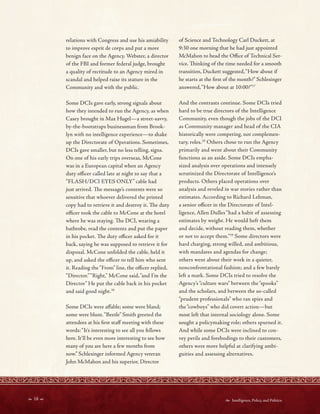
T˜°˛˝ N˙ˆˇ˘ ˜ D˛  O˘
˜ DCI/A’, S˜˙˘ °˜˙ G˜
3,500
3,000
2,500
2,000
1,500
1,000
500
0
and they relied on their DCIs’ knowledge of
and experience with operations to help them
accomplish that end. Te DCI as intelligence
operator may have emphasized diferent secret
activities depending on individual back-
grounds and predilections, and the targets
they worked against. For example, Dulles and
Casey were devotees of covert action, while
Helms preferred to work with espionage and
counterintelligence. Because of the prominent
place clandestine afairs had in American
foreign policy when they served, this type of
DCI generally served longer by far—seven
years on average—than any other type.
Te high level of secret activity during those
long tenures recurrently produced operational
mishaps, revelations of “faps,” and other
intelligence failures that hurt the CIA’s public
reputation and damaged its relations with the
White House and Congress. Te Bay of Pigs
disaster under Dulles, the inefective covert
action in Chile under Helms, and the Iran-
Contra scandal under Casey are prominent
examples. As journalist James Reston noted
during the Agency’s dark days in the mid-
1970s, DCIs who came up through the ranks
might have known more about what CIA
should be doing than outsiders,“but they are
not likely to be the best men at knowing what
it should not be doing.”15
Failures, indiscretions, and other such contro-
versies in turn have led to the departures of
those intelligence-operator DCIs and their re-
placement by manager-reformers charged with
“cleaning up the mess” and preventing similar
problems from happening again. Tere have
been two kinds of manager-reformer DCIs.
Number
of
Days
Souers
Vandenberg
Hillenkoetter
Smith
Dulles
McCone
Raborn
Helms
Schlesinger
Colby
Bush
Turner
Casey
Webster
Gates
Woolsey
Deutch
Tenet
Goss*
One is the insider—a career intelligence of-
fcer who used his experience at the CIA to
reorganize its bureaucracy and redirect its
*21 April 2005, Goss became Director, Central Intelligence Agency
after Negroponte took leadership of the US Intelligence Community.
activities during or after a time of political
controversy and lack of certitude about its
direction. Two DCIs functioned as manager-
reformer insiders: Colby and Gates. Colby, an
operations veteran with a career dating back
to the OSS, sought to rescue the CIA from
the political tempests of the mid-1970s and
to regain some of the Agency’s lost prestige
through his policy of controlled cooperation
with congressional investigators and targeted
termination of questionable activities. Gates,
a longtime Soviet analyst who had worked
on the NSC in two administrations and also
served as deputy director for intelligence,
moved the Agency into the post-Cold War era
after a period of undynamic leadership.
Te other type of manager-reformer is the
outsider, who was chosen because of his expe-
rience in the military, business, government,
or politics to implement a major reorganiza-
tion of the CIA and the Intelligence Com-
munity, or to regroup and redirect the Agency,
especially after major operational setbacks
or public conficts over secret activities. Six
DCIs were manager-reformer outsiders:
Vandenberg, Smith, McCone, Schlesinger,
Turner, and Porter Goss. Collectively, they
were responsible for more major changes at
the CIA (or its predecessor, the Central Intel-
ligence Group [CIG]) than any other category
of director. For example, under Vandenberg,
the CIG acquired its own budgetary and
personnel authority, received responsibility for
collecting all foreign intelligence (including
atomic secrets) and preparing national intel-
ligence analyses, and coordinated all interde-
partmental intelligence activities. Smith—in
response to intelligence failures before the
Korean War and to infghting among opera-
tions ofcers—centralized espionage and
covert actions, analysis, and administration by
rearranging the CIA into three directorates
and creating the Ofce of National Estimates.
In efect, he organized the Agency into the
shape it has today.
Schlesinger and Turner facilitated the depar-
ture of hundreds of clandestine services veter-
ans in their quests to streamline the Agency’s
bureaucracy, lower the profle of covert action,
and move the CIA more toward analysis and
technical collection. Goss was the only one
in the group who had previously worked at
the Agency, but he was selected because he
headed the intelligence oversight committee
in the House of Representatives. Taking over
during imbroglios over collection and analytic
failures connected with the 9/11 terrorist
attacks and assessments of Iraq’s weapons of
mass destruction, he set about revamping the
Agency’s work on international terrorism.
Most DCIs in this category were far more
concerned about achieving their objectives
quickly than about angering bureaucratic
rivals or fostering ill will among subordinates.
Largely because they accomplished so much—
or tried to—and did not worry about whom
they antagonized along the way, some of them
were among the most disliked or hardest to
get along with DCIs.
Finally, there are the restorers: George Bush
and William Webster. Like the manager-re-
former outsiders, they became DCIs after the
Agency went through difcult times—they
succeeded Colby and Casey, respectively—but
they were not charged with making signifcant
changes in the way the CIA did business. In-
stead, they used their“people skills” and public
reputations to raise morale, repair political
damage, and burnish the Agency’s reputation.
Bush, a prominent fgure in Republican Party
politics, went to Langley to mend the CIA’s
 17 
Te DCI, the White House, and Congress 
 18   Intelligence, Policy, and Politics:
relations with Congress and use his amiability
to improve esprit de corps and put a more
benign face on the Agency. Webster, a director
of the FBI and former federal judge, brought
a quality of rectitude to an Agency mired in
scandal and helped raise its stature in the
Community and with the public.
Some DCIs gave early, strong signals about
how they intended to run the Agency, as when
Casey brought in Max Hugel—a street-savvy,
by-the-bootstraps businessman from Brook-
lyn with no intelligence experience—to shake
up the Directorate of Operations. Sometimes,
DCIs gave smaller, but no less telling, signs.
On one of his early trips overseas, McCone
was in a European capital when an Agency
duty ofcer called late at night to say that a
“FLASH/DCI EYES ONLY” cable had
just arrived. Te message’s contents were so
sensitive that whoever delivered the printed
copy had to retrieve it and destroy it. Te duty
ofcer took the cable to McCone at the hotel
where he was staying. Te DCI, wearing a
bathrobe, read the contents and put the paper
in his pocket. Te duty ofcer asked for it
back, saying he was supposed to retrieve it for
disposal. McCone unfolded the cable, held it
up, and asked the ofcer to tell him who sent
it. Reading the“From” line, the ofcer replied,
“Director.”“Right,” McCone said,“and I’m the
Director” He put the cable back in his pocket
and said good night.16
Some DCIs were afable; some were bland;
some were blunt.“Beetle” Smith greeted the
attendees at his frst staf meeting with these
words:“It’s interesting to see all you fellows
here. It’ll be even more interesting to see how
many of you are here a few months from
now.” Schlesinger informed Agency veteran
John McMahon and his superior, Director
of Science and Technology Carl Duckett, at
9:30 one morning that he had just appointed
McMahon to head the Ofce of Technical Ser-
vice. Tinking of the time needed for a smooth
transition, Duckett suggested,“How about if
he starts at the frst of the month?” Schlesinger
answered,“How about at 10:00?”17
And the contrasts continue. Some DCIs tried
hard to be true directors of the Intelligence
Community, even though the jobs of the DCI
as Community manager and head of the CIA
historically were competing, not complemen-
tary, roles.18
Others chose to run the Agency
primarily and went about their Community
functions as an aside. Some DCIs empha-
sized analysis over operations and intensely
scrutinized the Directorate of Intelligence’s
products. Others placed operations over
analysis and reveled in war stories rather than
estimates. According to Richard Lehman,
a senior ofcer in the Directorate of Intel-
ligence, Allen Dulles“had a habit of assessing
estimates by weight. He would heft them
and decide, without reading them, whether
or not to accept them.”19
Some directors were
hard charging, strong willed, and ambitious,
with mandates and agendas for change;
others went about their work in a quieter,
nonconfrontational fashion; and a few barely
left a mark. Some DCIs tried to resolve the
Agency’s“culture wars” between the“spooks”
and the scholars, and between the so-called
“prudent professionals” who ran spies and
the“cowboys” who did covert action—but
most left that internal sociology alone. Some
sought a policymaking role; others spurned it.
And while some DCIs were inclined to con-
vey perils and forebodings to their customers,
others were more helpful at clarifying ambi-
guities and assessing alternatives.
- - - ----~-- - -
OUT OF THE SHADOWS
One defning characteristic of the DCIs was
that they were the most unsecret heads of any
secret agency in the world. DCIs lived in the
nebulous zone between secrecy and democracy,
clandestinely and openness. Tey headed the
world’s frst publicly acknowledged intelligence
service. While some countries guard the identi-
ties of their intelligence chiefs, the DCIs were
public fgures, held to account for what the
CIA, and to some extent the Community, did
and did not do. Te whole process of vetting
a prospective DCI was uniquely transparent
among intelligence services. His confrmation
hearings usually were open, and more than
a few times were used for partisan purposes
and political theater. Tat phenomenon is not
recent. Te frst controversial confrmation was
John McCone’s in 1962—the frst in which any
senators voted against a DCI nominee. After
that, two other nominations received signifcant
numbers of“no” votes (Colby and Gates), and
four had to be withdrawn (Teodore Sorensen,
Gates, Michael Cams, and Anthony Lake).20
Te contrast between the two worlds in which
DCIs existed—secret and public—fell into
stark relief from the mid-1960s to the mid-
1970s, when the relationship between intel-
ligence and democracy in the United States
underwent a sea change. Statements from two
DCIs of that period capture the magnitude
of the change. After he was appointed DCI
in 1966, Helms said,“I think there’s a tradi-
tion that the CIA is a silent service, and it’s a
good one. I think the silence ought to begin
with me.”21
In 1978, Colby, looking back on
the“time of troubles” he had recently sufered
through, said that such a“super secretive style
of operation had . . . become incompatible
with the one I believed essential.”22
After that, pragmatic openness became the
DCIs’ watchword in dealing with their politi-
cal monitors. As the Cold War foreign policy
consensus shattered for good, DCIs increas-
ingly had to contend with all the various
organs of accountability: special commissions,
watchdog groups, the courts, the media, and,
most importantly of
course, Congress. Later
“If there is one agency of
DCIs could scarcely
imagine the halcyon days the government in which
of their predecessors’ we must take some matters
dealings with Capitol on faith, without a constant
Hill in the 1950s, when examination of its methods
oversight was really over- and sources, I believe this
look. It is hard today to agency is the CIA.”
envision what it was like
in 1956, when Senator
Richard Russell, the CIA’s longtime friend
and protector, said that“If there is one agency
of the government in which we must take
some matters on faith, without a constant
examination of its methods and sources, I
believe this agency is the CIA.”
In those days, the DCI briefed Congress a
handful of times a year at most and almost al-
ways left with a fgurative, if not literal, blank
check. One of the Agency’s legislative coun-
sels, John Warner, told of an encounter he and
Dulles had with one of the CIA subcommit-
tees in the late 1950s:
It was sort of a crowded room, and [the
subcommittee chairman, Representative]
Clarence Cannon greets Dulles [with] “Oh,
it’s good to see you again, Mr. Secretary.” He
thinks it’s [Secretary of State John] Foster
Dulles, or mistakes the name; I don’t know.
Dulles, he’s a great raconteur. He reminds
Cannon of this, and Cannon reminds him
of that, and they swap stories for two hours.
 19 
Te DCI, the White House, and Congress 
 20   Intelligence, Policy, and Politics:
And at the end, [Cannon asks,] “Well, Mr.
Secretary, have you got enough money in
your budget for this year [and] the coming
year?” [Dulles replies,] “Well, I think we are
all right, Mr. Chairman. Tank you very
much.” Tat was the budget hearing.23
Te era of congressional benign neglect ended
during the period 1974-80, with the adoption
of the Hughes-Ryan Amendment requiring
a presidential fnding for covert actions; the
Church and Pike Committee investigations;
the establishment of the House and Sen-
ate permanent oversight committees; and
the passage of the Intelligence Accountabil-
ity Act mandating that
Congress be“promptly
“Bill Clinton remarked and fully informed” of
that cutting the intelligence covert actions. After that
budget during peacetime furry, the DCI relation-
was like canceling your ship with Congress
health insurance when was altered forever. For
you felt good.” a few eventful years,
Casey tried to stand as
the immovable object
against the irresistible force. As Robert Gates
observed, Casey“was guilty of contempt of
Congress from the day he was sworn in.’’24
Te
trend was soon back on track, however, and by
the year 2000, Agency ofcers were briefng
Congress in some fashion an average of fve
times a day, and the DCI’s frequent testimony
on the Hill was a headline-grabbing event.
THE FIRST CUSTOMER
IS ALWAYS RIGHT
Historically, the most important factor in the
life of the DCI was his relationship with the
president. Te CIA is more of a presiden-
tial organization than any other in the US
government—a special quality that was both
a boon and a bane to the DCIs. Presidents
have their own peculiar appreciation of intel-
ligence and their own way of dealing with the
CIA and their DCIs. We have had presidents
experienced with intelligence, or who were
fascinated with intelligence or with certain
kinds of secret information or operations.
Other presidents had little experience with in-
telligence, or did not care about it, or did not
like it or the CIA. As former Deputy Director
of Central Intelligence Richard Kerr aptly put
it,“a number of administrations…started with
the expectation that intelligence could solve
every problem, or that it could not do any-
thing right, and then moved to the opposite
view. Ten they settled down and vacillated
from one extreme to the other.”25
Presidents’ relations with their DCIs often
followed a similarly erratic course. Some began
by regarding the DCI as their senior intelli-
gence adviser and saw him regularly. Occasion-
ally that degree of contact continued; more
often, it did not. Other presidents preferred
from the start to have their national security
advisers function as their principal intelligence
ofcers. A few presidents at least made a bow
toward giving their DCIs authority over other
Community departments, but in most cases
the Community’s center of gravity meandered
between CIA Headquarters, the Pentagon,
Foggy Bottom, and the West Wing.
A few DCIs were close to their presidents;
some had cordial, businesslike relationships;
some had only infrequent contact; and some
had no relationships to speak of. From the
start, DCIs had to overcome assorted bar-
riers—physical, administrative, psychologi-
cal—in their interaction with the presidents.
Lawrence“Red” White, the Agency’s longtime
director of administration, recalled the time
'fb?t~}~·~...,,~'·--;.;~/:~....~t;':f•~1t~~7.·~;.'.'(£,;t~~i#1~:-x~,lt~~;-/'~~:~{~.r1:;~r.~t:·:t,.?t~i~;;r~~A6;.i~~~.,,1:ir:~.:~f~~1t~;;r~..o--~~I~
when
Dulles
told
Eisenhower
about
a
pos-
sible
location
for
the
headquarters
building.
“We’re
thinking
of
tearing
down
that
old
brewery
[where
the
Kennedy
Center
is
now]
and
building
it
right
there.’
Eisenhower
went
through
the
roof.
He
said,
“You
are
not
go-
ing
to
build
that
building
in
the
District
of
Columbia.
T
is
town
is
so
cluttered
up
now,
you
can’t
get
from
one
end
to
the
other,
and
you
are
going
to
get
out
of
town.”
26
T
en
there
were
the
ways
presidents
chose
to
run
their
White
Houses:
Eisenhower
with
his
rigid
military
staf
structure;
John
Kennedy
and
his
loose
agglomeration
of
ad
hoc
work-
ing
groups
and
catch-as-catch-can
meetings
with
advisers;
Lyndon
Johnson’s
congressio-
nal
cloakroom
approach,
in
which
the
“real
deals”
were
made
in
informal
settings
outside
the
National
Security
Council;
and
Richard
Nixon’s
notorious
“Berlin
Wall”
of
advisers—
Henry
Kissinger,
H.
R.
Haldeman,
and
John
Ehrlichman—who
controlled
access
to
the
Oval
Of
ce.
DCIs
sometimes
could
work
around
those
kinds
of
obstacles,
most
notably
by
chang-
ing
the
look
and
content
of
the
daily
brief
ng
product—the
Central
Intelligence
Bulletin,
the
President’s
Intelligence
Checklist,
and
the
President’s
Daily
Brief—and
develop-
ing
more
f
exible
and
responsive
methods
for
providing
current
intelligence
and
answers
to
taskings.
But
even
with
those
improvements,
DCIs
found
it
extremely
hard
to
surmount
the
psychological
barriers
some
presidents
erected.
What
was
a
DCI
to
do
when
Johnson
said
that
“the
CIA
is
made
up
of
boys
whose
families
sent
them
to
Princeton
but
wouldn’t
let
them
into
the
family
brokerage
business;”
and
told
Helms,
“Dick,
I
need
a
paper
on
Vietnam,
and
I’ll
tell
you
what
I
want
includ-
ed
in
it.”
27
Or
when
Nixon
returned
a
thick
package
of
PDBs
given
to
him
during
the
transition
period
unopened,
called
Agency
of-
f
cers
“clowns,”
and
asked,
“What
use
are
they?
T
ey’ve
got
40,000
people
over
there
reading
newspapers.”
28
T
e
DCI
often
served
at
the
clear
displeasure
of
the
president,
who
directed
him
to
act
and
then
often
tried
to
deny—not
very
plausi-
bly—that
he
had
anything
to
do
with
the
out-
come.
Bill
Clinton
remarked
that
cutting
the
intelligence
budget
during
peacetime
was
like
canceling
your
health
insurance
when
you
felt
good.
29
But
chief
executives
have
not
always
been
the
best
stewards
of
the
resources
of
the
Agency
they
have
so
often
called
on
to
help
implement—and,
in
more
than
a
few
cases,
salvage—their
foreign
policies.
It
should
be
noted,
however,
that
closeness
was
not
an
absolute
good
for
the
DCIs
or
a
solu-
tion
to
some
of
these
dif
culties.
Some
DCIs
paid
a
cost
for
being
too
close,
or
trying
to
be.
T
ey
wore
out
their
welcomes,
or
became
too
committed
to
the
success
of
covert
actions,
or
were
accused
of
politicization,
or
became
Allen
W.
Dulles,
longest
tenured
DCI,
at
November
1959
groundbreaking
ceremony
for
the
CIA
Original
Headquarters
building.

21
 Te
DCI,
the
White
House,
and
Congress

 22   Intelligence, Policy, and Politics:
_________________________
linked with controversial policies. It was not an
automatic beneft for the Agency or the DCI
for him to be able to say, as William Casey did,
“You understand, call him Ron.”30
HONORABLE MEN
At the cornerstone laying ceremony for the
Original Headquarters Building in 1959,
President Eisenhower said:
In war, nothing is more important to a
commander than the facts concerning the
strength, dispositions, and intentions of his
opponent, and the proper interpretation of
those facts. In peacetime, the necessary facts
…and their interpretation are essential to
the development of policy to further our
long-term national security…To provide
information of this kind is the task of the
organization of which you are a part. No
task could be more important.31
For almost 60 years, the DCIs carried out
that task in war and peace, in fush times and
lean. Amid accolades and scorn. No one of
their various leadership styles insured suc-
cess. Teir standing and accomplishments
depended on circumstances they could not
infuence: presidential agendas, world events,
and domestic politics. On occasion, with the
right conjunction of circumstances and per-
sonalities, DCIs reached the inner circle of the
national security apparatus; more often, they
did not. Troughout, however, they were—in
Richard Helms’s famous phrase—”honorable
men, devoted to [the nation’s] service.”32
1 Christopher Andrew,“For the President’s Eyes
Only: Secret Intelligence and the Presidency
from Washington to Bush” (New York: Harper-
Collins, 1995), 164.
2 Tom Braden,“Te Birth of the CIA,” American
Heritage 27 (February 1977): 10.
3 White House press release,“Remarks of the
President at the Swearing-in Ceremonies of
John McCone,” 29 November 1961, Executive
Registry Files, Job 80B01676R, box 8, folder
7. Te subhead quotation is John Deutch’s, in
Charles E. Lathrop, Te Literary Spy: Te Ul-
timate Source for Quotations on Espionage and
Intelligence (New Haven: Yale University Press,
2004), 118.
4 Stansfeld Turner, Secrecy and Democracy: Te
CIA in Transition (Boston: Houghton Mifin,
1985), 24.
5 Allen Dulles, Te Craft of Intelligence (New
York: Harper and Row, 1963), 5.
6 Trudi McC. Osborne,“Te (Really) Quiet
American: Richard McGarrah Helms,” Te
Washington Post, 20 May 1973, C2.
7 Lathrop, 117.
8 “Te Silent Service,”Time, 24 February 1967, 16.
9 “Preliminary Report of Committee Appointed
to Study War Department Intelligence Activi-
ties,” 3 November 1945, document 42 in For-
eign Relations of the United State, 1945-1950:
Emergence of the Intelligence Establishment
(Washington: Government Printing Ofce,
1996), 102.
10 “Statement to the Senate Armed Services Com-
mittee, 25 April 1947, National Security Act
clipping fle, folder 29, CIA Historical Intelli-
gence Collection.
11 “ Lathrop, 110.
12 Stephen E. Ambrose, Eisenhower the President
(New York: Simon and Schuster, 1984), 227.
13 Most of the following biographic data comes
from Directors and Deputy Directors of Cen-
tral Intelligence (Washington: CIA Center for
the Study of Intelligence, 1998).
14 See Stewart Alsop, Te Center: People and
Power in Political Washington (New York:
Harper and Row, 1968); Burton Hersh, Te
Old Boys: Te American Elite and the Origins
of the CIA (New York: Charles Scribner’s Sons,
1992); Rhodri Jefreys-Jones,“Te Socio-
Educational Composition of the CIA Elite: A
Statistical TSiote,” Journal of American Studies
19:3 (December 1985): 421-24; Robert E.
Spears, Jr.,“Te Bold Easterners Revisited: Te
Myth of the CIA Elite,”in Rhodri Jefreys-Jones
and Andrew Lownie, eds. North American
Spies: New Revisionist Essays (Lawrence:
University Press of Kansas, 1991), 202-17; and
William Colby and Peter Forbath, Honorable
Men: My Life in the CIA (New York: Simon
and Schuster, 1978), 180.
15 Renze L. Hoeksema,“Te President’s Role in
Insuring Efcient, Economical, and Respon-
sible Intelligence Services,” Presidential Studies
Quarterly, vol. 8, no. 2 (Spring 1978): 193.
16 Author’s conversation with Harold Bean, 30
October 2001.
17 Lathrop, 110. John McMahon, oral history in-
terview by Fenton Babcock, 4 December 1997,
25. (Transcript in CSI Oral History Program
fles.)
18 See Douglas F. Garthof, Directors of Central
Intelligence as Leaders of the U.S. Intelligence
Community, 1946-2005 (Washington: CIA
Center for the Study of Intelligence, 2005).
19 Richard Kovar,“Mr. Current Intelligence: An
Interview with Richard Lehman,” Studies in
Intelligence 43 2 (1999-2000): 27.
20 Gates was nominated twice. His name was
withdrawn during contentious hearings in
1987.
21 John Ranelagh, Te Agency: Te Rise and
Decline of the CIA (New York: Simon and
Schuster, 1986), 614.
22 Colby, 334.
23 John S. Warner, oral history interview by
Woodrow Kuhns, 27 September 1996, 48.
(Transcript in CSI Oral History Program fles.)
24 Robert M. Gates, From the Shadows: Te
Ultimate Insider’s Story of Five Presidents and
How Tey Won the Cold War (New York:
Simon and Schuster, 1996), 213.
25 Richard J. Kerr and Peter Dixon Davis,“Ronald
Reagan and the President’s Daily Brief,” Studies
in Intelligence 41 2 (1997): 31.
26 James Hanrahan,“Soldier, Manager, Leader: An
Interview with Former Executive Director La-
virrence K.‘Red’ White,” Studies in Intelligence
42 3 (1998): 8-9.
27 Lathrop, 174, 339.
28 John L. Helgerson, Getting to Know the Presi-
dent: CIA Briefngs of Presidential Candidates,
1952-1992 (Washington: CIA Center for
the Study of Intelligence, 1995), 91; Richard
Helms, with William Hood, A Look Over My
Shoulder: A Life in the Central Intelligence
Agency (New York: Random House, 2003),
410; Tomas Powers, Te Man Who Kept the
Secrets: Richard Helms and the CIA (New
York: Alfred A. Knopf, 1979), 201.
29 Lathrop, 344.
30 Kovar, 36.
31 “Our First Line of Defense”: Presidential Re-
fections on US Intelligence (Washington: CIA
Center for the Study of Intelligence, 1996), 19.
32 Richard Helms,“Global Intelligence and the
Democratic Society,” speech to the American
Society of Newspaper Editors, 14 April 1971,
13, DCI Files, Job 80R01284R, box 1, folder 6.
 23 
Te DCI, the White House, and Congress 
 24   Intelligence, Policy, and Politics:
An era's end:
;:Jf~ -lff14lffe~nk1J,n
c§@
August 1945 to January 1946
6 AUGUST.
Atomic Age ushered in with
the dropping of the atomic
bomb in Hiroshima
25 AUGUST.
Donovan memo on future
US intelligence eforts
15 JANUARY.
Truman awards Donovan with
Second Oak Cluster to the
Distinguished Service Award
Wild Bill Donovan
while serving as
Director of OSS.
27 DECEMBER.
Sidney Souers sends Commander Cliford a memo
on a proposed “Central Intelligence Agency”
11 NOVEMBER.
Lovett Committee recommends that a
centralized intelligence service with an
independent budget be established
20 SEPTEMBER.
Truman to Donovan memo
dissolving OSS-SSU
~

The
Creation
of
the
Central
Intelligence
Group
Michael
Warner
Editor’
s
Note:
T
is
article
is
an
expanded
ver-
sion
of
one
that
appealed
under
the
same
title
in
the
fall
1995
edition
of
Studies
in
Intelligence
.
January
1996
marked
the
50th
anniversary
of
President
Truman’s
appointment
of
the
f
rst
Director
of
Central
Intelligence
(DCI)
and
the
creation
of
the
Central
Intelligence
Group
(CIG),
CIA’s
institutional
predecessor.
T
e
of-
f
ce
diary
of
the
President’s
chief
military
ad-
viser.
Flt.
Admr.
William
D.
Leahy,
records
a
rather
unexpected
event
on
24
January
1946:
At
lunch
today
in
the
White
House,
with
only
members
of
the
Staf
present,
RAdm.
Sidney
Souers
and
I
were
presented
[by
President
Truman]
with
black
cloaks,
black
hats,
and
wooden
daggers,
and
the
President
read
an
amusing
directive
to
us
outlining
some
of
our
duties
in
the
Central
Intelligence
Agency
[sic],
“Cloak
and
Dagger
Group
of
Snoopers.”
1
With
this
whimsical
ceremony.
President
Truman
christened
Admiral
Souers
as
the
first
DCI.
The
humor
and
symbolism
of
this
inaugura-
tion
would
have
been
lost
on
many
veterans
of
the
Office
of
Strategic
Services
(OSS),
the
big
intelligence
and
covert
action
agency
that
Truman
had
suddenly
dismantled
at
Te
DCI,
the
White
House,
and
Congress

the
end
of
World
War
II,
only
four
months
earlier.
CIG
inevitably
suffered
(and
still
suffers)
from
comparisons
with
OSS.
The
Group
began
its
brief
existence
with
a
phony
cape
and
a
wooden
dagger.
It
was
a
bureau-
cratic
anomaly
with
no
independent
budget,
no
statutory
mandate,
and
staffers
assigned
from
the
permanent
departments
of
the
government.
Nevertheless,
CIG
grew
rapidly
and
soon
gained
a
fair
measure
of
organiza-
tional
autonomy.
The
Truman
administra-
tion
invested
it
with
the
two
basic
missions
of
strategic
warning
and
coordination
of
clandestine
activities
abroad,
although
inter-
departmental
rivalries
prevented
the
Group
from
performing
either
mission
to
the
fullest.
Strategic
warning
and
clandestine
activities
are
the
two
basic
missions
of
today’s
CIA.
Historical
accounts
of
Truman’s
dissolution
of
OSS
and
creation
of
CIG
have
concentrated
on
assigning
credit
to
certain
actors
and
blame
to
their
opponents
and
rivals.
T
e
passage
of
time
and
the
gradually
expanding
availability
of
sources,
however,
promise
to
foster
more
holistic
approaches
to
this
subject.
The
problem
for
the
Truman
administration
that
fall
of
1945
was
that
no
one,
including
the
President,
knew
just
what
he
wanted,
while
each
department
and
intelligence
service
knew
fully
what
sorts
of
results
it

27

 28   Intelligence, Policy, and Politics:
wanted to avoid. With this context in mind,
it is informative to view the formation of
CIG with an eye toward the way adminis-
tration officials preserved certain essential
functions of OSS and brought them together
again in a centralized, peacetime foreign
intelligence agency. Those decisions created a
permanent intelligence structure that, while
still incomplete, preserved some of the most
useful capabilities of the old OSS while rest-
ing on a firmer institutional foundation.
FROM WAR TO PEACE
Before World War II, the US Government
had not seen fit to centralize either strategic
warning or clandestine activities, let alone
combine both missions in a single orga-
nization. The exigencies of global conflict
persuaded Washington to build a formidable
intelligence apparatus in Maj. Gen. Wil-
liam J. Donovan’s Office of the Coordinator
of Information (renamed OSS in 1942),
America’s first nondepartmental Intelligence
arm. As such, it encountered resentment
from such established services as the FBI and
the Military Intelligence Division of the War
Te magnitude of US Government’s war-time functions demanded the
construction of temporary buildings on the National Mall.
Department General Staff (better known as
the G-2).
General Donovan advocated the creation of
a limited but permanent foreign intelligence
service after victory, mentioning the idea
at several points during the war.4
President
Roosevelt made no promises, however, and,
after Roosevelt’s death in April 1945 and the
German surrender that May, President Tru-
man felt no compulsion to keep OSS alive.
He disliked Donovan (perhaps fearing that
Donovan’s proposed intelligence establish-
ment might one day be used against Ameri-
cans).5
The President and his top military
advisers also knew that America’s wartime
intelligence success had been built on cryp-
tologic successes, in which OSS had played
only a supporting role. Signals intelligence
was the province of the Army and Navy, two
jealous rivals that only barely cooperated; not
even General Donovan contemplated central-
ized, civilian control of this field.
Truman could have tried to transform OSS
into a central intelligence service conducting
clandestine collection, analysis, and operations
abroad. He declined the opportunity and
dismantled OSS instead. Within three years,
however, Truman had overseen the creation
of a central intelligence service conducting
clandestine collection, analysis, and operations
abroad. Several authors have concluded from
the juxtaposition of these facts that Truman
dissolved OSS out of ignorance, haste, and
pique, and that he tacitly admitted his mistake
when he endorsed the reassembly of many
OSS functions in the new CIA. Even Presi-
dential aide Clark Cliford has complained
that Truman“prematurely, abruptly, and
unwisely disbanded the OSS.”6
A look at the mood in Washington, however,
places Truman’s decision in a more favorable
light. At the onset of the postwar era, the
nation and Congress wanted demobiliza-
tion—fast. OSS was already marked for huge
reductions because so many of its personnel
served with guerrilla, commando, and propa-
ganda units considered extraneous in peace-
time. Congress regarded OSS as a temporary
“war agency,” one of many bureaucratic hy-
brids raised for the national emergency that
would have to be weeded out after victory.
Indeed, early in 1945 Congress passed a law
requiring the White House to seek a specific
Congressional appropriation for any new
agency operating for longer than 12 months.
This obstacle impeded any Presidential wish
to preserve OSS or to create a permanent
peacetime intelligence agency along the lines
of General Donovan’s plan—a path made
even slicker by innuendo, spread by Dono-
van’s rivals, that the General was urging the
creation of an “American Gestapo.”
Truman had barely moved into the Oval
Office when he received a scathing report on
OSS. (Indeed, this same report might well
have been the primary source for the above
mentioned innuendo.) A few months before
he died. President Roosevelt had asked an
aide, Col. Richard Park, Jr., to conduct an
informal investigation of OSS and General
Donovan. Colonel Park completed his report
in March, but apparently Roosevelt never
read it. The day after Roosevelt’s death.
Park attended an Oval Office meeting with
President Truman. Although no minutes
of their discussion survived. Park probably
summarized his findings for the new Presi-
dent; in any event, he sent Truman a copy
of his report on OSS at about that time.
That document castigated OSS for bum-
bling and lax security, and complained that
Donovan’s proposed intelligence reform had
“all the earmarks of a Gestapo system.” Park
recommended abolishing OSS, although he
conceded that some of the Office’s person-
nel and activities were worth preserving in
other agencies. OSS’s Research and Analysis
Branch in particular could be “salvaged” and
given to the State Department.10
Donovan
himself hardly helped his own cause. OSS
was attached to the Executive Office of the
President but technically drew its orders and
pay from the Joint Chiefs of Staff (JCS).
Donovan refused to compromise on his pro-
posals with JCS representatives delegated to
study postwar intelligence needs. He insisted
that a permanent intelligence arm ought to
answer directly to the President and not to
his advisers.11
The Joint Chiefs had already
rescued Donovan once, when the G-2 had
tried to subsume OSS in 1943. This time the
White House did not ask the Joint Chiefs’
opinion. The JCS stood aside and let the Of-
fice meet its fate.
TAKING THE INITIATIVE
Te White House evidently concluded
that the problem was how to create a new
peacetime intelligence organization without
Donovan and his Ofce. Many senior advisers
in the Roosevelt and Truman administra-
tions believed that the nation needed some
sort of permanent intelligence establishment.
Te Bureau of the Budget took up this issue
shortly before President Roosevelt’s death,
presenting itself to Roosevelt as a disinterest-
ed observer and creating a small team to study
the government’s intelligence requirements
and recommend possible reforms. Soon after
he took ofce, Truman endorsed the Budget
Bureau’s efort.12
 29 
Te DCI, the White House, and Congress 
 30   Intelligence, Policy, and Politics:
In August, the Budget Bureau began draft-
ing liquidation plans for OSS and other war
agencies, but initially the Bureau assumed
that liquidation could be stretched over a pe-
riod of time sufcient to preserve OSS’s most
valuable assets while the Ofce liquidated
functions and released
personnel no longer
“In the meantime, needed in peacetime.
Donovan fumed On 27 or 28 August,
about the however, the Presi-
President’s decision…” dent or his principal
“reconversion” advis-
ers—Budget Director
Harold D. Smith, Special Counsel Samuel
Rosenman, and Director of War Mobiliza-
tion and Reconversion John W. Snyder—sud-
denly recommended dissolving OSS almost
immediately. Bureau stafers had already
conceived the idea of giving a part of OSS,
the Research and Analysis Branch (RA),
to the State Department as“a going concern.”
Te imminent dissolution of OSS meant
that something had to be done fast about
the rest of the Ofce; someone in the Bud-
get Bureau (probably the Assistant Director
for Administrative Management, Donald C.
Stone) quickly decided that the War Depart-
ment could receive the remainder of OSS“for
salvage and liquidation.” Stone told frustrated
OSS ofcers on 29 August that important
functions of the Ofce might survive:
Stone stated that he felt that the secret and
counterintelligence activities of OSS should
probably be continued at a fairly high level
for probably another year. He said he would
support such a program.15
Snyder and Rosenman endorsed the Budget
Bureau’s general plan for intelligence reorgani-
zation and passed it to Truman on 4 Septem-
ber 1945.16
Donovan predictably exploded
when he learned of the plan, but the President
ignored Donovan’s protests, telling Harold
Smith on 13 September to“recommend
the dissolution of Donovan’s outft even if
Donovan did not like it.”17
Within a week, the
Budget Bureau had the requisite papers ready
for the President’s signature. Executive Order
9621 on 20 September dissolved OSS as of
1 October 1945, sending RA to State and
everything else to the War Department. Te
Order also directed the Secretary of War to
liquidate OSS activities“whenever he deems
it compatible with the national interest.” Tat
same day, Truman sent a letter of apprecia-
tion (drafted by Donald Stone) to General
Donovan. Te transfer of OSS’s RA Branch
to the State Department, the President told
Donovan, marked“the beginning of the de-
velopment of a coordinated system of foreign
intelligence within the permanent framework
of the Government.” Te President also
implicitly repeated Stone’s earlier assurances
to OSS, informing Donovan that the War
Department would maintain certain OSS
components providing“services of a military
nature the need for which will continue for
some time.”20
OSS was through, but what would survive
the wreck? Te President probably gave little
thought to those necessary“services of a mili-
tary nature” that would somehow continue
under War Department auspices. Truman
shared the widespread feeling that the govern-
ment needed better intelligence, although he
provided little positive guidance on the matter
and said even less about intelligence collection
(as opposed to its collation). He commented
to Budget Director Harold Smith in Septem-
ber 1945 that he had in mind“a diferent kind
of intelligence service from what this country
has had in the past,” a“broad intelligence ser-
vice attached to the President’s ofce.” Later
remarks clarifed these comments slightly.
Speaking to an audience of CIA employees in
1952, Truman reminisced that, when he frst
took ofce, there had been:
…no concentration of information for the
beneft of the President. Each Department
and each organization had its own informa-
tion service, and that information service
was walled of from every other service.”22
Truman’s memoirs subsequently expanded on
this point, explaining what was at stake:
I have often thought that if there had been
something like coordination of information
in the government it would have been more
difcult, if not impossible, for the Japanese to
succeed in the sneak attack at Pearl Har-
bor. In those days [1941] the military did
not know everything the State Department
knew, and the diplomats did not have access
to all the Army and Navy knew.23
Tese comments suggest that Truman viewed
strategic warning as the primary mission of
his new intelligence establishment, and as
a function that had to be handled centrally.
His remarks also suggest that he innocently
viewed intelligence analysis as largely a matter
of collation; the facts would speak for them-
selves, if only they could only be gathered in
one place. Tat is what he wanted his new
intelligence service to do.
Te Budget Bureau itself had not proposed
anything that looked much clearer than the
President’s vague notions. Bureau stafers
wanted the State Department to serve as the
President’s“principal staf agency” in devel-
oping“high-level intelligence,” after taking
the lead in establishing the“integrated Gov-
ernment-wide Program.” At the same time,
however. Budget Bureau ofcers wanted the
departments to continue to conduct their own
intelligence functions, rather than relegat-
ing this duty to“any single central agency.” A
small interagency group,“under the leadership
of the State Department,” could coordinate
departmental intelligence operations. Tis
proposed program rested on two assumptions
that would soon be tested: that the State De-
partment was ready to take the lead, and that
the armed services were willing to follow.
In the meantime, Donovan fumed about
the President’s decision yet again to Budget
Bureau stafers who met with him on 22
September to arrange the details of the OSS’s
dissolution. An oversight in the drafting of
EO 9621 had left the originally proposed ter-
mination date of 1 October unchanged in the
fnal signed version, and now Donovan had
less than two weeks to dismantle his sprawl-
ing agency. One ofcial of the Budget Bureau
subsequently suggested to Donald Stone that
the War Department might ease the transi-
tion by keeping its portion of OSS function-
ing“for the time being,” perhaps even with
Donovan in change. Stone preferred someone
other than Donovan for this job and promised
to discuss the idea with Assistant Secretary of
War John J. McCloy on 24 September.
Two days later, McCloy stepped into the
breach. He glimpsed an opportunity to save
OSS components as the nucleus of a peace-
time intelligence service. A friend of Dono-
van’s, McCloy had long promoted an improved
national intelligence capability. He interpreted
the President’s directive as broadly as possible
by ordering OSS’s Deputy Director for Intel-
 31 
Te DCI, the White House, and Congress 
 32   Intelligence, Policy, and Politics:
ligence, Brig. Gen. John Magruder, to preserve
his Secret Intelligence (SI) and Counterespio-
nage (X-2) Branches“as a going operation” in
a new ofce that McCloy dubbed the“Strate-
gic Services Unit” (SSU):
Tis assignment of the OSS activities…is
a method of carrying out the desire of the
President, as indicated by representatives of
the Bureau of the Budget, that these facili-
ties of OSS be examined over the next three
months with a view to determining their
appropriate disposition. Obviously, this
will demand close liaison with the Bureau
of the Budget, the State Department, and
other agencies of the War Department, to
insure that the facilities and assets of OSS
are preserved for any possible future use…
Te situation is one in which the facilities
of an organization, normally shrinking in
size as a result of the end of fghting, must
be preserved so far as potentially of future
usefulness to the country.
Te following day, the new Secretary of War,
Robert P. Patterson, confrmed this directive
and implicitly endorsed McCloy’s interpreta-
tion, formally ordering Magruder to“preserve
as a unit such of these functions and facili-
ties as are valuable for permanent peacetime
purposes” [emphasis added].“ With this order,
Patterson postponed indefnitely any assimila-
tion of OSS’s records and personnel into the
War Department’s G-2.
General Magruder soon had to explain this
unorthodox arrangement to sharp-eyed
Congressmen and staf. Rep. Clarence Can-
non, chairman of the House Appropriations
Committee, asked the general on 2 October
about the OSS contingents sent to the State
and War Departments and the plans for dis-
posing of OSS’s unspent funds (roughly $4.5
million). Magruder explained that he did not
quite know what State would do with RA;
when Cannon asked about the War Depart-
ment’s contingent, the general read aloud from
the Secretary of War’s order to preserve OSS’s
more valuable functions“as a unit.” Two weeks
later, stafers from the House Military Afairs
Committee asked why the War Department
suddenly needed both SSU and the G-2:
General Magruder explained that he had
no orders to liquidate OSS (other than, of
course, those functions without any peace-
time signifcance) and that only the As-
sistant Secretary of War [McCloy] could
explain why OSS had been absorbed into the
War Department on the basis indicated. He
said he felt, however,…that the objective was
to retain SSU intact until the Secretary of
State had surveyed the intelligence feld and
made recommendations to the President.
Committee staf implicitly conceded that the
arrangement made sense, but hinted that both
SSU and the remnant of RA in the State
Department ought to be“considerably reduced
in size.”
Reducing SSU is just what was occupying
the unit’s new Executive Officer, Col. Wil-
liam W. Quinn:
Te orders that General Magruder received
from the Secretary of War were very simple.
He was charged with preserving the intel-
ligence assets created and held by OSS
during its existence and the disbandment of
paramilitary units, which included the 101
Detachment in Burma and Southeast Asia
and other forms of intelligence units, like
the Jedburgh teams, and morale operations,
et cetera. My initial business was primar-
ily liquidation. Te main problem was the
discharge of literally thousands of people.
Consequently, the intelligence collection ef-
fort more or less came to a standstill…32
Magruder did his best to sustain morale in
the Unit, keeping his deputies informed about
high-level debates over“the holy cause of
central intelligence,” as he jocularly dubbed it.
He suggested optimistically that SSU would
survive its current exile:
In the meantime I can assure you there is a
great deal of serious thinking in high places
regarding the solution that will be made for
OSS [SSU]. I hope it will prove fruitful.
Tere is a very serious movement under way
to reconstruct some of the more fortunate
aspects of our work.33
Despite Magruder’s and Quinn’s eforts, the
House of Representatives on 17 October
lopped $2 million from the OSS terminal bud-
get that SSU shared with the Interim Research
and Intelligence Service (IRIS), its erstwhile
sister branch now set in the Department of
State. Te cut directly threatened both SSU
and IRIS. Te Truman administration eventu-
ally convinced Congress to drop the House’s re-
cision and even increase funding for both pieces
of OSS, but not until after several anxious
weeks in SSU and the War Department.
Institutional enemies closer to hand also
seemed to threaten SSU’s independence that
fall. Just before Tanksgiving, McCloy warned
Secretary Patterson that only“close supervi-
sion” could prevent the War Department
bureaucracy from taking“the course of least
resistance by merely putting [SSU] into what
I think is a very unimaginative section of G-2
Brigadier General John Magruder, who had the thankless
task of trying to follow the directives of Assistant Secretary
of War, John J. McCloy, while addressing the House
Appropriation Committee’s questions on unspent OSS
funds and specifc OSS personnel.
and thus los[ing] a very valuable and neces-
sary military asset.” General Magruder told
his lieutenants that SSU was quietly winning
friends in high places, but repeatedly remind-
ed stafers of the need for discretion, noting
that“some people” did not like SSU“and the
less said about [the Unit] the better.”
CONTROVERSY AND
COMPROMISE
McCloy (with Stone’s help) had precipitated
an inspired bureaucratic initiative that would
eventually expand the Truman administra-
tion’s options in creating a new intelligence
establishment. Amid all the subsequent
interagency debates over the new intelligence
establishment that autumn, SSU preserved
OSS’s foreign intelligence assets for even-
tual transfer to whichever agency received
this responsibility. Te Truman administra-
tion waged a heated internal argument over
which powers to be given to the new central
intelligence service. Te Secretaries of State,
 33 
Te DCI, the White House, and Congress 
 34   Intelligence, Policy, and Politics:
War, and Navy, who quickly agreed that they
should oversee the proposed ofce, stood
together against rival plans proposed by the
Bureau of the Budget and the FBI. Te Army
and Navy, however, would not accept the State
Department’s insistence that the new ofce’s
director be selected by and accountable to the
Secretary of State. Te armed services instead
preferred a plan outlined by the JCS back in
September, which proposed lifting the new in-
telligence agency outside the Cabinet depart-
ments by placing it under a proposed National
Intelligence Authority.
Tis was the plan that would soon settle the
question of where to place SSU. Te JCS
had been working on this plan for months,
having been spurred to action by Donovan’s
1944 campaigning for a permanent peacetime
intelligence agency. In September, JCS Chair-
man William Leahy had transmitted the plan
(JCS 1181/5) to the Secretary of the Navy
and the Secretary of War, who sent it on to
the State Department, where it languished
for several weeks. Te plan proposed, among
other things, that a new“Central Intelligence
Agency” should, among its duties, perform:
…such services of common concern as the
National Intelligence Authority determines
can be more efciently accomplished by a
common agency, including the direct pro-
curement of intelligence.38
Tis artful ambiguity—”services of common
concern”—meant espionage and liaison with
foreign intelligence services, the cote of clan-
destine foreign intelligence. Everyone involved
with the draft knew this, but no one in the
administration or the military wanted to say
such things out loud; hence, the obfuscation.39
In any case, here was another function that
the drafters of the JCS plan felt had to be per-
formed, or at least coordinated,“centrally.”
In December 1945, an impatient President
Truman asked to see both the State Depart-
ment and the JCS proposals and decided that
the latter looked simpler and more workable.
Tis decision dashed the Budget Bureau’s
original hope that the State Department
would lead the government’s foreign intelli-
gence program. Early in the new year, Truman
created the CIG, implementing what was in
essence a modifcation of the JCS 1181/5 pro-
posal. He persuaded Capt. (soon to be Rear
Admiral) Sidney Souers, the Assistant Chief
of Naval Intelligence and a friend of Navy
Secretary Forrestal (and Presidential aide
Clark Cliford) who had advised the White
House on the intelligence debate, to serve for
a few months as the frst DCI.40
Te CIG
formally came into being with the President’s
directive of 22 January 1946. Cribbing text
from JCS 1181/5, the President authorized
CIG to:
…perform, for the benefit of said intel-
ligence agencies, such services of common
concern as the National Intelligence Au-
thority determines can be more efficiently
accomplished centrally.41
Here was the loaded phase“services of com-
mon concern” again, only this time the telltale
clause“including the direct procurement
of intelligence” had discreetly disappeared.
(With minor editing, the phase would appeal
yet again in the CIA’s enabling legislation, the
National Security Act of 1947.)
Two days later, on 24 January, Truman invited
Admiral Souers to the White House to
award him his black cape and wooden dagger.
Tanks in part to McCloy’s order to preserve
-------~------
OSS’s SI and X-2 Branches, the“cloak and
dagger” capability—the services of common
concern” mentioned in the President’s direc-
tive— was waiting in the War Department for
transfer to the new CIG. General Magruder
quietly applauded Souers’s appointment as
DCI, explaining to his deputies that SSU
might soon be moving:
With respect to SSU, we and the War De-
partment are thinking along the same lines:
that at such time as the Director [of Central
Intelligence] is ready to start operating, this
Unit, its activities, personnel, and facilities
will become available to the Director, but
as you know, the intent of the President’s
[22 January] directive was to avoid setting
up an independent agency. Terefore, the
Central Intelligence Group, purposely called
the Group, will utilize the facilities of several
Departments. Tis Unit will become some-
thing in the way of a contribution furnished
by the War Department.42
Assistant Secretary of War John J. McCloy
had saved the foreign intelligence core of OSS
in the SSU; all that was required was for the
National Intelligence Authority to approve a
method for transferring it. Tis the NIA did
at its third meeting, on 2 April 1946.43
Te ac-
tual transfer of SSU personnel began almost
as soon as CIG had acquired a new DCI,
Lt. Gen. Hoyt S. Vandenberg, in June 1946.
Vandenberg a month later was able to report
matter of factly to the National Intelligence
Authority that the tiny CIG had begun to
take over“all clandestine foreign intelligence
activities,” meaning the much larger SSU.
At that same meeting, Admiral Leahy also
reminded participants (in a diferent context)
that“it was always understood that CIG even-
tually would broaden its scope.44
FROM SMALL BEGINNINGS
An eminent historian once remarked that the
crowning achievement of historical research
is to attain an understanding of how things
do not happen. To put it simply, history
rarely offers up tidy events and clear motiva-
tions. President Truman did not follow a
neat plan in founding the CIG. He implic-
itly imposed two broad requirements on his
advisers and departments in the fall of 1945:
to create a structure that could collate the
best intelligence held by the various depart-
ments, and to make that structure operate,
at least initially, on funds derived from the
established agencies. Indeed, the friction and
waste in the process that resulted from this
vague guidance prompted complaints that
the President had acted rashly in dissolving
OSS and ignoring the advice of intelligence
professionals like Donovan.
In the fall of 1945, the President vaguely
wanted a new kind of centralized intelli-
gence service, but his Cabinet departments
and existing services knew fairly specifcally
what kinds of central
intelligence they did not
want. Between these “Two days later, on
two realities lay the 24 January, Truman
gray area in which the invited Admiral Souers to
CIG was founded and the White House to award
grew in 1946. Truman him his black cape and
always took credit for wooden dagger.”
assigning CIG the task
of providing timely
strategic warning and guarding against an-
other Pearl Harbor. CIG acquired its second
mission—the conduct of clandestine activities
abroad—in large part through the foresight of
Donald Stone and John J. McCloy. Tese two
appointees ensured that trained OSS person-
 35 
Te DCI, the White House, and Congress 
 36   Intelligence, Policy, and Politics:
	 	 	 	
	 	 	 	
_________________________
nel stayed together as a unit ready to join the
new peacetime intelligence service. Within
months of its creation, CIG had become the
nation’s primary agency for strategic warning
and the management of clandestine activi-
ties abroad, and within two years the Group
would bequeath both missions to its succes-
sor, the CIA.
Te relationship—and tension— between the
two missions (strategic warning and clandes-
tine activities) formed the central dynamic
in the unfolding early history of CIA. Many
ofcials thought the two should be handled
“centrally”, although not necessarily by a single
agency. Tat they ultimately were combined
under one organization (CIG and then CIA)
was due largely to the eforts of McCloy and
Magruder. Nevertheless, it is clear from the
history of the SSU that high-level Truman
administration ofcials acted with the tacit
assent of the White House in preserving
OSS’s most valuable components to become
the nucleus of the nation’s foreign intelligence
President Harry S. Truman presenting General William J. Donovan with the
Oak Leaf Cluster to his Distinguished Service Cross on 11 January 1946.
Teir relationship, which had always been unsteady, reached a new low after
Truman dissolved the OSS on 1 October 1945, a little over three month prior
to this photograph.
capability. Te President’s actions do not
deserve the change of incompetence that has
been leveled against them, but it does seem
justifed to conclude that Truman’s military
advisers deserve most of the credit for the
creation of a CIG that could collect as well as
collate foreign intelligence.
1 Diary of William D. Leahy, 24 January 1946,
Library of Congress. Admiral Leahy was simul-
taneously designated the President’s representa-
tive to the new, four-member National Intel-
ligence Authority (CIG’s oversight body). Te
other members were the Secretaries of State,
War, and Navy.
2 A recent unclassifed statement to CIA em-
ployees entitled“Vision, Mission, and Values of
the Central Intelligence Agency” identifed the
following as CIA’s basic missions:
“We support the President, the National Secu-
rity Council, and all who make and execute US
national security policy by:
•Providing accurate, evidence-based compre-
hensive and timely foreign intelligence related
to national security; and
•Conducting counterintelligence activities,
special activities, and other functions related
to foreign intelligence and national security as
directed by the President.”
3 Several authors describe the founding and
institutional arrangements of CIG. Tree CIA
ofcers had wide access to the relevant records
in writing their accounts; see Arthur B. Darling,
Te Central Intelligence Agency: An Instrument
of Government, to 1950 (University Park, PA:
Pennsylvania State University Press, 1990);
Tomas F. Troy, Donovan and the CIA: A His-
tory of the Establishment of the Central Intelligence
Agency (Washington, DC: CIA Center for the
Study of Intelligence, 1981); and Ludwell Lee
Montague, General Walter Bedell Smith as Direc-
tor of Central Intelligence: October 1950-February
1953 (University Park, PA: Pennsylvania State
University Press, 1992), pp. 15-35. See also
Bradley F. Smith, Te Shadow Warriors: OSS
and the Origins of the CIA (New York: Basic
Books, 1983). B. Nelson MacPherson ofers
thoughtful commentary in“CIA Origins as
Viewed from Within,” Intelligence and National
Security, 10 April 1995, pp. 353-359.
4 Donovan’s“Memorandum for the President,” 18
November 1944, is reprinted in Troy, Donovan
and the CIA, pp. 445-447.
5 Richard Dunlop, Donovan: America’s Master
Spy (Chicago: Rand McNally, 1982), pp. 467-
468. See also Troy, Donovan and the CIA,
p. 267.
6 Clark Cliford, it bears noting, played little if
any role in the dissolution of OSS; see Counsel
to the President: A Memoir (New York: Random
House, 1991, p. 165). William R. Corson calls
the afair a“sorry display of presidential bad
manners and shortsightedness”; Te Armies of
Ignorance: Te Rise of the American Intelligence
Empire (New York: Dial Press, 1977), p. 247.
7 Te Bureau of the Budget had warned Donovan
in September 1944 that OSS would be treated
as a war agency to be liquidated after the end of
hostilities. See Troy, Donovan and the CIA,
pp. 219-220.
8 Te legislation was titled the“Independent
Ofces Appropriation Act of 1945,” Public Law
358, 78th Congress, Second Session.
9 For an indication of the mixed Congressional
attitudes toward OSS, see Smith, Te Shadow
Warriors, pp. 404-405.
10 Te Park report resides in the Rose A. Conway
Files at the Harry S. Truman Library,“OSS/
Donovan” folder; see especially pp. 1-3 and
Appendix III. Tomas F. Troy has pointed to
strong similarities between the Park report and
Walter Trohan’s“Gestapo” stories in the Chicago
Tribune; see Donovan and the CIA, pp. 267, 282.
11 Montague, General Walter Bedell Smith,
pp. 19-21. For more on Donovan’s refusal to
compromise, see Troy, Donovan and the CIA,
pp. 270-271.
12 George F. Schwarzwalder, Division of Admin-
istrative Management, Bureau of the Budget,
project completion report,“Intelligence and
Internal Security Program of the Government”
[Project 217], 28 November 1947, National
Archives and Records Administration, Record
Group 51 (Bureau of the Budget), Series 39.35,
“Progress Reports,” Box 181, p. 5.
13 George Schwarzwalder recorded several years
later that the Budget Bureau learned on 24 Au-
gust that OSS would be dissolved; see his 1947
progress report on Project 217, cited above, p. 9.
14 Donald C. Stone, Assistant Director for
Administrative Management, Bureau of the
Budget, to Harold Smith, Director,“Termina-
tion of the Ofce of Strategic Services and the
Transfer of its Activities to the State and War
Departments,” 27 August 1945, reproduced in
C. Tomas Torne, Jr. and David S. Patterson,
editors Emergence of the Intelligence Establish-
ment, US Department of State, Foreign Relations
of the United States series (Washington, DC:
Government Printing Ofce, 1996), pp. 22-23.
Hereinafter cited as FRUS.
15 G.E. Ramsey, Jr., Bureau of the Budget, to
Deputy Comptroller McCandless,“Conference
on OSS with Don Stone and OSS represen-
tatives, Aug. 29,” 29 August 1945, National
Archives and Records Administration, Record
Group 51 (Bureau of the Budget), Series 39.19,
“OSS Organization and Functions,” Box 67.
16 Smith, Rosenman, and Snyder to Truman,
“Termination of the Ofce of Strategic Services
and the Transfer of its Activities to the State
and War Departments,” 4 September 1945, Of-
fcial File, Papers of Harry S. Truman, Harry S.
Truman Library, Independence, Missouri.
17 Te quoted phrase comes from Harold Smith’s
ofce diary for 13 September 1945, in the
Franklin D. Roosevelt Presidential Library,
Hyde Park, New York.
18 Executive Order 9621, 20 September 1945,
FRUS pp. 44-46
19 Stone’s authorship is noted in Corson, Armies of
Ignorance, p. 246.
20 Harry S. Truman to William J. Donovan, 20
September 1945; Document 4 in Michael
Warner, Te CIA under Harry Truman (Wash-
ington, DC: CIA, 1994) p. 15. See also Troy,
Donovan and the CIA, pp. 302-303.
21 Harold Smith’s ofce diary entries for 13 and
20 September 1945, Roosevelt Library.
22 Truman’s speech is reprinted as Document 81
in Warner, Te CIA under Harry Truman,
p. 471.
23 Harry S. Truman, Memoirs, Volume II, Years of
Trial and Hope (Garden City, NY: Doubleday,
1956), p. 56.
24 Quoted phrases are in Snyder, Rosenman, and
Smith to Truman, 4 September 1945.
25 Harold D. Smith to Harry S. Truman,“Trans-
fer of Functions of the Ofce of Strategic Ser-
vices,” 18 September 1945, Ofcial File, Papers
of Harry S. Truman, Harry S. Truman Library.
26 G.E. Ramsey, Jr., Bureau of the Budget, to the
 37 
Te DCI, the White House, and Congress 
 38   Intelligence, Policy, and Politics:
Assistant Director for Estimates, Bureau of the
Budget,“Disposition of OSS,“24 September
1945, FRUS, pp. 51-52.
27 For McCloy’s advocacy of a centralized intel-
ligence capability, see Kai Bird, Te Chairman:
John J. McCloy, the Making of the American
Establishment (New York: Simon  Schuster,
1992), pp. 129-130.
28 John J. McCloy to John Magruder, OSS,
“Transfer of OSS Personnel and Activities to
the War Department and Creation of Strategic
Services Unit,” 26 September 1945, FRUS,
pp. 235-236.
29 Robert P. Patterson to John Magruder, 27 Sep-
tember 1945, National Archives and Records
Administration, Record Group 319 (Army
Intelligence), Decimal File 1941-48, 334 OSS,
box 649,“Strategic Services Unit” folder.
30 US House of Representatives, House Ap-
propriations Committee,“First Supplemental
Surplus Appropriation Recision Bill, 1946,”
79th Cong., First Sess., 1945, pp. 615-625.
31 John R. Schoemer, Jr., Acting General Counsel,
Strategic Services Unit, memorandum for the
record,“Conference with representatives of
House Military Afairs Committee,” 19 October
1945, CIA History Staf HS/CSG-1400, item
14, unclassifed.
32 William W. Quinn, Bufalo Bill Remembers:
Truth and Courage (Fowlerville, MI: Wilderness
Adventure Books, 1991), p. 240.
33 SSU Staf Meeting Minutes, 23 October 1945,
National Archives and Records Administration,
Record Group 226 (OSS), Entry 190, WASH-
DIR-OP-266 (microflm Ml642), Roll 112,
folder 1268. General Magruder made his“holy
cause” quip at the 29 November meeting.
34 SSU Staf Meeting Minutes for 19 October, 30
October, and 20 December 1945. Harry S. Tru-
man to Sam Rayburn, Speaker of the House of
Representatives, 7 November 1945, reprinted in
US House of Representatives,“House Miscel-
laneous Documents II,” 79th Cong., 1st Sess.,
serial set volume 10970, document 372, with
attached letter from Harold D. Smith, Director
of the Bureau of the Budget, to President Tru-
man, dated 6 November 1945. First Supple-
mental Surplus Appropriation Recession Act,
1946, Public Law 79-301, Title 1, 60 Stat. 6, 7,
(1946).
35 McCloy to Patterson,“Central Intelligence
Agency,” 13 November 1945, National Archives
and Records Administration, Record Group
107 (War Department), Entry 180, Files of the
Assistant Secretary of War, box 5,“Intelligence”
folder.
36 SSU Staf Meeting Minutes for 1 November, 6
November, and 29 November 1945.
37 Troy, Donovan and the CIA, pp. 297-300,
315, 322.
38 JCS 1181/5 is attached to William D. Leahy,
memorandum for the Secretary of War and
Secretary of the Navy,“Establishment of a
central intelligence service upon liquidation
of OSS,” 19 September 1945; Document 2 in
Warner, Te CIA under Harry Truman, p. 5.
39 Te term“services of common concern” appar-
ently originated with OSS’s General Magruder
and was adopted by a JCS study group; Troy,
Donovan and the CIA, p. 233.
40 Truman, Memoirs, pp. 55-58. See also William
Henhoefer and James Hanrahan,“Notes on
the Early DCIs,” Studies in Intelligence (spring
1989), p. 29; also Cliford, Counsel to the Presi-
dent, p. 166.
41 President Truman to the Secretaries of State,
War, and Navy, 22 January 1946; FRUS,
pp. 179- 179
42 SSU Staf Meeting Minutes, 29 January 1946;
Magruder praised Souers’s appointment at the
24 January meeting.
43 National Intelligence Authority, minutes of the
NIA’s third meeting, 2 April 1946, CIA History
Staf HS/HC-245, National Archives and
Records Administration, Record Group 263
(CIA), History Staf Source Collection.
44 National Intelligence Authority, minutes of the
NIA’s fourth meeting, 17 July 1946; Document
13 in Warner, Te CIA under Harry Truman,
pp. 56-59.
'
...
IUIIIIIREl.llla,PUIIIFii lUIME
IY1111EITllllllBUIElllllEICY
llTl:Hn
•
LEffER FROM PRESIDENT TRUIWI
tO GlllERAL DONOVAR
.20 September 19~S •
...·-
. .
The letter belongs in this collection ot docu=ients
because o! its reference 1n the third paragraph· to *the
development ot a coordinated system of foreign 1ntel,11gen~e
within the permanent t'ramework ot the Government.• l.t ~t
were hidicative of nothing else this statement would. show
that the 1dea ot having an American peace-time, centralized
intelligence service bad gained sufficient accepta~11ty
to permit ot public mention without danger ot again exciting
cries of noestapo.n
the letter is also interesting because ot its clear
indication or the President's desire to preserve tile assets
or OSS for·use in peace-time intelligence work. som,what .
similar phraseology was used in the directive transterring
the intelligence p~ocurement branches of OSS to tbe-lfar
Department1 and it was echoed 1n the specific directives
issued by secreta~y Patterson an4 Assistant SecretaJ7
l!cCl.oy to General Magruder, who had been asked by th• to
take over direction of what was then entitlri ftThe Strategic
Serv1ces Unit ot the War Department.
 39 
Te DCI, the White House, and Congress 
••r:
i
.. ,
COPY
M~ dear General Donovan:
I appreciate voey much tho work which you. and ,-our statt
undertook, be51nn1ng prior to the Japanese aurrend.•r• to liqui­
date those wartime aot1vlt1ea ot the Ott'ice ot S'trateg1c Ser­
v.ices which will not bo needed 1n time or peaoe.
$'! ..
Tir.'1el7 atepa should also be taken to conserve those resoure,
and ekills developod withl.n your organization which are vital to
our peacetime purposes.
Accordingly, I have todal' directed, bl' Executive order,
that the activities 0£ the Research and Analya1a B~anoh and
the Preaentat1on Branch o~ the otrlce 0£ Strategic Services
be trans1'errod to the State Department. Thi.a traneter, which
is eft'ective aa of October l, .l.945, represents the b•g1nnin8 ·
ot the development or a coordinated a7Stem 0£ to~elgn intelli­
senoe witbin the .permanent 1'ramework of the GcTer:rmaent.
Consistent with the foregoing, the Executive order provides
tor the trana~er of the remaining aet1v1ties ot the Office ot
Strategic Services to the War Department; ten- the bollt1on or
the Office of Strategic Sex-vioes; and ror the oontlnued orderi.,.
liquidation ot some or the activities ot the 01.'11.ce without
interrupting other services or a m111tar;r nature the need tor
. which will continue tor some time.·
I want to take this occasion to thank you tor the capable
· leadership you ho.ve brought to a v,1tal wartime aot1v1t7 in your
capacity as Director ot Strategio Services. You may well find
aat1sfact1on 1n the achievements of the Ottice and take pride
in your 017!1 contribution to them. These are in th•n•elves
large rewards. Great add1tional reward tor your ettorta should
lie 1n the knowledge that the peacetime intelllgen~• aervlces
0£ the Government aro being erected on the toundat~Qn or the
1'ao111t1es and resources mobilized through the ornoe ot
Strategic Services during the war.
Sincerely yours.
HARRY s. TRUW.N
 40   Intelligence, Policy, and Politics:
Introducing a New Path:
d~7fl. (!XD#ffl
22 January 1946 to 10 June 1946
President Truman speaking with DCI Souers.
22 JANUARY.
Truman announces
establishment of CIG
to Secretaries of Navy,
State, and War
12 FEBRUARY.
Memo to Souers from
Vandenberg on who
is to monitor foreign
broadcasts
23 JANUARY.
Sidney Souers
named as Director
5 MARCH.
Winston Churchill makes
“Iron Curtain Speech”
in Fulton, MO MAY.
Greece erupts into a full-scale
civil war between loyalists
and communists
2 MARCH.
Soviet – Iran dispute discussed in UN
Ho Chi Minh elected president of North
Vietnam, Kingman Douglas becomes Deputy
Director of the Central Intelligence Group
~

Sidney
William
Souers
6
January
1946
–
10
June
1946
Tracy
Rich
A
successful
business
executive
and
veteran
naval
intelligence
reservist,
Rear
Admiral
Sid-
ney
Souers
was
the
f
rst
Director
of
Central
Intelligence,
a
post
created
by
a
presidential
directive
on
22
January
1946.
At
a
brief
instal-
lation
ceremony
in
the
White
House,
Harry
Truman
issued
a
mock
proclamation
dubbing
him
the
“director
of
centralized
snooping”
and
then
handed
Souers
a
black
cloak
and
wooden
dagger.
Despite
their
mutual
prominence
in
Missouri
Democratic
circles,
it
was
apparently
the
f
rst
time
Souers
had
met
the
President.
1
Souers
would
spend
a
mere
six
months
as
DCI—a
short
stint
that
has
faded
into
rela-
tive
obscurity.
Nevertheless,
he
was
a
key
f
g-
ure
in
the
development
of
the
US
intelligence
community
in
the
decade
following
the
end
of
World
War
II
and
would
prove
to
be
a
valued
national
security
adviser
for
the
President.
Souers
was
intimately
familiar
with
the
substance
of
the
directive
that
established
the
post
of
DCI
and
was
thus
the
logical
choice
for
the
job.
A
friend
and
protégé
of
Secretary
of
the
Navy
James
Forrestal,
then
Captain
Souers
had
been
named
deputy
chief
of
naval
intelligence
in
1944.
In
that
capacity,
he
had
been
deeply
engaged
in
the
debate
on
the
shape
of
a
new
national
intelligence
appara-
tus.
He
served
as
the
Navy’s
representative
on
an
interdepartmental
working
committee,
addressed
the
issue
of
military
intelligence
for
Ferdinand
Eberstadt’s
study
of
the
proposed
merger
of
the
War
and
Navy
departments,
and
prepared
a
memo
on
national
intelligence
sent
by
Fleet
Admiral
Chester
A.
Nimitz
to
the
Secretary
of
the
Navy.
At
Truman’s
re-
quest,
Souers
wrote
a
memorandum
explain-
ing
his
objections
to
a
plan
put
forward
by
the
State
Department
and
why
he
thought
the
President
would
be
better
served
by
the
arrangement
proposed
by
the
Joint
Chiefs
of
Staf
.
His
advocacy
of
the
JCS
plan,
which
be-
came
the
basis
for
Truman’s
directive,
led
the
President
to
refer
to
it
as
“the
Souers
plan”
on
occasion.
2,
3
Souers
was,
said
noted
CIA
histo-
rian
Arthur
Darling,
“an
inf
uential
voice.”
4
As
a
short-term
DCI—he
had
insisted
on
leaving
as
soon
as
the
President
and
relevant
Cabinet
members
could
agree
on
a
permanent
successor—Souers
had
the
task
of
getting
the
new
Central
Intelligence
Group
up
and
running.
Given
the
sharp
dif
erences
preced-
ing
the
issuance
of
the
presidential
directive,
it
was
a
task
that
could
not
be
rushed,
and
Souers
avoided
taking
actions
that
might
trig-
ger
a
dispute
or
cause
other
players
to
dig
in
their
heels.
From
the
outset,
Souers
clearly
saw
the
CIG
as
“a
holding
agency
until
a
fully
functional
agency”
could
take
over
the
intelligence
mis-
sion,
5
and,
having
completed
the
initial
orga-

43

Te
DCI,
the
White
House,
and
Congress

 44   Intelligence, Policy, and Politics:
Rear Admiral Sidney W. Souers receives the Legion of Merit in 1946.
nization and planning,6
he left his successor
well positioned to continue work toward a
permanent central intelligence organization.
Souers bequeathed to him several talented
officers (among them Walter Pforzheimer,7
Lawrence Houston,8
and Ludwell Lee Mon-
tague9
) and a well-advanced draft of enabling
legislation for a new central intelligence
organization. In addition, as Documents
1946-03-05D, 1946-03-14, and 1946-03-16
illustrate, the CIG under Souers had made
significant progress in determining how
best to preserve and transfer from the War
Department to the CIG those elements of
the Strategic Services Unit (SSU) deemed
to be “of continuing usefulness.” The project
status reports contained in this document
collection reveals a heavy workload aimed
at defining the missions and the tools of the
new US intelligence apparatus.
Te DCI’s second major task was to fnd his
successor so he could return to St. Louis and
his varied business interests. He soon fxed
on Hoyt S. Vandenberg, a war hero and the
nephew of a prominent Republican senator,
as the ideal candidate to guide the CIG and
secure passage of legislation for an indepen-
dent central intelligence agency. Vandenberg
was reluctant, but Souers, who had impressed
wartime colleagues as a shrewd intelligence
operator, secured his agreement.
Not all of Souers’s proposals were imple-
mented. For example, he argued that the vari-
ous departmental intelligence bodies should
coordinate their representation on budget
issues, a tactic that he characterized as“one of
the more efective means for guarding against
arbitrary depletion of intelligence sources at
the expense of national security.” After the
bruising interdepartmental battles to create
the CIG, a proposal was unlikely to gain trac-
tion for decades to come.
In June 1946, Souers returned to St. Louis,
but his“retirement” was brief. Within a year,
he was recalled to Washington to set up an
intelligence service for the Atomic Energy
Commission. In September 1947, he became
the executive secretary of the newly created
National Security Council, a post in which he
would help steer the evolution of the CIG’s
successor, the Central Intelligence Agency.10
Even after leaving that post in 1950, he
remained a close adviser and poker-playing
buddy to the President, spending much of his
time in Washington. Truman later comment-
ed in an oral history,“You can depend on this
guy. He was one of my greatest assets.” Souers
sufered a debilitating stroke and died on 14
January 1973, just weeks after Truman’s death
in Kansas City.
_________________________
1 Souers once told an interviewer that he was
appalled when Truman was nominated for the
Senate, noting that he would not have hired
him in his own business for more than $250 a
month. (“Notes on Early DCIs”).
2 For an in-depth treatment of Souer’s tenure as
DCI, see the internal CIA history completed in
1953 by Arthur Darling. Te Central Intel-
ligence Agency: An Instrument of Govern-
ment, to 1950 was frst publicly released by
CIA in 1989 and was published the following
year by Te Pennsylvania State University
Press. Souer’s tenure is also covered by the late
Danny D. Jansen and Rhodri Jefreys-Jones in
“Te Missouri Gang and the CIA,” a chapter in
North American Spies: New Revisionist Essays,
edited by Jefreys-Jones and Andrew Lownie
and published in 1991 by the University Press
of Kansas.“Notes on the Early DCIs,” written
by William Henhoefer and James Hanrahan,
released 13 September 2012.
3 Ralph E. Weber, Spymasters: Ten CIA Ofcers
in Teir Own Words (Wilmington, DE: Schol-
arly Resources Books, 1999), p. 2.
4 Darling, Te Central Intelligence Agency, p. 68.
5 As Document 1946-03-21A demonstrates, the
CIG’s dependence on other agencies for its bud-
get and staf caused a wide range of problems, in
this case a forced reliance on others for proper
screening of personnel. Document 1946-03-
27A suggests that Souers found this approach
problematic.
6 Darling, p. 106.
7 Walter Pforzheimer played a key role in draft-
ing the legislation that created CIA and went on
to serve as the Agency’s frst Legislative Liaison.
He also collected a wide range of books on the
craft of intelligence, a collection that forms the
basis of the CIA Library’s Historical Intelli-
gence Collection. Pforzheimer was the collec-
tion’s frst curator, a post he held until 1974.
8 An OSS veteran, Larry Houston served as the
General Counsel of the Strategic Services Unit
before holding the same post in the CIG under
Souers. After the creation of CIA, he served
as its General Counsel from 1947 to 1973. He
is widely recognized as one of the architects
of CIA and a central player in virtually every
Agency undertaking during his tenure.
9 Ludwell Lee Montague was an Army intelli-
gence ofcer who served as executive secretary
of the wartime Joint Intelligence Committee.
On joining the CIG, he headed the Central
Reports Staf, and, when CIA replaced the
CIG, he helped set up the Ofce of National
Estimates. He was a member of the Board of
National Estimates until his retirement in 1971.
10 Entries in the diary of Admiral Roscoe Hillen-
koetter, the third DCI, show that Souers was in
frequent contact with Hillenkoetter regarding
legislation pertaining to the CIG. (See 1947-
04-09a).
 45 
Te DCI, the White House, and Congress 
 46   Intelligence, Policy, and Politics:
Oeclassiried and Approved For Release IJ:l~,1,ff:'c1A-RoP10-0t569R000100040021--4
eeuflDENTlAL
APPENDIX A
DR AF t
INITIAL PERSONNEL AU'l'HORIZATION
CENTRAL INTELLIGENCE GROUP
St ate war Navy
centre l Rooorts sta.rr
Ool., ca·Jt. P-8 ( Assuzned) l 2 ( l Al.r) l
Col. Ce'lt. i'-8 (Detailed) 1 2 ( l Airl l
P-7 ~ 2
Lt. Cmdr, P-6 6 6 (3 _.url 5
Ma. 1or L i., , Cmdr. I'-'., 7 l
P-4 l
P-3 1 Lt. l
P-2 2 2
CAF-7 l
! CAF--· l 2 l
'
CAF-1; ll 5
i '!'OTAL ( less Detailed) 17 26 18
1
pentre.l ..' ::..unni~ Start
Col. Capt . P-8 or 7 CAF-15 or 14 3 6 ( 3 A1rl 3
Lt . Col. Cmdr•• P-6 CAF-13 3 6 (3 Air) 3
CAF-5 4 8 4
f TO
TAL 10 20 10
1
ll.dm1n1.11trative Section
Col.. CEl.t-H:.. CAF-14 l 2 (l A1r) l
Lt, Col.-Capt. Cmdr.-Lt. CAF-12 to 10 7 7 7
CAF-7 2 8 2
0AF- 6 0 ' 2 0
1 CAP-'J 2 2 2
CAF-1;• 2 2 2
I
; CAF-'i 2 10 l
I
I
'!'OTAL 16 'B 15
I
TOTAL ( les11 t,e tailed·~ I1+3 79 43 I
. :.. . ... '. ...;--·.·
. • , ti ·~
:
~
0
8
D
§
0::
m
fD
,J)
0
6
a::
Cl
0::
~
w-)
~
ON
~
~
'
i
£
...
0
u.
'ti
.,

e
a.
a.
'1'.
-0
C:
'
'ti
i
'
~
I
Cl
Intellige.nc:111 Advisor y Jlo,u'd
Cantrel PlnnninB Staff
AF1'EHDn ''ll
nl1'1'IAL OOOAJITZATION
C'EN'I'RIL DITELLIGl!:lfCE GROUP
l?~..!:!£.!-~f._£.~ntral Int.el~_!~ nc_e
Adml.ni~tr etive Section
teputy Dlrectc:r
----------,,--- ---- . ·- - - - - -------~
• i I
I ! JCentral
I j
' i
C
ent r .l lntell1gence Ser vi ces
(To be determined)
:R.tport11 St af'1'
-;:,i':
k
.--i
~
i::
l)
p.
0,
,.:;
_
....
~
I
~[
d ~
H-
::-~ ~
.:i ~-
(.) -·

47

Te
DCI,
the
White
House,
and
Congress

 48   Intelligence, Policy, and Politics:
First Steps:
Yfo/1.
~
10 June 1946 to 1 May 1947
’
A mushroom shaped symbol of death—
Operation Crossroads outcome.
25 JULY.
US tests atomic
bomb at
Bikini Atoll
Hoyt S. Vandenberg
in profle.
10 JUNE.
Hoyt Vandenberg
sworn in as
Director – CIG
19 DECEMBER. 12 MARCH.
French Indo-China Truman announces Truman
war starts Doctrine and proposes $400
Million in support of Greek and
Turkish resistance to Communism
26 FEBRUARY.
Truman’s press
announcement
of a proposed
bill for National
Defense
Establishment
world situation.
President Truman speaking to Congress on
11 DECEMBER.
Vandenberg speaks at Air War
College, Maxwell Field, Alabama
29 APRIL.
Vandenberg testimony
for Senate on National
Security Act Bill.
Hillenkoetter appointed
as Director of CIG
Te French Foreign Legion
patrolling in what is now Vietnam.
~

Hoyt
Sanford
Vandenberg
10
June
1946
–
1
May
1947
Tracy
Rich
A
West
Point
graduate
and
career
military
aviator,
Lt.
Gen.
Hoyt
Vandenberg
1
shared
little
with
Sidney
Souers
other
than
a
reluc-
tance
to
serve
as
DCI.
His
goal
was
to
become
the
f
rst
chief
of
an
independent
US
air
force.
Souers,
however,
saw
him
as
just
the
man
to
give
the
CIG
energy,
and
he
was
also
keenly
aware
that
Vandenberg’s
uncle,
a
powerful
Republican
senator,
could
help
smooth
the
way
for
legislation
that
would
put
central
intelligence
on
a
sound
legal
footing.
Can-
nily,
Souers
asked
Vandenberg
if
he
thought
the
powers
that
be
would
make
him
Chief
of
Staf
of
the
Air
Force
just
because
of
his
good
looks—the
“impossibly
handsome”
pilot
had
allegedly
been
singled
out
by
Marilyn
Monroe
as
one
of
the
three
men
with
whom
she
would
most
like
to
be
stranded
on
a
desert
island.
Souers
pointed
out
to
Vandenberg
that
a
bet-
ter
way
to
position
himself
to
become
chief
of
the
air
force
would
be
to
serve
the
President
as
DCI.
Vandenberg
saw
the
logic
and
agreed
to
take
the
job.
Vandenberg
had
learned
the
value
of
coordi-
nated
intelligence
during
a
stint
as
command-
er
of
the
9th
Air
Force
in
World
War
II,
when
his
men
played
a
key
role
in
the
Allies’
march
across
Europe,
and
he
had
gained
a
thorough
understanding
of
the
CIG
while
serving
on
the
Intelligence
Advisory
Board
as
the
Army’s
Assistant
Chief
of
Staf
for
Intelligence
(G-2).
When
he
took
over
from
Souers
on
10
June
1946,
he
was
up
to
speed
on
the
progress
that
had
been
made
and
the
work
that
remained
to
be
done.
Souers
had
also
spelled
out
many
of
the
challenges
ahead
in
a
farewell
progress
report,
dated
7
June
1946.
T
e
departing
DCI
recommended
that
Vandenberg
seek
greater
authority
and
an
independent
budget
as
soon
as
possible.
Excerpts
from
“General
Van’s”
diary,
included
in
this
document
collection,
reveal
that
the
new
DCI
continued
to
con-
sult
with
his
predecessor
as
he
continued
the
struggle
to
gain
independence
and
respect
for
the
CIG.
Characterized
by
his
biographer
as
a
“superb
blend
of
leader
and
manager,”
Vandenberg
pursued
Souers’s
recommendations
with
gus-
to.
His
often
tightly
packed
calendar
reveals
a
man
who
had
clout
and
connections
and
did
not
“Souers
pointed
out
to
hesitate
to
use
them
to
Vandenberg
that
a
better
reach
his
goals.
Within
way
to
position
himself
his
f
rst
months
on
the
to
become
chief
of
the
air
job,
he
campaigned
to
force
would
be
to
serve
the
double
the
CIG’s
budget
President
as
DCI.”
and
to
expand
its
staf
;
by
September
he
had
won
the
right
for
the
CIG
to
“hire
and
f
re
and
spend.”
T
is
docu-
ment
collection
also
shows
him
dealing
with
the
nitty-gritty
problems
generated
by
these

51

Te
DCI,
the
White
House,
and
Congress

 52   Intelligence, Policy, and Politics:
strategic victories. Few later DCIs would take
issue with his concerns about space, and his
desire to have all CIG employees in a single
building would be echoed by his successors
for decades (see Document 1946-06-07a, 20
November 1946).
Vandenberg also set out to ensure that the
CIG had the right to conduct independent
research and analysis, a discussion of which
had begun under Souers (see Document
1946-03-26B). It was his contention that
the DCI “should not be required to rely
solely upon evaluated intelligence from the
various departments,” each of which would
assess information through a parochial lens.2
Although forced to backtrack on his demand
that funding, facilities, and personnel be
centralized in the CIG, he did eventually
succeed in securing a measure of indepen-
dence and set up the Office of Reports and
Estimates (ORE) to undertake the new role.
He also secured for ORE the responsibil-
ity for developing a national program of
scientific intelligence and the authority to
coordinate all intelligence related to foreign
development of atomic energy; to support
the latter, the files and personnel of the intel-
ligence division of the “Manhattan Engineer
District”(MED), the US program to develop
nuclear weapons, were transferred to ORE.
Although ORE produced the first national
estimate—on Soviet capabilities and inten-
tions—in July, it faced significant resistance
from the departments, both on substance
and the provision of personnel, and the evo-
lution of a truly national estimative process
and machinery would continue for decades.
Vandenberg was also intent on ensuring
that the DCI conduct all foreign intelligence
collection and foreign counterintelligence.
His determination was driven in part by his
fear that an enemy might pit one foreign
intelligence collector against another as had
occurred in Hitler’s Germany. Unlike Souers,
who had declined to take over the FBI’s
clandestine operations in Latin America, he
wrested control of Latin American intelligence
operations from J. Edgar Hoover (Vanden-
berg said Hoover was“mad as hell” at being
forced to cede his responsibilities).3
Tese
new CIG duties were added to the mission of
the Ofce of Special Operations, established
by Vandenberg in July 1946 to manage the
assets—money, personnel, equipment, and so
forth—being transferred to the CIG from the
soon-to-be eliminated Strategic Services Unit.
After intense wrangling among the members
of the Intelligence Advisory Board, Vanden-
berg also secured the right to collect foreign
intelligence in the United States and assumed
control of the Foreign Broadcast Information
Bureau (now the Open Source Center) from
the Army.
General Hoyt S. Vandenberg.
_________________________
Like Souers, however, Vandenberg recognized
that the DCI, whose authority rested only on
a presidential directive, would have no real
power without Congressional legislation,4
and
he stepped up eforts to give the CIG and the
DCI teeth. As Truman and key Cabinet of-
fcials began discussions on improving US na-
tional security by consolidating the branches
of the military and creating a national defense
council, Vandenberg lobbied for the inclusion
in the legislation of provisions for a central
intelligence organization. During the ensuing
debates, Vandenberg beat back attempts by
the military services to retain control over US
intelligence. Te resulting National Security
Act, signed by Truman on 26 July 1947, re-
mains the basis for the organization structure
of the US national security apparatus.
Just under a year after replacing Souers, Van-
denberg left the CIG in response to a request
from General Dwight Eisenhower, then Chief
of Staf of the Army, that he return to“im-
portant and necessary duties with the Army
Air Forces.” He held that post only briefy
before being promoted to the rank of general
and named Vice Chief of Staf of the newly
created independent US Air Force in October.
He did not realize his dream of becoming
Chief of Staf of the Air Force until succeed-
ing General Carl Spaatz in April 1948. In
1953, sufering from prostate cancer, Vanden-
berg retired from active duty. He died nine
months later at the age of 55.
1 For more information on Hoyt Vandenberg as
DCI, see Darling, op. cit., and Charles R. Chris-
tensen,“An Assessment of General Hoyt S.
Vandenberg’s Accomplishments as Director of
Central Intelligence,” Intelligence and National
Security 11, no. 4 (October 1996), pp. 754–64.
For a look at Vandenberg’s air force career, see
Phillip S. Meilinger, Hoyt S. Vandenberg: Te
Life of a General (Bloomington and Indianapo-
lis: Indiana University Press, 1989).
2 Darling, p. 107.
3 See Document 1952-03-17, paragraph 11.
4 Darling, Introduction to Chapter V.
 53 
Te DCI, the White House, and Congress 
C
O'
,
T
CIG-A. 15.01
xo Laiiiliu. Jaoob
xo Overeeu 'hwll .Age:aoy
Donovan, W• J ◄
AfPlffllftlllELEASE IYTIE
IIIITllllfflWIEIClllEICYUlE:
2111 lt Jul.JlMI
lkjor 0-nl WllUaa ·J• PonoTu
~ liel•w• s.wto• ~ a. Im•
1'wo Wall ltzwt
._ Totlc 1, •• T.
tballk ,w ftl'J' IIQOh tor JtNJ oom,-t;qy la totard•
1211 tu lnMr tna Juo taMM ot tll• Oftw .... Apno1•
1 • wq ppNOl-talft ot rom lllterut aJ14 .S.cl la thl•
•-'• 11r. IAadau bu been uke4 to contaot u.
I • woD4•r1ag lt you MW set 4Gft 11o WuhtilJWn
th••• 4-p. X Nallie JOU an ftJ7 'blll7, 'bwt I wwld. ·
e.ppNOb.te • t• aimdlN ot ,our U.. •t .,our 0011WW•~•
10 om lNll•.. MN tu.a I 4e th• t11pl1otiou ot t.h• tuk
11bat bu 'bffa ....,,,,ed •• ad I t..1 tha, ll:Lalal.cl )'OU be bl•
te ctn • a t• at--l t woul.4 gtw • a boolt ta -.
. rtpt 4tnatiaa...roar .__ -
au.-.laa ~ •tter• IRMll4. I
IN1, llNp • fl'• ald.111 --, olwlau Id.nan. u4 u•t•t.
• l• •Tlll4bac •-- ot the pittalla tbat would be flt~•
topa.
With kindeat P9Nmal nprda.
,
'
Very l11110enl7 J'O'IN•
Bffl •• 'fAIDIDIIQ
l , l ~ 0.0.ral, UBI..
1'1.NOW ot Oeatnl I11wlUgnoe
 54   Intelligence, Policy, and Politics:
Holding the Line:
:x~YE
~
1 May 1947 to 7 October 1950
’
r-GJ
1 MAY.
Roscoe Hillenkoetter sworn
in as Director of CIG
26 JULY.
National Security Act of 1947 was
signed on the President’s plane —
Te Sacred Cow
Souers becomes Executive Secretary,
Sacred Cow.
National Security Council
HST s frst Presidential Plane,
3 APRIL.
European Recovery Act
(Te Marshall Plan)
signed into law
30 APRIL.
Raising the Israeli fag.
Hoyt Vandenberg becomes
Chief of Staf — U.S. Air Force
15 MAY.
Arab - Israeli
War on
establishment
of Israel State
6 AUGUST.
Memo to President on
apparent agreement
of USSR to enter into
negotiations on Germany
Hoyt S. Vandenberg
8 DECEMBER.
Senate using voice vote
confrms Hillenkoetter
as frst Director of CIA
1 OCTOBER.
Hoyt Vandenberg named
in uniform.
Vice Chief of Staf — U.S. Air Force
5 JUNE.
George C. Marshall speech
on European rebuilding —
the Marshall Plan
Jordanian artillery shells.
24 JUNE.
Blockade of Berlin
implemented and
the airlift started
14 JUNE.
Release of ORE-41-48 Efect
of Soviet Restrictions on the
US Position in Berlin
9 JUNE.
Memo to President on proposed
unifcation of US, British,
and French zones of Germany
versus Kremlin’s opposition to
European Recovery Act
’
Truman walks with
Soviets explode Joe-1,
aides after meeting on
4 APRIL. the Korean situation.
North Atlantic Treaty
Organization (NATO) established
USSR’s frst atomic bomb.
Truman signing NATO treaty in
oval ofce.
29 AUGUST.
USSR detonates atomic
bomb — Joe 1
16 OCTOBER.
Greek Civil
War ends
31 JANUARY.
Truman ordered the development
of hydrogen bomb in response to
USSR’s frst atomic bomb blast
24 JUNE.
Korean War starts and
Truman calls meeting
on Sunday evening to
discuss the “situation”
27 MAY.
CIA Act of 1949
clarifes the Agency’s
working parameters
23 MAY.
Federal Republic of
Germany established —
West Germany
1 OCTOBER.
Peoples Republic
of China —
Mao takes power
Mao announcing formation of the
Peoples Republic of China.
9 FEBRUARY.
US Senator Joseph
McCarthy telegrams
Truman accusing State
Department of employing
205 Communists —
includes HST’s unsent reply

58


Intelligence,
Policy,
and
Politics:
~

Roscoe
Henry
Hillenkoeter
1
May
1947–7
October
1950
Tracy
Rich
A
veteran
intelligence
of
cer,
DCI
Roscoe
Hillenkoetter
oversaw
the
transition
of
the
presidentially
authorized
Central
Intelligence
Group
to
the
legislatively
created
CIA.
Like
Souers
and
Vandenberg,
however,
he
was
a
reluctant
nominee.
He
was
serving
as
naval
attaché
in
Paris,
his
third
stint
in
France,
a
job
that
put
him
at
the
heart
of
intelligence
col-
lection
there
(see
Document
1952-12-02c
for
Hillenkoetter’
s
discussion
of
his
role).
Against
his
wishes,
he
was
ordered
to
return
to
Wash-
ington
and
succeed
Vandenberg.
At
the
time,
he
was
a
brand-new
f
ag
of
cer,
having
received
his
f
rst
star
only
a
few
months
earlier.
Hillenkoetter
was
highly
regarded
by
many
for
his
knowledge
of
and
experience
in
intel-
ligence.
A
St.
Louis
native
who
had
graduated
with
distinction
from
the
US
Naval
Academy,
he
had
served
as
assistant
naval
attaché
in
Madrid
and
Lisbon
and
as
naval
attaché
in
Vichy
France.
In
1942,
after
recovering
from
wounds
suf
ered
during
the
Japanese
attack
on
Pearl
Harbor,
he
was
assigned
to
the
staf
of
Admiral
Chester
Nimitz
as
of
cer
in
charge
of
intelligence
for
the
Pacif
c
area.
In
that
capacity,
he
set
up
a
Joint
Intelligence
Com-
mittee
Pacif
c
Ocean
Area
(
JICPOA),
a
war-
time
intelligence
network
that
anticipated
by
almost
half
a
century
today’s
joint
commands.
Admiral
William
Leahy,
Hillenkoetter’s
boss
in
Vichy
France,
once
observed
that
no
man
in
the
country
had
a
better
grasp
of
the
mechan-
ics
of
foreign
intelligence.
1
Hillenkoetter
had
been
one
of
the
candidates
to
become
DCI
when
the
post
was
created
in
1946,
but,
as
noted
earlier,
Sidney
Souers
was
given
the
job
because
of
his
familiarity
with
the
background
and
substance
of
the
presidential
directive.
In
1947,
however,
Leahy
used
his
clout
as
chair-
man
of
the
National
Intelligence
Authority
to
ensure
that
Hillenkoetter
succeeded
Vanden-
berg
as
DCI.
As
DCI,
Hillenkoetter
inherited
the
solid
work
of
Souers
and
Vandenberg,
but
his
lega-
cy
also
included
bickering
within
the
CIG
and
festering
resentment
from
the
service
chiefs
and,
as
a
consequence,
a
growing
conviction
that
a
collective
intelligence
body
such
as
the
CIG
was
unworkable.
T
e
chiefs
considered
the
DCI
to
be
their
equal,
if
not
subordinate,
and
were
annoyed
by
Vandenberg’s
insistence
that
the
DCI
be
the
executive
agent
of
the
Secretaries
of
State,
War,
and
the
Navy.
2
Unfortunately,
“Hilly”
had
neither
Vanden-
berg’s
forceful
personality
nor
his
seniority
in
a
town
that
placed
a
high
premium
on
both,
3
and
he
was
reluctant
to
make
his
job
more
dif-
f
cult
by
antagonizing
the
chiefs.
Within
two
months
of
taking
of
ce,
for
example,
he
volun-
teered
to
relinquish
the
authority
of
the
DCI
to
act
as
executive
agent
of
the
Intelligence
Advisory
Board
(IAB)
that
had
been
wrested
from the service chiefs by Vandenberg—“to
create better feeling” among the IAB agen-
cies.4
He was similarly compliant when the
NSC, in creating the Ofce of Policy Coordi-
nation (OPC) to carry out covert operations,
set up an operating framework that placed
OPC clearly outside the efective control of
the DCI. His successor, Walter Bedell Smith,
quickly demonstrated that he would not toler-
ate such an arrangement.
Te bureaucratic challenges to his role as DCI
and to the standing of the new CIA were not
Hillenkoetter’s only headaches. In April 1948,
a violent riot in Bogota, Colombia, forced
the visiting US Secretary of State, the widely
respected George C. Marshall, to take cover
and led to charges that CIA had failed to
warn of the potential for trouble. Hillenkoet-
ter and the Agency were publicly exonerated
during the resulting Congressional hearings,
but, as Document 1950-08-03 illustrates, that
vindication did not erase public perception
of a CIA intelligence failure. Te Bogotazo,
as it came to be called, also refected ongoing
tension with the State Department. It was
followed by the testing of a Soviet nuclear
weapon well before the timeframe in which
CIA analysts had predicted and, later still, by
what many perceived as twin failures of intel-
ligence in the Koreas—the invasion of South
Korea by the North and the entry of China
into the confict. Recent scholarship suggests
that the record of CIA’s analytic performance
does not sustain allegations of failure,5
but at
the time the charges added to perceptions that
Hillenkoetter was in over his head and gave
opponents of CIA even more ammunition in
their bureaucratic struggle.
In January 1948, in part at Hillenkoetter’s
suggestion, the National Security Council
created the Intelligence Survey Group to
study and assess changes in the US intelli-
gence system since the end of the war and the
passage of the National Security Act. Mathias
Correa,6
William H. Jackson,7
and OSS no-
table Allen Dulles were asked to conduct the
review. Because the service intelligence bodies
refused to cooperate, they ended up focusing
primarily on CIA.8
Te report, delivered to
the NSC a year later, was scathing across the
board. Intelligence estimates, personnel man-
agement, and internal organization all came in
for criticism. Hillenkoetter was able to rebut
many of the assertions in the report, but he
could overcome neither the overall impression
of institutional inadequacy nor the percep-
tions of a lack of leadership at the top of the
US Intelligence Community.
Hillenkoetter himself was not persuaded of
the impartiality of the review. As he recalled,
Jackson and Correa spent little time at CIA,
and the man characterized as the real inspec-
tor was“personally incompatible and obnox-
ious to very many of the CIA people, includ-
ing myself.” Hillenkoetter also developed
Admiral Roscoe H. Hillenkoetter, former head of the CIA, meeting with his
successor, General Walter B. Smith and Maryland Senator Millard E. Tydings.
 59 
Te DCI, the White House, and Congress 
 60   Intelligence, Policy, and Politics:
_________________________
such an intense dislike of Jackson that, after
Walter Bedell Smith was tapped to succeed
him, he refused Smith’s request to appoint
Jackson DDCI so that he could get up to
speed before Smith’s arrival. Tere has also
been speculation that Dulles, whose name
had been bandied about in discussions of a
civilian director for CIA,9
may have had an
ulterior motive in highlighting Hillenkoetter’s
lack of leadership.10
Hillenkoetter was on the defensive for almost
all of his tenure,11
and, after the delivery of
the Dulles-Jackson-Correa report, it was clear
that he could not continue as DCI. Neverthe-
less, he lingered in ofce for another year and
a half, in large part because President Truman
disliked Secretary of State Lewis Johnson and
refused to accept anyone he nominated for the
job. With the outbreak of Korean War, how-
ever, Hillenkoetter asked to return to the navy,
and in October 1950 he was given a command
of Cruiser Division 1, Cruiser-Destroyer
Force, Pacifc Fleet. He left the Agency in the
hands of General Walter Bedell Smith—a
man who was his opposite in seniority, infu-
ence, and demeanor.
For all the criticism of his directorship, Hil-
lenkoetter could point to a major achieve-
ment—the CIA Act of 1949. In congressional
hearings, he stressed the urgency of passing
this enabling legislation, which had been post-
poned in 1947 to minimize controversy. A key
element of the act was a provision that would
enable the Agency to expend funds without re-
gard to the laws and regulations that governed
the expenditure of government money. Te act
also gave CIA a number of other signifcant
administrative authorities that would prove
valuable to Hillenkoetter’s successors.
After completing his Korean War tour, Hil-
lenkoetter commanded the Brooklyn Navy
Yard and the Tird Military District. He
retired from the navy in 1957 and became a
director of Electronic and Missile Facilities,
Inc. During 1957-1962, he also served on the
board of the National Investigations Commit-
tee on Aerial Phenomena (NICAP), a civilian
UFO group that enjoyed high visibility and a
board stocked with prominent retired military
ofcers. He died of emphysema in New York
City on 18 June 1982.
1 “Roscoe H. Hillenkoetter,” Current Biography,
January 1950, p. 25. Darling devotes several
chapters to Hillenkoetter’s role in CIG/CIA.
2 Darling, Introduction to Chapter VI.
3 Unlike Vandenberg, a scratch golfer, Hil-
lenkoetter shot in the low nineties. His chief
recreation was reading history. In Document
1952-12-02b, he notes that reading the history
of OSS and its“trials and troubles” helped him
when he was DCI. (Current Biography, p.25)
4 Darling, p. 201.
5 See HCD Korea release (citation info needed).
6 Correa, a former New York District Attorney,
had worked in OSS counterintelligence in Italy
before becoming an aide to Secretary of the
Navy James Forrestal dealing with intelligence
reform in 1945.
7 William H. Jackson, a New York lawyer and
banker, had been the Assistant Military Attaché
for Air in London and Chief of the Secret
Intelligence Branch, G-2, European Teater, in
World War II. He became DDCI in 1950.
8 Darling, Introduction to Chapter VIII.
9 Darling, p. 194.
10 See Document 1952-12-02b for Hillenkoetter’s
recollection of setting the inquiry in motion.
11 See Document 1950-08-03, for his point-by-
point rebuttal, sent to President Truman, of
charges raised in a New York Herald-Tribune
article.
:...·:,~~.£:';
; _::: .~
...
10 April 194,7..
KBRAND1DI Fe.a G»mU.L VANDENm:RG.
l. Putsllant to your iAstructicma, it has been arranged for AdairaJ.
B:l.lleakoetter to Ti.sit each of O'IJl Otticea and Start Sections to meet the
people concerned and to be lri.efed bJr' them as to their activitiee. A
schedtt1e ot this progrea is attached.
2. In your e.baence and in that or General Wright, I arranged tor
the Admiral to attend the 10 o•cloek meeting toda,y, Thuredq 10 April, of
the Polley Co-meil, JRDB, so tbat he could meet the other members. Be
alreadJ' mew Adm1ral Shen.an, Admiral Wright, and captain Thach.
3. I have the fol.l.olrini s'1gpstiou to otferi
!.• Tbat )oU ~e Admral. Hillenkoetter to cell an Admiral ~ ,
Secretary' Patterson, and Act.iDg Secretary- Ache.Ion !ld that )OU go 1dth bbl
to call on General Mar11ball when be returns. (The Admiral bas seen Mr.
l'orrestal.)
b. Alao I think that the Admiral. zshould aeet. the •mber• ot the
I.AB inclua.iag llr. J. Ed.gar .Hoover. '?bis could be done by caJJSne an lAB
aeetin.g1 including llr. Hoover, w:l.t.h nothing on the Agenda other than au
intormal get together and disolSsion, or you~t take the Admiral to call
on the aembere of the IAB; however, the f'ot'llell seems pref'erable to me.
(The .Admi1:-al has already seen Admiral Inglis wt he is the ~ IAB member
he has aeen.)
.!t• ilso believe 1t would be a good idea ror you to introdllCe
the Admiral as time goes on to your .friends in Congrei,a and in the Senate,
and to 8:tJ7 other people he should meet.
A• I know nothing of the plans con~ the date ot of11c1al.
turno'fW by you to the Admira:L, however, auggest the following considera.tionis:
1. Believe the date should come after y-ou have completed
appearances bef~e Congressional ColDIDittees on legislation-both budget and
otherwise.
g,. Alao the question erises as to what is the .A.drniral1 s sta.tut1
pending the turnover. The cable order f'rom the Na-vy DllelY states that he
is to report here fCJr duty as the Director. However1 pending bis actual
taking over, you aight consider a press release stating t.hat he is here and
will take over from ;you at some date in the i'ut.ure. Of course, the next
question if!: when the official anru;,uncement of' y-our change 1n oec-upa:tion is
to be me.de and the two might well be s:lllUltaneous. This last is a litt1e
over ary- bead but Just wanted to suggest the matter t.o you in case you wish
to do ~bing about it.
 61 
Te DCI, the White House, and Congress 
•
.:.
10P srotta
PRIDI.Y. 11 APRIL 1941
Colonel Dabney accompanied ~ral to :foll.owing briefingas
0900 - Office or Colleotion  Diaeemination
0930 - Eneutive Swt
. Mr. Huddle - To meet · Mm1ra1 Hlllenltoetter
Capt. Granthan (tel) - Re Peter Viecher,. wbo was relieved as
Secretary, JIC by Captain Hyde. Indicat.ed that
Ir. Viacher implied that he wrked later in 80118
capacity under Admiral Sou~ in CIG and la'ter
eerved 1D lia11on cape.city- nth the Committee on
the Anied Services. Would like to know what his
reliabillt) is. lfbat weight to giv• a~hing that.
he 111.ght have to say. Interesting to 1mo1r under
what cil'cuaetances he served 1n his connections
with JIC am CIG. Major White received t.he call
and reported back thet General Val1denberg knew
VfYrY lltti. more about Vil!lcher than Captain
Granthu. did; that he bad be81l sapm-e:ted without
prejudice f'.rom no due to termination of military
eerviceJ ~t he bed never wrked in S.?J1' oapa.cit7
tor CIG.
Mr. Corey• Delivered letter from Victor Antu.so, Comrul Gener!.l
or the Re~bllc ot San Marino to Admix-al Hillenkoetter.
Admiral Stone - To see General Yandenberg.
I SO - Gen.ere! Vandenberg informed him that he had
~----' been rromoted t o P•? am. congratulet.ed him ozi th~
veey tine job which he had been doing.
Col. Gallo~y (tel) - General Vandenberg sent him papers on
thorez received from S/N. Col. Ge.llol'a,)' 111
contact f'ield by cable am instruct hill to get
the answer. When answer is received, w1.11·
coordinate with Mr. Huddle in preparation ot
re~.
Col. Clarke - Re War Department IntelligeDCe DirlsioD SI
opere.tioM. General Vandenberg am Admiral
Billenkoatt.er signed and delivered to Col.
Clarke a memorandum to the effect that such
SI operations should be discontinued 'ri.th the
leaat practicable delay.
 62   Intelligence, Policy, and Politics:
Catalyst to the Future:
7tl~:zf~d~
~
7 October 1950 to 1953
’
:!f2_50
7 OCTOBER.
Hillenkoetter turns duties as DCI
over to Walter Bedell Smith at his
swearing in as Director of CIA.
Meanwhile, the People’s Republic
of China invades Tibet.
19 OCTOBER.
People’s Republic
of China enters at the Panmunjum peace talks.
the Korean War.
US and North Korean guards
12 MARCH.
Communists driven
out of Seoul
5 APRIL.
Julius and Ethel Rosenberg.
Julius and Ethel Rosenberg are found
guilty of spying for the USSR
11 APRIL. 25 SEPTEMBER.
Truman fres Peace talks resume
MacArthur in Panmunjum
Command Cruiser Division I.
15 OCTOBER.
Hillenkoetters fag ship while he was commander of
Hillenkoetter returns to sea duty as
commander of Command Cruiser
Division I on the “Saint Paul”
4 JANUARY.
Seoul falls to
Chinese Communists
DCI Walter Bedell Smith
being awarded an honorary
law degree.
1 SEPTEMBER.
HaMossad – Institute for
Intelligence and Special
Operations – Israel’s Secret
Service founded
Seal of HaMossah –
Institute for Intelligence
and Special Operations
10 JUNE.
Amherst College awards DCI
Smith Honorary Law Degree
 65 
Te DCI, the White House, and Congress 
18 FEBRUARY.
Greece and Turkey
join NATO
remains open
Seal of the
new National
Security Agency.
26 MAY.
Border between East and West
Germany closed, only the border
between East and West Berlin
18 JANUARY.
President Eisenhower
appoints Walter B. Smith
as Undersecretary of State
1 NOVEMBER.
National Security
Agency formed
26 FEBRUARY.
Allen Dulles becomes
Director of Central
Eisenhower taking the
oath of ofce at the
1953 Inauguration.
Allen Dulles, 5th DCI.
29 MARCH.
Truman
announces no
second term
26 FEBRUARY.
Churchill announces that
Britain has atomic bomb
13 JULY.
East Germany
announces formation of
National Peoples Army
President Truman and
Mrs. Truman at the
dinner where he made
the announcement
that he would not run
for a second term.
Intelligence Agency
20 JANUARY.
Dwight D. Eisenhower
becomes 34th President of
the United States of America
29 NOVEMBER.
President-elect Eisenhower
visits Korea fulflling
campaign promise to
visit war zone
4 NOVEMBER.
Dwight D. Eisenhower
Outpost.
Eisenhower at Korean
elected to be the 34th
President of the United States

66


Intelligence,
Policy,
and
Politics:
~

The
Signifcance
of
Walter
Bedell
Smith
as
DCI,
1950-53
Nicholas
Dujmovic
|
CIA
History
Staf
Many
of
the
documents
being
released
in
this
collection
concern
a
little
known
but
tremen-
dously
signif
cant
early
Director
of
Central
Intelligence
(DCI),
Walter
Bedell
Smith.
Smith
arguably
was
CIA’s
most
successful
and
inf
uential
Director
because
of
the
legacy
he
left
in
most
of
the
Agency’s
major
business
areas.
He
not
only
reorganized
CIA’s
opera-
tional
and
analytic
missions
into
the
director-
ate
system
that
def
nes
the
Agency’s
organiza-
tion
to
this
day,
he
also
initiated
CIA’s
mission
of
providing
daily
intelligence
reporting
to
the
President,
radically
reformed
the
system
for
producing
National
Intelligence
Estimates,
and
fostered
cooperation
within
the
emerging
U.S.
Intelligence
Community.
A
generation
of
Agency
leaders
following
his
tenure,
and
historians
since,
regard
him
as
having
“put
CIA
on
the
map”
by
signif
cantly
increasing
its
visibility
and
impact.
1
Smith,
after
a
notable
US
Army
career
and
service
as
the
US
Ambassador
to
Moscow,
was
tapped
by
President
Harry
S.
Truman
in
August
1950
to
become
the
fourth
DCI,
a
position
of
leadership
not
only
of
the
Central
Intelligence
Agency
but
also
formally
of
the
emerging
US
Intelligence
Community.
It
can-
not
be
said
that
the
DCI
position
in
1950
was
a
prestigious
one;
intelligence
historians
point
out
that
the
short
tenures
and
relative
lack
of
political
clout
of
the
f
rst
three
DCIs
had
left
CIA
without
much
inf
uence
in
Washington.
T
e
Agency
and
its
needs
were
often
ignored
by
State
and
Defense
Department
of
cials,
and
sometimes
even
by
the
White
House.
2
Matters
were
not
helped
by
several
perceived
CIA
warning
failures,
including
the
lack
of
a
clear
warning
regarding
the
outbreak
of
the
Korean
War
in
June
1950.
When
President
Truman
assembled
the
National
Security
Council
to
deal
with
this
crisis,
then-DCI
Hillenkoetter
was
absent.
Hillenkoetter’s
defensiveness
about
CIA’s
record
is
ref
ected
in
Document
1950-08-03
in
this
collection,
which
is
a
DCI
memorandum
to
President
Truman
commenting
on
press
reports
of
“f
ve
major
failures”
of
CIA.
It
in
this
context,
then,
that
General
Smith
was
not
happy
with
this
new
assignment
and
privately
expressed
his
misgivings,
writing
to
one
conf
dant
“I
expect
the
worst
and
I
am
sure
I
won’t
be
disappointed,”
and
to
another
remarking
“I’m
afraid
I’m
accepting
a
poisoned
chalice.”
Many
of
the
documents
in
this
col-
lection
are
candid
expressions
of
Smith’s
that
he
was
“under
no
illusions”
about
the
dif
culty
of
the
CIA
job
but
that
he
felt
at
a
time
of
national
need
he
could
not
say
no;
these
are
in
response
to
the
many
congratulatory
letters
Smith
received
from
politicians,
senior
f
o
-
cials,
celebrities,
and
ordinary
Americans
alike
after the appointment was announced. See the
letters under the document fle 1950-8-19.
When General Smith was sworn in to replace
Hillenkoetter in October 1950, for the frst
time CIA had a leader with sufcient pres-
tige, vision, leadership experience, and White
House support to improve the Agency’s
operations and activities and to raise CIA’s
profle in Washington and among policymak-
ers. CIA ofcials found their new Director“an
exacting, hard-hitting executive who brooked
neither mediocrity nor ineptitude, a man who
not only barked but bit.”3
At his frst staf
meeting, Smith told senior CIA ofcials,“It’s
interesting to see all you fellows here. It’ll be
even more interesting to see how many of
you are here a few months from now.” Smith’s
decisiveness is shown in staf meeting minutes
such as Documents 1950-12-18 and 1951-
04-04, and his plain-speaking manner—direct
to the point of being brusque—is shown in
Document 1952-10-01, which deals with the
issue of Communists in government during
the McCarthy period.
Smith’s most important enduring legacy
within CIA is the Agency’s Directorate struc-
ture, which continues more than sixty years
after he created it. A graphic illustration of
this is Document 1971-03-09,“Origin of Key
Components of CIA.” After arriving at CIA
in October 1950, he soon concluded that the
Agency had an overly horizontal organiza-
tion with too many discrete and independent
entities, and he soon began to restructure
CIA more along military lines. Among his
frst acts as DCI in late 1950 was combining
a collection of uncoordinated and dispersed
support functions into the Directorate of
Administration (DA). CIA’s burgeoning Cold
War missions required a more centralized ap-
proach to support and logistics. Te new DA
was responsible for fnance, logistics, secu-
rity, training, personnel, medical, and other
support services, and it lives on today as the
Directorate of Support.
Smith took over the Agency at a time of per-
ceived analytic defciencies that contributed to
inadequate warning of the invasion of South
Korea and the entrance of Chinese troops
into that war. In response, Smith centralized
analysis in 1951 by function into the Ofce of
Current Intelligence (daily support to policy-
makers), the Ofce of Research and Reports
(basic economic and geographic reporting),
and the Ofce of Collection and Dissemina-
tion (information management). Te produc-
tion of national intelligence estimates was put
under a small Board of National Estimates
(anticipating the National Intelligence Coun-
cil by more than twenty years) supported by
a larger Ofce of National Estimates, both of
which reported to the DCI, thus assuring cen-
tral oversight of strategic intelligence. In Janu-
ary 1952, Smith consolidated CIA’s analytic
ofces into the Directorate of Intelligence,
which has served continuously since as the na-
tion’s premier all-source analysis organization.
DCI Walter B. Smith riding in open car with President Harry S. Truman.
 67 
Te DCI, the White House, and Congress 
 68   Intelligence, Policy, and Politics:
Smith’s April 1952 report to the National
Security Council on the changes he wrought
and was bringing about at CIA is included in
this collection as Document 1952-04-23.
Under Smith, CIA began providing more
comprehensive and policymaker-centered
intelligence support to the White House. Te
Ofce of Current Intelligence was already
preparing material for Smith’s weekly briefngs
of President Truman, and in addition Smith
launched the Current Intelligence Bulletin and
the Current Intelligence Weekly Review as more
focused publications tailored for the president
and senior policymakers. Document 1951-
02-19, minutes of Smith’s staf meeting for
19 February 1951, notes the frst delivery of
the daily intelligence report to the President.
After President Truman received the frst
Bulletin, he wrote,“Dear Bedel [sic], I have
been reading the intelligence bulletin and I am
highly impressed with it. I believe you have hit
the jackpot with this one.” Smith’s concept of
the Bulletin lives on with the President’s Daily
Brief. Smith also established the precedent of
providing intelligence briefngs to presidential
candidates and presidents-elect.
In the increasingly important area of opera-
tions, Smith resolved a debilitating confict
between CIA’s foreign intelligence collec-
tors and covert action operators (who at the
time reported also to the State Department)
by merging their components into the new
Directorate of Plans, which reported directly
to the DCI. Tis merger began in 1951 and
was completed by the fall of 1952 and brought
a heretofore unknown measure of integration
and efciency to previously uncoordinated op-
erations. Te Directorate of Plans later became
the Directorate of Operations, the predecessor
of today’s National Clandestine Service.
To increase accountability in the new struc-
ture of CIA, Smith appointed the Agency’s
frst Inspector General. It was through his
initiative that CIA and the British began to
share most of their high level national assess-
ments, which resulted in the closest and most
robust analytic relationship CIA has enjoyed
to the present day. In sum, Smith made major,
long-lasting changes in CIA that substantially
improved its efectiveness and infuence over
subsequent decades.
In addition to his revamping the estimative
process, in his role as leader of the emerging
Intelligence Community Smith was especially
determined that CIA should cooperate with
military intelligence in collecting and analyz-
ing information about the confict in Korea. In
1951, he requested that the National Security
Council review how disparate military entities
were handling communications intelligence
(COMINT), an initiative that led to Presi-
dent Truman’s creation of NSA by executive
order in 1952.
Before Smith became DCI, CIA was regarded
in Washington as an upstart organization of
no real consequence, and many Americans
had not even heard of the Agency. By the time
Smith left CIA in early 1953 to become Presi-
dent Eisenhower’s Under Secretary of State,
the Agency under his leadership had consoli-
dated the operational and analytical responsi-
bilities it received under the National Security
Act of 1947 and had assumed a preeminent
status in the Intelligence Community.
_________________________
1 A contemporary internal history of Bedell
Smith’s directorship, completed in 1971 by
Ludwell Lee Montague, General Walter Bedell
Smith as Director of Central Intelligence, October
1950—February 1953, was declassifed in 1990
and subsequently published by Te Pennsylva-
nia State University Press in 1992. Tis long-re-
leased history, included in this collection for the
convenience of scholars, details many of Smith’s
activities and accomplishments but lacks the
historical distance by which Smith’s legacy can
be fully appreciated.
2 Te situation facing the early DCIs is covered
in the internal history completed in 1953 by
Arthur Darling, Te Central Intelligence Agency:
An Instrument of Government, to 1950, which
was frst publicly released by CIA in 1989 and
which was published the following year by
Te Pennsylvania State University Press. Like
the Montague history, this material is being
re-released in this collection largely for the
convenience of scholars.
3 Former chief of analysis R. Jack Smith, Te
Unknown CIA (1989).
 69 
Te DCI, the White House, and Congress 
 70   Intelligence, Policy, and Politics:
l
Reproducedat the Dwight D. Eisenhower Library
GENERAL HEADQUARTERS
UNITED NATIONS COMMAND
OFFICE OF THE CHIEF OF ST.8.FF
Lieut. Gen. Walter Bedell Smith. USA
Director. Central Intelligence Agenoy
24th and E Sts., N.W.
Washington, D. C.
Dear Bedell:
Noted by DCI
~~ ,tJ'--
26 October 1950
Congratulations on your appointment as Director of the
C.I.A. It's a big job you have. However, it's not big
enough for you and I expeot to see you going on to another
assignment shortly. '
At present I am Deputy C/S FEC and UN Comm.and and C
/S RO
K
(Korean operations). I came over the first part of July.
Colonel Louis J. Fortier, of the G-2 Section here, has
just gone baok t o the Stat es t o be retired in December at
his own request. He will be in ,'fashizlgton at flalter Reed
Hospital. He was a B.G. during lffl II and is anxious to be
recalled to active duty as a B.G. in intelligence work. I
consider him to be one of the most brilliant intelligenoe
officers I have ever known. He is partioularly well informed
on the Far East. It you should have need of a person of his
qualifications, I recommend him highly.
With best regards.
r
Reprodw«d ot the Dwigltt D. Eisn1/wt-g Llbiary
THE WHITE HOUSE
WASH ING TON
Dear Bedell: January l6, 1953
- - --l
As you know, I consider the establ ishment of the
Central Intelligence Agency one of the most important steps
which I have taken, ae President, in the interests of our
national. security. An effecti ve intelligence service, which
this country now possesses, is a vital element in our efforts
for a just and lasting peace .
As Director of Central Intelligence since 1950,
following your superior service aatAmbassador to M:scov, you
have successfully and faithfully accomplished your mission
of developing the Central Intelli gence Ae,ency into an effi­
cient and permanent arm of the Government 's national security
structure. During this cri tical period the far-reaching m­
provements and strengthening which you have introduced i n the
intelligence field have been of immeasurabl e value to me and
the other members of the National Security Council in deaJ.ing
with the difficult problems facing us.
I am firmly convinced that no President ever bad
such a vealth of vital information made available to him in
such a useful manner as I have received through CIA. I vant
you to knov bow deeply I appreciate and admire the conscien­
tious. and loyal way in which you have accomplished your mis­
sion. I am equally sure that future Preaid.ents vill benefit
substantially from the outstanding vork which you have done
in developing the Central Intelligence Agency.
As I prepare to leave tbe Presidency, I want to say
thank you to a true f~iend, a real patriot, and a public ad­
ministrator of the highest calibre.
General Walter Eedell Smith, U.S.A.,
Director of Central Intelligence,
W
ashington, D. c.
 71 
Te DCI, the White House, and Congress 
HARRY . TRUMA l
II'§; LIBRARYOF
~ CONGRESS
A l JONAL
ARCHIVES
Acknowledgements
Te CIA’s Historical Collections Division and the School of Public Policy of George
Mason University gratefully acknowledge the following organizations and their stafs
for their courteous contribution of materials for this collection.
Harry S Truman Presidential Dwight D Eisenhower
Library and Museum Presidential Library and Museum
Independence, Missouri Abilene, Kansas
Library of Congress National Archives and
Washington, DC Records Administration
Washington, DC
Agency Disclaimer
All statements of facts, opinion, and analysis expressed in this booklet are those
of the authors. Tey do not necessarily refect ofcial positions or views of the
Central Intelligence Agency or any other US Government entity, past or pres-
ent. Nothing in the contents should be construed as asserting or implying U.S.
Government endorsement of an article’s statements or interpretations.
 72   Intelligence, Policy, and Politics:

Intelligence policy-and-politics-the-dci-the-white-house-and-congress

  • 1.
    ~'✓ CENTER F ORTHE ~ ' STUDY o, INTELLIGENCE /p,.y;.:.~ H1$t_i)iICAL ccTI.E.CTIONS Released on 13 SEPTEMBER 2012 at George Mason University, School of Public Policy Arlington, VA
  • 2.
     2   Intelligence, Policy, and Politics: t & Intelligence, Policy, and Politics: Te DCI, the White House, and Congress George Mason University | School of Public Policy | Arlington, VA September 13, 2012 1:30 – 1:35 Welcome Dr. Peter N. Stearns Provost, George Mason University 1:35 – 1:40 Public Release of the Papers of the Early DCIs Mr. Bruce S. Barkan Chief, HCD, CIA 1:40 – 1:45 Overview of DCI Panel and Introduction of Keynote Speaker Dr. David S. Robarge Chief Historian, CIA 1:45 – 2:00 Keynote Speaker General Michael V. Hayden, USAF (retired) 2:00 – 3:00 Personal Perspectives of the DCIs Panel Members: Hon. R. James Woolsey Hon. Leon E. Panetta, Secretary of Defense Hon. Porter J. Goss General Michael V. Hayden, USAF (retired) 3:00 – 3:30 Break 3:30 – 4:15 Directors of Central Intelligence 1946-2005 : A Long Look Back Dr. David S. Robarge 4:15 – 5:25 T e Of ce of the DCI: A View from the Hill Professor T omas Newcomb Mr. Michael W. Sheehy Dr. Louis Fisher Ms. Suzanne E. Spaulding 5:20 – 5:30 Appreciations Mr. Joseph W. Lambert Director, IMS, CIA Closing Remarks Dr. Edward Rhodes Dean, School of Public Policy, George Mason University
  • 3.
    t & Table of Contents Symposium Partners 4 Speaker Bios 6 Symposium Overview: Directors of Central Intelligence, 1946-2005 11 An Era’s End: Donovan and the Interim 25 Timeline: August 1945 – January 1946 . . . . . . . . . . . . . . . . . . . . . . . . . . . . . . . 26 T e Creation of the Central Intelligence Group . . . . . . . . . . . . . . . . . . . . . . . . 27 Letter from Truman to Donovan . . . . . . . . . . . . . . . . . . . . . . . . . . . . . . . . . . . . . 39 Introducing a New Path: Sidney W Souers 41 Timeline: 22 January 1946 – 10 June 1946 . . . . . . . . . . . . . . . . . . . . . . . . . . . . 42 Sidney William Souers: 6 January 1946 – 10 June 1946 . . . . . . . . . . . . . . . . . 43 Initial Personnel and Organization . . . . . . . . . . . . . . . . . . . . . . . . . . . . . . . . . . . 46 First Steps: Hoyt S Vandenberg 49 Timeline: 10 June 1946 – 1 May 1947 . . . . . . . . . . . . . . . . . . . . . . . . . . . . . . . . 50 Hoyt Sanford Vandenberg: 10 June 1946 – 1 May 1947 . . . . . . . . . . . . . . . . . 51 Letter from Vandenberg to Donovan, 16 July 1946. . . . . . . . . . . . . . . . . . . . . . 54 Holding the Line: Roscoe H Hillenkoetter 55 Timeline: 1 May 1947 – 7 October 1950 . . . . . . . . . . . . . . . . . . . . . . . . . . . . . . 56 Roscoe Henry Hillenkoetter: 1 May 1947 – 7 October 1950 . . . . . . . . . . . . . 58 Memorandum to General Vandenberg regarding Admiral Hillenkoetter brief ng Friday, 11 April 1947 . . . . . . . . . . . . . . . . . . . . . . . . . . . . . . . . . . . . . . 61 Catalyst to the Future: Walter Bedell Smith 63 Timeline: 7 October 1950-53 . . . . . . . . . . . . . . . . . . . . . . . . . . . . . . . . . . . . . . . 64 T e Signif cance of Walter Bedell Smith as DCI, 1950-53 . . . . . . . . . . . . . . . 66 Letter from Roderick R. Allen, Major General, USA to Smith, 6 October 1950 . . . . . . . . . . . . . . . . . . . . . . . . . . . . . . . . . . . . 70 Letter from Harry S. Truman, President to Smith, 16 January, 1953 . . . . . . . 71 Acknowledgements 72  3  Te DCI, the White House, and Congress 
  • 4.
     4  Intelligence, Policy, and Politics: ~,,,., CENTE~FORTHE -J,,STUDYoF INTEWGF.NCE Te Historical Collections Division (HCD) of CIA’s Information Management Services is re- sponsible for executing the Agency’s Historical Review Program. Tis program seeks to identify and declassify collections of documents that detail the Agency’s analysis and activities relating to historically signifcant topics and events. HCD’s goals include increasing the usability and acces- sibility of historical collections. HCD also develops release events and partnerships to highlight each collection and make it available to the broadest audience possible. Te mission of HCD is to: • Promote an accurate, objective understanding of the information and intelligence that has helped shape major US foreign policy decisions. • Broaden access to lessons-learned, presenting historical material that gives greater under- standing to the scope and context of past actions. • Improve current decision-making and analysis by facilitating refection on the impacts and efects arising from past foreign policy decisions. • Showcase CIA’s contributions to national security and provide the American public with valu- able insight into the workings of its government. • Demonstrate the CIA’s commitment to the Open Government Initiative and its three core values: Transparency, Participation, and Collaboration. Te History Staf in the CIA Center for the Study of Intelligence fosters understanding of the Agency’s history and its relationship to today’s intelligence challenges by communicating instruc- tive historical insights to the CIA workforce, other US Government agencies, and the public. CIA historian research topics on all aspects of Agency activities and disseminate their knowledge though publications, courses, briefngs and Web-based products. Tey also work with other Intelligence Community historians on publication and education projects that highlight inter- agency approaches to intelligence issues. Lastly, the CIA History Staf conducts an ambitious program of oral history interviews that are invaluable for preserving institutional memories that are not captured in the documentary record.
  • 5.
    d ~ UNIVl!IISITY School of Public Policy TeSchool of Public Policy at George Mason University prepares highly qualifed, astute policy professionals who move rapidly into leadership positions in the private sector; not-for-profts; state and federal governments; and international organizations. With its emphases on innova- tion, diversity, ethics, and international perspectives, the School of Public Policy is among George Mason University’s fastest-growing units. When the School of Public Policy was founded in 1990, it was housed in trailers on the main campus in Fairfax, Va. Twenty-two years later, it now lives in a brand-new, seven-story building in Arlington, Va., with more than 60 full-time faculty and more than 950 full- and part-time Master’s and PhD students. In a short time, the School of Public Policy has been recognized as one of the largest and most respected public policy schools in the country. It ofers students and working professionals a comprehensive education that integrates real-world experience, problem-solving and applied knowledge. Master’s students pursue degrees in Public Policy; Health and Medical Policy; Inter- national Commerce and Policy; Organization Development and Knowledge Management; Peace Operations; or Transportation Policy, Operations, and Logistics. Students graduate with the methodological and communication skills needed to design and pro- mote efective policies. And because solving complex policy challenges requires an interdisciplin- ary approach, the School employs faculty members with backgrounds ranging from economics to political science, anthropology, and law, representing expertise in diverse topic areas, including transportation, economic development, national security, ethics, health care, global trade, educa- tion, governance, and technology.  5  Te DCI, the White House, and Congress 
  • 6.
     6   Intelligence, Policy, and Politics: t & Speaker Biographies Louis Fisher, PhD Dr. Louis Fisher is the Scholar in Residence at T e Constitution Project, headquartered in Washington, D.C. From 1970 to 2006, he worked at the Library of Congress as Senior Special- ist in Separation of Powers within the Congressional Research Service (CRS) and from 2006 to 2010 served as the Specialist in Constitutional Law within the Law Library. During his service with CRS, he was the research director for the House Iran-Contra Committee and wrote major sections of the Committee’s f nal report. Dr. Fisher has written over twenty books with the most recent being Defending Congress and the Constitution (2011). His writing has garnered numerous accolades including the Louis Brownlow Book Award and Neustadt Book Award. In 2011 he received the Walter Beach Pi Sigma Alpha Award from the National Capital Area Political Science Association for strengthening the rela- tionship between political science and public service. In 2012 he received the Hubert H. Hum- phrey Award from the American Political Science Association in recognition of notable public service by a political scientist. Louis Fisher received his doctorate in political science from the New School for Social Research (1967) and has taught at Queens College, Georgetown University, American University, Catholic University of America, Indiana University, Johns Hopkins University as well as the College of William and Mary and the Catholic University of America Law Schools. Porter J Goss Porter J. Goss served as the 19th and last Director of Central Intelligence from September 24, 2004 until April 21, 2005. At that time, he became the f rst Director of the Central Intelligence Agency under the newly signed Intelligence Reform and Terrorism Prevention Act. He contin- ued as D/CIA until May 26, 2006. Previously, Mr. Goss served as the Congressman from Southwest Florida for almost 16 years. He was Chairman of the House Permanent Select Committee on Intelligence from 1997 until his nomination as DCI in August 2004. He served for almost a decade as a member of the commit- tee which oversees the intelligence community and authorizes its annual budget. During the 107th
  • 7.
    - - -- ------1@!3-- - - - Congress, Mr. Goss co-chaired the joint congressional inquiry into the terrorist attacks of Septem- ber 11, 2001. He was the second Director of Central Intelligence to have served in Congress. In addition to Intelligence, Mr. Goss’ Congressional career focused on the environment, House ethics, senior issues, health care reform and the Rules Committee. He was a leader on the Ever- glade’s legislation and takes great pride in the passage of the Ricky Ray Bill which ofered relief to victims who contracted HIV through a contaminated blood supply. Mr. Goss was awarded the Distinguished Service Award in 2006. Mr. Goss was a U.S. Army Intelligence ofcer from 1960 to 1962. He served as a clandestine service ofcer with the Central Intelligence Agency from 1962 until 1972, when a serious illness forced his retirement. While at the CIA, he completed assignments in Latin America, the Carib- bean, and Europe. After leaving the CIA, Mr. Goss and his family settled in Sanibel, Florida, where he was a small business owner and co-founder of a local newspaper. He was an active leader in the incorpora- tion of the City of Sanibel in 1974 and was elected its frst Mayor. From 1983 until 1988, Mr. Goss was a member of the Lee County (Florida) Commission, serving as its chairman in 1985 and 1986. Mr. Goss holds a Bachelor of Arts degree in classical Greek from Yale University, graduating with high honors. He was born in Waterbury, Connecticut on November 26, 1938. He and his wife, Mariel, have four children and 12 grandchildren. Michael V Hayden Michael V. Hayden is a Distinguished Visiting Professor with George Mason University’s School of Public Policy. A retired U.S. Air Force four-star general, he is a former director of the Nation- al Security Agency (1999–2005) and the Central Intelligence Agency (2006–09). General Hayden has more than 20 years’ experience developing and implementing U.S. security and foreign policy, having worked in the White House, U.S. embassies, and the Department of Defense, as well as at the NSA and the CIA. After earning a bachelor’s degree in history and a master’s degree in modern American history from Duquesne University, Michael Hayden entered active duty in the U.S. Air Force. He has taught American defense policy as part of the Air Force ROTC program at St. Michael’s College in Winooski, Vermont. General Hayden has appeared in the media on such shows as Charlie Rose, Meet the Press, Tis Week, Nightline, and CNN’s Nightly News.  7  Te DCI, the White House, and Congress 
  • 8.
     8  Intelligence, Policy, and Politics: - - --- -- -----<~------ - - - - --- -- -----<~------ - - Thomas M Newcomb Tomas M. Newcomb is a Professor of Political Science and Criminal Justice at Heidelberg Uni- versity in Ohio and is a member of the CIA Director’s Historical Review Panel. In 2005, Profes- sor Newcomb retired from the White House as a Special Assistant to the President for National Security Afairs. He previously served as a legal advisor to the U.S. Foreign Intelligence Surveillance Court; an attorney in the Ofce of Intelligence Policy and Review at the Department of Justice; a subcommittee staf director and counsel on the House Permanent Select Committee on Intel- ligence (HPSCI); an attorney with CIA’s Ofce of General Counsel; a clandestine service ofcer and (once) chief of station at fve CIA stations in Europe and Africa; and as a buck sergeant with the 101st Airborne infantry in Vietnam. With spouse Dee Jackson, who retired after service at CIA and HPSCI, he runs an agricultural folly called Dead Drop Vineyards on their farm in Ohio. Professor Newcomb has a BA and JD from the University of Minnesota and practiced trial law with Minneapolis-area frms before turning to public service. Leon E Panetta Leon E. Panetta was sworn in as the 23rd Secretary of Defense on July 1, 2011. Before joining the Department of Defense, Secretary Panetta served as the Director of the Central Intelligence Agency [D/CIA] from 2009 to 2011 where he led the Agency and managed human intelligence and open-source collection programs on behalf of the Intelligence Community. Before joining CIA, Secretary Panetta spent 10 years co-directing, with his wife, the Leon & Sylvia Panetta Institute for Public Policy at California State University, Monterey Bay, a nonpar- tisan, nonproft Institute promoting the value of public service. In 2006, he served as a member of the Iraq Study Group, which conducted an independent assessment of the war in Iraq. From July 1994 to January 1997, Secretary Panetta served as Chief of Staf to President William Clinton. Earlier, he was Director of the Ofce of Management and Budget. From 1977 to 1993, he represented California’s 16th (now 17th) Congressional District, rising to House Budget Committee chairman during his fnal term. Secretary Panetta served as a legislative assistant to Senator Tomas H. Kuchel [R-CA]; special assistant to the Secretary of Health, Education and Welfare; director of the U.S. Ofce for Civil Rights; and executive assistant to Mayor John Lindsay of New York. He also spent fve years in private law practice.
  • 9.
    - ----- ------<~----- --- - - - -------1~- - - - - He served as an Army intelligence ofcer from 1964 to 1966 and received the Army Commenda- tion Medal. Secretary Panetta holds a Bachelor of Arts degree in political science, and a law degree, both from Santa Clara University, California. He was born June 28, 1938 in Monterey, and lives in Carmel Valley. Te Panettas have three grown sons and six grandchildren. David Robarge, PhD Dr. David Robarge received his Ph.D. in American History from Columbia University. After teach- ing at Columbia and working on the staf of banker David Rockefeller, and at the Gannett Center for Media Studies at Columbia, Dr. Robarge joined CIA in 1989 and worked as a political and leadership analyst on the Middle East. He came to the History Staf in 1996 and was appointed Chief Historian in June 2005. Dr. Robarge has published a classifed biography of DCI John Mc- Cone and an unclassifed monograph on CIA’s supersonic reconnaissance aircraft, the A-12. His articles and book reviews on Agency leadership, analysis, counterintelligence, technical collection, and covert action have appeared in Studies in Intelligence, Intelligence and National Security, and the Journal of Intelligence History. He has taught intelligence history at George Mason University and Georgetown University and also has written a biography of Chief Justice John Marshall. Michael W Sheehy Michael W. Sheehy joined McBee Strategic in March of 2009, after more than thirty years of service in the U.S. House of Representatives. For six years, Mr. Sheehy was the national security advisor for Speaker of the House Nancy Pelosi. In that capacity, he served as the Speaker’s principal advisor on all matters afecting the security of the United States including defense, foreign policy, energy security, homeland security, and intelligence. Prior to joining the Speaker’s staf, Mr. Sheehy served for thirteen years as Democratic staf direc- tor and chief counsel on the House Permanent Select Committee on Intelligence where he was responsible for the committee’s work in authorizing funding for, and overseeing the conduct of, the nation’s intelligence activities. Before joining the Intelligence Committee, he was chief of staf for Congressmen Richard Neal (D-MA) and Edward Boland (D-MA). Mr. Sheehy served in the Navy for fve years before beginning his career on Capitol Hill. He holds a B.A. from Marquette University and a J.D. from Georgetown University.  9  Te DCI, the White House, and Congress 
  • 10.
     10  Intelligence, Policy, and Politics: - -----------<~------ -- - - - - -----,~-- - - - Suzanne E Spaulding Ms. Suzanne E. Spaulding is a recognized expert on national security issues, including intelligence, homeland security, terrorism, critical infrastructure protection, cyber security, intelligence, law en- forcement, foreign investment, biodefense, crisis management, and issues related to the threat from chemical, biological, nuclear, or radiological weapons. Developing her expertise over a career spanning 20 years, Ms. Spaulding has worked on national security issues in the Executive Branch and for Congress. She served as the Executive Director of two Congressionally-mandated commissions: the National Commission on Terrorism, chaired by Ambassador L. Paul Bremer III, and the Commission to Assess the Organization of the Federal Government to Combat the Proliferation of Weapons of Mass Destruction, chaired by former Deputy Secretary of Defense and CIA Director John Deutch. On Capitol Hill, Ms. Spaulding served as Legislative Director and Senior Counsel for Senator Arlen Specter (R-PA), General Counsel for the Senate Select Committee on Intelligence, and Minority Staf Director for the U.S. House of Representatives Permanent Select Committee on In- telligence. She also spent time at the Central Intelligence Agency, where she was Assistant General Counsel and the Legal Adviser to the Director of Central Intelligence’s Nonproliferation Center. R James Woolsey R. James Woolsey is Vice President at Booz Allen & Hamilton for Global Strategic Security and former director of the U.S. Central Intelligence Agency. Previously, Mr. Woolsey was partner at the law frm of Shea & Gardner. He recently served as counsel for major corporations in both commercial arbitrations and the negotiation of joint ventures and other agreements. Besides serving as Director of Central Intelligence, Mr. Woolsey has served in the U.S. govern- ment as Ambassador to the Negotiation on Conventional Armed Forces in Europe (CFE), Vienna, 1989-1991, Under Secretary of the Navy, 1977-1979, and General Counsel to the U.S. Senate Committee on Armed Services, 1970-73. He was also appointed by the President as Delegate at Large to the U.S.-Soviet Strategic Arms Reduction Talks (START) and Nuclear and Space Arms Talks (NST) in Geneva between 1983 and 1986. During his military service in the U.S. Army, he served as an adviser on the U.S. Delegation to the Strategic Arms Limitation Talks (SALT I), Helsinki and Vienna, from 1969 to 1970.
  • 11.
    ~ & _________________________ Symposium Overview Directors of Central Intelligence, 1946–2005 Dr. David Robarge Originally printed in the Studies in Intelligence, Vol 49, No. 3, 2005. For nearly six decades, the director of central intelligence (DCI) headed the world’s most important intelligence agency and oversaw the largest, most sophisticated, and most productive set of intelligence services ever known. From 1946 to 2005, 19 DCIs served through 10 changes in president; scores of major and minor wars, civil wars, military incursions, and other armed conf icts; two energy crises; a global recession; the specter of nuclear holocaust and the pursuit of arms control; the raising of the Berlin Wall and the fall of the Iron Curtain; the proliferation of weapons of mass destruction; and the ar- rival of international terrorism on the shores of America and the war against it overseas. During that time, the DCIs participated in or oversaw several vital contributions that intel- ligence made to US national security: strategic warning, clandestine collection, independent analysis, overhead reconnaissance, support to warf ghters and peacekeepers, arms control verif cation, encouragement of democracy, and counterterrorism. T e responsibilities of the DCI grew logarithmically after January 1946, when President Harry Truman whimsically presented the f rst DCI, Sidney Souers, with a black hat, black cloak, and wooden dagger and declared him the “Director of Central- ized Snooping.” 1 At that time, the DCI had no CIA to run, no independent budget or personnel to manage, no authority to collect foreign secrets, and no power to bring about a consensus among agencies. Maybe that is why Souers, when asked not long after his appoint- ment, “What do you want to do?” replied, “I want to go home.” 2 T en came the National Security Act of 1947, which set forth a description of the DCI’s job: T ere is a Director of Central Intelligence who shall serve as head of the United States intelligence community…act as the principal adviser to the President for intelligence matters related to the national security; and…serve as head of the Central Intelligence Agency. Two years later, the Central Intelligence Agency Act laid down the DCI’s and the Agency’s administrative rubrics. Over the next several decades, the DCI would directly “Nineteen DCIs served through manage thousands of 10 changes in president, scores employees and bil- of wars,…a global recession, the lions of dollars, and specter of nuclear holocaust, would have an impor- and the arrival of international tant part in guiding terrorism on US shores.” many thousands and many billions more.  11  Te DCI, the White House, and Congress 
  • 12.
     12  Intelligence, Policy, and Politics: - - - -------1~ - - - - “IT’S A VERY HARD JOB” After John McCone was sworn in as DCI in November 1961, President John Kennedy shook his hand and gently warned him that he was“now living on the bull’s eye, and I wel- come you to that spot.”3 Te bull’s eye seems an appropriate metaphor, considering how often DCIs were the targets of recrimination and attack. George H. W. Bush called the job “the best…in Washington,”4 but arguably it also was the toughest. Te DCI really did not“direct” something called“central intelligence.” He was respon- sible for coordinating national collection and analysis, but he lacked the authority to do so, faced “With no political, military, formidable competitors or industrial base, the DCI in other agencies, and had was‘the easiest man in no constituency to sup- Washington to fre.’” port him. He had to walk the knife’s edge between politics and politicization, and was the handy scapegoat for intelligence missteps often committed or set in train years before. And he had to deal with the reality that, as Allen Dulles wrote,“Intelligence is probably the least understood and most mis- represented of the professions.”5 The purpose for establishing the position of DCI and the CIA under law in 1947 was to help avoid another Pearl Harbor surprise by taking strategic intelligence functions from the confines of separate departments and el- evating them to the national level. The DCI was to have been the only adviser to the pres- ident with even a chance of presenting him with unbiased, nondepartmental intelligence. The seemingly straightforward phrases in the National Security Act, however, only gave the DCI the potential to be a leader of the Intelligence Community. Whether a given DCI came close to being one was a result of the interplay of personalities, politics, and world events. With line authority only over the CIA, the DCI depended on his powers of bureaucratic persuasion and, most vi- tally, his political clout at the White House to be heard and heeded. Richard Helms often noted that the secretary of defense was the second most powerful person in Washington—except, perhaps for a few first ladies—whereas the DCI was “the easiest man in Washington to fire. I have no politi- cal, military, or industrial base.”6 Moreover, the DCI’s showcase product—national-level analysis—often carried the implicit message, “Mr. President, your policy is not working.” Presidents often have unrealistic expecta- tions about what the CIA’s espionage and covert action capabilities can achieve, and they usually did not appreciate hearing from their DCIs that the world was complicated and uncertain. No wonder R. James Woolsey said his version of the job’s description could be written very simply:“Not to be liked.”7 DCIs IN PROFILE Allen Dulles once told Congress that the CIA “should be directed by a relatively small but elite corps of men with a passion for anonym- ity and a willingness to stick at that particular job.”8 While Dulles’s advice may be applicable to the heads of the Agency’s directorates and ofces, hardly any part of his statement was borne out over the history of the DCI’s posi- tion. Elite, yes; but neither small in number nor anonymous—many were well known in their various pursuits when they were nominated. And even if they were willing to stay for the long haul, few did. In late 1945,
  • 13.
    an interdepartmental committeethat was developing a plan for a national-level intel- ligence agency recommended that its director be appointed for a long term, preferably not less than six years.9 Testifying to Congress in early 1947 about the proposed National Se- curity Act, Dulles asserted that appointment as DCI“should be somewhat comparable to appointment to high judicial ofce, and should be equally free from interference due to political changes.”10 Te reality of a DCI’s tenure was otherwise. Te average time they served was just over three years, and only fve DCIs stayed at least four. It is a tribute to the DCIs and all the intelligence professionals they led under 11 administrations over nearly six decades that they were able to accomplish as much as they did despite all the bureaucratic disruptions. Te frequency of these“regime changes” at the CIA must further be considered in light of the fact that most new DCIs had next to no time to settle in and read in. Over half had to face foreign policy or intelligence-related crises within their frst month. Tese included: the Chinese invasion of North Korea in 1950; the death of Stalin in 1953; the US military incursion into the Dominican Republic in 1965; France’s withdrawal from NATO and a marked upsurge in the Cultural Revolution in China in 1966; the Yom Kippur war and the fall of the Allende regime in Chile in 1973; the publication of the leaked Pike Committee report in 1976; the breakdown in the SALT II talks in 1977; a military coup attempt in recently democratized Spain in 1981; the as- sassination of the Lebanese prime minister in 1987; the ofcial breakup of the Soviet Union in 1991; and a deadly terrorist attack in Egypt in 2004. In other instances, major events immediately preceded the DCI’s arrival: the signing of the Vietnam War peace accords in 1973 and the terrorist shootings outside the CIA head- quarters compound in 1993. Soon after his appointment in 1950, Walter Bedell Smith said,“I expect the worst and I am sure I won’t be disappointed.”11 Most subsequent DCIs likewise were not. Perhaps the best advice they could have received from the presidents who picked them was,“Be ready to hit the ground running.” Who were the DCIs? President Eisenhower called the CIA“one of the most peculiar types of operation[s] any government can have” and said“it probably takes a strange kind of genius to run it.”12 Whatever the validity of that char- acterization, these are the salient demographic facts about the 19 DCIs:”13 • Tey were born in 14 diferent states. Most hailed from the Midwest (nine) and the Northeast (seven). One was born in the Southwest, one in the West, and one overseas. • Tey attended 21 diferent colleges, univer- sities, and graduate or professional schools. Eight fnished college, and ten others went on for post-graduate degrees. One,“Beetle” Smith, completed only high school. Con- sidering that he ended his public service with four stars and an ambassadorship, he could be called the Horatio Alger of DCIs. • Before their appointments, the DCIs came from a variety of walks of life, some from more than one. Six were from the military, eight had been government ofcials and/ or lawyers, three had been businessmen, and four came from politics, academe, or journalism. All three branches of govern-  13  Te DCI, the White House, and Congress 
  • 14.
     14  Intelligence, Policy, and Politics: ment were represented, as were three of fve military services. • Two-thirds of the DCIs had direct experience with intelligence in military or civilian life before their appointments. One served in the OSS (William Casey), two in the CIA (Robert Gates and Porter Goss), and three in both (Dulles, Helms, and William Colby). • Te DCIs’ average age at the time of their appointment was slightly under 55. Te youngest was 43 (James Schlesinger); the oldest was 67 (Casey). HISTORIANS AND DCIs An inconsistency exists between the fairly ex- tensive bibliography on DCIs and historians’ evaluation of their personal contribution to US national security. Nearly as many biogra- phies have been written about DCIs as about comparable members of the American foreign policy community—the secretaries of state and defense, the presidents’ national security advisers, and the chairmen of the Joint Chiefs of Staf. However, the 19 heads of the largest agglomeration of secret services in what used to be called the Free World generally have not been perceived as being nearly as infuential as most of their counterparts. Historians have regarded a number of secre- taries of state and defense—notably George Marshall, Dean Acheson, John Foster Dulles, Dean Rusk, Robert McNamara, and Henry Kissinger—as major players in the diplomatic and military developments of their times, as is at least one national security adviser, Kissinger Te DCIs are another matter. Only two, Dulles and Casey, usually are considered to have had an impact rivaling that of the other top foreign policy ofcials in the administrations in which they served. Te rest rarely get mentioned in most foreign afairs surveys (although Helms and Colby may come up when the Agency’s “time of troubles” in the 1970s is discussed). Even in overviews of the CIA and the Intel- ligence Community, only a handful—Hoyt Vandenberg, Smith, Dulles, McCone, Casey, and possibly Helms—are portrayed as making noteworthy contributions to the way the US government conducts intelligence activity. Tat consensus may derive from conceptions of the proper place of intelligence practi- tioners in the foreign policy process. Intel- ligence, the premise goes, should be detached from policy so as to avoid cross-corruption of either. If intelligence services have a stake in policy, they may skew their analyses or become aggressive advocates of covert action. Te Intelligence Community must remain a source of objective assessment and not be- come a politicized instrument of the incum- bent administration. As heads of the Com- munity, DCIs should be“intellocrats” who administer specialized secret functions, not to beneft any departmental interests but to advance policies set elsewhere in the executive branch—specifcally, the White House. Te DCIs reported to the National Security Council and truly served at the pleasure of the president. Indeed, much of every DCI’s infuence was directly proportional to his per- sonal relationship with the chief executive. At the same time, and somewhat paradoxically, after incoming presidents began choosing “their” DCIs in 1977, the nonpartisan stature of the DCI diminished and, along with it, his independence. Te general rule of “new president, new DCI” did not always translate
  • 15.
    into greater infuence.Te president’s national security adviser and the secretaries of state and defense usually still had more access to the Oval Ofce. Te situation was not much diferent at Langley. Directors came and went, but bu- reaucracies stayed. When DCIs tried to“clean house” (Schlesinger and Stansfeld Turner) or manage through loyalists from previous jobs (Turner and John Deutch), the result was administrative disarray and low morale. For these reasons and more, no DCI ever had a chance to become as autonomous as J. Edgar Hoover at the FBI, or to be assessed as having more than an episodic impact on US foreign policy achievements. A LEADERSHIP TYPOLOGY Can DCIs, then, be regarded as leaders, as opposed to heads of organizations or chief ad- ministrators? Was US intelligence noticeably diferent because a certain individual served as DCI? Did DCIs have—could they have had—a leadership role commensurate with that of their counterparts at the Departments of State and Defense? One way to begin answering those questions is through serial biography and group analysis. In contrast to clandestine services ofcers, however, DCIs have not been examined in such a fashion. Tey do not ft into categories like“prudent professionals” and“bold easterners,” and they lack the sociological homogeneity needed to be thought of, or to think of themselves as, a network of “old boys” or, in William Colby’s words,“the cream of the academic and social aristocracy.” Biographers attached those labels largely to former operators in the Ofce of Strategic Services who joined the early CIA and then stayed on—a situation that ap- plies to only three DCIs (Dulles, Helms, and Colby).”14 Tis heterogeneity does not mean, however, that the DCIs cannot be analyzed collectively. At least some aspects of the many models ap- plied to political and corporate leaders can be used with the DCIs, although empiricism or utility may sufer—complex personalities and complicated situations are sometimes made less square to ft more easily into the models’ round holes, or so many diferent holes are created that comparisons among individuals become too hard to draw. A straightforward approach to the DCIs would take into account the institutional and political limitations on their authority, the objectives they were appointed to accomplish, and the personality traits they exhibited and managerial methods they used during their tenures. What were the directors told to do (mission) and how did they go about doing it (style)? With those questions addressed, an evaluation of their efectiveness can be made. How well did the DCIs do what they were ex- pected to do, given their authorities, resources, and access (record)? What“types” of DCIs, if any, have been most successful (patterns)? Using this perspective, fve varieties of DCIs are evident. Te frst is the administrator- custodian or administrator-technocrat, charged with implementing, fne-tuning, or reorienting intelligence activities under close direction from the White House. Examples of this type have been Souers, Roscoe Hil- lenkoetter, William Raborn, Woolsey, Deutch, and George Tenet. Usually appointed at a time of uncertainty about the Intelligence Community’s roles and capabilities (the late 1940s and the mid-1990s), these DCIs tried  15  Te DCI, the White House, and Congress 
  • 16.
     16  Intelligence, Policy, and Politics: to maintain stability in the CIA’s relationships with other Community agencies, Congress, and the public. Teir main goal was to do bet- ter with what they already had, and to avoid distractions and scandals. Except for Raborn, all of these administrators had experience with intelligence afairs, but they were not intelligence careerists. Some had a very low- key style, almost to the point of acting like placeholders and time-servers (Hillenkoet- ter, Raborn). Others energetically pursued administrative changes designed to make the CIA and the Community more responsive to policymakers and better adapted to a new political environment (Deutch, Tenet). Te next type is the intelligence operator— DCIs who were current or former profession- al intelligence ofcers tasked with devising, undertaking, and overseeing an extensive array of covert action, espionage, and counterin- telligence programs in aggressive pursuit of US national security policy. Tree DCIs ft this category: Dulles, Helms, and Casey. Te presidents they served had no qualms about using all of the US government’s clandestine capabilities against America’s adversaries, T˜°˛˝ N˙ˆˇ˘ ˜ D˛ O˘ ˜ DCI/A’, S˜˙˘ °˜˙ G˜ 3,500 3,000 2,500 2,000 1,500 1,000 500 0 and they relied on their DCIs’ knowledge of and experience with operations to help them accomplish that end. Te DCI as intelligence operator may have emphasized diferent secret activities depending on individual back- grounds and predilections, and the targets they worked against. For example, Dulles and Casey were devotees of covert action, while Helms preferred to work with espionage and counterintelligence. Because of the prominent place clandestine afairs had in American foreign policy when they served, this type of DCI generally served longer by far—seven years on average—than any other type. Te high level of secret activity during those long tenures recurrently produced operational mishaps, revelations of “faps,” and other intelligence failures that hurt the CIA’s public reputation and damaged its relations with the White House and Congress. Te Bay of Pigs disaster under Dulles, the inefective covert action in Chile under Helms, and the Iran- Contra scandal under Casey are prominent examples. As journalist James Reston noted during the Agency’s dark days in the mid- 1970s, DCIs who came up through the ranks might have known more about what CIA should be doing than outsiders,“but they are not likely to be the best men at knowing what it should not be doing.”15 Failures, indiscretions, and other such contro- versies in turn have led to the departures of those intelligence-operator DCIs and their re- placement by manager-reformers charged with “cleaning up the mess” and preventing similar problems from happening again. Tere have been two kinds of manager-reformer DCIs. Number of Days Souers Vandenberg Hillenkoetter Smith Dulles McCone Raborn Helms Schlesinger Colby Bush Turner Casey Webster Gates Woolsey Deutch Tenet Goss* One is the insider—a career intelligence of- fcer who used his experience at the CIA to reorganize its bureaucracy and redirect its *21 April 2005, Goss became Director, Central Intelligence Agency after Negroponte took leadership of the US Intelligence Community.
  • 17.
    activities during orafter a time of political controversy and lack of certitude about its direction. Two DCIs functioned as manager- reformer insiders: Colby and Gates. Colby, an operations veteran with a career dating back to the OSS, sought to rescue the CIA from the political tempests of the mid-1970s and to regain some of the Agency’s lost prestige through his policy of controlled cooperation with congressional investigators and targeted termination of questionable activities. Gates, a longtime Soviet analyst who had worked on the NSC in two administrations and also served as deputy director for intelligence, moved the Agency into the post-Cold War era after a period of undynamic leadership. Te other type of manager-reformer is the outsider, who was chosen because of his expe- rience in the military, business, government, or politics to implement a major reorganiza- tion of the CIA and the Intelligence Com- munity, or to regroup and redirect the Agency, especially after major operational setbacks or public conficts over secret activities. Six DCIs were manager-reformer outsiders: Vandenberg, Smith, McCone, Schlesinger, Turner, and Porter Goss. Collectively, they were responsible for more major changes at the CIA (or its predecessor, the Central Intel- ligence Group [CIG]) than any other category of director. For example, under Vandenberg, the CIG acquired its own budgetary and personnel authority, received responsibility for collecting all foreign intelligence (including atomic secrets) and preparing national intel- ligence analyses, and coordinated all interde- partmental intelligence activities. Smith—in response to intelligence failures before the Korean War and to infghting among opera- tions ofcers—centralized espionage and covert actions, analysis, and administration by rearranging the CIA into three directorates and creating the Ofce of National Estimates. In efect, he organized the Agency into the shape it has today. Schlesinger and Turner facilitated the depar- ture of hundreds of clandestine services veter- ans in their quests to streamline the Agency’s bureaucracy, lower the profle of covert action, and move the CIA more toward analysis and technical collection. Goss was the only one in the group who had previously worked at the Agency, but he was selected because he headed the intelligence oversight committee in the House of Representatives. Taking over during imbroglios over collection and analytic failures connected with the 9/11 terrorist attacks and assessments of Iraq’s weapons of mass destruction, he set about revamping the Agency’s work on international terrorism. Most DCIs in this category were far more concerned about achieving their objectives quickly than about angering bureaucratic rivals or fostering ill will among subordinates. Largely because they accomplished so much— or tried to—and did not worry about whom they antagonized along the way, some of them were among the most disliked or hardest to get along with DCIs. Finally, there are the restorers: George Bush and William Webster. Like the manager-re- former outsiders, they became DCIs after the Agency went through difcult times—they succeeded Colby and Casey, respectively—but they were not charged with making signifcant changes in the way the CIA did business. In- stead, they used their“people skills” and public reputations to raise morale, repair political damage, and burnish the Agency’s reputation. Bush, a prominent fgure in Republican Party politics, went to Langley to mend the CIA’s  17  Te DCI, the White House, and Congress 
  • 18.
     18  Intelligence, Policy, and Politics: relations with Congress and use his amiability to improve esprit de corps and put a more benign face on the Agency. Webster, a director of the FBI and former federal judge, brought a quality of rectitude to an Agency mired in scandal and helped raise its stature in the Community and with the public. Some DCIs gave early, strong signals about how they intended to run the Agency, as when Casey brought in Max Hugel—a street-savvy, by-the-bootstraps businessman from Brook- lyn with no intelligence experience—to shake up the Directorate of Operations. Sometimes, DCIs gave smaller, but no less telling, signs. On one of his early trips overseas, McCone was in a European capital when an Agency duty ofcer called late at night to say that a “FLASH/DCI EYES ONLY” cable had just arrived. Te message’s contents were so sensitive that whoever delivered the printed copy had to retrieve it and destroy it. Te duty ofcer took the cable to McCone at the hotel where he was staying. Te DCI, wearing a bathrobe, read the contents and put the paper in his pocket. Te duty ofcer asked for it back, saying he was supposed to retrieve it for disposal. McCone unfolded the cable, held it up, and asked the ofcer to tell him who sent it. Reading the“From” line, the ofcer replied, “Director.”“Right,” McCone said,“and I’m the Director” He put the cable back in his pocket and said good night.16 Some DCIs were afable; some were bland; some were blunt.“Beetle” Smith greeted the attendees at his frst staf meeting with these words:“It’s interesting to see all you fellows here. It’ll be even more interesting to see how many of you are here a few months from now.” Schlesinger informed Agency veteran John McMahon and his superior, Director of Science and Technology Carl Duckett, at 9:30 one morning that he had just appointed McMahon to head the Ofce of Technical Ser- vice. Tinking of the time needed for a smooth transition, Duckett suggested,“How about if he starts at the frst of the month?” Schlesinger answered,“How about at 10:00?”17 And the contrasts continue. Some DCIs tried hard to be true directors of the Intelligence Community, even though the jobs of the DCI as Community manager and head of the CIA historically were competing, not complemen- tary, roles.18 Others chose to run the Agency primarily and went about their Community functions as an aside. Some DCIs empha- sized analysis over operations and intensely scrutinized the Directorate of Intelligence’s products. Others placed operations over analysis and reveled in war stories rather than estimates. According to Richard Lehman, a senior ofcer in the Directorate of Intel- ligence, Allen Dulles“had a habit of assessing estimates by weight. He would heft them and decide, without reading them, whether or not to accept them.”19 Some directors were hard charging, strong willed, and ambitious, with mandates and agendas for change; others went about their work in a quieter, nonconfrontational fashion; and a few barely left a mark. Some DCIs tried to resolve the Agency’s“culture wars” between the“spooks” and the scholars, and between the so-called “prudent professionals” who ran spies and the“cowboys” who did covert action—but most left that internal sociology alone. Some sought a policymaking role; others spurned it. And while some DCIs were inclined to con- vey perils and forebodings to their customers, others were more helpful at clarifying ambi- guities and assessing alternatives.
  • 19.
    - - -----~-- - - OUT OF THE SHADOWS One defning characteristic of the DCIs was that they were the most unsecret heads of any secret agency in the world. DCIs lived in the nebulous zone between secrecy and democracy, clandestinely and openness. Tey headed the world’s frst publicly acknowledged intelligence service. While some countries guard the identi- ties of their intelligence chiefs, the DCIs were public fgures, held to account for what the CIA, and to some extent the Community, did and did not do. Te whole process of vetting a prospective DCI was uniquely transparent among intelligence services. His confrmation hearings usually were open, and more than a few times were used for partisan purposes and political theater. Tat phenomenon is not recent. Te frst controversial confrmation was John McCone’s in 1962—the frst in which any senators voted against a DCI nominee. After that, two other nominations received signifcant numbers of“no” votes (Colby and Gates), and four had to be withdrawn (Teodore Sorensen, Gates, Michael Cams, and Anthony Lake).20 Te contrast between the two worlds in which DCIs existed—secret and public—fell into stark relief from the mid-1960s to the mid- 1970s, when the relationship between intel- ligence and democracy in the United States underwent a sea change. Statements from two DCIs of that period capture the magnitude of the change. After he was appointed DCI in 1966, Helms said,“I think there’s a tradi- tion that the CIA is a silent service, and it’s a good one. I think the silence ought to begin with me.”21 In 1978, Colby, looking back on the“time of troubles” he had recently sufered through, said that such a“super secretive style of operation had . . . become incompatible with the one I believed essential.”22 After that, pragmatic openness became the DCIs’ watchword in dealing with their politi- cal monitors. As the Cold War foreign policy consensus shattered for good, DCIs increas- ingly had to contend with all the various organs of accountability: special commissions, watchdog groups, the courts, the media, and, most importantly of course, Congress. Later “If there is one agency of DCIs could scarcely imagine the halcyon days the government in which of their predecessors’ we must take some matters dealings with Capitol on faith, without a constant Hill in the 1950s, when examination of its methods oversight was really over- and sources, I believe this look. It is hard today to agency is the CIA.” envision what it was like in 1956, when Senator Richard Russell, the CIA’s longtime friend and protector, said that“If there is one agency of the government in which we must take some matters on faith, without a constant examination of its methods and sources, I believe this agency is the CIA.” In those days, the DCI briefed Congress a handful of times a year at most and almost al- ways left with a fgurative, if not literal, blank check. One of the Agency’s legislative coun- sels, John Warner, told of an encounter he and Dulles had with one of the CIA subcommit- tees in the late 1950s: It was sort of a crowded room, and [the subcommittee chairman, Representative] Clarence Cannon greets Dulles [with] “Oh, it’s good to see you again, Mr. Secretary.” He thinks it’s [Secretary of State John] Foster Dulles, or mistakes the name; I don’t know. Dulles, he’s a great raconteur. He reminds Cannon of this, and Cannon reminds him of that, and they swap stories for two hours.  19  Te DCI, the White House, and Congress 
  • 20.
     20  Intelligence, Policy, and Politics: And at the end, [Cannon asks,] “Well, Mr. Secretary, have you got enough money in your budget for this year [and] the coming year?” [Dulles replies,] “Well, I think we are all right, Mr. Chairman. Tank you very much.” Tat was the budget hearing.23 Te era of congressional benign neglect ended during the period 1974-80, with the adoption of the Hughes-Ryan Amendment requiring a presidential fnding for covert actions; the Church and Pike Committee investigations; the establishment of the House and Sen- ate permanent oversight committees; and the passage of the Intelligence Accountabil- ity Act mandating that Congress be“promptly “Bill Clinton remarked and fully informed” of that cutting the intelligence covert actions. After that budget during peacetime furry, the DCI relation- was like canceling your ship with Congress health insurance when was altered forever. For you felt good.” a few eventful years, Casey tried to stand as the immovable object against the irresistible force. As Robert Gates observed, Casey“was guilty of contempt of Congress from the day he was sworn in.’’24 Te trend was soon back on track, however, and by the year 2000, Agency ofcers were briefng Congress in some fashion an average of fve times a day, and the DCI’s frequent testimony on the Hill was a headline-grabbing event. THE FIRST CUSTOMER IS ALWAYS RIGHT Historically, the most important factor in the life of the DCI was his relationship with the president. Te CIA is more of a presiden- tial organization than any other in the US government—a special quality that was both a boon and a bane to the DCIs. Presidents have their own peculiar appreciation of intel- ligence and their own way of dealing with the CIA and their DCIs. We have had presidents experienced with intelligence, or who were fascinated with intelligence or with certain kinds of secret information or operations. Other presidents had little experience with in- telligence, or did not care about it, or did not like it or the CIA. As former Deputy Director of Central Intelligence Richard Kerr aptly put it,“a number of administrations…started with the expectation that intelligence could solve every problem, or that it could not do any- thing right, and then moved to the opposite view. Ten they settled down and vacillated from one extreme to the other.”25 Presidents’ relations with their DCIs often followed a similarly erratic course. Some began by regarding the DCI as their senior intelli- gence adviser and saw him regularly. Occasion- ally that degree of contact continued; more often, it did not. Other presidents preferred from the start to have their national security advisers function as their principal intelligence ofcers. A few presidents at least made a bow toward giving their DCIs authority over other Community departments, but in most cases the Community’s center of gravity meandered between CIA Headquarters, the Pentagon, Foggy Bottom, and the West Wing. A few DCIs were close to their presidents; some had cordial, businesslike relationships; some had only infrequent contact; and some had no relationships to speak of. From the start, DCIs had to overcome assorted bar- riers—physical, administrative, psychologi- cal—in their interaction with the presidents. Lawrence“Red” White, the Agency’s longtime director of administration, recalled the time
  • 21.
    'fb?t~}~·~...,,~'·--;.;~/:~....~t;':f•~1t~~7.·~;.'.'(£,;t~~i#1~:-x~,lt~~;-/'~~:~{~.r1:;~r.~t:·:t,.?t~i~;;r~~A6;.i~~~.,,1:ir:~.:~f~~1t~;;r~..o--~~I~ when Dulles told Eisenhower about a pos- sible location for the headquarters building. “We’re thinking of tearing down that old brewery [where the Kennedy Center is now] and building it right there.’ Eisenhower went through the roof. He said, “You are not go- ing to build that building in the District of Columbia. T is town is so cluttered up now, you can’t get from one end to the other, and you are going to get out of town.” 26 T en there were the ways presidents chose to run their White Houses: Eisenhower with his rigid military staf structure; John Kennedy and his loose agglomeration of ad hoc work- ing groups and catch-as-catch-can meetings with advisers; Lyndon Johnson’s congressio- nal cloakroom approach, in which the “real deals” were made in informal settings outside the National Security Council; and Richard Nixon’s notorious “Berlin Wall” of advisers— Henry Kissinger, H. R. Haldeman, and John Ehrlichman—who controlled access to the Oval Of ce. DCIs sometimes could work around those kinds of obstacles, most notably by chang- ing the look and content of the daily brief ng product—the Central Intelligence Bulletin, the President’s Intelligence Checklist, and the President’s Daily Brief—and develop- ing more f exible and responsive methods for providing current intelligence and answers to taskings. But even with those improvements, DCIs found it extremely hard to surmount the psychological barriers some presidents erected. What was a DCI to do when Johnson said that “the CIA is made up of boys whose families sent them to Princeton but wouldn’t let them into the family brokerage business;” and told Helms, “Dick, I need a paper on Vietnam, and I’ll tell you what I want includ- ed in it.” 27 Or when Nixon returned a thick package of PDBs given to him during the transition period unopened, called Agency of- f cers “clowns,” and asked, “What use are they? T ey’ve got 40,000 people over there reading newspapers.” 28 T e DCI often served at the clear displeasure of the president, who directed him to act and then often tried to deny—not very plausi- bly—that he had anything to do with the out- come. Bill Clinton remarked that cutting the intelligence budget during peacetime was like canceling your health insurance when you felt good. 29 But chief executives have not always been the best stewards of the resources of the Agency they have so often called on to help implement—and, in more than a few cases, salvage—their foreign policies. It should be noted, however, that closeness was not an absolute good for the DCIs or a solu- tion to some of these dif culties. Some DCIs paid a cost for being too close, or trying to be. T ey wore out their welcomes, or became too committed to the success of covert actions, or were accused of politicization, or became Allen W. Dulles, longest tenured DCI, at November 1959 groundbreaking ceremony for the CIA Original Headquarters building.  21  Te DCI, the White House, and Congress 
  • 22.
     22  Intelligence, Policy, and Politics: _________________________ linked with controversial policies. It was not an automatic beneft for the Agency or the DCI for him to be able to say, as William Casey did, “You understand, call him Ron.”30 HONORABLE MEN At the cornerstone laying ceremony for the Original Headquarters Building in 1959, President Eisenhower said: In war, nothing is more important to a commander than the facts concerning the strength, dispositions, and intentions of his opponent, and the proper interpretation of those facts. In peacetime, the necessary facts …and their interpretation are essential to the development of policy to further our long-term national security…To provide information of this kind is the task of the organization of which you are a part. No task could be more important.31 For almost 60 years, the DCIs carried out that task in war and peace, in fush times and lean. Amid accolades and scorn. No one of their various leadership styles insured suc- cess. Teir standing and accomplishments depended on circumstances they could not infuence: presidential agendas, world events, and domestic politics. On occasion, with the right conjunction of circumstances and per- sonalities, DCIs reached the inner circle of the national security apparatus; more often, they did not. Troughout, however, they were—in Richard Helms’s famous phrase—”honorable men, devoted to [the nation’s] service.”32 1 Christopher Andrew,“For the President’s Eyes Only: Secret Intelligence and the Presidency from Washington to Bush” (New York: Harper- Collins, 1995), 164. 2 Tom Braden,“Te Birth of the CIA,” American Heritage 27 (February 1977): 10. 3 White House press release,“Remarks of the President at the Swearing-in Ceremonies of John McCone,” 29 November 1961, Executive Registry Files, Job 80B01676R, box 8, folder 7. Te subhead quotation is John Deutch’s, in Charles E. Lathrop, Te Literary Spy: Te Ul- timate Source for Quotations on Espionage and Intelligence (New Haven: Yale University Press, 2004), 118. 4 Stansfeld Turner, Secrecy and Democracy: Te CIA in Transition (Boston: Houghton Mifin, 1985), 24. 5 Allen Dulles, Te Craft of Intelligence (New York: Harper and Row, 1963), 5. 6 Trudi McC. Osborne,“Te (Really) Quiet American: Richard McGarrah Helms,” Te Washington Post, 20 May 1973, C2. 7 Lathrop, 117. 8 “Te Silent Service,”Time, 24 February 1967, 16. 9 “Preliminary Report of Committee Appointed to Study War Department Intelligence Activi- ties,” 3 November 1945, document 42 in For- eign Relations of the United State, 1945-1950: Emergence of the Intelligence Establishment (Washington: Government Printing Ofce, 1996), 102. 10 “Statement to the Senate Armed Services Com- mittee, 25 April 1947, National Security Act clipping fle, folder 29, CIA Historical Intelli- gence Collection. 11 “ Lathrop, 110. 12 Stephen E. Ambrose, Eisenhower the President (New York: Simon and Schuster, 1984), 227. 13 Most of the following biographic data comes from Directors and Deputy Directors of Cen- tral Intelligence (Washington: CIA Center for the Study of Intelligence, 1998). 14 See Stewart Alsop, Te Center: People and Power in Political Washington (New York: Harper and Row, 1968); Burton Hersh, Te Old Boys: Te American Elite and the Origins of the CIA (New York: Charles Scribner’s Sons, 1992); Rhodri Jefreys-Jones,“Te Socio- Educational Composition of the CIA Elite: A
  • 23.
    Statistical TSiote,” Journalof American Studies 19:3 (December 1985): 421-24; Robert E. Spears, Jr.,“Te Bold Easterners Revisited: Te Myth of the CIA Elite,”in Rhodri Jefreys-Jones and Andrew Lownie, eds. North American Spies: New Revisionist Essays (Lawrence: University Press of Kansas, 1991), 202-17; and William Colby and Peter Forbath, Honorable Men: My Life in the CIA (New York: Simon and Schuster, 1978), 180. 15 Renze L. Hoeksema,“Te President’s Role in Insuring Efcient, Economical, and Respon- sible Intelligence Services,” Presidential Studies Quarterly, vol. 8, no. 2 (Spring 1978): 193. 16 Author’s conversation with Harold Bean, 30 October 2001. 17 Lathrop, 110. John McMahon, oral history in- terview by Fenton Babcock, 4 December 1997, 25. (Transcript in CSI Oral History Program fles.) 18 See Douglas F. Garthof, Directors of Central Intelligence as Leaders of the U.S. Intelligence Community, 1946-2005 (Washington: CIA Center for the Study of Intelligence, 2005). 19 Richard Kovar,“Mr. Current Intelligence: An Interview with Richard Lehman,” Studies in Intelligence 43 2 (1999-2000): 27. 20 Gates was nominated twice. His name was withdrawn during contentious hearings in 1987. 21 John Ranelagh, Te Agency: Te Rise and Decline of the CIA (New York: Simon and Schuster, 1986), 614. 22 Colby, 334. 23 John S. Warner, oral history interview by Woodrow Kuhns, 27 September 1996, 48. (Transcript in CSI Oral History Program fles.) 24 Robert M. Gates, From the Shadows: Te Ultimate Insider’s Story of Five Presidents and How Tey Won the Cold War (New York: Simon and Schuster, 1996), 213. 25 Richard J. Kerr and Peter Dixon Davis,“Ronald Reagan and the President’s Daily Brief,” Studies in Intelligence 41 2 (1997): 31. 26 James Hanrahan,“Soldier, Manager, Leader: An Interview with Former Executive Director La- virrence K.‘Red’ White,” Studies in Intelligence 42 3 (1998): 8-9. 27 Lathrop, 174, 339. 28 John L. Helgerson, Getting to Know the Presi- dent: CIA Briefngs of Presidential Candidates, 1952-1992 (Washington: CIA Center for the Study of Intelligence, 1995), 91; Richard Helms, with William Hood, A Look Over My Shoulder: A Life in the Central Intelligence Agency (New York: Random House, 2003), 410; Tomas Powers, Te Man Who Kept the Secrets: Richard Helms and the CIA (New York: Alfred A. Knopf, 1979), 201. 29 Lathrop, 344. 30 Kovar, 36. 31 “Our First Line of Defense”: Presidential Re- fections on US Intelligence (Washington: CIA Center for the Study of Intelligence, 1996), 19. 32 Richard Helms,“Global Intelligence and the Democratic Society,” speech to the American Society of Newspaper Editors, 14 April 1971, 13, DCI Files, Job 80R01284R, box 1, folder 6.  23  Te DCI, the White House, and Congress 
  • 24.
     24  Intelligence, Policy, and Politics:
  • 25.
    An era's end: ;:Jf~-lff14lffe~nk1J,n c§@ August 1945 to January 1946
  • 26.
    6 AUGUST. Atomic Ageushered in with the dropping of the atomic bomb in Hiroshima 25 AUGUST. Donovan memo on future US intelligence eforts 15 JANUARY. Truman awards Donovan with Second Oak Cluster to the Distinguished Service Award Wild Bill Donovan while serving as Director of OSS. 27 DECEMBER. Sidney Souers sends Commander Cliford a memo on a proposed “Central Intelligence Agency” 11 NOVEMBER. Lovett Committee recommends that a centralized intelligence service with an independent budget be established 20 SEPTEMBER. Truman to Donovan memo dissolving OSS-SSU
  • 27.
    ~ The Creation of the Central Intelligence Group Michael Warner Editor’ s Note: T is article is an expanded ver- sion of one that appealed under the same title in the fall 1995 edition of Studies in Intelligence . January 1996 marked the 50th anniversary of President Truman’s appointment of the f rst Director of Central Intelligence (DCI) and the creation of the Central Intelligence Group (CIG), CIA’s institutional predecessor. T e of- f ce diary of the President’s chief military ad- viser. Flt. Admr. William D. Leahy, records a rather unexpected event on 24 January 1946: At lunch today in the White House, with only members of the Staf present, RAdm. Sidney Souers and I were presented [by President Truman] with black cloaks, black hats, and wooden daggers, and the President read an amusing directive to us outlining some of our duties in the Central Intelligence Agency [sic], “Cloak and Dagger Group of Snoopers.” 1 With this whimsical ceremony. President Truman christened Admiral Souers as the first DCI. The humor and symbolism of this inaugura- tion would have been lost on many veterans of the Office of Strategic Services (OSS), the big intelligence and covert action agency that Truman had suddenly dismantled at Te DCI, the White House, and Congress  the end of World War II, only four months earlier. CIG inevitably suffered (and still suffers) from comparisons with OSS. The Group began its brief existence with a phony cape and a wooden dagger. It was a bureau- cratic anomaly with no independent budget, no statutory mandate, and staffers assigned from the permanent departments of the government. Nevertheless, CIG grew rapidly and soon gained a fair measure of organiza- tional autonomy. The Truman administra- tion invested it with the two basic missions of strategic warning and coordination of clandestine activities abroad, although inter- departmental rivalries prevented the Group from performing either mission to the fullest. Strategic warning and clandestine activities are the two basic missions of today’s CIA. Historical accounts of Truman’s dissolution of OSS and creation of CIG have concentrated on assigning credit to certain actors and blame to their opponents and rivals. T e passage of time and the gradually expanding availability of sources, however, promise to foster more holistic approaches to this subject. The problem for the Truman administration that fall of 1945 was that no one, including the President, knew just what he wanted, while each department and intelligence service knew fully what sorts of results it  27 
  • 28.
     28  Intelligence, Policy, and Politics: wanted to avoid. With this context in mind, it is informative to view the formation of CIG with an eye toward the way adminis- tration officials preserved certain essential functions of OSS and brought them together again in a centralized, peacetime foreign intelligence agency. Those decisions created a permanent intelligence structure that, while still incomplete, preserved some of the most useful capabilities of the old OSS while rest- ing on a firmer institutional foundation. FROM WAR TO PEACE Before World War II, the US Government had not seen fit to centralize either strategic warning or clandestine activities, let alone combine both missions in a single orga- nization. The exigencies of global conflict persuaded Washington to build a formidable intelligence apparatus in Maj. Gen. Wil- liam J. Donovan’s Office of the Coordinator of Information (renamed OSS in 1942), America’s first nondepartmental Intelligence arm. As such, it encountered resentment from such established services as the FBI and the Military Intelligence Division of the War Te magnitude of US Government’s war-time functions demanded the construction of temporary buildings on the National Mall. Department General Staff (better known as the G-2). General Donovan advocated the creation of a limited but permanent foreign intelligence service after victory, mentioning the idea at several points during the war.4 President Roosevelt made no promises, however, and, after Roosevelt’s death in April 1945 and the German surrender that May, President Tru- man felt no compulsion to keep OSS alive. He disliked Donovan (perhaps fearing that Donovan’s proposed intelligence establish- ment might one day be used against Ameri- cans).5 The President and his top military advisers also knew that America’s wartime intelligence success had been built on cryp- tologic successes, in which OSS had played only a supporting role. Signals intelligence was the province of the Army and Navy, two jealous rivals that only barely cooperated; not even General Donovan contemplated central- ized, civilian control of this field. Truman could have tried to transform OSS into a central intelligence service conducting clandestine collection, analysis, and operations abroad. He declined the opportunity and dismantled OSS instead. Within three years, however, Truman had overseen the creation of a central intelligence service conducting clandestine collection, analysis, and operations abroad. Several authors have concluded from the juxtaposition of these facts that Truman dissolved OSS out of ignorance, haste, and pique, and that he tacitly admitted his mistake when he endorsed the reassembly of many OSS functions in the new CIA. Even Presi- dential aide Clark Cliford has complained that Truman“prematurely, abruptly, and unwisely disbanded the OSS.”6
  • 29.
    A look atthe mood in Washington, however, places Truman’s decision in a more favorable light. At the onset of the postwar era, the nation and Congress wanted demobiliza- tion—fast. OSS was already marked for huge reductions because so many of its personnel served with guerrilla, commando, and propa- ganda units considered extraneous in peace- time. Congress regarded OSS as a temporary “war agency,” one of many bureaucratic hy- brids raised for the national emergency that would have to be weeded out after victory. Indeed, early in 1945 Congress passed a law requiring the White House to seek a specific Congressional appropriation for any new agency operating for longer than 12 months. This obstacle impeded any Presidential wish to preserve OSS or to create a permanent peacetime intelligence agency along the lines of General Donovan’s plan—a path made even slicker by innuendo, spread by Dono- van’s rivals, that the General was urging the creation of an “American Gestapo.” Truman had barely moved into the Oval Office when he received a scathing report on OSS. (Indeed, this same report might well have been the primary source for the above mentioned innuendo.) A few months before he died. President Roosevelt had asked an aide, Col. Richard Park, Jr., to conduct an informal investigation of OSS and General Donovan. Colonel Park completed his report in March, but apparently Roosevelt never read it. The day after Roosevelt’s death. Park attended an Oval Office meeting with President Truman. Although no minutes of their discussion survived. Park probably summarized his findings for the new Presi- dent; in any event, he sent Truman a copy of his report on OSS at about that time. That document castigated OSS for bum- bling and lax security, and complained that Donovan’s proposed intelligence reform had “all the earmarks of a Gestapo system.” Park recommended abolishing OSS, although he conceded that some of the Office’s person- nel and activities were worth preserving in other agencies. OSS’s Research and Analysis Branch in particular could be “salvaged” and given to the State Department.10 Donovan himself hardly helped his own cause. OSS was attached to the Executive Office of the President but technically drew its orders and pay from the Joint Chiefs of Staff (JCS). Donovan refused to compromise on his pro- posals with JCS representatives delegated to study postwar intelligence needs. He insisted that a permanent intelligence arm ought to answer directly to the President and not to his advisers.11 The Joint Chiefs had already rescued Donovan once, when the G-2 had tried to subsume OSS in 1943. This time the White House did not ask the Joint Chiefs’ opinion. The JCS stood aside and let the Of- fice meet its fate. TAKING THE INITIATIVE Te White House evidently concluded that the problem was how to create a new peacetime intelligence organization without Donovan and his Ofce. Many senior advisers in the Roosevelt and Truman administra- tions believed that the nation needed some sort of permanent intelligence establishment. Te Bureau of the Budget took up this issue shortly before President Roosevelt’s death, presenting itself to Roosevelt as a disinterest- ed observer and creating a small team to study the government’s intelligence requirements and recommend possible reforms. Soon after he took ofce, Truman endorsed the Budget Bureau’s efort.12  29  Te DCI, the White House, and Congress 
  • 30.
     30  Intelligence, Policy, and Politics: In August, the Budget Bureau began draft- ing liquidation plans for OSS and other war agencies, but initially the Bureau assumed that liquidation could be stretched over a pe- riod of time sufcient to preserve OSS’s most valuable assets while the Ofce liquidated functions and released personnel no longer “In the meantime, needed in peacetime. Donovan fumed On 27 or 28 August, about the however, the Presi- President’s decision…” dent or his principal “reconversion” advis- ers—Budget Director Harold D. Smith, Special Counsel Samuel Rosenman, and Director of War Mobiliza- tion and Reconversion John W. Snyder—sud- denly recommended dissolving OSS almost immediately. Bureau stafers had already conceived the idea of giving a part of OSS, the Research and Analysis Branch (RA), to the State Department as“a going concern.” Te imminent dissolution of OSS meant that something had to be done fast about the rest of the Ofce; someone in the Bud- get Bureau (probably the Assistant Director for Administrative Management, Donald C. Stone) quickly decided that the War Depart- ment could receive the remainder of OSS“for salvage and liquidation.” Stone told frustrated OSS ofcers on 29 August that important functions of the Ofce might survive: Stone stated that he felt that the secret and counterintelligence activities of OSS should probably be continued at a fairly high level for probably another year. He said he would support such a program.15 Snyder and Rosenman endorsed the Budget Bureau’s general plan for intelligence reorgani- zation and passed it to Truman on 4 Septem- ber 1945.16 Donovan predictably exploded when he learned of the plan, but the President ignored Donovan’s protests, telling Harold Smith on 13 September to“recommend the dissolution of Donovan’s outft even if Donovan did not like it.”17 Within a week, the Budget Bureau had the requisite papers ready for the President’s signature. Executive Order 9621 on 20 September dissolved OSS as of 1 October 1945, sending RA to State and everything else to the War Department. Te Order also directed the Secretary of War to liquidate OSS activities“whenever he deems it compatible with the national interest.” Tat same day, Truman sent a letter of apprecia- tion (drafted by Donald Stone) to General Donovan. Te transfer of OSS’s RA Branch to the State Department, the President told Donovan, marked“the beginning of the de- velopment of a coordinated system of foreign intelligence within the permanent framework of the Government.” Te President also implicitly repeated Stone’s earlier assurances to OSS, informing Donovan that the War Department would maintain certain OSS components providing“services of a military nature the need for which will continue for some time.”20 OSS was through, but what would survive the wreck? Te President probably gave little thought to those necessary“services of a mili- tary nature” that would somehow continue under War Department auspices. Truman shared the widespread feeling that the govern- ment needed better intelligence, although he provided little positive guidance on the matter and said even less about intelligence collection (as opposed to its collation). He commented to Budget Director Harold Smith in Septem- ber 1945 that he had in mind“a diferent kind of intelligence service from what this country
  • 31.
    has had inthe past,” a“broad intelligence ser- vice attached to the President’s ofce.” Later remarks clarifed these comments slightly. Speaking to an audience of CIA employees in 1952, Truman reminisced that, when he frst took ofce, there had been: …no concentration of information for the beneft of the President. Each Department and each organization had its own informa- tion service, and that information service was walled of from every other service.”22 Truman’s memoirs subsequently expanded on this point, explaining what was at stake: I have often thought that if there had been something like coordination of information in the government it would have been more difcult, if not impossible, for the Japanese to succeed in the sneak attack at Pearl Har- bor. In those days [1941] the military did not know everything the State Department knew, and the diplomats did not have access to all the Army and Navy knew.23 Tese comments suggest that Truman viewed strategic warning as the primary mission of his new intelligence establishment, and as a function that had to be handled centrally. His remarks also suggest that he innocently viewed intelligence analysis as largely a matter of collation; the facts would speak for them- selves, if only they could only be gathered in one place. Tat is what he wanted his new intelligence service to do. Te Budget Bureau itself had not proposed anything that looked much clearer than the President’s vague notions. Bureau stafers wanted the State Department to serve as the President’s“principal staf agency” in devel- oping“high-level intelligence,” after taking the lead in establishing the“integrated Gov- ernment-wide Program.” At the same time, however. Budget Bureau ofcers wanted the departments to continue to conduct their own intelligence functions, rather than relegat- ing this duty to“any single central agency.” A small interagency group,“under the leadership of the State Department,” could coordinate departmental intelligence operations. Tis proposed program rested on two assumptions that would soon be tested: that the State De- partment was ready to take the lead, and that the armed services were willing to follow. In the meantime, Donovan fumed about the President’s decision yet again to Budget Bureau stafers who met with him on 22 September to arrange the details of the OSS’s dissolution. An oversight in the drafting of EO 9621 had left the originally proposed ter- mination date of 1 October unchanged in the fnal signed version, and now Donovan had less than two weeks to dismantle his sprawl- ing agency. One ofcial of the Budget Bureau subsequently suggested to Donald Stone that the War Department might ease the transi- tion by keeping its portion of OSS function- ing“for the time being,” perhaps even with Donovan in change. Stone preferred someone other than Donovan for this job and promised to discuss the idea with Assistant Secretary of War John J. McCloy on 24 September. Two days later, McCloy stepped into the breach. He glimpsed an opportunity to save OSS components as the nucleus of a peace- time intelligence service. A friend of Dono- van’s, McCloy had long promoted an improved national intelligence capability. He interpreted the President’s directive as broadly as possible by ordering OSS’s Deputy Director for Intel-  31  Te DCI, the White House, and Congress 
  • 32.
     32  Intelligence, Policy, and Politics: ligence, Brig. Gen. John Magruder, to preserve his Secret Intelligence (SI) and Counterespio- nage (X-2) Branches“as a going operation” in a new ofce that McCloy dubbed the“Strate- gic Services Unit” (SSU): Tis assignment of the OSS activities…is a method of carrying out the desire of the President, as indicated by representatives of the Bureau of the Budget, that these facili- ties of OSS be examined over the next three months with a view to determining their appropriate disposition. Obviously, this will demand close liaison with the Bureau of the Budget, the State Department, and other agencies of the War Department, to insure that the facilities and assets of OSS are preserved for any possible future use… Te situation is one in which the facilities of an organization, normally shrinking in size as a result of the end of fghting, must be preserved so far as potentially of future usefulness to the country. Te following day, the new Secretary of War, Robert P. Patterson, confrmed this directive and implicitly endorsed McCloy’s interpreta- tion, formally ordering Magruder to“preserve as a unit such of these functions and facili- ties as are valuable for permanent peacetime purposes” [emphasis added].“ With this order, Patterson postponed indefnitely any assimila- tion of OSS’s records and personnel into the War Department’s G-2. General Magruder soon had to explain this unorthodox arrangement to sharp-eyed Congressmen and staf. Rep. Clarence Can- non, chairman of the House Appropriations Committee, asked the general on 2 October about the OSS contingents sent to the State and War Departments and the plans for dis- posing of OSS’s unspent funds (roughly $4.5 million). Magruder explained that he did not quite know what State would do with RA; when Cannon asked about the War Depart- ment’s contingent, the general read aloud from the Secretary of War’s order to preserve OSS’s more valuable functions“as a unit.” Two weeks later, stafers from the House Military Afairs Committee asked why the War Department suddenly needed both SSU and the G-2: General Magruder explained that he had no orders to liquidate OSS (other than, of course, those functions without any peace- time signifcance) and that only the As- sistant Secretary of War [McCloy] could explain why OSS had been absorbed into the War Department on the basis indicated. He said he felt, however,…that the objective was to retain SSU intact until the Secretary of State had surveyed the intelligence feld and made recommendations to the President. Committee staf implicitly conceded that the arrangement made sense, but hinted that both SSU and the remnant of RA in the State Department ought to be“considerably reduced in size.” Reducing SSU is just what was occupying the unit’s new Executive Officer, Col. Wil- liam W. Quinn: Te orders that General Magruder received from the Secretary of War were very simple. He was charged with preserving the intel- ligence assets created and held by OSS during its existence and the disbandment of paramilitary units, which included the 101 Detachment in Burma and Southeast Asia and other forms of intelligence units, like the Jedburgh teams, and morale operations,
  • 33.
    et cetera. Myinitial business was primar- ily liquidation. Te main problem was the discharge of literally thousands of people. Consequently, the intelligence collection ef- fort more or less came to a standstill…32 Magruder did his best to sustain morale in the Unit, keeping his deputies informed about high-level debates over“the holy cause of central intelligence,” as he jocularly dubbed it. He suggested optimistically that SSU would survive its current exile: In the meantime I can assure you there is a great deal of serious thinking in high places regarding the solution that will be made for OSS [SSU]. I hope it will prove fruitful. Tere is a very serious movement under way to reconstruct some of the more fortunate aspects of our work.33 Despite Magruder’s and Quinn’s eforts, the House of Representatives on 17 October lopped $2 million from the OSS terminal bud- get that SSU shared with the Interim Research and Intelligence Service (IRIS), its erstwhile sister branch now set in the Department of State. Te cut directly threatened both SSU and IRIS. Te Truman administration eventu- ally convinced Congress to drop the House’s re- cision and even increase funding for both pieces of OSS, but not until after several anxious weeks in SSU and the War Department. Institutional enemies closer to hand also seemed to threaten SSU’s independence that fall. Just before Tanksgiving, McCloy warned Secretary Patterson that only“close supervi- sion” could prevent the War Department bureaucracy from taking“the course of least resistance by merely putting [SSU] into what I think is a very unimaginative section of G-2 Brigadier General John Magruder, who had the thankless task of trying to follow the directives of Assistant Secretary of War, John J. McCloy, while addressing the House Appropriation Committee’s questions on unspent OSS funds and specifc OSS personnel. and thus los[ing] a very valuable and neces- sary military asset.” General Magruder told his lieutenants that SSU was quietly winning friends in high places, but repeatedly remind- ed stafers of the need for discretion, noting that“some people” did not like SSU“and the less said about [the Unit] the better.” CONTROVERSY AND COMPROMISE McCloy (with Stone’s help) had precipitated an inspired bureaucratic initiative that would eventually expand the Truman administra- tion’s options in creating a new intelligence establishment. Amid all the subsequent interagency debates over the new intelligence establishment that autumn, SSU preserved OSS’s foreign intelligence assets for even- tual transfer to whichever agency received this responsibility. Te Truman administra- tion waged a heated internal argument over which powers to be given to the new central intelligence service. Te Secretaries of State,  33  Te DCI, the White House, and Congress 
  • 34.
     34  Intelligence, Policy, and Politics: War, and Navy, who quickly agreed that they should oversee the proposed ofce, stood together against rival plans proposed by the Bureau of the Budget and the FBI. Te Army and Navy, however, would not accept the State Department’s insistence that the new ofce’s director be selected by and accountable to the Secretary of State. Te armed services instead preferred a plan outlined by the JCS back in September, which proposed lifting the new in- telligence agency outside the Cabinet depart- ments by placing it under a proposed National Intelligence Authority. Tis was the plan that would soon settle the question of where to place SSU. Te JCS had been working on this plan for months, having been spurred to action by Donovan’s 1944 campaigning for a permanent peacetime intelligence agency. In September, JCS Chair- man William Leahy had transmitted the plan (JCS 1181/5) to the Secretary of the Navy and the Secretary of War, who sent it on to the State Department, where it languished for several weeks. Te plan proposed, among other things, that a new“Central Intelligence Agency” should, among its duties, perform: …such services of common concern as the National Intelligence Authority determines can be more efciently accomplished by a common agency, including the direct pro- curement of intelligence.38 Tis artful ambiguity—”services of common concern”—meant espionage and liaison with foreign intelligence services, the cote of clan- destine foreign intelligence. Everyone involved with the draft knew this, but no one in the administration or the military wanted to say such things out loud; hence, the obfuscation.39 In any case, here was another function that the drafters of the JCS plan felt had to be per- formed, or at least coordinated,“centrally.” In December 1945, an impatient President Truman asked to see both the State Depart- ment and the JCS proposals and decided that the latter looked simpler and more workable. Tis decision dashed the Budget Bureau’s original hope that the State Department would lead the government’s foreign intelli- gence program. Early in the new year, Truman created the CIG, implementing what was in essence a modifcation of the JCS 1181/5 pro- posal. He persuaded Capt. (soon to be Rear Admiral) Sidney Souers, the Assistant Chief of Naval Intelligence and a friend of Navy Secretary Forrestal (and Presidential aide Clark Cliford) who had advised the White House on the intelligence debate, to serve for a few months as the frst DCI.40 Te CIG formally came into being with the President’s directive of 22 January 1946. Cribbing text from JCS 1181/5, the President authorized CIG to: …perform, for the benefit of said intel- ligence agencies, such services of common concern as the National Intelligence Au- thority determines can be more efficiently accomplished centrally.41 Here was the loaded phase“services of com- mon concern” again, only this time the telltale clause“including the direct procurement of intelligence” had discreetly disappeared. (With minor editing, the phase would appeal yet again in the CIA’s enabling legislation, the National Security Act of 1947.) Two days later, on 24 January, Truman invited Admiral Souers to the White House to award him his black cape and wooden dagger. Tanks in part to McCloy’s order to preserve
  • 35.
    -------~------ OSS’s SI andX-2 Branches, the“cloak and dagger” capability—the services of common concern” mentioned in the President’s direc- tive— was waiting in the War Department for transfer to the new CIG. General Magruder quietly applauded Souers’s appointment as DCI, explaining to his deputies that SSU might soon be moving: With respect to SSU, we and the War De- partment are thinking along the same lines: that at such time as the Director [of Central Intelligence] is ready to start operating, this Unit, its activities, personnel, and facilities will become available to the Director, but as you know, the intent of the President’s [22 January] directive was to avoid setting up an independent agency. Terefore, the Central Intelligence Group, purposely called the Group, will utilize the facilities of several Departments. Tis Unit will become some- thing in the way of a contribution furnished by the War Department.42 Assistant Secretary of War John J. McCloy had saved the foreign intelligence core of OSS in the SSU; all that was required was for the National Intelligence Authority to approve a method for transferring it. Tis the NIA did at its third meeting, on 2 April 1946.43 Te ac- tual transfer of SSU personnel began almost as soon as CIG had acquired a new DCI, Lt. Gen. Hoyt S. Vandenberg, in June 1946. Vandenberg a month later was able to report matter of factly to the National Intelligence Authority that the tiny CIG had begun to take over“all clandestine foreign intelligence activities,” meaning the much larger SSU. At that same meeting, Admiral Leahy also reminded participants (in a diferent context) that“it was always understood that CIG even- tually would broaden its scope.44 FROM SMALL BEGINNINGS An eminent historian once remarked that the crowning achievement of historical research is to attain an understanding of how things do not happen. To put it simply, history rarely offers up tidy events and clear motiva- tions. President Truman did not follow a neat plan in founding the CIG. He implic- itly imposed two broad requirements on his advisers and departments in the fall of 1945: to create a structure that could collate the best intelligence held by the various depart- ments, and to make that structure operate, at least initially, on funds derived from the established agencies. Indeed, the friction and waste in the process that resulted from this vague guidance prompted complaints that the President had acted rashly in dissolving OSS and ignoring the advice of intelligence professionals like Donovan. In the fall of 1945, the President vaguely wanted a new kind of centralized intelli- gence service, but his Cabinet departments and existing services knew fairly specifcally what kinds of central intelligence they did not want. Between these “Two days later, on two realities lay the 24 January, Truman gray area in which the invited Admiral Souers to CIG was founded and the White House to award grew in 1946. Truman him his black cape and always took credit for wooden dagger.” assigning CIG the task of providing timely strategic warning and guarding against an- other Pearl Harbor. CIG acquired its second mission—the conduct of clandestine activities abroad—in large part through the foresight of Donald Stone and John J. McCloy. Tese two appointees ensured that trained OSS person-  35  Te DCI, the White House, and Congress 
  • 36.
     36  Intelligence, Policy, and Politics: _________________________ nel stayed together as a unit ready to join the new peacetime intelligence service. Within months of its creation, CIG had become the nation’s primary agency for strategic warning and the management of clandestine activi- ties abroad, and within two years the Group would bequeath both missions to its succes- sor, the CIA. Te relationship—and tension— between the two missions (strategic warning and clandes- tine activities) formed the central dynamic in the unfolding early history of CIA. Many ofcials thought the two should be handled “centrally”, although not necessarily by a single agency. Tat they ultimately were combined under one organization (CIG and then CIA) was due largely to the eforts of McCloy and Magruder. Nevertheless, it is clear from the history of the SSU that high-level Truman administration ofcials acted with the tacit assent of the White House in preserving OSS’s most valuable components to become the nucleus of the nation’s foreign intelligence President Harry S. Truman presenting General William J. Donovan with the Oak Leaf Cluster to his Distinguished Service Cross on 11 January 1946. Teir relationship, which had always been unsteady, reached a new low after Truman dissolved the OSS on 1 October 1945, a little over three month prior to this photograph. capability. Te President’s actions do not deserve the change of incompetence that has been leveled against them, but it does seem justifed to conclude that Truman’s military advisers deserve most of the credit for the creation of a CIG that could collect as well as collate foreign intelligence. 1 Diary of William D. Leahy, 24 January 1946, Library of Congress. Admiral Leahy was simul- taneously designated the President’s representa- tive to the new, four-member National Intel- ligence Authority (CIG’s oversight body). Te other members were the Secretaries of State, War, and Navy. 2 A recent unclassifed statement to CIA em- ployees entitled“Vision, Mission, and Values of the Central Intelligence Agency” identifed the following as CIA’s basic missions: “We support the President, the National Secu- rity Council, and all who make and execute US national security policy by: •Providing accurate, evidence-based compre- hensive and timely foreign intelligence related to national security; and •Conducting counterintelligence activities, special activities, and other functions related to foreign intelligence and national security as directed by the President.” 3 Several authors describe the founding and institutional arrangements of CIG. Tree CIA ofcers had wide access to the relevant records in writing their accounts; see Arthur B. Darling, Te Central Intelligence Agency: An Instrument of Government, to 1950 (University Park, PA: Pennsylvania State University Press, 1990); Tomas F. Troy, Donovan and the CIA: A His- tory of the Establishment of the Central Intelligence Agency (Washington, DC: CIA Center for the Study of Intelligence, 1981); and Ludwell Lee Montague, General Walter Bedell Smith as Direc- tor of Central Intelligence: October 1950-February 1953 (University Park, PA: Pennsylvania State University Press, 1992), pp. 15-35. See also Bradley F. Smith, Te Shadow Warriors: OSS and the Origins of the CIA (New York: Basic Books, 1983). B. Nelson MacPherson ofers thoughtful commentary in“CIA Origins as
  • 37.
    Viewed from Within,”Intelligence and National Security, 10 April 1995, pp. 353-359. 4 Donovan’s“Memorandum for the President,” 18 November 1944, is reprinted in Troy, Donovan and the CIA, pp. 445-447. 5 Richard Dunlop, Donovan: America’s Master Spy (Chicago: Rand McNally, 1982), pp. 467- 468. See also Troy, Donovan and the CIA, p. 267. 6 Clark Cliford, it bears noting, played little if any role in the dissolution of OSS; see Counsel to the President: A Memoir (New York: Random House, 1991, p. 165). William R. Corson calls the afair a“sorry display of presidential bad manners and shortsightedness”; Te Armies of Ignorance: Te Rise of the American Intelligence Empire (New York: Dial Press, 1977), p. 247. 7 Te Bureau of the Budget had warned Donovan in September 1944 that OSS would be treated as a war agency to be liquidated after the end of hostilities. See Troy, Donovan and the CIA, pp. 219-220. 8 Te legislation was titled the“Independent Ofces Appropriation Act of 1945,” Public Law 358, 78th Congress, Second Session. 9 For an indication of the mixed Congressional attitudes toward OSS, see Smith, Te Shadow Warriors, pp. 404-405. 10 Te Park report resides in the Rose A. Conway Files at the Harry S. Truman Library,“OSS/ Donovan” folder; see especially pp. 1-3 and Appendix III. Tomas F. Troy has pointed to strong similarities between the Park report and Walter Trohan’s“Gestapo” stories in the Chicago Tribune; see Donovan and the CIA, pp. 267, 282. 11 Montague, General Walter Bedell Smith, pp. 19-21. For more on Donovan’s refusal to compromise, see Troy, Donovan and the CIA, pp. 270-271. 12 George F. Schwarzwalder, Division of Admin- istrative Management, Bureau of the Budget, project completion report,“Intelligence and Internal Security Program of the Government” [Project 217], 28 November 1947, National Archives and Records Administration, Record Group 51 (Bureau of the Budget), Series 39.35, “Progress Reports,” Box 181, p. 5. 13 George Schwarzwalder recorded several years later that the Budget Bureau learned on 24 Au- gust that OSS would be dissolved; see his 1947 progress report on Project 217, cited above, p. 9. 14 Donald C. Stone, Assistant Director for Administrative Management, Bureau of the Budget, to Harold Smith, Director,“Termina- tion of the Ofce of Strategic Services and the Transfer of its Activities to the State and War Departments,” 27 August 1945, reproduced in C. Tomas Torne, Jr. and David S. Patterson, editors Emergence of the Intelligence Establish- ment, US Department of State, Foreign Relations of the United States series (Washington, DC: Government Printing Ofce, 1996), pp. 22-23. Hereinafter cited as FRUS. 15 G.E. Ramsey, Jr., Bureau of the Budget, to Deputy Comptroller McCandless,“Conference on OSS with Don Stone and OSS represen- tatives, Aug. 29,” 29 August 1945, National Archives and Records Administration, Record Group 51 (Bureau of the Budget), Series 39.19, “OSS Organization and Functions,” Box 67. 16 Smith, Rosenman, and Snyder to Truman, “Termination of the Ofce of Strategic Services and the Transfer of its Activities to the State and War Departments,” 4 September 1945, Of- fcial File, Papers of Harry S. Truman, Harry S. Truman Library, Independence, Missouri. 17 Te quoted phrase comes from Harold Smith’s ofce diary for 13 September 1945, in the Franklin D. Roosevelt Presidential Library, Hyde Park, New York. 18 Executive Order 9621, 20 September 1945, FRUS pp. 44-46 19 Stone’s authorship is noted in Corson, Armies of Ignorance, p. 246. 20 Harry S. Truman to William J. Donovan, 20 September 1945; Document 4 in Michael Warner, Te CIA under Harry Truman (Wash- ington, DC: CIA, 1994) p. 15. See also Troy, Donovan and the CIA, pp. 302-303. 21 Harold Smith’s ofce diary entries for 13 and 20 September 1945, Roosevelt Library. 22 Truman’s speech is reprinted as Document 81 in Warner, Te CIA under Harry Truman, p. 471. 23 Harry S. Truman, Memoirs, Volume II, Years of Trial and Hope (Garden City, NY: Doubleday, 1956), p. 56. 24 Quoted phrases are in Snyder, Rosenman, and Smith to Truman, 4 September 1945. 25 Harold D. Smith to Harry S. Truman,“Trans- fer of Functions of the Ofce of Strategic Ser- vices,” 18 September 1945, Ofcial File, Papers of Harry S. Truman, Harry S. Truman Library. 26 G.E. Ramsey, Jr., Bureau of the Budget, to the  37  Te DCI, the White House, and Congress 
  • 38.
     38  Intelligence, Policy, and Politics: Assistant Director for Estimates, Bureau of the Budget,“Disposition of OSS,“24 September 1945, FRUS, pp. 51-52. 27 For McCloy’s advocacy of a centralized intel- ligence capability, see Kai Bird, Te Chairman: John J. McCloy, the Making of the American Establishment (New York: Simon Schuster, 1992), pp. 129-130. 28 John J. McCloy to John Magruder, OSS, “Transfer of OSS Personnel and Activities to the War Department and Creation of Strategic Services Unit,” 26 September 1945, FRUS, pp. 235-236. 29 Robert P. Patterson to John Magruder, 27 Sep- tember 1945, National Archives and Records Administration, Record Group 319 (Army Intelligence), Decimal File 1941-48, 334 OSS, box 649,“Strategic Services Unit” folder. 30 US House of Representatives, House Ap- propriations Committee,“First Supplemental Surplus Appropriation Recision Bill, 1946,” 79th Cong., First Sess., 1945, pp. 615-625. 31 John R. Schoemer, Jr., Acting General Counsel, Strategic Services Unit, memorandum for the record,“Conference with representatives of House Military Afairs Committee,” 19 October 1945, CIA History Staf HS/CSG-1400, item 14, unclassifed. 32 William W. Quinn, Bufalo Bill Remembers: Truth and Courage (Fowlerville, MI: Wilderness Adventure Books, 1991), p. 240. 33 SSU Staf Meeting Minutes, 23 October 1945, National Archives and Records Administration, Record Group 226 (OSS), Entry 190, WASH- DIR-OP-266 (microflm Ml642), Roll 112, folder 1268. General Magruder made his“holy cause” quip at the 29 November meeting. 34 SSU Staf Meeting Minutes for 19 October, 30 October, and 20 December 1945. Harry S. Tru- man to Sam Rayburn, Speaker of the House of Representatives, 7 November 1945, reprinted in US House of Representatives,“House Miscel- laneous Documents II,” 79th Cong., 1st Sess., serial set volume 10970, document 372, with attached letter from Harold D. Smith, Director of the Bureau of the Budget, to President Tru- man, dated 6 November 1945. First Supple- mental Surplus Appropriation Recession Act, 1946, Public Law 79-301, Title 1, 60 Stat. 6, 7, (1946). 35 McCloy to Patterson,“Central Intelligence Agency,” 13 November 1945, National Archives and Records Administration, Record Group 107 (War Department), Entry 180, Files of the Assistant Secretary of War, box 5,“Intelligence” folder. 36 SSU Staf Meeting Minutes for 1 November, 6 November, and 29 November 1945. 37 Troy, Donovan and the CIA, pp. 297-300, 315, 322. 38 JCS 1181/5 is attached to William D. Leahy, memorandum for the Secretary of War and Secretary of the Navy,“Establishment of a central intelligence service upon liquidation of OSS,” 19 September 1945; Document 2 in Warner, Te CIA under Harry Truman, p. 5. 39 Te term“services of common concern” appar- ently originated with OSS’s General Magruder and was adopted by a JCS study group; Troy, Donovan and the CIA, p. 233. 40 Truman, Memoirs, pp. 55-58. See also William Henhoefer and James Hanrahan,“Notes on the Early DCIs,” Studies in Intelligence (spring 1989), p. 29; also Cliford, Counsel to the Presi- dent, p. 166. 41 President Truman to the Secretaries of State, War, and Navy, 22 January 1946; FRUS, pp. 179- 179 42 SSU Staf Meeting Minutes, 29 January 1946; Magruder praised Souers’s appointment at the 24 January meeting. 43 National Intelligence Authority, minutes of the NIA’s third meeting, 2 April 1946, CIA History Staf HS/HC-245, National Archives and Records Administration, Record Group 263 (CIA), History Staf Source Collection. 44 National Intelligence Authority, minutes of the NIA’s fourth meeting, 17 July 1946; Document 13 in Warner, Te CIA under Harry Truman, pp. 56-59.
  • 39.
    ' ... IUIIIIIREl.llla,PUIIIFii lUIME IY1111EITllllllBUIElllllEICY llTl:Hn • LEffER FROMPRESIDENT TRUIWI tO GlllERAL DONOVAR .20 September 19~S • ...·- . . The letter belongs in this collection ot docu=ients because o! its reference 1n the third paragraph· to *the development ot a coordinated system of foreign 1ntel,11gen~e within the permanent t'ramework ot the Government.• l.t ~t were hidicative of nothing else this statement would. show that the 1dea ot having an American peace-time, centralized intelligence service bad gained sufficient accepta~11ty to permit ot public mention without danger ot again exciting cries of noestapo.n the letter is also interesting because ot its clear indication or the President's desire to preserve tile assets or OSS for·use in peace-time intelligence work. som,what . similar phraseology was used in the directive transterring the intelligence p~ocurement branches of OSS to tbe-lfar Department1 and it was echoed 1n the specific directives issued by secreta~y Patterson an4 Assistant SecretaJ7 l!cCl.oy to General Magruder, who had been asked by th• to take over direction of what was then entitlri ftThe Strategic Serv1ces Unit ot the War Department.  39  Te DCI, the White House, and Congress 
  • 40.
    ••r: i .. , COPY M~ dearGeneral Donovan: I appreciate voey much tho work which you. and ,-our statt undertook, be51nn1ng prior to the Japanese aurrend.•r• to liqui­ date those wartime aot1vlt1ea ot the Ott'ice ot S'trateg1c Ser­ v.ices which will not bo needed 1n time or peaoe. $'! .. Tir.'1el7 atepa should also be taken to conserve those resoure, and ekills developod withl.n your organization which are vital to our peacetime purposes. Accordingly, I have todal' directed, bl' Executive order, that the activities 0£ the Research and Analya1a B~anoh and the Preaentat1on Branch o~ the otrlce 0£ Strategic Services be trans1'errod to the State Department. Thi.a traneter, which is eft'ective aa of October l, .l.945, represents the b•g1nnin8 · ot the development or a coordinated a7Stem 0£ to~elgn intelli­ senoe witbin the .permanent 1'ramework of the GcTer:rmaent. Consistent with the foregoing, the Executive order provides tor the trana~er of the remaining aet1v1ties ot the Office ot Strategic Services to the War Department; ten- the bollt1on or the Office of Strategic Sex-vioes; and ror the oontlnued orderi.,. liquidation ot some or the activities ot the 01.'11.ce without interrupting other services or a m111tar;r nature the need tor . which will continue tor some time.· I want to take this occasion to thank you tor the capable · leadership you ho.ve brought to a v,1tal wartime aot1v1t7 in your capacity as Director ot Strategio Services. You may well find aat1sfact1on 1n the achievements of the Ottice and take pride in your 017!1 contribution to them. These are in th•n•elves large rewards. Great add1tional reward tor your ettorta should lie 1n the knowledge that the peacetime intelllgen~• aervlces 0£ the Government aro being erected on the toundat~Qn or the 1'ao111t1es and resources mobilized through the ornoe ot Strategic Services during the war. Sincerely yours. HARRY s. TRUW.N  40   Intelligence, Policy, and Politics:
  • 41.
    Introducing a NewPath: d~7fl. (!XD#ffl 22 January 1946 to 10 June 1946
  • 42.
    President Truman speakingwith DCI Souers. 22 JANUARY. Truman announces establishment of CIG to Secretaries of Navy, State, and War 12 FEBRUARY. Memo to Souers from Vandenberg on who is to monitor foreign broadcasts 23 JANUARY. Sidney Souers named as Director 5 MARCH. Winston Churchill makes “Iron Curtain Speech” in Fulton, MO MAY. Greece erupts into a full-scale civil war between loyalists and communists 2 MARCH. Soviet – Iran dispute discussed in UN Ho Chi Minh elected president of North Vietnam, Kingman Douglas becomes Deputy Director of the Central Intelligence Group
  • 43.
    ~ Sidney William Souers 6 January 1946 – 10 June 1946 Tracy Rich A successful business executive and veteran naval intelligence reservist, Rear Admiral Sid- ney Souers was the f rst Director of Central Intelligence, a post created by a presidential directive on 22 January 1946. At a brief instal- lation ceremony in the White House, Harry Truman issued a mock proclamation dubbing him the “director of centralized snooping” and then handed Souers a black cloak and wooden dagger. Despite their mutual prominence in Missouri Democratic circles, it was apparently the f rst time Souers had met the President. 1 Souers would spend a mere six months as DCI—a short stint that has faded into rela- tive obscurity. Nevertheless, he was a key f g- ure in the development of the US intelligence community in the decade following the end of World War II and would prove to be a valued national security adviser for the President. Souers was intimately familiar with the substance of the directive that established the post of DCI and was thus the logical choice for the job. A friend and protégé of Secretary of the Navy James Forrestal, then Captain Souers had been named deputy chief of naval intelligence in 1944. In that capacity, he had been deeply engaged in the debate on the shape of a new national intelligence appara- tus. He served as the Navy’s representative on an interdepartmental working committee, addressed the issue of military intelligence for Ferdinand Eberstadt’s study of the proposed merger of the War and Navy departments, and prepared a memo on national intelligence sent by Fleet Admiral Chester A. Nimitz to the Secretary of the Navy. At Truman’s re- quest, Souers wrote a memorandum explain- ing his objections to a plan put forward by the State Department and why he thought the President would be better served by the arrangement proposed by the Joint Chiefs of Staf . His advocacy of the JCS plan, which be- came the basis for Truman’s directive, led the President to refer to it as “the Souers plan” on occasion. 2, 3 Souers was, said noted CIA histo- rian Arthur Darling, “an inf uential voice.” 4 As a short-term DCI—he had insisted on leaving as soon as the President and relevant Cabinet members could agree on a permanent successor—Souers had the task of getting the new Central Intelligence Group up and running. Given the sharp dif erences preced- ing the issuance of the presidential directive, it was a task that could not be rushed, and Souers avoided taking actions that might trig- ger a dispute or cause other players to dig in their heels. From the outset, Souers clearly saw the CIG as “a holding agency until a fully functional agency” could take over the intelligence mis- sion, 5 and, having completed the initial orga-  43  Te DCI, the White House, and Congress 
  • 44.
     44  Intelligence, Policy, and Politics: Rear Admiral Sidney W. Souers receives the Legion of Merit in 1946. nization and planning,6 he left his successor well positioned to continue work toward a permanent central intelligence organization. Souers bequeathed to him several talented officers (among them Walter Pforzheimer,7 Lawrence Houston,8 and Ludwell Lee Mon- tague9 ) and a well-advanced draft of enabling legislation for a new central intelligence organization. In addition, as Documents 1946-03-05D, 1946-03-14, and 1946-03-16 illustrate, the CIG under Souers had made significant progress in determining how best to preserve and transfer from the War Department to the CIG those elements of the Strategic Services Unit (SSU) deemed to be “of continuing usefulness.” The project status reports contained in this document collection reveals a heavy workload aimed at defining the missions and the tools of the new US intelligence apparatus. Te DCI’s second major task was to fnd his successor so he could return to St. Louis and his varied business interests. He soon fxed on Hoyt S. Vandenberg, a war hero and the nephew of a prominent Republican senator, as the ideal candidate to guide the CIG and secure passage of legislation for an indepen- dent central intelligence agency. Vandenberg was reluctant, but Souers, who had impressed wartime colleagues as a shrewd intelligence operator, secured his agreement. Not all of Souers’s proposals were imple- mented. For example, he argued that the vari- ous departmental intelligence bodies should coordinate their representation on budget issues, a tactic that he characterized as“one of the more efective means for guarding against arbitrary depletion of intelligence sources at the expense of national security.” After the bruising interdepartmental battles to create the CIG, a proposal was unlikely to gain trac- tion for decades to come. In June 1946, Souers returned to St. Louis, but his“retirement” was brief. Within a year, he was recalled to Washington to set up an intelligence service for the Atomic Energy Commission. In September 1947, he became the executive secretary of the newly created National Security Council, a post in which he would help steer the evolution of the CIG’s successor, the Central Intelligence Agency.10 Even after leaving that post in 1950, he remained a close adviser and poker-playing buddy to the President, spending much of his time in Washington. Truman later comment- ed in an oral history,“You can depend on this guy. He was one of my greatest assets.” Souers sufered a debilitating stroke and died on 14 January 1973, just weeks after Truman’s death in Kansas City.
  • 45.
    _________________________ 1 Souers oncetold an interviewer that he was appalled when Truman was nominated for the Senate, noting that he would not have hired him in his own business for more than $250 a month. (“Notes on Early DCIs”). 2 For an in-depth treatment of Souer’s tenure as DCI, see the internal CIA history completed in 1953 by Arthur Darling. Te Central Intel- ligence Agency: An Instrument of Govern- ment, to 1950 was frst publicly released by CIA in 1989 and was published the following year by Te Pennsylvania State University Press. Souer’s tenure is also covered by the late Danny D. Jansen and Rhodri Jefreys-Jones in “Te Missouri Gang and the CIA,” a chapter in North American Spies: New Revisionist Essays, edited by Jefreys-Jones and Andrew Lownie and published in 1991 by the University Press of Kansas.“Notes on the Early DCIs,” written by William Henhoefer and James Hanrahan, released 13 September 2012. 3 Ralph E. Weber, Spymasters: Ten CIA Ofcers in Teir Own Words (Wilmington, DE: Schol- arly Resources Books, 1999), p. 2. 4 Darling, Te Central Intelligence Agency, p. 68. 5 As Document 1946-03-21A demonstrates, the CIG’s dependence on other agencies for its bud- get and staf caused a wide range of problems, in this case a forced reliance on others for proper screening of personnel. Document 1946-03- 27A suggests that Souers found this approach problematic. 6 Darling, p. 106. 7 Walter Pforzheimer played a key role in draft- ing the legislation that created CIA and went on to serve as the Agency’s frst Legislative Liaison. He also collected a wide range of books on the craft of intelligence, a collection that forms the basis of the CIA Library’s Historical Intelli- gence Collection. Pforzheimer was the collec- tion’s frst curator, a post he held until 1974. 8 An OSS veteran, Larry Houston served as the General Counsel of the Strategic Services Unit before holding the same post in the CIG under Souers. After the creation of CIA, he served as its General Counsel from 1947 to 1973. He is widely recognized as one of the architects of CIA and a central player in virtually every Agency undertaking during his tenure. 9 Ludwell Lee Montague was an Army intelli- gence ofcer who served as executive secretary of the wartime Joint Intelligence Committee. On joining the CIG, he headed the Central Reports Staf, and, when CIA replaced the CIG, he helped set up the Ofce of National Estimates. He was a member of the Board of National Estimates until his retirement in 1971. 10 Entries in the diary of Admiral Roscoe Hillen- koetter, the third DCI, show that Souers was in frequent contact with Hillenkoetter regarding legislation pertaining to the CIG. (See 1947- 04-09a).  45  Te DCI, the White House, and Congress 
  • 46.
     46  Intelligence, Policy, and Politics: Oeclassiried and Approved For Release IJ:l~,1,ff:'c1A-RoP10-0t569R000100040021--4 eeuflDENTlAL APPENDIX A DR AF t INITIAL PERSONNEL AU'l'HORIZATION CENTRAL INTELLIGENCE GROUP St ate war Navy centre l Rooorts sta.rr Ool., ca·Jt. P-8 ( Assuzned) l 2 ( l Al.r) l Col. Ce'lt. i'-8 (Detailed) 1 2 ( l Airl l P-7 ~ 2 Lt. Cmdr, P-6 6 6 (3 _.url 5 Ma. 1or L i., , Cmdr. I'-'., 7 l P-4 l P-3 1 Lt. l P-2 2 2 CAF-7 l ! CAF--· l 2 l ' CAF-1; ll 5 i '!'OTAL ( less Detailed) 17 26 18 1 pentre.l ..' ::..unni~ Start Col. Capt . P-8 or 7 CAF-15 or 14 3 6 ( 3 A1rl 3 Lt . Col. Cmdr•• P-6 CAF-13 3 6 (3 Air) 3 CAF-5 4 8 4 f TO TAL 10 20 10 1 ll.dm1n1.11trative Section Col.. CEl.t-H:.. CAF-14 l 2 (l A1r) l Lt, Col.-Capt. Cmdr.-Lt. CAF-12 to 10 7 7 7 CAF-7 2 8 2 0AF- 6 0 ' 2 0 1 CAP-'J 2 2 2 CAF-1;• 2 2 2 I ; CAF-'i 2 10 l I I '!'OTAL 16 'B 15 I TOTAL ( les11 t,e tailed·~ I1+3 79 43 I . :.. . ... '. ...;--·.· . • , ti ·~
  • 47.
    : ~ 0 8 D § 0:: m fD ,J) 0 6 a:: Cl 0:: ~ w-) ~ ON ~ ~ ' i £ ... 0 u. 'ti ., e a. a. '1'. -0 C: ' 'ti i ' ~ I Cl Intellige.nc:111 Advisor yJlo,u'd Cantrel PlnnninB Staff AF1'EHDn ''ll nl1'1'IAL OOOAJITZATION C'EN'I'RIL DITELLIGl!:lfCE GROUP l?~..!:!£.!-~f._£.~ntral Int.el~_!~ nc_e Adml.ni~tr etive Section teputy Dlrectc:r ----------,,--- ---- . ·- - - - - -------~ • i I I ! JCentral I j ' i C ent r .l lntell1gence Ser vi ces (To be determined) :R.tport11 St af'1' -;:,i': k .--i ~ i:: l) p. 0, ,.:; _ .... ~ I ~[ d ~ H- ::-~ ~ .:i ~- (.) -·  47  Te DCI, the White House, and Congress 
  • 48.
     48  Intelligence, Policy, and Politics:
  • 49.
  • 50.
    ’ A mushroom shapedsymbol of death— Operation Crossroads outcome. 25 JULY. US tests atomic bomb at Bikini Atoll Hoyt S. Vandenberg in profle. 10 JUNE. Hoyt Vandenberg sworn in as Director – CIG 19 DECEMBER. 12 MARCH. French Indo-China Truman announces Truman war starts Doctrine and proposes $400 Million in support of Greek and Turkish resistance to Communism 26 FEBRUARY. Truman’s press announcement of a proposed bill for National Defense Establishment world situation. President Truman speaking to Congress on 11 DECEMBER. Vandenberg speaks at Air War College, Maxwell Field, Alabama 29 APRIL. Vandenberg testimony for Senate on National Security Act Bill. Hillenkoetter appointed as Director of CIG Te French Foreign Legion patrolling in what is now Vietnam.
  • 51.
    ~ Hoyt Sanford Vandenberg 10 June 1946 – 1 May 1947 Tracy Rich A West Point graduate and career military aviator, Lt. Gen. Hoyt Vandenberg 1 shared little with Sidney Souers other than a reluc- tance to serve as DCI. His goal was to become the f rst chief of an independent US air force. Souers, however, saw him as just the man to give the CIG energy, and he was also keenly aware that Vandenberg’s uncle, a powerful Republican senator, could help smooth the way for legislation that would put central intelligence on a sound legal footing. Can- nily, Souers asked Vandenberg if he thought the powers that be would make him Chief of Staf of the Air Force just because of his good looks—the “impossibly handsome” pilot had allegedly been singled out by Marilyn Monroe as one of the three men with whom she would most like to be stranded on a desert island. Souers pointed out to Vandenberg that a bet- ter way to position himself to become chief of the air force would be to serve the President as DCI. Vandenberg saw the logic and agreed to take the job. Vandenberg had learned the value of coordi- nated intelligence during a stint as command- er of the 9th Air Force in World War II, when his men played a key role in the Allies’ march across Europe, and he had gained a thorough understanding of the CIG while serving on the Intelligence Advisory Board as the Army’s Assistant Chief of Staf for Intelligence (G-2). When he took over from Souers on 10 June 1946, he was up to speed on the progress that had been made and the work that remained to be done. Souers had also spelled out many of the challenges ahead in a farewell progress report, dated 7 June 1946. T e departing DCI recommended that Vandenberg seek greater authority and an independent budget as soon as possible. Excerpts from “General Van’s” diary, included in this document collection, reveal that the new DCI continued to con- sult with his predecessor as he continued the struggle to gain independence and respect for the CIG. Characterized by his biographer as a “superb blend of leader and manager,” Vandenberg pursued Souers’s recommendations with gus- to. His often tightly packed calendar reveals a man who had clout and connections and did not “Souers pointed out to hesitate to use them to Vandenberg that a better reach his goals. Within way to position himself his f rst months on the to become chief of the air job, he campaigned to force would be to serve the double the CIG’s budget President as DCI.” and to expand its staf ; by September he had won the right for the CIG to “hire and f re and spend.” T is docu- ment collection also shows him dealing with the nitty-gritty problems generated by these  51  Te DCI, the White House, and Congress 
  • 52.
     52  Intelligence, Policy, and Politics: strategic victories. Few later DCIs would take issue with his concerns about space, and his desire to have all CIG employees in a single building would be echoed by his successors for decades (see Document 1946-06-07a, 20 November 1946). Vandenberg also set out to ensure that the CIG had the right to conduct independent research and analysis, a discussion of which had begun under Souers (see Document 1946-03-26B). It was his contention that the DCI “should not be required to rely solely upon evaluated intelligence from the various departments,” each of which would assess information through a parochial lens.2 Although forced to backtrack on his demand that funding, facilities, and personnel be centralized in the CIG, he did eventually succeed in securing a measure of indepen- dence and set up the Office of Reports and Estimates (ORE) to undertake the new role. He also secured for ORE the responsibil- ity for developing a national program of scientific intelligence and the authority to coordinate all intelligence related to foreign development of atomic energy; to support the latter, the files and personnel of the intel- ligence division of the “Manhattan Engineer District”(MED), the US program to develop nuclear weapons, were transferred to ORE. Although ORE produced the first national estimate—on Soviet capabilities and inten- tions—in July, it faced significant resistance from the departments, both on substance and the provision of personnel, and the evo- lution of a truly national estimative process and machinery would continue for decades. Vandenberg was also intent on ensuring that the DCI conduct all foreign intelligence collection and foreign counterintelligence. His determination was driven in part by his fear that an enemy might pit one foreign intelligence collector against another as had occurred in Hitler’s Germany. Unlike Souers, who had declined to take over the FBI’s clandestine operations in Latin America, he wrested control of Latin American intelligence operations from J. Edgar Hoover (Vanden- berg said Hoover was“mad as hell” at being forced to cede his responsibilities).3 Tese new CIG duties were added to the mission of the Ofce of Special Operations, established by Vandenberg in July 1946 to manage the assets—money, personnel, equipment, and so forth—being transferred to the CIG from the soon-to-be eliminated Strategic Services Unit. After intense wrangling among the members of the Intelligence Advisory Board, Vanden- berg also secured the right to collect foreign intelligence in the United States and assumed control of the Foreign Broadcast Information Bureau (now the Open Source Center) from the Army. General Hoyt S. Vandenberg.
  • 53.
    _________________________ Like Souers, however,Vandenberg recognized that the DCI, whose authority rested only on a presidential directive, would have no real power without Congressional legislation,4 and he stepped up eforts to give the CIG and the DCI teeth. As Truman and key Cabinet of- fcials began discussions on improving US na- tional security by consolidating the branches of the military and creating a national defense council, Vandenberg lobbied for the inclusion in the legislation of provisions for a central intelligence organization. During the ensuing debates, Vandenberg beat back attempts by the military services to retain control over US intelligence. Te resulting National Security Act, signed by Truman on 26 July 1947, re- mains the basis for the organization structure of the US national security apparatus. Just under a year after replacing Souers, Van- denberg left the CIG in response to a request from General Dwight Eisenhower, then Chief of Staf of the Army, that he return to“im- portant and necessary duties with the Army Air Forces.” He held that post only briefy before being promoted to the rank of general and named Vice Chief of Staf of the newly created independent US Air Force in October. He did not realize his dream of becoming Chief of Staf of the Air Force until succeed- ing General Carl Spaatz in April 1948. In 1953, sufering from prostate cancer, Vanden- berg retired from active duty. He died nine months later at the age of 55. 1 For more information on Hoyt Vandenberg as DCI, see Darling, op. cit., and Charles R. Chris- tensen,“An Assessment of General Hoyt S. Vandenberg’s Accomplishments as Director of Central Intelligence,” Intelligence and National Security 11, no. 4 (October 1996), pp. 754–64. For a look at Vandenberg’s air force career, see Phillip S. Meilinger, Hoyt S. Vandenberg: Te Life of a General (Bloomington and Indianapo- lis: Indiana University Press, 1989). 2 Darling, p. 107. 3 See Document 1952-03-17, paragraph 11. 4 Darling, Introduction to Chapter V.  53  Te DCI, the White House, and Congress 
  • 54.
    C O' , T CIG-A. 15.01 xo Laiiiliu.Jaoob xo Overeeu 'hwll .Age:aoy Donovan, W• J ◄ AfPlffllftlllELEASE IYTIE IIIITllllfflWIEIClllEICYUlE: 2111 lt Jul.JlMI lkjor 0-nl WllUaa ·J• PonoTu ~ liel•w• s.wto• ~ a. Im• 1'wo Wall ltzwt ._ Totlc 1, •• T. tballk ,w ftl'J' IIQOh tor JtNJ oom,-t;qy la totard• 1211 tu lnMr tna Juo taMM ot tll• Oftw .... Apno1• 1 • wq ppNOl-talft ot rom lllterut aJ14 .S.cl la thl• •-'• 11r. IAadau bu been uke4 to contaot u. I • woD4•r1ag lt you MW set 4Gft 11o WuhtilJWn th••• 4-p. X Nallie JOU an ftJ7 'blll7, 'bwt I wwld. · e.ppNOb.te • t• aimdlN ot ,our U.. •t .,our 0011WW•~• 10 om lNll•.. MN tu.a I 4e th• t11pl1otiou ot t.h• tuk 11bat bu 'bffa ....,,,,ed •• ad I t..1 tha, ll:Lalal.cl )'OU be bl• te ctn • a t• at--l t woul.4 gtw • a boolt ta -. . rtpt 4tnatiaa...roar .__ - au.-.laa ~ •tter• IRMll4. I IN1, llNp • fl'• ald.111 --, olwlau Id.nan. u4 u•t•t. • l• •Tlll4bac •-- ot the pittalla tbat would be flt~• topa. With kindeat P9Nmal nprda. , ' Very l11110enl7 J'O'IN• Bffl •• 'fAIDIDIIQ l , l ~ 0.0.ral, UBI.. 1'1.NOW ot Oeatnl I11wlUgnoe  54   Intelligence, Policy, and Politics:
  • 55.
    Holding the Line: :x~YE ~ 1May 1947 to 7 October 1950
  • 56.
    ’ r-GJ 1 MAY. Roscoe Hillenkoettersworn in as Director of CIG 26 JULY. National Security Act of 1947 was signed on the President’s plane — Te Sacred Cow Souers becomes Executive Secretary, Sacred Cow. National Security Council HST s frst Presidential Plane, 3 APRIL. European Recovery Act (Te Marshall Plan) signed into law 30 APRIL. Raising the Israeli fag. Hoyt Vandenberg becomes Chief of Staf — U.S. Air Force 15 MAY. Arab - Israeli War on establishment of Israel State 6 AUGUST. Memo to President on apparent agreement of USSR to enter into negotiations on Germany Hoyt S. Vandenberg 8 DECEMBER. Senate using voice vote confrms Hillenkoetter as frst Director of CIA 1 OCTOBER. Hoyt Vandenberg named in uniform. Vice Chief of Staf — U.S. Air Force 5 JUNE. George C. Marshall speech on European rebuilding — the Marshall Plan Jordanian artillery shells. 24 JUNE. Blockade of Berlin implemented and the airlift started 14 JUNE. Release of ORE-41-48 Efect of Soviet Restrictions on the US Position in Berlin 9 JUNE. Memo to President on proposed unifcation of US, British, and French zones of Germany versus Kremlin’s opposition to European Recovery Act
  • 57.
    ’ Truman walks with Sovietsexplode Joe-1, aides after meeting on 4 APRIL. the Korean situation. North Atlantic Treaty Organization (NATO) established USSR’s frst atomic bomb. Truman signing NATO treaty in oval ofce. 29 AUGUST. USSR detonates atomic bomb — Joe 1 16 OCTOBER. Greek Civil War ends 31 JANUARY. Truman ordered the development of hydrogen bomb in response to USSR’s frst atomic bomb blast 24 JUNE. Korean War starts and Truman calls meeting on Sunday evening to discuss the “situation” 27 MAY. CIA Act of 1949 clarifes the Agency’s working parameters 23 MAY. Federal Republic of Germany established — West Germany 1 OCTOBER. Peoples Republic of China — Mao takes power Mao announcing formation of the Peoples Republic of China. 9 FEBRUARY. US Senator Joseph McCarthy telegrams Truman accusing State Department of employing 205 Communists — includes HST’s unsent reply
  • 58.
     58   Intelligence, Policy, and Politics: ~ Roscoe Henry Hillenkoeter 1 May 1947–7 October 1950 Tracy Rich A veteran intelligence of cer, DCI Roscoe Hillenkoetter oversaw the transition of the presidentially authorized Central Intelligence Group to the legislatively created CIA. Like Souers and Vandenberg, however, he was a reluctant nominee. He was serving as naval attaché in Paris, his third stint in France, a job that put him at the heart of intelligence col- lection there (see Document 1952-12-02c for Hillenkoetter’ s discussion of his role). Against his wishes, he was ordered to return to Wash- ington and succeed Vandenberg. At the time, he was a brand-new f ag of cer, having received his f rst star only a few months earlier. Hillenkoetter was highly regarded by many for his knowledge of and experience in intel- ligence. A St. Louis native who had graduated with distinction from the US Naval Academy, he had served as assistant naval attaché in Madrid and Lisbon and as naval attaché in Vichy France. In 1942, after recovering from wounds suf ered during the Japanese attack on Pearl Harbor, he was assigned to the staf of Admiral Chester Nimitz as of cer in charge of intelligence for the Pacif c area. In that capacity, he set up a Joint Intelligence Com- mittee Pacif c Ocean Area ( JICPOA), a war- time intelligence network that anticipated by almost half a century today’s joint commands. Admiral William Leahy, Hillenkoetter’s boss in Vichy France, once observed that no man in the country had a better grasp of the mechan- ics of foreign intelligence. 1 Hillenkoetter had been one of the candidates to become DCI when the post was created in 1946, but, as noted earlier, Sidney Souers was given the job because of his familiarity with the background and substance of the presidential directive. In 1947, however, Leahy used his clout as chair- man of the National Intelligence Authority to ensure that Hillenkoetter succeeded Vanden- berg as DCI. As DCI, Hillenkoetter inherited the solid work of Souers and Vandenberg, but his lega- cy also included bickering within the CIG and festering resentment from the service chiefs and, as a consequence, a growing conviction that a collective intelligence body such as the CIG was unworkable. T e chiefs considered the DCI to be their equal, if not subordinate, and were annoyed by Vandenberg’s insistence that the DCI be the executive agent of the Secretaries of State, War, and the Navy. 2 Unfortunately, “Hilly” had neither Vanden- berg’s forceful personality nor his seniority in a town that placed a high premium on both, 3 and he was reluctant to make his job more dif- f cult by antagonizing the chiefs. Within two months of taking of ce, for example, he volun- teered to relinquish the authority of the DCI to act as executive agent of the Intelligence Advisory Board (IAB) that had been wrested
  • 59.
    from the servicechiefs by Vandenberg—“to create better feeling” among the IAB agen- cies.4 He was similarly compliant when the NSC, in creating the Ofce of Policy Coordi- nation (OPC) to carry out covert operations, set up an operating framework that placed OPC clearly outside the efective control of the DCI. His successor, Walter Bedell Smith, quickly demonstrated that he would not toler- ate such an arrangement. Te bureaucratic challenges to his role as DCI and to the standing of the new CIA were not Hillenkoetter’s only headaches. In April 1948, a violent riot in Bogota, Colombia, forced the visiting US Secretary of State, the widely respected George C. Marshall, to take cover and led to charges that CIA had failed to warn of the potential for trouble. Hillenkoet- ter and the Agency were publicly exonerated during the resulting Congressional hearings, but, as Document 1950-08-03 illustrates, that vindication did not erase public perception of a CIA intelligence failure. Te Bogotazo, as it came to be called, also refected ongoing tension with the State Department. It was followed by the testing of a Soviet nuclear weapon well before the timeframe in which CIA analysts had predicted and, later still, by what many perceived as twin failures of intel- ligence in the Koreas—the invasion of South Korea by the North and the entry of China into the confict. Recent scholarship suggests that the record of CIA’s analytic performance does not sustain allegations of failure,5 but at the time the charges added to perceptions that Hillenkoetter was in over his head and gave opponents of CIA even more ammunition in their bureaucratic struggle. In January 1948, in part at Hillenkoetter’s suggestion, the National Security Council created the Intelligence Survey Group to study and assess changes in the US intelli- gence system since the end of the war and the passage of the National Security Act. Mathias Correa,6 William H. Jackson,7 and OSS no- table Allen Dulles were asked to conduct the review. Because the service intelligence bodies refused to cooperate, they ended up focusing primarily on CIA.8 Te report, delivered to the NSC a year later, was scathing across the board. Intelligence estimates, personnel man- agement, and internal organization all came in for criticism. Hillenkoetter was able to rebut many of the assertions in the report, but he could overcome neither the overall impression of institutional inadequacy nor the percep- tions of a lack of leadership at the top of the US Intelligence Community. Hillenkoetter himself was not persuaded of the impartiality of the review. As he recalled, Jackson and Correa spent little time at CIA, and the man characterized as the real inspec- tor was“personally incompatible and obnox- ious to very many of the CIA people, includ- ing myself.” Hillenkoetter also developed Admiral Roscoe H. Hillenkoetter, former head of the CIA, meeting with his successor, General Walter B. Smith and Maryland Senator Millard E. Tydings.  59  Te DCI, the White House, and Congress 
  • 60.
     60  Intelligence, Policy, and Politics: _________________________ such an intense dislike of Jackson that, after Walter Bedell Smith was tapped to succeed him, he refused Smith’s request to appoint Jackson DDCI so that he could get up to speed before Smith’s arrival. Tere has also been speculation that Dulles, whose name had been bandied about in discussions of a civilian director for CIA,9 may have had an ulterior motive in highlighting Hillenkoetter’s lack of leadership.10 Hillenkoetter was on the defensive for almost all of his tenure,11 and, after the delivery of the Dulles-Jackson-Correa report, it was clear that he could not continue as DCI. Neverthe- less, he lingered in ofce for another year and a half, in large part because President Truman disliked Secretary of State Lewis Johnson and refused to accept anyone he nominated for the job. With the outbreak of Korean War, how- ever, Hillenkoetter asked to return to the navy, and in October 1950 he was given a command of Cruiser Division 1, Cruiser-Destroyer Force, Pacifc Fleet. He left the Agency in the hands of General Walter Bedell Smith—a man who was his opposite in seniority, infu- ence, and demeanor. For all the criticism of his directorship, Hil- lenkoetter could point to a major achieve- ment—the CIA Act of 1949. In congressional hearings, he stressed the urgency of passing this enabling legislation, which had been post- poned in 1947 to minimize controversy. A key element of the act was a provision that would enable the Agency to expend funds without re- gard to the laws and regulations that governed the expenditure of government money. Te act also gave CIA a number of other signifcant administrative authorities that would prove valuable to Hillenkoetter’s successors. After completing his Korean War tour, Hil- lenkoetter commanded the Brooklyn Navy Yard and the Tird Military District. He retired from the navy in 1957 and became a director of Electronic and Missile Facilities, Inc. During 1957-1962, he also served on the board of the National Investigations Commit- tee on Aerial Phenomena (NICAP), a civilian UFO group that enjoyed high visibility and a board stocked with prominent retired military ofcers. He died of emphysema in New York City on 18 June 1982. 1 “Roscoe H. Hillenkoetter,” Current Biography, January 1950, p. 25. Darling devotes several chapters to Hillenkoetter’s role in CIG/CIA. 2 Darling, Introduction to Chapter VI. 3 Unlike Vandenberg, a scratch golfer, Hil- lenkoetter shot in the low nineties. His chief recreation was reading history. In Document 1952-12-02b, he notes that reading the history of OSS and its“trials and troubles” helped him when he was DCI. (Current Biography, p.25) 4 Darling, p. 201. 5 See HCD Korea release (citation info needed). 6 Correa, a former New York District Attorney, had worked in OSS counterintelligence in Italy before becoming an aide to Secretary of the Navy James Forrestal dealing with intelligence reform in 1945. 7 William H. Jackson, a New York lawyer and banker, had been the Assistant Military Attaché for Air in London and Chief of the Secret Intelligence Branch, G-2, European Teater, in World War II. He became DDCI in 1950. 8 Darling, Introduction to Chapter VIII. 9 Darling, p. 194. 10 See Document 1952-12-02b for Hillenkoetter’s recollection of setting the inquiry in motion. 11 See Document 1950-08-03, for his point-by- point rebuttal, sent to President Truman, of charges raised in a New York Herald-Tribune article.
  • 61.
    :...·:,~~.£:'; ; _::: .~ ... 10April 194,7.. KBRAND1DI Fe.a G»mU.L VANDENm:RG. l. Putsllant to your iAstructicma, it has been arranged for AdairaJ. B:l.lleakoetter to Ti.sit each of O'IJl Otticea and Start Sections to meet the people concerned and to be lri.efed bJr' them as to their activitiee. A schedtt1e ot this progrea is attached. 2. In your e.baence and in that or General Wright, I arranged tor the Admiral to attend the 10 o•cloek meeting toda,y, Thuredq 10 April, of the Polley Co-meil, JRDB, so tbat he could meet the other members. Be alreadJ' mew Adm1ral Shen.an, Admiral Wright, and captain Thach. 3. I have the fol.l.olrini s'1gpstiou to otferi !.• Tbat )oU ~e Admral. Hillenkoetter to cell an Admiral ~ , Secretary' Patterson, and Act.iDg Secretary- Ache.Ion !ld that )OU go 1dth bbl to call on General Mar11ball when be returns. (The Admiral bas seen Mr. l'orrestal.) b. Alao I think that the Admiral. zshould aeet. the •mber• ot the I.AB inclua.iag llr. J. Ed.gar .Hoover. '?bis could be done by caJJSne an lAB aeetin.g1 including llr. Hoover, w:l.t.h nothing on the Agenda other than au intormal get together and disolSsion, or you~t take the Admiral to call on the aembere of the IAB; however, the f'ot'llell seems pref'erable to me. (The .Admi1:-al has already seen Admiral Inglis wt he is the ~ IAB member he has aeen.) .!t• ilso believe 1t would be a good idea ror you to introdllCe the Admiral as time goes on to your .friends in Congrei,a and in the Senate, and to 8:tJ7 other people he should meet. A• I know nothing of the plans con~ the date ot of11c1al. turno'fW by you to the Admira:L, however, auggest the following considera.tionis: 1. Believe the date should come after y-ou have completed appearances bef~e Congressional ColDIDittees on legislation-both budget and otherwise. g,. Alao the question erises as to what is the .A.drniral1 s sta.tut1 pending the turnover. The cable order f'rom the Na-vy DllelY states that he is to report here fCJr duty as the Director. However1 pending bis actual taking over, you aight consider a press release stating t.hat he is here and will take over from ;you at some date in the i'ut.ure. Of course, the next question if!: when the official anru;,uncement of' y-our change 1n oec-upa:tion is to be me.de and the two might well be s:lllUltaneous. This last is a litt1e over ary- bead but Just wanted to suggest the matter t.o you in case you wish to do ~bing about it.  61  Te DCI, the White House, and Congress 
  • 62.
    • .:. 10P srotta PRIDI.Y. 11APRIL 1941 Colonel Dabney accompanied ~ral to :foll.owing briefingas 0900 - Office or Colleotion Diaeemination 0930 - Eneutive Swt . Mr. Huddle - To meet · Mm1ra1 Hlllenltoetter Capt. Granthan (tel) - Re Peter Viecher,. wbo was relieved as Secretary, JIC by Captain Hyde. Indicat.ed that Ir. Viacher implied that he wrked later in 80118 capacity under Admiral Sou~ in CIG and la'ter eerved 1D lia11on cape.city- nth the Committee on the Anied Services. Would like to know what his reliabillt) is. lfbat weight to giv• a~hing that. he 111.ght have to say. Interesting to 1mo1r under what cil'cuaetances he served 1n his connections with JIC am CIG. Major White received t.he call and reported back thet General Val1denberg knew VfYrY lltti. more about Vil!lcher than Captain Granthu. did; that he bad be81l sapm-e:ted without prejudice f'.rom no due to termination of military eerviceJ ~t he bed never wrked in S.?J1' oapa.cit7 tor CIG. Mr. Corey• Delivered letter from Victor Antu.so, Comrul Gener!.l or the Re~bllc ot San Marino to Admix-al Hillenkoetter. Admiral Stone - To see General Yandenberg. I SO - Gen.ere! Vandenberg informed him that he had ~----' been rromoted t o P•? am. congratulet.ed him ozi th~ veey tine job which he had been doing. Col. Gallo~y (tel) - General Vandenberg sent him papers on thorez received from S/N. Col. Ge.llol'a,)' 111 contact f'ield by cable am instruct hill to get the answer. When answer is received, w1.11· coordinate with Mr. Huddle in preparation ot re~. Col. Clarke - Re War Department IntelligeDCe DirlsioD SI opere.tioM. General Vandenberg am Admiral Billenkoatt.er signed and delivered to Col. Clarke a memorandum to the effect that such SI operations should be discontinued 'ri.th the leaat practicable delay.  62   Intelligence, Policy, and Politics:
  • 63.
    Catalyst to theFuture: 7tl~:zf~d~ ~ 7 October 1950 to 1953
  • 64.
    ’ :!f2_50 7 OCTOBER. Hillenkoetter turnsduties as DCI over to Walter Bedell Smith at his swearing in as Director of CIA. Meanwhile, the People’s Republic of China invades Tibet. 19 OCTOBER. People’s Republic of China enters at the Panmunjum peace talks. the Korean War. US and North Korean guards 12 MARCH. Communists driven out of Seoul 5 APRIL. Julius and Ethel Rosenberg. Julius and Ethel Rosenberg are found guilty of spying for the USSR 11 APRIL. 25 SEPTEMBER. Truman fres Peace talks resume MacArthur in Panmunjum Command Cruiser Division I. 15 OCTOBER. Hillenkoetters fag ship while he was commander of Hillenkoetter returns to sea duty as commander of Command Cruiser Division I on the “Saint Paul” 4 JANUARY. Seoul falls to Chinese Communists DCI Walter Bedell Smith being awarded an honorary law degree. 1 SEPTEMBER. HaMossad – Institute for Intelligence and Special Operations – Israel’s Secret Service founded Seal of HaMossah – Institute for Intelligence and Special Operations 10 JUNE. Amherst College awards DCI Smith Honorary Law Degree
  • 65.
     65  TeDCI, the White House, and Congress  18 FEBRUARY. Greece and Turkey join NATO remains open Seal of the new National Security Agency. 26 MAY. Border between East and West Germany closed, only the border between East and West Berlin 18 JANUARY. President Eisenhower appoints Walter B. Smith as Undersecretary of State 1 NOVEMBER. National Security Agency formed 26 FEBRUARY. Allen Dulles becomes Director of Central Eisenhower taking the oath of ofce at the 1953 Inauguration. Allen Dulles, 5th DCI. 29 MARCH. Truman announces no second term 26 FEBRUARY. Churchill announces that Britain has atomic bomb 13 JULY. East Germany announces formation of National Peoples Army President Truman and Mrs. Truman at the dinner where he made the announcement that he would not run for a second term. Intelligence Agency 20 JANUARY. Dwight D. Eisenhower becomes 34th President of the United States of America 29 NOVEMBER. President-elect Eisenhower visits Korea fulflling campaign promise to visit war zone 4 NOVEMBER. Dwight D. Eisenhower Outpost. Eisenhower at Korean elected to be the 34th President of the United States
  • 66.
     66   Intelligence, Policy, and Politics: ~ The Signifcance of Walter Bedell Smith as DCI, 1950-53 Nicholas Dujmovic | CIA History Staf Many of the documents being released in this collection concern a little known but tremen- dously signif cant early Director of Central Intelligence (DCI), Walter Bedell Smith. Smith arguably was CIA’s most successful and inf uential Director because of the legacy he left in most of the Agency’s major business areas. He not only reorganized CIA’s opera- tional and analytic missions into the director- ate system that def nes the Agency’s organiza- tion to this day, he also initiated CIA’s mission of providing daily intelligence reporting to the President, radically reformed the system for producing National Intelligence Estimates, and fostered cooperation within the emerging U.S. Intelligence Community. A generation of Agency leaders following his tenure, and historians since, regard him as having “put CIA on the map” by signif cantly increasing its visibility and impact. 1 Smith, after a notable US Army career and service as the US Ambassador to Moscow, was tapped by President Harry S. Truman in August 1950 to become the fourth DCI, a position of leadership not only of the Central Intelligence Agency but also formally of the emerging US Intelligence Community. It can- not be said that the DCI position in 1950 was a prestigious one; intelligence historians point out that the short tenures and relative lack of political clout of the f rst three DCIs had left CIA without much inf uence in Washington. T e Agency and its needs were often ignored by State and Defense Department of cials, and sometimes even by the White House. 2 Matters were not helped by several perceived CIA warning failures, including the lack of a clear warning regarding the outbreak of the Korean War in June 1950. When President Truman assembled the National Security Council to deal with this crisis, then-DCI Hillenkoetter was absent. Hillenkoetter’s defensiveness about CIA’s record is ref ected in Document 1950-08-03 in this collection, which is a DCI memorandum to President Truman commenting on press reports of “f ve major failures” of CIA. It in this context, then, that General Smith was not happy with this new assignment and privately expressed his misgivings, writing to one conf dant “I expect the worst and I am sure I won’t be disappointed,” and to another remarking “I’m afraid I’m accepting a poisoned chalice.” Many of the documents in this col- lection are candid expressions of Smith’s that he was “under no illusions” about the dif culty of the CIA job but that he felt at a time of national need he could not say no; these are in response to the many congratulatory letters Smith received from politicians, senior f o - cials, celebrities, and ordinary Americans alike
  • 67.
    after the appointmentwas announced. See the letters under the document fle 1950-8-19. When General Smith was sworn in to replace Hillenkoetter in October 1950, for the frst time CIA had a leader with sufcient pres- tige, vision, leadership experience, and White House support to improve the Agency’s operations and activities and to raise CIA’s profle in Washington and among policymak- ers. CIA ofcials found their new Director“an exacting, hard-hitting executive who brooked neither mediocrity nor ineptitude, a man who not only barked but bit.”3 At his frst staf meeting, Smith told senior CIA ofcials,“It’s interesting to see all you fellows here. It’ll be even more interesting to see how many of you are here a few months from now.” Smith’s decisiveness is shown in staf meeting minutes such as Documents 1950-12-18 and 1951- 04-04, and his plain-speaking manner—direct to the point of being brusque—is shown in Document 1952-10-01, which deals with the issue of Communists in government during the McCarthy period. Smith’s most important enduring legacy within CIA is the Agency’s Directorate struc- ture, which continues more than sixty years after he created it. A graphic illustration of this is Document 1971-03-09,“Origin of Key Components of CIA.” After arriving at CIA in October 1950, he soon concluded that the Agency had an overly horizontal organiza- tion with too many discrete and independent entities, and he soon began to restructure CIA more along military lines. Among his frst acts as DCI in late 1950 was combining a collection of uncoordinated and dispersed support functions into the Directorate of Administration (DA). CIA’s burgeoning Cold War missions required a more centralized ap- proach to support and logistics. Te new DA was responsible for fnance, logistics, secu- rity, training, personnel, medical, and other support services, and it lives on today as the Directorate of Support. Smith took over the Agency at a time of per- ceived analytic defciencies that contributed to inadequate warning of the invasion of South Korea and the entrance of Chinese troops into that war. In response, Smith centralized analysis in 1951 by function into the Ofce of Current Intelligence (daily support to policy- makers), the Ofce of Research and Reports (basic economic and geographic reporting), and the Ofce of Collection and Dissemina- tion (information management). Te produc- tion of national intelligence estimates was put under a small Board of National Estimates (anticipating the National Intelligence Coun- cil by more than twenty years) supported by a larger Ofce of National Estimates, both of which reported to the DCI, thus assuring cen- tral oversight of strategic intelligence. In Janu- ary 1952, Smith consolidated CIA’s analytic ofces into the Directorate of Intelligence, which has served continuously since as the na- tion’s premier all-source analysis organization. DCI Walter B. Smith riding in open car with President Harry S. Truman.  67  Te DCI, the White House, and Congress 
  • 68.
     68  Intelligence, Policy, and Politics: Smith’s April 1952 report to the National Security Council on the changes he wrought and was bringing about at CIA is included in this collection as Document 1952-04-23. Under Smith, CIA began providing more comprehensive and policymaker-centered intelligence support to the White House. Te Ofce of Current Intelligence was already preparing material for Smith’s weekly briefngs of President Truman, and in addition Smith launched the Current Intelligence Bulletin and the Current Intelligence Weekly Review as more focused publications tailored for the president and senior policymakers. Document 1951- 02-19, minutes of Smith’s staf meeting for 19 February 1951, notes the frst delivery of the daily intelligence report to the President. After President Truman received the frst Bulletin, he wrote,“Dear Bedel [sic], I have been reading the intelligence bulletin and I am highly impressed with it. I believe you have hit the jackpot with this one.” Smith’s concept of the Bulletin lives on with the President’s Daily Brief. Smith also established the precedent of providing intelligence briefngs to presidential candidates and presidents-elect. In the increasingly important area of opera- tions, Smith resolved a debilitating confict between CIA’s foreign intelligence collec- tors and covert action operators (who at the time reported also to the State Department) by merging their components into the new Directorate of Plans, which reported directly to the DCI. Tis merger began in 1951 and was completed by the fall of 1952 and brought a heretofore unknown measure of integration and efciency to previously uncoordinated op- erations. Te Directorate of Plans later became the Directorate of Operations, the predecessor of today’s National Clandestine Service. To increase accountability in the new struc- ture of CIA, Smith appointed the Agency’s frst Inspector General. It was through his initiative that CIA and the British began to share most of their high level national assess- ments, which resulted in the closest and most robust analytic relationship CIA has enjoyed to the present day. In sum, Smith made major, long-lasting changes in CIA that substantially improved its efectiveness and infuence over subsequent decades. In addition to his revamping the estimative process, in his role as leader of the emerging Intelligence Community Smith was especially determined that CIA should cooperate with military intelligence in collecting and analyz- ing information about the confict in Korea. In 1951, he requested that the National Security Council review how disparate military entities were handling communications intelligence (COMINT), an initiative that led to Presi- dent Truman’s creation of NSA by executive order in 1952. Before Smith became DCI, CIA was regarded in Washington as an upstart organization of no real consequence, and many Americans had not even heard of the Agency. By the time Smith left CIA in early 1953 to become Presi- dent Eisenhower’s Under Secretary of State, the Agency under his leadership had consoli- dated the operational and analytical responsi- bilities it received under the National Security Act of 1947 and had assumed a preeminent status in the Intelligence Community.
  • 69.
    _________________________ 1 A contemporaryinternal history of Bedell Smith’s directorship, completed in 1971 by Ludwell Lee Montague, General Walter Bedell Smith as Director of Central Intelligence, October 1950—February 1953, was declassifed in 1990 and subsequently published by Te Pennsylva- nia State University Press in 1992. Tis long-re- leased history, included in this collection for the convenience of scholars, details many of Smith’s activities and accomplishments but lacks the historical distance by which Smith’s legacy can be fully appreciated. 2 Te situation facing the early DCIs is covered in the internal history completed in 1953 by Arthur Darling, Te Central Intelligence Agency: An Instrument of Government, to 1950, which was frst publicly released by CIA in 1989 and which was published the following year by Te Pennsylvania State University Press. Like the Montague history, this material is being re-released in this collection largely for the convenience of scholars. 3 Former chief of analysis R. Jack Smith, Te Unknown CIA (1989).  69  Te DCI, the White House, and Congress 
  • 70.
     70  Intelligence, Policy, and Politics: l Reproducedat the Dwight D. Eisenhower Library GENERAL HEADQUARTERS UNITED NATIONS COMMAND OFFICE OF THE CHIEF OF ST.8.FF Lieut. Gen. Walter Bedell Smith. USA Director. Central Intelligence Agenoy 24th and E Sts., N.W. Washington, D. C. Dear Bedell: Noted by DCI ~~ ,tJ'-- 26 October 1950 Congratulations on your appointment as Director of the C.I.A. It's a big job you have. However, it's not big enough for you and I expeot to see you going on to another assignment shortly. ' At present I am Deputy C/S FEC and UN Comm.and and C /S RO K (Korean operations). I came over the first part of July. Colonel Louis J. Fortier, of the G-2 Section here, has just gone baok t o the Stat es t o be retired in December at his own request. He will be in ,'fashizlgton at flalter Reed Hospital. He was a B.G. during lffl II and is anxious to be recalled to active duty as a B.G. in intelligence work. I consider him to be one of the most brilliant intelligenoe officers I have ever known. He is partioularly well informed on the Far East. It you should have need of a person of his qualifications, I recommend him highly. With best regards.
  • 71.
    r Reprodw«d ot theDwigltt D. Eisn1/wt-g Llbiary THE WHITE HOUSE WASH ING TON Dear Bedell: January l6, 1953 - - --l As you know, I consider the establ ishment of the Central Intelligence Agency one of the most important steps which I have taken, ae President, in the interests of our national. security. An effecti ve intelligence service, which this country now possesses, is a vital element in our efforts for a just and lasting peace . As Director of Central Intelligence since 1950, following your superior service aatAmbassador to M:scov, you have successfully and faithfully accomplished your mission of developing the Central Intelli gence Ae,ency into an effi­ cient and permanent arm of the Government 's national security structure. During this cri tical period the far-reaching m­ provements and strengthening which you have introduced i n the intelligence field have been of immeasurabl e value to me and the other members of the National Security Council in deaJ.ing with the difficult problems facing us. I am firmly convinced that no President ever bad such a vealth of vital information made available to him in such a useful manner as I have received through CIA. I vant you to knov bow deeply I appreciate and admire the conscien­ tious. and loyal way in which you have accomplished your mis­ sion. I am equally sure that future Preaid.ents vill benefit substantially from the outstanding vork which you have done in developing the Central Intelligence Agency. As I prepare to leave tbe Presidency, I want to say thank you to a true f~iend, a real patriot, and a public ad­ ministrator of the highest calibre. General Walter Eedell Smith, U.S.A., Director of Central Intelligence, W ashington, D. c.  71  Te DCI, the White House, and Congress 
  • 72.
    HARRY . TRUMAl II'§; LIBRARYOF ~ CONGRESS A l JONAL ARCHIVES Acknowledgements Te CIA’s Historical Collections Division and the School of Public Policy of George Mason University gratefully acknowledge the following organizations and their stafs for their courteous contribution of materials for this collection. Harry S Truman Presidential Dwight D Eisenhower Library and Museum Presidential Library and Museum Independence, Missouri Abilene, Kansas Library of Congress National Archives and Washington, DC Records Administration Washington, DC Agency Disclaimer All statements of facts, opinion, and analysis expressed in this booklet are those of the authors. Tey do not necessarily refect ofcial positions or views of the Central Intelligence Agency or any other US Government entity, past or pres- ent. Nothing in the contents should be construed as asserting or implying U.S. Government endorsement of an article’s statements or interpretations.  72   Intelligence, Policy, and Politics: