The Development of E-Mail Literacy: From Writing to Peers to Writing to Authority FiguresPresenter: Ji-Jhen LiInstructor:Dr. Pi-Ying Hsu  May 4, 2011
2CitationChen, C-F. E. (2006). The development of E-           mail literacy: From writing to peers to           writing to authority figures. Language           Learning and Technology, 10 (2), 35-55.
3Content1Introduction2MethodologyFindings & Conclusions34Reflection
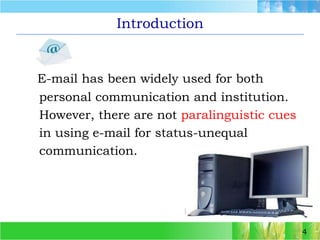
E-mail has been widely used for both      personal communication and institution.      However, there are notparalinguistic cues in using e-mail for status-unequal      communication.4Introduction
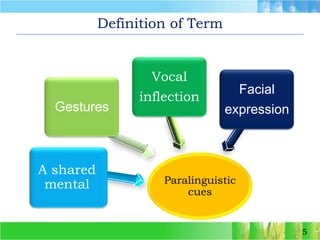
Definition of Term5A shared mentalVocalinflectionGesturesFacialexpressionParalinguistic cues
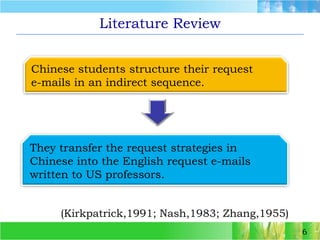
6Literature ReviewChinese students structure their request e-mails in an indirect sequence. They transfer the request strategies in Chinese into the English request e-mails written to US professors.(Kirkpatrick,1991; Nash,1983; Zhang,1955)
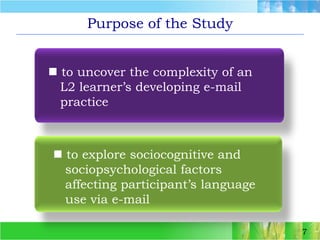
7Purpose of the Study to uncover the complexity of an    L2 learner’s developing e-mail    practice  to explore sociocognitive and    sociopsychological factors    affecting participant’s language    use via e-mail
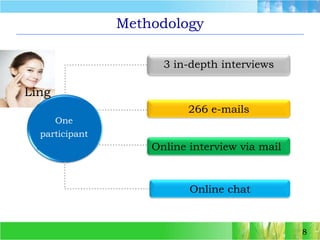
8Methodology3 in-depth interviewsOneparticipantLing266 e-mailsOnline interview via mailOnline chat
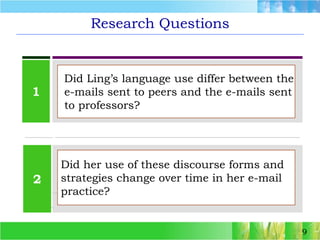
9Research Questions1Did Ling’s language use differ between the  e-mails sent to peers and the e-mails sent   to professors?2Did her use of these discourse forms and  strategies change over time in her e-mail practice?
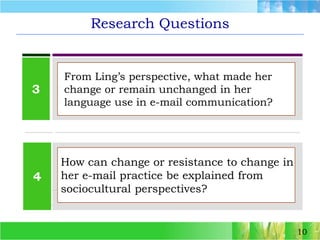
Research Questions103 From Ling’s perspective, what made her  change or remain unchanged in her  language use in e-mail communication? 4How can change or resistance to change in her e-mail practice be explained from sociocultural perspectives?
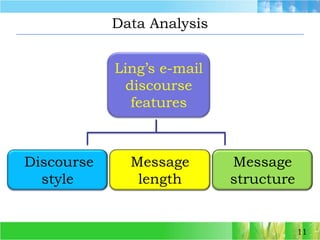
Data Analysis11Ling’s e-mail discourse  featuresDiscourse styleMessage lengthMessage structure
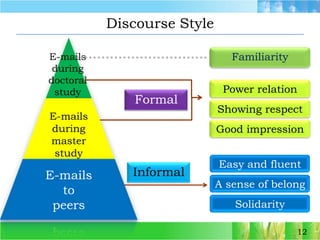
Discourse Style12E-mails duringdoctoral studyFamiliarityE-mails during master studyPower relationFormalShowing respectE-mails to peersGood impressionEasy and fluentInformalA sense of belongSolidarity
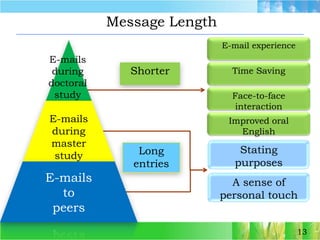
Message Length13E-mailsduringdoctoral studyE-mail experienceE-mails during master studyShorterTime SavingFace-to-face interactionImproved oral EnglishE-mails to peersStating purposesLong entriesA sense of personal touch
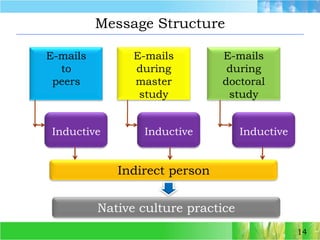
Message Structure14E-mails to peersE-mails during master studyE-mails during doctoral studyInductiveInductiveInductiveIndirect personNative culture practice
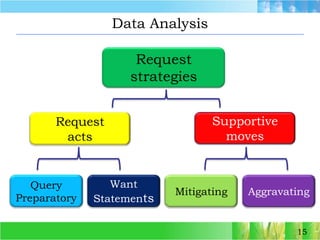
Data Analysis15Request strategiesRequest actsSupportive movesQueryPreparatoryWant StatementsMitigatingAggravating
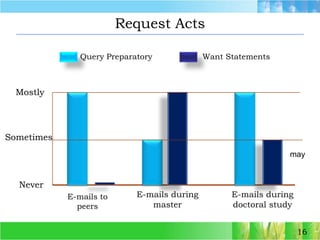
Request Acts16Query PreparatoryWant StatementsMostlySometimesmayNeverE-mails during masterE-mails duringdoctoral study E-mails to  peers
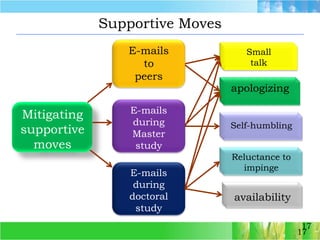
Supportive MovesE-mails to peersSmalltalkapologizingE-mails during  Master studyMitigatingsupportivemovesSelf-humblingReluctance to impingeE-mails during doctoralstudy availability1717
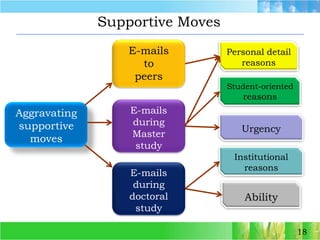
Supportive Moves18E-mails to peersPersonal detailreasonsStudent-orientedreasonsE-mails during  Master studyAggravating supportivemovesUrgencyInstitutionalreasonsE-mails during doctoralstudy Ability
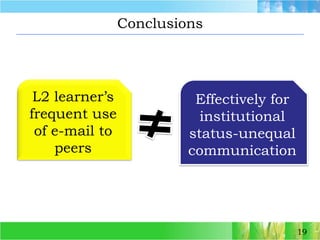
Conclusions19L2 learner’s frequent use of e-mail to peersEffectively for institutional status-unequal communication
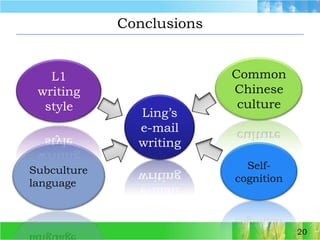
20ConclusionsCommon Chinese cultureL1 writing styleLing’s e-mail writing Subculture language  Self-cognition
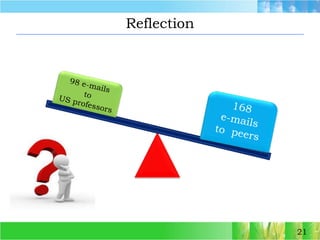
Reflection2198 e-mailsto US professors168 e-mailsto  peers
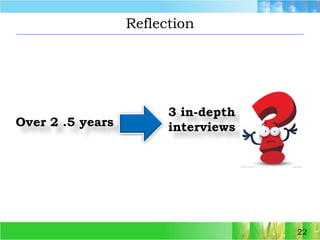
Reflection223 in-depth interviewsOver 2 .5 years
Reflection23
24Thanks for your listening.

Markppt 78