Marketing Management
The Marketing Concept
Dr. Govind Kumar (Ph.D.)
Assistant Professor
FCM, Rama University
Kanpur
MBA II Sem (2015-16)
Marketing
marketing is the process of planning and executing the
conceptions, pricing, promotion, and distribution of ideas,
goods, and services, to create exchanges that satisfy
individual and organizational goals.
Marketing Management
Marketing management is the art and science of choosing
target markets and getting, keeping, and growing customers
through creating, delivering, and communicating superior
customer value.
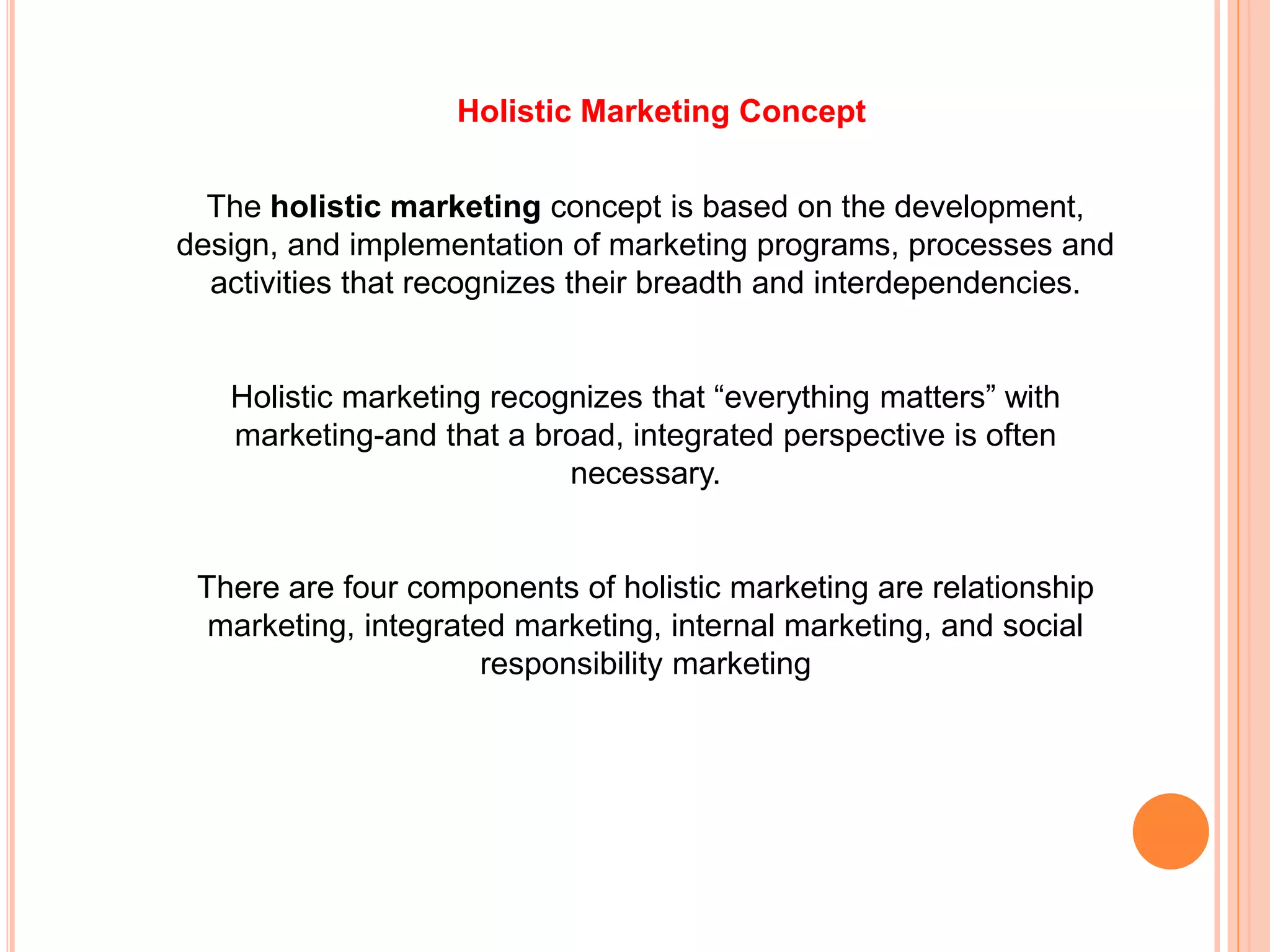
The holistic marketing concept is based on the development,
design, and implementation of marketing programs, processes and
activities that recognizes their breadth and interdependencies.
Holistic marketing recognizes that “everything matters” with
marketing-and that a broad, integrated perspective is often
necessary.
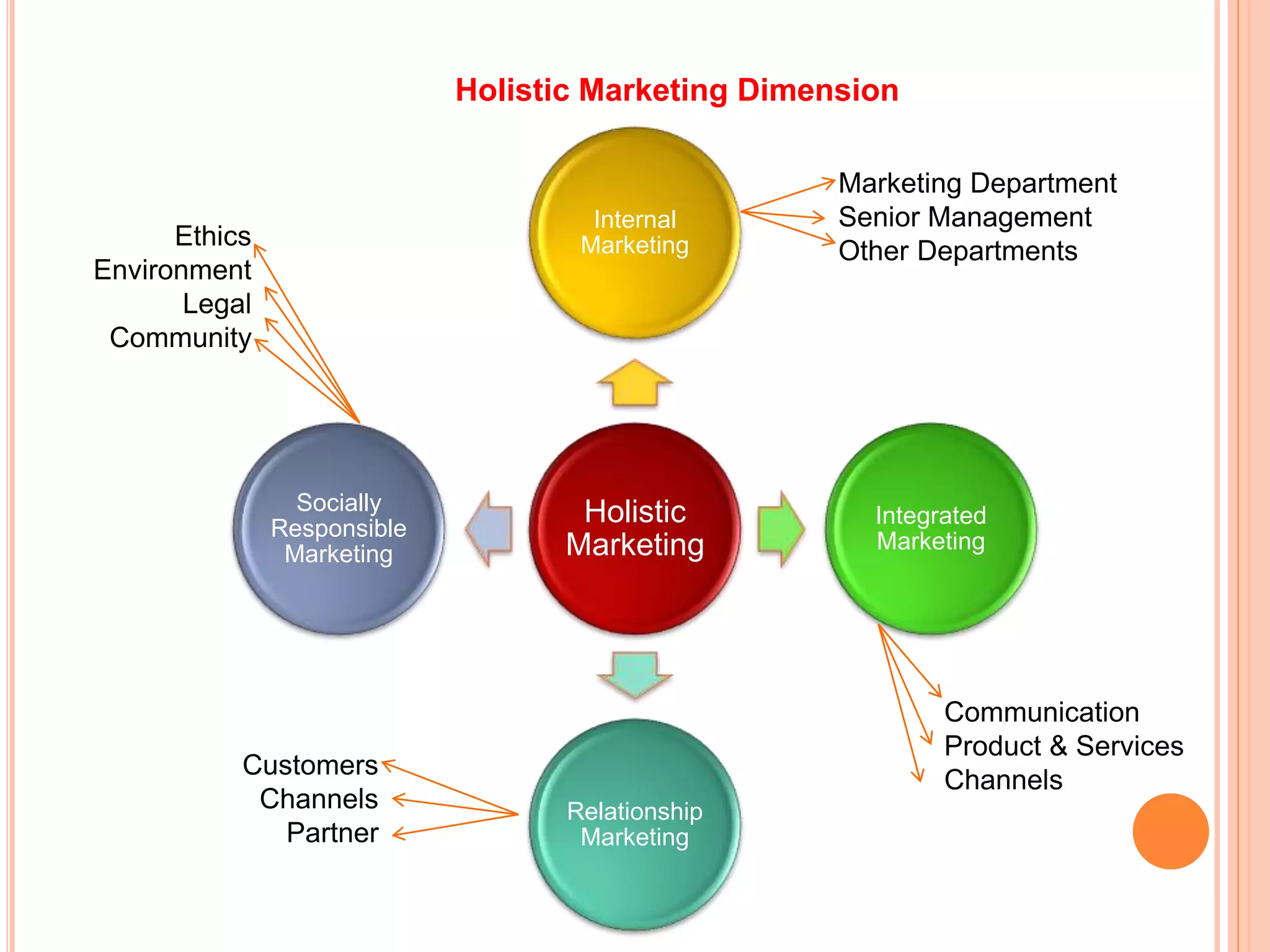
There are four components of holistic marketing are relationship
marketing, integrated marketing, internal marketing, and social
responsibility marketing
Holistic Marketing Concept
Holistic Marketing Dimension
Holistic
Marketing
Internal
Marketing
Integrated
Marketing
Relationship
Marketing
Socially
Responsible
Marketing
Marketing Department
Senior Management
Other Departments
Communication
Product & Services
Channels
Customers
Channels
Partner
Ethics
Environment
Legal
Community
Components of Marketing Mix
Marketing
Mix
Product
Price
Place
Promotion
Product Variety
Quality
Design
Features
Brand Name
Packaging
Sizes
Services
Warranties
Returns
List Price
Discounts
Allowances
Payment Period
Credit Terms
Sales Promotion
Advertising
Sales Force
Public Relations
Direct Marketing
Channels
Coverage
Locations
Inventory
Transport
4Ps Given
by
McCarthy
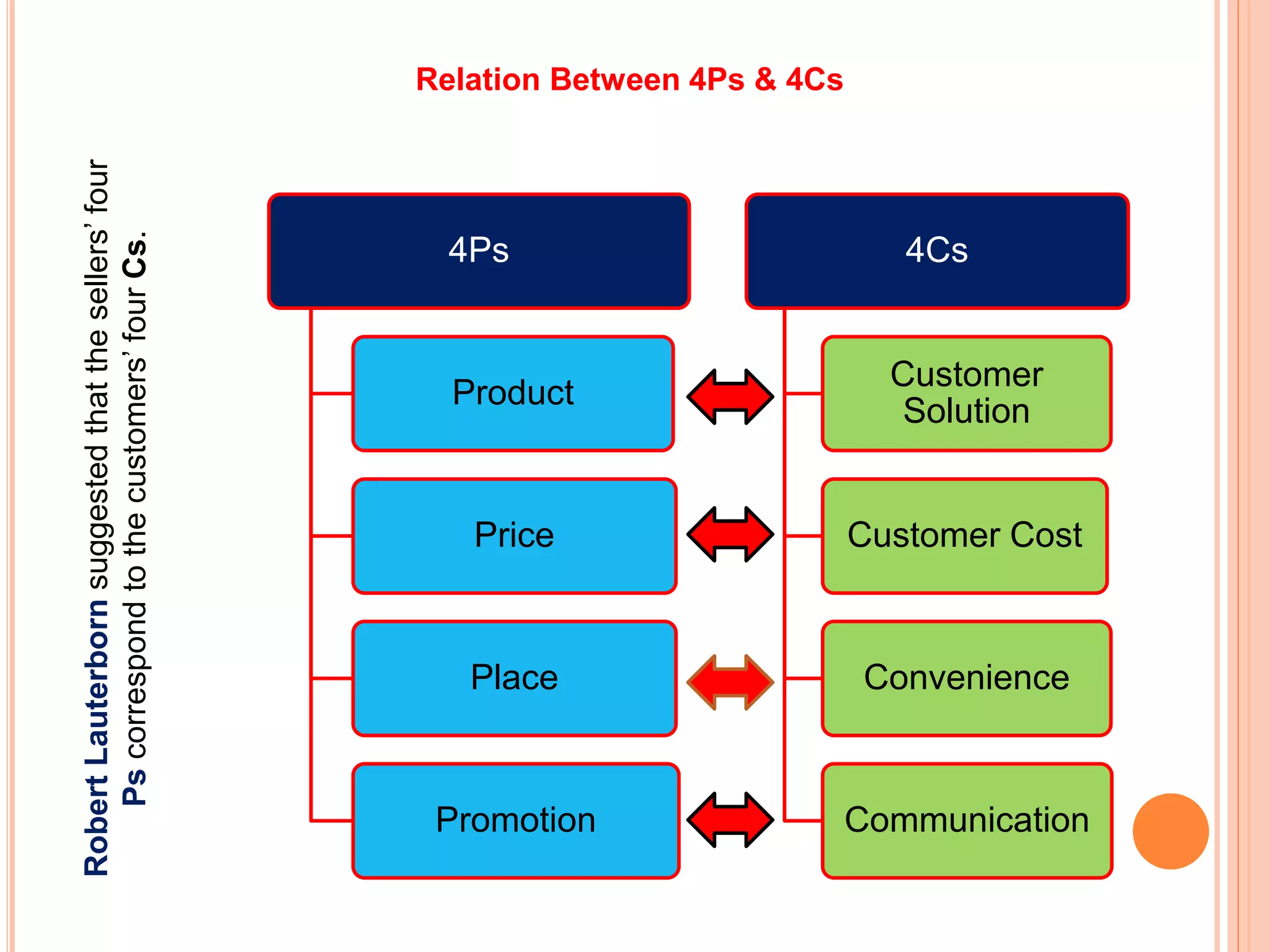
Relation Between 4Ps & 4Cs
4Ps
Product
Price
Place
Promotion
4Cs
Customer
Solution
Customer Cost
Convenience
Communication
RobertLauterbornsuggestedthatthesellers’four
Pscorrespondtothecustomers’fourCs.
Advertising
Sales
Promotion
Direct
Marketing
Events &
Experiences
Public
Relations
Personal
Selling
Distribution
Target
Consumers
Company
Products,Services,
Prices
Communication Mix
Offering Mix
Marketing-Mix Strategy
Core Concept of Marketing
A core set of concepts creates a foundation for marketing management
and a holistic marketing orientation.
Needs, Wants, and Demands:
Needs are the basic human requirements. People need food, air, water, clothing,
and shelter (security) to survive. People also have strong needs for recreation,
education, and entertainment.
These above needs become wants when they are directed to specific objects
that might satisfy the need. An American needs food buy may want a hamburger,
French fries and a soft drink.
Demands are wants for specific products backed by an ability to pay. Many
people want a Mercedes; only a few are willing and able to buy one.
Company measures not only how many people want their product but also how
many would actually be willing and able to buy it.
TargetMarket
Positioning
Segmentation
Offerings&Brands
Value&Satisfaction
MarketingChannels
SupplyChain
Competition
MarketingEnvironment
MarketPlanning
From a managerial point of view, marketing is the process of planning
and executing the conceptions, pricing, promotion, and distribution of
ideas, goods, and services, to create exchanges that satisfy individual
and organizational goals.
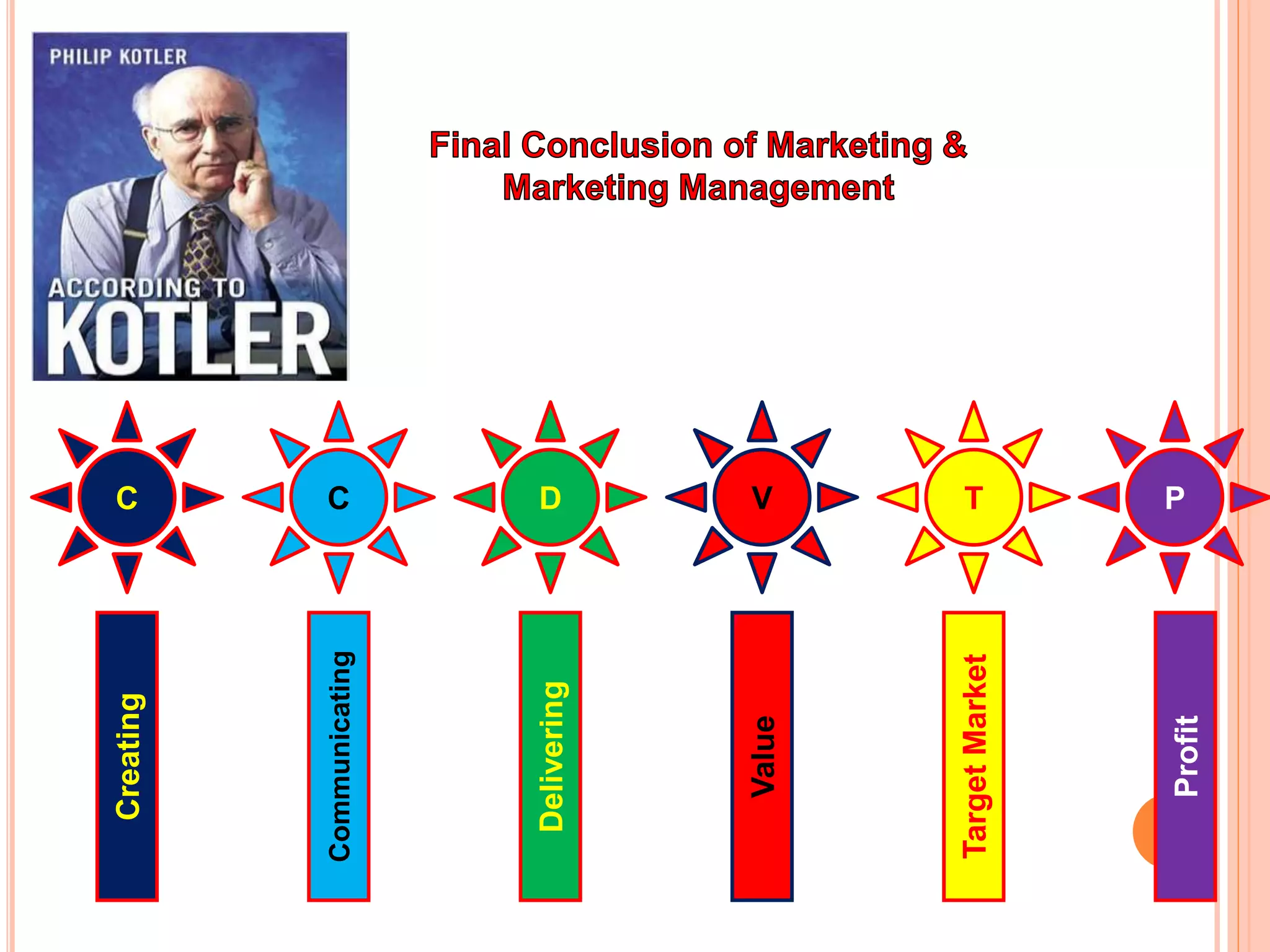
Marketing management is the art and science of choosing target markets
and getting, keeping, and growing customers through creating, delivering,
and communicating superior customer value.
Marketing management has experienced a number of shifts in recent years
as companies seek marketing excellence.
The set of tasks necessary for successful marketing management includes
developing marketing strategies and plans, connecting with
customers, building strong brands, shaping the market offerings,
delivering and communicating value, capturing marketing insights and
performance, and creating successful long-term growth.
C C D V T P
Creating
Communicating
Delivering
Value
TargetMarket
Profit
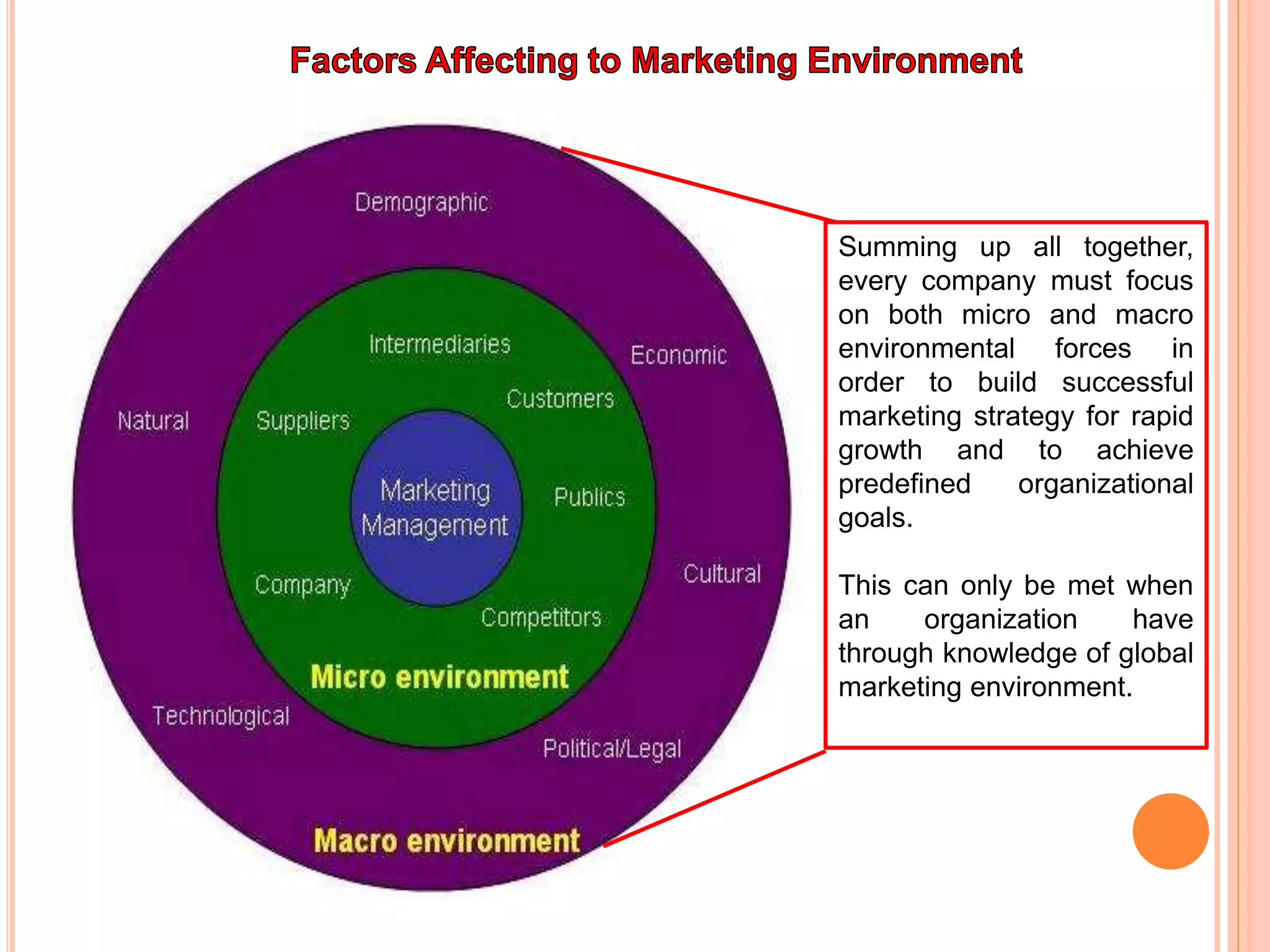
Summing up all together,
every company must focus
on both micro and macro
environmental forces in
order to build successful
marketing strategy for rapid
growth and to achieve
predefined organizational
goals.
This can only be met when
an organization have
through knowledge of global
marketing environment.
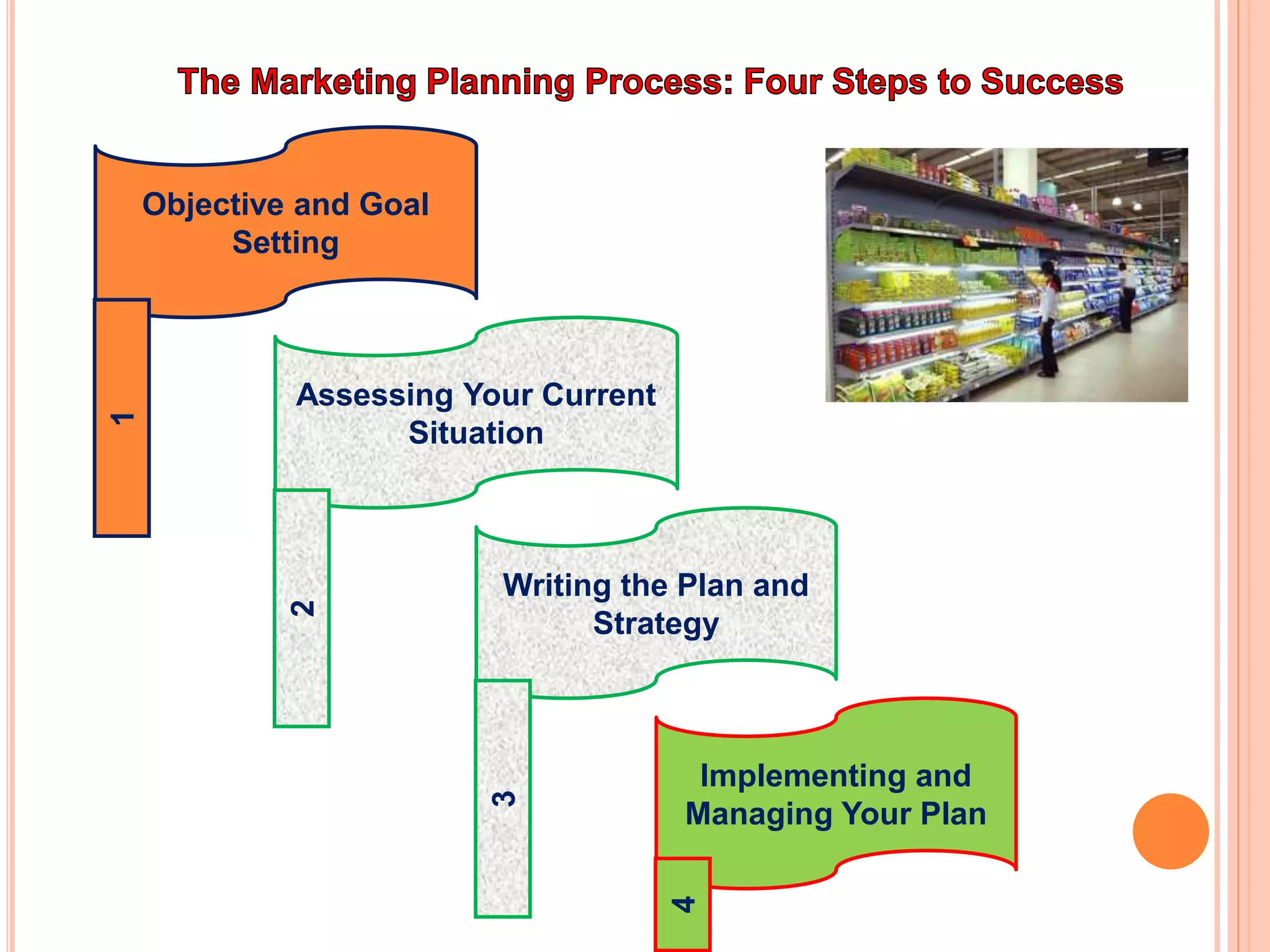
Objective and Goal
Setting
Assessing Your Current
Situation
Writing the Plan and
Strategy
Implementing and
Managing Your Plan
1
2
3
4
Jobber (2007) defines it as a "system in which marketing
data is formally gathered, stored, analyzed and
distributed to managers in accordance with their
informational needs on a regular basis."
Kotler, at al, (2006) "an overall Marketing Information
System can be defined as a set structure of procedures
and methods for the regular, planned collection,
analysis and presentation of information for use in
making marketing decisions."
Marketing
Information
System
Internal
Record
Marketing
Research
Marketing
Intelligence
System
Marketing
Decision Support
System
Consumer behavior as the behavior that consumers display in
searching for, purchasing, using, evaluating, and
disposing/ordering of products and services that they expect
will satisfy their needs.
Consumer behavior focuses on how individual consumers and
families or households make decisions to spend their available
resources (time, money, effort) on consumption-related items.
CB includes what they buy, why they buy it, when they buy it,
where they buy it, how often they buy it, how often they use it, how
they evaluate it after the purchase, the impact of such evaluation
on future purchases, and how they dispose of it.
Consumer behavior describes two different kinds of
consuming entities: the personal consumer and the
organizational consumer.
Personal Consumer: They buys goods and services for
his/her own use, for the use of the household, or as a gift for
a friend.
Organizational Consumer: Includes profit and non-profit
businesses, government agencies (local, state & national),
and institutions (e.g. schools, hospitals, and prisons), which
must buy products, equipment, and services in order to run
their organizations.
Customer
Value
Satisfaction Trust Retention
CS
TR
Basic Outline
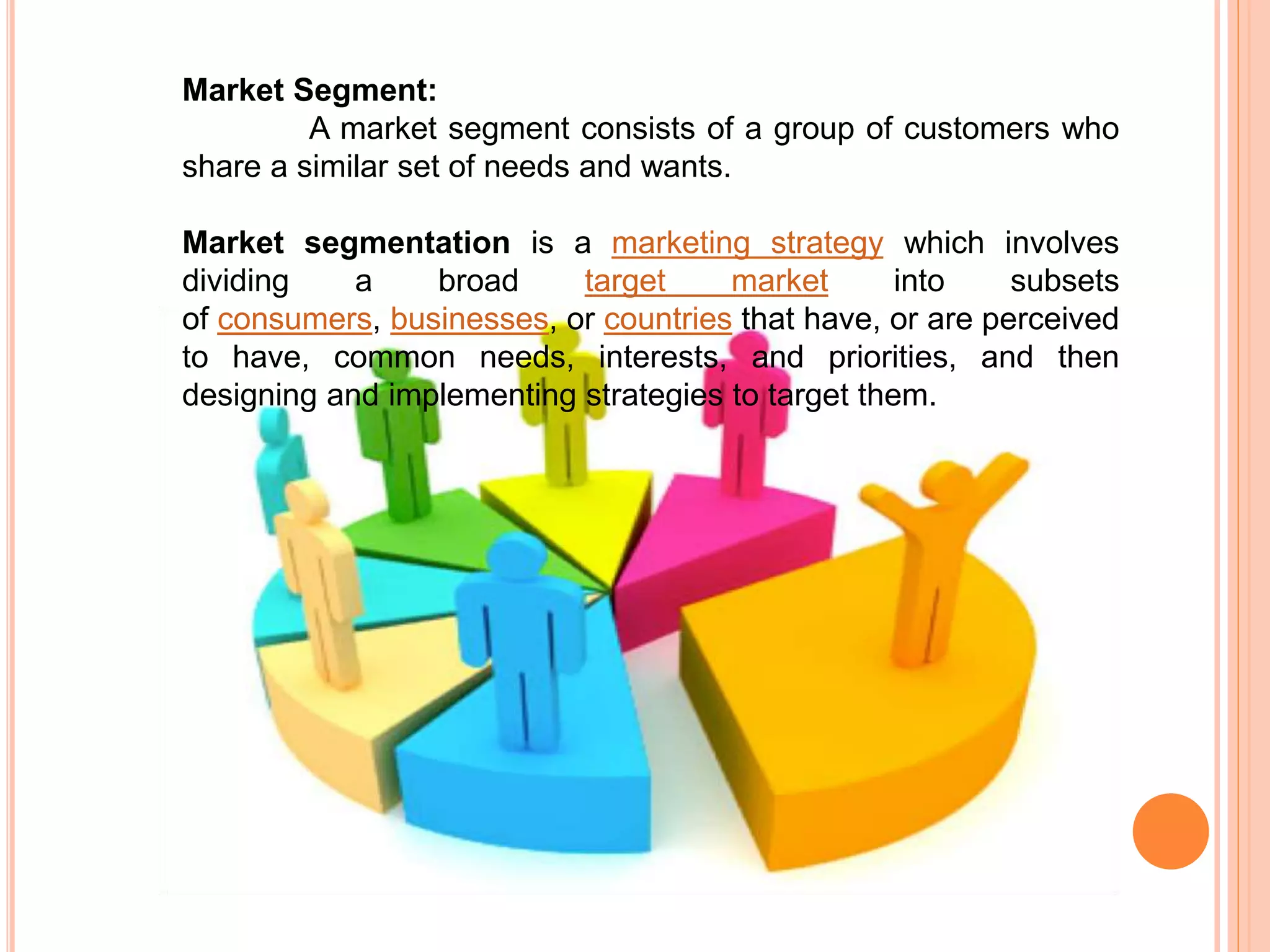
Market Segment:
A market segment consists of a group of customers who
share a similar set of needs and wants.
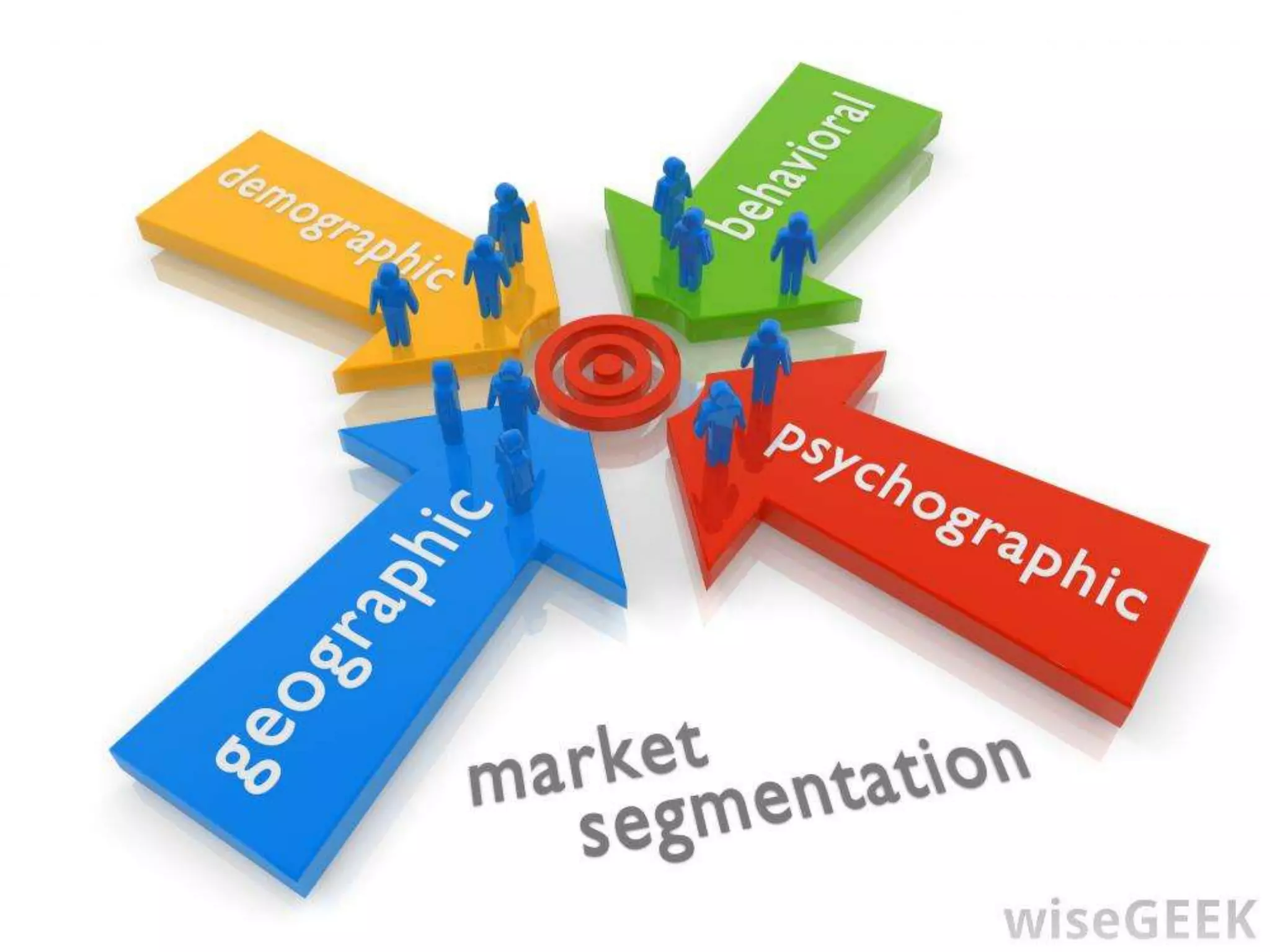
Market segmentation is a marketing strategy which involves
dividing a broad target market into subsets
of consumers, businesses, or countries that have, or are perceived
to have, common needs, interests, and priorities, and then
designing and implementing strategies to target them.
Market Segments can be defined in many different ways. One
way to carve up a market is to identify the same preference
segments.
For Instance- Suppose ice cream buyers are asked how much
they value sweetness and creaminess as two product attributes.
Three different patterns can emerge.
Homogeneous Preference
Diffused Preference
Clustered Preference
Segmentation
Geographic
Segmentation
Demographic
Segmentation
Psychographic
Segmentation
Behavioral
Segmentation
Countries
Nations
States
Regions
Cities
Life Style
Personality
Age
Family Size
Family Life
Cycle
Gender
Income
Occupation
Education
Religion
Social Class
Occasions
Benefits
User Status
Usage Rate
Loyalty Status
Attitudes
towards Products
Key Points to Remember:
Target marketing involves three activities: market
segmentation, market targeting, and market positioning.
Markets can be targeted at four levels: segments, niche, local
area and individuals.
Market segments are large, identifiable, groups, within a
market.
There are two bases for segmenting consumer markets:
consumer characteristics and consumer response.
To be useful, market segments must be measurable,
substantial, accessible, differentiable, and actionable.
Marketer must choose target markets in a socially responsible
manner.
Form
Features
Performance Quality
Conformance Quality
Durability
Reliability
Reparability
Style
BaseofProductDifferentiation
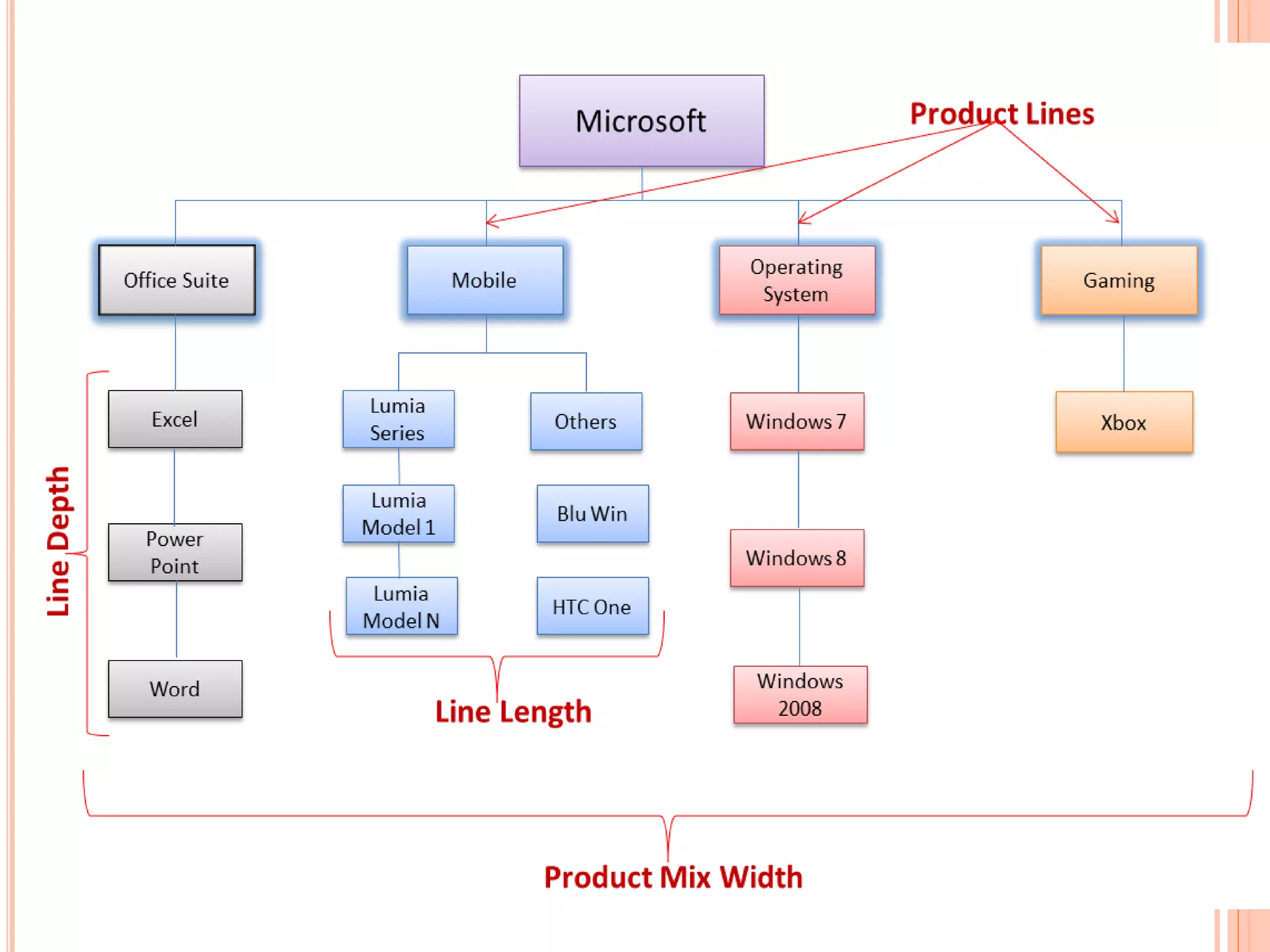
A product mix also called product assortment is the set of all products and
items a particular sellers offers for sale. A product mix consists of various
product lines.
A company’s product mix has a certain width, length, depth and
consistency.
Width- The width of a product mix refers to how many different product
lines the company carries.
Length- The length of a product mix refers to the number of items in the
mix.
Depth- A width a product mix refers to how many variants are offered of
each product in the line.
Consistency- The consistency of the product mix refers to how closely
related the various product lines are in end use, production requirements,
distribution channels, or some other way.
For Instance-
P P P P P
Marketers play a key role in the new-product process by
identifying and evaluating new-product ideas and working with
R&D and others in every stage of development.
Idea Generation
Idea Screening
Concept Development & Testing
Marketing Strategy Development
Business Analysis
Product Development
Marketing Testing
Commercialization
Drop
Accept
Product Life
Cycle
P
P
P
P
PLC
PLC Stage
Characteristics Introduction Growth Maturity Decline
Sales Low Rising Peak Declining
Costs High Cost Average Cost Low Cast Low Cost
Profits Negative Rising High Declining
Customers Innovators Early Adopters Middle Majority Laggards
Competitors Few Growing
Stable No beginning to
decline
Declining
Marketing
Objectives
Create P
Awareness
Max Market Share Max Profit
Reduce
Expenditure
Strategies
Products
Offer a basic
Product
Offer Product
Extensions
Diversity Brands & Items
Models
Phase out
weak
Price Change cost-plus
Price to Penetrate
Market
Price to match or best
competitors
Cut price
Distribution
Build selective
Dis.
Build intensive
Distribution
Build more int.
distribution
Go selective
Advertising
Build product
awareness
Build awareness &
interest in mass mkt.
Stress brand difference
& benefits
Reduce to
level needed
Sales
Promotion
Use heavy sales
promotion
Reduce to take
advantage of heavy
customer demand
Increase to encourage
brand switching
Reduce to
minimal level
Summary of the Lesson:
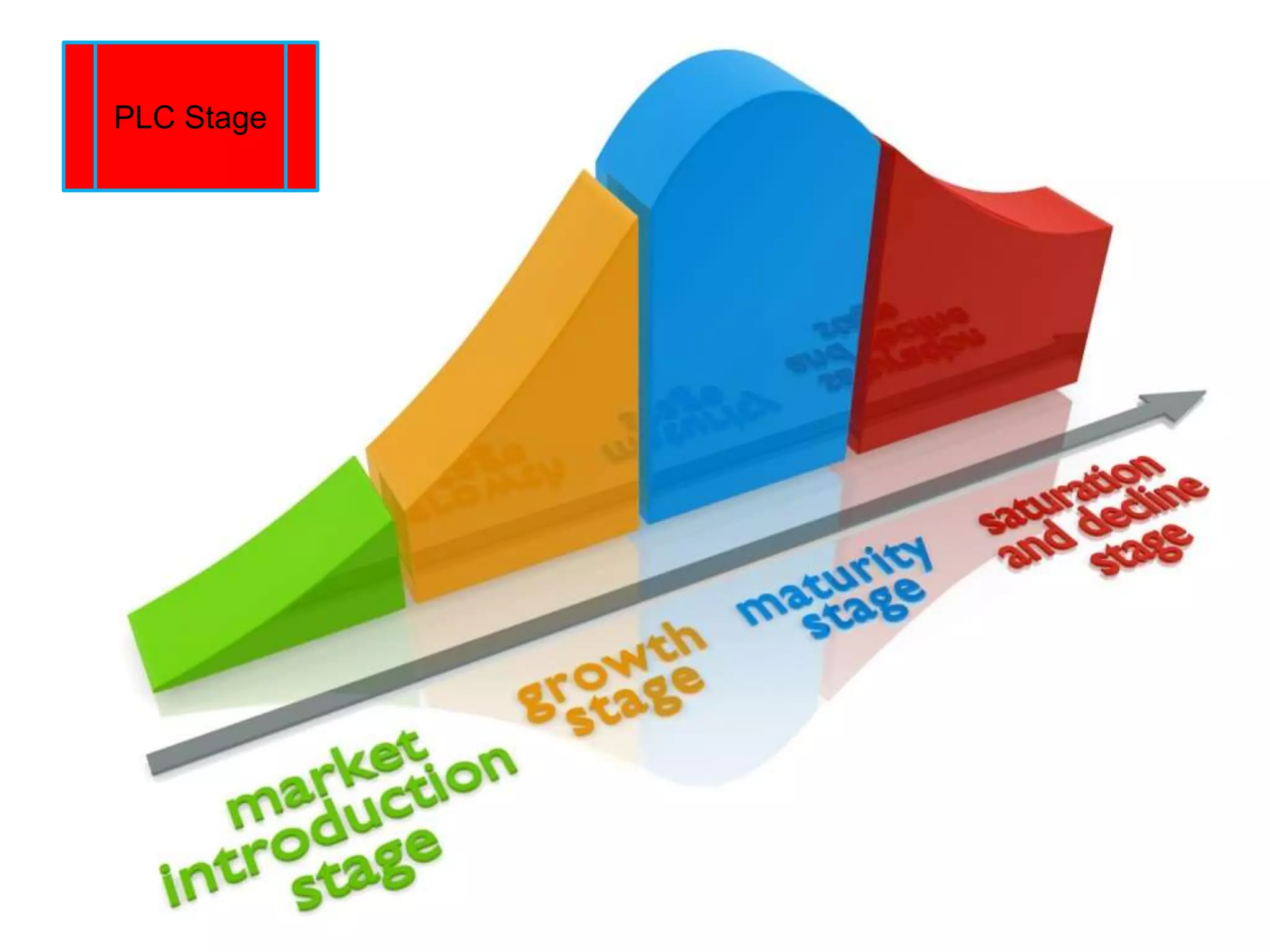
Each stage of the product life cycle calls for different marketing
strategies. The introduction stage is marked by slow growth and
minimal profits. If successful, the product enters a growth stage
marked by rapid sales growth and increasing profits. There follows
a maturity stage in which sales growth slows and profits stabilize.
Finally, the product enters a decline stage. The companies' task is
to identify the weak products; develop a strategy for each one; and
phase out weak products in a way that minimizes the hardship to
company profits, employees and customers.
Packaging
&
Labeling
What Customer
Wants?
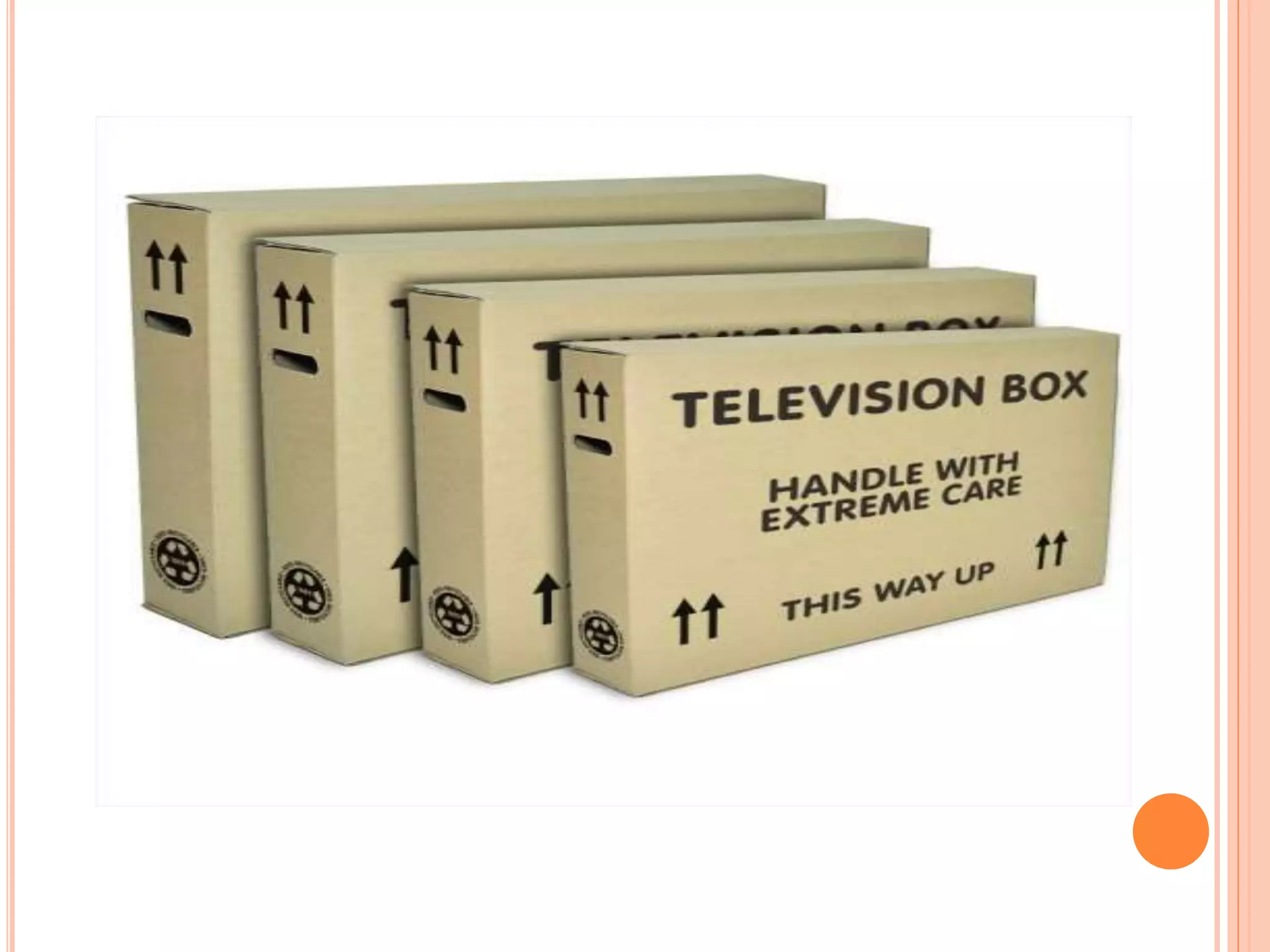
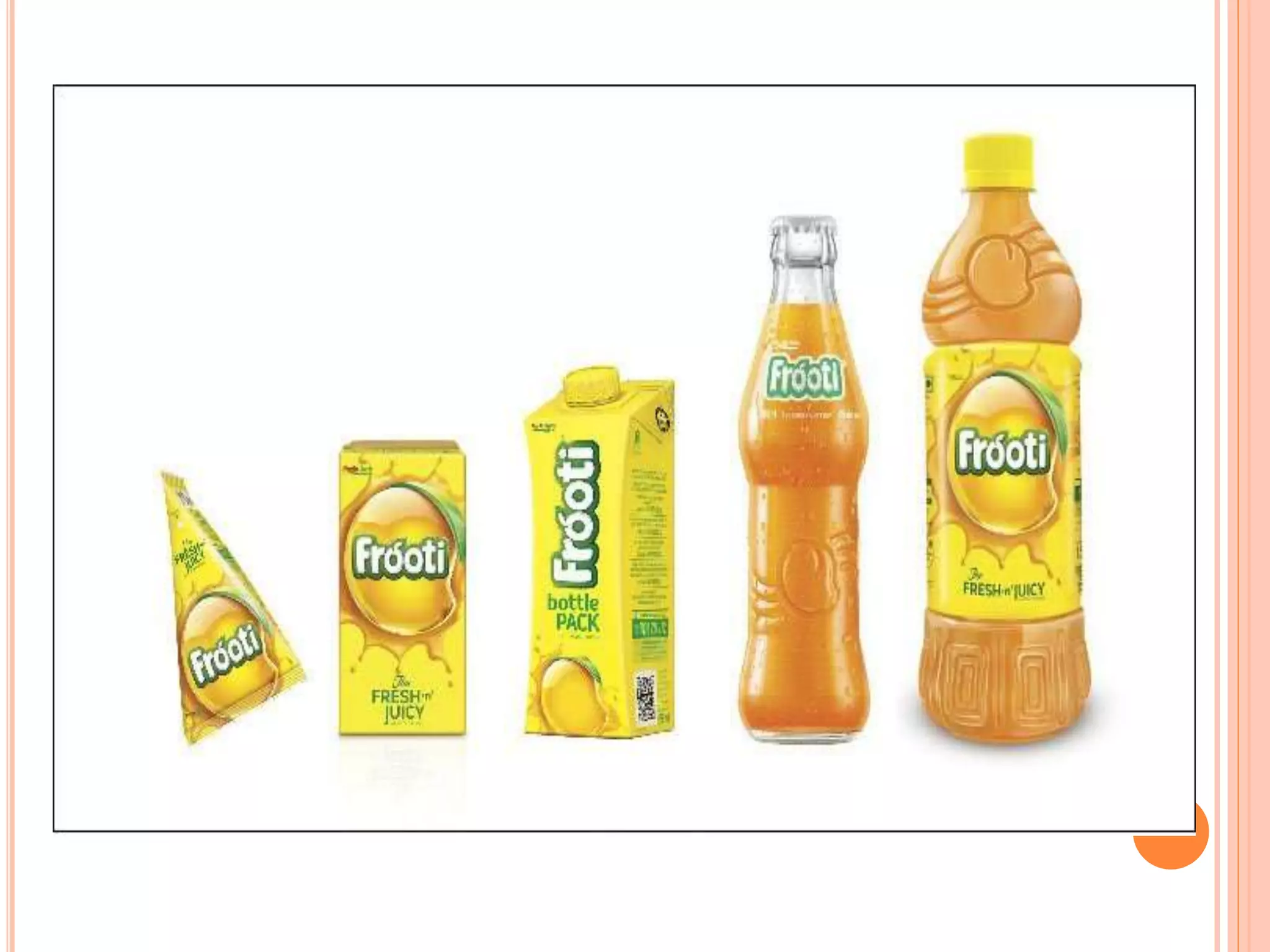
Why Packaging So Important:
Customers are drawn, more than anything, to products that look
good. Something that is well designed and interesting is bound to
attract more potential customers than a product that is poorly
designed and looks bland.
It is, after all, the key part in marketing product and ensuring it
sells. It is also the key part in associating a brand to a certain thing-
be it a color or a font .
Packaging Design: Where it Begins:
A good design should always reflex the product and the creativity
and personality of the company. There is more, however, to
packaging design than simply ensuring a package looks appealing.
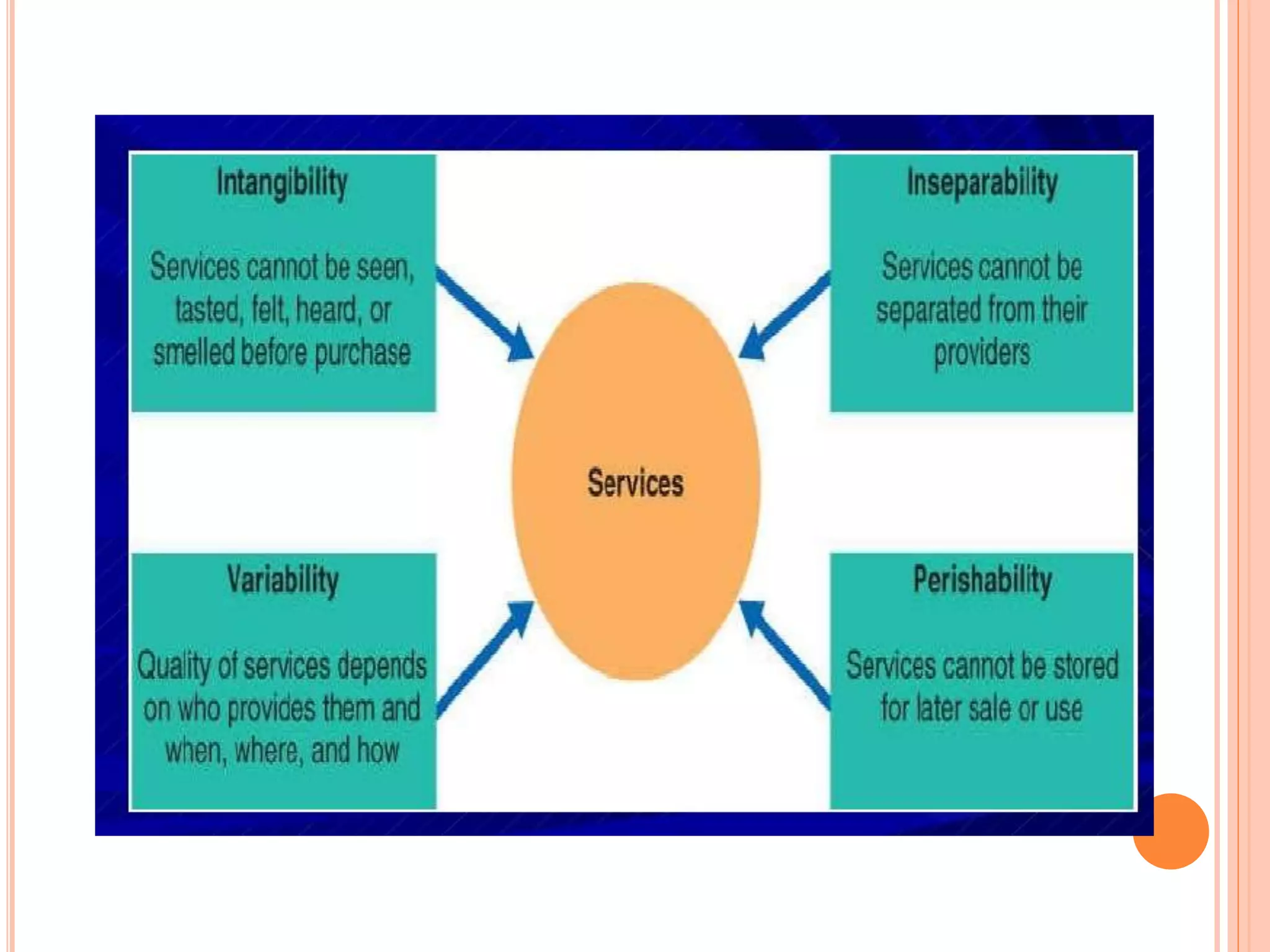
Intangible products such as accounting, banking, cleaning,
consultancy, education, insurance, expertise, medical
treatment, or transportation.
Sometimes services are difficult to identify because they are
closely associated with a good; such as the combination of
a diagnosis with the administration of a medicine.
No transfer of possession or ownership takes place when
services are sold, and they (1) cannot be stored or
transported, (2) are instantly perishable, and (3) come into
existence at the time they are bought and consumed.
Three Types of Marketing in Service
Industry
.
(Parasuraman, Zeithaml &
Berry, 1985)
Example:
Price is not just a number on a tag or an item:
Price is all around us. You pay rent for your apartment, tuition
for your education, and a fee to your physician or dentist. The
airline, railway, taxi, and bus companies charge you a fare; the
local utilities call their price rate; and the local bank charges
you interest for the money you borrow.
Skimmin
g
Pricing
Product-Line
Pricing
Cyclical
Pricing
Differential Pricing
Cost based
Pricing
Demand
based
Pricing
Competition
based
Pricing
Other
Pricing
Method
Cost –Plus Pricing
Markup Pricing
Value Pricing
Target Return Pricing
Going Rate Pricing
Transfer Pricing
1. Cost Based Pricing refers to a pricing method in which some
percentage of desired profit margins is added to the cost of the product
to obtain the final price. In other words, cost based pricing can be
defined as a pricing method in which a certain percentage of the total
cost of production is added to the cost of the product to determine its
selling price.
(a) Cost Plus Pricing: Refers to the simplest method of
determining the price of a product. In cost plus pricing method, a
fixed percentage, also called markup percentage, of the total cost
(as a profit) is added to the total cost to set the price. For
example, XYZ organization bears the total cost of Rs. 100 per unit
for producing a product. It adds Rs. 50 per unit to the price of
product as’ profit. In such a case, the final price of a product of the
organization would be Rs. 150.
(b) Markup Pricing: Refers to a pricing method in which the
fixed amount or the percentage of cost of the product is
added to product’s price to get the selling price of the
product. Markup pricing is more common in retailing in which
a retailer sells the product to earn profit. For example, if a
retailer has taken a product from the wholesaler for Rs. 100,
then he/she might add up a markup of Rs. 20 to gain profit.
2. Demand Based Pricing: Demand based pricing refers to a
pricing method in which the price of a product is finalized
according to its demand. If the demand of a product is more, an
organization prefers to set high prices for products to gain profit;
whereas, if the demand of a product is less, the low prices are
charged to attract the customers.
3. Competition Based Pricing refers to a method in which
an organization considers the prices of competitors’
products to set the prices of its own products. The
organization may charge higher, lower, or equal prices as
compared to the prices of its competitors.
4. Other Pricing Method
i. Value Pricing: Implies a method in which an organization tries to
win loyal customers by charging low prices for their high quality
products. The organization aims to become a low cost producer
without sacrificing the quality. It can deliver high quality products at
low.
Many companies are intent on developing stronger bonds with their
customers- called CRM.
This is the process of managing detailed information about individual
customers and carefully managing all customer “touch points” to
maximize customer loyalty.
A customer touch point is any occasion on which a customer
encounters the brand and product-from actual experience to
personal or mass communications to casual observation.
CRM….
Continue…
Some of the groundwork for customer relationship management was
laid by Don Peppers and Martha Rogers in a series of books. Peppers
and Rogers outline a four-step framework for one-to-one marketing
that can be adapted to CRM marketing as follows-
A. Identify your prospects and customers
B. Differentiate customers in terms of (1) their needs and (2) their
value to your company.
C. Interact with individual customers to improve your knowledge
about their individual needs and to build stronger relationships.
D. Customize products, services and messages to each customer.
Mass Marketing
*Average Customer
*Customer Anonymity
*Standard Product
*Mass Production
*Mass Distribution
*Mass Advertising
*Mass Promotion
*One-Way Message
*Economies of Scale
*Share of Market
*All Customers
*Customer Attraction
One-to-One Marketing
*Individual Customer
*Customer Profile
*Customized Mkt Offering
*Customized Production
*Individualized Distribution
*Individualized Message
*Individualized Incentives
*Two-Way Messages
*Economies of Scope
*Share of Customer
*Profitable Customers
*Customer Retention
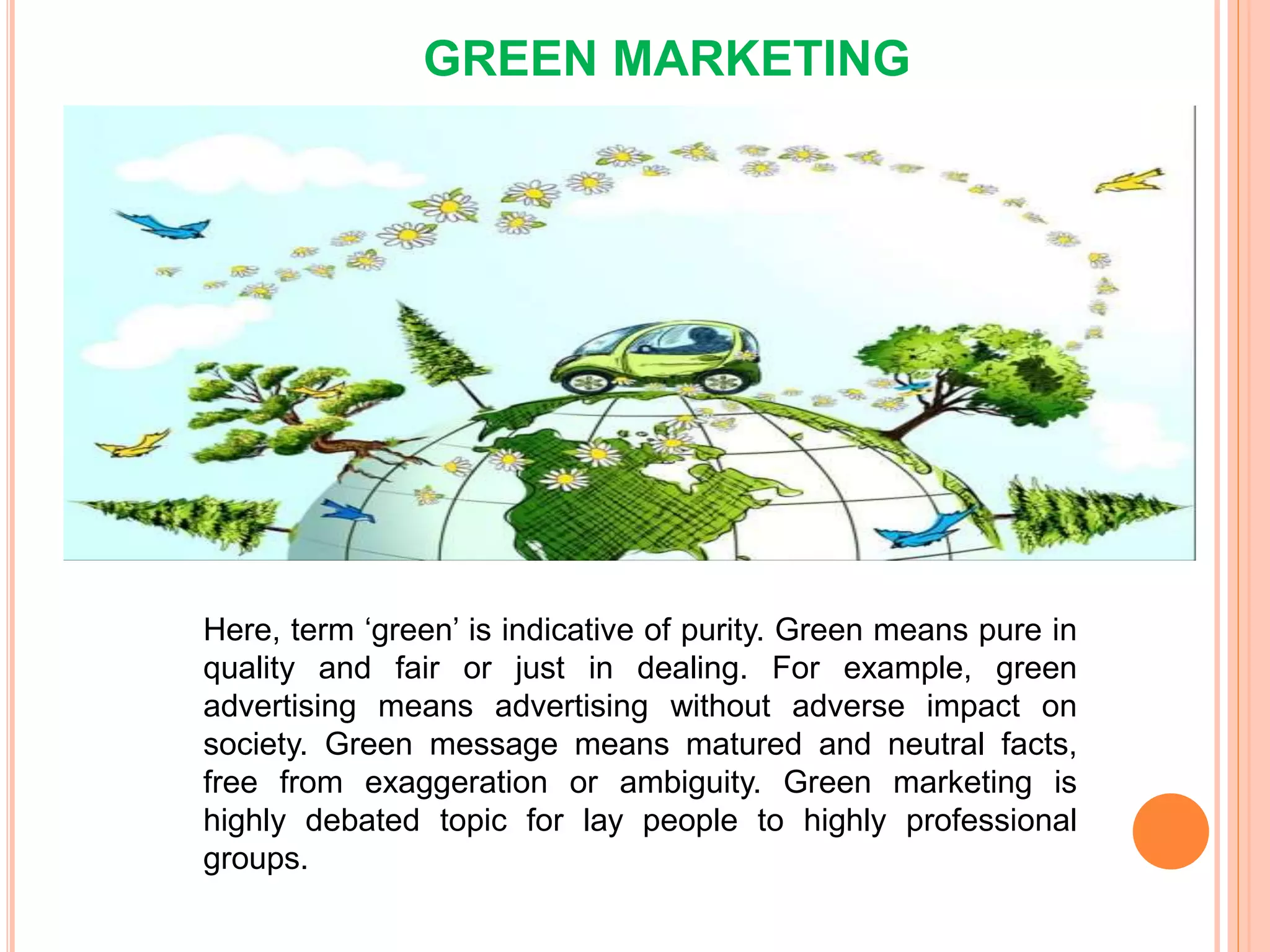
GREEN MARKETING
Here, term ‘green’ is indicative of purity. Green means pure in
quality and fair or just in dealing. For example, green
advertising means advertising without adverse impact on
society. Green message means matured and neutral facts,
free from exaggeration or ambiguity. Green marketing is
highly debated topic for lay people to highly professional
groups.
Concept of green marketing
concerns with protection of
ecological environment.
Excessive pollution has
provoked the Nature and the
Nature starts behaving in
unnatural ways (in form of
global warming v/s global
cooling, heavy rains
v/s draught, and other natural calamities like frequent earthquakes and
tsunami, cyclones, epidemics, and so forth). Economic growth via
production and consumption threatens peaceful life of human being on
the earth. Green marketing is an attempt to protect consumer welfare
and environment (the nature) through production, consumption, and
disposal of eco-friendly products.
Definition of Green Marketing:
“The marketing or promotion of a product based on its environment
performance or an improvement thereof (Charter & Polonsky,
1999)”
The holistic management process responsible for identifying and
satisfying the requirements of customers and society, in a profitable
and sustainable way 9Peattie, 1995)
Basically, green marketing concerns
with three aspects:
1. Promotion of production and
consummation of pure/quality products,
2. Fair and just dealing with customers and
society, and
3. Protection of ecological environment.
Impacts or Importance of Green Marketing:
Green marketing affects positively the health of people and the
ecological environment. People are aware of pure products and
pure methods of producing, using, and disposing the products.
It encourages integrated efforts for purity in production and
consumption as well.
Environmental Benefits
Consumer Benefits
Product benefits
Developing Economies
Reasons Why companies to adopt Green Marketing:
Opportunities or competitive advantage.
Corporate social responsibilities (CSR).
Government pressure.
Competitive pressure.
Cost or profit issues.
Challenges in Green Marketing:
Majority of the people are not aware of Green products and their
uses.
Green products require a recyclable and renewable materials or
elements which are
expensive.
People are often perceived that green products are expensive
compared to traditional
products.
Green Marketing depends on technology and requires a huge
investment in Research and
Development.
Green Marketing Mix
The combination of 4 Green P‟s or Green factors(Eco-friendly) is
known as Green Marketing Mix.
GMM
Green
Product
Green
Price
Green
Place
Green
Promotion
SN Company Activities
1
Philips India Energy saving Lights, Medical Equipments, House hold appliances
2 Go GreenBOV Battery Operated Vehicles(BOV)
3 Philips Compact Fluorescent Light (CFL) bulbs
4
Hewlett-Packard
Company
Energy-efficient products and services and
institute energy-efficient operating practices in its
facilities worldwide.
5
Wipro
Technologies
Sustainable IT products and solutions, which help customers,
achieve high productivity in energy, space and asset management
through the lifecycle. Recycled plastic. Launched Green ware
ranges of desktops are not only 100% recyclable, but also toxin-free.
6
CISCO Systems Cisco is planning to minimize the ecological impact by establishing
responsible operation programs aimed to reduce energy
consumption
7
Infosys
Technologies
Ltd.
Focused on green buildings, water harvesting and conservation,
better transport management by encouraging car pool for its
employees and increasing bio-diversity in its campuses.
Company Involved in Green Marketing
Showing Countries ranked according to
their response level on Green
Marketing
SN Countries
1 India
2 UK
3 US
4 Australia
5 Canada
6 China
Global Marketing
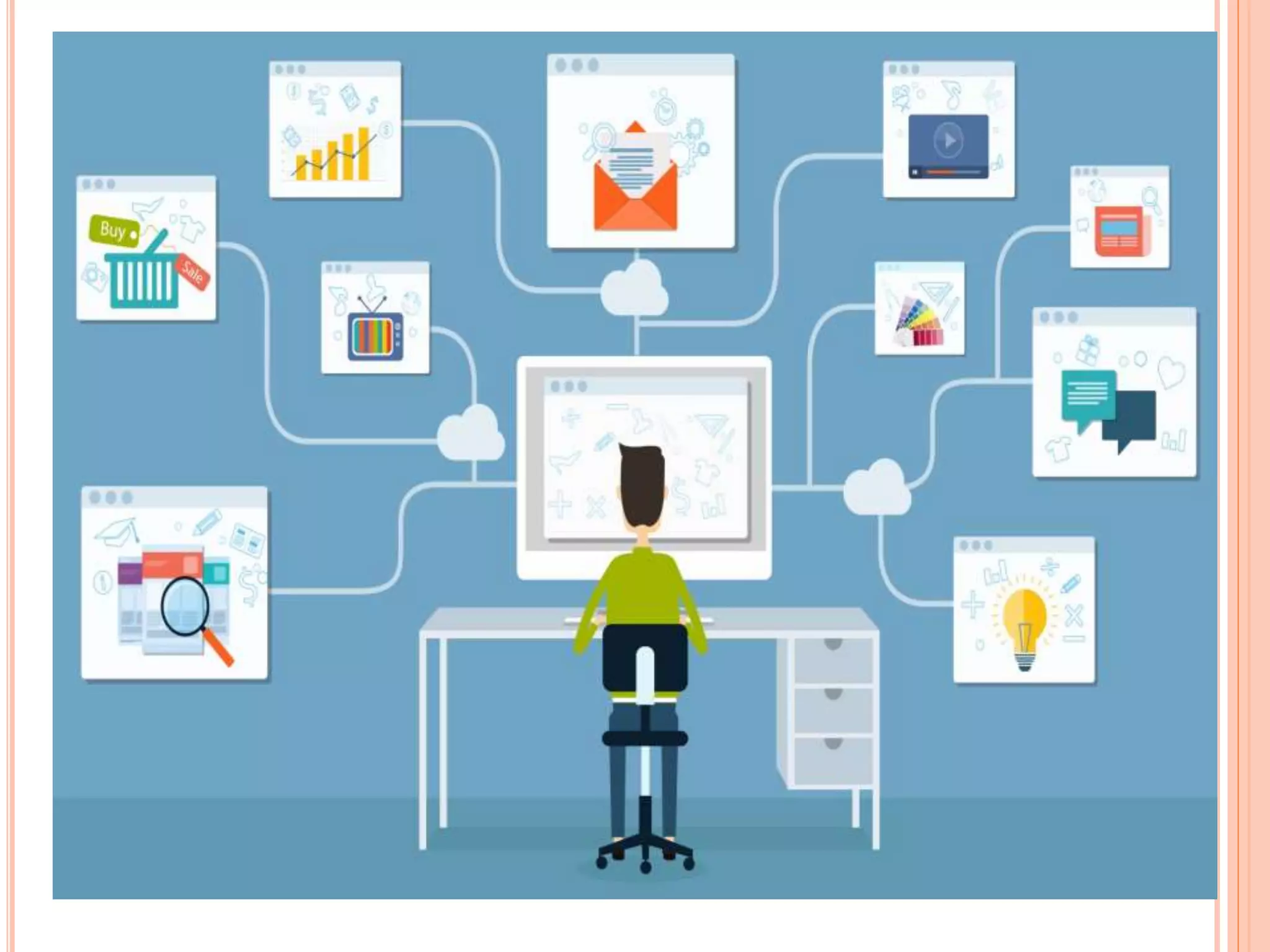
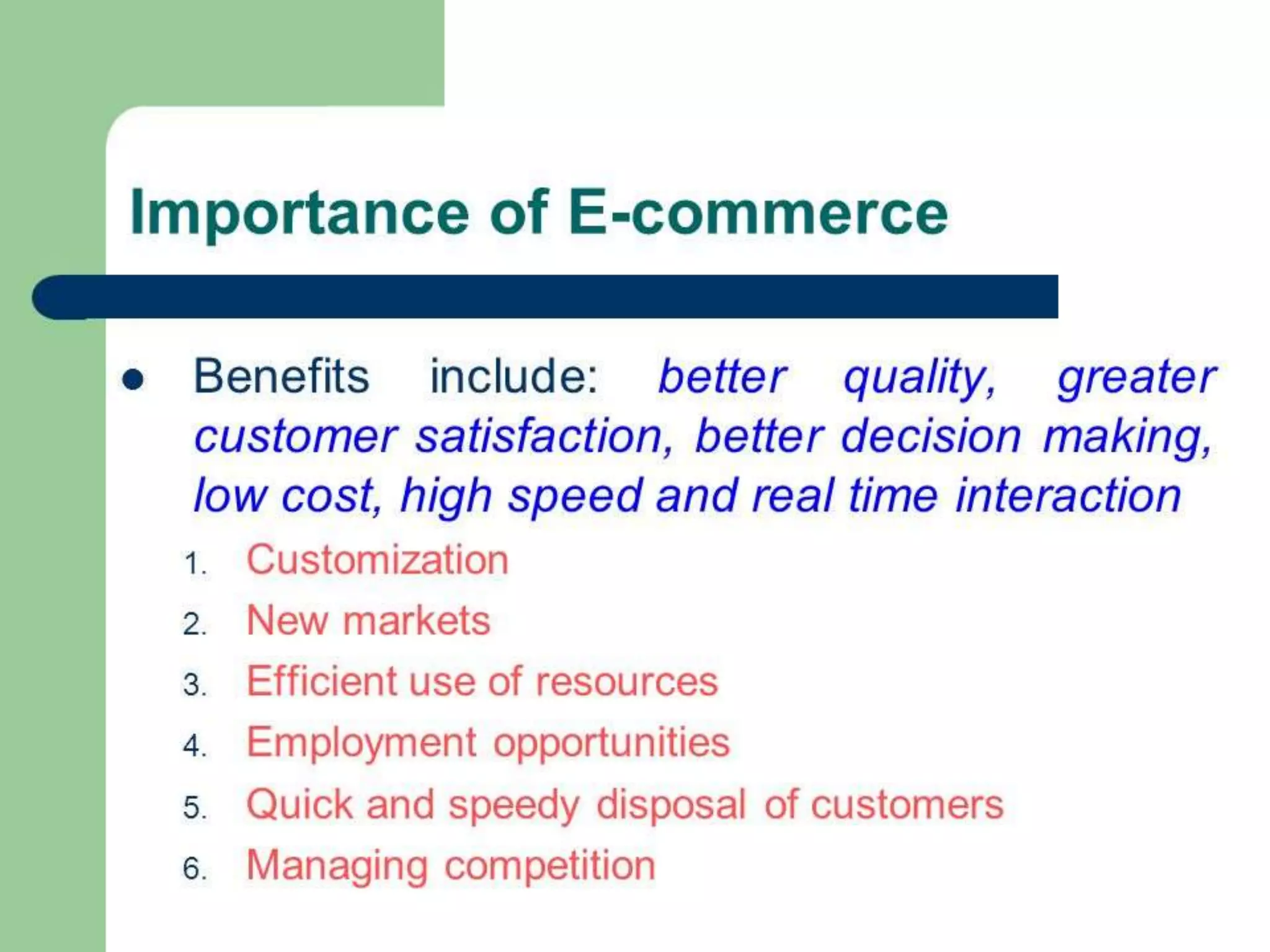
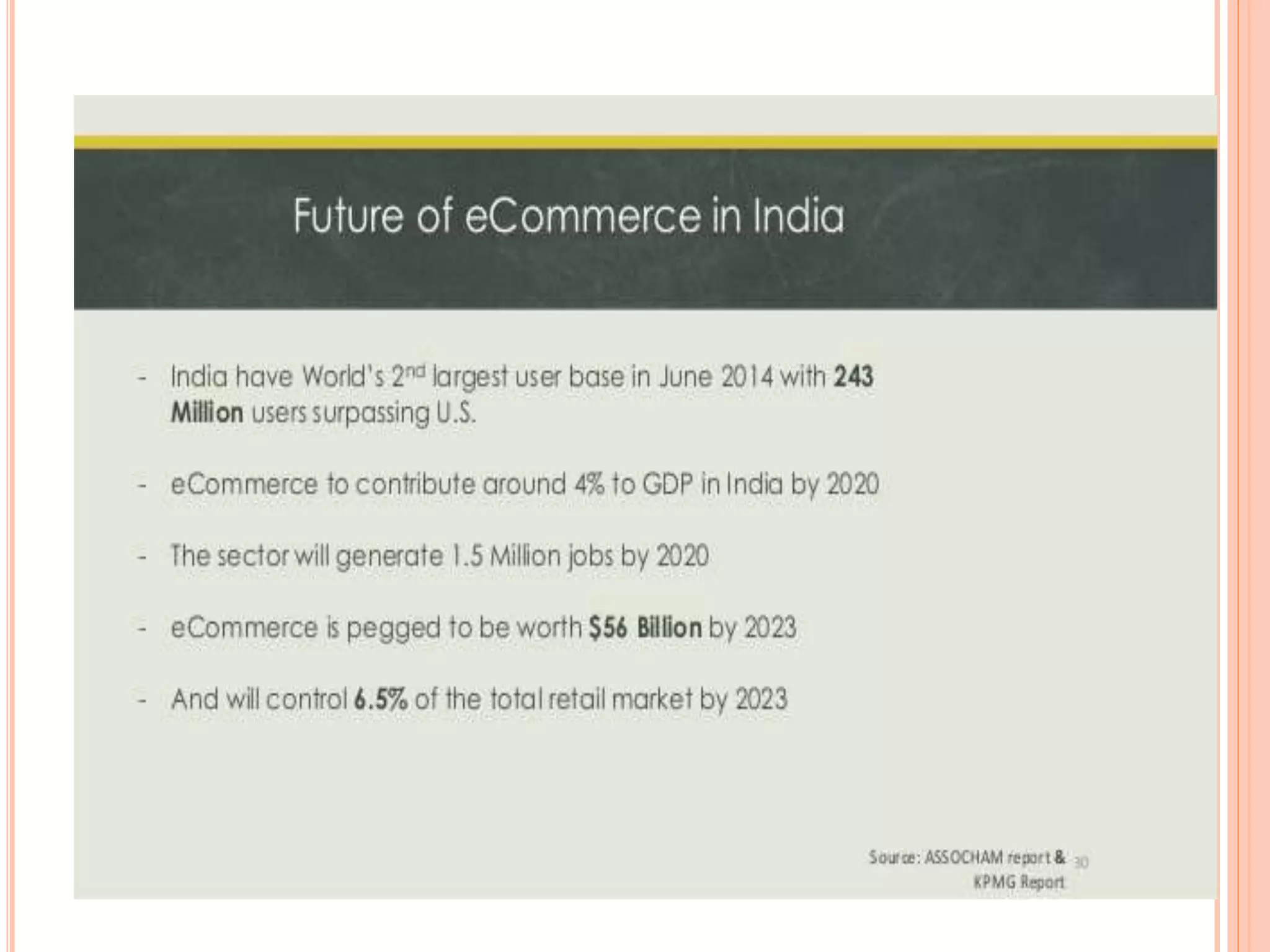
Electronic commerce, commonly written as ecommerce, is the
trading or facilitation of trading in products or services using computer
networks, such as the Internet. Electronic commerce draws on
technologies such as mobile commerce, electronic funds transfer,
supply chain management, Internet marketing, online transaction
processing, electronic data interchange (EDI), inventory management
systems, and automated data collection systems. Modern electronic
commerce typically uses the World Wide Web for at least one part of
the transaction’s life-cycle, although it may also use other
technologies such as e-mail.
Wholesaling & Retailing
Marketing Channel
Successful value creation needs successful value
delivery. Holistic marketers are increasingly taking a
value network view of their business. Instead of limiting
their focus to their immediate suppliers, distributors, and
customers, they are examining the whole supply chain
that links raw materials, components, and manufactured
goods and shows how they move toward the final
consumers.
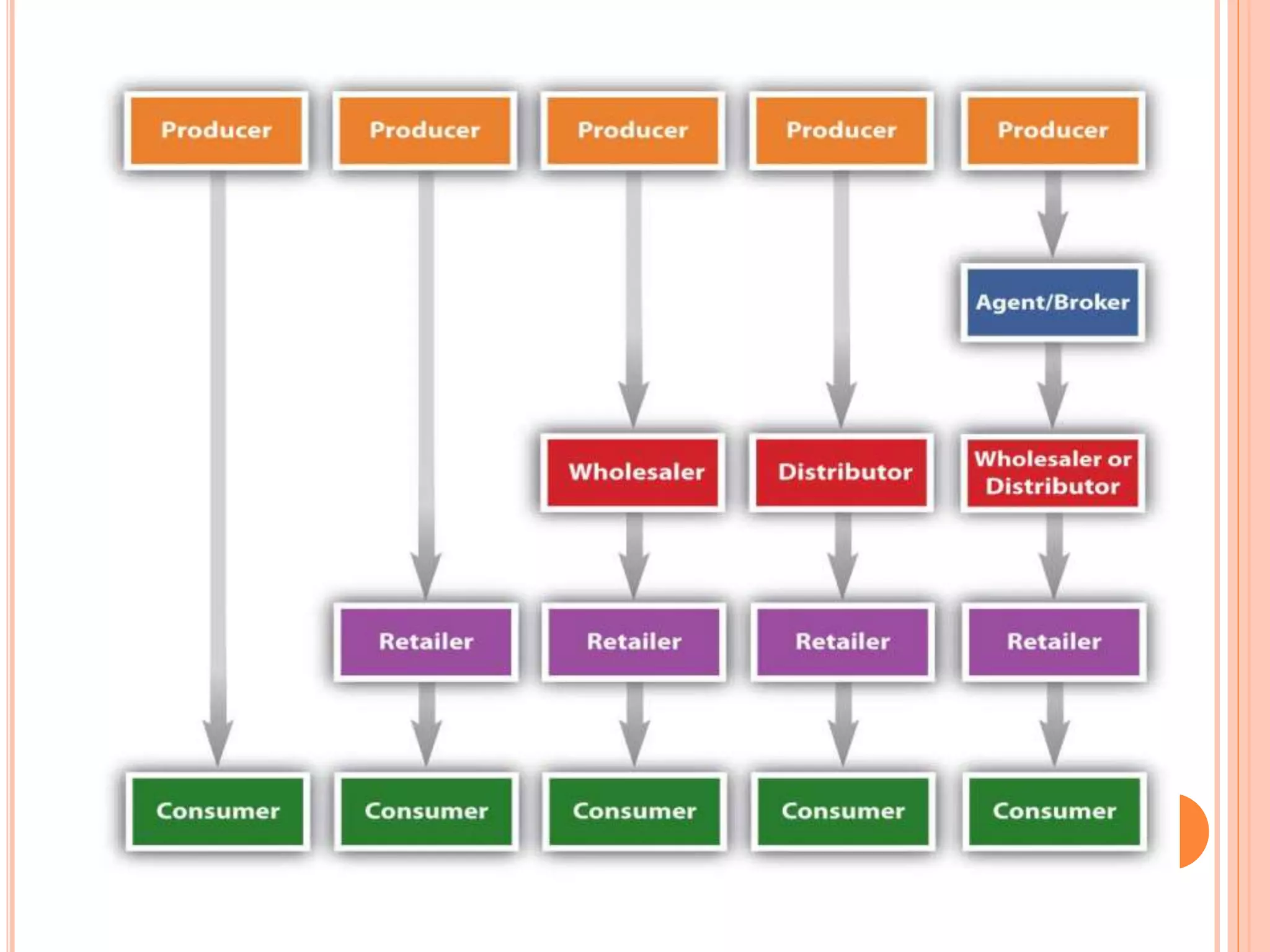
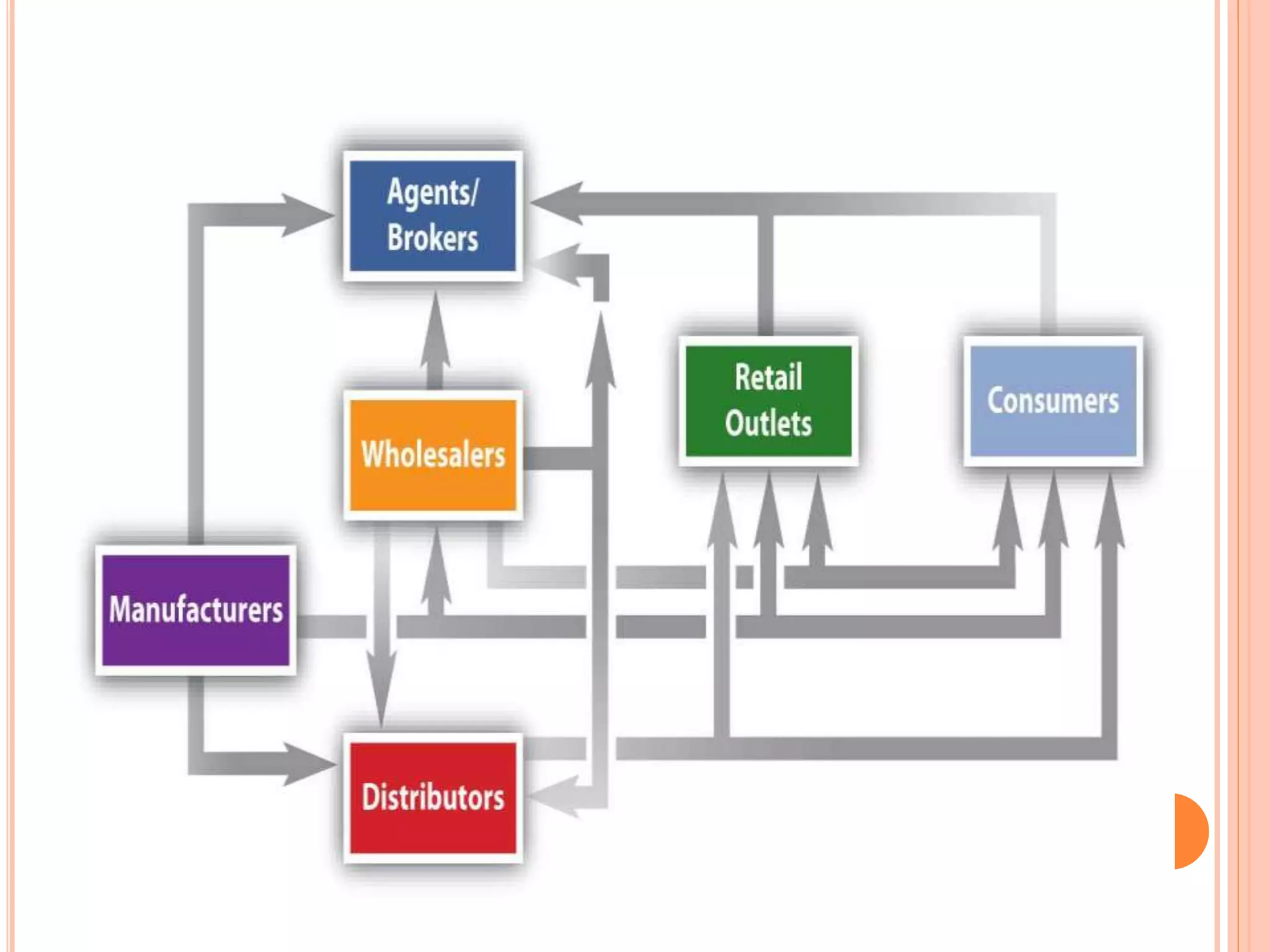
Most producers do not sell their goods directly to final users.
Between producers and final users stands one or more
marketing channels, a host of marketing intermediaries
performing a variety of functions.
Marketing channels decisions are among the most critical
decisions facing management. The company's chosen
channels profoundly affects all other marketing decisions.
Companies use intermediaries when they lack the financial
resources to carry out direct marketing, when direct marketing
is not feasible, and when they can earn more by doing so.
The most important functions performed by intermediaries are
information, promotion, negotiation, ordering, financing, risk
taking, physical procession, payment etc.
Manufacturers have many alternatives for reaching a
market. They can sell direct or use one-two-,or three-level
channels, deciding which types of channel to use calls for
analyzing customer needs, establishing channels objectives
and identifying and evaluating the major alternatives,
including the types and numbers of intermediaries involved
in the channels.
Effective channel management calls for selecting
intermediaries and training and motivating them. The goal is
to build a long-term partnership that will be profitable for all
channel members.
Marketing channels are characterized by continuous and
sometimes dramatic change.
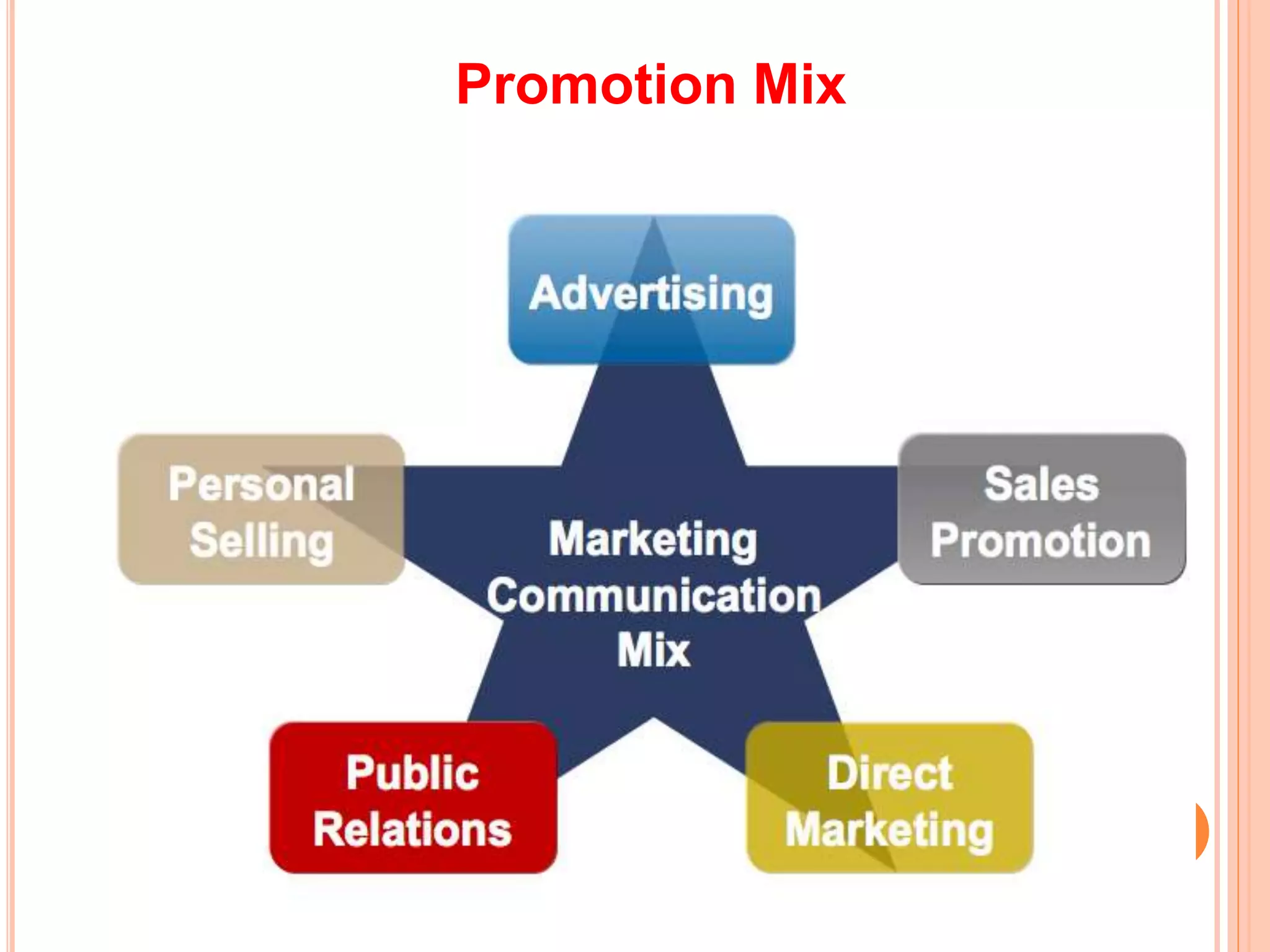
Promotion Mix
Marketing management by Govind Kumar

Marketing management by Govind Kumar

  • 1.
    Marketing Management The MarketingConcept Dr. Govind Kumar (Ph.D.) Assistant Professor FCM, Rama University Kanpur MBA II Sem (2015-16)
  • 2.
    Marketing marketing is theprocess of planning and executing the conceptions, pricing, promotion, and distribution of ideas, goods, and services, to create exchanges that satisfy individual and organizational goals. Marketing Management Marketing management is the art and science of choosing target markets and getting, keeping, and growing customers through creating, delivering, and communicating superior customer value.
  • 3.
    The holistic marketingconcept is based on the development, design, and implementation of marketing programs, processes and activities that recognizes their breadth and interdependencies. Holistic marketing recognizes that “everything matters” with marketing-and that a broad, integrated perspective is often necessary. There are four components of holistic marketing are relationship marketing, integrated marketing, internal marketing, and social responsibility marketing Holistic Marketing Concept
  • 4.
    Holistic Marketing Dimension Holistic Marketing Internal Marketing Integrated Marketing Relationship Marketing Socially Responsible Marketing MarketingDepartment Senior Management Other Departments Communication Product & Services Channels Customers Channels Partner Ethics Environment Legal Community
  • 5.
    Components of MarketingMix Marketing Mix Product Price Place Promotion Product Variety Quality Design Features Brand Name Packaging Sizes Services Warranties Returns List Price Discounts Allowances Payment Period Credit Terms Sales Promotion Advertising Sales Force Public Relations Direct Marketing Channels Coverage Locations Inventory Transport 4Ps Given by McCarthy
  • 6.
    Relation Between 4Ps& 4Cs 4Ps Product Price Place Promotion 4Cs Customer Solution Customer Cost Convenience Communication RobertLauterbornsuggestedthatthesellers’four Pscorrespondtothecustomers’fourCs.
  • 7.
  • 8.
    Core Concept ofMarketing A core set of concepts creates a foundation for marketing management and a holistic marketing orientation. Needs, Wants, and Demands: Needs are the basic human requirements. People need food, air, water, clothing, and shelter (security) to survive. People also have strong needs for recreation, education, and entertainment. These above needs become wants when they are directed to specific objects that might satisfy the need. An American needs food buy may want a hamburger, French fries and a soft drink. Demands are wants for specific products backed by an ability to pay. Many people want a Mercedes; only a few are willing and able to buy one. Company measures not only how many people want their product but also how many would actually be willing and able to buy it.
  • 9.
  • 10.
    From a managerialpoint of view, marketing is the process of planning and executing the conceptions, pricing, promotion, and distribution of ideas, goods, and services, to create exchanges that satisfy individual and organizational goals. Marketing management is the art and science of choosing target markets and getting, keeping, and growing customers through creating, delivering, and communicating superior customer value. Marketing management has experienced a number of shifts in recent years as companies seek marketing excellence. The set of tasks necessary for successful marketing management includes developing marketing strategies and plans, connecting with customers, building strong brands, shaping the market offerings, delivering and communicating value, capturing marketing insights and performance, and creating successful long-term growth.
  • 11.
    C C DV T P Creating Communicating Delivering Value TargetMarket Profit
  • 12.
    Summing up alltogether, every company must focus on both micro and macro environmental forces in order to build successful marketing strategy for rapid growth and to achieve predefined organizational goals. This can only be met when an organization have through knowledge of global marketing environment.
  • 13.
    Objective and Goal Setting AssessingYour Current Situation Writing the Plan and Strategy Implementing and Managing Your Plan 1 2 3 4
  • 14.
    Jobber (2007) definesit as a "system in which marketing data is formally gathered, stored, analyzed and distributed to managers in accordance with their informational needs on a regular basis." Kotler, at al, (2006) "an overall Marketing Information System can be defined as a set structure of procedures and methods for the regular, planned collection, analysis and presentation of information for use in making marketing decisions."
  • 15.
  • 16.
    Consumer behavior asthe behavior that consumers display in searching for, purchasing, using, evaluating, and disposing/ordering of products and services that they expect will satisfy their needs. Consumer behavior focuses on how individual consumers and families or households make decisions to spend their available resources (time, money, effort) on consumption-related items. CB includes what they buy, why they buy it, when they buy it, where they buy it, how often they buy it, how often they use it, how they evaluate it after the purchase, the impact of such evaluation on future purchases, and how they dispose of it.
  • 17.
    Consumer behavior describestwo different kinds of consuming entities: the personal consumer and the organizational consumer. Personal Consumer: They buys goods and services for his/her own use, for the use of the household, or as a gift for a friend. Organizational Consumer: Includes profit and non-profit businesses, government agencies (local, state & national), and institutions (e.g. schools, hospitals, and prisons), which must buy products, equipment, and services in order to run their organizations.
  • 18.
  • 19.
  • 23.
    Market Segment: A marketsegment consists of a group of customers who share a similar set of needs and wants. Market segmentation is a marketing strategy which involves dividing a broad target market into subsets of consumers, businesses, or countries that have, or are perceived to have, common needs, interests, and priorities, and then designing and implementing strategies to target them.
  • 24.
    Market Segments canbe defined in many different ways. One way to carve up a market is to identify the same preference segments. For Instance- Suppose ice cream buyers are asked how much they value sweetness and creaminess as two product attributes. Three different patterns can emerge. Homogeneous Preference Diffused Preference Clustered Preference
  • 27.
    Segmentation Geographic Segmentation Demographic Segmentation Psychographic Segmentation Behavioral Segmentation Countries Nations States Regions Cities Life Style Personality Age Family Size FamilyLife Cycle Gender Income Occupation Education Religion Social Class Occasions Benefits User Status Usage Rate Loyalty Status Attitudes towards Products
  • 28.
    Key Points toRemember: Target marketing involves three activities: market segmentation, market targeting, and market positioning. Markets can be targeted at four levels: segments, niche, local area and individuals. Market segments are large, identifiable, groups, within a market. There are two bases for segmenting consumer markets: consumer characteristics and consumer response. To be useful, market segments must be measurable, substantial, accessible, differentiable, and actionable. Marketer must choose target markets in a socially responsible manner.
  • 35.
  • 36.
    A product mixalso called product assortment is the set of all products and items a particular sellers offers for sale. A product mix consists of various product lines. A company’s product mix has a certain width, length, depth and consistency. Width- The width of a product mix refers to how many different product lines the company carries. Length- The length of a product mix refers to the number of items in the mix. Depth- A width a product mix refers to how many variants are offered of each product in the line. Consistency- The consistency of the product mix refers to how closely related the various product lines are in end use, production requirements, distribution channels, or some other way.
  • 37.
  • 39.
    P P PP P Marketers play a key role in the new-product process by identifying and evaluating new-product ideas and working with R&D and others in every stage of development.
  • 40.
    Idea Generation Idea Screening ConceptDevelopment & Testing Marketing Strategy Development Business Analysis Product Development Marketing Testing Commercialization Drop Accept
  • 41.
  • 42.
  • 43.
    Characteristics Introduction GrowthMaturity Decline Sales Low Rising Peak Declining Costs High Cost Average Cost Low Cast Low Cost Profits Negative Rising High Declining Customers Innovators Early Adopters Middle Majority Laggards Competitors Few Growing Stable No beginning to decline Declining Marketing Objectives Create P Awareness Max Market Share Max Profit Reduce Expenditure Strategies Products Offer a basic Product Offer Product Extensions Diversity Brands & Items Models Phase out weak Price Change cost-plus Price to Penetrate Market Price to match or best competitors Cut price Distribution Build selective Dis. Build intensive Distribution Build more int. distribution Go selective Advertising Build product awareness Build awareness & interest in mass mkt. Stress brand difference & benefits Reduce to level needed Sales Promotion Use heavy sales promotion Reduce to take advantage of heavy customer demand Increase to encourage brand switching Reduce to minimal level
  • 44.
    Summary of theLesson: Each stage of the product life cycle calls for different marketing strategies. The introduction stage is marked by slow growth and minimal profits. If successful, the product enters a growth stage marked by rapid sales growth and increasing profits. There follows a maturity stage in which sales growth slows and profits stabilize. Finally, the product enters a decline stage. The companies' task is to identify the weak products; develop a strategy for each one; and phase out weak products in a way that minimizes the hardship to company profits, employees and customers.
  • 45.
  • 54.
    Why Packaging SoImportant: Customers are drawn, more than anything, to products that look good. Something that is well designed and interesting is bound to attract more potential customers than a product that is poorly designed and looks bland. It is, after all, the key part in marketing product and ensuring it sells. It is also the key part in associating a brand to a certain thing- be it a color or a font . Packaging Design: Where it Begins: A good design should always reflex the product and the creativity and personality of the company. There is more, however, to packaging design than simply ensuring a package looks appealing.
  • 56.
    Intangible products suchas accounting, banking, cleaning, consultancy, education, insurance, expertise, medical treatment, or transportation. Sometimes services are difficult to identify because they are closely associated with a good; such as the combination of a diagnosis with the administration of a medicine. No transfer of possession or ownership takes place when services are sold, and they (1) cannot be stored or transported, (2) are instantly perishable, and (3) come into existence at the time they are bought and consumed.
  • 58.
    Three Types ofMarketing in Service Industry
  • 59.
  • 60.
  • 61.
  • 62.
    Price is notjust a number on a tag or an item: Price is all around us. You pay rent for your apartment, tuition for your education, and a fee to your physician or dentist. The airline, railway, taxi, and bus companies charge you a fare; the local utilities call their price rate; and the local bank charges you interest for the money you borrow.
  • 63.
  • 64.
    Cost based Pricing Demand based Pricing Competition based Pricing Other Pricing Method Cost –PlusPricing Markup Pricing Value Pricing Target Return Pricing Going Rate Pricing Transfer Pricing
  • 65.
    1. Cost BasedPricing refers to a pricing method in which some percentage of desired profit margins is added to the cost of the product to obtain the final price. In other words, cost based pricing can be defined as a pricing method in which a certain percentage of the total cost of production is added to the cost of the product to determine its selling price.
  • 66.
    (a) Cost PlusPricing: Refers to the simplest method of determining the price of a product. In cost plus pricing method, a fixed percentage, also called markup percentage, of the total cost (as a profit) is added to the total cost to set the price. For example, XYZ organization bears the total cost of Rs. 100 per unit for producing a product. It adds Rs. 50 per unit to the price of product as’ profit. In such a case, the final price of a product of the organization would be Rs. 150.
  • 67.
    (b) Markup Pricing:Refers to a pricing method in which the fixed amount or the percentage of cost of the product is added to product’s price to get the selling price of the product. Markup pricing is more common in retailing in which a retailer sells the product to earn profit. For example, if a retailer has taken a product from the wholesaler for Rs. 100, then he/she might add up a markup of Rs. 20 to gain profit.
  • 68.
    2. Demand BasedPricing: Demand based pricing refers to a pricing method in which the price of a product is finalized according to its demand. If the demand of a product is more, an organization prefers to set high prices for products to gain profit; whereas, if the demand of a product is less, the low prices are charged to attract the customers.
  • 69.
    3. Competition BasedPricing refers to a method in which an organization considers the prices of competitors’ products to set the prices of its own products. The organization may charge higher, lower, or equal prices as compared to the prices of its competitors.
  • 70.
    4. Other PricingMethod i. Value Pricing: Implies a method in which an organization tries to win loyal customers by charging low prices for their high quality products. The organization aims to become a low cost producer without sacrificing the quality. It can deliver high quality products at low.
  • 71.
    Many companies areintent on developing stronger bonds with their customers- called CRM. This is the process of managing detailed information about individual customers and carefully managing all customer “touch points” to maximize customer loyalty. A customer touch point is any occasion on which a customer encounters the brand and product-from actual experience to personal or mass communications to casual observation.
  • 72.
    CRM…. Continue… Some of thegroundwork for customer relationship management was laid by Don Peppers and Martha Rogers in a series of books. Peppers and Rogers outline a four-step framework for one-to-one marketing that can be adapted to CRM marketing as follows- A. Identify your prospects and customers B. Differentiate customers in terms of (1) their needs and (2) their value to your company. C. Interact with individual customers to improve your knowledge about their individual needs and to build stronger relationships. D. Customize products, services and messages to each customer.
  • 75.
    Mass Marketing *Average Customer *CustomerAnonymity *Standard Product *Mass Production *Mass Distribution *Mass Advertising *Mass Promotion *One-Way Message *Economies of Scale *Share of Market *All Customers *Customer Attraction One-to-One Marketing *Individual Customer *Customer Profile *Customized Mkt Offering *Customized Production *Individualized Distribution *Individualized Message *Individualized Incentives *Two-Way Messages *Economies of Scope *Share of Customer *Profitable Customers *Customer Retention
  • 77.
    GREEN MARKETING Here, term‘green’ is indicative of purity. Green means pure in quality and fair or just in dealing. For example, green advertising means advertising without adverse impact on society. Green message means matured and neutral facts, free from exaggeration or ambiguity. Green marketing is highly debated topic for lay people to highly professional groups.
  • 78.
    Concept of greenmarketing concerns with protection of ecological environment. Excessive pollution has provoked the Nature and the Nature starts behaving in unnatural ways (in form of global warming v/s global cooling, heavy rains v/s draught, and other natural calamities like frequent earthquakes and tsunami, cyclones, epidemics, and so forth). Economic growth via production and consumption threatens peaceful life of human being on the earth. Green marketing is an attempt to protect consumer welfare and environment (the nature) through production, consumption, and disposal of eco-friendly products.
  • 79.
    Definition of GreenMarketing: “The marketing or promotion of a product based on its environment performance or an improvement thereof (Charter & Polonsky, 1999)” The holistic management process responsible for identifying and satisfying the requirements of customers and society, in a profitable and sustainable way 9Peattie, 1995)
  • 80.
    Basically, green marketingconcerns with three aspects: 1. Promotion of production and consummation of pure/quality products, 2. Fair and just dealing with customers and society, and 3. Protection of ecological environment.
  • 81.
    Impacts or Importanceof Green Marketing: Green marketing affects positively the health of people and the ecological environment. People are aware of pure products and pure methods of producing, using, and disposing the products. It encourages integrated efforts for purity in production and consumption as well. Environmental Benefits Consumer Benefits Product benefits Developing Economies
  • 82.
    Reasons Why companiesto adopt Green Marketing: Opportunities or competitive advantage. Corporate social responsibilities (CSR). Government pressure. Competitive pressure. Cost or profit issues. Challenges in Green Marketing: Majority of the people are not aware of Green products and their uses. Green products require a recyclable and renewable materials or elements which are expensive. People are often perceived that green products are expensive compared to traditional products. Green Marketing depends on technology and requires a huge investment in Research and Development.
  • 83.
    Green Marketing Mix Thecombination of 4 Green P‟s or Green factors(Eco-friendly) is known as Green Marketing Mix. GMM Green Product Green Price Green Place Green Promotion
  • 84.
    SN Company Activities 1 PhilipsIndia Energy saving Lights, Medical Equipments, House hold appliances 2 Go GreenBOV Battery Operated Vehicles(BOV) 3 Philips Compact Fluorescent Light (CFL) bulbs 4 Hewlett-Packard Company Energy-efficient products and services and institute energy-efficient operating practices in its facilities worldwide. 5 Wipro Technologies Sustainable IT products and solutions, which help customers, achieve high productivity in energy, space and asset management through the lifecycle. Recycled plastic. Launched Green ware ranges of desktops are not only 100% recyclable, but also toxin-free. 6 CISCO Systems Cisco is planning to minimize the ecological impact by establishing responsible operation programs aimed to reduce energy consumption 7 Infosys Technologies Ltd. Focused on green buildings, water harvesting and conservation, better transport management by encouraging car pool for its employees and increasing bio-diversity in its campuses. Company Involved in Green Marketing
  • 85.
    Showing Countries rankedaccording to their response level on Green Marketing SN Countries 1 India 2 UK 3 US 4 Australia 5 Canada 6 China
  • 88.
  • 90.
    Electronic commerce, commonlywritten as ecommerce, is the trading or facilitation of trading in products or services using computer networks, such as the Internet. Electronic commerce draws on technologies such as mobile commerce, electronic funds transfer, supply chain management, Internet marketing, online transaction processing, electronic data interchange (EDI), inventory management systems, and automated data collection systems. Modern electronic commerce typically uses the World Wide Web for at least one part of the transaction’s life-cycle, although it may also use other technologies such as e-mail.
  • 101.
  • 104.
    Marketing Channel Successful valuecreation needs successful value delivery. Holistic marketers are increasingly taking a value network view of their business. Instead of limiting their focus to their immediate suppliers, distributors, and customers, they are examining the whole supply chain that links raw materials, components, and manufactured goods and shows how they move toward the final consumers.
  • 105.
    Most producers donot sell their goods directly to final users. Between producers and final users stands one or more marketing channels, a host of marketing intermediaries performing a variety of functions. Marketing channels decisions are among the most critical decisions facing management. The company's chosen channels profoundly affects all other marketing decisions. Companies use intermediaries when they lack the financial resources to carry out direct marketing, when direct marketing is not feasible, and when they can earn more by doing so. The most important functions performed by intermediaries are information, promotion, negotiation, ordering, financing, risk taking, physical procession, payment etc.
  • 106.
    Manufacturers have manyalternatives for reaching a market. They can sell direct or use one-two-,or three-level channels, deciding which types of channel to use calls for analyzing customer needs, establishing channels objectives and identifying and evaluating the major alternatives, including the types and numbers of intermediaries involved in the channels. Effective channel management calls for selecting intermediaries and training and motivating them. The goal is to build a long-term partnership that will be profitable for all channel members. Marketing channels are characterized by continuous and sometimes dramatic change.
  • 110.