MARKETING
ENVIRONMENT
Chapter 2
After studying this chapter, you should be able to:
Examine company’smicroenvironment
Examine company’smacroenvironment
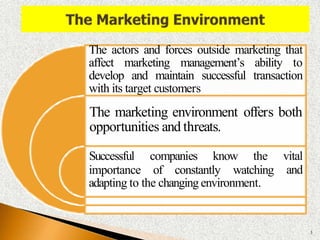
The actors and forces outside marketing that
affect marketing management’s ability to
develop and maintain successful transaction
with its target customers
The marketing environment offers both
opportunities and threats.
importance of constantly watching
Successful companies know the vital
and
adapting to the changing environment.
3
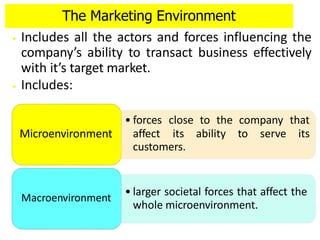
The Marketing Environment
⦁ Includes all the actors and forces influencing the
company’s ability to transact business effectively
with it’s target market.
⦁ Includes:
• forces close to the company that
affect its ability to serve its
customers.
Microenvironment
• larger societal forces that affect the
whole microenvironment.
Macroenvironment
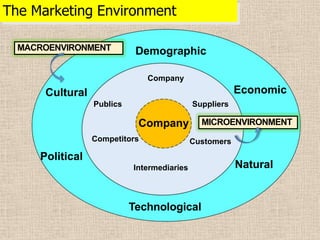
The Marketing Environment
Demographic
Economic
Natural
Technological
Political
Cultural
Company
Customers
Intermediaries
Suppliers
Company
Competitors
Publics
MACROENVIRONMENT
MICROENVIRONMENT
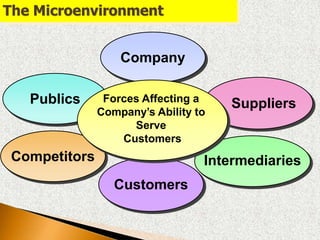
Company
Customers
Publics Suppliers
Competitors Intermediaries
Forces Affecting a
Company’s Ability to
Serve
Customers
The Microenvironment
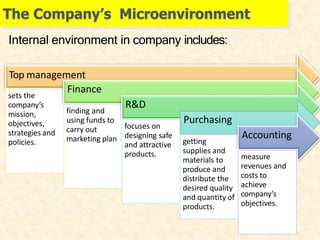
The Company’s Microenvironment
sets the
company’s
mission,
objectives,
strategies and
policies.
Finance
finding and
using funds to
carry out
marketing plan
R&D
focuses on
designing safe
and attractive
products.
Purchasing
getting
supplies and
materials to
produce and
distribute the
desired quality
and quantity of
products.
Accounting
measure
revenues and
costs to
achieve
company’s
objectives.
Internal environment in company includes:
Top management
The Company’s Microenvironment
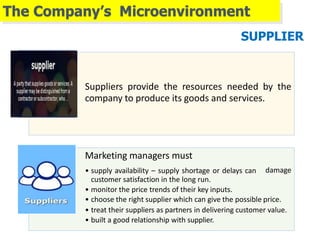
Suppliers provide the resources needed by the
company to produce its goods and services.
damage
Marketing managers must
• supply availability – supply shortage or delays can
customer satisfaction in the long run.
• monitor the price trends of their key inputs.
• choose the right supplier which can give the possible price.
• treat their suppliers as partners in delivering customer value.
• built a good relationship with supplier.
SUPPLIER
The Company’s Microenvironment
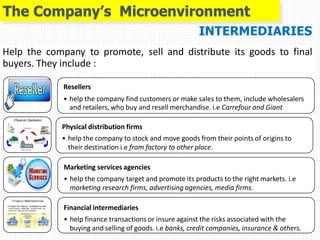
Help the company to promote, sell and distribute its goods to final
buyers. They include :
Resellers
• help the company find customers or make sales to them, include wholesalers
and retailers, who buy and resell merchandise. i.e Carrefour and Giant
Physical distribution firms
• help the company to stock and move goods from their points of origins to
their destination i.e from factory to other place.
Marketing services agencies
• help the company target and promote its products to the right markets. i.e
marketing research firms, advertising agencies, media firms.
Financial intermediaries
• help finance transactions or insure against the risks associated with the
buying and selling of goods. i.e banks, credit companies, insurance & others.
The Company’s Microenvironment
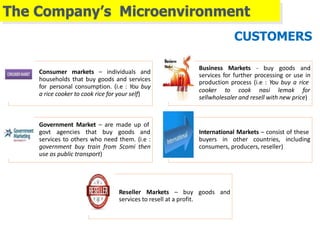
Consumer markets – individuals and
households that buy goods and services
for personal consumption. (i.e : You buy
a rice cooker to cook rice for your self)
Business Markets - buy goods and
services for further processing or use in
production process (i.e : You buy a rice
cooker to cook nasi lemak for
sellwholesaler and resell with new price)
Government Market – are made up of
govt agencies that buy goods and
services to others who need them. (i.e :
government buy train from Scomi then
use as public transport)
International Markets – consist of these
buyers in other countries, including
consumers, producers, reseller)
Reseller Markets – buy goods and
services to resell at a profit.
CUSTOMERS
Tobe successful, a company must do better than its
competitors do.
Marketers must gain strategic advantage by
positioning their offerings strongly against
competitor’s offerings in the minds of consumers.
Should consider own size and industry position
compared to those of its competitors.
COMPETITOR
The Company’s Microenvironment
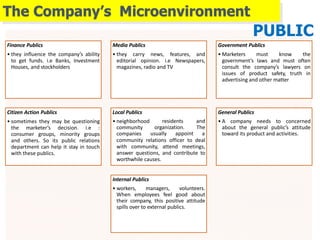
Finance Publics
• they influence the company’s ability
to get funds. i.e Banks, Investment
Houses, and stockholders
Media Publics
• they carry news, features, and
editorial opinion. i.e Newspapers,
magazines, radio and TV
Government Publics
• Marketers must know the
government’s laws and must often
consult the company’s lawyers on
issues of product safety, truth in
advertising and other matter
Citizen Action Publics
• sometimes they may be questioning
the marketer’s decision. i.e :
consumer groups, minority groups
and others. So its public relations
department can help it stay in touch
with these publics.
residents
organization.
Local Publics
• neighborhood
community
companies
and
The
usually appoint a
community relations officer to deal
with community, attend meetings,
answer questions, and contribute to
worthwhile causes.
General Publics
• A company needs to concerned
about the general public’s attitude
toward its product and activities.
Internal Publics
• workers, managers, volunteers.
When employees feel good about
their company, this positive attitude
spills over to external publics.
PUBLIC
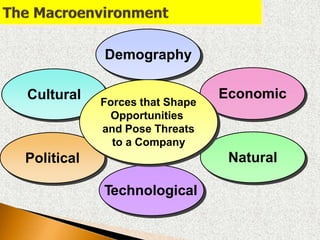
Demography
Technological
Cultural Economic
Political Natural
Forces that Shape
Opportunities
and Pose Threats
to a Company
involves people, and
Important because it
people make up markets.
THE DEMOGRAPHIC ENVIRONMENT
Is the study of human populations in terms of
size, density, location, age, gender, race,
occupation, family structure, geographic
population shifts, educational characteristics,
population diversity and other statistics.
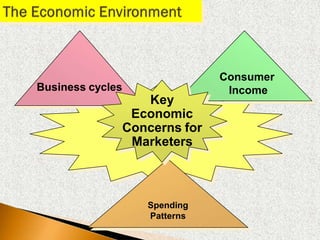
Spending
Patterns
Business cycles
Consumer
Income
Key
Economic
Concerns for
Marketers
The Company’s Macroenvironment
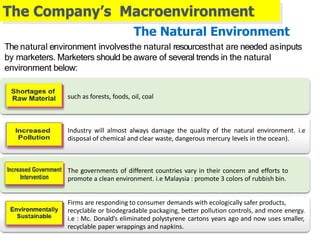
Industry will almost always damage the quality of the natural environment. i.e
disposal of chemical and clear waste, dangerous mercury levels in the ocean).
The governments of different countries vary in their concern and efforts to
promote a clean environment. i.e Malaysia : promote 3 colors of rubbish bin.
Firms are responding to consumer demands with ecologically safer products,
recyclable or biodegradable packaging, better pollution controls, and more energy.
i.e : Mc. Donald’s eliminated polystyrene cartons years ago and now uses smaller,
recyclable paper wrappings and napkins.
The Natural Environment
The natural environment involvesthe natural resourcesthat are needed asinputs
by marketers. Marketers should be aware of several trends in the natural
environment below:
such as forests, foods, oil, coal
The Company’s Macroenvironment
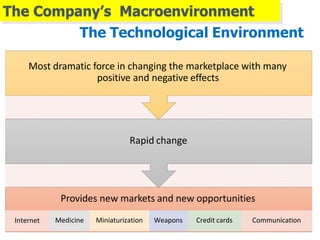
Provides new markets and new opportunities
Internet Medicine Miniaturization Weapons Credit cards Communication
Rapid change
The Technological Environment
Most dramatic force in changing the marketplace with many
positive and negative effects
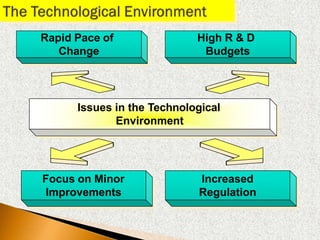
Rapid Pace of
Change
High R & D
Budgets
Focus on Minor
Improvements
Increased
Regulation
Issues in the Technological
Environment
The Company’s Macroenvironment
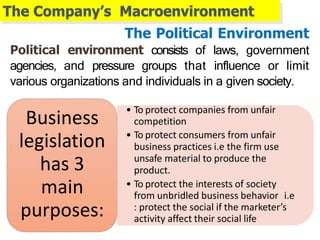
• To protect companies from unfair
competition
• To protect consumers from unfair
business practices i.e the firm use
unsafe material to produce the
product.
• To protect the interests of society
from unbridled business behavior i.e
: protect the social if the marketer’s
activity affect their social life
Business
legislation
has 3
main
purposes:
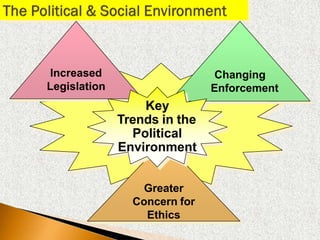
The Political Environment
Political environment consists of laws, government
agencies, and pressure groups that influence or limit
various organizations and individuals in a given society.
Increased
Legislation
Changing
Enforcement
Key
Trends in the
Political
Environment
Greater
Concern for
Ethics
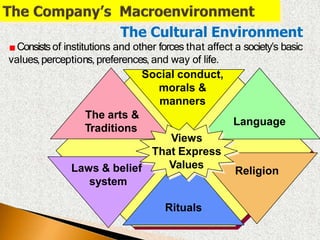
The Cultural Environment
Religion
Laws & belief
system
Rituals
Consists of institutions and other forces that affect a society’s basic
values,perceptions, preferences, and way of life.
Social conduct,
morals &
manners
The arts &
Traditions
Language
Views
That Express
Values

Marketing chapter 2

  • 1.
  • 2.
    After studying thischapter, you should be able to: Examine company’smicroenvironment Examine company’smacroenvironment
  • 3.
    The actors andforces outside marketing that affect marketing management’s ability to develop and maintain successful transaction with its target customers The marketing environment offers both opportunities and threats. importance of constantly watching Successful companies know the vital and adapting to the changing environment. 3
  • 4.
    The Marketing Environment ⦁Includes all the actors and forces influencing the company’s ability to transact business effectively with it’s target market. ⦁ Includes: • forces close to the company that affect its ability to serve its customers. Microenvironment • larger societal forces that affect the whole microenvironment. Macroenvironment
  • 5.
  • 6.
    Company Customers Publics Suppliers Competitors Intermediaries ForcesAffecting a Company’s Ability to Serve Customers The Microenvironment
  • 7.
    The Company’s Microenvironment setsthe company’s mission, objectives, strategies and policies. Finance finding and using funds to carry out marketing plan R&D focuses on designing safe and attractive products. Purchasing getting supplies and materials to produce and distribute the desired quality and quantity of products. Accounting measure revenues and costs to achieve company’s objectives. Internal environment in company includes: Top management
  • 8.
    The Company’s Microenvironment Suppliersprovide the resources needed by the company to produce its goods and services. damage Marketing managers must • supply availability – supply shortage or delays can customer satisfaction in the long run. • monitor the price trends of their key inputs. • choose the right supplier which can give the possible price. • treat their suppliers as partners in delivering customer value. • built a good relationship with supplier. SUPPLIER
  • 9.
    The Company’s Microenvironment Helpthe company to promote, sell and distribute its goods to final buyers. They include : Resellers • help the company find customers or make sales to them, include wholesalers and retailers, who buy and resell merchandise. i.e Carrefour and Giant Physical distribution firms • help the company to stock and move goods from their points of origins to their destination i.e from factory to other place. Marketing services agencies • help the company target and promote its products to the right markets. i.e marketing research firms, advertising agencies, media firms. Financial intermediaries • help finance transactions or insure against the risks associated with the buying and selling of goods. i.e banks, credit companies, insurance & others.
  • 10.
    The Company’s Microenvironment Consumermarkets – individuals and households that buy goods and services for personal consumption. (i.e : You buy a rice cooker to cook rice for your self) Business Markets - buy goods and services for further processing or use in production process (i.e : You buy a rice cooker to cook nasi lemak for sellwholesaler and resell with new price) Government Market – are made up of govt agencies that buy goods and services to others who need them. (i.e : government buy train from Scomi then use as public transport) International Markets – consist of these buyers in other countries, including consumers, producers, reseller) Reseller Markets – buy goods and services to resell at a profit. CUSTOMERS
  • 11.
    Tobe successful, acompany must do better than its competitors do. Marketers must gain strategic advantage by positioning their offerings strongly against competitor’s offerings in the minds of consumers. Should consider own size and industry position compared to those of its competitors. COMPETITOR
  • 12.
    The Company’s Microenvironment FinancePublics • they influence the company’s ability to get funds. i.e Banks, Investment Houses, and stockholders Media Publics • they carry news, features, and editorial opinion. i.e Newspapers, magazines, radio and TV Government Publics • Marketers must know the government’s laws and must often consult the company’s lawyers on issues of product safety, truth in advertising and other matter Citizen Action Publics • sometimes they may be questioning the marketer’s decision. i.e : consumer groups, minority groups and others. So its public relations department can help it stay in touch with these publics. residents organization. Local Publics • neighborhood community companies and The usually appoint a community relations officer to deal with community, attend meetings, answer questions, and contribute to worthwhile causes. General Publics • A company needs to concerned about the general public’s attitude toward its product and activities. Internal Publics • workers, managers, volunteers. When employees feel good about their company, this positive attitude spills over to external publics. PUBLIC
  • 13.
    Demography Technological Cultural Economic Political Natural Forcesthat Shape Opportunities and Pose Threats to a Company
  • 14.
    involves people, and Importantbecause it people make up markets. THE DEMOGRAPHIC ENVIRONMENT Is the study of human populations in terms of size, density, location, age, gender, race, occupation, family structure, geographic population shifts, educational characteristics, population diversity and other statistics.
  • 15.
  • 16.
    The Company’s Macroenvironment Industrywill almost always damage the quality of the natural environment. i.e disposal of chemical and clear waste, dangerous mercury levels in the ocean). The governments of different countries vary in their concern and efforts to promote a clean environment. i.e Malaysia : promote 3 colors of rubbish bin. Firms are responding to consumer demands with ecologically safer products, recyclable or biodegradable packaging, better pollution controls, and more energy. i.e : Mc. Donald’s eliminated polystyrene cartons years ago and now uses smaller, recyclable paper wrappings and napkins. The Natural Environment The natural environment involvesthe natural resourcesthat are needed asinputs by marketers. Marketers should be aware of several trends in the natural environment below: such as forests, foods, oil, coal
  • 17.
    The Company’s Macroenvironment Providesnew markets and new opportunities Internet Medicine Miniaturization Weapons Credit cards Communication Rapid change The Technological Environment Most dramatic force in changing the marketplace with many positive and negative effects
  • 18.
    Rapid Pace of Change HighR & D Budgets Focus on Minor Improvements Increased Regulation Issues in the Technological Environment
  • 19.
    The Company’s Macroenvironment •To protect companies from unfair competition • To protect consumers from unfair business practices i.e the firm use unsafe material to produce the product. • To protect the interests of society from unbridled business behavior i.e : protect the social if the marketer’s activity affect their social life Business legislation has 3 main purposes: The Political Environment Political environment consists of laws, government agencies, and pressure groups that influence or limit various organizations and individuals in a given society.
  • 20.
  • 21.
    The Cultural Environment Religion Laws& belief system Rituals Consists of institutions and other forces that affect a society’s basic values,perceptions, preferences, and way of life. Social conduct, morals & manners The arts & Traditions Language Views That Express Values