A FRAMEWORK for
MARKETING MANAGEMENT
Kotler Keller
Chapter 6Chapter 6
Analyzing
Business Markets
• Business Marketing is the practice of
individuals, or organizations, including
commercial businesses, governments and
institutions, facilitating the sale of their products
or services to other companies or organizations
that in turn resell them, use them as
components in products or services they offer,
or use them to support their operations. Also
known as industrial marketing, business
marketing is also called business-to-business
marketing, or B2B marketing, for short.
6-2
• Business marketing vs. consumer marketing
Business marketing generally entails shorter
and more direct channels of distribution.
While consumer marketing is aimed at large
demographic groups through mass media and
retailers, the negotiation process between the
buyer and seller is more personal in business
marketing
6-3
Business marketers commit only a small part of
their promotional budgets to advertising, and
that is usually through direct mail efforts and
trade journals. While that advertising is limited, it
often helps the business marketer set up
successful sales calls.
Marketing to a business trying to make a profit
(Business-to-Business marketing) as opposed
to an individual for personal use (Business-to-
Consumer, or B2C marketing) is similar in terms
of the fundamental principals of marketing.
6-4
6-5
Organizational Buying
Decision-making process by which
formal organizations establish the
need for purchased products and
services, and identify,
evaluate, and choose among
alternative brands and suppliers
6-6
Organizational Buying
• Fewer buyers
• Larger buyers
• Geographically concentrated buyers
• Closer relationships with suppliers
• Closer relationships with customers
6-7
Organizational Buying
• Fluctuating demand
• Inelastic demand
• Leasing
• Professional
purchasing
• Direct purchasing
• Multiple buying
influences
• Multiple sales calls
• Derived demand
• Reciprocity
6-8
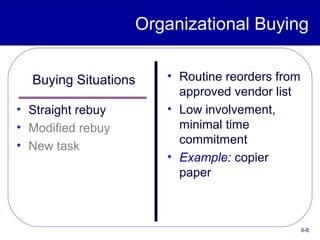
Organizational Buying
Buying Situations
• Straight rebuy
• Modified rebuy
• New task
• Routine reorders from
approved vendor list
• Low involvement,
minimal time
commitment
• Example: copier
paper
6-9
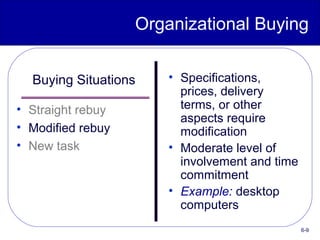
Organizational Buying
Buying Situations
• Straight rebuy
• Modified rebuy
• New task
• Specifications,
prices, delivery
terms, or other
aspects require
modification
• Moderate level of
involvement and time
commitment
• Example: desktop
computers
6-10
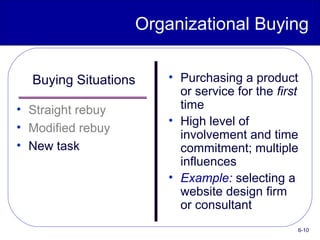
Organizational Buying
Buying Situations
• Straight rebuy
• Modified rebuy
• New task
• Purchasing a product
or service for the first
time
• High level of
involvement and time
commitment; multiple
influences
• Example: selecting a
website design firm
or consultant
6-11
Systems Buying and Selling
Many business buyers prefer to buy a
total solution to problem from one seller.
called system buying.
This practice originated with government
purchases of major weapons &
communication systems.
The government solicit bids from prime
contractors, who assembled package or
system.
System Buying & Selling
The contractor who was awarded contract
will be responsible for bidding out &
assembling system subcomponents from
second tier contractors.
The prime contractor would thus provide a
turnkey solution, so called because the
buyer simply had to turn one key to get the
job done.
6-12
System Buying & Selling
System selling is a key industrial
marketing strategy in bidding to build
large scale industrial projects, such as
dams, steel factories, irrigation systems,
sanitation systems, pipelines, utilities and
even new towns.
Firms must compete on price, quality,
reliability & other attributes to win
contracts.
6-13
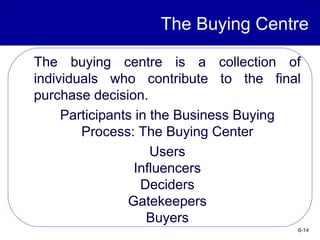
The Buying Centre
The buying centre is a collection of
individuals who contribute to the final
purchase decision.
Participants in the Business Buying
Process: The Buying Center
Users
Influencers
Deciders
Gatekeepers
Buyers
6-14
The Buying Centre
Buying centre includes people who play any of buying
roles:
• Users: People who actually use business products
example an executive, production line worker etc.
• Influencers: People who set specifications of buying
decisions b/c of their technical expertise,
organizational position.
• Deciders: People who make actual buying decision
regarding business product and the supplier. A
purchasing agent may be a decider in straight rebuy
condition. Top management may make decision
regarding whether to buy an expensive computer
system. 6-15
The Buying Centre
• Gatekeepers: People who control the flow of
purchasing information within organization as
well as between firm and potential vendors.
These people may be purchasing agents,
secretaries or technical personnel.
• Buyers: People who interact with suppliers,
arrange terms of sale & process purchase
orders. Basically it is purchasing department
role but if purchase is expensive, complex new
buy, the buyers role may be filled with someone
in top management.
6-16
6-17
Types of Business Customers
• Price-oriented: Price is everything.
• Solution-oriented: They want low price but
will respond to argument about lower total
cost.
• Gold-standard: They want the best
performance in terms of product quality,
assistance, reliable delivery and son on.
• Strategic-value: They want a fairly
permanent sole supplier relationship with
your company.
6-18
Types of Purchasing Processes
Peter Kraljic Identifies four product related
purchasing processes.
• Routine products: Products that have low
value & cost to customer and involve little
risk. (e.g Office supplies)
• Leverage Products: Product have high
value & cost to customer but involve little
risk of supply. (e.g. Engine Pistons).
Types of Purchasing Processes
• Strategic Products: Product have
high value and cost to customer and
also involve high risk. (e.g mainframe
computers).
• Bottleneck Products: Product have
low value and cost to customer but
they involve some risk. (e.g Spare
Parts).
6-19
6-20
Buyphases:
Stages in the Business Buying Process
• Problem recognition
• General need description
• Product specification
• Supplier search
• Proposal solicitation
• Supplier selection
• Order-routine specification
• Performance review
Proposal Solicitation
The buyer invites qualifies suppliers to
submit proposals. If the item is complex
the buyer will require a detailed written
proposal from each qualifies suppliers.
After evaluating the proposal the buyer will
invite a few suppliers to make formal
presentation.
Business marketers must be skilled in
researching, writing & presenting
proposals.
6-21
Supplier Selection
Before selecting a supplier buying centre will
specify desired supplier attributes and indicate
their relative importance. To rate & identify
most attractive suppliers, buying centers use
following supplier evaluation model.
• Price
• Supplier Reputation
• Product Reliability
• Service Reliability
• Supplier Flexibility
6-22

Chap# 6:- Business markets

  • 1.
    A FRAMEWORK for MARKETINGMANAGEMENT Kotler Keller Chapter 6Chapter 6 Analyzing Business Markets
  • 2.
    • Business Marketingis the practice of individuals, or organizations, including commercial businesses, governments and institutions, facilitating the sale of their products or services to other companies or organizations that in turn resell them, use them as components in products or services they offer, or use them to support their operations. Also known as industrial marketing, business marketing is also called business-to-business marketing, or B2B marketing, for short. 6-2
  • 3.
    • Business marketingvs. consumer marketing Business marketing generally entails shorter and more direct channels of distribution. While consumer marketing is aimed at large demographic groups through mass media and retailers, the negotiation process between the buyer and seller is more personal in business marketing 6-3
  • 4.
    Business marketers commitonly a small part of their promotional budgets to advertising, and that is usually through direct mail efforts and trade journals. While that advertising is limited, it often helps the business marketer set up successful sales calls. Marketing to a business trying to make a profit (Business-to-Business marketing) as opposed to an individual for personal use (Business-to- Consumer, or B2C marketing) is similar in terms of the fundamental principals of marketing. 6-4
  • 5.
    6-5 Organizational Buying Decision-making processby which formal organizations establish the need for purchased products and services, and identify, evaluate, and choose among alternative brands and suppliers
  • 6.
    6-6 Organizational Buying • Fewerbuyers • Larger buyers • Geographically concentrated buyers • Closer relationships with suppliers • Closer relationships with customers
  • 7.
    6-7 Organizational Buying • Fluctuatingdemand • Inelastic demand • Leasing • Professional purchasing • Direct purchasing • Multiple buying influences • Multiple sales calls • Derived demand • Reciprocity
  • 8.
    6-8 Organizational Buying Buying Situations •Straight rebuy • Modified rebuy • New task • Routine reorders from approved vendor list • Low involvement, minimal time commitment • Example: copier paper
  • 9.
    6-9 Organizational Buying Buying Situations •Straight rebuy • Modified rebuy • New task • Specifications, prices, delivery terms, or other aspects require modification • Moderate level of involvement and time commitment • Example: desktop computers
  • 10.
    6-10 Organizational Buying Buying Situations •Straight rebuy • Modified rebuy • New task • Purchasing a product or service for the first time • High level of involvement and time commitment; multiple influences • Example: selecting a website design firm or consultant
  • 11.
    6-11 Systems Buying andSelling Many business buyers prefer to buy a total solution to problem from one seller. called system buying. This practice originated with government purchases of major weapons & communication systems. The government solicit bids from prime contractors, who assembled package or system.
  • 12.
    System Buying &Selling The contractor who was awarded contract will be responsible for bidding out & assembling system subcomponents from second tier contractors. The prime contractor would thus provide a turnkey solution, so called because the buyer simply had to turn one key to get the job done. 6-12
  • 13.
    System Buying &Selling System selling is a key industrial marketing strategy in bidding to build large scale industrial projects, such as dams, steel factories, irrigation systems, sanitation systems, pipelines, utilities and even new towns. Firms must compete on price, quality, reliability & other attributes to win contracts. 6-13
  • 14.
    The Buying Centre Thebuying centre is a collection of individuals who contribute to the final purchase decision. Participants in the Business Buying Process: The Buying Center Users Influencers Deciders Gatekeepers Buyers 6-14
  • 15.
    The Buying Centre Buyingcentre includes people who play any of buying roles: • Users: People who actually use business products example an executive, production line worker etc. • Influencers: People who set specifications of buying decisions b/c of their technical expertise, organizational position. • Deciders: People who make actual buying decision regarding business product and the supplier. A purchasing agent may be a decider in straight rebuy condition. Top management may make decision regarding whether to buy an expensive computer system. 6-15
  • 16.
    The Buying Centre •Gatekeepers: People who control the flow of purchasing information within organization as well as between firm and potential vendors. These people may be purchasing agents, secretaries or technical personnel. • Buyers: People who interact with suppliers, arrange terms of sale & process purchase orders. Basically it is purchasing department role but if purchase is expensive, complex new buy, the buyers role may be filled with someone in top management. 6-16
  • 17.
    6-17 Types of BusinessCustomers • Price-oriented: Price is everything. • Solution-oriented: They want low price but will respond to argument about lower total cost. • Gold-standard: They want the best performance in terms of product quality, assistance, reliable delivery and son on. • Strategic-value: They want a fairly permanent sole supplier relationship with your company.
  • 18.
    6-18 Types of PurchasingProcesses Peter Kraljic Identifies four product related purchasing processes. • Routine products: Products that have low value & cost to customer and involve little risk. (e.g Office supplies) • Leverage Products: Product have high value & cost to customer but involve little risk of supply. (e.g. Engine Pistons).
  • 19.
    Types of PurchasingProcesses • Strategic Products: Product have high value and cost to customer and also involve high risk. (e.g mainframe computers). • Bottleneck Products: Product have low value and cost to customer but they involve some risk. (e.g Spare Parts). 6-19
  • 20.
    6-20 Buyphases: Stages in theBusiness Buying Process • Problem recognition • General need description • Product specification • Supplier search • Proposal solicitation • Supplier selection • Order-routine specification • Performance review
  • 21.
    Proposal Solicitation The buyerinvites qualifies suppliers to submit proposals. If the item is complex the buyer will require a detailed written proposal from each qualifies suppliers. After evaluating the proposal the buyer will invite a few suppliers to make formal presentation. Business marketers must be skilled in researching, writing & presenting proposals. 6-21
  • 22.
    Supplier Selection Before selectinga supplier buying centre will specify desired supplier attributes and indicate their relative importance. To rate & identify most attractive suppliers, buying centers use following supplier evaluation model. • Price • Supplier Reputation • Product Reliability • Service Reliability • Supplier Flexibility 6-22