




Marketing and Public Relations in an Academic Library
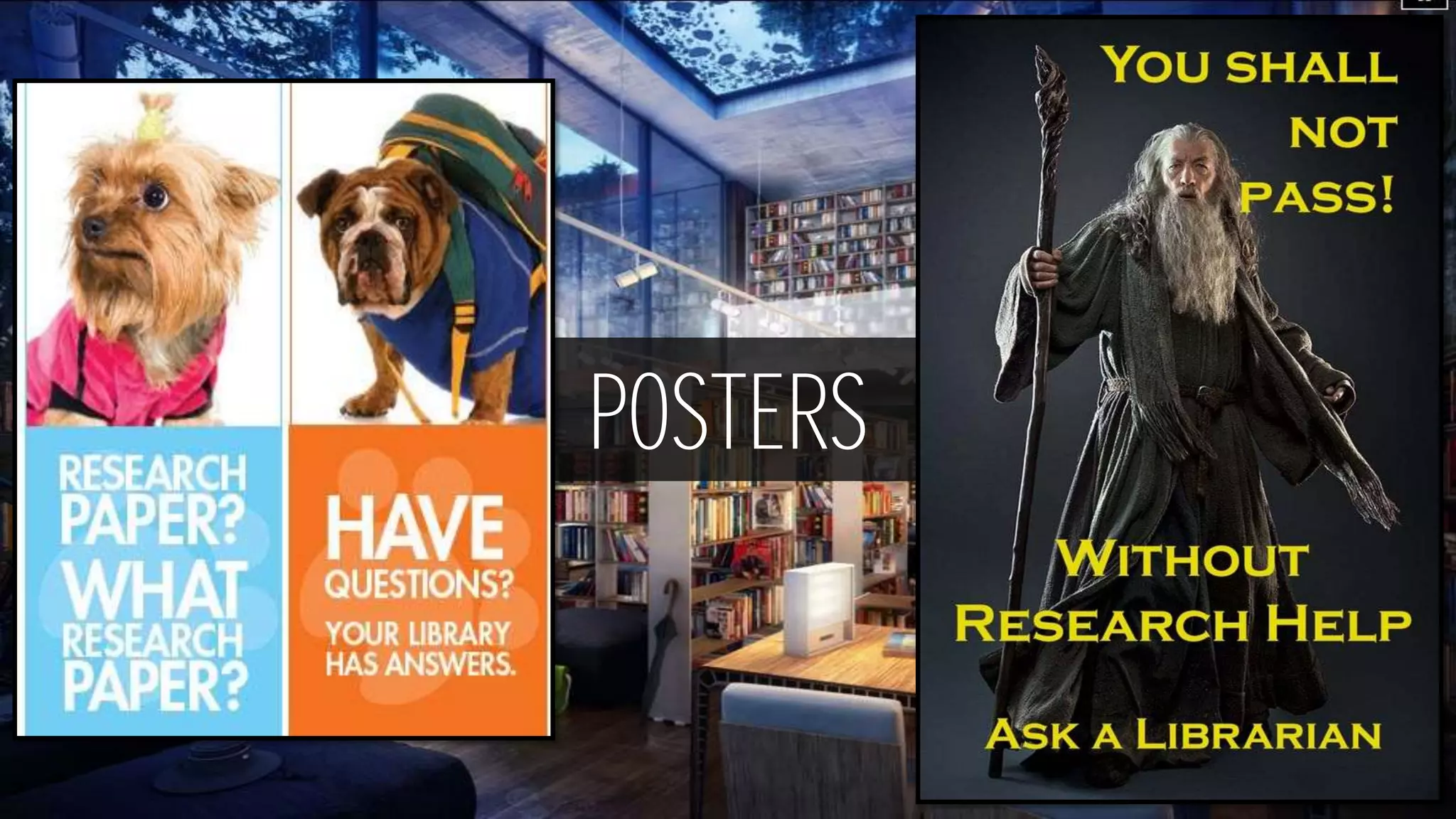
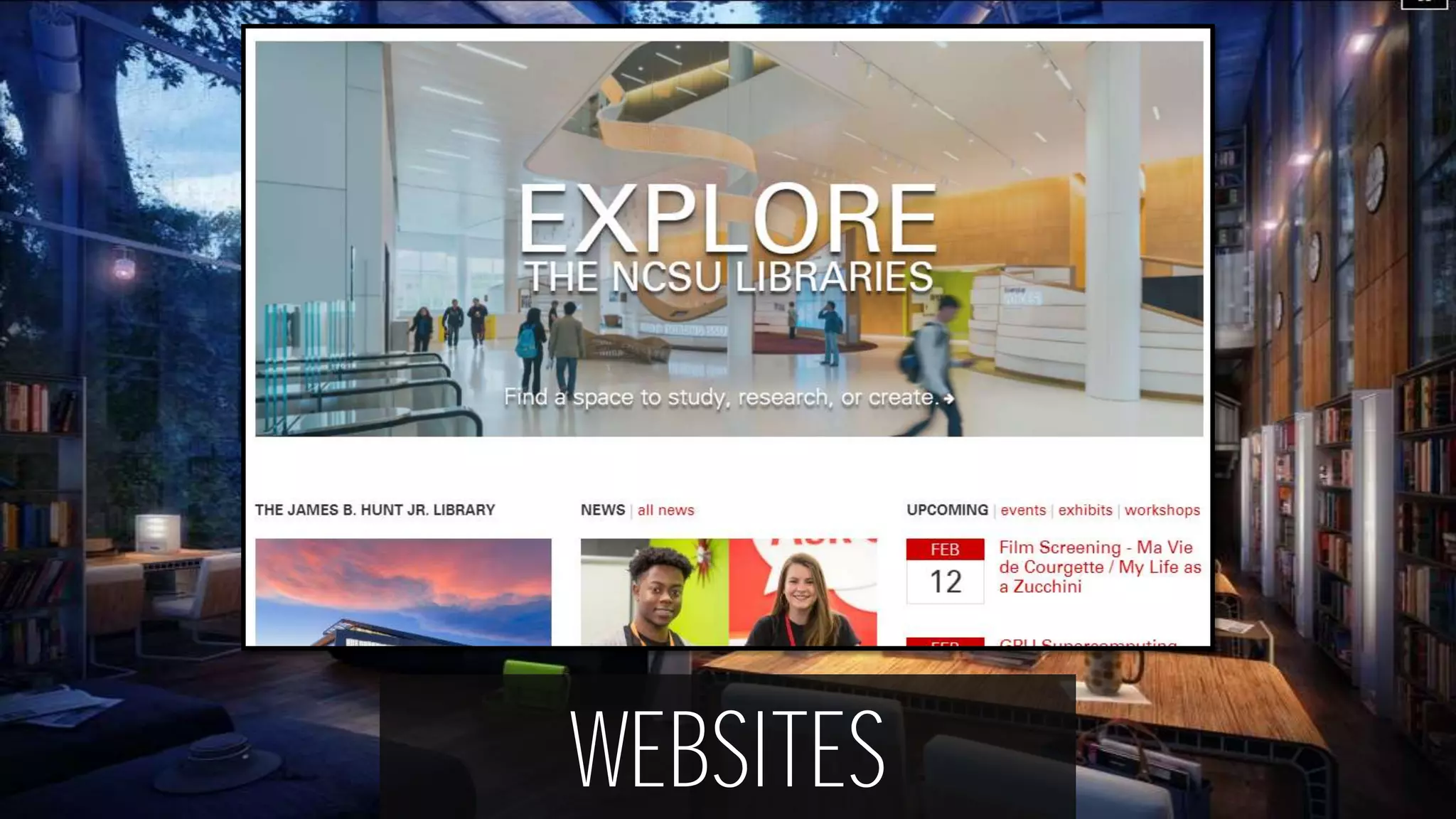
This document discusses marketing and public relations in academic libraries. It defines marketing as planning exchange relations with clients by studying their needs and using communication and services to inform and serve them. Marketing in academic libraries involves keeping users informed of activities and collection development. It also builds relationships and engages more users. The document discusses several promotional strategies libraries use, including displays, posters, giveaways, exhibits, and websites. It defines public relations as a planned effort to build understanding between libraries and users. Reference librarians often serve as the public relations officer by informing users of services and boosting the library's image.
Marketing and Public Relations in an Academic Library
1.
MARKETING AND PUBLICRELATIONS IN
an ACADEMIC LIBRARY
Kim Shanish b. Asuncion
Iii-25 blisci
2.
WHATIS MARKETING?
Accordingto Jestin and Parameswari (2002), marketing is planning
and managing the organization’s exchange relations with its clientele.
It consists of studying the target market’s needs, designing
appropriate products and services, and using effective pricing,
communication, and distribution to inform, motivate, and serve the
market.
3.
WHATIS library MARKETING?
It is about keeping users informed about library activities and
involving them in collection development (Noel and Waugh, 2002).
Also through marketing, it helps contribute in building relationship
with the users that begins and ends with awareness.
Libraries' main objective has been to engage more users to use
their materials and services.
4.
WHATIS library MARKETING?
Libraries and information centers have begun to see that marketing
of information products and services is essential to improve user
satisfaction and promote the use of services by current and potential
users.
Marketing takes service from the library to the customer. It involves
market research, analyzing programs and services, setting goals and
objectives, and using persuasive communication.
MARKETING IN ANACADEMICLIBRARY
Dodsworth believes that the changes in society have lead to creation
of opportunities and threats for libraries like majority of people using
search engines in preference.
Academic libraries have found that users are unsatisfied with their
collections and are at the same time unaware of library programs and
services.
Williams believes academic libraries spend millions of dollars a year on
electronic resources, yet many of them are underused and unknown
to users.
7.
MARKETING IN ANACADEMICLIBRARY
Ewers and Austen claim that if libraries want to be client-oriented,
they should understand their clients' needs, their environment, their
resources and strengths, and the social factors that influence users.
Marketing is useful to university libraries to improve their image and
to attract more users.
WHATIS PUBLIC RELATIONS?
Public relations is a management function of continuing and planned
character, through which public and private organization such as the
library seek to win and retain the understanding, sympathy, and
support of those whom they are or maybe concerned.
Library public relations is a deliberate, planned, and sustained effort
to establish and maintain mutual understanding between the library
and the publics (users).
18.
WHATIS PUBLIC RELATIONS?
The objectives of any academic institution cannot be
achieved without the presence of public relations.
19.
WHO PLAYS THEROLE OF PUBLIC RELATIONS
OFFICER FOR AN ACADEMIC LIBRARY?
21.
REFERENCE LIBRARIAN ASPUBLIC RELATIONS OFFICER
He goes outside the confines of the library to carve a good image
of the library in the minds of the potential users.
It is the duty of reference librarian to inform the public about their
services.
The reference librarian may use handbills to pass on information to
people and advertise library services.
22.
REFERENCE LIBRARIAN ASPUBLIC RELATIONS OFFICER
He/She is the image booster to the library he or she is working for
because of his/her duties, which deal directly with the users.
23.
REFERENCE LIBRARIAN ASPUBLIC RELATIONS OFFICER
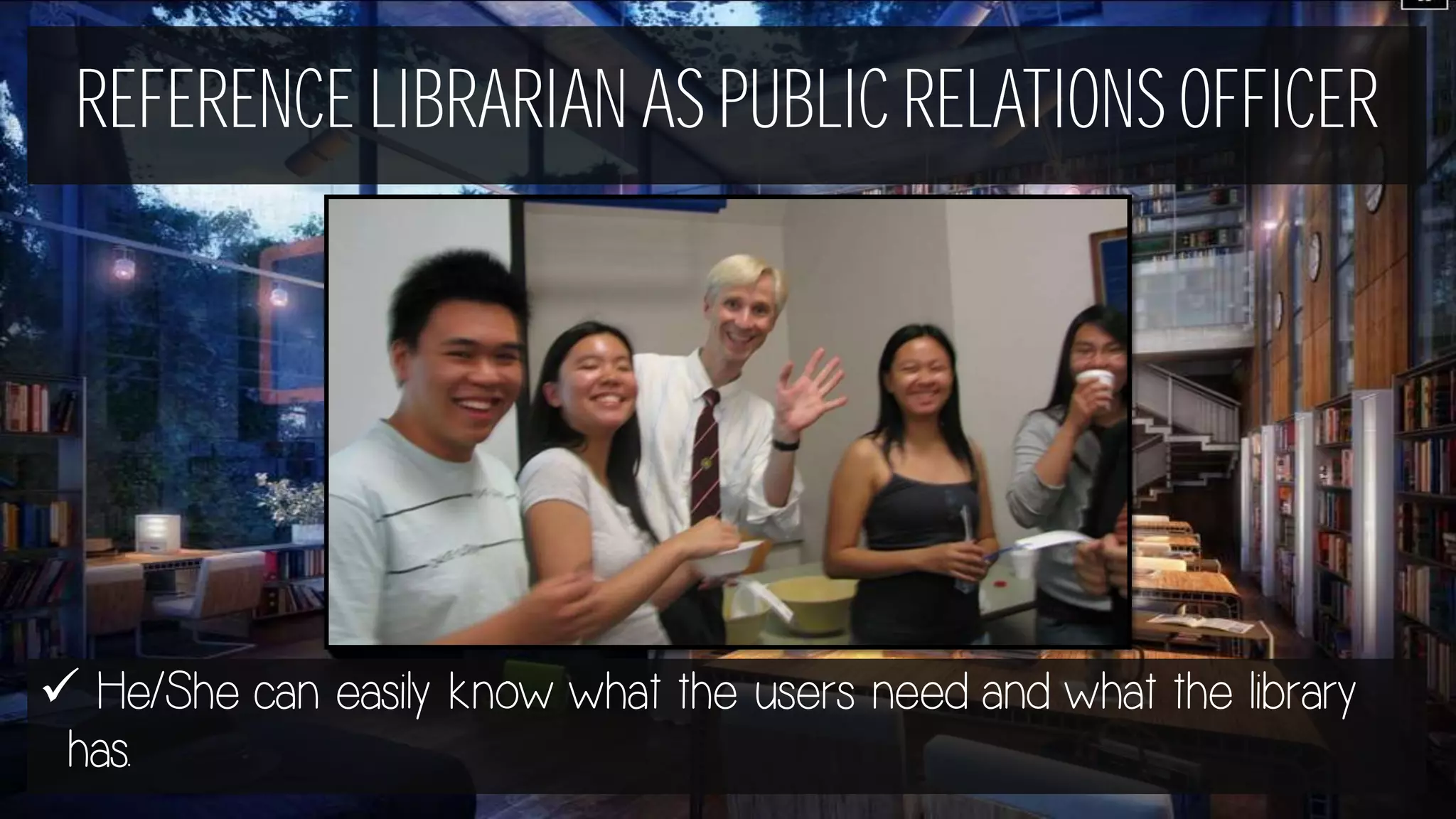
He/She can easily know what the users need and what the library
has.
REFERENCES
Jestin, K.J.& Parameswari, B. (2002) ‘Marketing of information products and services for libraries in India’, Library Philosophy and Practice, vol. 5,
no. 1.
Noel, R. & Waugh, T. (2002) ‘Marketing library and information services comparing experiences at large institutions’, In: Putting Knowledge to
Work. Presented at the Special Libraries Association.
Lesley Williams, "Making 'E' Visible," Library Journal,131.11 (2006): 40-43.
B. Ewers, & G. Austen, "Market Orientation: A Framework for Australian University Library Management", 2004 URL (consulted January2007):
http://eprints.qut.edu.au/archive/00000469/01/E wers_Market.PDF
Elle Dodsworth, "Information Polices Marketing academic libraries: a case necessary plan,"Journal of Academic librarianship, 24(4)(July1998):320-
322
Wolpert, A. 1998. Services to remote users: Marketing the library’s role. Library Trends. 47(1): 21-42.
Harrington, D. L., and X. Li. 2001. Spinning an academic web community: Measuring marketing effectiveness. Journal of Academic Librarianship.
27(3): 199-208
Brunsdale, M. 2000. From mild to wild: Strategies for promoting academic libraries to undergraduates. Reference & User Services Quarterly.
39(4): 331-36.
Aitufe, T.A.‘Public relations in academic libraries’, Library Review, Vol. 42 No. 2, pp. 39-45.1993
Dodsworth, E.M., ‘ Marketing academic libraries: a necessary plan’, The Journal of Academic Librarianship, Vol. 24 No. 4, pp.320.1998.