Analyzing the marketing
environment
By: Ahmed Mustafa
1
2
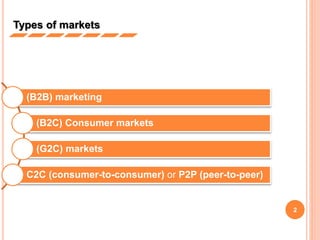
(B2B) marketing
(B2C) Consumer markets
(G2C) markets
C2C (consumer-to-consumer) or P2P (peer-to-peer)
Types of markets
3
Marketing Environment
The market environment is a marketing term and
refers to factors and forces that affect an organization’s
ability to build and maintain successful relationships
with customers.
The marketing environment represents a mix
between the internal and external forces which
surround an organization and have an impact upon it,
especially their ability to build and maintain
successful relationships with target customers.
4
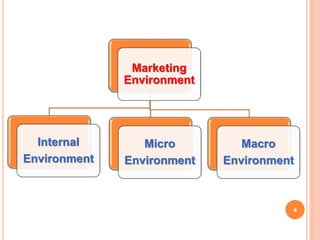
Marketing
Environment
Internal
Environment
Macro
Environment
Micro
Environment
5
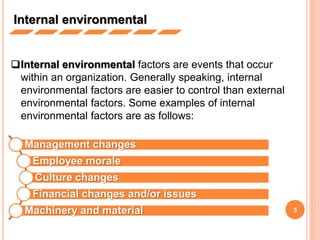
Internal environmental factors are events that occur
within an organization. Generally speaking, internal
environmental factors are easier to control than external
environmental factors. Some examples of internal
environmental factors are as follows:
Internal environmental
Management changes
Employee morale
Culture changes
Financial changes and/or issues
Machinery and material
6
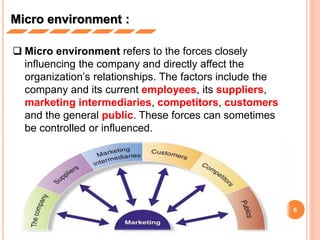
Micro environment :
 Micro environment refers to the forces closely
influencing the company and directly affect the
organization’s relationships. The factors include the
company and its current employees, its suppliers,
marketing intermediaries, competitors, customers
and the general public. These forces can sometimes
be controlled or influenced.
7
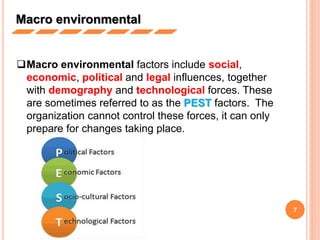
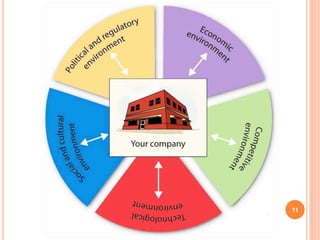
Macro environmental factors include social,
economic, political and legal influences, together
with demography and technological forces. These
are sometimes referred to as the PEST factors. The
organization cannot control these forces, it can only
prepare for changes taking place.
Macro environmental
8
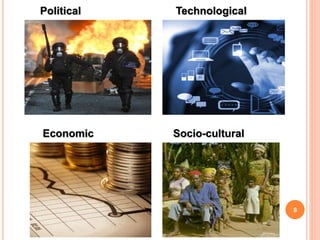
Political Technological
Economic Socio-cultural
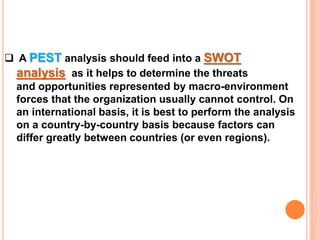
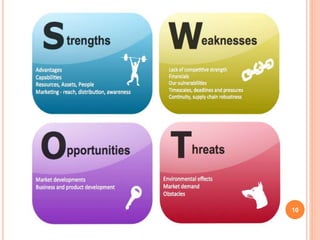
 A PEST analysis should feed into a SWOT
analysis as it helps to determine the threats
and opportunities represented by macro-environment
forces that the organization usually cannot control. On
an international basis, it is best to perform the analysis
on a country-by-country basis because factors can
differ greatly between countries (or even regions).
10
11
12
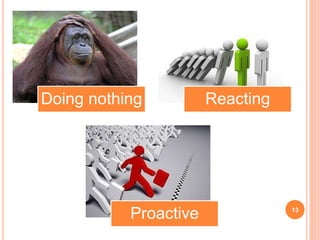
Responding to Environment
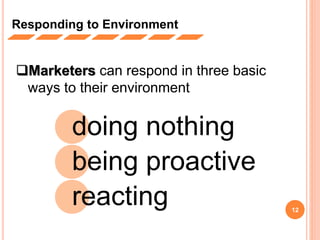
Marketers can respond in three basic
ways to their environment
doing nothing
being proactive
reacting
13
Doing nothing Reacting
Proactive
14

Market Environment

  • 1.
  • 2.
    2 (B2B) marketing (B2C) Consumermarkets (G2C) markets C2C (consumer-to-consumer) or P2P (peer-to-peer) Types of markets
  • 3.
    3 Marketing Environment The marketenvironment is a marketing term and refers to factors and forces that affect an organization’s ability to build and maintain successful relationships with customers. The marketing environment represents a mix between the internal and external forces which surround an organization and have an impact upon it, especially their ability to build and maintain successful relationships with target customers.
  • 4.
  • 5.
    5 Internal environmental factorsare events that occur within an organization. Generally speaking, internal environmental factors are easier to control than external environmental factors. Some examples of internal environmental factors are as follows: Internal environmental Management changes Employee morale Culture changes Financial changes and/or issues Machinery and material
  • 6.
    6 Micro environment : Micro environment refers to the forces closely influencing the company and directly affect the organization’s relationships. The factors include the company and its current employees, its suppliers, marketing intermediaries, competitors, customers and the general public. These forces can sometimes be controlled or influenced.
  • 7.
    7 Macro environmental factorsinclude social, economic, political and legal influences, together with demography and technological forces. These are sometimes referred to as the PEST factors. The organization cannot control these forces, it can only prepare for changes taking place. Macro environmental
  • 8.
  • 9.
     A PESTanalysis should feed into a SWOT analysis as it helps to determine the threats and opportunities represented by macro-environment forces that the organization usually cannot control. On an international basis, it is best to perform the analysis on a country-by-country basis because factors can differ greatly between countries (or even regions).
  • 10.
  • 11.
  • 12.
    12 Responding to Environment Marketerscan respond in three basic ways to their environment doing nothing being proactive reacting
  • 13.
  • 14.