Marketing Environment
Defined
The marketingenvironment encompasses external forces and actors
influencing a company's ability to develop and sustain customer
relationships. It includes both controllable elements, like marketing mix
decisions, and uncontrollable factors such as economic shifts or new
regulations.
4.
Micro vs. Macro
Environments
Themicro-environment includes
close company actors like suppliers
(e.g., Intel). The macro-environment
comprises larger societal forces, such
as economic inflation or new data
privacy laws. Both critically shape
marketing decisions.
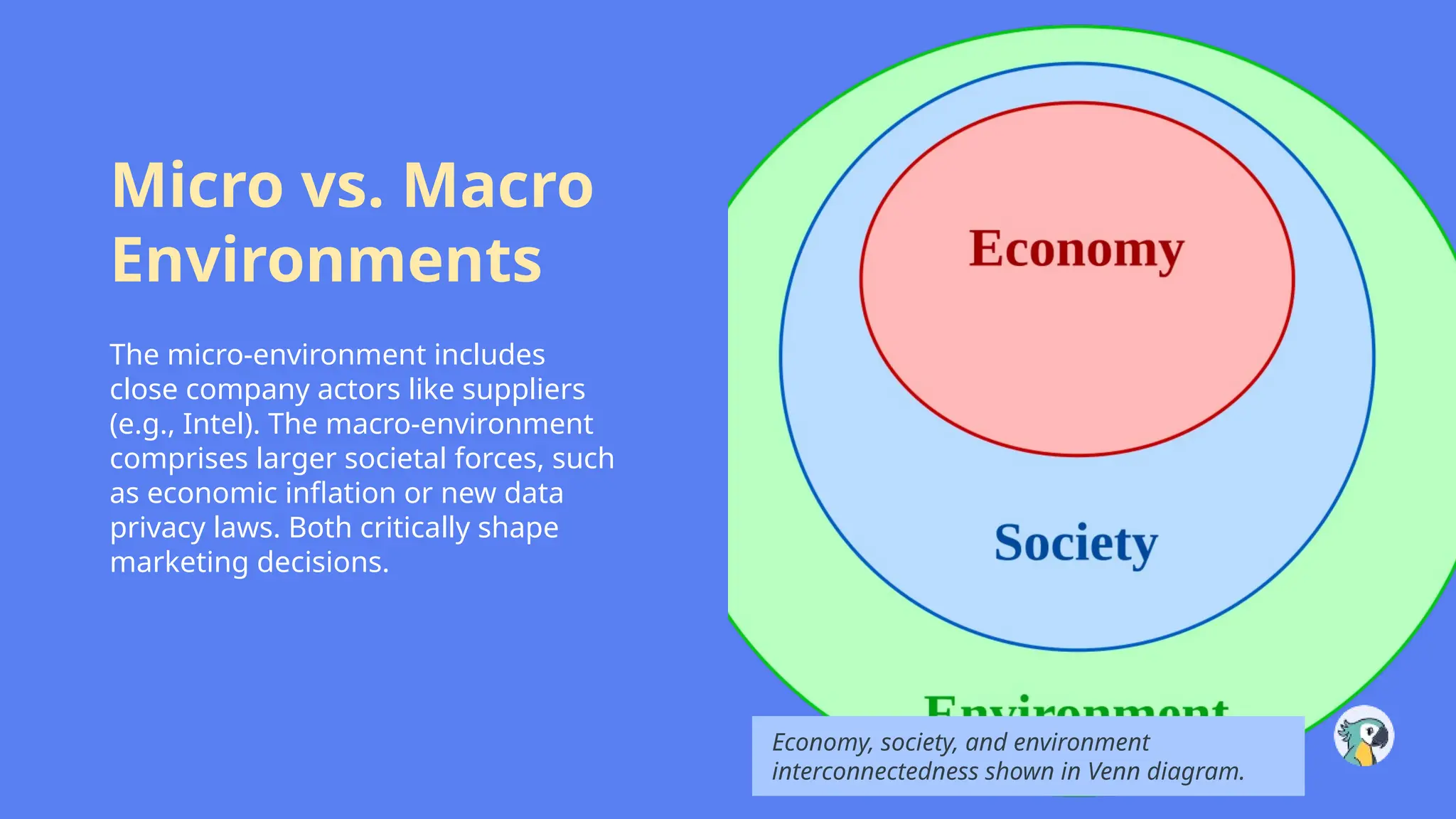
Economy, society, and environment
interconnectedness shown in Venn diagram.
5.
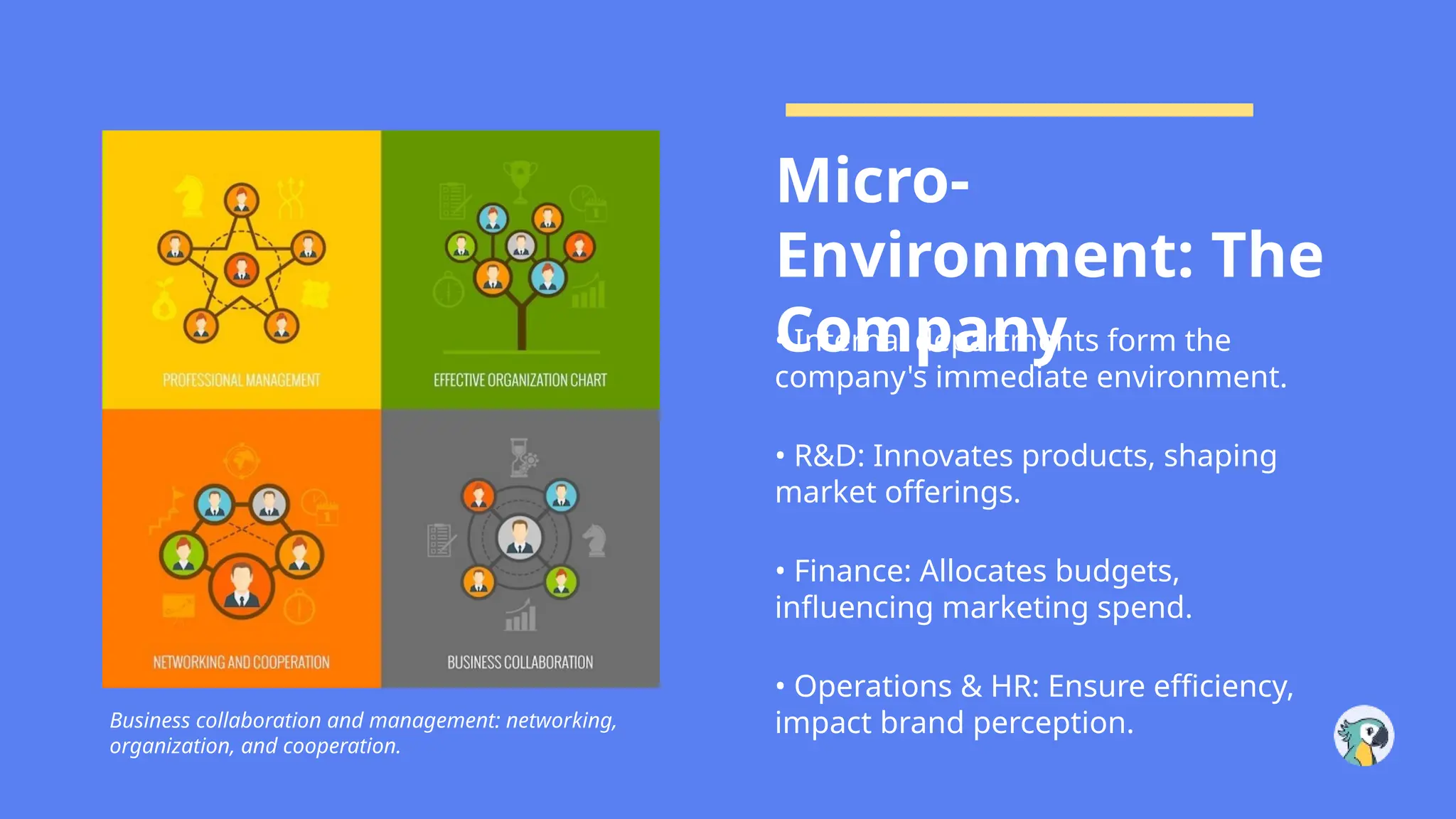
Business collaboration andmanagement: networking,
organization, and cooperation.
Micro-
Environment: The
Company
• Internal departments form the
company's immediate environment.
• R&D: Innovates products, shaping
market offerings.
• Finance: Allocates budgets,
influencing marketing spend.
• Operations & HR: Ensure efficiency,
impact brand perception.
6.
Micro-
Environment:
Suppliers
Suppliers provide essentialinputs for
production, like microchips for Tesla or
fabric for Nike. Disruptions, such as
semiconductor shortages, can severely
impact production schedules and pricing
strategies, directly affecting marketing
efforts.
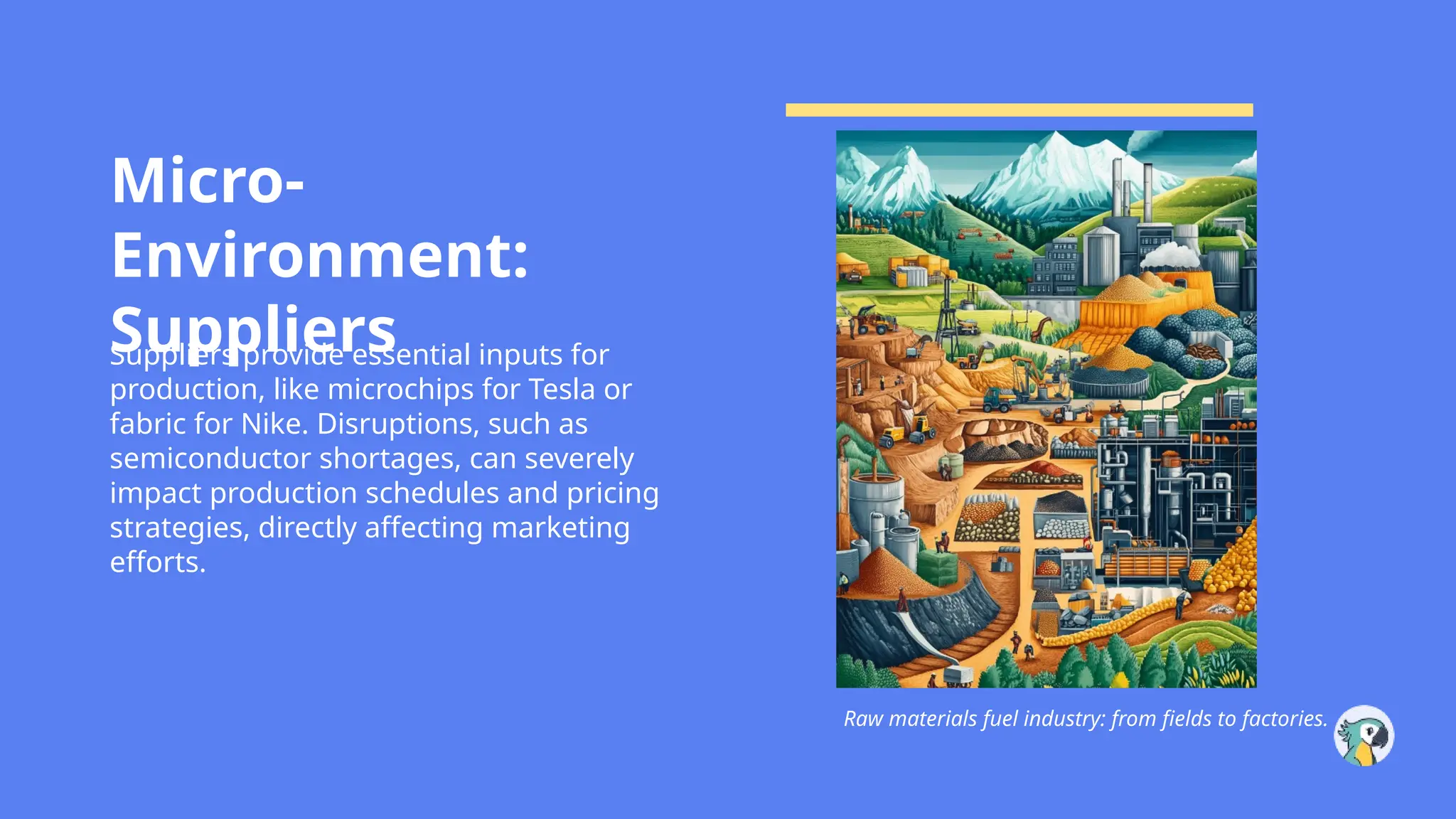
Raw materials fuel industry: from fields to factories.
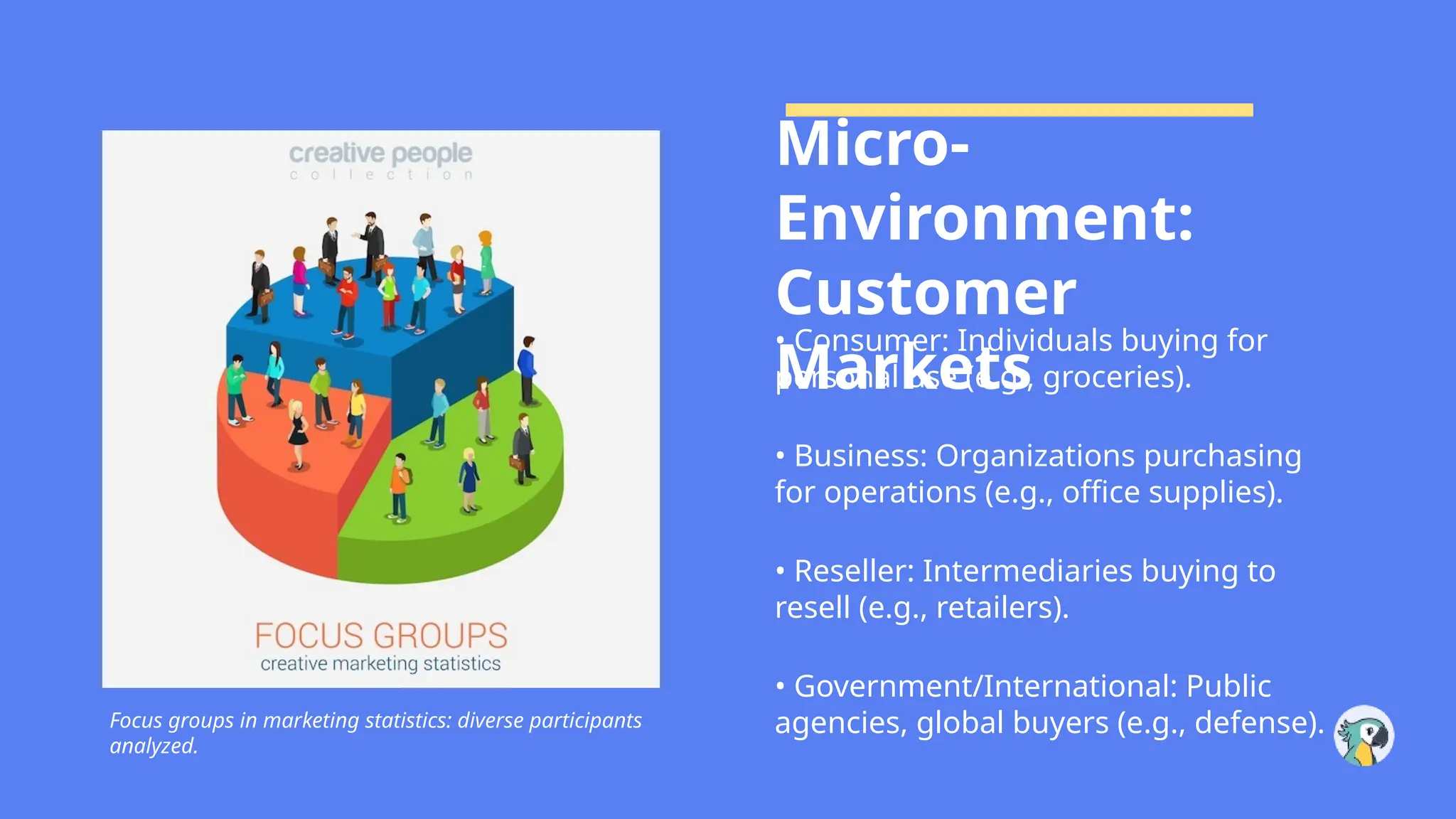
Focus groups inmarketing statistics: diverse participants
analyzed.
Micro-
Environment:
Customer
Markets
• Consumer: Individuals buying for
personal use (e.g., groceries).
• Business: Organizations purchasing
for operations (e.g., office supplies).
• Reseller: Intermediaries buying to
resell (e.g., retailers).
• Government/International: Public
agencies, global buyers (e.g., defense).
9.
Micro-
Environment:
Competitors
Understanding direct (e.g.,Coca-Cola
vs. Pepsi), indirect, and substitute
competitors is crucial. Analyzing their
strategies allows businesses to
differentiate offerings and gain
competitive advantage. Strategic
positioning is key for market success.
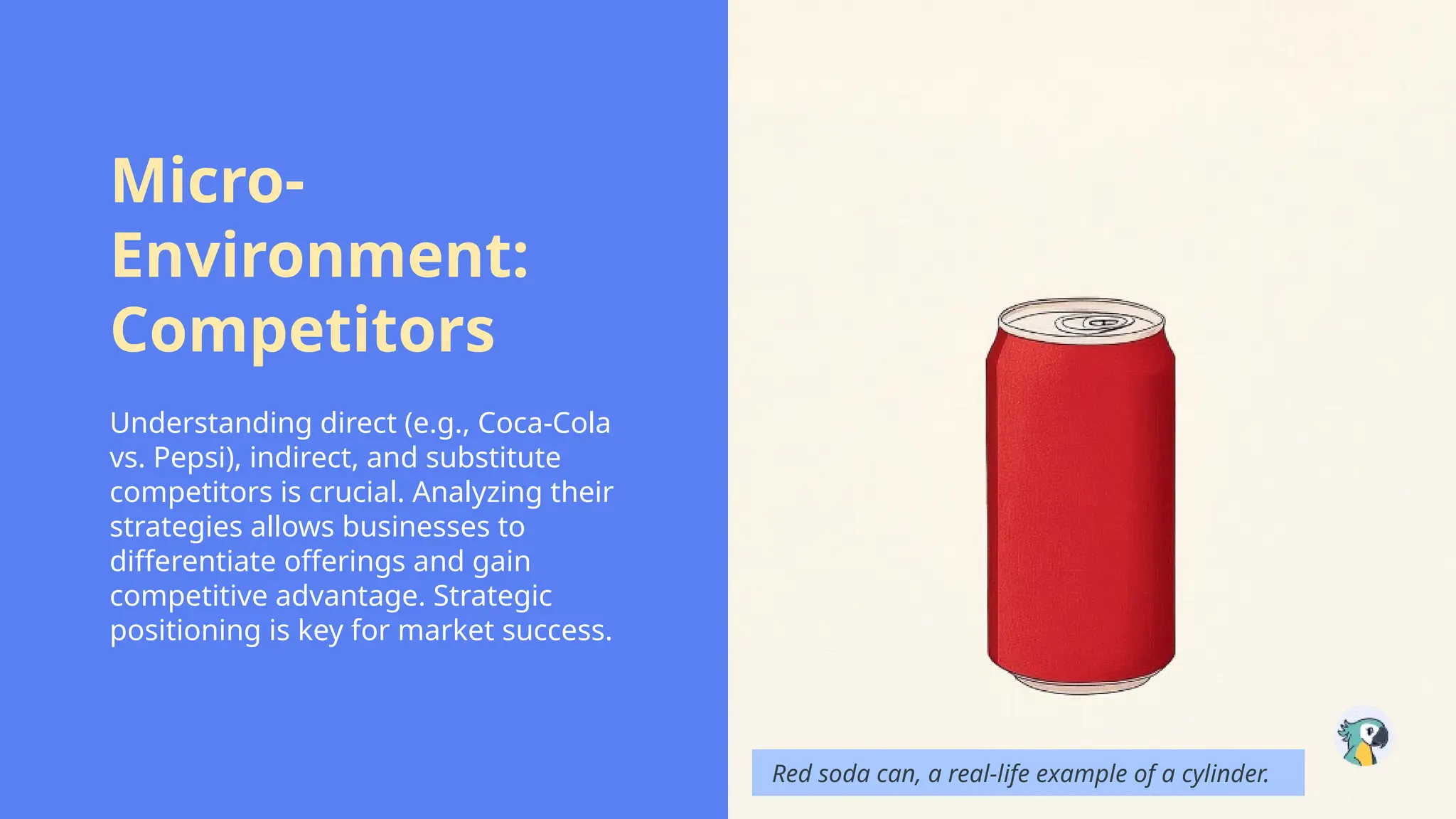
Red soda can, a real-life example of a cylinder.
10.
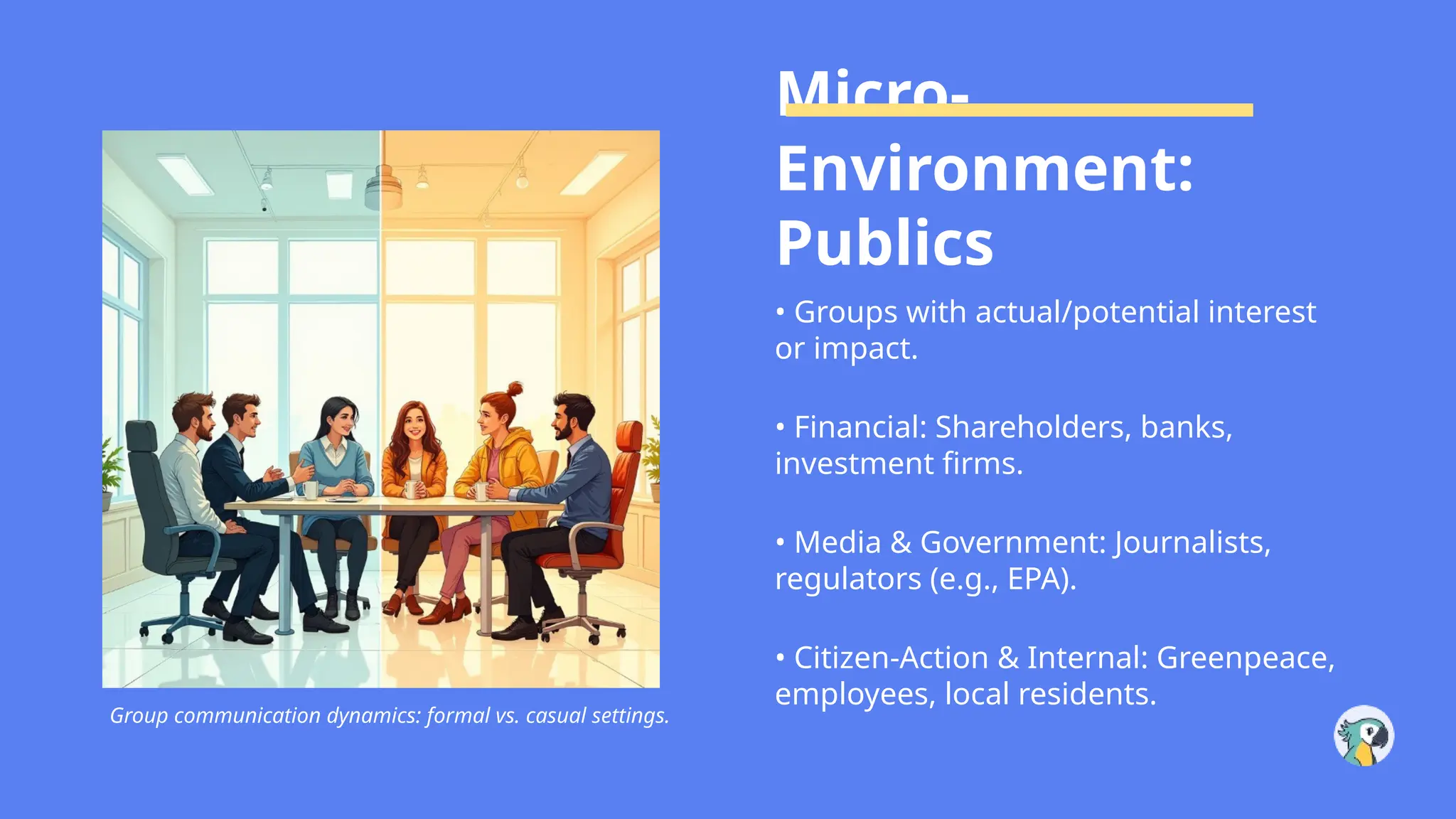
Group communication dynamics:formal vs. casual settings.
Micro-
Environment:
Publics
• Groups with actual/potential interest
or impact.
• Financial: Shareholders, banks,
investment firms.
• Media & Government: Journalists,
regulators (e.g., EPA).
• Citizen-Action & Internal: Greenpeace,
employees, local residents.
11.
Macro-Environment:
Demographic Forces
Demographic forcesanalyze population characteristics like age (e.g.,
Gen Z), location, and lifestyle trends (e.g., remote work). These
profoundly influence market segmentation, product demand, and
communication strategies.
12.
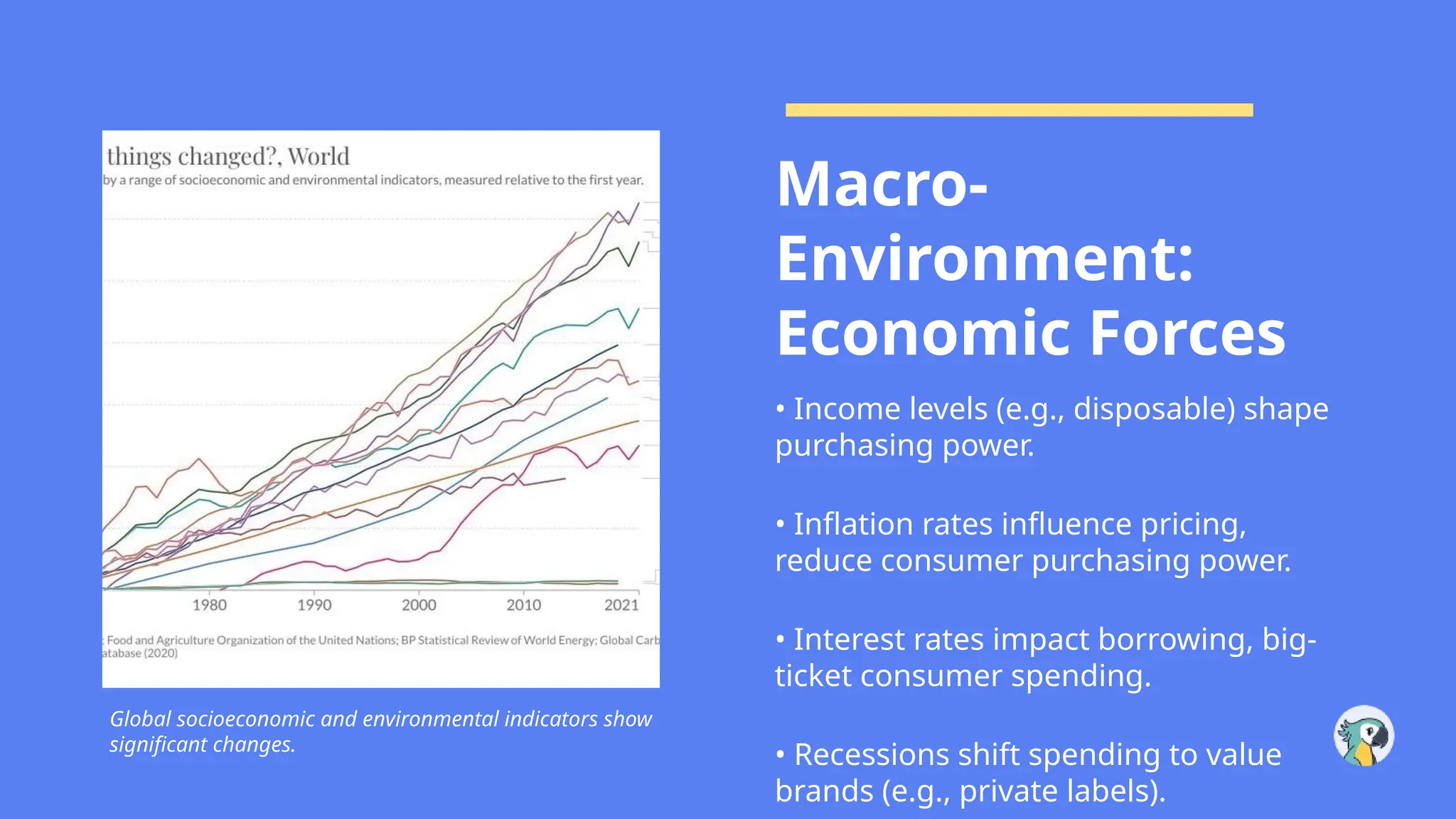
Global socioeconomic andenvironmental indicators show
significant changes.
Macro-
Environment:
Economic Forces
• Income levels (e.g., disposable) shape
purchasing power.
• Inflation rates influence pricing,
reduce consumer purchasing power.
• Interest rates impact borrowing, big-
ticket consumer spending.
• Recessions shift spending to value
brands (e.g., private labels).
13.
Natural Environment Technological
Environment
Resourcescarcity, like water shortages or
dwindling fossil fuels, directly impacts
production and supply chains. Pollution
concerns, such as plastic waste, drive
demand for sustainable products and
eco-friendly packaging. Businesses must
integrate sustainability efforts into their
marketing to appeal to environmentally
conscious consumers.
Rapid innovation, including AI and
blockchain, continuously creates new
markets and disrupts existing ones. New
product development, like electric
vehicles, demands agile marketing
strategies. The accelerating pace of
technological change necessitates
constant adaptation to leverage emerging
platforms and consumer behaviors.
14.
Political & LegalForces Cultural Influences
Government regulations, like FDA food
safety standards, directly impact product
development and marketing claims. Trade
policies, such as tariffs on imported
goods, influence pricing strategies.
Pressure groups, like environmental
advocacy groups, can shape corporate
social responsibility initiatives.
Societal values, such as a growing
emphasis on sustainability, drive
consumer preferences. Perceptions of
health and wellness lead to demand for
organic products. Behaviors like increased
remote work (digital nomadism) create
new market segments for travel and
technology.
15.
Environmental
Scanning & SWOT
4Ps Adaptation
Continuous monitoring of micro (e.g.,
competitors) and macro (e.g., economic
shifts) environments is crucial. This
identifies opportunities (e.g., AI
integration) and threats (e.g., new
regulations). Such analysis directly
informs robust SWOT.
Environmental insights directly shape the
4 Ps. Product (e.g., eco-friendly versions)
and Price (e.g., competitive pricing) adapt
to market dynamics. Place (e.g., e-
commerce) and Promotion (e.g., social
media) leverage evolving trends.
16.
Company Environment Analysis:Your
Turn!
Choose a well-known company (e.g., Apple, Coca-Cola). Identify three
specific micro-environmental factors (e.g., a key supplier, a major
competitor, a specific customer segment) and three macro-environmental
factors (e.g., demographic shifts, rising inflation, new regulations)
currently impacting its marketing strategy. Justify each factor chosen.
17.
Activity: Future MarketingTrends
Analysis
Research a significant macro-environmental trend (e.g., AI, climate
change, demographic shifts). Predict its impact on marketing planning
for a specific industry (e.g., automotive, fashion, healthcare) over the next
5-10 years. What actionable insights can you present?