Physical Education (P.E.)
Grade 9
(Part 1)
2ND Quarter
SOCIAL DANCES & DANCE MIXERS
The Fitness Side of
Social Dancing and
Dance Mixers
Module 1
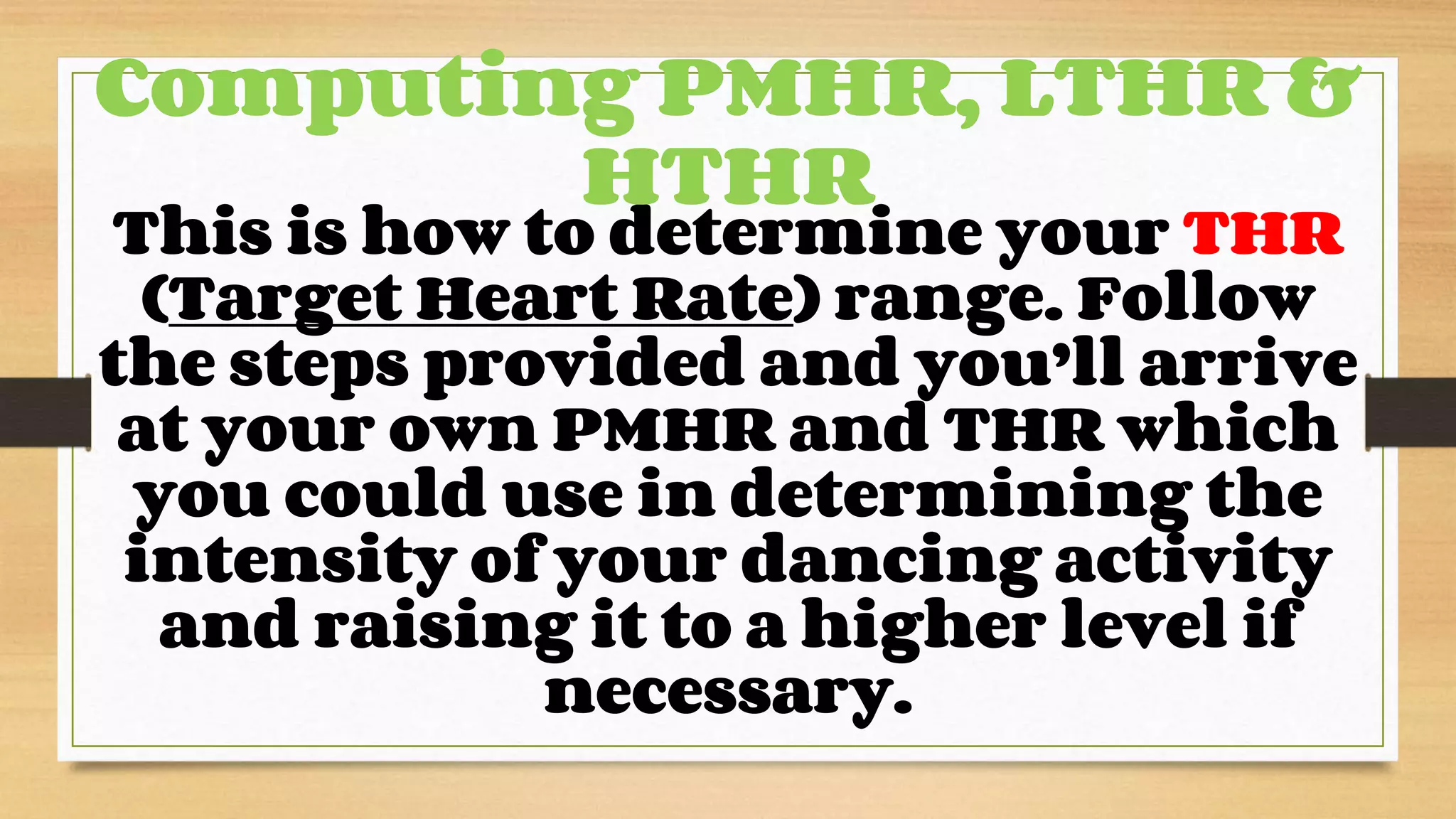
This is how to determine your THR
(Target Heart Rate) range. Follow
the steps provided and you’ll arrive
at your own PMHR and THR which
you could use in determining the
intensity of your dancing activity
and raising it to a higher level if
necessary.
Computing PMHR, LTHR &
HTHR
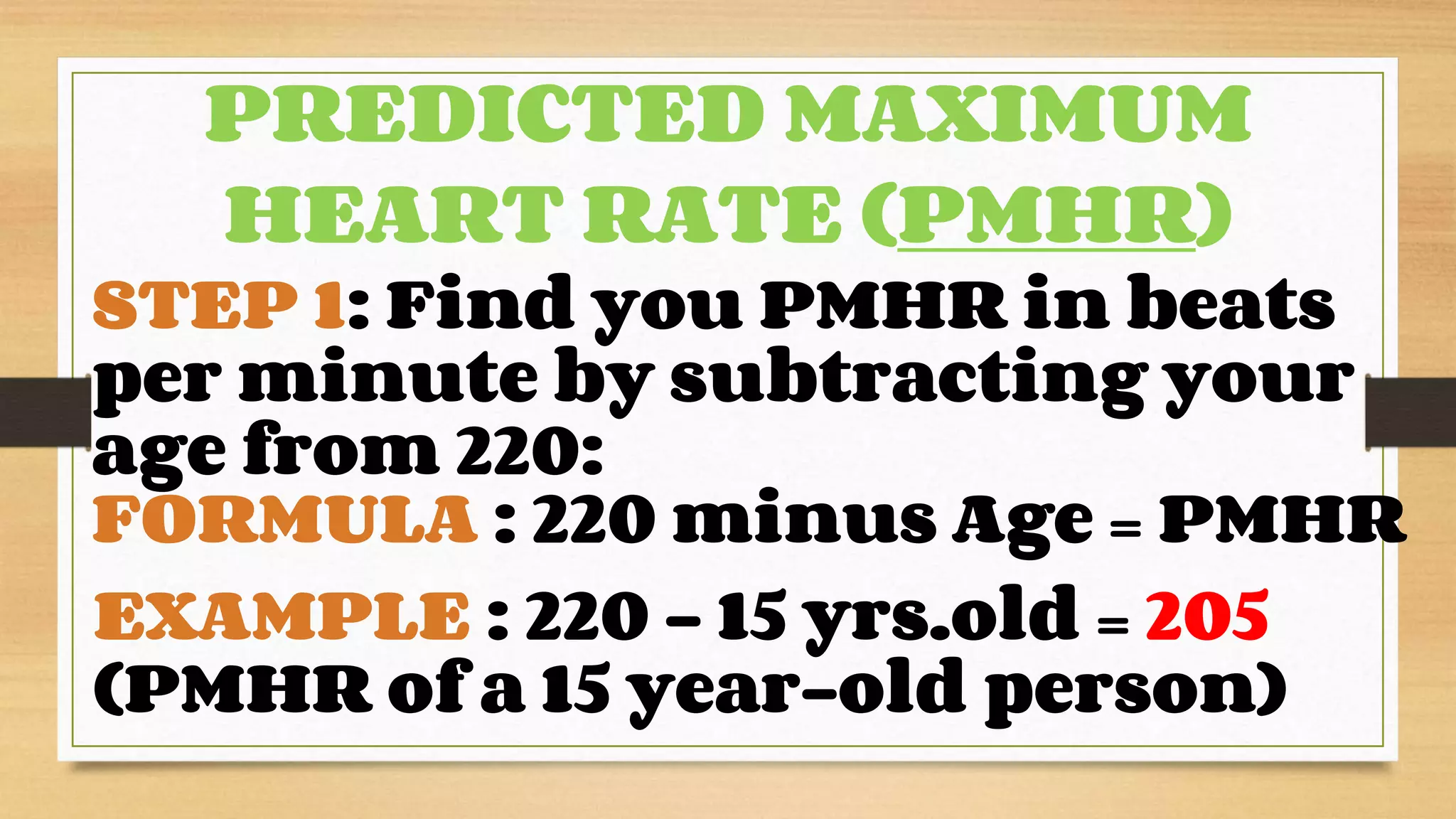
PREDICTED MAXIMUM
HEART RATE (PMHR)
STEP 1: Find you PMHR in beats
per minute by subtracting your
age from 220:
FORMULA : 220 minus Age = PMHR
EXAMPLE : 220 – 15 yrs.old = 205
(PMHR of a 15 year-old person)
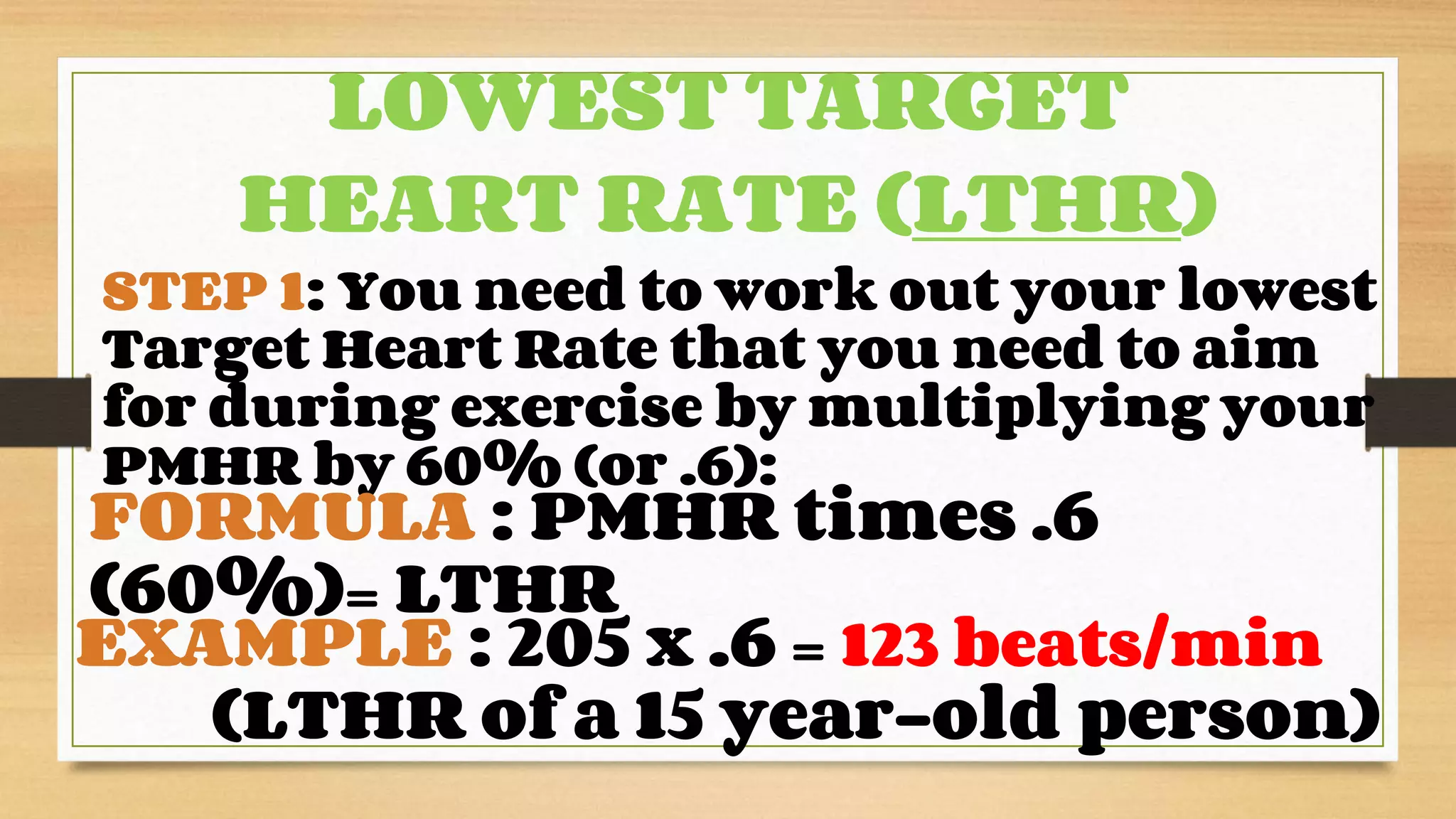
LOWEST TARGET
HEART RATE (LTHR)
STEP 1: You need to work out your lowest
Target Heart Rate that you need to aim
for during exercise by multiplying your
PMHR by 60% (or .6):
FORMULA : PMHR times .6
(60%)= LTHR
EXAMPLE : 205 x .6 = 123 beats/min
(LTHR of a 15 year-old person)
HIGHEST TARGET
HEART RATE (HTHR)
STEP 1: Lastly, you need to work out for
your Highest Target Heart Rate that you
can aim for during exercise by
multiplying your PMHR by 80% (or .8):
FORMULA : PMHR times .8
(80%) = HTHR
EXAMPLE : 205 x .8 = 164 beats /min
(HTHR of a 15 year-old person)
So, when you are dancing, you are
aiming for the range of the two figures
you have produced in Steps 2 and 3. In
the example given, the Target Heart
Rate of a 15 year-old individual is from
123 to 164 beats per minute during
exercise. To maximize the benefits you
can derive from social dancing in
relation to cardio-vascular fitness, you
need to know your Target Heart Rate.
This determines the intensity or level
of exerted effort you are pouring into
your dancing.
Nature and Background of
Social Dances and Dance
Mixers
Module 2
⮚ Social dances and dance mixers are
dances intended primarily to get to
know other people in attendance to a
certain social function.
⮚ They are also called ballroom dances.
They are usually performed in pairs,
male and female, but may also be
performed in groups.
⮚ Social dances are classified into two
major classifications namely the
Latin American Dances and the Modern
Standard Dances.
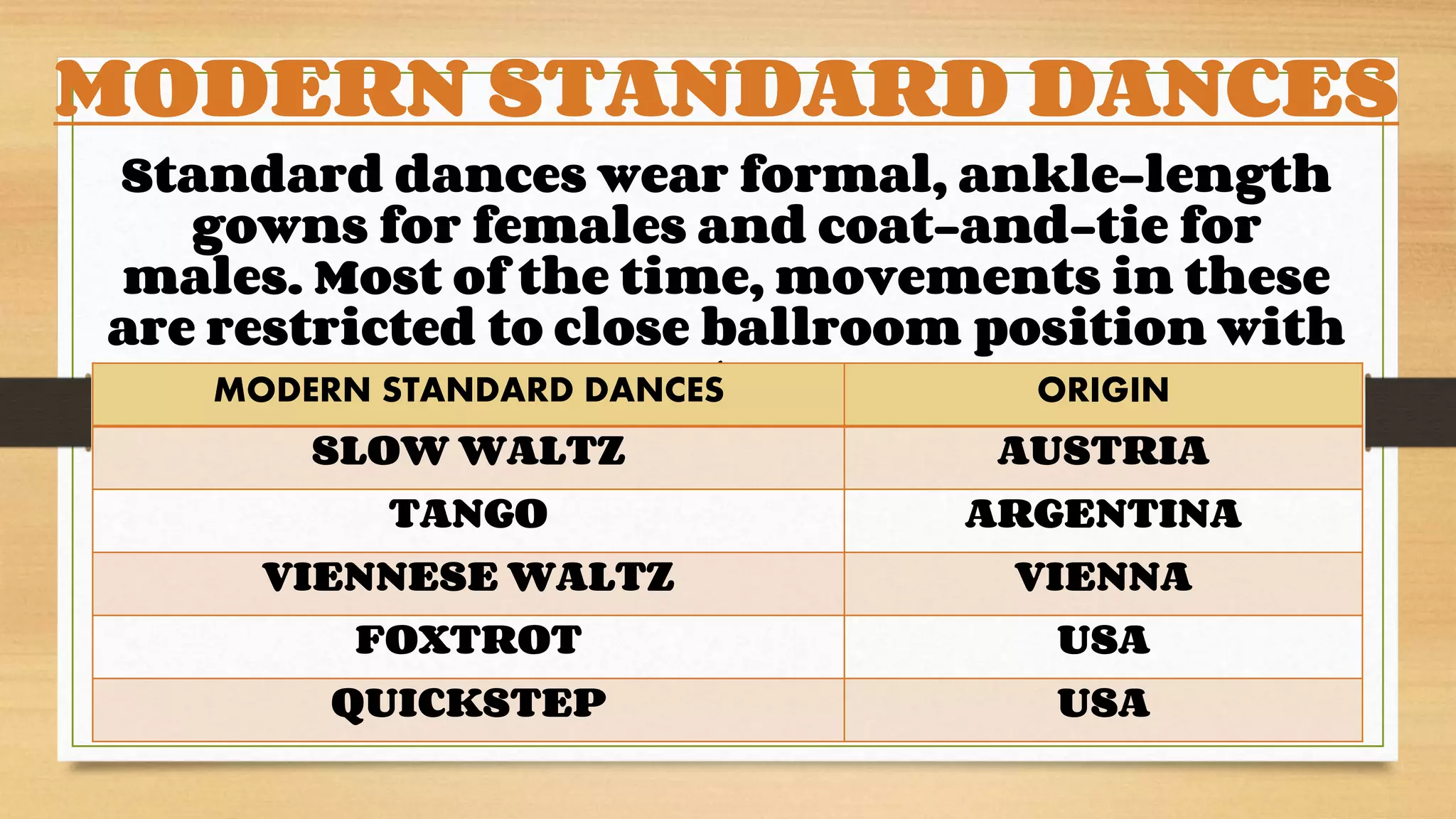
MODERN STANDARD DANCES
Standard dances wear formal, ankle-length
gowns for females and coat-and-tie for
males. Most of the time, movements in these
are restricted to close ballroom position with
partner.
MODERN STANDARD DANCES ORIGIN
SLOW WALTZ AUSTRIA
TANGO ARGENTINA
VIENNESE WALTZ VIENNA
FOXTROT USA
QUICKSTEP USA
Viennese Waltz example
Slow Waltz example
Tango example
LATIN AMERICAN DANCES
They are called Latin American dances
because most of them are from the
Latin-American countries. Latin
dances distinguish themselves by the
costumes worn by performers. They are
somewhat revealing, tight-fitting, sexy
yet sophisticated in nature. They are
also distinguished by the nature of the
movements. They are freer and can be
performed in close or open hold.
LATIN AMERICAN DANCES
LATIN AMERICAN DANCES ORIGIN
CHA-CHA CUBA
RUMBA CUBA
SAMBA BRAZIL
PASO DOBLE SPAIN
JIVE/BOOGIE USA
SWING USA
MERENGUE DOMINICAN
REPUBLIC
SALSA CUBA
MAMBO CUBA
Cha-Cha example
Jive example
Swing example
Dance mixers, on the other hand,
are social dances which allow
group of performers to change
partners periodically while
dancing to allow chance to get to
know other members of the
performing group. Its primary
function is to maximize the social
dimensions of dancing.
DANCE ETIQUETTE
Dance etiquette is a set of
guidelines that help dancers
navigate the social dimensions
of dancing. It is essential for
dancers to maximize how to go
about the process of social
dancing and have a happy
dancing experience.
DANCE ETIQUETTE
❖ NO-FAULT DANCING:
✔ Never blame a partner for missed execution of
figures.
✔ Dance to the level of your partner.
✔ The show must go on, say “sorry” to your partner if
something went wrong.
✔ Don’t do aerial choreography yourself. They require
training by a qualified instructor.
❖ DEMEANOR:
✔ Be personable, smile and make eye contact with
partner.
✔ Project a positive image on the dance floor even if it’s
not your personal style.
✔ Dance at the level of your partner.
✔ If you don’t know the dance, be honest, refuse
promptly if asked to dance.
✔ No teaching on the dance floor. It may insult your
partner.
Now that you have learned the
fundamentals of social dancing and its
relation to maintaining and improving an
active and healthy lifestyle, it’s now your
turn to share what you have learned with
your family, friends and immediate
community. The true measure of your
understanding of the concepts and
principles of social dancing merged with
fitness is your capacity to apply it into your
experiences in real life. As the saying goes, “It
takes two to Tango,” which means it takes
two or more persons to make any endeavor
work.
✔Reminder:
Here are the activities
you need to answer in
P.E. (2nd quarter)
MODULE 1 and 2.
Module 1
Activity:
“LET’S TRY”
Module 1 Activity:
“LET’S ELABORATE”
Module 1 Activity:
“LET’S EVALUATE”
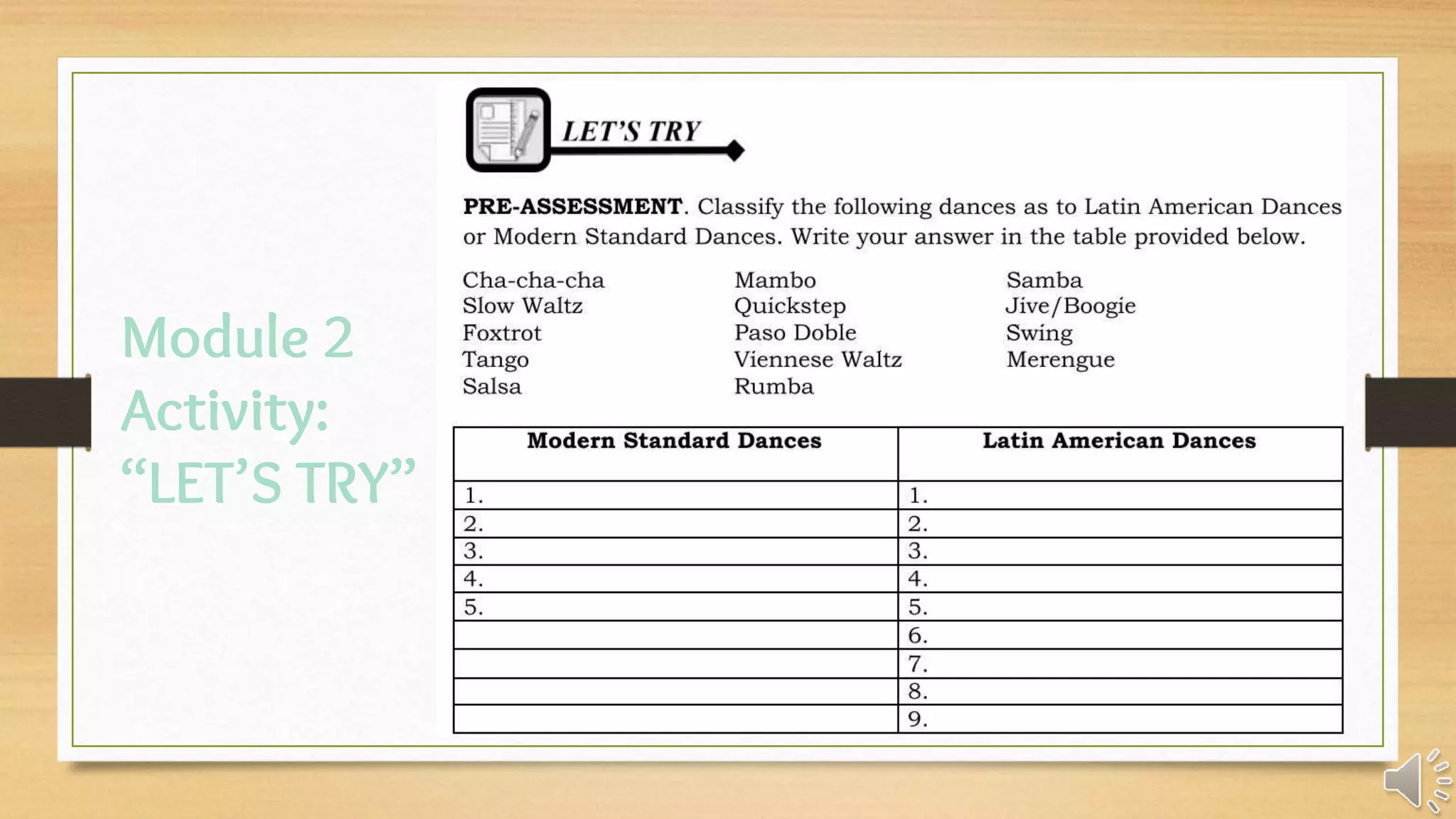
Module 2
Activity:
“LET’S TRY”

MAPEH-9-P.E.-lesson-2nd-Quarter-PART1-of-2.pptx

  • 1.
    Physical Education (P.E.) Grade9 (Part 1) 2ND Quarter SOCIAL DANCES & DANCE MIXERS
  • 2.
    The Fitness Sideof Social Dancing and Dance Mixers Module 1
  • 3.
    This is howto determine your THR (Target Heart Rate) range. Follow the steps provided and you’ll arrive at your own PMHR and THR which you could use in determining the intensity of your dancing activity and raising it to a higher level if necessary. Computing PMHR, LTHR & HTHR
  • 4.
    PREDICTED MAXIMUM HEART RATE(PMHR) STEP 1: Find you PMHR in beats per minute by subtracting your age from 220: FORMULA : 220 minus Age = PMHR EXAMPLE : 220 – 15 yrs.old = 205 (PMHR of a 15 year-old person)
  • 5.
    LOWEST TARGET HEART RATE(LTHR) STEP 1: You need to work out your lowest Target Heart Rate that you need to aim for during exercise by multiplying your PMHR by 60% (or .6): FORMULA : PMHR times .6 (60%)= LTHR EXAMPLE : 205 x .6 = 123 beats/min (LTHR of a 15 year-old person)
  • 6.
    HIGHEST TARGET HEART RATE(HTHR) STEP 1: Lastly, you need to work out for your Highest Target Heart Rate that you can aim for during exercise by multiplying your PMHR by 80% (or .8): FORMULA : PMHR times .8 (80%) = HTHR EXAMPLE : 205 x .8 = 164 beats /min (HTHR of a 15 year-old person)
  • 7.
    So, when youare dancing, you are aiming for the range of the two figures you have produced in Steps 2 and 3. In the example given, the Target Heart Rate of a 15 year-old individual is from 123 to 164 beats per minute during exercise. To maximize the benefits you can derive from social dancing in relation to cardio-vascular fitness, you need to know your Target Heart Rate. This determines the intensity or level of exerted effort you are pouring into your dancing.
  • 8.
    Nature and Backgroundof Social Dances and Dance Mixers Module 2
  • 9.
    ⮚ Social dancesand dance mixers are dances intended primarily to get to know other people in attendance to a certain social function. ⮚ They are also called ballroom dances. They are usually performed in pairs, male and female, but may also be performed in groups. ⮚ Social dances are classified into two major classifications namely the Latin American Dances and the Modern Standard Dances.
  • 10.
    MODERN STANDARD DANCES Standarddances wear formal, ankle-length gowns for females and coat-and-tie for males. Most of the time, movements in these are restricted to close ballroom position with partner. MODERN STANDARD DANCES ORIGIN SLOW WALTZ AUSTRIA TANGO ARGENTINA VIENNESE WALTZ VIENNA FOXTROT USA QUICKSTEP USA
  • 11.
  • 12.
  • 13.
  • 14.
    LATIN AMERICAN DANCES Theyare called Latin American dances because most of them are from the Latin-American countries. Latin dances distinguish themselves by the costumes worn by performers. They are somewhat revealing, tight-fitting, sexy yet sophisticated in nature. They are also distinguished by the nature of the movements. They are freer and can be performed in close or open hold.
  • 15.
    LATIN AMERICAN DANCES LATINAMERICAN DANCES ORIGIN CHA-CHA CUBA RUMBA CUBA SAMBA BRAZIL PASO DOBLE SPAIN JIVE/BOOGIE USA SWING USA MERENGUE DOMINICAN REPUBLIC SALSA CUBA MAMBO CUBA
  • 16.
  • 17.
  • 18.
  • 19.
    Dance mixers, onthe other hand, are social dances which allow group of performers to change partners periodically while dancing to allow chance to get to know other members of the performing group. Its primary function is to maximize the social dimensions of dancing.
  • 20.
    DANCE ETIQUETTE Dance etiquetteis a set of guidelines that help dancers navigate the social dimensions of dancing. It is essential for dancers to maximize how to go about the process of social dancing and have a happy dancing experience.
  • 21.
    DANCE ETIQUETTE ❖ NO-FAULTDANCING: ✔ Never blame a partner for missed execution of figures. ✔ Dance to the level of your partner. ✔ The show must go on, say “sorry” to your partner if something went wrong. ✔ Don’t do aerial choreography yourself. They require training by a qualified instructor. ❖ DEMEANOR: ✔ Be personable, smile and make eye contact with partner. ✔ Project a positive image on the dance floor even if it’s not your personal style. ✔ Dance at the level of your partner. ✔ If you don’t know the dance, be honest, refuse promptly if asked to dance. ✔ No teaching on the dance floor. It may insult your partner.
  • 22.
    Now that youhave learned the fundamentals of social dancing and its relation to maintaining and improving an active and healthy lifestyle, it’s now your turn to share what you have learned with your family, friends and immediate community. The true measure of your understanding of the concepts and principles of social dancing merged with fitness is your capacity to apply it into your experiences in real life. As the saying goes, “It takes two to Tango,” which means it takes two or more persons to make any endeavor work.
  • 23.
    ✔Reminder: Here are theactivities you need to answer in P.E. (2nd quarter) MODULE 1 and 2.
  • 24.
  • 25.
  • 26.
  • 27.