QUARTER 2:
Physical Education
Subject Teacher: Mrs. Lorrelaine S. Rojo
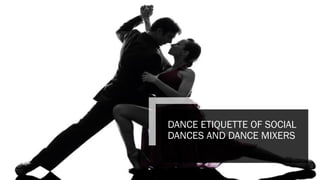
DANCE ETIQUETTE OF SOCIAL
DANCES AND DANCE MIXERS
■ Dance etiquette is the set of conventional rules which
govern the social behavior of social dance by way of its
participants.
■ Such policies encompass the manner in which the
participants must look and the manner wherein they
approach, dance with and leave their partner.
■ Etiquette can vary in its specification and stringency
among different forms of dance.
Why is dance etiquette
significant?
1. Because it helps you fit in with the social dance
crowd and makes social interaction easier.
2. It helps you keep the peace and avoid getting into
conflicts with other dancers.
3. It shows that you care about and respect other
people and most importantly, it helps you build a
good reputation for yourself, both as a person and
as a dancer.
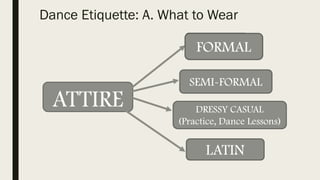
Dance Etiquette: A. What to Wear
ATTIRE
FORMAL
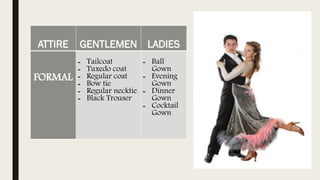
ATTIRE GENTLEMEN LADIES
FORMAL
- Tailcoat
- Tuxedo coat
- Regular coat
- Bow tie
- Regular necktie
- Black Trouser
- Ball
Gown
- Evening
Gown
- Dinner
Gown
- Cocktail
Gown
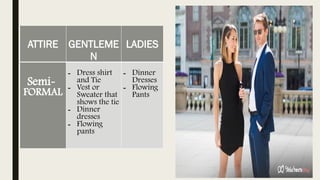
ATTIRE GENTLEME
N
LADIES
Semi-
FORMAL
- Dress shirt
and Tie
- Vest or
Sweater that
shows the tie
- Dinner
dresses
- Flowing
pants
- Dinner
Dresses
- Flowing
Pants
ATTIRE GENTLEMEN LADIES
Dressy
Casual
- Solid color T-
Shirts
- Turtle neck
- Polo Shirt
- Cotton Slocks
- Anything
Thatdisplays
a
conservative
toned-down
apprearanc
e
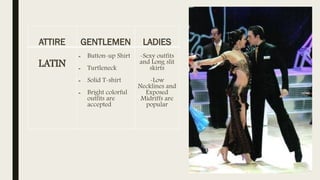
ATTIRE GENTLEMEN LADIES
LATIN
- Button-up Shirt
- Turtleneck
- Solid T-shirt
- Bright colorful
outfits are
accepted
-Sexy outfits
and Long slit
skirts
-Low
Necklines and
Exposed
Midriffs are
popular
DON’TS IN TERMS OF OUTFIT AND SHOES:
■ Do not wear sneaker or any shoe with rubber or spongy
sole.
■ Avoid sleeveless shirt and strapped dress.
■ Avoid shaggy, baggy, low armpit upper shirt.
■ Avoid accessories like big rings, watches, brooches,
loose/long necklaces and big belt buckles.
■ Long hair should be put up or tied in a pony tail.
Dance Etiquette: B. NO-FAULT DANCING
■ Never blame a partner for missed execution of
figures
■ Dance to the level of your partner
■ The show must go on, say sorry to your partner
if something went wrong.
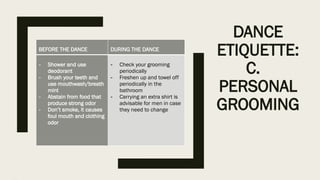
DANCE
ETIQUETTE:
C.
PERSONAL
GROOMING
BEFORE THE DANCE DURING THE DANCE
- Shower and use
deodorant
- Brush your teeth and
use mouthwash/breath
mint
- Abstain from food that
produce strong odor
- Don’t smoke, it causes
foul mouth and clothing
odor
- Check your grooming
periodically
- Freshen up and towel off
periodically in the
bathroom
- Carrying an extra shirt is
advisable for men in case
they need to change
Dance Etiquette: D.DEMEANOR
- Be personable, smile and make eye contact with partner.
- Project positive image on the dance floor even if it’s not your personal
style.
- Dance at the level of your partner.
- If you don’t know the dance, be honest, refuse promptly if asked to
dance.
- No teaching on the dance floor. It may insult your partner.
- Do not cut other dancers off.
Dance Etiquette: E. ON THE DANCE FLOOR
■ Line of Direction (Counter clockwise)
■ While on the Floor ( Avoid colliding with other
pairs)
■ Be Polite (Thank you or Compliment your
partner)
■ Accompany your partner back to her seat
 Dance etiquette is right here to ensure everyone has a great time in social
dance setting, so be aware of it.
 Your outfit and accessories need to be comfortable, safe and also reflect the
way of life and level of formality of the dance group.
 Most importantly, remember your dance shoes.
 Ask everyone to dance but not monopolize one partner for the entire night.
 Today’s beginner will be the good dancers of tomorrow, so be nice to them
and dance with them.
 Do not decline a dance except you absolutely have to. Be considerate of
other couples on the floor.
 Exercise good floor craft.
 Do not cut other couples off.
 Stationary dancers stay in the middle, traveling dancers move on the
boundary along the line of dance.
 Avoid patterns that your partner cannot do.
 Never blame your partner for missteps and no unsolicited teaching on the
floor.
 Most importantly, you should smile, be warm, be personable and be nice.
Social dance is dance which is recreational and
generally executed with a partner and in groups
or as a community activity for fun and enjoyment.
Social dances and dance mixers are dances.
Sometimes it does not require a partner but
actually some people in an institution or
community.
Many social dances are dance mixers and the primary
function is that people ought to mix and often exchange
partners. The optimum purpose of social dances involve
organizations of people enjoying activity within sets where
groups and couples regularly change places or even
partners. Some of the primary forms of group dancing
within sets known as ‘country dancing’ are those in which
couples are aligned in either longways, circular or
columnar formation, or in squares called ‘quadrilles’
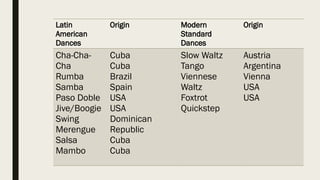
Latin
American
Dances
Origin Modern
Standard
Dances
Origin
Cha-Cha-
Cha
Rumba
Samba
Paso Doble
Jive/Boogie
Swing
Merengue
Salsa
Mambo
Cuba
Cuba
Brazil
Spain
USA
USA
Dominican
Republic
Cuba
Cuba
Slow Waltz
Tango
Viennese
Waltz
Foxtrot
Quickstep
Austria
Argentina
Vienna
USA
USA
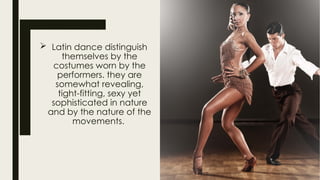
 Latin dance distinguish
themselves by the
costumes worn by the
performers. they are
somewhat revealing,
tight-fitting, sexy yet
sophisticated in nature
and by the nature of the
movements.
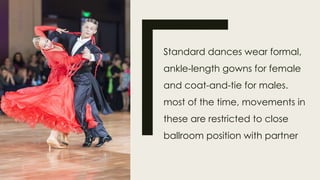
Standard dances wear formal,
ankle-length gowns for female
and coat-and-tie for males.
most of the time, movements in
these are restricted to close
ballroom position with partner
Social or ballroom dances are different from
dance sports because the latter is freer in
nature and primarily intended to widen one’s
social horizon for recreation and fitness.
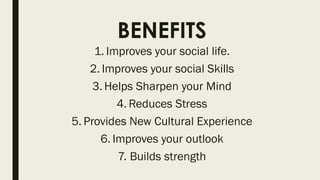
BENEFITS
1. Improves your social life.
2. Improves your social Skills
3. Helps Sharpen your Mind
4. Reduces Stress
5. Provides New Cultural Experience
6. Improves your outlook
7. Builds strength

Q2 P.E. 9.pptx. Social dance and Dance etiquette

  • 1.
    QUARTER 2: Physical Education SubjectTeacher: Mrs. Lorrelaine S. Rojo
  • 2.
    DANCE ETIQUETTE OFSOCIAL DANCES AND DANCE MIXERS
  • 3.
    ■ Dance etiquetteis the set of conventional rules which govern the social behavior of social dance by way of its participants. ■ Such policies encompass the manner in which the participants must look and the manner wherein they approach, dance with and leave their partner. ■ Etiquette can vary in its specification and stringency among different forms of dance.
  • 4.
    Why is danceetiquette significant? 1. Because it helps you fit in with the social dance crowd and makes social interaction easier. 2. It helps you keep the peace and avoid getting into conflicts with other dancers. 3. It shows that you care about and respect other people and most importantly, it helps you build a good reputation for yourself, both as a person and as a dancer.
  • 5.
    Dance Etiquette: A.What to Wear ATTIRE FORMAL
  • 6.
    ATTIRE GENTLEMEN LADIES FORMAL -Tailcoat - Tuxedo coat - Regular coat - Bow tie - Regular necktie - Black Trouser - Ball Gown - Evening Gown - Dinner Gown - Cocktail Gown
  • 7.
    ATTIRE GENTLEME N LADIES Semi- FORMAL - Dressshirt and Tie - Vest or Sweater that shows the tie - Dinner dresses - Flowing pants - Dinner Dresses - Flowing Pants
  • 8.
    ATTIRE GENTLEMEN LADIES Dressy Casual -Solid color T- Shirts - Turtle neck - Polo Shirt - Cotton Slocks - Anything Thatdisplays a conservative toned-down apprearanc e
  • 9.
    ATTIRE GENTLEMEN LADIES LATIN -Button-up Shirt - Turtleneck - Solid T-shirt - Bright colorful outfits are accepted -Sexy outfits and Long slit skirts -Low Necklines and Exposed Midriffs are popular
  • 10.
    DON’TS IN TERMSOF OUTFIT AND SHOES: ■ Do not wear sneaker or any shoe with rubber or spongy sole. ■ Avoid sleeveless shirt and strapped dress. ■ Avoid shaggy, baggy, low armpit upper shirt. ■ Avoid accessories like big rings, watches, brooches, loose/long necklaces and big belt buckles. ■ Long hair should be put up or tied in a pony tail.
  • 11.
    Dance Etiquette: B.NO-FAULT DANCING ■ Never blame a partner for missed execution of figures ■ Dance to the level of your partner ■ The show must go on, say sorry to your partner if something went wrong.
  • 12.
    DANCE ETIQUETTE: C. PERSONAL GROOMING BEFORE THE DANCEDURING THE DANCE - Shower and use deodorant - Brush your teeth and use mouthwash/breath mint - Abstain from food that produce strong odor - Don’t smoke, it causes foul mouth and clothing odor - Check your grooming periodically - Freshen up and towel off periodically in the bathroom - Carrying an extra shirt is advisable for men in case they need to change
  • 13.
    Dance Etiquette: D.DEMEANOR -Be personable, smile and make eye contact with partner. - Project positive image on the dance floor even if it’s not your personal style. - Dance at the level of your partner. - If you don’t know the dance, be honest, refuse promptly if asked to dance. - No teaching on the dance floor. It may insult your partner. - Do not cut other dancers off.
  • 14.
    Dance Etiquette: E.ON THE DANCE FLOOR ■ Line of Direction (Counter clockwise) ■ While on the Floor ( Avoid colliding with other pairs) ■ Be Polite (Thank you or Compliment your partner) ■ Accompany your partner back to her seat
  • 15.
     Dance etiquetteis right here to ensure everyone has a great time in social dance setting, so be aware of it.  Your outfit and accessories need to be comfortable, safe and also reflect the way of life and level of formality of the dance group.  Most importantly, remember your dance shoes.  Ask everyone to dance but not monopolize one partner for the entire night.  Today’s beginner will be the good dancers of tomorrow, so be nice to them and dance with them.  Do not decline a dance except you absolutely have to. Be considerate of other couples on the floor.  Exercise good floor craft.  Do not cut other couples off.  Stationary dancers stay in the middle, traveling dancers move on the boundary along the line of dance.  Avoid patterns that your partner cannot do.  Never blame your partner for missteps and no unsolicited teaching on the floor.  Most importantly, you should smile, be warm, be personable and be nice.
  • 16.
    Social dance isdance which is recreational and generally executed with a partner and in groups or as a community activity for fun and enjoyment. Social dances and dance mixers are dances. Sometimes it does not require a partner but actually some people in an institution or community.
  • 17.
    Many social dancesare dance mixers and the primary function is that people ought to mix and often exchange partners. The optimum purpose of social dances involve organizations of people enjoying activity within sets where groups and couples regularly change places or even partners. Some of the primary forms of group dancing within sets known as ‘country dancing’ are those in which couples are aligned in either longways, circular or columnar formation, or in squares called ‘quadrilles’
  • 18.
  • 19.
     Latin dancedistinguish themselves by the costumes worn by the performers. they are somewhat revealing, tight-fitting, sexy yet sophisticated in nature and by the nature of the movements.
  • 20.
    Standard dances wearformal, ankle-length gowns for female and coat-and-tie for males. most of the time, movements in these are restricted to close ballroom position with partner
  • 21.
    Social or ballroomdances are different from dance sports because the latter is freer in nature and primarily intended to widen one’s social horizon for recreation and fitness.
  • 22.
    BENEFITS 1. Improves yoursocial life. 2. Improves your social Skills 3. Helps Sharpen your Mind 4. Reduces Stress 5. Provides New Cultural Experience 6. Improves your outlook 7. Builds strength