MAPEH – WEEK 2 First
Quarter
Music
Symbols of notes and rests, Musical
score of
“Magtanim ay Masaya”, “Magtanim
ay Di Biro”, “Bahay Kubo”
Reviewing previous lesson and
presenting new lesson
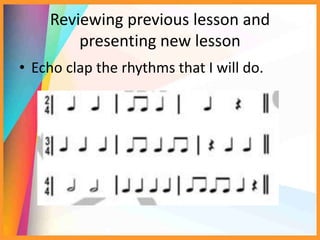
• Echo clap the rhythms that I will do.
Establishing a purpose for the lesson
• There are 3 measures in each rhythmic pattern.
• Let us count the measures in each time signature.
• Clap the rhythmic patterns.
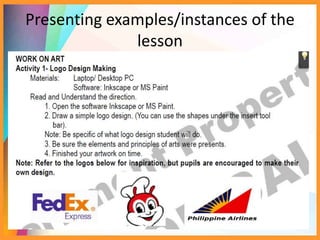
Presenting examples/instances of the
lesson
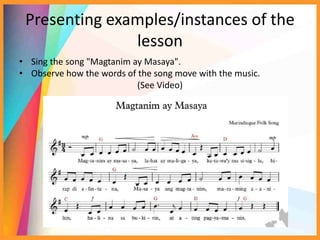
• Sing the song "Magtanim ay Masaya".
• Observe how the words of the song move with the music.
(See Video)
Discussing new concepts and
practicing new skills #1
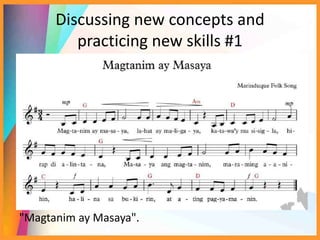
1. Movements in music are written in notes and rests.
Rhythm is the movement in music.
2. Present and discuss Table 1.
3. Identify the rhythm (note and rest) used in
"Magtanim ay Masaya".
Discussing new concepts and
practicing new skills #2
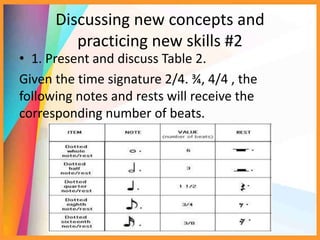
• 1. Present and discuss Table 2.
Given the time signature 2/4. ¾, 4/4 , the
following notes and rests will receive the
corresponding number of beats.
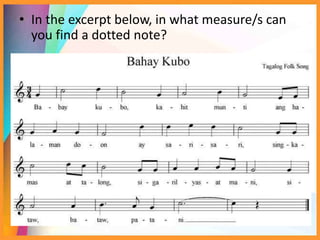
• In the excerpt below, in what measure/s can
you find a dotted note?
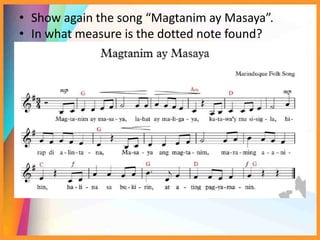
• Show again the song “Magtanim ay Masaya”.
• In what measure is the dotted note found?
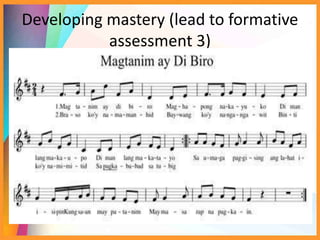
Developing mastery (lead to formative
assessment 3)
Sing the song. Identify the measure/s in
which the following notes/rests are
used:
1. quarter note
2. half rest
3. sixteenth note
4. dotted eighth note
5. quarter rest
Finding practical application of
concepts and skills in daily living
• Rhythm is made up of regular repeated
patterns of movement or sound. It is also a
systematic arrangement of musical sounds,
principally according to duration and periodical
stress.
• People will understand us better if we move or
speak with good rhythm. Act out a daily
routine that you do in school or at home, which
shows good rhythm. Example: the way you
pass your papers after a test
Making generalization and
abstractions about the lesson
• Music is made up of different kinds of notes
and rests to represent duration of sounds and
silence.
Evaluating learning
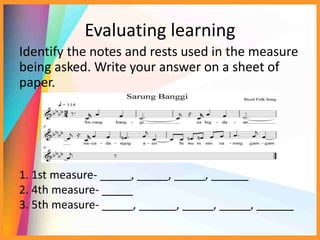
Identify the notes and rests used in the measure
being asked. Write your answer on a sheet of
paper.
1. 1st measure- _____, _____, _____, ______
2. 4th measure- _____
3. 5th measure- _____, ______, _____, _____, ______
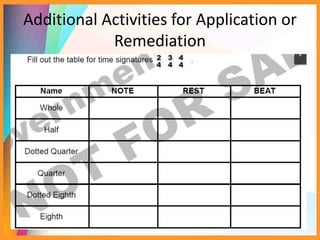
Additional Activities for Application or
Remediation
arts
Drawing
Logo Design Making
Reviewing previous lesson and
presenting new lesson
• Think Creatively One of the most
important considerations for logo
design is the color palette. This is
not a superficial decision, color
carries meanings and
communicates ideas.
Presenting examples/instances of the
lesson
Discussing new concepts and practicing new skills #1
CRAFT CREATIVENESS
Activity 2- Alternative
Alternative for Activity 1: Logo Design Making
Materials: graphing paper, pencil, ruler, coloring
materials (colored pens and pencils are good but
crayons and water medium can also be used)
* In the absence of a graphing paper, you may
let your students draw their own grid squares
(suggested size per grid box is 1 x 1 cm) using
their pencil and ruler on a bond paper
Discussing new concepts and practicing new skills #1
Read, understand and follow the directions.
1. Imagine a symbol or logo you want to make.
2. Using a pencil draw your work on a Graphing
Paper.
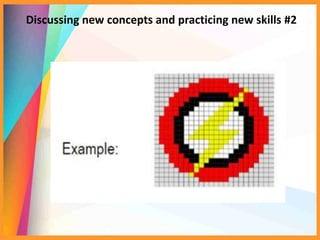
3. Remember the Simple Rules in making a Pixel
Art, start coloring each box of the graphing paper
with the color of your choice. One box, one color.
There are no half colored boxes.
4. Be sure the elements and principles of arts were
presents.
5. Explain the logo that you have made.
6. Finished your artwork on time.
Discussing new concepts and practicing new skills #2
p.e.
Assessment of physical
activities and physical fitness
• Practical assessment of physical
activities and physical fitness.
health
Personal Health -Issues and
Concerns
Reviewing previous lesson and
presenting new lesson
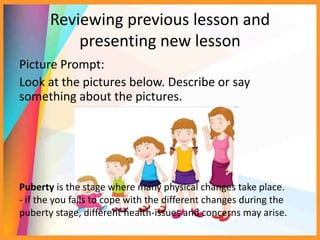
Picture Prompt:
Look at the pictures below. Describe or say
something about the pictures.
Puberty is the stage where many physical changes take place.
- if the you fails to cope with the different changes during the
puberty stage, different health-issues and concerns may arise.
Reviewing previous lesson and
presenting new lesson
Picture Prompt:
1. The teacher will show pictures depicting changes in the body
of a child. The teacher should be able to emphasize that puberty
is the stage where many physical changes take place.
2. Ask the learners to describe or say something about the
pictures.
3. The teacher will write all possible answers given by the
students or the teacher may prepare description in metacards
and let the students choose the appropriate description in the
picture shown.
4. The teacher will explain that if the student fails to cope with
the different changes during the puberty stage, different health-
issues and concerns may arise.
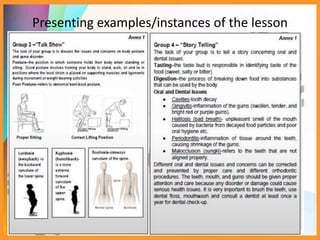
Presenting examples/instances of the lesson
• Activity: (Annex 1)
Discussing new concepts and
practicing new skills #1
The teacher will group the class into four (5)
Each group must have a leader and a reporter
The reporter will explain to the class the output.
Group 1 – Physical changes for girls during puberty.
Group 2 – Physical Changes for the boys during puberty.
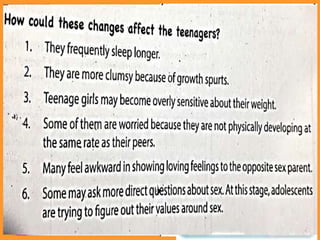
Group 3 – How could changes during puberty affect the
teenagers?
Group 4 – How are emotional changes affecting young
people.
Group 5 – What are the problems and health concerns of
many adolescents?
Discussing new concepts and
practicing new skills #1
Discussing new concepts and
practicing new skills #2
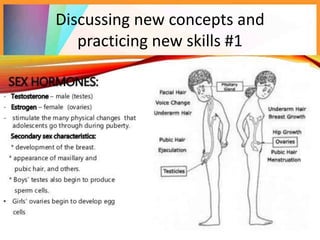
What are the physical changes for the girls and
boys during adolescence stage?
Finding practical application of
concepts and skills in daily living
How do you feel about the changes that
happened in you during adolescence?
Making generalization and
abstractions about the lesson
What is puberty?
What are the Physical changes for girls during puberty?
What are the Physical Changes for the boys during
puberty.
How could changes during puberty affect the teenagers?
How are emotional changes affecting young people.
What are the problems and health concerns of many
adolescents?
Evaluating learning
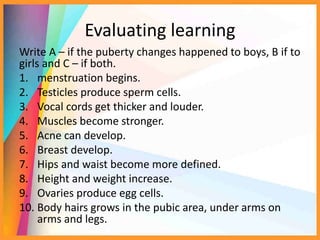
Write A – if the puberty changes happened to boys, B if to
girls and C – if both.
1. menstruation begins.
2. Testicles produce sperm cells.
3. Vocal cords get thicker and louder.
4. Muscles become stronger.
5. Acne can develop.
6. Breast develop.
7. Hips and waist become more defined.
8. Height and weight increase.
9. Ovaries produce egg cells.
10. Body hairs grows in the pubic area, under arms on
arms and legs.
weekly assessments
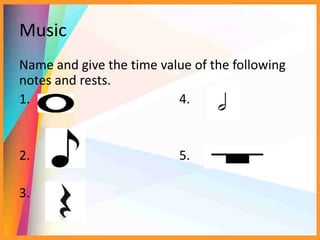
Music
Name and give the time value of the following
notes and rests.
1. 4.
2. 5.
3.
Health
Write A – if the puberty changes happened to boys, B if to girls and C –
if both.
menstruation begins.
Testicles produce sperm cells.
Vocal cords get thicker and louder.
Muscles become stronger.
Acne can develop.
Breast develop.
Hips and waist become more defined.
Height and weight increase.
Ovaries produce egg cells.
Body hairs grows in the pubic area, under arms on arms and legs.
MAPEH – WEEK 2 First Quarter.pptx

  • 1.
    MAPEH – WEEK2 First Quarter
  • 2.
  • 3.
    Symbols of notesand rests, Musical score of “Magtanim ay Masaya”, “Magtanim ay Di Biro”, “Bahay Kubo”
  • 4.
    Reviewing previous lessonand presenting new lesson • Echo clap the rhythms that I will do.
  • 5.
    Establishing a purposefor the lesson • There are 3 measures in each rhythmic pattern. • Let us count the measures in each time signature. • Clap the rhythmic patterns.
  • 6.
    Presenting examples/instances ofthe lesson • Sing the song "Magtanim ay Masaya". • Observe how the words of the song move with the music. (See Video)
  • 7.
    Discussing new conceptsand practicing new skills #1 1. Movements in music are written in notes and rests. Rhythm is the movement in music. 2. Present and discuss Table 1. 3. Identify the rhythm (note and rest) used in "Magtanim ay Masaya".
  • 8.
    Discussing new conceptsand practicing new skills #2 • 1. Present and discuss Table 2. Given the time signature 2/4. ¾, 4/4 , the following notes and rests will receive the corresponding number of beats.
  • 9.
    • In theexcerpt below, in what measure/s can you find a dotted note?
  • 10.
    • Show againthe song “Magtanim ay Masaya”. • In what measure is the dotted note found?
  • 11.
    Developing mastery (leadto formative assessment 3) Sing the song. Identify the measure/s in which the following notes/rests are used: 1. quarter note 2. half rest 3. sixteenth note 4. dotted eighth note 5. quarter rest
  • 12.
    Finding practical applicationof concepts and skills in daily living • Rhythm is made up of regular repeated patterns of movement or sound. It is also a systematic arrangement of musical sounds, principally according to duration and periodical stress. • People will understand us better if we move or speak with good rhythm. Act out a daily routine that you do in school or at home, which shows good rhythm. Example: the way you pass your papers after a test
  • 13.
    Making generalization and abstractionsabout the lesson • Music is made up of different kinds of notes and rests to represent duration of sounds and silence.
  • 14.
    Evaluating learning Identify thenotes and rests used in the measure being asked. Write your answer on a sheet of paper. 1. 1st measure- _____, _____, _____, ______ 2. 4th measure- _____ 3. 5th measure- _____, ______, _____, _____, ______
  • 15.
    Additional Activities forApplication or Remediation
  • 16.
  • 17.
  • 18.
    Reviewing previous lessonand presenting new lesson • Think Creatively One of the most important considerations for logo design is the color palette. This is not a superficial decision, color carries meanings and communicates ideas.
  • 19.
  • 20.
    Discussing new conceptsand practicing new skills #1 CRAFT CREATIVENESS Activity 2- Alternative Alternative for Activity 1: Logo Design Making Materials: graphing paper, pencil, ruler, coloring materials (colored pens and pencils are good but crayons and water medium can also be used) * In the absence of a graphing paper, you may let your students draw their own grid squares (suggested size per grid box is 1 x 1 cm) using their pencil and ruler on a bond paper
  • 21.
    Discussing new conceptsand practicing new skills #1 Read, understand and follow the directions. 1. Imagine a symbol or logo you want to make. 2. Using a pencil draw your work on a Graphing Paper. 3. Remember the Simple Rules in making a Pixel Art, start coloring each box of the graphing paper with the color of your choice. One box, one color. There are no half colored boxes. 4. Be sure the elements and principles of arts were presents. 5. Explain the logo that you have made. 6. Finished your artwork on time.
  • 22.
    Discussing new conceptsand practicing new skills #2
  • 23.
  • 24.
  • 25.
    • Practical assessmentof physical activities and physical fitness.
  • 26.
  • 27.
  • 28.
    Reviewing previous lessonand presenting new lesson Picture Prompt: Look at the pictures below. Describe or say something about the pictures. Puberty is the stage where many physical changes take place. - if the you fails to cope with the different changes during the puberty stage, different health-issues and concerns may arise.
  • 29.
    Reviewing previous lessonand presenting new lesson Picture Prompt: 1. The teacher will show pictures depicting changes in the body of a child. The teacher should be able to emphasize that puberty is the stage where many physical changes take place. 2. Ask the learners to describe or say something about the pictures. 3. The teacher will write all possible answers given by the students or the teacher may prepare description in metacards and let the students choose the appropriate description in the picture shown. 4. The teacher will explain that if the student fails to cope with the different changes during the puberty stage, different health- issues and concerns may arise.
  • 30.
    Presenting examples/instances ofthe lesson • Activity: (Annex 1)
  • 31.
    Discussing new conceptsand practicing new skills #1 The teacher will group the class into four (5) Each group must have a leader and a reporter The reporter will explain to the class the output. Group 1 – Physical changes for girls during puberty. Group 2 – Physical Changes for the boys during puberty. Group 3 – How could changes during puberty affect the teenagers? Group 4 – How are emotional changes affecting young people. Group 5 – What are the problems and health concerns of many adolescents?
  • 32.
    Discussing new conceptsand practicing new skills #1
  • 33.
    Discussing new conceptsand practicing new skills #2 What are the physical changes for the girls and boys during adolescence stage?
  • 34.
    Finding practical applicationof concepts and skills in daily living How do you feel about the changes that happened in you during adolescence?
  • 35.
    Making generalization and abstractionsabout the lesson What is puberty? What are the Physical changes for girls during puberty? What are the Physical Changes for the boys during puberty. How could changes during puberty affect the teenagers? How are emotional changes affecting young people. What are the problems and health concerns of many adolescents?
  • 36.
    Evaluating learning Write A– if the puberty changes happened to boys, B if to girls and C – if both. 1. menstruation begins. 2. Testicles produce sperm cells. 3. Vocal cords get thicker and louder. 4. Muscles become stronger. 5. Acne can develop. 6. Breast develop. 7. Hips and waist become more defined. 8. Height and weight increase. 9. Ovaries produce egg cells. 10. Body hairs grows in the pubic area, under arms on arms and legs.
  • 37.
  • 38.
    Music Name and givethe time value of the following notes and rests. 1. 4. 2. 5. 3.
  • 40.
    Health Write A –if the puberty changes happened to boys, B if to girls and C – if both. menstruation begins. Testicles produce sperm cells. Vocal cords get thicker and louder. Muscles become stronger. Acne can develop. Breast develop. Hips and waist become more defined. Height and weight increase. Ovaries produce egg cells. Body hairs grows in the pubic area, under arms on arms and legs.