Music
Quarter 1 – Module 3:
Rhythm: Conduct Time
Signatures
6
CO_Q1_Music6_Module3
Music – Grade 6
Alternative Delivery Mode
Quarter 1 – Module 3: Rhythm: Conduct Time Signatures
First Edition, 2020
Republic Act 8293, section 176 states that: No copyright shall subsist in any work of
the Government of the Philippines. However, prior approval of the government agency or office
wherein the work is created shall be necessary for exploitation of such work for profit. Such
agency or office may, among other things, impose as a condition the payment of royalties.
Borrowed materials (i.e., songs, stories, poems, pictures, photos, brand names,
trademarks, etc.) included in this module are owned by their respective copyright holders.
Every effort has been exerted to locate and seek permission to use these materials from their
respective copyright owners. The publisher and authors do not represent nor claim ownership
over them.
Published by the Department of Education
Secretary: Leonor Magtolis Briones
Undersecretary: Diosdado M. San Antonio
Printed in the Philippines by ________________________
Department of Education – Region VI (Western Visayas)
Office Address: Duran Street, Iloilo City
Telefax: (033) 336-2816, (033) 509-7653
E-mail Address: region6@deped.gov.ph
Development Team of the Module
Authors: Gloria E. Tiwana, Jeanie F. Balista
Editors: Mary Grace V. Cinco, Ma. Fe L. Brillantes, Lilibeth E. Larupay
Reviewers: Ma. Fe L. Brillantes, Lilibeth E. Larupay, Percy M. Borro
Illustrators: Francis Julius P. Fama, Cyrell T. Navarro, Armand Glenn S. Lapor
Layout Artists: Lilibeth E. Larupay, Armand Glenn S. Lapor
Management Team: Ramir B. Uytico, Pedro T. Escobarte, Jr.
Roel F. Bermejo, Nordy D. Siason
Lilibeth T. Estoque, Azucena T. Falales
Elena P. Gonzaga, Donald T. Genine
Athea V. Landar, Celestino S. Dalumpines IV
Ruben S. Libutaque, Lilibeth E. Larupay
Percy M. Borro, Ma. Fe L. Brillantes, Juan Adlai C. Caigoy
6
Music
Quarter 1 – Module 3:
Rhythm: Conduct Time
Signatures
Introductory Message
This Self-Learning Module (SLM) is prepared so that you, our dear
learners, can continue your studies and learn while at home. Activities,
questions, directions, exercises, and discussions are carefully stated for you
to understand each lesson.
Each SLM is composed of different parts. Each part shall guide you
step-by-step as you discover and understand the lesson prepared for you.
Pre-tests are provided to measure your prior knowledge on lessons in
each SLM. This will tell you if you need to proceed on completing this module
or if you need to ask your facilitator or your teacher's assistance for better
understanding of the lesson. At the end of each module, you need to answer
the post-test to self-check your learning. Answer keys are provided for each
activity and test. We trust that you will be honest in using these.
In addition to the material in the main text, Notes to the Teacher are
also provided to our facilitators and parents for strategies and reminders on
how they can best help you on your home-based learning.
Please use this module with care. Do not put unnecessary marks on
any part of this SLM. Use a separate sheet of paper in answering the exercises
and tests. And read the instructions carefully before performing each tack.
If you have any questions in using this SLM or any difficulty in
answering the tasks in this module, do not hesitate to consult your teacher
or facilitator.
Thank you.
1
What I Need to Know
This module was designed and written with you in mind. It is here to help you
master on how to conduct time signatures. The scope of this module permits it to be
used in many different learning situations. The language used recognizes the diverse
vocabulary level of students. The lessons are arranged to follow the standard
sequence of the course. But the order in which you read them can be changed to
correspond with the module you are now using.
The module is divided into two lessons, namely:
• Lesson 1 – Conduct , , and Time Signatures
• Lesson 2 – Conduct Time Signature
After going through this module, you are expected to:
1. demonstrate the conducting gestures of , , and time signatures; and
2. demonstrate the conducting gestures of time signature
CO_Q1_Music6_Module3
2
What I Know
Directions: Read and understand each item carefully. Write the letter of the
correct answer on a separate sheet of paper.
1. Time signature marks the meter of a composition. What time signature has four
beats in a measure and a quarter note receives one beat?
A. B. C. D.
2. There are two types of time signature; the simple and compound time
signatures. Which does not belong to simple time signatures
A. B. C. D.
3. A conductor uses conducting pattern to lead a musical group. Which is the
conducting pattern for time signature?
A. B. C. D.
4. Time signatures have different counting patterns. What time signature has 1, 2,
3, 4 counting pattern?
A. B. C. D.
5. Waltz rhythm has a counting pattern of 1, 2, 3. What conducting pattern will
you use for waltz?
A. B. C. D.
6. Conducting patterns and gestures are based on the time signature. Which time
signature is appropriate for march rhythm with counting patterns of 1, 2?
A. B. C. D.
CO_Q1_Music6_Module3
3
4
4
CO_Q1_Music6_Module3
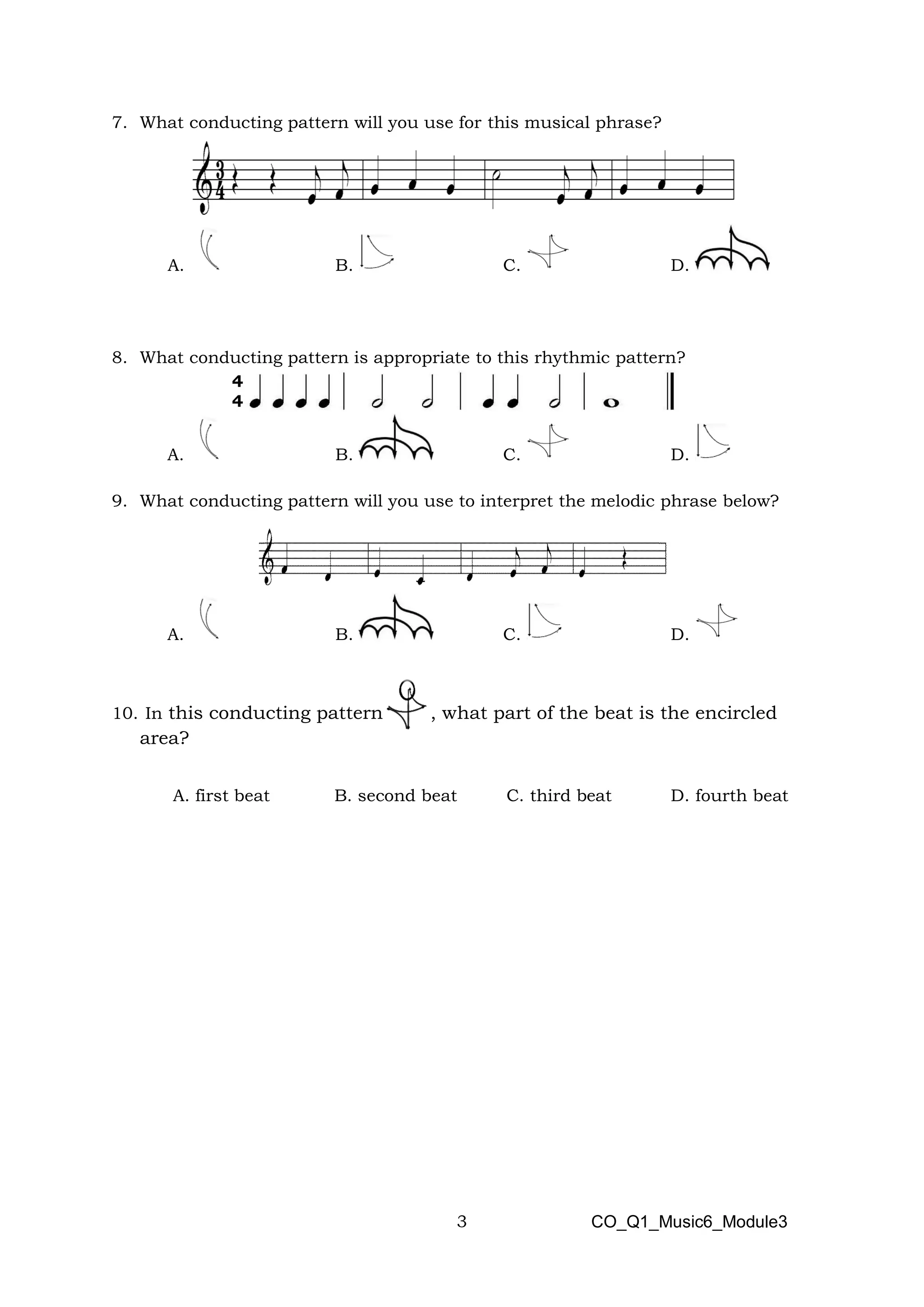
7. What conducting pattern will you use for this musical phrase?
A. B. C. D.
8. What conducting pattern is appropriate to this rhythmic pattern?
A. B. C. D.
9. What conducting pattern will you use to interpret the melodic phrase below?
A. B. C. D.
10. In this conducting pattern , what part of the beat is the encircled
area?
A. first beat B. second beat C. third beat D. fourth beat
4
2 3
4, 4,
4
4
2
4
4
4
3
4
6
8
Lesson
1
Rhythm: Conduct
and Time Signatures
There are patterns that are greatly helpful in every meter found in music
particularly in conducting.
Conducting gestures are used to guide and synchronize the performance of a
choir or musical group. Conducting patterns and gestures are based on the time
signature, tempo, and rhythm of a song.
What’s In
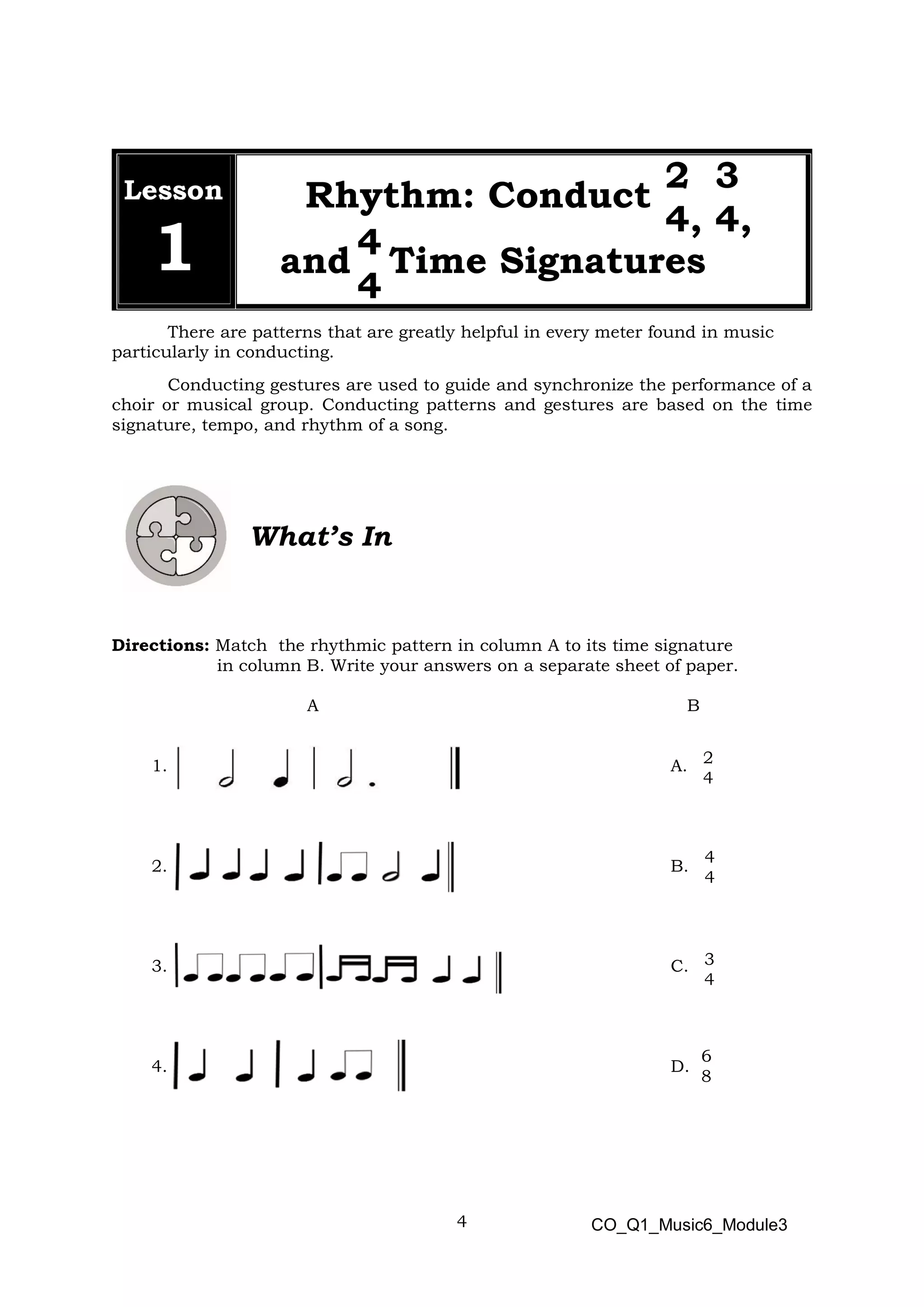
Directions: Match the rhythmic pattern in column A to its time signature
in column B. Write your answers on a separate sheet of paper.
A B
1. A.
2. B.
3. C.
4. D.
CO_Q1_Music6_Module3
5
Notes to the Teacher
This module is designed for independent or self-paced
study. It allows the learners to learn by considering their
convenience for time and or location according to his or her
individual needs and ability. Learners can study at his/her
preferred time and environment without undue interruption of
work. Please make sure learners who use this material can get
frequent feedback and are given the opportunity to reflect on
information and on their learning experiences.
What’s New
Conducting Patterns
Have you watched or attended a concert? Have you noticed the conductor
leading the choir, band or orchestra?
Conductors direct a choir, ensemble, band, and orchestra through arm
movements that suits the chosen music or repertoire of the group. These are called
conducting gestures or conducting patterns.
We see conductors in school choirs, church choirs, marching bands,
symphony band, ethnic ensemble and in a concert orchestra.
CO_Q1_Music6_Module3
6
2
4
4
4
3
4
2 3 4
4, 4, 4
2 3 4
4, 4, 4
2
4
3
4
4
4
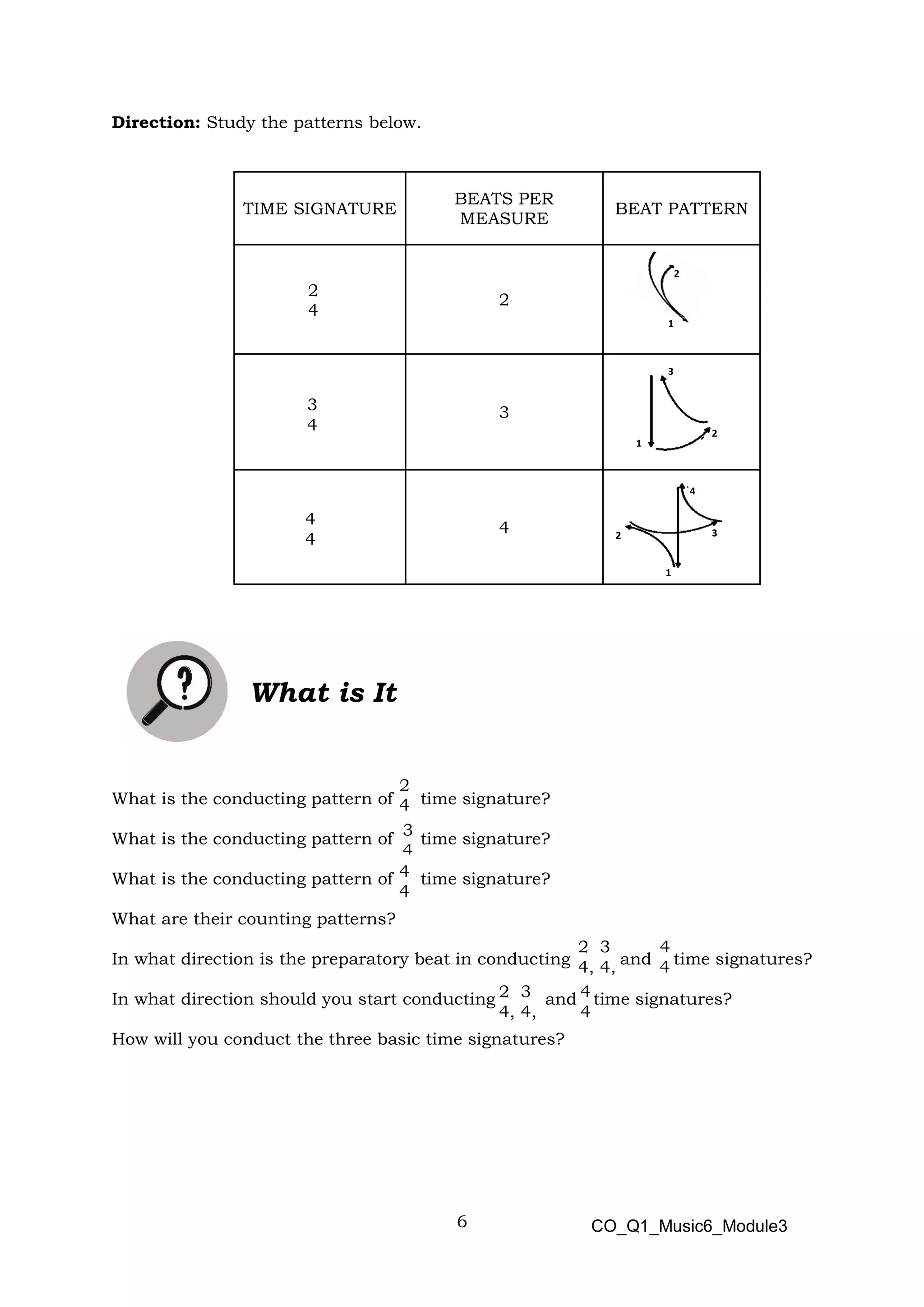
Direction: Study the patterns below.
What is It
What is the conducting pattern of time signature?
What are their counting patterns?
In what direction is the preparatory beat in conducting and time signatures?
In what direction should you start conducting and time signatures?
How will you conduct the three basic time signatures?
TIME SIGNATURE
BEATS PER
MEASURE
BEAT PATTERN
2
3
4
CO_Q1_Music6_Module3
4
1
2 3
1
2
3
1
2
7
2 3 4
4, 4, 4
3
4
2
4
4
4
What’s More
Counting Patterns
Common examples of simple time signatures are and .
In conducting a composition with complete measures the first beat is always
the down beat. Conductors give preparatory beat prior to the starting of a musical
piece. The counting pattern for time signature is 1, 2; for time signature is 1,
2, 3; for time signature is 1, 2, 3, 4.
A. Write the counting patterns for each time signature.
1.
2.
3.
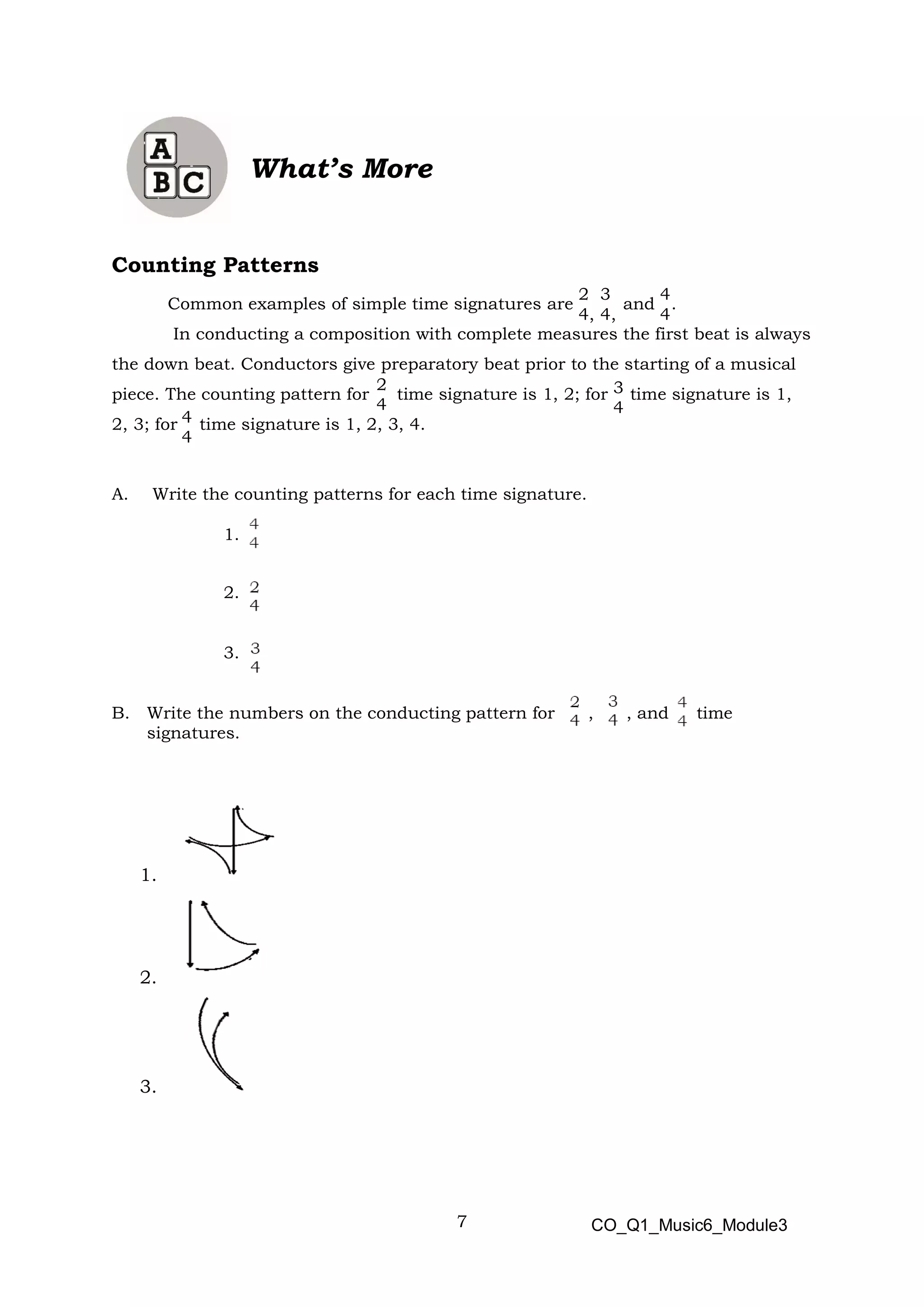
B. Write the numbers on the conducting pattern for , , and time
signatures.
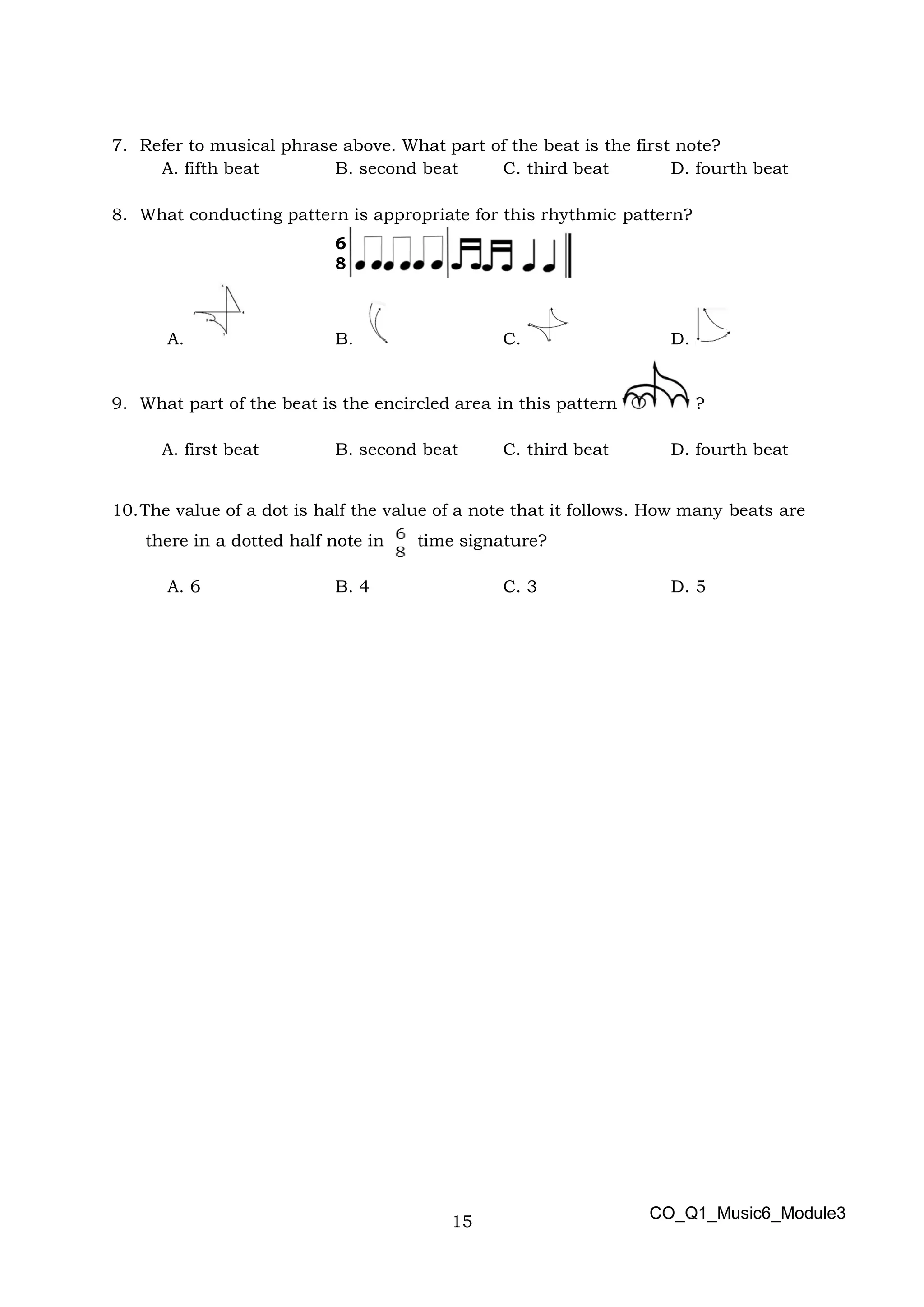
1.
2.
3.
CO_Q1_Music6_Module3
8
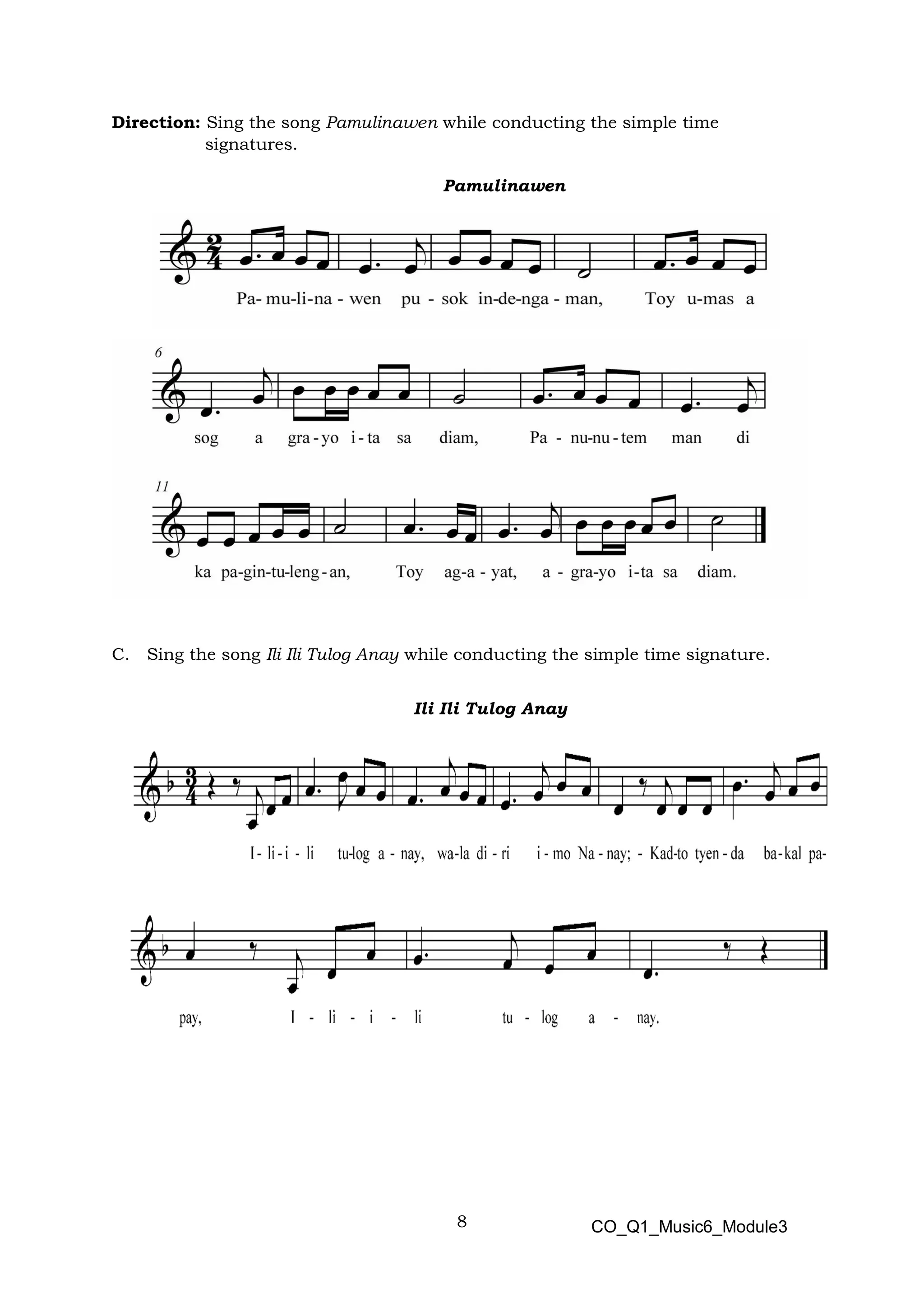
Direction: Sing the song Pamulinawen while conducting the simple time
signatures.
Pamulinawen
C. Sing the song Ili Ili Tulog Anay while conducting the simple time signature.
Ili Ili Tulog Anay
CO_Q1_Music6_Module3
9
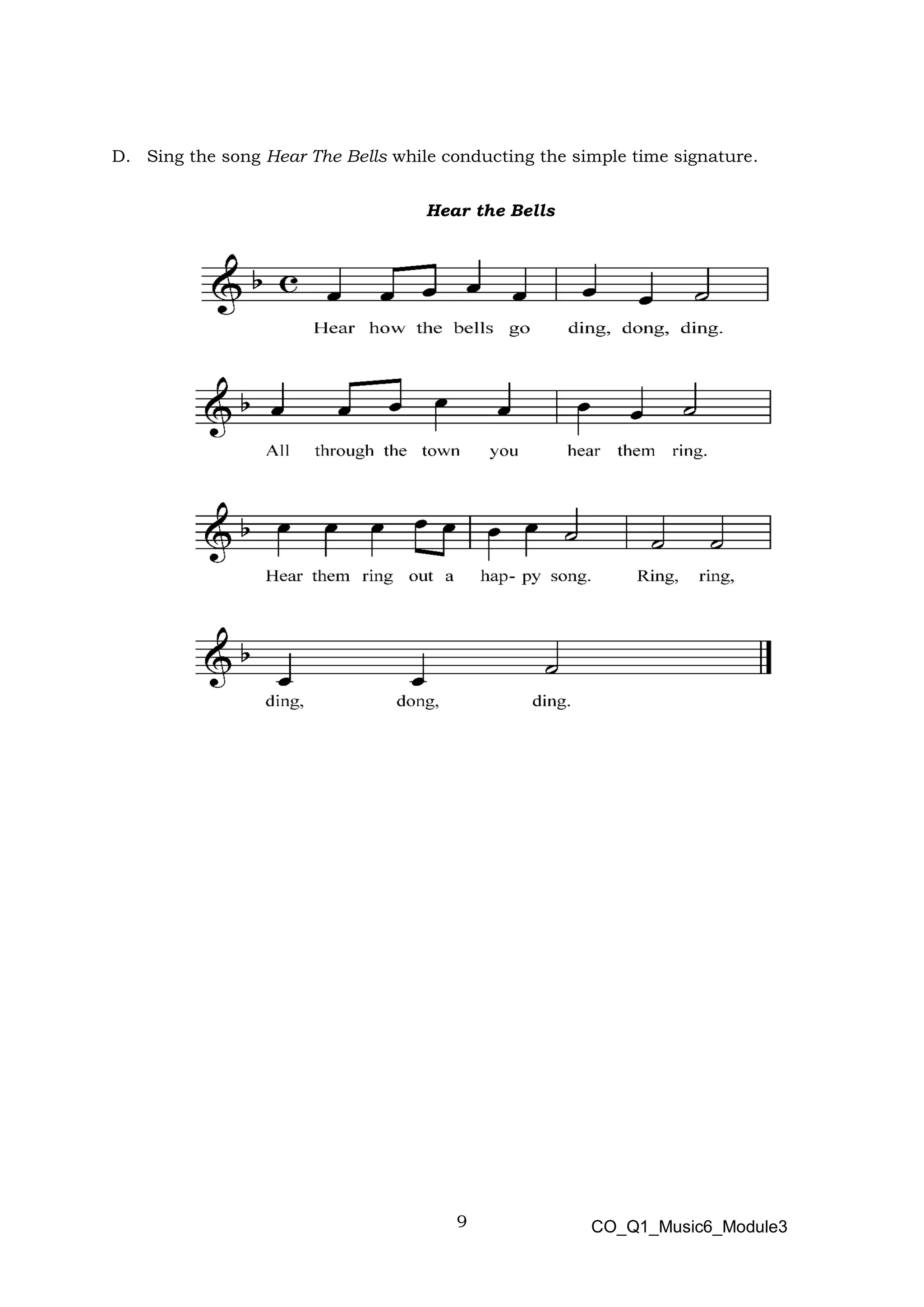
D. Sing the song Hear The Bells while conducting the simple time signature.
Hear the Bells
CO_Q1_Music6_Module3
10
2
4
3
4
4
4
What I Have Learned
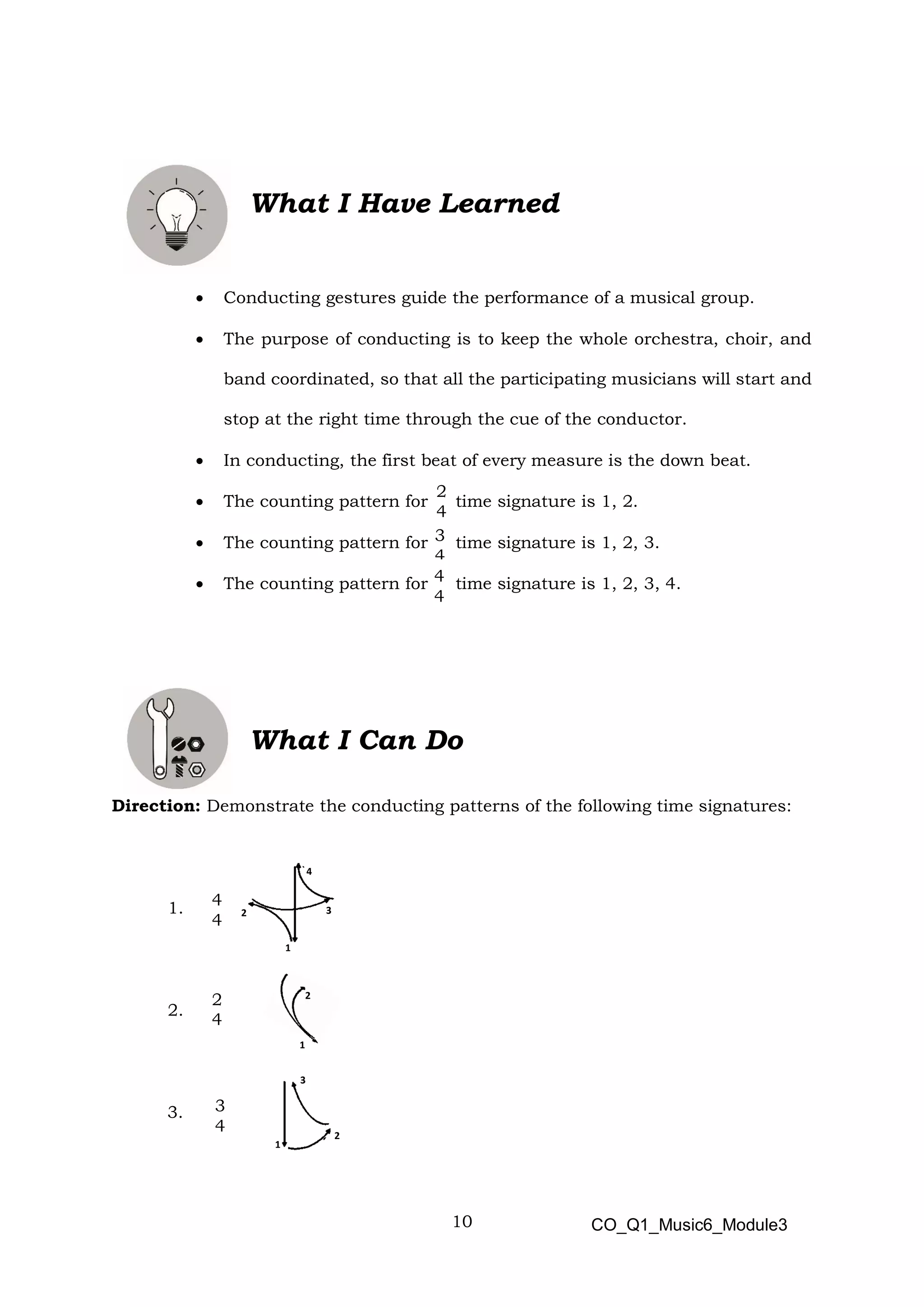
• Conducting gestures guide the performance of a musical group.
• The purpose of conducting is to keep the whole orchestra, choir, and
band coordinated, so that all the participating musicians will start and
stop at the right time through the cue of the conductor.
• In conducting, the first beat of every measure is the down beat.
• The counting pattern for time signature is 1, 2.
• The counting pattern for time signature is 1, 2, 3.
• The counting pattern for time signature is 1, 2, 3, 4.
What I Can Do
Direction: Demonstrate the conducting patterns of the following time signatures:
1.
2.
3.
2
4
CO_Q1_Music6_Module3
4
1
2 3
1
2
3
1
2
4
4
3
4
11
3
4
4
4
2
4
6
8
4
4
Assessment
Directions: Read and understand each item carefully. Write the letter of the
correct answer on a separate sheet of paper.
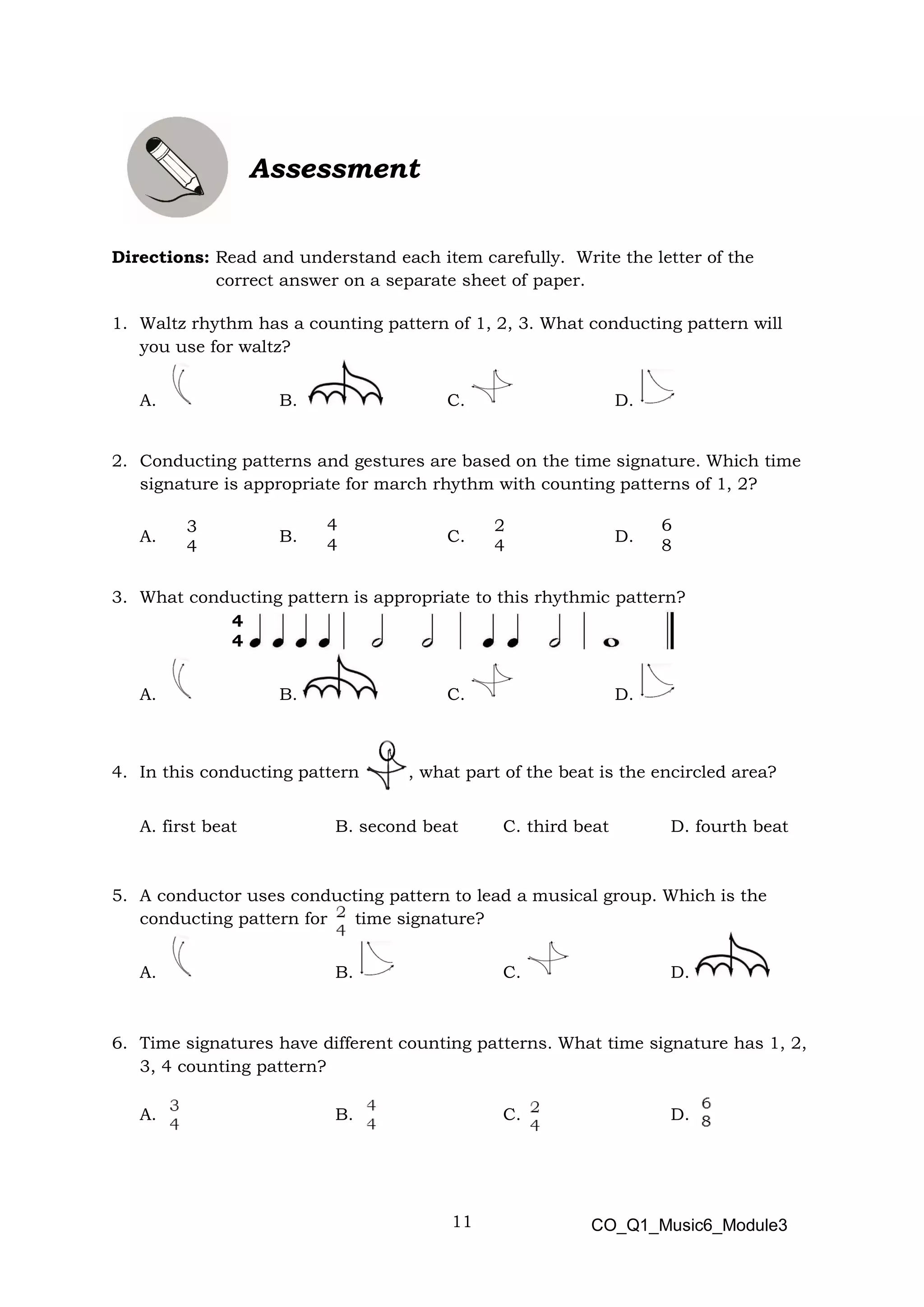
1. Waltz rhythm has a counting pattern of 1, 2, 3. What conducting pattern will
you use for waltz?
A. B. C. D.
2. Conducting patterns and gestures are based on the time signature. Which time
signature is appropriate for march rhythm with counting patterns of 1, 2?
A. B. C. D.
3. What conducting pattern is appropriate to this rhythmic pattern?
A. B. C. D.
4. In this conducting pattern , what part of the beat is the encircled area?
A. first beat B. second beat C. third beat D. fourth beat
5. A conductor uses conducting pattern to lead a musical group. Which is the
conducting pattern for time signature?
A. B. C. D.
6. Time signatures have different counting patterns. What time signature has 1, 2,
3, 4 counting pattern?
A. B. C. D.
CO_Q1_Music6_Module3
12
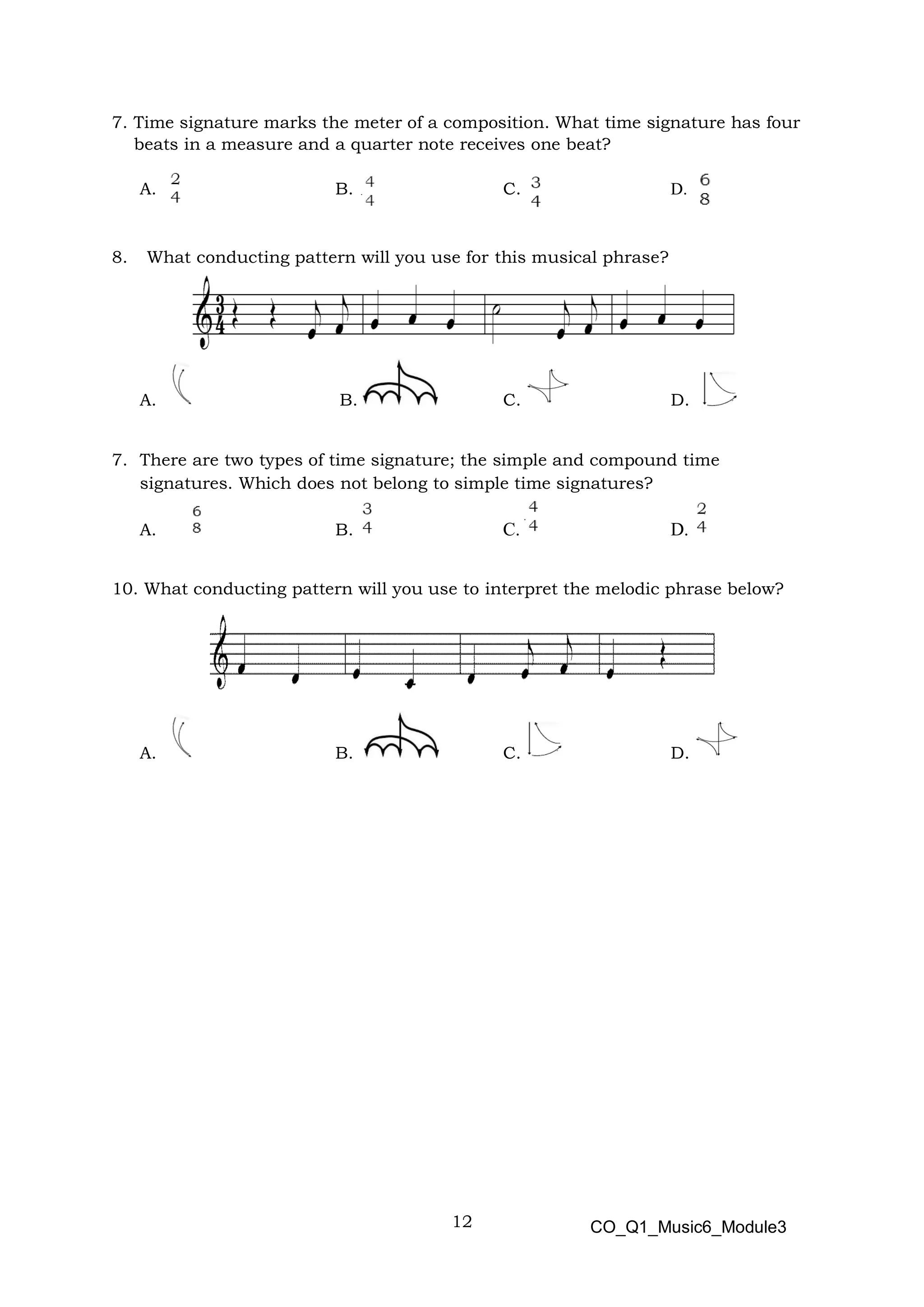
7. Time signature marks the meter of a composition. What time signature has four
beats in a measure and a quarter note receives one beat?
A. B. C. D.
8. What conducting pattern will you use for this musical phrase?
A. B. C. D.
7. There are two types of time signature; the simple and compound time
signatures. Which does not belong to simple time signatures?
A. B. C. D.
10. What conducting pattern will you use to interpret the melodic phrase below?
A. B. C. D.
CO_Q1_Music6_Module3
13
Additional Activities
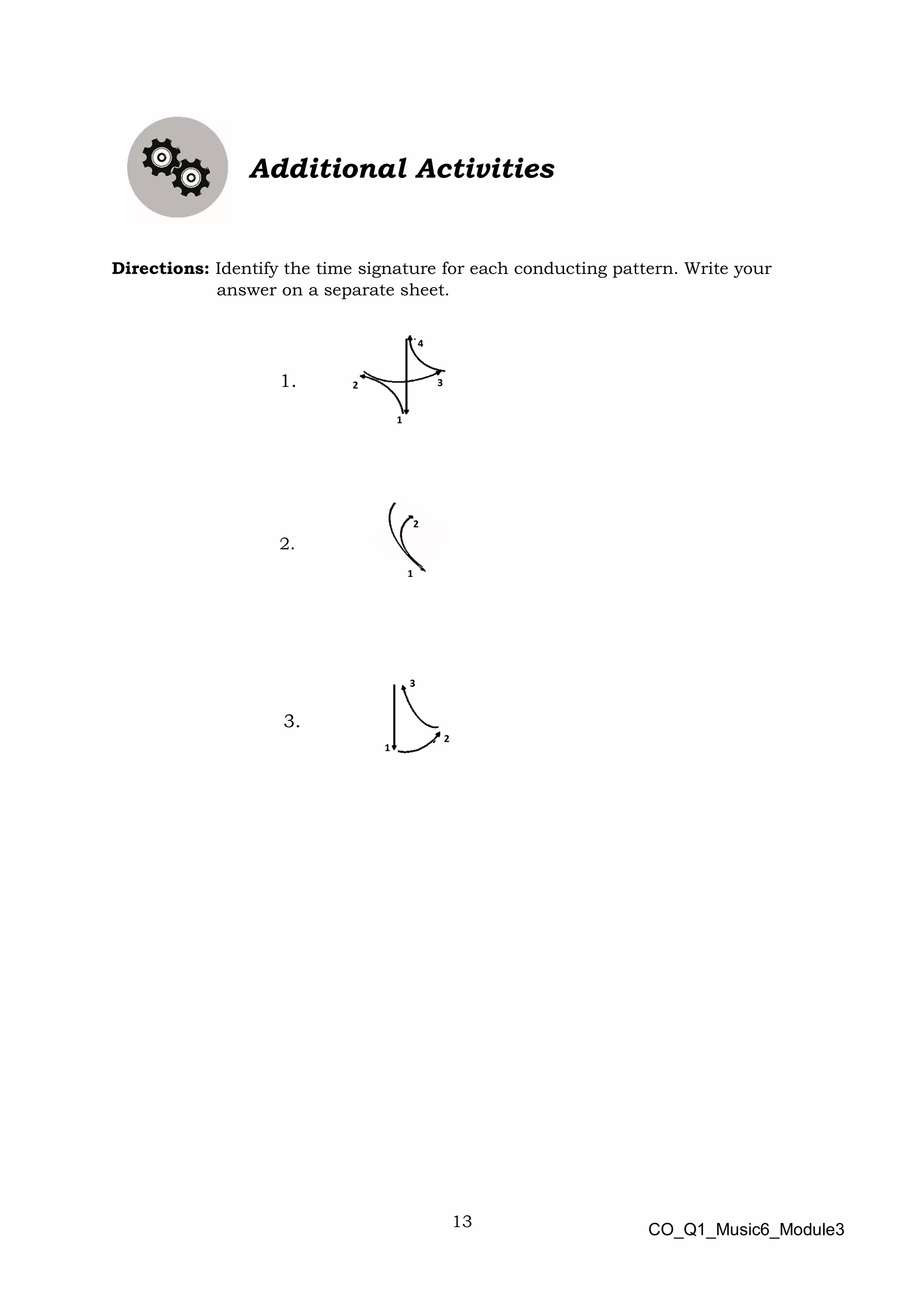
Directions: Identify the time signature for each conducting pattern. Write your
answer on a separate sheet.
1.
2.
3.
CO_Q1_Music6_Module3
4
1
2 3
1
2
3
1
2
14
What I Know
Directions: Read and understand each item carefully. Write the letter of the
correct answer on a separate sheet of paper.
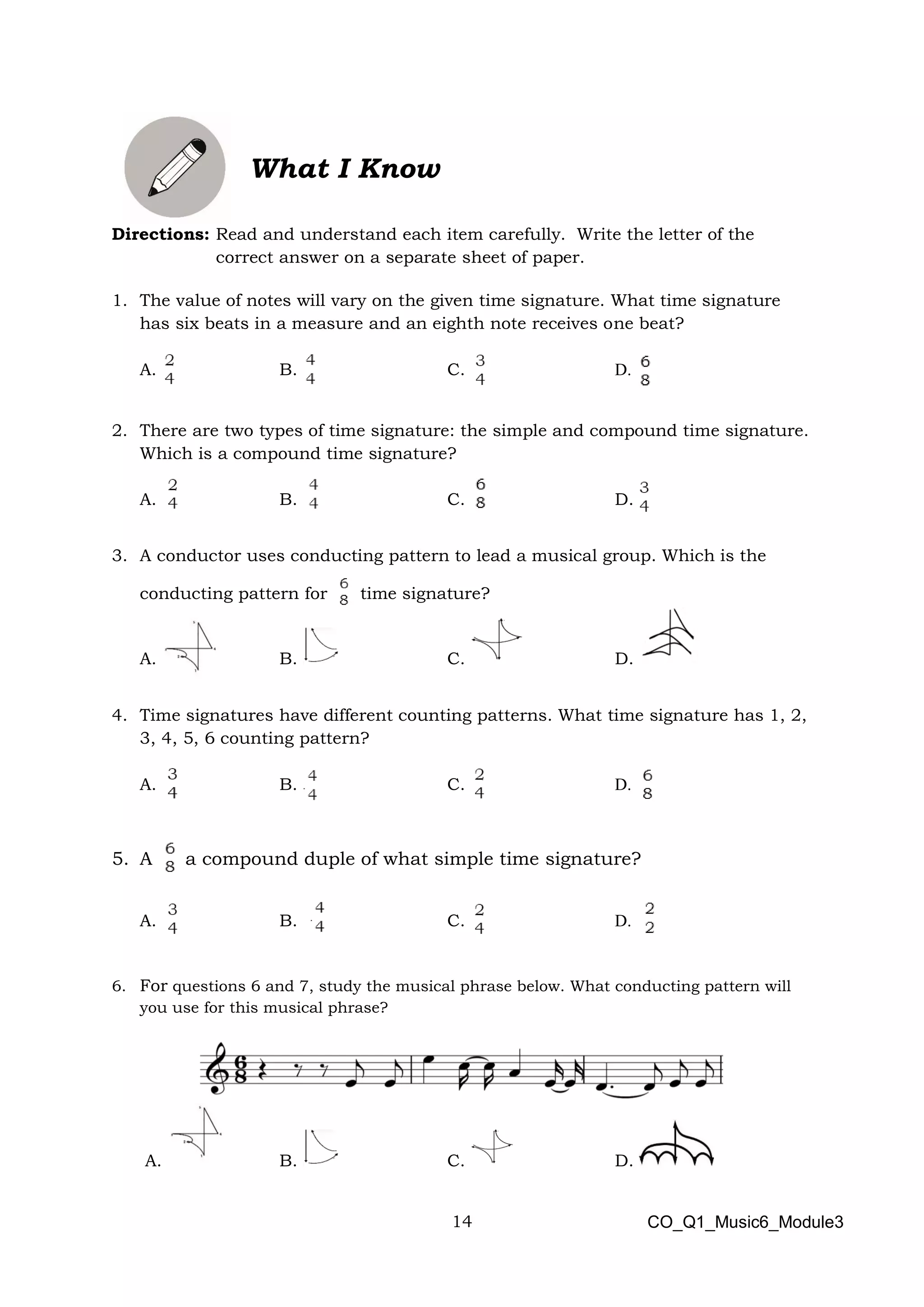
1. The value of notes will vary on the given time signature. What time signature
has six beats in a measure and an eighth note receives one beat?
A. B. C. D.
2. There are two types of time signature: the simple and compound time signature.
Which is a compound time signature?
A. B. C. D.
3. A conductor uses conducting pattern to lead a musical group. Which is the
conducting pattern for time signature?
A. B. C. D.
4. Time signatures have different counting patterns. What time signature has 1, 2,
3, 4, 5, 6 counting pattern?
A. B. C. D.
5. A is a compound duple of what simple time signature?
A. B. C. D.
6. For questions 6 and 7, study the musical phrase below. What conducting pattern will
you use for this musical phrase?
A. B. C. D.
CO_Q1_Music6_Module3
15
6
8
7. Refer to musical phrase above. What part of the beat is the first note?
A. fifth beat B. second beat C. third beat D. fourth beat
8. What conducting pattern is appropriate for this rhythmic pattern?
A. B. C. D.
9. What part of the beat is the encircled area in this pattern ?
A. first beat B. second beat C. third beat D. fourth beat
10.The value of a dot is half the value of a note that it follows. How many beats are
there in a dotted half note in time signature?
A. 6 B. 4 C. 3 D. 5
CO_Q1_Music6_Module3
16
Notes to the Teacher
This module is designed for independent or self-paced
study. It allows the learners to learn by considering their
convenience for time and or location according to his or her
individual needs and ability. Learners can study at his/her
preferred time and environment without undue interruption of
work. Please make sure learners who use this material can get
frequent feedback and are given the opportunity to reflect on
information and on their learning experiences.
6
8
6
8
4
4
2
4
3
4
Lesson
2
Rhythm: Conduct
Time Signature
Time signature in music has a unique conducting pattern. It indicates the
number of beats inherent to each measure. The time signature is a compound
meter. It has different conducting patterns.
You have learned in the last lesson that conducting pattern is greatly helpful
to the conductor to synchronize with his musical group.
What’s In
Direction: Demonstrate the conducting patterns of the following time signatures:
CO_Q1_Music6_Module3
4
1
2 3
1
2
3
1
2
17
6
8
6
8
6
8
6
8
6
8
6
8
What’s New
Conducting Patterns for Time Signature
Have you experienced listening to music and finding yourself clapping,
stomping and conducting?
A conductor is the leader of a group of musicians who helps them produce
good music together. He directs them by waving his hands or making use of a stick
called a baton. He communicates with them by making gestures when he wants
them to sing or play instruments in soft, loud, slow or fast manner.
You have already learned to conduct the three simple time signatures. Today,
you will learn to conduct the time signature in three different conducting patterns.
What is It
What kind of time signature is ?
What is the counting pattern for time signature?
Which pattern do you find easy to conduct?
How many beats are there in time signature?
How will you conduct time signature?
CO_Q1_Music6_Module3
18
6
8
6
8
2
4
6
8
6
8
6
8
What’s More
Conducting Time Signature
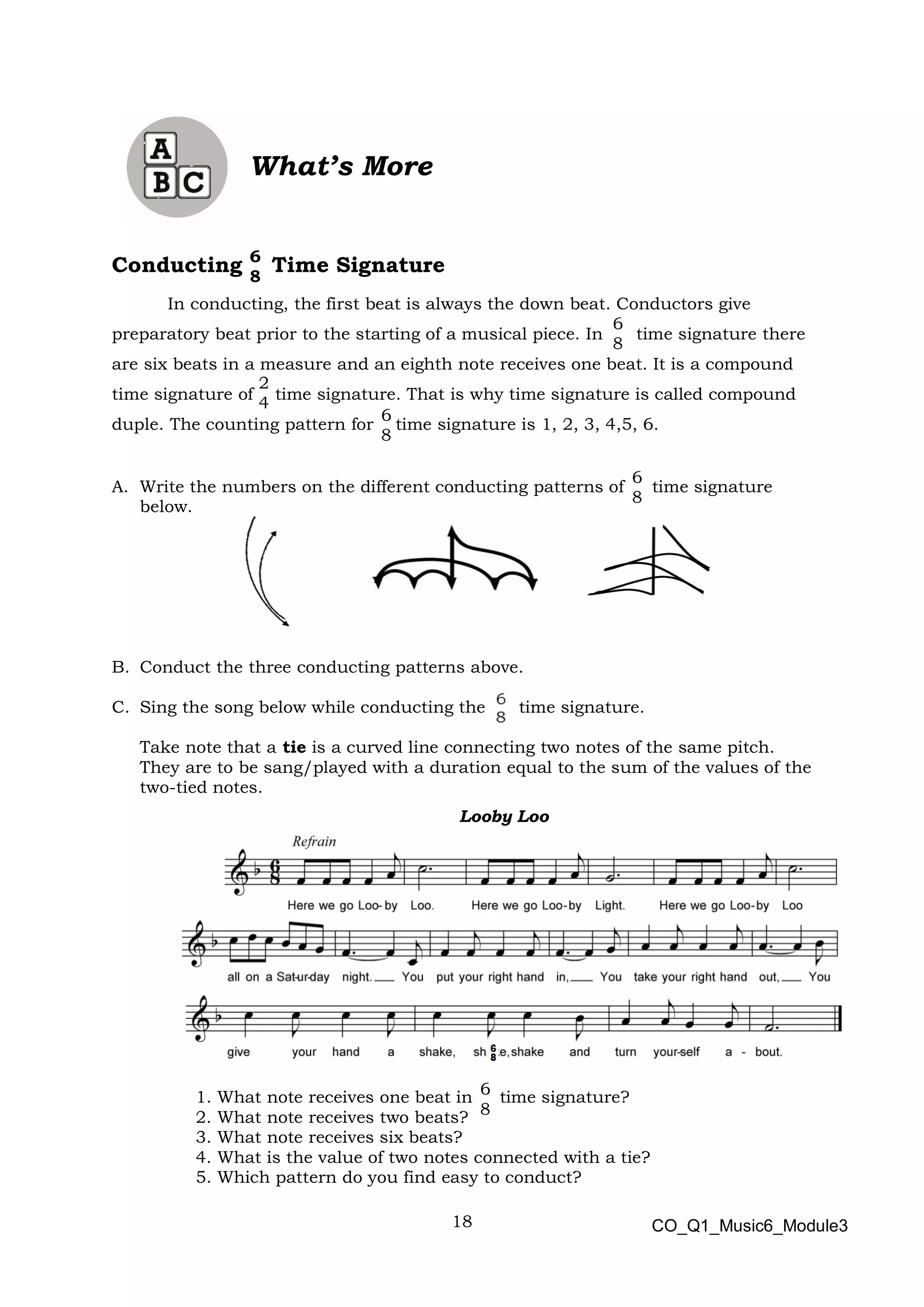
In conducting, the first beat is always the down beat. Conductors give
preparatory beat prior to the starting of a musical piece. In time signature there
are six beats in a measure and an eighth note receives one beat. It is a compound
time signature of time signature. That is why time signature is called compound
duple. The counting pattern for time signature is 1, 2, 3, 4,5, 6.
A. Write the numbers on the different conducting patterns of time signature
below.
B. Conduct the three conducting patterns above.
C. Sing the song below while conducting the time signature.
Take note that a tie is a curved line connecting two notes of the same pitch.
They are to be sang/played with a duration equal to the sum of the values of the
two-tied notes.
Looby Loo
1. What note receives one beat in time signature?
2. What note receives two beats?
3. What note receives six beats?
4. What is the value of two notes connected with a tie?
5. Which pattern do you find easy to conduct?
CO_Q1_Music6_Module3
19
6
8
6
8
6
8
What I Have Learned
• Conducting gestures guide the performance of a musical group.
• The conductor uses conducting patterns or gestures to synchronize
with his musical group.
• Conductors give preparatory beat prior to the starting of a musical
piece.
• In time signature, there are six beats in a measure and an eighth note
gets one beat.
• In conducting time signature, the first beat is the down beat.
• The counting pattern for time signature is 1, 2, 3, 4, 5, 6.
What I Can Do
Direction: Demonstrate the three conducting patterns in time signature.
CO_Q1_Music6_Module3
20
Assessment
Directions: Read and understand each item carefully. Write the letter of the
correct answer on a separate sheet of paper.
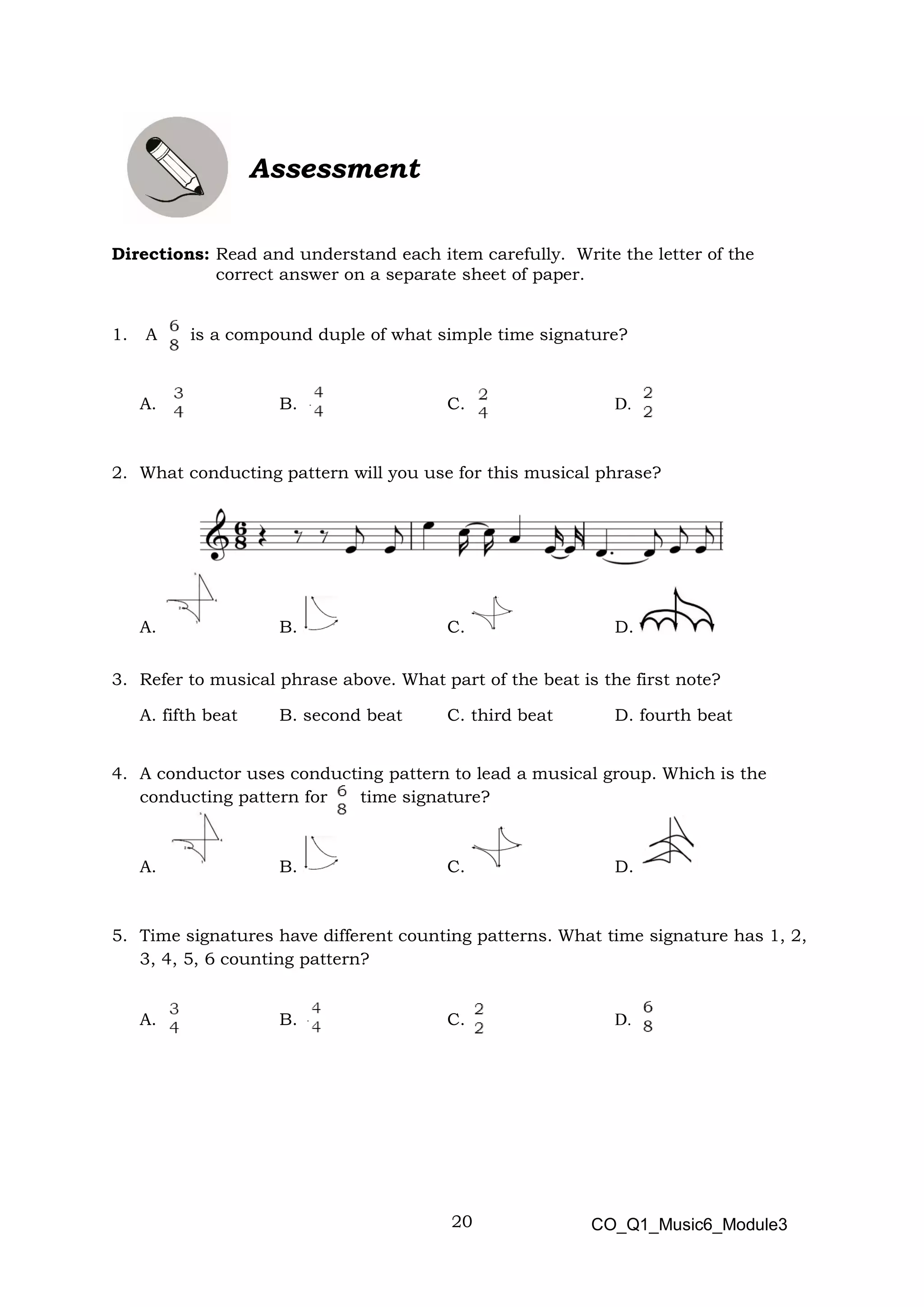
1. A is a compound duple of what simple time signature?
A. B. C. D.
2. What conducting pattern will you use for this musical phrase?
A. B. C. D.
3. Refer to musical phrase above. What part of the beat is the first note?
A. fifth beat B. second beat C. third beat D. fourth beat
4. A conductor uses conducting pattern to lead a musical group. Which is the
conducting pattern for time signature?
A. B. C. D.
5. Time signatures have different counting patterns. What time signature has 1, 2,
3, 4, 5, 6 counting pattern?
A. B. C. D.
CO_Q1_Music6_Module3
21
6
8
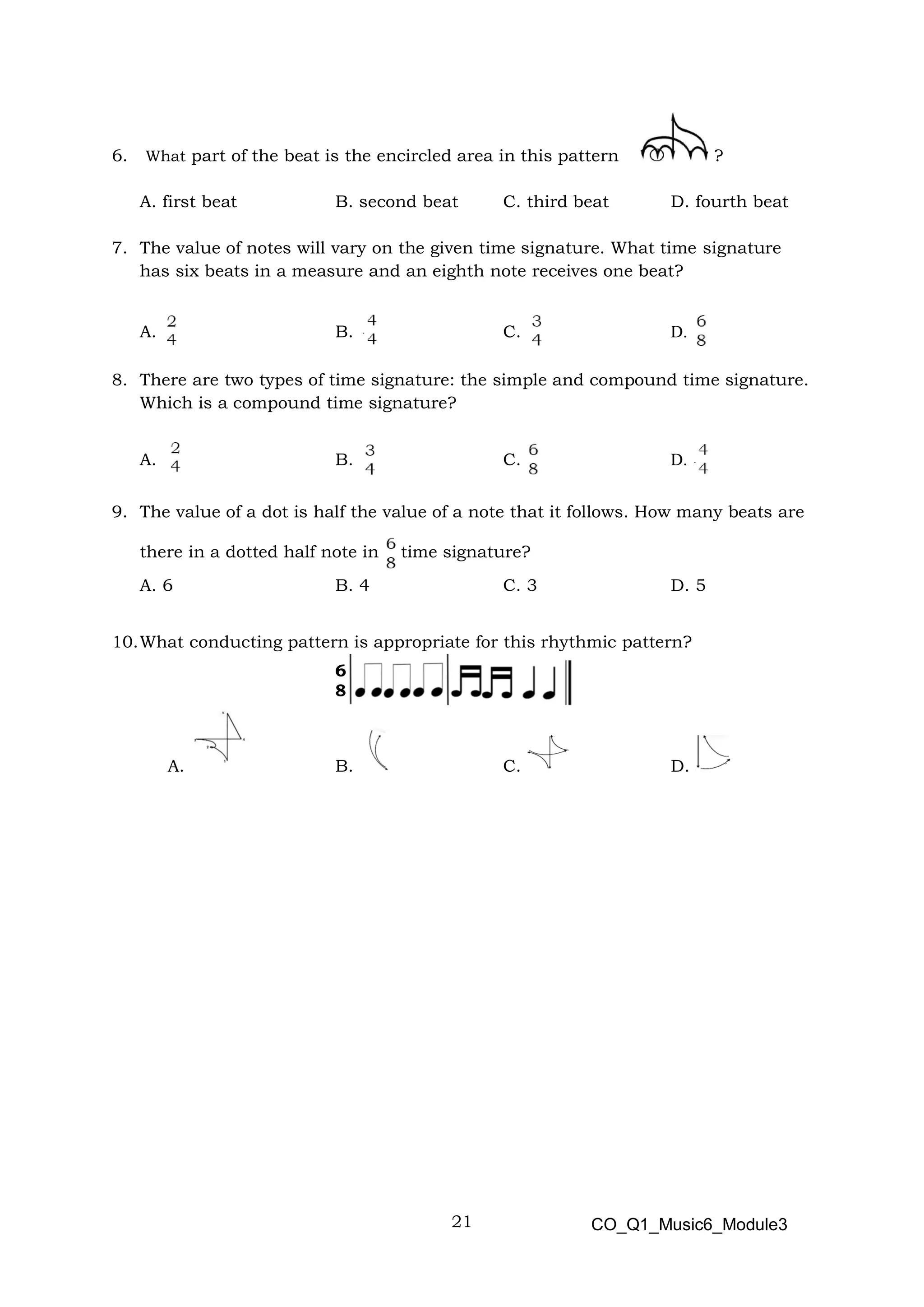
6. What part of the beat is the encircled area in this pattern ?
A. first beat B. second beat C. third beat D. fourth beat
7. The value of notes will vary on the given time signature. What time signature
has six beats in a measure and an eighth note receives one beat?
A. B. C. D.
8. There are two types of time signature: the simple and compound time signature.
Which is a compound time signature?
A. B. C. D.
9. The value of a dot is half the value of a note that it follows. How many beats are
there in a dotted half note in time signature?
A. 6 B. 4 C. 3 D. 5
10.What conducting pattern is appropriate for this rhythmic pattern?
A. B. C. D.
CO_Q1_Music6_Module3
22
Additional Activities
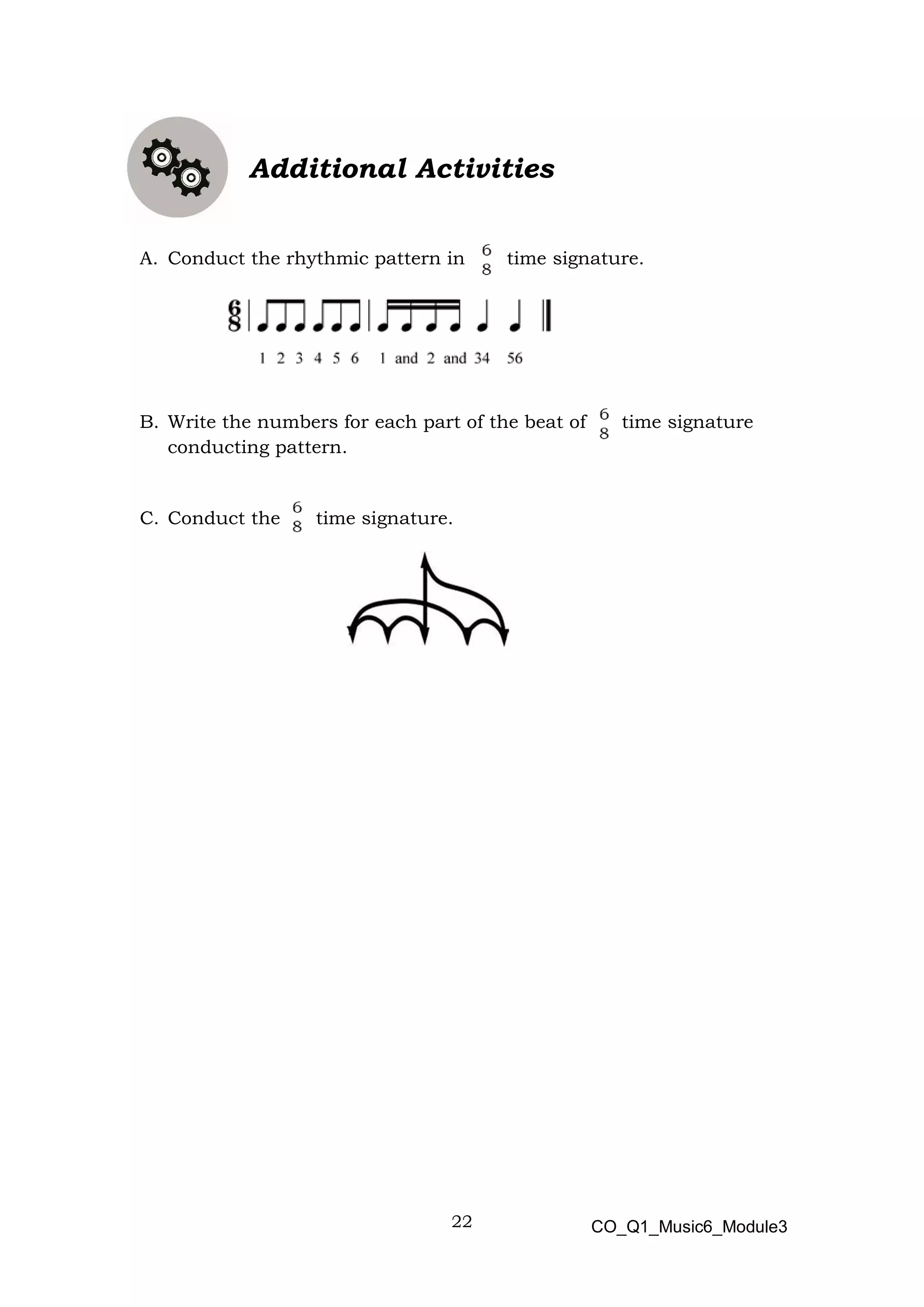
A. Conduct the rhythmic pattern in time signature.
B. Write the numbers for each part of the beat of time signature
conducting pattern.
C. Conduct the time signature.
CO_Q1_Music6_Module3
23
Answer Key
Lesson 1
What
I
Know
1.
B
2.
C
3.
A
4.
B
5.
D
6.
C
7.
B
8.
C
9.
A
10.
D
What’s
In
1.
C
2.
B
3.
D
4.
A
5.
C
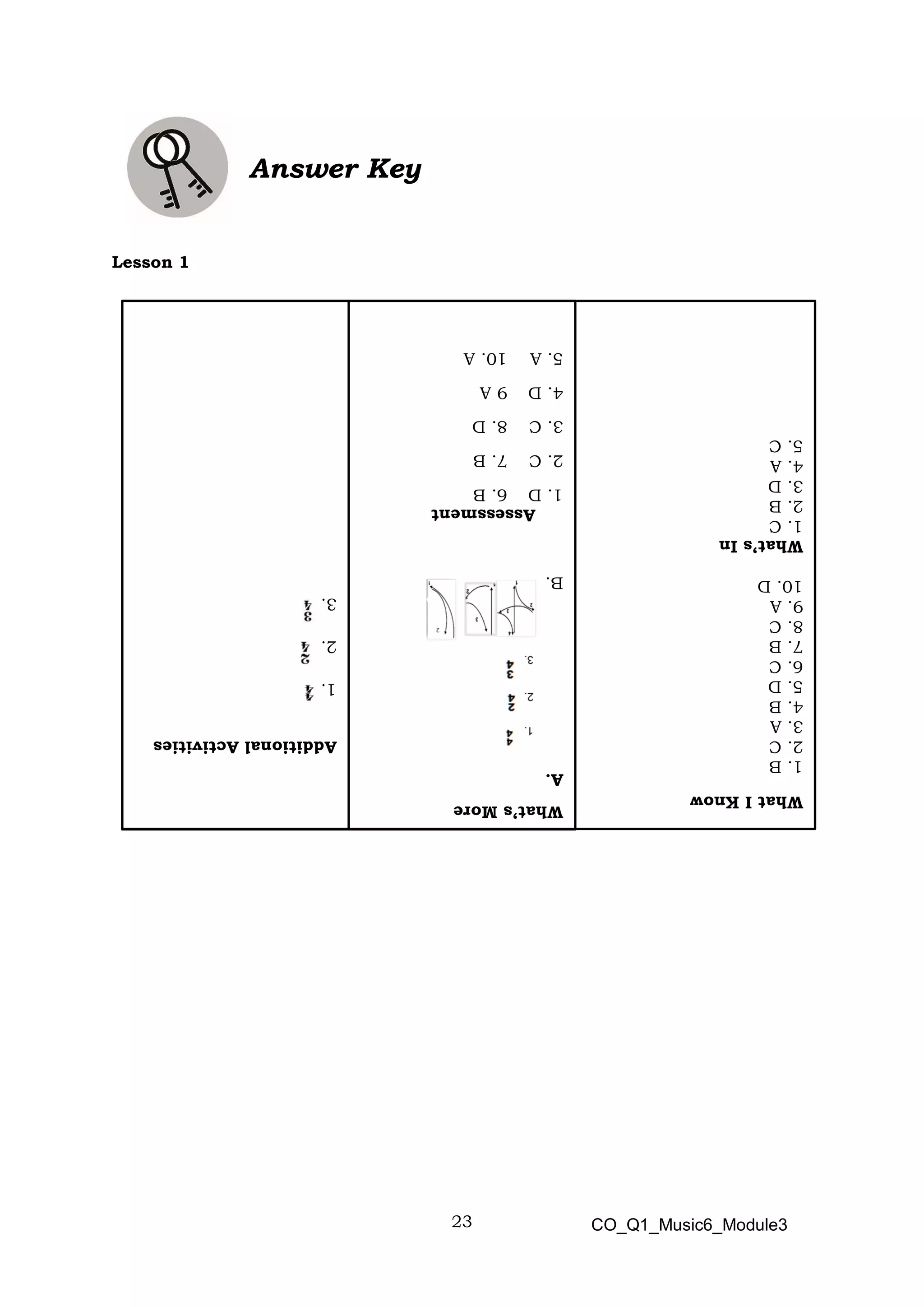
Additional
Activities
1.
2.
3.
What’s
More
A.
B.
Assessment
1.
D
6.
B
2.
C
7.
B
3.
C
8.
D
4.
D
9
A
5.
A
10.
A
CO_Q1_Music6_Module3
24
Lesson 2
References
Our World of MAPEH 6 pp. 16-21
What
I
Know
1.
D
2.
C
3.
D
4.
D
5.
C
6.
D
7.
A
8.
B
9.
B
10.
A
What’s
More
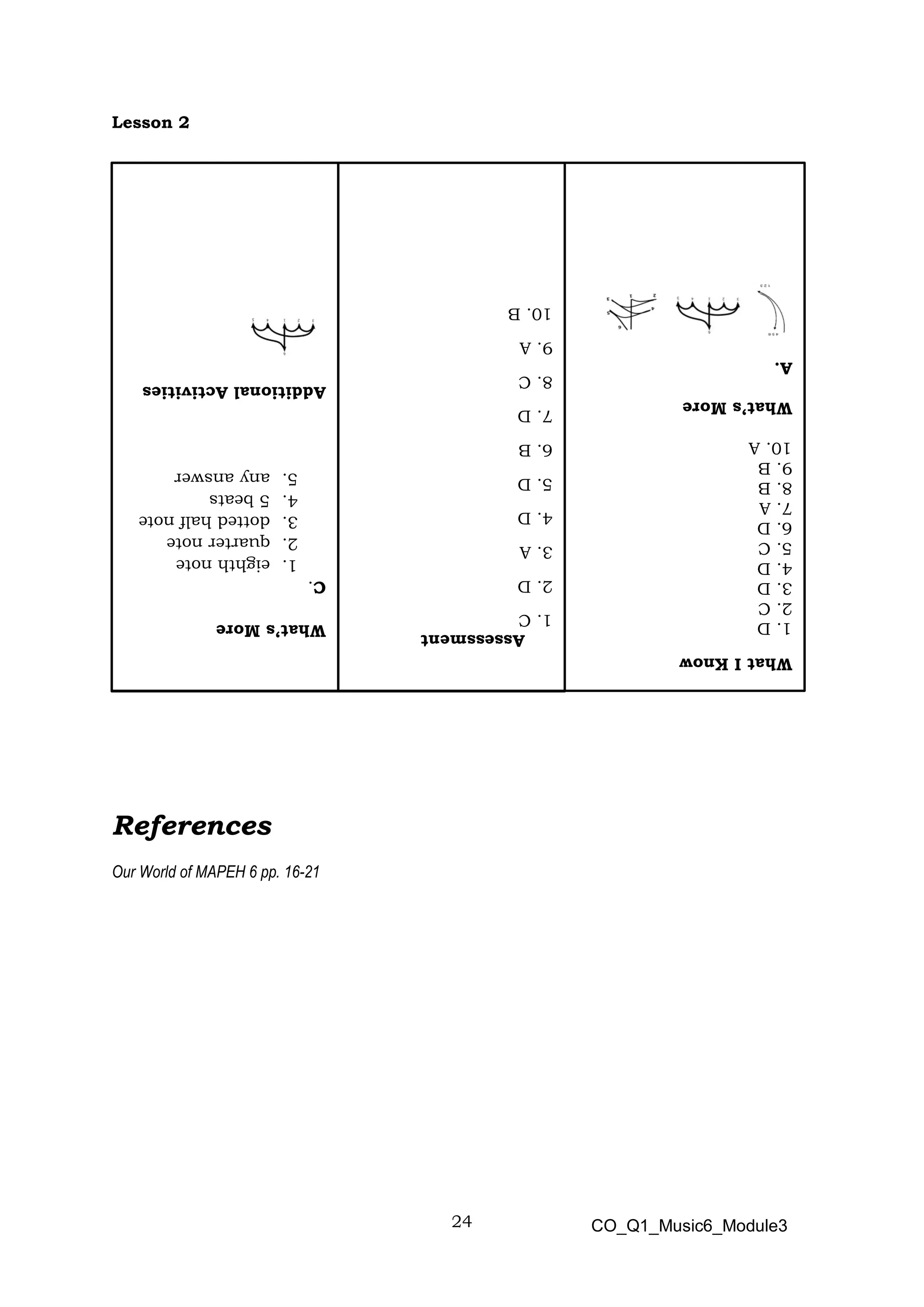
A.
What’s
More
C.
1.
eighth
note
2.
quarter
note
3.
dotted
half
note
4.
5
beats
5.
any
answer
Additional
Activities
Assessment
1.
C
2.
D
3.
A
4.
D
5.
D
6.
B
7.
D
8.
C
9.
A
10.
B
CO_Q1_Music6_Module3
25
For inquiries or feedback, please write or call:
Department of Education - Bureau of Learning Resources (DepEd-BLR)
Ground Floor, Bonifacio Bldg., DepEd Complex
Meralco Avenue, Pasig City, Philippines 1600
Telefax: (632) 8634-1072; 8634-1054; 8631-4985
Email Address: blr.lrqad@deped.gov.ph * blr.lrpd@deped.gov.ph

Music6 q1 mod3_rhythm-conduct-time-signatures_version3

  • 1.
    Music Quarter 1 –Module 3: Rhythm: Conduct Time Signatures 6 CO_Q1_Music6_Module3
  • 2.
    Music – Grade6 Alternative Delivery Mode Quarter 1 – Module 3: Rhythm: Conduct Time Signatures First Edition, 2020 Republic Act 8293, section 176 states that: No copyright shall subsist in any work of the Government of the Philippines. However, prior approval of the government agency or office wherein the work is created shall be necessary for exploitation of such work for profit. Such agency or office may, among other things, impose as a condition the payment of royalties. Borrowed materials (i.e., songs, stories, poems, pictures, photos, brand names, trademarks, etc.) included in this module are owned by their respective copyright holders. Every effort has been exerted to locate and seek permission to use these materials from their respective copyright owners. The publisher and authors do not represent nor claim ownership over them. Published by the Department of Education Secretary: Leonor Magtolis Briones Undersecretary: Diosdado M. San Antonio Printed in the Philippines by ________________________ Department of Education – Region VI (Western Visayas) Office Address: Duran Street, Iloilo City Telefax: (033) 336-2816, (033) 509-7653 E-mail Address: region6@deped.gov.ph Development Team of the Module Authors: Gloria E. Tiwana, Jeanie F. Balista Editors: Mary Grace V. Cinco, Ma. Fe L. Brillantes, Lilibeth E. Larupay Reviewers: Ma. Fe L. Brillantes, Lilibeth E. Larupay, Percy M. Borro Illustrators: Francis Julius P. Fama, Cyrell T. Navarro, Armand Glenn S. Lapor Layout Artists: Lilibeth E. Larupay, Armand Glenn S. Lapor Management Team: Ramir B. Uytico, Pedro T. Escobarte, Jr. Roel F. Bermejo, Nordy D. Siason Lilibeth T. Estoque, Azucena T. Falales Elena P. Gonzaga, Donald T. Genine Athea V. Landar, Celestino S. Dalumpines IV Ruben S. Libutaque, Lilibeth E. Larupay Percy M. Borro, Ma. Fe L. Brillantes, Juan Adlai C. Caigoy
  • 3.
    6 Music Quarter 1 –Module 3: Rhythm: Conduct Time Signatures
  • 4.
    Introductory Message This Self-LearningModule (SLM) is prepared so that you, our dear learners, can continue your studies and learn while at home. Activities, questions, directions, exercises, and discussions are carefully stated for you to understand each lesson. Each SLM is composed of different parts. Each part shall guide you step-by-step as you discover and understand the lesson prepared for you. Pre-tests are provided to measure your prior knowledge on lessons in each SLM. This will tell you if you need to proceed on completing this module or if you need to ask your facilitator or your teacher's assistance for better understanding of the lesson. At the end of each module, you need to answer the post-test to self-check your learning. Answer keys are provided for each activity and test. We trust that you will be honest in using these. In addition to the material in the main text, Notes to the Teacher are also provided to our facilitators and parents for strategies and reminders on how they can best help you on your home-based learning. Please use this module with care. Do not put unnecessary marks on any part of this SLM. Use a separate sheet of paper in answering the exercises and tests. And read the instructions carefully before performing each tack. If you have any questions in using this SLM or any difficulty in answering the tasks in this module, do not hesitate to consult your teacher or facilitator. Thank you.
  • 5.
    1 What I Needto Know This module was designed and written with you in mind. It is here to help you master on how to conduct time signatures. The scope of this module permits it to be used in many different learning situations. The language used recognizes the diverse vocabulary level of students. The lessons are arranged to follow the standard sequence of the course. But the order in which you read them can be changed to correspond with the module you are now using. The module is divided into two lessons, namely: • Lesson 1 – Conduct , , and Time Signatures • Lesson 2 – Conduct Time Signature After going through this module, you are expected to: 1. demonstrate the conducting gestures of , , and time signatures; and 2. demonstrate the conducting gestures of time signature CO_Q1_Music6_Module3
  • 6.
    2 What I Know Directions:Read and understand each item carefully. Write the letter of the correct answer on a separate sheet of paper. 1. Time signature marks the meter of a composition. What time signature has four beats in a measure and a quarter note receives one beat? A. B. C. D. 2. There are two types of time signature; the simple and compound time signatures. Which does not belong to simple time signatures A. B. C. D. 3. A conductor uses conducting pattern to lead a musical group. Which is the conducting pattern for time signature? A. B. C. D. 4. Time signatures have different counting patterns. What time signature has 1, 2, 3, 4 counting pattern? A. B. C. D. 5. Waltz rhythm has a counting pattern of 1, 2, 3. What conducting pattern will you use for waltz? A. B. C. D. 6. Conducting patterns and gestures are based on the time signature. Which time signature is appropriate for march rhythm with counting patterns of 1, 2? A. B. C. D. CO_Q1_Music6_Module3
  • 7.
    3 4 4 CO_Q1_Music6_Module3 7. What conductingpattern will you use for this musical phrase? A. B. C. D. 8. What conducting pattern is appropriate to this rhythmic pattern? A. B. C. D. 9. What conducting pattern will you use to interpret the melodic phrase below? A. B. C. D. 10. In this conducting pattern , what part of the beat is the encircled area? A. first beat B. second beat C. third beat D. fourth beat
  • 8.
    4 2 3 4, 4, 4 4 2 4 4 4 3 4 6 8 Lesson 1 Rhythm:Conduct and Time Signatures There are patterns that are greatly helpful in every meter found in music particularly in conducting. Conducting gestures are used to guide and synchronize the performance of a choir or musical group. Conducting patterns and gestures are based on the time signature, tempo, and rhythm of a song. What’s In Directions: Match the rhythmic pattern in column A to its time signature in column B. Write your answers on a separate sheet of paper. A B 1. A. 2. B. 3. C. 4. D. CO_Q1_Music6_Module3
  • 9.
    5 Notes to theTeacher This module is designed for independent or self-paced study. It allows the learners to learn by considering their convenience for time and or location according to his or her individual needs and ability. Learners can study at his/her preferred time and environment without undue interruption of work. Please make sure learners who use this material can get frequent feedback and are given the opportunity to reflect on information and on their learning experiences. What’s New Conducting Patterns Have you watched or attended a concert? Have you noticed the conductor leading the choir, band or orchestra? Conductors direct a choir, ensemble, band, and orchestra through arm movements that suits the chosen music or repertoire of the group. These are called conducting gestures or conducting patterns. We see conductors in school choirs, church choirs, marching bands, symphony band, ethnic ensemble and in a concert orchestra. CO_Q1_Music6_Module3
  • 10.
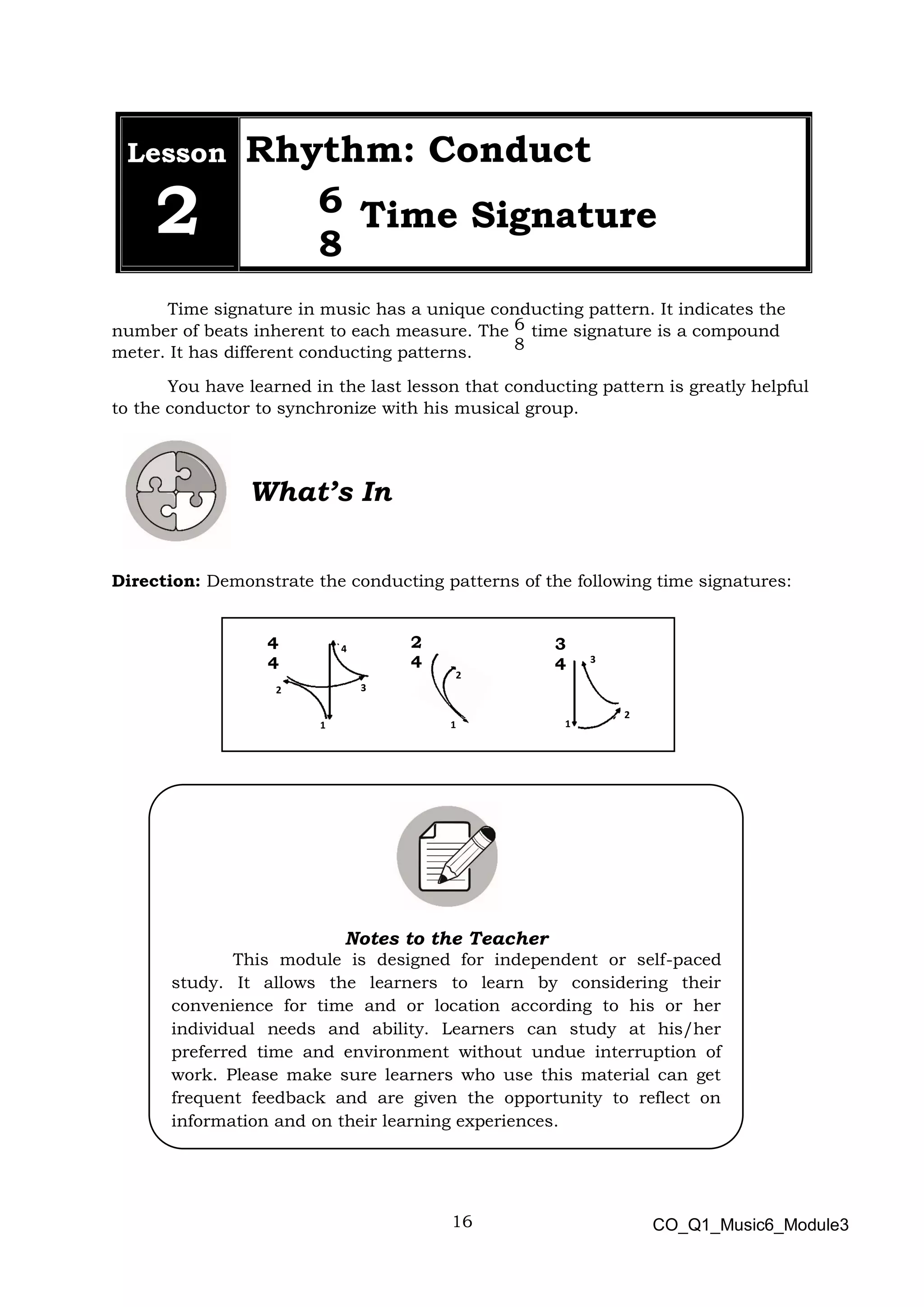
    6 2 4 4 4 3 4 2 3 4 4,4, 4 2 3 4 4, 4, 4 2 4 3 4 4 4 Direction: Study the patterns below. What is It What is the conducting pattern of time signature? What is the conducting pattern of time signature? What is the conducting pattern of time signature? What are their counting patterns? In what direction is the preparatory beat in conducting and time signatures? In what direction should you start conducting and time signatures? How will you conduct the three basic time signatures? TIME SIGNATURE BEATS PER MEASURE BEAT PATTERN 2 3 4 CO_Q1_Music6_Module3 4 1 2 3 1 2 3 1 2
  • 11.
    7 2 3 4 4,4, 4 3 4 2 4 4 4 What’s More Counting Patterns Common examples of simple time signatures are and . In conducting a composition with complete measures the first beat is always the down beat. Conductors give preparatory beat prior to the starting of a musical piece. The counting pattern for time signature is 1, 2; for time signature is 1, 2, 3; for time signature is 1, 2, 3, 4. A. Write the counting patterns for each time signature. 1. 2. 3. B. Write the numbers on the conducting pattern for , , and time signatures. 1. 2. 3. CO_Q1_Music6_Module3
  • 12.
    8 Direction: Sing thesong Pamulinawen while conducting the simple time signatures. Pamulinawen C. Sing the song Ili Ili Tulog Anay while conducting the simple time signature. Ili Ili Tulog Anay CO_Q1_Music6_Module3
  • 13.
    9 D. Sing thesong Hear The Bells while conducting the simple time signature. Hear the Bells CO_Q1_Music6_Module3
  • 14.
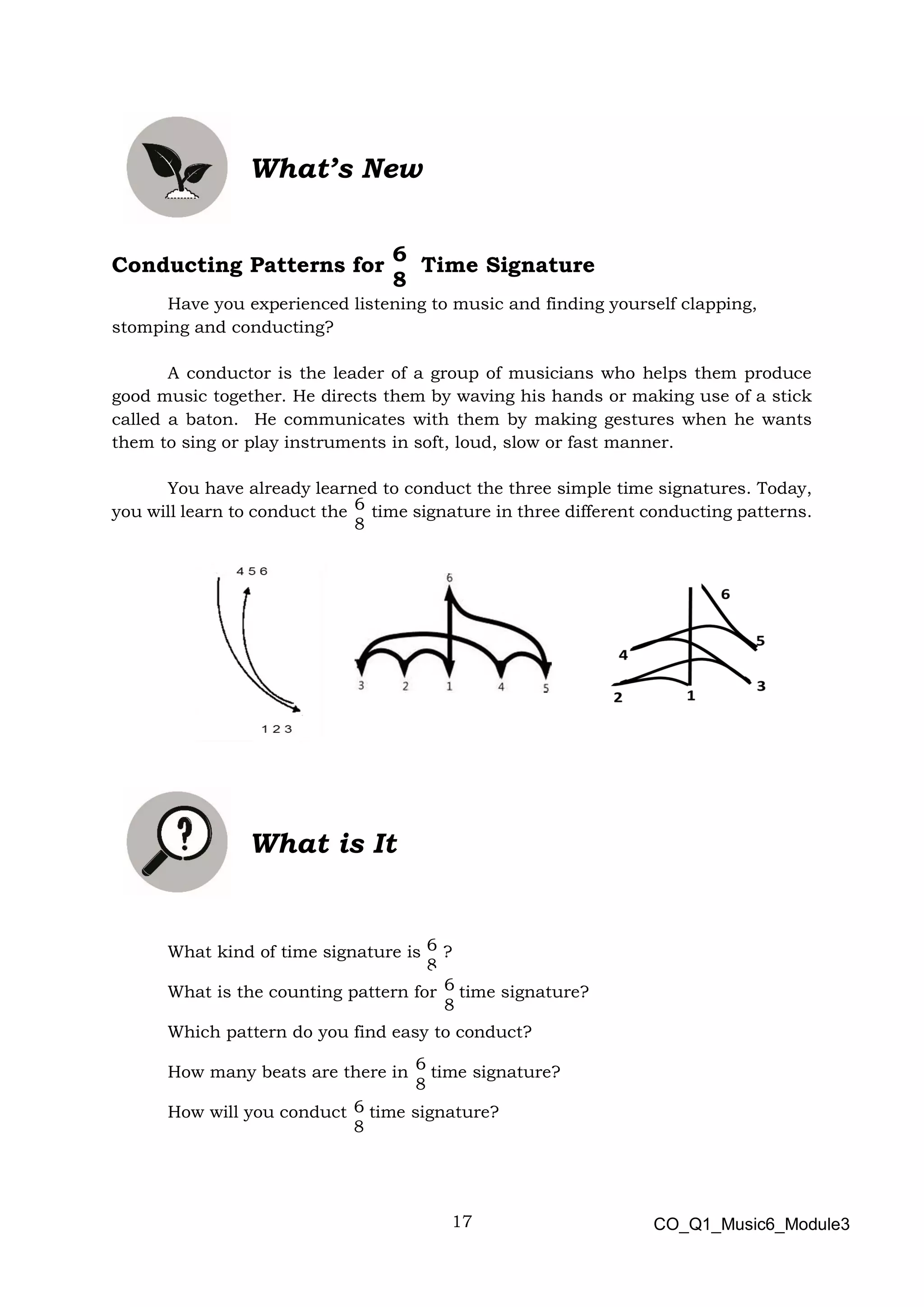
    10 2 4 3 4 4 4 What I HaveLearned • Conducting gestures guide the performance of a musical group. • The purpose of conducting is to keep the whole orchestra, choir, and band coordinated, so that all the participating musicians will start and stop at the right time through the cue of the conductor. • In conducting, the first beat of every measure is the down beat. • The counting pattern for time signature is 1, 2. • The counting pattern for time signature is 1, 2, 3. • The counting pattern for time signature is 1, 2, 3, 4. What I Can Do Direction: Demonstrate the conducting patterns of the following time signatures: 1. 2. 3. 2 4 CO_Q1_Music6_Module3 4 1 2 3 1 2 3 1 2 4 4 3 4
  • 15.
    11 3 4 4 4 2 4 6 8 4 4 Assessment Directions: Read andunderstand each item carefully. Write the letter of the correct answer on a separate sheet of paper. 1. Waltz rhythm has a counting pattern of 1, 2, 3. What conducting pattern will you use for waltz? A. B. C. D. 2. Conducting patterns and gestures are based on the time signature. Which time signature is appropriate for march rhythm with counting patterns of 1, 2? A. B. C. D. 3. What conducting pattern is appropriate to this rhythmic pattern? A. B. C. D. 4. In this conducting pattern , what part of the beat is the encircled area? A. first beat B. second beat C. third beat D. fourth beat 5. A conductor uses conducting pattern to lead a musical group. Which is the conducting pattern for time signature? A. B. C. D. 6. Time signatures have different counting patterns. What time signature has 1, 2, 3, 4 counting pattern? A. B. C. D. CO_Q1_Music6_Module3
  • 16.
    12 7. Time signaturemarks the meter of a composition. What time signature has four beats in a measure and a quarter note receives one beat? A. B. C. D. 8. What conducting pattern will you use for this musical phrase? A. B. C. D. 7. There are two types of time signature; the simple and compound time signatures. Which does not belong to simple time signatures? A. B. C. D. 10. What conducting pattern will you use to interpret the melodic phrase below? A. B. C. D. CO_Q1_Music6_Module3
  • 17.
    13 Additional Activities Directions: Identifythe time signature for each conducting pattern. Write your answer on a separate sheet. 1. 2. 3. CO_Q1_Music6_Module3 4 1 2 3 1 2 3 1 2
  • 18.
    14 What I Know Directions:Read and understand each item carefully. Write the letter of the correct answer on a separate sheet of paper. 1. The value of notes will vary on the given time signature. What time signature has six beats in a measure and an eighth note receives one beat? A. B. C. D. 2. There are two types of time signature: the simple and compound time signature. Which is a compound time signature? A. B. C. D. 3. A conductor uses conducting pattern to lead a musical group. Which is the conducting pattern for time signature? A. B. C. D. 4. Time signatures have different counting patterns. What time signature has 1, 2, 3, 4, 5, 6 counting pattern? A. B. C. D. 5. A is a compound duple of what simple time signature? A. B. C. D. 6. For questions 6 and 7, study the musical phrase below. What conducting pattern will you use for this musical phrase? A. B. C. D. CO_Q1_Music6_Module3
  • 19.
    15 6 8 7. Refer tomusical phrase above. What part of the beat is the first note? A. fifth beat B. second beat C. third beat D. fourth beat 8. What conducting pattern is appropriate for this rhythmic pattern? A. B. C. D. 9. What part of the beat is the encircled area in this pattern ? A. first beat B. second beat C. third beat D. fourth beat 10.The value of a dot is half the value of a note that it follows. How many beats are there in a dotted half note in time signature? A. 6 B. 4 C. 3 D. 5 CO_Q1_Music6_Module3
  • 20.
    16 Notes to theTeacher This module is designed for independent or self-paced study. It allows the learners to learn by considering their convenience for time and or location according to his or her individual needs and ability. Learners can study at his/her preferred time and environment without undue interruption of work. Please make sure learners who use this material can get frequent feedback and are given the opportunity to reflect on information and on their learning experiences. 6 8 6 8 4 4 2 4 3 4 Lesson 2 Rhythm: Conduct Time Signature Time signature in music has a unique conducting pattern. It indicates the number of beats inherent to each measure. The time signature is a compound meter. It has different conducting patterns. You have learned in the last lesson that conducting pattern is greatly helpful to the conductor to synchronize with his musical group. What’s In Direction: Demonstrate the conducting patterns of the following time signatures: CO_Q1_Music6_Module3 4 1 2 3 1 2 3 1 2
  • 21.
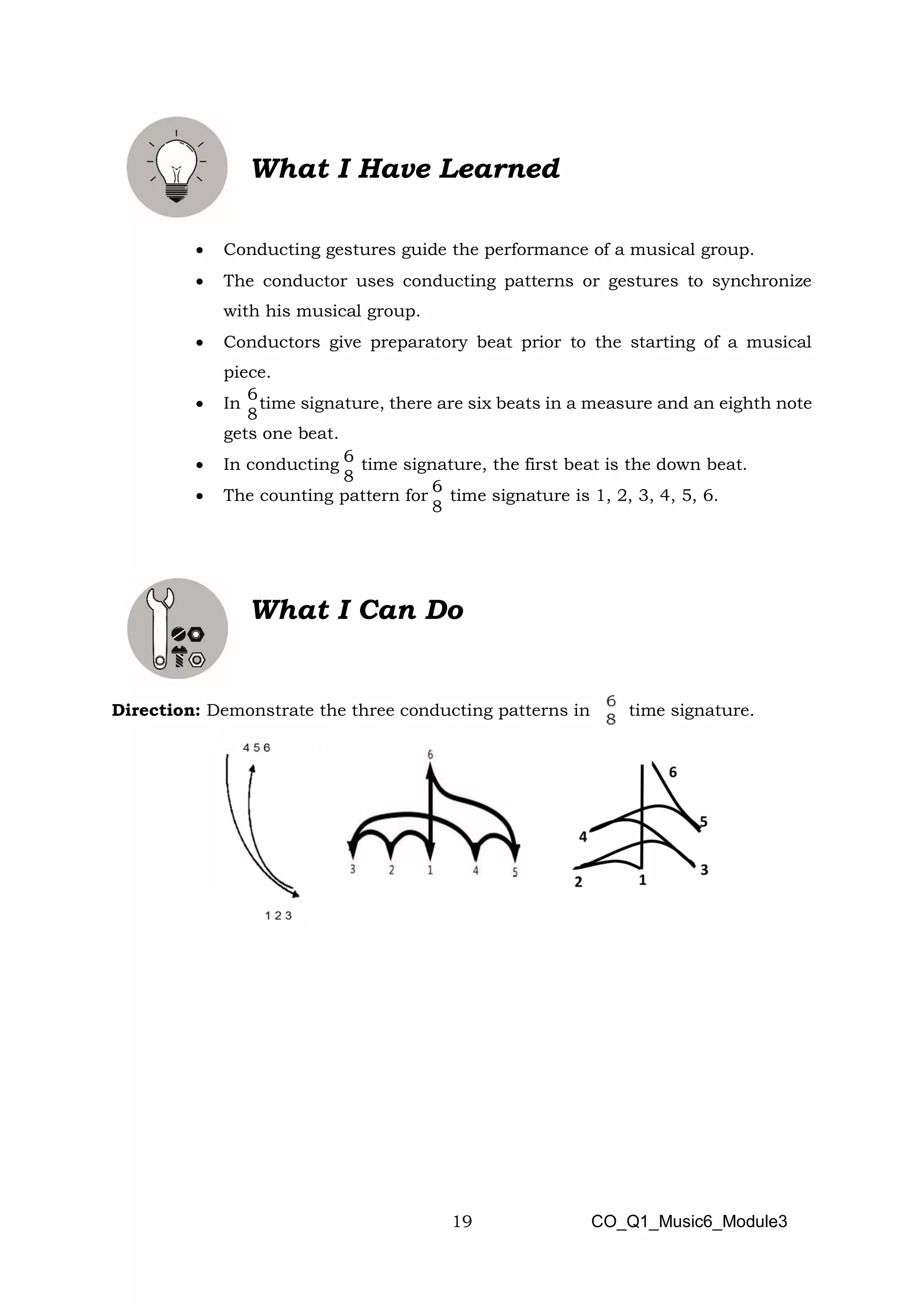
    17 6 8 6 8 6 8 6 8 6 8 6 8 What’s New Conducting Patternsfor Time Signature Have you experienced listening to music and finding yourself clapping, stomping and conducting? A conductor is the leader of a group of musicians who helps them produce good music together. He directs them by waving his hands or making use of a stick called a baton. He communicates with them by making gestures when he wants them to sing or play instruments in soft, loud, slow or fast manner. You have already learned to conduct the three simple time signatures. Today, you will learn to conduct the time signature in three different conducting patterns. What is It What kind of time signature is ? What is the counting pattern for time signature? Which pattern do you find easy to conduct? How many beats are there in time signature? How will you conduct time signature? CO_Q1_Music6_Module3
  • 22.
    18 6 8 6 8 2 4 6 8 6 8 6 8 What’s More Conducting TimeSignature In conducting, the first beat is always the down beat. Conductors give preparatory beat prior to the starting of a musical piece. In time signature there are six beats in a measure and an eighth note receives one beat. It is a compound time signature of time signature. That is why time signature is called compound duple. The counting pattern for time signature is 1, 2, 3, 4,5, 6. A. Write the numbers on the different conducting patterns of time signature below. B. Conduct the three conducting patterns above. C. Sing the song below while conducting the time signature. Take note that a tie is a curved line connecting two notes of the same pitch. They are to be sang/played with a duration equal to the sum of the values of the two-tied notes. Looby Loo 1. What note receives one beat in time signature? 2. What note receives two beats? 3. What note receives six beats? 4. What is the value of two notes connected with a tie? 5. Which pattern do you find easy to conduct? CO_Q1_Music6_Module3
  • 23.
    19 6 8 6 8 6 8 What I HaveLearned • Conducting gestures guide the performance of a musical group. • The conductor uses conducting patterns or gestures to synchronize with his musical group. • Conductors give preparatory beat prior to the starting of a musical piece. • In time signature, there are six beats in a measure and an eighth note gets one beat. • In conducting time signature, the first beat is the down beat. • The counting pattern for time signature is 1, 2, 3, 4, 5, 6. What I Can Do Direction: Demonstrate the three conducting patterns in time signature. CO_Q1_Music6_Module3
  • 24.
    20 Assessment Directions: Read andunderstand each item carefully. Write the letter of the correct answer on a separate sheet of paper. 1. A is a compound duple of what simple time signature? A. B. C. D. 2. What conducting pattern will you use for this musical phrase? A. B. C. D. 3. Refer to musical phrase above. What part of the beat is the first note? A. fifth beat B. second beat C. third beat D. fourth beat 4. A conductor uses conducting pattern to lead a musical group. Which is the conducting pattern for time signature? A. B. C. D. 5. Time signatures have different counting patterns. What time signature has 1, 2, 3, 4, 5, 6 counting pattern? A. B. C. D. CO_Q1_Music6_Module3
  • 25.
    21 6 8 6. What partof the beat is the encircled area in this pattern ? A. first beat B. second beat C. third beat D. fourth beat 7. The value of notes will vary on the given time signature. What time signature has six beats in a measure and an eighth note receives one beat? A. B. C. D. 8. There are two types of time signature: the simple and compound time signature. Which is a compound time signature? A. B. C. D. 9. The value of a dot is half the value of a note that it follows. How many beats are there in a dotted half note in time signature? A. 6 B. 4 C. 3 D. 5 10.What conducting pattern is appropriate for this rhythmic pattern? A. B. C. D. CO_Q1_Music6_Module3
  • 26.
    22 Additional Activities A. Conductthe rhythmic pattern in time signature. B. Write the numbers for each part of the beat of time signature conducting pattern. C. Conduct the time signature. CO_Q1_Music6_Module3
  • 27.
  • 28.
    24 Lesson 2 References Our Worldof MAPEH 6 pp. 16-21 What I Know 1. D 2. C 3. D 4. D 5. C 6. D 7. A 8. B 9. B 10. A What’s More A. What’s More C. 1. eighth note 2. quarter note 3. dotted half note 4. 5 beats 5. any answer Additional Activities Assessment 1. C 2. D 3. A 4. D 5. D 6. B 7. D 8. C 9. A 10. B CO_Q1_Music6_Module3
  • 29.
  • 30.
    For inquiries orfeedback, please write or call: Department of Education - Bureau of Learning Resources (DepEd-BLR) Ground Floor, Bonifacio Bldg., DepEd Complex Meralco Avenue, Pasig City, Philippines 1600 Telefax: (632) 8634-1072; 8634-1054; 8631-4985 Email Address: blr.lrqad@deped.gov.ph * blr.lrpd@deped.gov.ph