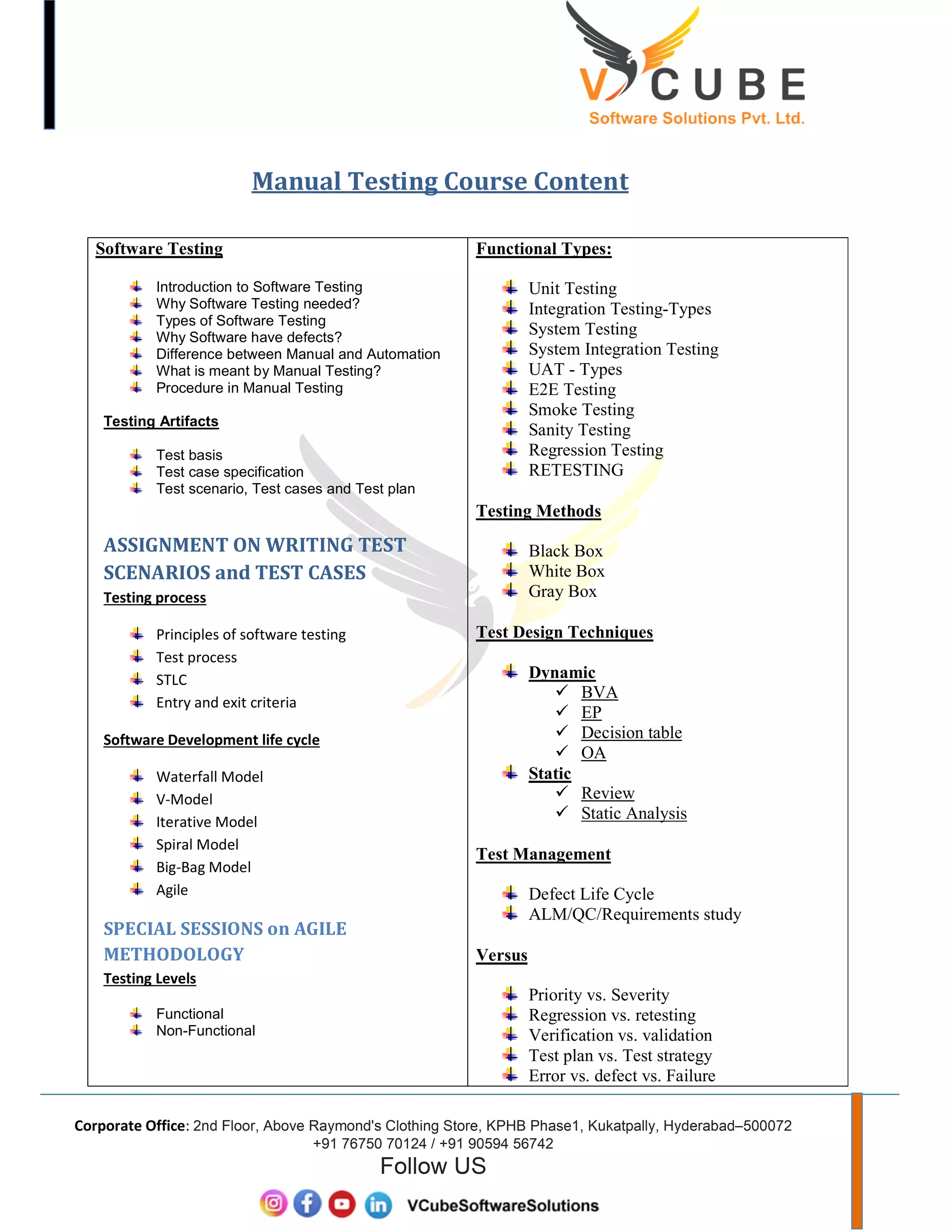
Manual Testing Course Content
Software Testing
Introduction to Software Testing
Why Software Testing needed?
Types of Software Testing
Why Software have defects?
Difference between Manual and Automation
What is meant by Manual Testing?
Procedure in Manual Testing
Testing Artifacts
Test basis
Test case specification
Test scenario, Test cases and Test plan
ASSIGNMENT ON WRITING TEST
SCENARIOS and TEST CASES
Testing process
Principles of software testing
Test process
STLC
Entry and exit criteria
Software Development life cycle
Waterfall Model
V-Model
Iterative Model
Spiral Model
Big-Bag Model
Agile
SPECIAL SESSIONS on AGILE
METHODOLOGY
Testing Levels
Functional
Non-Functional
Functional Types:
Unit Testing
Integration Testing-Types
System Testing
System Integration Testing
UAT - Types
E2E Testing
Smoke Testing
Sanity Testing
Regression Testing
RETESTING
Testing Methods
Black Box
White Box
Gray Box
Test Design Techniques
Dynamic
 BVA
 EP
 Decision table
 OA
Static
 Review
 Static Analysis
Test Management
Defect Life Cycle
ALM/QC/Requirements study
Versus
Priority vs. Severity
Regression vs. retesting
Verification vs. validation
Test plan vs. Test strategy
Error vs. defect vs. Failure
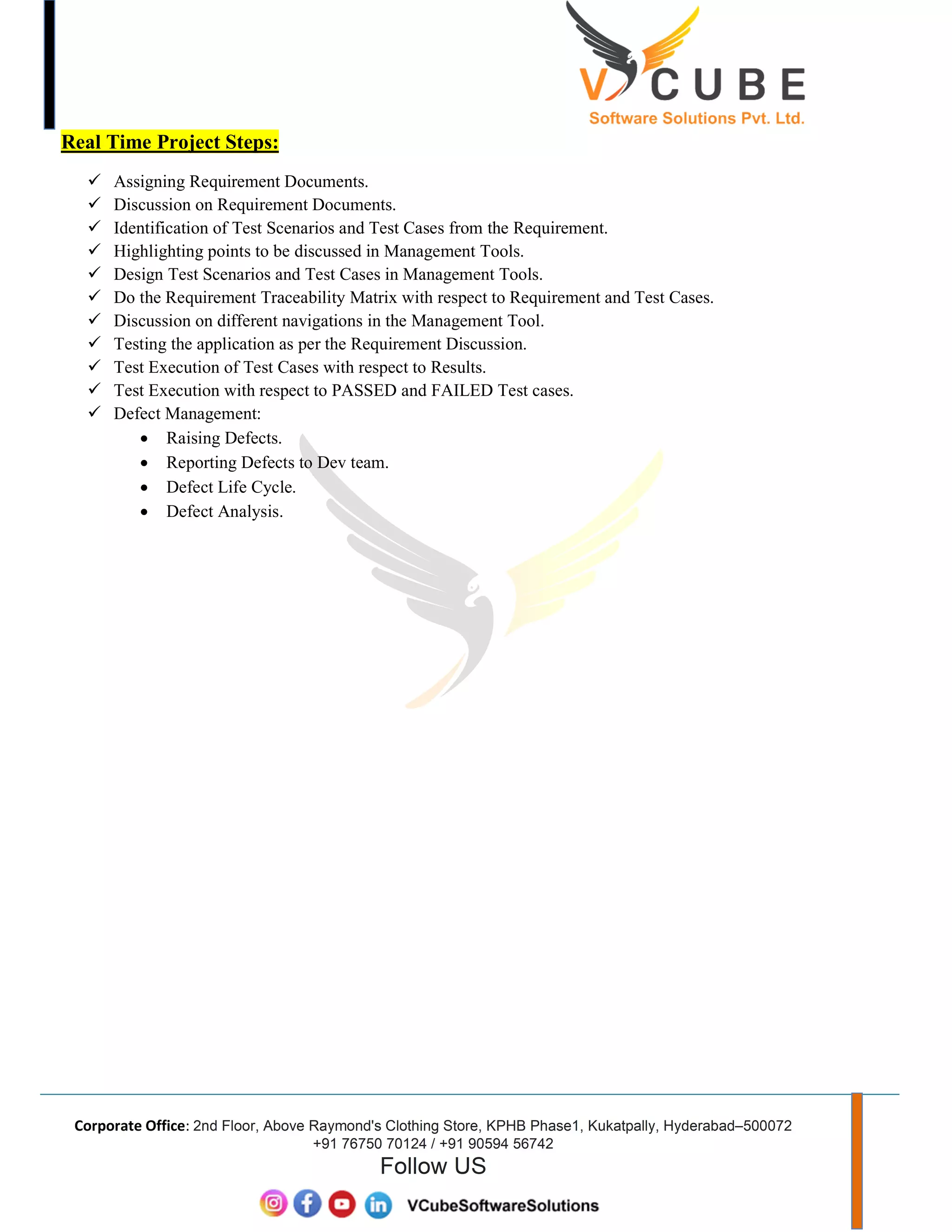
Real Time Project Steps:
 Assigning Requirement Documents.
 Discussion on Requirement Documents.
 Identification of Test Scenarios and Test Cases from the Requirement.
 Highlighting points to be discussed in Management Tools.
 Design Test Scenarios and Test Cases in Management Tools.
 Do the Requirement Traceability Matrix with respect to Requirement and Test Cases.
 Discussion on different navigations in the Management Tool.
 Testing the application as per the Requirement Discussion.
 Test Execution of Test Cases with respect to Results.
 Test Execution with respect to PASSED and FAILED Test cases.
 Defect Management:
 Raising Defects.
 Reporting Defects to Dev team.
 Defect Life Cycle.
 Defect Analysis.

Manual Testing Course

  • 1.
    Manual Testing CourseContent Software Testing Introduction to Software Testing Why Software Testing needed? Types of Software Testing Why Software have defects? Difference between Manual and Automation What is meant by Manual Testing? Procedure in Manual Testing Testing Artifacts Test basis Test case specification Test scenario, Test cases and Test plan ASSIGNMENT ON WRITING TEST SCENARIOS and TEST CASES Testing process Principles of software testing Test process STLC Entry and exit criteria Software Development life cycle Waterfall Model V-Model Iterative Model Spiral Model Big-Bag Model Agile SPECIAL SESSIONS on AGILE METHODOLOGY Testing Levels Functional Non-Functional Functional Types: Unit Testing Integration Testing-Types System Testing System Integration Testing UAT - Types E2E Testing Smoke Testing Sanity Testing Regression Testing RETESTING Testing Methods Black Box White Box Gray Box Test Design Techniques Dynamic  BVA  EP  Decision table  OA Static  Review  Static Analysis Test Management Defect Life Cycle ALM/QC/Requirements study Versus Priority vs. Severity Regression vs. retesting Verification vs. validation Test plan vs. Test strategy Error vs. defect vs. Failure
  • 2.
    Real Time ProjectSteps:  Assigning Requirement Documents.  Discussion on Requirement Documents.  Identification of Test Scenarios and Test Cases from the Requirement.  Highlighting points to be discussed in Management Tools.  Design Test Scenarios and Test Cases in Management Tools.  Do the Requirement Traceability Matrix with respect to Requirement and Test Cases.  Discussion on different navigations in the Management Tool.  Testing the application as per the Requirement Discussion.  Test Execution of Test Cases with respect to Results.  Test Execution with respect to PASSED and FAILED Test cases.  Defect Management:  Raising Defects.  Reporting Defects to Dev team.  Defect Life Cycle.  Defect Analysis.