Skyappz Software is the leading mobile app development company in Coimbatore, also provides web development, Branding, digital marketing services and IT Consulting. Future is ours join hands with us
First-rate SoftWare TestingCourse
Learning and Trainning Academy In
Coimbatore | SkyAppz
All our programs are meticulously crafted by our expert mentors to align
with the latest industry requirements, ensuring that every learner is
equipped with practical and relevant skills for success.
Why Choose SkyAppz?
stands Skyappz apart is its hands-on learning culture — particularly for
interns and freshers. As a developer, designer, or data fanatic, Skyappz
lets you work on live products, rather than dummy projects. The supportive
team environment, periodic knowledge sharing, and freedom to venture out
into new technologies make it a great place to grow personally.
2.
What topics arecovered in the Software Testing course?
● Software Development Life Cycle (SDLC)
● Software Testing Life Cycle (STLC)
● Manual Testing Concepts
● Automated Testing Basics
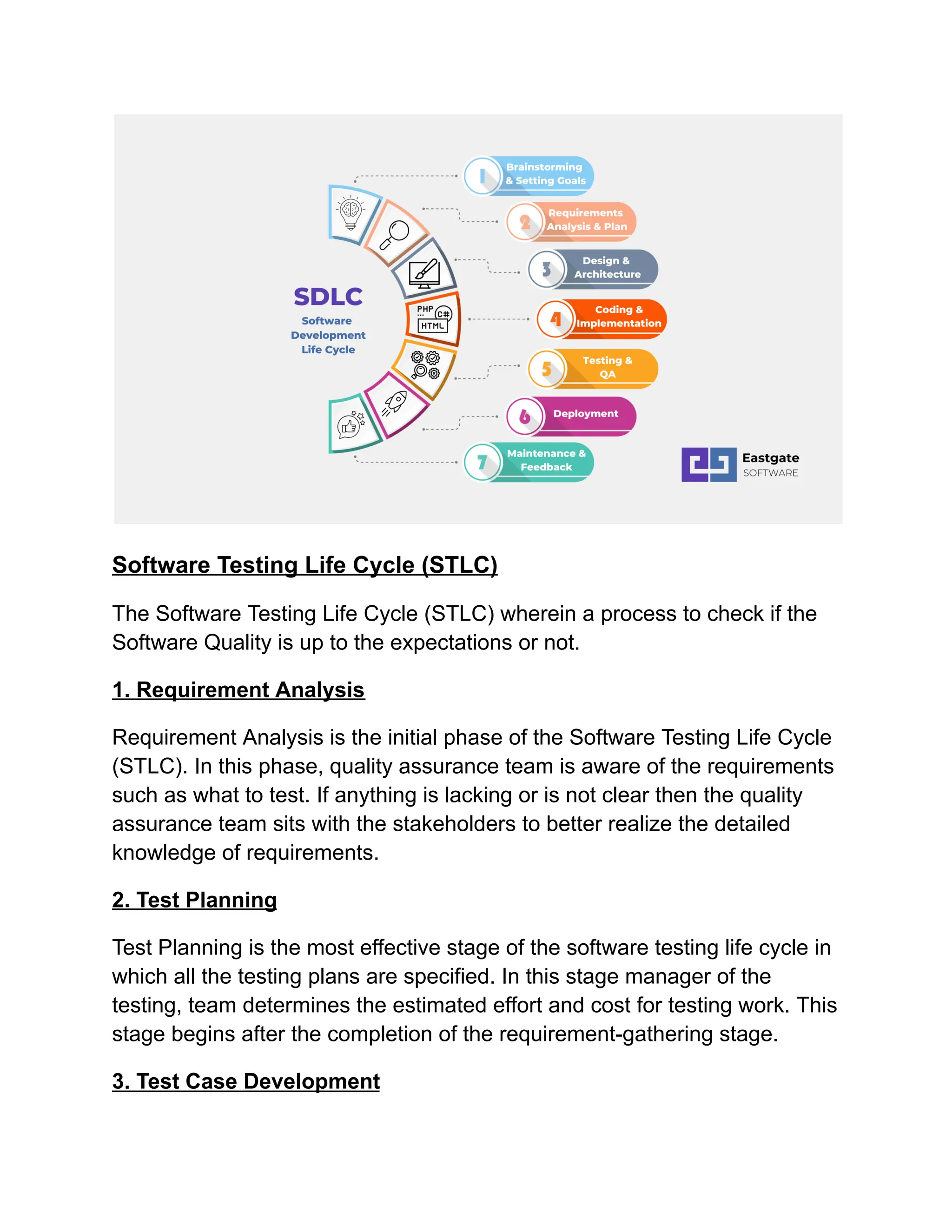
Software Development Life Cycle (SDLC)
Software testing Development Life Cycle (SDLC) is a process that software
developers and development teams follow to design, develop, test, and
maintain software systems. It gives a definitive structure for handling
software projects in an efficient and systematic way with high quality and
adherence to user requirements.
Planning
● Delimit the scope and objective of the project.
● Determine resources, timelines, and cost estimates.
● Perform feasibility studies and risk analysis.
● Requirements Gathering and Analysis
● Collect functional and non-functional requirements from stakeholders.
● Write down and analyze requirements for completeness and clarity.
● Deliver a Software Requirements Specification (SRS) document.
Design
3.
● Develop softwarearchitecture and design strategies.
● Develop high-level design (HLD) and low-level design (LLD).
● Plan data structures, algorithms, UI/UX, and system interfaces.
● Implementation (or Coding)
● Translate design documents into real code in the appropriate
programming language.
● Abide by coding conventions and best practices.
Testing
● Test the software for bugs and ensure it meets specifications.
● Conduct various kinds of testing (unit, integration, system,
acceptance).
● Automated and manual testing tools as necessary.
Deployment
● Deploy the software to the production environment.
● Ensure proper support, configuration, and installation.
● Might include phased rollouts or complete deployment.
Maintenance
● Offer continual support and updates.
● Correct bugs, patch security holes, and improve functionality.
● Watch for performance and user feedback to make improvements in
the future.
4.
Software Testing LifeCycle (STLC)
The Software Testing Life Cycle (STLC) wherein a process to check if the
Software Quality is up to the expectations or not.
1. Requirement Analysis
Requirement Analysis is the initial phase of the Software Testing Life Cycle
(STLC). In this phase, quality assurance team is aware of the requirements
such as what to test. If anything is lacking or is not clear then the quality
assurance team sits with the stakeholders to better realize the detailed
knowledge of requirements.
2. Test Planning
Test Planning is the most effective stage of the software testing life cycle in
which all the testing plans are specified. In this stage manager of the
testing, team determines the estimated effort and cost for testing work. This
stage begins after the completion of the requirement-gathering stage.
3. Test Case Development
5.
The Test CaseDevelopment stage begins after the test planning stage is
over. During this stage testing team jots down the detailed test cases. The
testing team creates test data required for testing. When test cases are
created then these are reviewed by the quality assurance team.
4. Test Environment Setup
Test Environment Setup is a major activity in the STLC. Essentially, the test
environment determines the premises upon which software is tested. This
is an independent task and may be initiated along with test case
development. In this process, the testing team is not engaged. either the
customer or the developer develops the testing environment.
5. Test Execution
In Test Execution, once the test case development and test environment
setup test execution phase is initiated. In this phase, testing team begins
executing test cases from prepared test cases in the previous step.
6. Test Closure
Test Closure is the last phase of the Software Testing Life Cycle (STLC) in
which all test-related activities are finished and documented. The primary
goal of the test closure phase is to confirm that all test-related activities
have been finished and the software is ready for release.
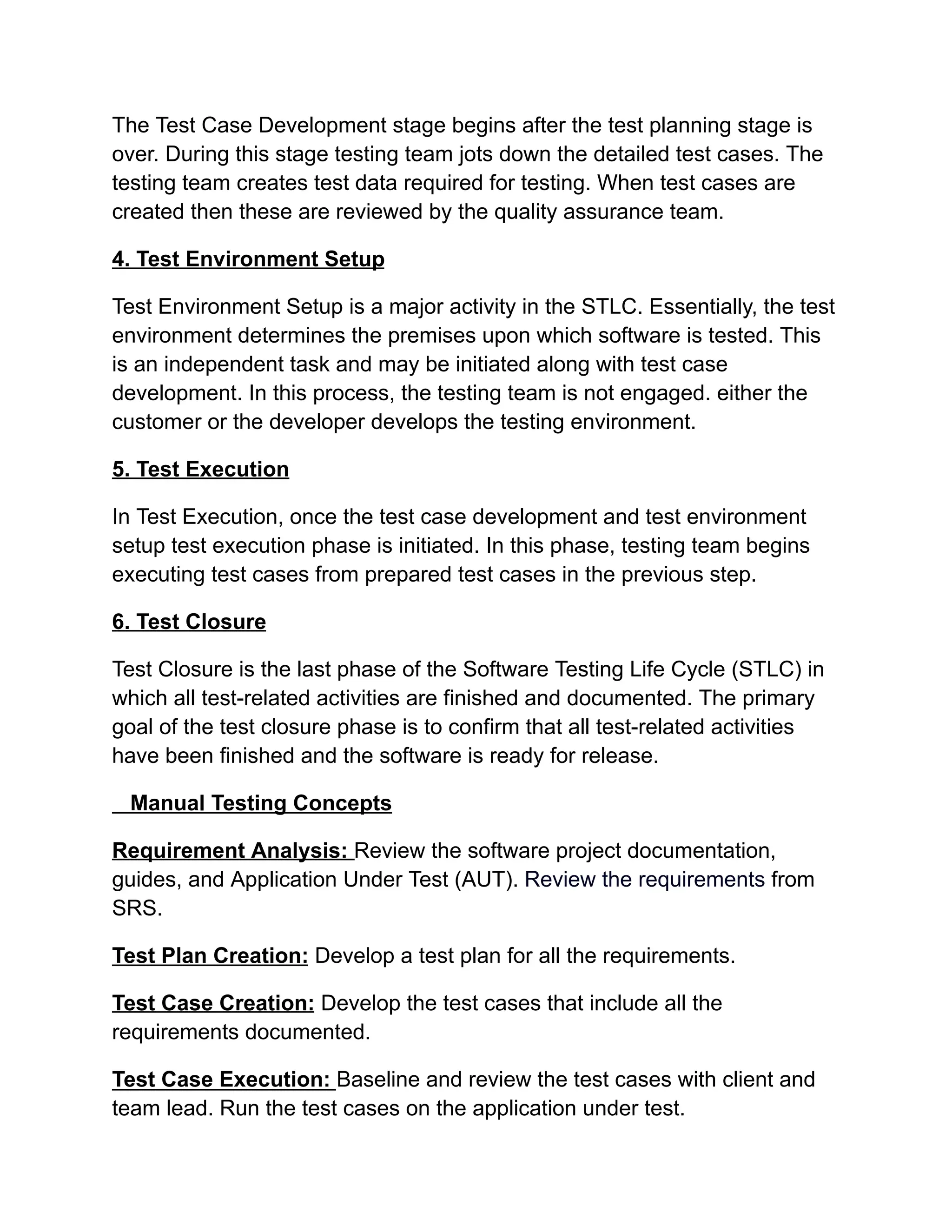
Manual Testing Concepts
Requirement Analysis: Review the software project documentation,
guides, and Application Under Test (AUT). Review the requirements from
SRS.
Test Plan Creation: Develop a test plan for all the requirements.
Test Case Creation: Develop the test cases that include all the
requirements documented.
Test Case Execution: Baseline and review the test cases with client and
team lead. Run the test cases on the application under test.
6.
Defect Logging: Identifythe defects, log and report them to the
developers.
Defect Fix and Re-verification: After fixing the bugs, once again run the
test cases that failed to check if they pass.
Automated Software testing :
Automated Software testing is any method that allows you to execute your
tests without someone having to do it for you. In the past, testing has been
manual. A person goes through a list of instructions to test if things are
acting as they should. An automated test, on the other hand, is written once
and then can be executed whenever you require it.
"text": "SkyAppz Academy"
}
},{
"@type":"Question",
"name": "What is Software Testing?",
"acceptedAnswer": {
"@type": "Answer",
"text": "It’s the process of checking if a software works correctly and is free
from bugs."
}
},{
"@type": "Question",
"name": "What is a Test Case?",
"acceptedAnswer": {
"@type": "Answer",
"text": "A test case is a set of steps to check if a part of the software works
correctly."
}
},{
"@type": "Question",
"name": "What is Regression Testing?",
"acceptedAnswer": {
9.
"@type": "Answer",
"text": "Itchecks if new changes didn’t break the old features."
}
}]
}
</script>
Article:
<script type="application/ld+json">
{
"@context": "https://schema.org",
"@type": "BlogPosting",
"mainEntityOfPage": {
"@type": "WebPage",
"@id":
"https://manage.wix.com/dashboard/be38f5a5-781d-4976-b4b5-39c97d5a8
249/blog/a610a977-e36a-438f-8025-2d062e68997a/edit"
},
"headline": "First-rate SoftWare Testing Course Learning and Trainning
Academy In Coimbatore | SkyAppz",
"description": "Upgrade your skills at Skyappz Academy, Coimbatore. Learn
Data Science, Software Development, Digital Marketing, and more with
hands-on projects",
"image": [
!["@type": "Answer",
"text": "It checks if new changes didn’t break the old features."
}
}]
}
</script>
Article:
<script type="application/ld+json">
{
"@context": "https://schema.org",
"@type": "BlogPosting",
"mainEntityOfPage": {
"@type": "WebPage",
"@id":
"https://manage.wix.com/dashboard/be38f5a5-781d-4976-b4b5-39c97d5a8
249/blog/a610a977-e36a-438f-8025-2d062e68997a/edit"
},
"headline": "First-rate SoftWare Testing Course Learning and Trainning
Academy In Coimbatore | SkyAppz",
"description": "Upgrade your skills at Skyappz Academy, Coimbatore. Learn
Data Science, Software Development, Digital Marketing, and more with
hands-on projects",
"image": [](https://image.slidesharecdn.com/blog1-250521075828-f74fa161/75/First-Rate-SoftWare-Testing-Course-In-Comibatore-9-2048.jpg)
!["brain-7170513_1280.jpg",
"matrix-7484076_1280.jpg",
"software-development-life-cycle-stages-1-1.png",
""
],
"author": {
"@type": "Organization",
"name": "SkyAppz Academy",
"url": "https://skyappzacademy.com/software-testing/"
},
"publisher": {
"@type": "Organization",
"name": "SkyAppz Academy",
"logo": {
"@type": "ImageObject",
"url": "https://images.app.goo.gl/TvBQmaqzxu1ojCnW7"
}
},
"datePublished": "2025-05-16",
"dateModified": "2025-05-16"
}](https://image.slidesharecdn.com/blog1-250521075828-f74fa161/75/First-Rate-SoftWare-Testing-Course-In-Comibatore-10-2048.jpg)