Randall Barron, CLIA, QWEL, ARCSA
     Water Conservation Technician
                   City of Santa Rosa
Overview of our Water System
 Santa Rosa’s population is 161,496
 Provide water and sewer services
 Over 52,000 service connections
   Approximately 43,000 SFR, 3,000 MFR, 3,000 CII and
    1,700 dedicated irrigation customers
 In 2008, delivered 18,450 acre-feet of water
   Currently most of our water supply from SCWA
   Additional Groundwater Sources Available
Snapshot of Santa Rosa’s Demand

   Current Demand
       Average daily use: 17 mgd
       Winter daily use: 13 mgd
       Peak month average daily use: 32.5 mgd
Water Use Efficiency Program
   Started in 1976-77 in response to the drought
   Further established in the early 1990s
   Signatory to CUWCC MOU in 1998
   Saving 4,497AFY or over 4.0 mgd
   Reduces GHG’s by 2,900 tons per year
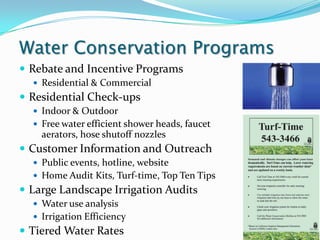
Water Conservation Programs
 Rebate and Incentive Programs
   Residential & Commercial
 Residential Check-ups
   Indoor & Outdoor
   Free water efficient shower heads, faucet
    aerators, hose shutoff nozzles
 Customer Information and Outreach
   Public events, hotline, website
   Home Audit Kits, Turf-time, Top Ten Tips
 Large Landscape Irrigation Audits
   Water use analysis
   Irrigation Efficiency
 Tiered Water Rates
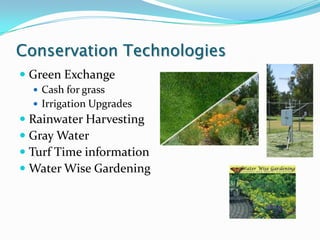
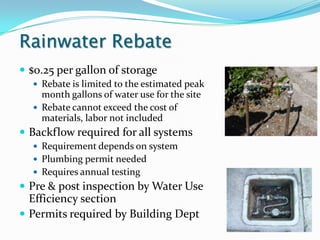
Conservation Technologies
 Green Exchange
   Cash for grass
   Irrigation Upgrades
 Rainwater Harvesting
 Gray Water
 Turf Time information
 Water Wise Gardening
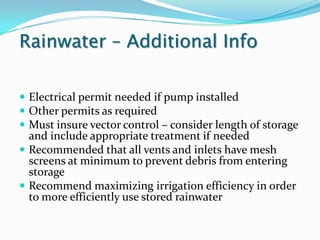
Rainwater Rebate
 $0.25 per gallon of storage
   Rebate is limited to the estimated peak
    month gallons of water use for the site
   Rebate cannot exceed the cost of
    materials, labor not included
 Backflow required for all systems
   Requirement depends on system
   Plumbing permit needed
   Requires annual testing
 Pre & post inspection by Water Use
  Efficiency section
 Permits required by Building Dept
Rainwater – Additional Info

 Electrical permit needed if pump installed
 Other permits as required
 Must insure vector control – consider length of storage
  and include appropriate treatment if needed
 Recommended that all vents and inlets have mesh
  screens at minimum to prevent debris from entering
  storage
 Recommend maximizing irrigation efficiency in order
  to more efficiently use stored rainwater
Peak Month Water Use
 At pre-inspection, all landscape square footage is
  measured as low (LW), moderate (MW) and high (HW)
  water use.
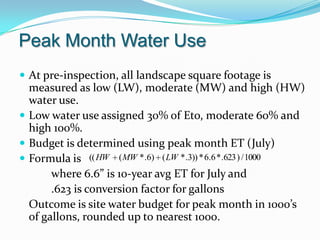
 Low water use assigned 30% of Eto, moderate 60% and
  high 100%.
 Budget is determined using peak month ET (July)
 Formula is (( HW ( MW * .6) ( LW * .3)) * 6.6 * .623 ) / 1000
       where 6.6” is 10-year avg ET for July and
       .623 is conversion factor for gallons
  Outcome is site water budget for peak month in 1000’s
  of gallons, rounded up to nearest 1000.
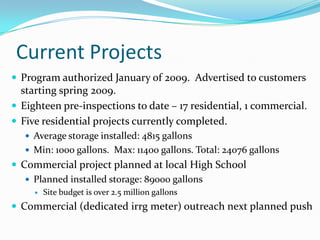
Current Projects
 Program authorized January of 2009. Advertised to customers
  starting spring 2009.
 Eighteen pre-inspections to date – 17 residential, 1 commercial.
 Five residential projects currently completed.
    Average storage installed: 4815 gallons
    Min: 1000 gallons. Max: 11400 gallons. Total: 24076 gallons
 Commercial project planned at local High School
    Planned installed storage: 89000 gallons
        Site budget is over 2.5 million gallons
 Commercial (dedicated irrg meter) outreach next planned push
Case Studies
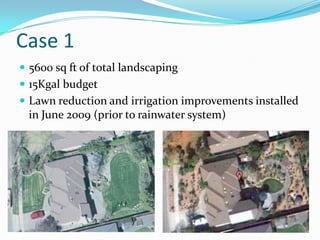
Case 1
 5600 sq ft of total landscaping
 15Kgal budget
 Lawn reduction and irrigation improvements installed
 in June 2009 (prior to rainwater system)
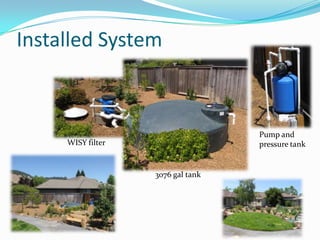
Installed System


                                   Pump and
     WISY filter                   pressure tank


                   3076 gal tank
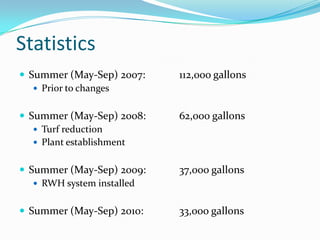
Statistics
 Summer (May-Sep) 2007:    112,000 gallons
    Prior to changes


 Summer (May-Sep) 2008:    62,000 gallons
    Turf reduction
    Plant establishment


 Summer (May-Sep) 2009:    37,000 gallons
    RWH system installed


 Summer (May-Sep) 2010:    33,000 gallons
Case 2
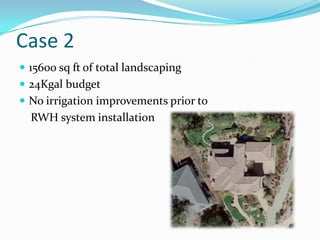
 15600 sq ft of total landscaping
 24Kgal budget
 No irrigation improvements prior to
  RWH system installation
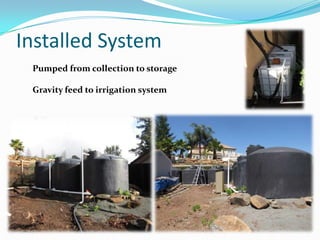
Installed System
 Pumped from collection to storage

 Gravity feed to irrigation system
Statistics
 Summer (May-Sep) 2007:                140,000 gallons
   Prior to changes


 Summer (May-Sep) 2008:                126,000 gallons
   550 gallons storage installed


 Summer (May-Sep) 2009:                75,000 gallons
   Additional 4500 gallons installed


 Summer (May-Sep) 2010:
   Additional 6000 gallons installed   33,000 gallons
Rebate Cost v. Savings
 Current cost per acre foot of water:   $ 604

 Projected cost in 2011:                $ 676

 Cost to city of rebate:                $ 678

 Site water savings due to increase
  in consumer awareness:                 Pri¢ele$$
Questions – Thank you


Randall S Barron, City of Santa Rosa, (707) 543-3994, rbarron@srcity.org

Manhattan Beach Randy

  • 1.
    Randall Barron, CLIA,QWEL, ARCSA Water Conservation Technician City of Santa Rosa
  • 2.
    Overview of ourWater System  Santa Rosa’s population is 161,496  Provide water and sewer services  Over 52,000 service connections  Approximately 43,000 SFR, 3,000 MFR, 3,000 CII and 1,700 dedicated irrigation customers  In 2008, delivered 18,450 acre-feet of water  Currently most of our water supply from SCWA  Additional Groundwater Sources Available
  • 3.
    Snapshot of SantaRosa’s Demand  Current Demand  Average daily use: 17 mgd  Winter daily use: 13 mgd  Peak month average daily use: 32.5 mgd
  • 4.
    Water Use EfficiencyProgram  Started in 1976-77 in response to the drought  Further established in the early 1990s  Signatory to CUWCC MOU in 1998  Saving 4,497AFY or over 4.0 mgd  Reduces GHG’s by 2,900 tons per year
  • 5.
    Water Conservation Programs Rebate and Incentive Programs  Residential & Commercial  Residential Check-ups  Indoor & Outdoor  Free water efficient shower heads, faucet aerators, hose shutoff nozzles  Customer Information and Outreach  Public events, hotline, website  Home Audit Kits, Turf-time, Top Ten Tips  Large Landscape Irrigation Audits  Water use analysis  Irrigation Efficiency  Tiered Water Rates
  • 6.
    Conservation Technologies  GreenExchange  Cash for grass  Irrigation Upgrades  Rainwater Harvesting  Gray Water  Turf Time information  Water Wise Gardening
  • 7.
    Rainwater Rebate  $0.25per gallon of storage  Rebate is limited to the estimated peak month gallons of water use for the site  Rebate cannot exceed the cost of materials, labor not included  Backflow required for all systems  Requirement depends on system  Plumbing permit needed  Requires annual testing  Pre & post inspection by Water Use Efficiency section  Permits required by Building Dept
  • 8.
    Rainwater – AdditionalInfo  Electrical permit needed if pump installed  Other permits as required  Must insure vector control – consider length of storage and include appropriate treatment if needed  Recommended that all vents and inlets have mesh screens at minimum to prevent debris from entering storage  Recommend maximizing irrigation efficiency in order to more efficiently use stored rainwater
  • 9.
    Peak Month WaterUse  At pre-inspection, all landscape square footage is measured as low (LW), moderate (MW) and high (HW) water use.  Low water use assigned 30% of Eto, moderate 60% and high 100%.  Budget is determined using peak month ET (July)  Formula is (( HW ( MW * .6) ( LW * .3)) * 6.6 * .623 ) / 1000 where 6.6” is 10-year avg ET for July and .623 is conversion factor for gallons Outcome is site water budget for peak month in 1000’s of gallons, rounded up to nearest 1000.
  • 10.
    Current Projects  Programauthorized January of 2009. Advertised to customers starting spring 2009.  Eighteen pre-inspections to date – 17 residential, 1 commercial.  Five residential projects currently completed.  Average storage installed: 4815 gallons  Min: 1000 gallons. Max: 11400 gallons. Total: 24076 gallons  Commercial project planned at local High School  Planned installed storage: 89000 gallons  Site budget is over 2.5 million gallons  Commercial (dedicated irrg meter) outreach next planned push
  • 11.
  • 12.
    Case 1  5600sq ft of total landscaping  15Kgal budget  Lawn reduction and irrigation improvements installed in June 2009 (prior to rainwater system)
  • 13.
    Installed System Pump and WISY filter pressure tank 3076 gal tank
  • 14.
    Statistics  Summer (May-Sep)2007: 112,000 gallons  Prior to changes  Summer (May-Sep) 2008: 62,000 gallons  Turf reduction  Plant establishment  Summer (May-Sep) 2009: 37,000 gallons  RWH system installed  Summer (May-Sep) 2010: 33,000 gallons
  • 15.
    Case 2  15600sq ft of total landscaping  24Kgal budget  No irrigation improvements prior to RWH system installation
  • 16.
    Installed System Pumpedfrom collection to storage Gravity feed to irrigation system
  • 17.
    Statistics  Summer (May-Sep)2007: 140,000 gallons  Prior to changes  Summer (May-Sep) 2008: 126,000 gallons  550 gallons storage installed  Summer (May-Sep) 2009: 75,000 gallons  Additional 4500 gallons installed  Summer (May-Sep) 2010:  Additional 6000 gallons installed 33,000 gallons
  • 18.
    Rebate Cost v.Savings  Current cost per acre foot of water: $ 604  Projected cost in 2011: $ 676  Cost to city of rebate: $ 678  Site water savings due to increase in consumer awareness: Pri¢ele$$
  • 19.
    Questions – Thankyou Randall S Barron, City of Santa Rosa, (707) 543-3994, rbarron@srcity.org

Editor's Notes

  • #2 Intro, who we are, about our program, two typical installations
  • #3 One AF is approx 326,000 gallons
  • #8 CDPH's Title 17 of Code of Regulations says “Premises having auxiliary water supply’ must have cross-connection control (1) Auxiliary Water Supply is any water supply other than that received from a public water system. (2) Premises where there is an unapproved auxiliary water supply and there are not interconnections with the public water system, a double check may be provided in lieu of a reduce pressure device if approved by the Health agency and water supplier. (3) Backflow preventer shall be tested at least annually or more frequently if determined to be necessary by the water supplier.
  • #15 Part physical water savings, part heightening of customer awareness
  • #18 107kgal/summer savings. $622/yr System cost: $6550