One Billion Gallon Water Challenge Update
CASE STUDY HIGHLIGHTS
Anticipated Savings as of January
2015
$ $92,000 per year savings
by water reuse
60.6 Million gallons water
per year
Benefits to the Community
The City of LaSalle, Illinois, is situated
beside the Illinois River and sources
their water from seven groundwater
wells. This location makes their water
vulnerable to agricultural runoff. In
addition, the Illinois EPA identified five
potential industrial sources of
contamination affecting five of these
wells in their 2013 water quality report.
Conservation efforts at industrial
facilities, like Carus Corp., help
communities prepare for increased
future demands at a lower cost to the
utility and all users in the community.
REDUCING WATER CONSUMPTION BY RE-USE
ISTC launched its One Billion Gallon Water Challenge
in 2014 to promote water conservation measures by
businesses, industries, communities, and the general
public in Illinois.
ISTC has made a commitment to fund projects and conduct field-based research
with industries, municipalities and universities that result in measurable and
meaningful water savings. We are currently funding projects with the following
partners: Carus Corporation, American Water, Loyola University, City of Urbana,
Illinois State Water Survey, and the Illinois Green Economy Network.
CARUS CORPORATION
Carus Corporation is an environmental services company
providing materials to the water, industrial, air and soil
remediation markets, operating six sites globally. Carus
Corporation has reduced the energy and carbon footprint of its
flagship product, potassium permanganate, by 25% since 2009 in
response to competitive threats. Carus Corporation is now expanding these
efforts to water conservation as well. The current project aims to reuse non-
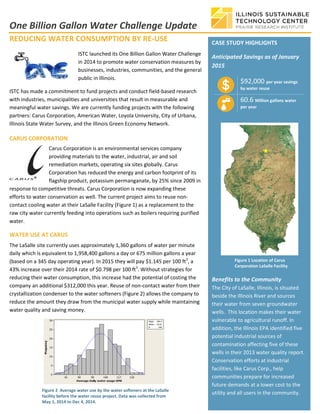
contact cooling water at their LaSalle Facility (Figure 1) as a replacement to the
raw city water currently feeding into operations such as boilers requiring purified
water.
WATER USE AT CARUS
The LaSalle site currently uses approximately 1,360 gallons of water per minute
daily which is equivalent to 1,958,400 gallons a day or 675 million gallons a year
(based on a 345 day operating year). In 2015 they will pay $1.145 per 100 ft3
, a
43% increase over their 2014 rate of $0.798 per 100 ft3
. Without strategies for
reducing their water consumption, this increase had the potential of costing the
company an additional $312,000 this year. Reuse of non-contact water from their
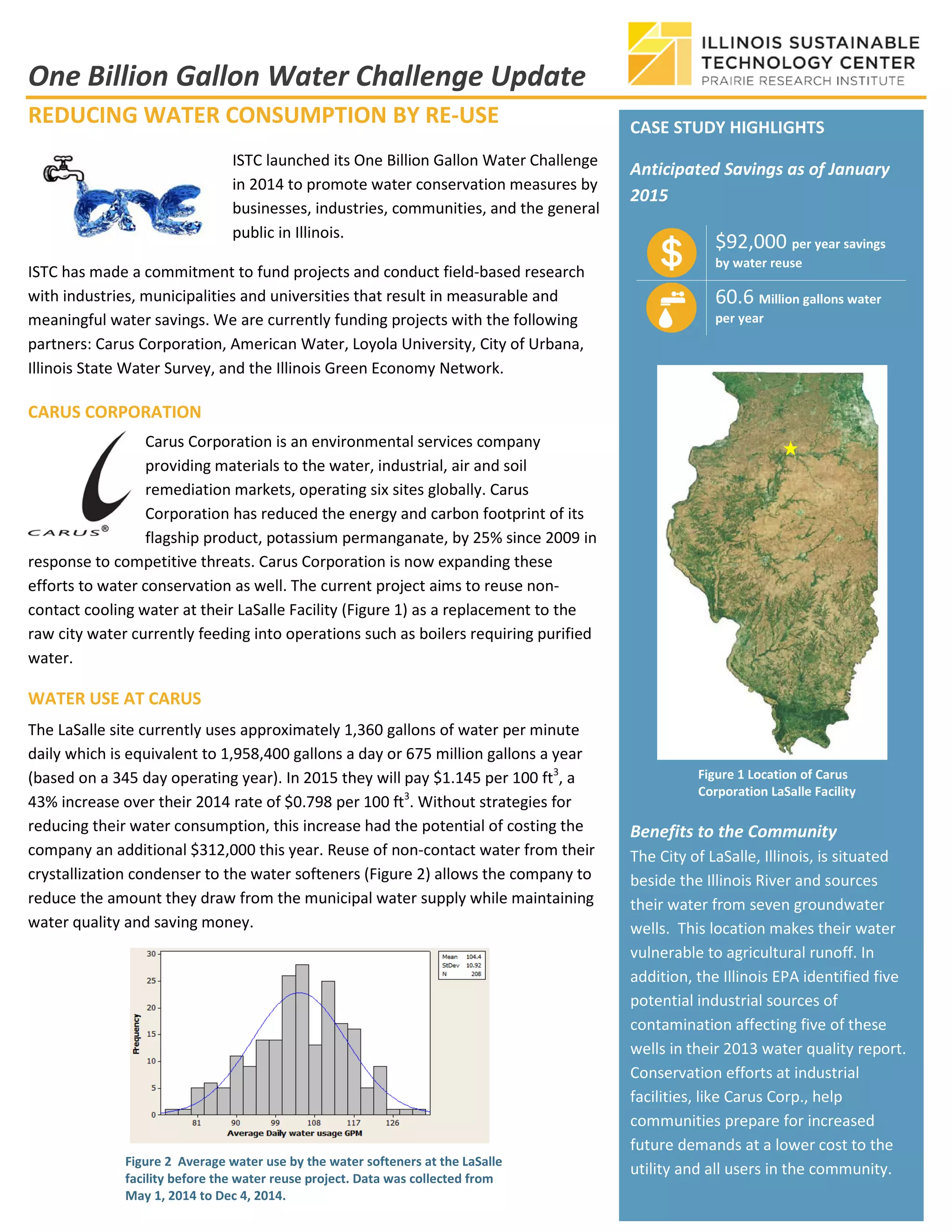
crystallization condenser to the water softeners (Figure 2) allows the company to
reduce the amount they draw from the municipal water supply while maintaining
water quality and saving money.
Figure 2 Average water use by the water softeners at the LaSalle
facility before the water reuse project. Data was collected from
May 1, 2014 to Dec 4, 2014.
Figure 1 Location of Carus
Corporation LaSalle Facility
One Billion Gallon Water Challenge Update
HOW THE SYSTEM WORKS
Where is the water coming from?
Water is used as a heat sink in the
condenser to bring down the product
temperature without making contact
with any part of the product stream.
This water is then taken to a hotwell
(weir) for it to cool down before
discharge. There is no treatment
required before discharge of the water
because it has remained chemically
unchanged; it has only been used to
extract heat from the process.
This hotwell water is the target source
of the reuse project.
Where is the water going?
Before the project, the facility
purchased raw city water to feed the
water softeners and reverse osmosis
(RO) system to meet boiler water
requirements.
The reuse project was designed to
pump the water from the hotwell to
replace the raw city water feed to the
softeners.
A pump was added between the hotwell
and water softeners along with water
level and conductivity monitoring. This
ensures that the hotwell water meets
the feed quality standards required of
the softeners and RO system.
In the event that the hotwell water level
or quality does not meet requirements,
raw city water will automatically be fed
into the softeners.
SYSTEM SCHEMATIC
Figure 3 The piping contained within the red bubble indicates the new piping and pump for
recycling water from the condenser hotwell to the water softeners.
PROJECT STARTUP
In January 2015, the infrastructure and Standard Operating Procedures were in
place and water recycling from the condenser to the softeners was initiated.
Initial measurements indicate that they will save an additional 8.7 million gallons
of water beyond the initial estimate of 51.9 million gallons. This would mean a
reduction in their expected ROI with cost-sharing from about 11 months to 8
months.
In Figure 4, you can see
how the water use at the
facility would sharply
increase in coordination
with water demand at the
softeners.
After the water recycling
project began, the total
water use in the plant
reduced dramatically and
has stopped showing
softener-related spikes.
The study will continue to
collect data through June 2015 to confirm ongoing water savings and smooth
system operation.
For other case studies visit: http://www.istc.illinois.edu/water.cfm
For additional project details or on how you can participate in the One Billion
Gallon Water Challenge contact:
N. Rajagopalan, Associate Director, ISTC, nrajagop@illinois.edu; 217.244.8905
N. Holm, Assistant Director, ISTC, naholm@illinois.edu; 217.244.3330
Figure 4 The aqua line is water flow exiting the softeners. The
green line indicates total water being used at the plant.
Project Startup
Water
Softener
Water
Softener
Reverse Osmosis
System
High Pressure
Pump
RO Water
storage
Tank
Raw City
Water
Variable Flow rate based on
RO water Storage Tank Level
Booster Pump
Barometric Condenser Cooling
Water
Hotwell
New Recycle
water Pump
RO flush water
South Lagoon
Plant Cooling and
Seal Water System
South Lagoon
Edler Feed
Water System
RO Water
Pump

ISTC1

  • 1.
    One Billion GallonWater Challenge Update CASE STUDY HIGHLIGHTS Anticipated Savings as of January 2015 $ $92,000 per year savings by water reuse 60.6 Million gallons water per year Benefits to the Community The City of LaSalle, Illinois, is situated beside the Illinois River and sources their water from seven groundwater wells. This location makes their water vulnerable to agricultural runoff. In addition, the Illinois EPA identified five potential industrial sources of contamination affecting five of these wells in their 2013 water quality report. Conservation efforts at industrial facilities, like Carus Corp., help communities prepare for increased future demands at a lower cost to the utility and all users in the community. REDUCING WATER CONSUMPTION BY RE-USE ISTC launched its One Billion Gallon Water Challenge in 2014 to promote water conservation measures by businesses, industries, communities, and the general public in Illinois. ISTC has made a commitment to fund projects and conduct field-based research with industries, municipalities and universities that result in measurable and meaningful water savings. We are currently funding projects with the following partners: Carus Corporation, American Water, Loyola University, City of Urbana, Illinois State Water Survey, and the Illinois Green Economy Network. CARUS CORPORATION Carus Corporation is an environmental services company providing materials to the water, industrial, air and soil remediation markets, operating six sites globally. Carus Corporation has reduced the energy and carbon footprint of its flagship product, potassium permanganate, by 25% since 2009 in response to competitive threats. Carus Corporation is now expanding these efforts to water conservation as well. The current project aims to reuse non- contact cooling water at their LaSalle Facility (Figure 1) as a replacement to the raw city water currently feeding into operations such as boilers requiring purified water. WATER USE AT CARUS The LaSalle site currently uses approximately 1,360 gallons of water per minute daily which is equivalent to 1,958,400 gallons a day or 675 million gallons a year (based on a 345 day operating year). In 2015 they will pay $1.145 per 100 ft3 , a 43% increase over their 2014 rate of $0.798 per 100 ft3 . Without strategies for reducing their water consumption, this increase had the potential of costing the company an additional $312,000 this year. Reuse of non-contact water from their crystallization condenser to the water softeners (Figure 2) allows the company to reduce the amount they draw from the municipal water supply while maintaining water quality and saving money. Figure 2 Average water use by the water softeners at the LaSalle facility before the water reuse project. Data was collected from May 1, 2014 to Dec 4, 2014. Figure 1 Location of Carus Corporation LaSalle Facility
  • 2.
    One Billion GallonWater Challenge Update HOW THE SYSTEM WORKS Where is the water coming from? Water is used as a heat sink in the condenser to bring down the product temperature without making contact with any part of the product stream. This water is then taken to a hotwell (weir) for it to cool down before discharge. There is no treatment required before discharge of the water because it has remained chemically unchanged; it has only been used to extract heat from the process. This hotwell water is the target source of the reuse project. Where is the water going? Before the project, the facility purchased raw city water to feed the water softeners and reverse osmosis (RO) system to meet boiler water requirements. The reuse project was designed to pump the water from the hotwell to replace the raw city water feed to the softeners. A pump was added between the hotwell and water softeners along with water level and conductivity monitoring. This ensures that the hotwell water meets the feed quality standards required of the softeners and RO system. In the event that the hotwell water level or quality does not meet requirements, raw city water will automatically be fed into the softeners. SYSTEM SCHEMATIC Figure 3 The piping contained within the red bubble indicates the new piping and pump for recycling water from the condenser hotwell to the water softeners. PROJECT STARTUP In January 2015, the infrastructure and Standard Operating Procedures were in place and water recycling from the condenser to the softeners was initiated. Initial measurements indicate that they will save an additional 8.7 million gallons of water beyond the initial estimate of 51.9 million gallons. This would mean a reduction in their expected ROI with cost-sharing from about 11 months to 8 months. In Figure 4, you can see how the water use at the facility would sharply increase in coordination with water demand at the softeners. After the water recycling project began, the total water use in the plant reduced dramatically and has stopped showing softener-related spikes. The study will continue to collect data through June 2015 to confirm ongoing water savings and smooth system operation. For other case studies visit: http://www.istc.illinois.edu/water.cfm For additional project details or on how you can participate in the One Billion Gallon Water Challenge contact: N. Rajagopalan, Associate Director, ISTC, nrajagop@illinois.edu; 217.244.8905 N. Holm, Assistant Director, ISTC, naholm@illinois.edu; 217.244.3330 Figure 4 The aqua line is water flow exiting the softeners. The green line indicates total water being used at the plant. Project Startup Water Softener Water Softener Reverse Osmosis System High Pressure Pump RO Water storage Tank Raw City Water Variable Flow rate based on RO water Storage Tank Level Booster Pump Barometric Condenser Cooling Water Hotwell New Recycle water Pump RO flush water South Lagoon Plant Cooling and Seal Water System South Lagoon Edler Feed Water System RO Water Pump