1
Circular solutions for
Water Materials
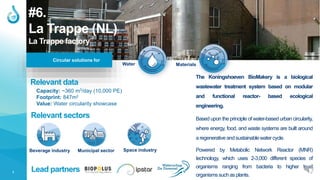
Relevant data
Lead partners
Relevant sectors
#6.
La Trappe (NL)
La Trappe factory
Capacity: ~360 m3
/day (10,000 PE)
Footprint: 847m2
Value: Water circularity showcase
Beverage industry Municipal sector Space industry
The Koningshoeven BioMakery is a biological
wastewater treatment system based on modular
and functional reactor- based ecological
engineering.
Based upon the principle of water-based urban circularity,
where energy, food, and waste systems are built around
a regenerative and sustainablewater cycle.
Powered by Metabolic Network Reactor (MNR)
technology, which uses 2-3,000 different species of
organisms ranging from bacteria to higher level
organismssuchas plants.
2
1. Objectives of the NextGen solutions
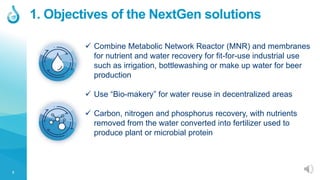
 Combine Metabolic Network Reactor (MNR) and membranes
for nutrient and water recovery for fit-for-use industrial use
such as irrigation, bottlewashing or make up water for beer
production
 Use “Bio-makery” for water reuse in decentralized areas
 Carbon, nitrogen and phosphorus recovery, with nutrients
removed from the water converted into fertilizer used to
produce plant or microbial protein
3
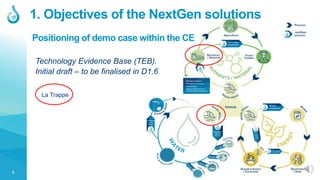
Technology Evidence Base (TEB).
Initial draft – to be finalised in D1.6
La Trappe
Positioning of demo case within the CE
1. Objectives of the NextGen solutions
4
2. New NextGen solutions
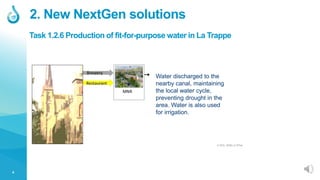
Water discharged to the
nearby canal, maintaining
the local water cycle,
preventing drought in the
area. Water is also used
for irrigation.
© 2020, SEMiLLA IPStar
Task 1.2.6 Production of fit-for-purpose water in La Trappe
5
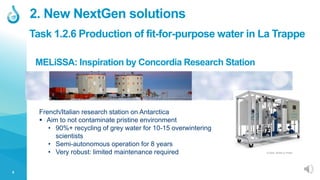
French/Italian research station on Antarctica
 Aim to not contaminate pristine environment
• 90%+ recycling of grey water for 10-15 overwintering
scientists
• Semi-autonomous operation for 8 years
• Very robust: limited maintenance required © 2020, SEMiLLA IPStar
2. New NextGen solutions
MELiSSA: Inspiration by Concordia Research Station
Task 1.2.6 Production of fit-for-purpose water in La Trappe
6
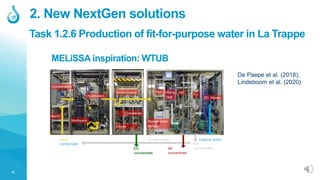
MELiSSA inspiration: WTUB
De Paepe et al. (2018);
Lindeboom et al. (2020)
Task 1.2.6 Production of fit-for-purpose water in La Trappe
2. New NextGen solutions
7
2. New NextGen solutions
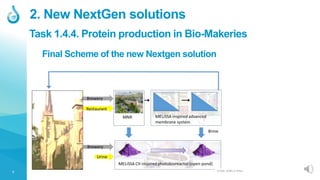
Final Scheme of the new Nextgen solution
© 2020, SEMiLLA IPStar
Task 1.4.4. Protein production in Bio-Makeries
8
3. Results – MNR Water quality analysis
Case
study
Topic Objectives
Key
Parameters
Influent
Range (mg/l)
Discharge
Limits
(mg/l)
Effluent
Range
(mg/l)
#6
La
Trappe
(NL)
Water
Successful
operation of
brewery
MNR
Effluent is fit
for irrigation
use / aquifer
recharge.
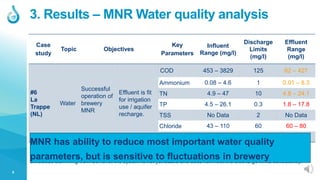
COD 453 – 3829 125 62 – 427
Ammonium 0.08 – 4.6 1 0.01 – 8.3
TN 4.9 – 47 10 4.8 – 24.1
TP 4.5 – 26.1 0.3 1.8 – 17.8
TSS No Data 2 No Data
Chloride 43 – 110 60 60 – 80
Sulphate 20 – 103 60 62 – 159
Note: The MNR on the brewery line demonstrated the ability to reduce most important water quality parameters
below discharge limits under stable influent conditions. However, due to a highly variable influent and operational
difficulties stemming from Covid19, the system is not yet stable and does not meet the discharge limits consistently.
MNR has ability to reduce most important water quality
parameters, but is sensitive to fluctuations in brewery
9
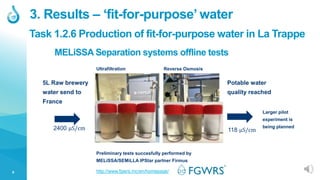
MELiSSA Separation systems offline tests
Preliminary tests succesfully performed by
MELiSSA/SEMiLLA IPStar partner Firmus
http://www.fgwrs.mc/en/homepage/
5L Raw brewery
water send to
France
Potable water
quality reached
Ultrafiltration Reverse Osmosis
Larger pilot
experiment is
being planned
3. Results – ‘fit-for-purpose’ water
Task 1.2.6 Production of fit-for-purpose water in La Trappe
118 μS/cm
2400 μS/cm
10
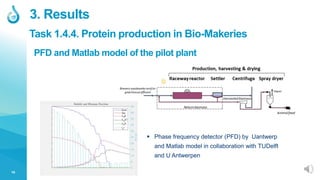
 Phase frequency detector (PFD) by Uantwerp
and Matlab model in collaboration with TUDelft
and U Antwerpen
3. Results
PFD and Matlab model of the pilot plant
Task 1.4.4. Protein production in Bio-Makeries
11
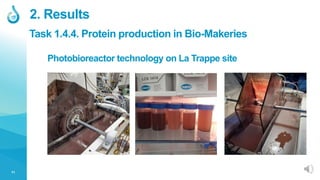
Photobioreactor technology on La Trappe site
2. Results
Task 1.4.4. Protein production in Bio-Makeries
12
5. Lessons learned
 Closer interaction with brewery needed.
 Due to decentralized character highly reliant on too few operators
 Combination with remotely controlled physicochemical treatment
provides redundancy
 Interesting solution that offers opportunity for high-value added product
recovery, but requires large surface area
 Fluctuations may affect quality of biomass
 Operation by highly skilled operators crucial (PD and MSc students)
13
2. Lessons learned – new solutions
Local solution to COVID challenges
Collaboration started with Jotem waterbehandeling B.V.
 Construction of WTUB inspired systems on-going
• Scenario 1: Brewery effluent
• Scenario 2: Municipal effluent
• Both scenarios: reuse quality of permeate (QMRA and
QCRA) and concentrate quality for purple bacteria
Task 1.2.6 Production of fit-for-purpose water in La Trappe
(Pilot)
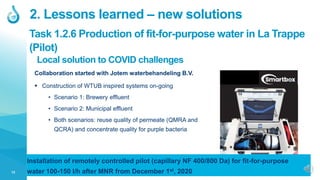
Installation of remotely controlled pilot (capillary NF 400/800 Da) for fit-for-purpose
water 100-150 l/h after MNR from December 1st, 2020
14
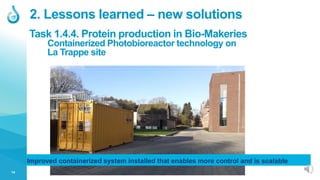
Containerized Photobioreactor technology on
La Trappe site
2. Lessons learned – new solutions
Task 1.4.4. Protein production in Bio-Makeries
Improved containerized system installed that enables more control and is scalable
15
Thank you!
xtGen - Community of Practice
15

NextGen La Trappe Netherlands

  • 1.
    1 Circular solutions for WaterMaterials Relevant data Lead partners Relevant sectors #6. La Trappe (NL) La Trappe factory Capacity: ~360 m3 /day (10,000 PE) Footprint: 847m2 Value: Water circularity showcase Beverage industry Municipal sector Space industry The Koningshoeven BioMakery is a biological wastewater treatment system based on modular and functional reactor- based ecological engineering. Based upon the principle of water-based urban circularity, where energy, food, and waste systems are built around a regenerative and sustainablewater cycle. Powered by Metabolic Network Reactor (MNR) technology, which uses 2-3,000 different species of organisms ranging from bacteria to higher level organismssuchas plants.
  • 2.
    2 1. Objectives ofthe NextGen solutions  Combine Metabolic Network Reactor (MNR) and membranes for nutrient and water recovery for fit-for-use industrial use such as irrigation, bottlewashing or make up water for beer production  Use “Bio-makery” for water reuse in decentralized areas  Carbon, nitrogen and phosphorus recovery, with nutrients removed from the water converted into fertilizer used to produce plant or microbial protein
  • 3.
    3 Technology Evidence Base(TEB). Initial draft – to be finalised in D1.6 La Trappe Positioning of demo case within the CE 1. Objectives of the NextGen solutions
  • 4.
    4 2. New NextGensolutions Water discharged to the nearby canal, maintaining the local water cycle, preventing drought in the area. Water is also used for irrigation. © 2020, SEMiLLA IPStar Task 1.2.6 Production of fit-for-purpose water in La Trappe
  • 5.
    5 French/Italian research stationon Antarctica  Aim to not contaminate pristine environment • 90%+ recycling of grey water for 10-15 overwintering scientists • Semi-autonomous operation for 8 years • Very robust: limited maintenance required © 2020, SEMiLLA IPStar 2. New NextGen solutions MELiSSA: Inspiration by Concordia Research Station Task 1.2.6 Production of fit-for-purpose water in La Trappe
  • 6.
    6 MELiSSA inspiration: WTUB DePaepe et al. (2018); Lindeboom et al. (2020) Task 1.2.6 Production of fit-for-purpose water in La Trappe 2. New NextGen solutions
  • 7.
    7 2. New NextGensolutions Final Scheme of the new Nextgen solution © 2020, SEMiLLA IPStar Task 1.4.4. Protein production in Bio-Makeries
  • 8.
    8 3. Results –MNR Water quality analysis Case study Topic Objectives Key Parameters Influent Range (mg/l) Discharge Limits (mg/l) Effluent Range (mg/l) #6 La Trappe (NL) Water Successful operation of brewery MNR Effluent is fit for irrigation use / aquifer recharge. COD 453 – 3829 125 62 – 427 Ammonium 0.08 – 4.6 1 0.01 – 8.3 TN 4.9 – 47 10 4.8 – 24.1 TP 4.5 – 26.1 0.3 1.8 – 17.8 TSS No Data 2 No Data Chloride 43 – 110 60 60 – 80 Sulphate 20 – 103 60 62 – 159 Note: The MNR on the brewery line demonstrated the ability to reduce most important water quality parameters below discharge limits under stable influent conditions. However, due to a highly variable influent and operational difficulties stemming from Covid19, the system is not yet stable and does not meet the discharge limits consistently. MNR has ability to reduce most important water quality parameters, but is sensitive to fluctuations in brewery
  • 9.
    9 MELiSSA Separation systemsoffline tests Preliminary tests succesfully performed by MELiSSA/SEMiLLA IPStar partner Firmus http://www.fgwrs.mc/en/homepage/ 5L Raw brewery water send to France Potable water quality reached Ultrafiltration Reverse Osmosis Larger pilot experiment is being planned 3. Results – ‘fit-for-purpose’ water Task 1.2.6 Production of fit-for-purpose water in La Trappe 118 μS/cm 2400 μS/cm
  • 10.
    10  Phase frequencydetector (PFD) by Uantwerp and Matlab model in collaboration with TUDelft and U Antwerpen 3. Results PFD and Matlab model of the pilot plant Task 1.4.4. Protein production in Bio-Makeries
  • 11.
    11 Photobioreactor technology onLa Trappe site 2. Results Task 1.4.4. Protein production in Bio-Makeries
  • 12.
    12 5. Lessons learned Closer interaction with brewery needed.  Due to decentralized character highly reliant on too few operators  Combination with remotely controlled physicochemical treatment provides redundancy  Interesting solution that offers opportunity for high-value added product recovery, but requires large surface area  Fluctuations may affect quality of biomass  Operation by highly skilled operators crucial (PD and MSc students)
  • 13.
    13 2. Lessons learned– new solutions Local solution to COVID challenges Collaboration started with Jotem waterbehandeling B.V.  Construction of WTUB inspired systems on-going • Scenario 1: Brewery effluent • Scenario 2: Municipal effluent • Both scenarios: reuse quality of permeate (QMRA and QCRA) and concentrate quality for purple bacteria Task 1.2.6 Production of fit-for-purpose water in La Trappe (Pilot) Installation of remotely controlled pilot (capillary NF 400/800 Da) for fit-for-purpose water 100-150 l/h after MNR from December 1st, 2020
  • 14.
    14 Containerized Photobioreactor technologyon La Trappe site 2. Lessons learned – new solutions Task 1.4.4. Protein production in Bio-Makeries Improved containerized system installed that enables more control and is scalable
  • 15.
    15 Thank you! xtGen -Community of Practice 15