1
Circular solutions for
Water
Westland Region (NL)
Relevant data Relevant sectors
Horticulture Households
Lead partners
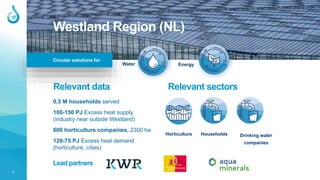
0,5 M households served
100-150 PJ Excess heat supply
(industry near outside Westland)
600 horticulture companies, 2300 ha
120-75 PJ Excess heat demand
(horticulture, cities)
Energy
Drinking water
companies
2
Region Delfland (incl. Westland)
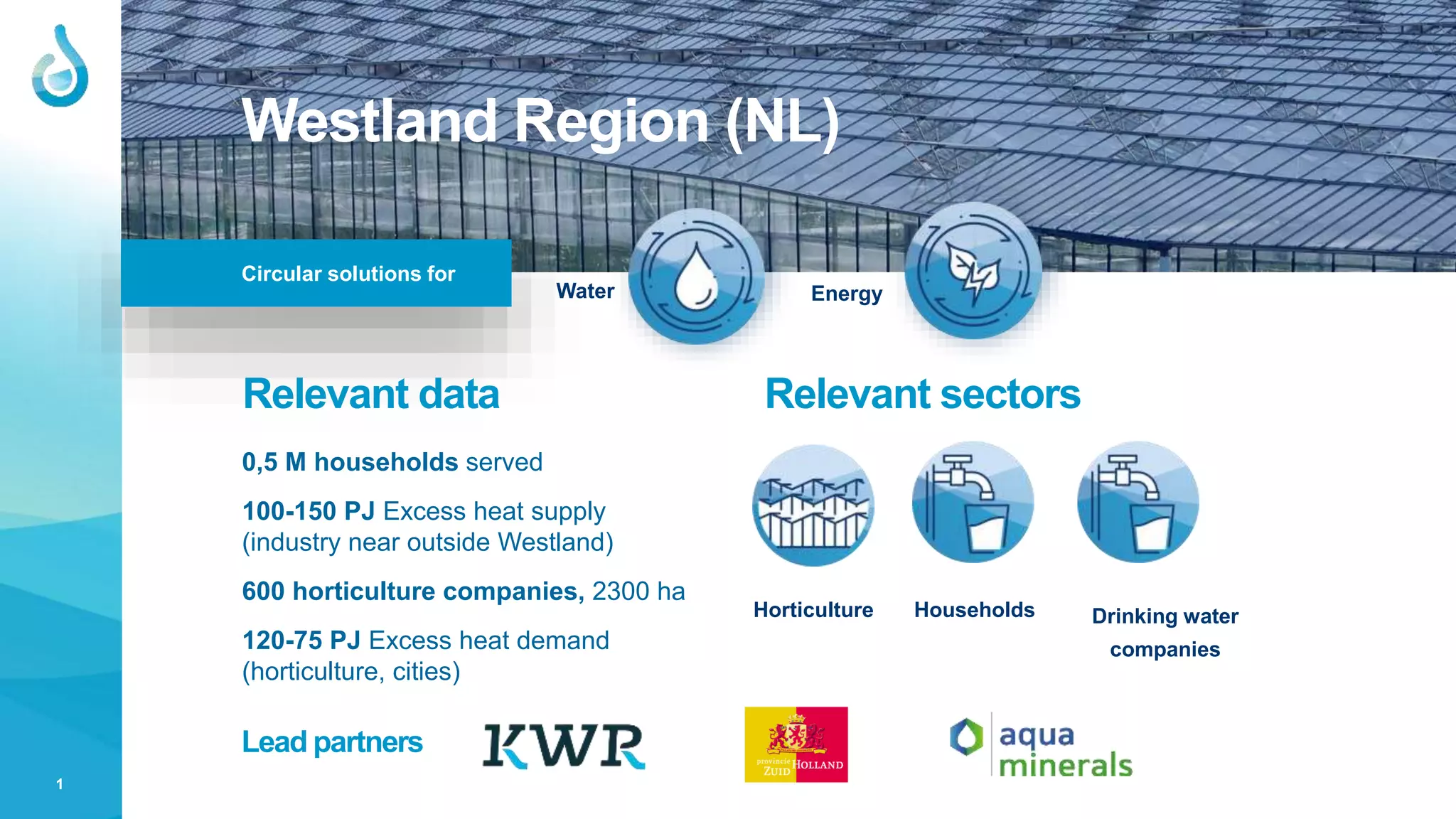
Delfland region is characterized by
the horticulture sector (Westland)
and Urban area (Rotterdam)
Horticulture = Front runner sector
- High yield production with limited space
- Very effective use and recyling of water
- High environmental goals. Zero emission
of nutrients and pesticides in 2027
- Transition to sustainable energy sources
3
1. Objectives of the NextGen solutions
The demonstration of an integrated approach for a circular water system at the Delfland region.
The key innovations and actions:
1. For the transition towards a more circular water system in the Delfland region, an integrated assessment
of performance of technologies and strategies will be done. This assessment will include (T1.2.1):
• The use of alternative water sources (through region-wide rainwater storage and reuse using large scale
Aquifer Storage & Recovery (ASR) systems and reuse of WWTP effluent) and advanced water treatment
systems (recycling and purification) for the horticulture sector,
• And several urban water management systems (rainwater harvesting, grey water recycling, green roofs
and domestic water saving).
2. For an integrated water-energy approach in the Delfland region, the contribution of Aquifer Thermal
Energy Storage systems (ATES) to the overall energy balance will be assessed. This assessment will include
(T1.3.5):
• A feasibility study of a High Temperature-Aquifer Thermal Energy Storage system (HT-ATES) at the
horticulture Koppert Cress, and the role HT-ATES could play in the South-Holland heat roundabout.
3. For the upscaling of the recovery of materials and resources from the water system, a novel business
model of reused materials brokerage will be demonstrated (T5.1)
4
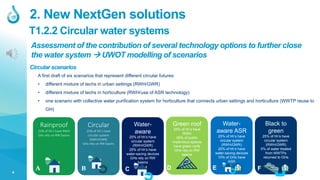
T1.2.2 Circular water systems
2. New NextGen solutions
Circular scenarios
A first draft of six scenarios that represent different circular futures:
• different mixture of techs in urban settings (RWH/GWR)
• different mixture of techs in horticulture (RWH/use of ASR technology)
• one scenario with collective water purification system for horticulture that connects urban settings and horticulture (WWTP reuse to
GH)
Rainproof
25% of hh’s have RWH
GHs rely on RW basins
A
Circular
25% of hh’s have
circular system
(RWH/GWR)
GHs rely on RW basins
B
Water-
aware
25% of hh’s have
circular system
(RWH/GWR)
25% of hh’s have
water-saving devices
GHs rely on RW
basins
C
Green roof
25% of hh’s have
RWH
50% of public
impervious spaces
have green roofs
GHs rely on RW
basins
D
Water-
aware ASR
25% of hh’s have
circular system
(RWH/GWR)
25% of hh’s have
water-saving devices
10% of GHs have
ASR
E
Black to
green
25% of hh’s have
circular system
(RWH/GWR)
5% of water treated
from WWTPs
returned to GHs
F
Assessment of the contribution of several technology options to further close
the water system  UWOT modelling of scenarios
5
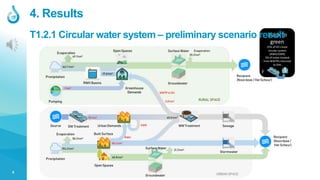
T1.2.1 Circular water system – preliminary scenario result
4. Results
6
T1.2.1 Circular water systems
2. New NextGen solutions
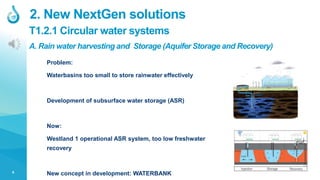
A. Rain water harvesting and Storage (Aquifer Storage and Recovery)
Problem:
Waterbasins too small to store rainwater effectively
Development of subsurface water storage (ASR)
Now:
Westland 1 operational ASR system, too low freshwater
recovery
New concept in development: WATERBANK
7
T1.2.1 Circular water systems
2. New NextGen solutions
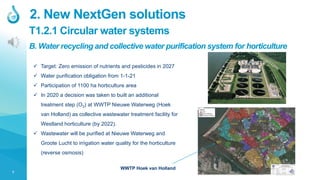
B. Water recycling and collective water purification system for horticulture
 Target: Zero emission of nutrients and pesticides in 2027
 Water purification obligation from 1-1-21
 Participation of 1100 ha horticulture area
 In 2020 a decision was taken to built an additional
treatment step (O3) at WWTP Nieuwe Waterweg (Hoek
van Holland) as collective wastewater treatment facility for
Westland horticulture (by 2022).
 Wastewater will be purified at Nieuwe Waterweg and
Groote Lucht to irrigation water quality for the horticulture
(reverse osmosis)
WWTP Hoek van Holland
8
2. New NextGen solutions
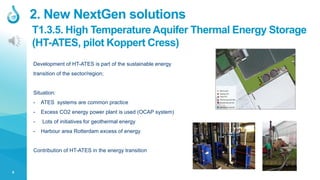
T1.3.5. High Temperature Aquifer Thermal Energy Storage
(HT-ATES, pilot Koppert Cress)
Development of HT-ATES is part of the sustainable energy
transition of the sector/region;
Situation:
- ATES systems are common practice
- Excess CO2 energy power plant is used (OCAP system)
- Lots of initiatives for geothermal energy
- Harbour area Rotterdam excess of energy
Contribution of HT-ATES in the energy transition
9
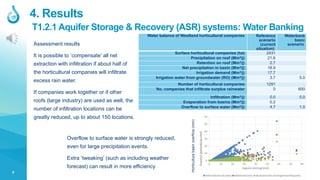
4. Results
Water balance of Westland horticultural companies Reference
scenario
(current
situation)
Waterbank
basic
scenario
Surface horticultural companies (ha) 2431
Precipitation on roof (Mm3/j) 21.6
Retention on roof (Mm3/j) 2.7
Net precipitation in basin (Mm3/j) 18.9
Irrigation demand (Mm3/j) 17.7
Irrigation water from groundwater (RO) (Mm3/j) 3.7 5.0
Number of horticultural companies 1291
No. companies that infiltrate surplus rainwater 0 600
Infiltration (Mm3/j) 0.0 5.0
Evaporation from basins (Mm3/j) 0.2
Overflow to surface water (Mm3/j) 4.7 1.0
Overflow to surface water is strongly reduced,
even for large precipitation events.
Extra ‘tweaking’ (such as including weather
forecast) can result in more efficiency
Assessment results
It is possible to ‘compensate’ all net
extraction with infiltration if about half of
the horticultural companies will infiltrate
excess rain water.
If companies work together or if other
roofs (large industry) are used as well, the
number of infiltration locations can be
greatly reduced, up to about 150 locations.
Horticulture
basin
overflow
(mm)
T1.2.1 Aquifer Storage & Recovery (ASR) systems: Water Banking
10
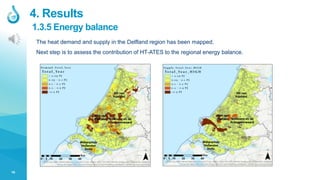
4. Results
1.3.5 Energy balance
The heat demand and supply in the Delfland region has been mapped.
Next step is to assess the contribution of HT-ATES to the regional energy balance.
11
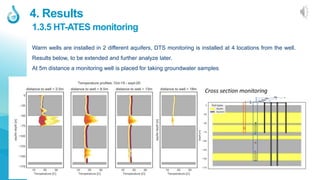
4. Results
1.3.5 HT-ATES monitoring
Warm wells are installed in 2 different aquifers, DTS monitoring is installed at 4 locations from the well.
Results below, to be extended and further analyze later.
At 5m distance a monitoring well is placed for taking groundwater samples
12
5. Lessons learned
1. ‘Cycling’ thinking requires a view and acting of the whole watercycle
2. Cooperation is crucial -> interdependency between stakeholders
3. But requires also a ‘cross border’ view of stakeholders and that is difficult in
practice!
13
5. Lessons learned
Example
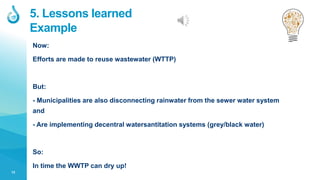
Now:
Efforts are made to reuse wastewater (WTTP)
But:
- Municipalities are also disconnecting rainwater from the sewer water system
and
- Are implementing decentral watersantitation systems (grey/black water)
So:
In time the WWTP can dry up!
14
Thank you!
xtGen - Community of Practice
14
anna.serra@eurecat.org
sandra.cases@eurecat.org

NextGen Westland, Netherlands

  • 1.
    1 Circular solutions for Water WestlandRegion (NL) Relevant data Relevant sectors Horticulture Households Lead partners 0,5 M households served 100-150 PJ Excess heat supply (industry near outside Westland) 600 horticulture companies, 2300 ha 120-75 PJ Excess heat demand (horticulture, cities) Energy Drinking water companies
  • 2.
    2 Region Delfland (incl.Westland) Delfland region is characterized by the horticulture sector (Westland) and Urban area (Rotterdam) Horticulture = Front runner sector - High yield production with limited space - Very effective use and recyling of water - High environmental goals. Zero emission of nutrients and pesticides in 2027 - Transition to sustainable energy sources
  • 3.
    3 1. Objectives ofthe NextGen solutions The demonstration of an integrated approach for a circular water system at the Delfland region. The key innovations and actions: 1. For the transition towards a more circular water system in the Delfland region, an integrated assessment of performance of technologies and strategies will be done. This assessment will include (T1.2.1): • The use of alternative water sources (through region-wide rainwater storage and reuse using large scale Aquifer Storage & Recovery (ASR) systems and reuse of WWTP effluent) and advanced water treatment systems (recycling and purification) for the horticulture sector, • And several urban water management systems (rainwater harvesting, grey water recycling, green roofs and domestic water saving). 2. For an integrated water-energy approach in the Delfland region, the contribution of Aquifer Thermal Energy Storage systems (ATES) to the overall energy balance will be assessed. This assessment will include (T1.3.5): • A feasibility study of a High Temperature-Aquifer Thermal Energy Storage system (HT-ATES) at the horticulture Koppert Cress, and the role HT-ATES could play in the South-Holland heat roundabout. 3. For the upscaling of the recovery of materials and resources from the water system, a novel business model of reused materials brokerage will be demonstrated (T5.1)
  • 4.
    4 T1.2.2 Circular watersystems 2. New NextGen solutions Circular scenarios A first draft of six scenarios that represent different circular futures: • different mixture of techs in urban settings (RWH/GWR) • different mixture of techs in horticulture (RWH/use of ASR technology) • one scenario with collective water purification system for horticulture that connects urban settings and horticulture (WWTP reuse to GH) Rainproof 25% of hh’s have RWH GHs rely on RW basins A Circular 25% of hh’s have circular system (RWH/GWR) GHs rely on RW basins B Water- aware 25% of hh’s have circular system (RWH/GWR) 25% of hh’s have water-saving devices GHs rely on RW basins C Green roof 25% of hh’s have RWH 50% of public impervious spaces have green roofs GHs rely on RW basins D Water- aware ASR 25% of hh’s have circular system (RWH/GWR) 25% of hh’s have water-saving devices 10% of GHs have ASR E Black to green 25% of hh’s have circular system (RWH/GWR) 5% of water treated from WWTPs returned to GHs F Assessment of the contribution of several technology options to further close the water system  UWOT modelling of scenarios
  • 5.
    5 T1.2.1 Circular watersystem – preliminary scenario result 4. Results
  • 6.
    6 T1.2.1 Circular watersystems 2. New NextGen solutions A. Rain water harvesting and Storage (Aquifer Storage and Recovery) Problem: Waterbasins too small to store rainwater effectively Development of subsurface water storage (ASR) Now: Westland 1 operational ASR system, too low freshwater recovery New concept in development: WATERBANK
  • 7.
    7 T1.2.1 Circular watersystems 2. New NextGen solutions B. Water recycling and collective water purification system for horticulture  Target: Zero emission of nutrients and pesticides in 2027  Water purification obligation from 1-1-21  Participation of 1100 ha horticulture area  In 2020 a decision was taken to built an additional treatment step (O3) at WWTP Nieuwe Waterweg (Hoek van Holland) as collective wastewater treatment facility for Westland horticulture (by 2022).  Wastewater will be purified at Nieuwe Waterweg and Groote Lucht to irrigation water quality for the horticulture (reverse osmosis) WWTP Hoek van Holland
  • 8.
    8 2. New NextGensolutions T1.3.5. High Temperature Aquifer Thermal Energy Storage (HT-ATES, pilot Koppert Cress) Development of HT-ATES is part of the sustainable energy transition of the sector/region; Situation: - ATES systems are common practice - Excess CO2 energy power plant is used (OCAP system) - Lots of initiatives for geothermal energy - Harbour area Rotterdam excess of energy Contribution of HT-ATES in the energy transition
  • 9.
    9 4. Results Water balanceof Westland horticultural companies Reference scenario (current situation) Waterbank basic scenario Surface horticultural companies (ha) 2431 Precipitation on roof (Mm3/j) 21.6 Retention on roof (Mm3/j) 2.7 Net precipitation in basin (Mm3/j) 18.9 Irrigation demand (Mm3/j) 17.7 Irrigation water from groundwater (RO) (Mm3/j) 3.7 5.0 Number of horticultural companies 1291 No. companies that infiltrate surplus rainwater 0 600 Infiltration (Mm3/j) 0.0 5.0 Evaporation from basins (Mm3/j) 0.2 Overflow to surface water (Mm3/j) 4.7 1.0 Overflow to surface water is strongly reduced, even for large precipitation events. Extra ‘tweaking’ (such as including weather forecast) can result in more efficiency Assessment results It is possible to ‘compensate’ all net extraction with infiltration if about half of the horticultural companies will infiltrate excess rain water. If companies work together or if other roofs (large industry) are used as well, the number of infiltration locations can be greatly reduced, up to about 150 locations. Horticulture basin overflow (mm) T1.2.1 Aquifer Storage & Recovery (ASR) systems: Water Banking
  • 10.
    10 4. Results 1.3.5 Energybalance The heat demand and supply in the Delfland region has been mapped. Next step is to assess the contribution of HT-ATES to the regional energy balance.
  • 11.
    11 4. Results 1.3.5 HT-ATESmonitoring Warm wells are installed in 2 different aquifers, DTS monitoring is installed at 4 locations from the well. Results below, to be extended and further analyze later. At 5m distance a monitoring well is placed for taking groundwater samples
  • 12.
    12 5. Lessons learned 1.‘Cycling’ thinking requires a view and acting of the whole watercycle 2. Cooperation is crucial -> interdependency between stakeholders 3. But requires also a ‘cross border’ view of stakeholders and that is difficult in practice!
  • 13.
    13 5. Lessons learned Example Now: Effortsare made to reuse wastewater (WTTP) But: - Municipalities are also disconnecting rainwater from the sewer water system and - Are implementing decentral watersantitation systems (grey/black water) So: In time the WWTP can dry up!
  • 14.
    14 Thank you! xtGen -Community of Practice 14 anna.serra@eurecat.org sandra.cases@eurecat.org