MANDIBULAR
IMPACTIONS
.
Contents
Introduction
Definitions
Etiology of impaction
Order of frequency of impaction
Complications associated with
retained impacted teeth
Indications & contraindications for
removal of impacted teeth.
Impacted mandibular third molar
Surgical anatomy of molar
region
Classification
Preoperative assessment
Diagnosis
Evaluation of risk of removal –
I/O, E/O, RADIOGRAPHS
Informed consent.
Extraction Vs non-extraction management
of impacted third molar
Various surgical procedures for removal of
impacted third molar
Other impacted teeth,
Canine
Premolars
1st & 2nd molars
Surgical consideration for impacted teeth
in
The region of elective osteotomies
In the line of fracture.
Complications of removal of
impacted tooth
Conclusion
References.
Introduction
The most commonly performed surgical procedure in most
oral and maxillofacial surgery practices is the removal of
impacted teeth.
Surgical removal of the impacted tooth is a problem under
the best circumstances. The surgeon can perform the
surgery more comfortably and scientifically if he has
determined in advance just what problems he will
encounter. With this information he can plan a well
organized surgical approach including a proper patient
evaluation, an accurate diagnosis and radiographic
localization and necessary preoperative consultations.
Impacted tooth -Definitions
A tooth which is completely or partially unerupted and is
positioned against another tooth, bone or soft tissue so that its
further eruption is unlikely, described according to its anatomic
Position . (Archer)
An impacted tooth is one that is partially erupted or unerupted ,
beyond the chronological date of eruption, and will not
eventually assume a normal relationship with other teeth and
tissues.
An impacted tooth is one, which fails to either erupt partially or
totally in its normal place in mouth due to inadequate space, and
obstruction of an adjacent tooth or teeth or soft tissue and bone,
beyond its chronological age of eruption.
The term "impacted teeth" is often used incorrectly. Descriptive terms
should be applied when classifying impacted teeth
Malposed tooth: A tooth, unerupted or erupted, which is in
an abnormal position in the maxilla or mandible.
Unerupted tooth: A tooth not having perforated the oral
mucosa. Early loss of deciduous teeth may cause arrested
development teeth.
Embedded tooth: This term is synonymous with the term
impacted tooth.
Partial impaction: A tooth that is incompletely erupted is a
partial eruption. The tooth may be seen clinically but is
frequently malposed and always covered with soft tissue to
some extent.
Complete bony impaction: The tooth is completely contained
within the bone
Partial bony impaction: The tooth is partially covered with the
bone. The tooth may be a complete soft tissue impaction & a
partial bony impaction.
Potential impaction: An unerupted tooth that still retains the
potential for eruption, but which will most likely not erupt
into normal position & function because of obstruction, unless
surgical intervention occurs – is referred to as potential
impaction.
Ectopic/ displaced teeth: a tooth is ectopic if malposed due to
congenital factors or displaced by the presence of pathology.
Ankylosed teeth: when the cementum of the teeth is fused to
the bone and there is no periodontal soft tissue in between, a
tooth is considered to be ankylosed
Etilogy of impaction
Nodine points out that for at least 200 years it has been
believed that civilization could be held responsible for the
withdrawal or elimination of a stimulus that is necessary for
development of the human jaws.
This lost stimulus is the force demanded for the mastication
of hard food. The modern soft diet does not require a decided
effort in mastication. And so, this growth stimulus of the
jaws is lost- gradual evolutionary reduction in the size of
the human jaw which is too small to accommodate third
molars. and thus modern man has impacted teeth.
Theories of impaction
(DURBECK)
Orthodontic theory
The normal growth of the jaws and movement of teeth is in a forward
direction and anything interfering with such development will cause
an impaction of teeth.
Dense bone and many pathologic conditions like acute
infections, fever, severe trauma ,malocclusion ,inflammation
of the periodontal membrane etc which can cause increased
bone density - retards such forward growth of the jaws
Constant mouth breathing - contracted arches. Thus leaving
insufficient room for erupting M3.
Early loss of deciduous teeth - arrested development of teeth,
resulting in impactions.
Nature tries to eliminate that what is not used,
and our civilization with its changing nutritional
habits has practically eliminated the human need
for large powerful jaws.
As a result, the size of jaws has decreased -
abnormal position of M3 leading to impaction
Phylogenic theory
Heredity – such as transmission of small jaws from
parent and large teeth from the other parent– may be
an important etiologic factor in impactions.
Mendelian theory
Causes of impaction
Local Systemic
local causes (Berger)
Irregularity in the position and presence of an
adjacent tooth.
Density of the overlying or surrounding bone.
Long – continued chronic inflammation with
resultant increase in density of the overlying
mucous membrane.
Lack of space due to underdeveloped jaws.
Unduly long retention of the primary teeth.
Premature loss of the primary teeth.
Acquired diseases, such as necrosis due to
infection or abscesses and inflammatory changes
in the bone due to exanthematous diseases in
children
Systemic causes (Berger)
Prenatal causes
Heredity
Miscegenation
Postnatal causes
Rickets
Anemia
Congenital syphilis
T.B
Endocrine dysfunctions
Malnutrition
Rare conditions
Cleidocranial dysostosis
Oxycephaly
Progeria
Achondroplasia
Cleft palate
Order of impaction
According to Archer impacted teeth occur in the following
order of frequency:
Maxillary 3rd molars.
Mandibular 3rd molars.
Maxillary cuspids.
Mandibular bicuspids.
Mandibular cuspids.
Maxillary bicuspids.
Maxillary central incisors.
Maxillary lateral incisors
Complications associated with retained
impacted teeth:
Dental caries
Pericoronal infection
Pain
Fascial space infections
Risk of development of cysts and tumors
Fractures
Trismus
Other complications
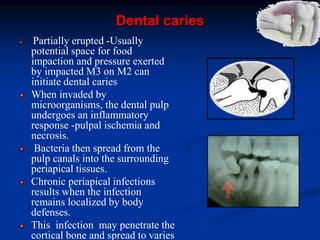
Dental caries
Partially erupted -Usually
potential space for food
impaction and pressure exerted
by impacted M3 on M2 can
initiate dental caries
When invaded by
microorganisms, the dental pulp
undergoes an inflammatory
response -pulpal ischemia and
necrosis.
Bacteria then spread from the
pulp canals into the surrounding
periapical tissues.
Chronic periapical infections
results when the infection
remains localized by body
defenses.
This infection may penetrate the
cortical bone and spread to varies
pain
Pain may be referred not only to the areas of
distribution of the nerve involved and even to the
associated nerve plexus, but also to remote regions.
Pain is often referred to the ear.
Pain may be slight and restricted to the immediate
area of the impacted tooth, or it may be severe, even
excruciating, involving all the lower and upper teeth
on the affected side, the ear, the post-auricular area,
any part of the area supplied by the trigeminal nerve,
or even the entire area supplied by this nerve.
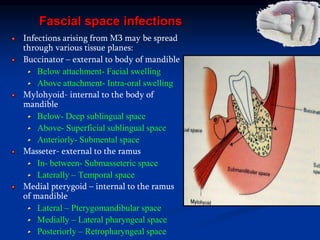
Fascial space infections
Infections arising from M3 may be spread
through various tissue planes:
Buccinator – external to body of mandible
Below attachment- Facial swelling
Above attachment- Intra-oral swelling
Mylohyoid- internal to the body of
mandible
Below- Deep sublingual space
Above- Superficial sublingual space
Anteriorly- Submental space
Masseter- external to the ramus
In- between- Submasseteric space
Laterally – Temporal space
Medial pterygoid – internal to the ramus
of mandible
Lateral – Pterygomandibular space
Medially – Lateral pharyngeal space
Posteriorly – Retropharyngeal space
Risk of development of cysts and tumors
Most cystic changes were found in patients
between20 and 25 years, and the various studies
therefore concluded that age may be used as
an indication for surgical removal of impacted
lower third molars , as the risk of surgical
morbidity also increases with the increasing
age.
Incidence of dentigerous cyst- 1.6%
(KEITH,1973)
Incidence of cyst and tumour formation-
2.31%(Guven et al,2000)
Incidence of ameloblastoma – 0.14 - 2
%(Shear,1978)
Risk of surgical morbidity increases with age.
Other complications
Ringing, singing or buzzing sound in the ear.
Otitis
Affections of the eye, such as dimness of vision,
blindness, iritis, pain simulating that of glaucoma.
Trismus
Cheek bite etc.
Indications for removal of impacted
teeth
Disparity in Size or Number of Teeth and Jaw Structure :
If disparity exists between the size or number of teeth and
the size of the jaw and when alternative modalities of
treatment such as' orthodontics or transplantation of the
tooth are not feasible
Lack of space in the jaw is probably the most common
indication for removal of impacted teeth of all types.
Facilitation of
Orthodontic Treatment :
Removal of unerupted permanent teeth early in the course
of orthodontic treatment is indicated when the orthodontist
has determined that such removal will facilitate the overall
treatment of the case .
Damage to Adjacent Teeth :
Entrapment of food, development of caries and elimination
of bony support to a functional tooth immediately adjacent
to it indicates its removal. The removal of impacted M3
early results in better prognosis for the second molar
because bony defects created by surgical removal of teeth
in young adults fill rapidly and more completely than in
older individuals .
Impacted Teeth under Prosthetic Appliances
Impacted teeth in edentulous areas may be discovered
radiographically when construction of a prosthesis is being
contemplated. Removal of symptomatic impacted teeth
under a prosthesis is almost always indicated. It is usually
advisable to remove impacted teeth in apparently
edentulous mandibles prior to denture construction.
Impacted Teeth Associated with Qdontogenic Tumors
or Cyst of the Jaw
A tooth displaced by a cyst may erupt following the removal of
a cyst -removal is not necessary.
Impacted Teeth with Recurrent Infection
Partially impacted teeth often become infected repeatedly.
Impacted teeth under prosthetic appliances and those
associated with odontogenic cysts and tumours may make
their initial presence known by an infection.
Internal Resorption or Caries Associated with an Impacted
Tooth
Dental caries or internal or external resorption of an impacted
tooth is an indication for its removal. It is not uncommon to
find caries in the crown of an uncovered impacted third molar.
Although the tooth did not appear to have contact with the oral
cavity, a communication existed permitting bacteria to reach it.
Pain of Unknown Etiology :
Pain in the temporomandibular joint, the ear, neck, and opposing dental
arch on the same side, and occasionally headache, may be eliminated by
removal of an impacted tooth. Because of the multiplicity of factors
which result in pain, one cannot make guarantees that removal of an
impacted tooth will solve an atypical pain problem, but removal of
impacted teeth is a rational positive step that often solves an unexplained
problem of vague head pain.
Removal of Impacted Teeth in Preparation for Irradiation of the Jaws and
Surrounding Tissues
If the ports of delivery of the radiation include the teeth, especially
partially impacted teeth, the teeth should be removed prior to radiation
therapy. During the last 20 years, removal of teeth prior to radiation
therapy has become less popular, but the pendulum is beginning to swing
back because a number of patients have been seen with
osteoradionecrosis following postradiation removal of teeth.
Lack of Function. as an Indication for Removal of Impacted Teeth
When it is determined that an impacted tooth does not and will not
perform a useful function in the oral cavity the tooth should be removed
immediately if no contraindications to surgery .
Contraindications for removal of
impacted teeth
Possible Damage to Adjacent Structures
If the removal of an asymptomatic impaction is
likely to result in the loss of adjacent teeth, damage
to the vital structures like neurovascular bundle,
the tooth should be left in place.
Compromised Physical Status
One of the most significant factors to be
considered when removing of an impacted tooth is
the patient's physical condition and life
expectancy. Surgical removal is contra indicated if
the patient is not fit to undergo minor oral surgical
procedure.
Prosthetic consideration
Sometimes, partially erupted tooth has to be
retained since such a tooth has to be could be
utilized as an abutment for a fixed partial denture.
Availability of adequate space:
If adequate space is available for the eruption of
the unerupted tooth, it is better to retain it.
Socioeconomic reasons:
The patient may not be willing for removal due to
fear or socioeconomic reasons.
According to Larry J. Peterson the general contraindications
for removal of impacted teeth can be grouped into 3
primary areas :
Patients age – extremes of age,
Poor heath.
Surgical damage to adjacent structures.
Local factors
Radiotherapy
Teeth in close proximity to tumour
Acute gingivitis
Systemic factors
Uncontrolled diabetes
Pregnancy
Underlying bleeding disorders
Acute blood dyscrasias
Cardiac conditions
Patients on anticoagulants, steroids,etc
Impacted mandibular third
molar
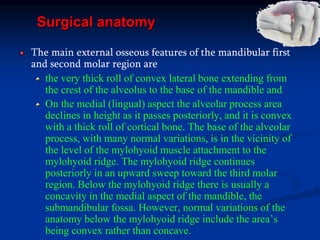
Surgical anatomy
The main external osseous features of the mandibular first
and second molar region are
the very thick roll of convex lateral bone extending from
the crest of the alveolus to the base of the mandible and
On the medial (lingual) aspect the alveolar process area
declines in height as it passes posteriorly, and it is convex
with a thick roll of cortical bone. The base of the alveolar
process, with many normal variations, is in the vicinity of
the level of the mylohyoid muscle attachment to the
mylohyoid ridge. The mylohyoid ridge continues
posteriorly in an upward sweep toward the third molar
region. Below the mylohyoid ridge there is usually a
concavity in the medial aspect of the mandible, the
submandibular fossa. However, normal variations of the
anatomy below the mylohyoid ridge include the area’s
being convex rather than concave.
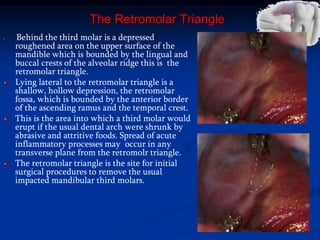
The Retromolar Triangle
Behind the third molar is a depressed
roughened area on the upper surface of the
mandible which is bounded by the lingual and
buccal crests of the alveolar ridge this is the
retromolar triangle.
Lying lateral to the retromolar triangle is a
shallow, hollow depression, the retromolar
fossa, which is bounded by the anterior border
of the ascending ramus and the temporal crest.
This is the area into which a third molar would
erupt if the usual dental arch were shrunk by
abrasive and attritive foods. Spread of acute
inflammatory processes may occur in any
transverse plane from the retromolr triangle.
The retromolar triangle is the site for initial
surgical procedures to remove the usual
impacted mandibular third molars.
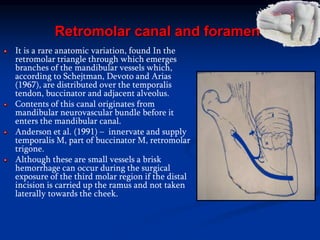
Retromolar canal and foramen
It is a rare anatomic variation, found In the
retromolar triangle through which emerges
branches of the mandibular vessels which,
according to Schejtman, Devoto and Arias
(1967), are distributed over the temporalis
tendon, buccinator and adjacent alveolus.
Contents of this canal originates from
mandibular neurovascular bundle before it
enters the mandibular canal.
Anderson et al. (1991) – innervate and supply
temporalis M, part of buccinator M, retromolar
trigone.
Although these are small vessels a brisk
hemorrhage can occur during the surgical
exposure of the third molar region if the distal
incision is carried up the ramus and not taken
laterally towards the cheek.
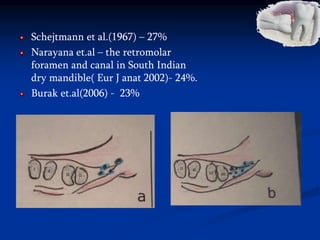
Schejtmann et al.(1967) – 27%
Narayana et.al – the retromolar
foramen and canal in South Indian
dry mandible( Eur J anat 2002)- 24%.
Burak et.al(2006) - 23%
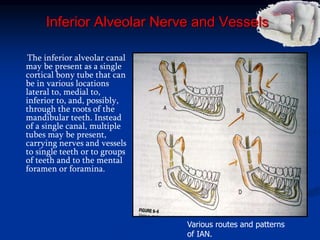
Inferior Alveolar Nerve and Vessels
The inferior alveolar canal
may be present as a single
cortical bony tube that can
be in various locations
lateral to, medial to,
inferior to, and, possibly,
through the roots of the
mandibular teeth. Instead
of a single canal, multiple
tubes may be present,
carrying nerves and vessels
to single teeth or to groups
of teeth and to the mental
foramen or foramina.
Various routes and patterns
of IAN.
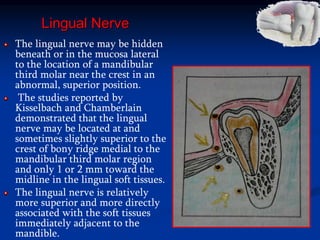
Lingual Nerve
The lingual nerve may be hidden
beneath or in the mucosa lateral
to the location of a mandibular
third molar near the crest in an
abnormal, superior position.
The studies reported by
Kisselbach and Chamberlain
demonstrated that the lingual
nerve may be located at and
sometimes slightly superior to the
crest of bony ridge medial to the
mandibular third molar region
and only 1 or 2 mm toward the
midline in the lingual soft tissues.
The lingual nerve is relatively
more superior and more directly
associated with the soft tissues
immediately adjacent to the
mandible.
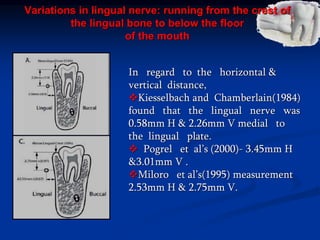
Variations in lingual nerve: running from the crest of
the lingual bone to below the floor
of the mouth
In regard to the horizontal &
vertical distance,
Kiesselbach and Chamberlain(1984)
found that the lingual nerve was
0.58mm H & 2.26mm V medial to
the lingual plate.
 Pogrel et al’s (2000)- 3.45mm H
&3.01mm V .
Miloro et al’s(1995) measurement
2.53mm H & 2.75mm V.
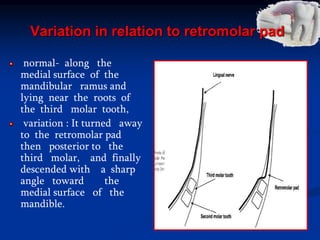
Variation in relation to retromolar pad
normal- along the
medial surface of the
mandibular ramus and
lying near the roots of
the third molar tooth,
variation : It turned away
to the retromolar pad
then posterior to the
third molar, and finally
descended with a sharp
angle toward the
medial surface of the
mandible.
Various pathways of the lingual nerve
In relation to the
submandibular duct:
It may run close to the third
molar region and above the
submandibular duct.
It may run below the dut but
above the gland, far from the
third molar area.
It may run below the duct
and gland far from the third
molar area.
Classification of third molar impactions
Winters classification : G.B
WINTER IN THE YEAR 1925
was the first one to devise a
satisfactory classification of the
third molar on the basis of the
long axis of the impacted
mandibular 3rd molar in relation
to the long axis of the 2nd molar .
Vertical.
Horizontal
Inverted
Mesioangular
Distrangular
Buccoangular
Linguoangular
These may also
occur
simultaneously in :
Buccal version
Lingual version
Torsiversion
Degree of angulation(α angle)
The degree of angulation was
determined by measurement of
the angle between the
longitudinal
axis of the wisdom tooth and the
occlusal plane.
Vertical – 80 and 100,
Mesioangular - 10 and 80
Distoangular - 100, and
Horizontal- 350 and 10.
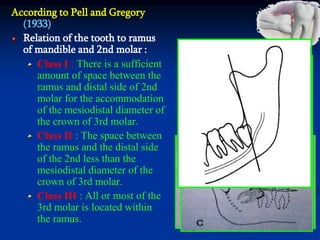
According to Pell and Gregory
(1933)
Relation of the tooth to ramus
of mandible and 2nd molar :
Class I : There is a sufficient
amount of space between the
ramus and distal side of 2nd
molar for the accommodation
of the mesiodistal diameter of
the crown of 3rd molar.
Class II : The space between
the ramus and the distal side
of the 2nd less than the
mesiodistal diameter of the
crown of 3rd molar.
Class III : All or most of the
3rd molar is located within
the ramus.
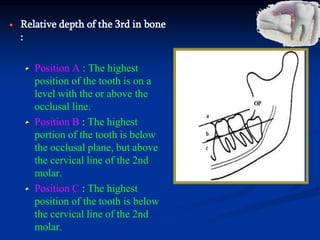
Relative depth of the 3rd in bone
:
Position A : The highest
position of the tooth is on a
level with the or above the
occlusal line.
Position B : The highest
portion of the tooth is below
the occlusal plane, but above
the cervical line of the 2nd
molar.
Position C : The highest
position of the tooth is below
the cervical line of the 2nd
molar.
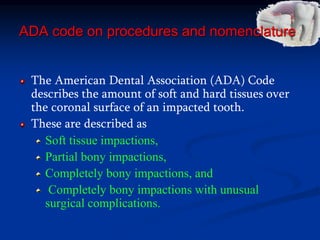
ADA code on procedures and nomenclature
The American Dental Association (ADA) Code
describes the amount of soft and hard tissues over
the coronal surface of an impacted tooth.
These are described as
Soft tissue impactions,
Partial bony impactions,
Completely bony impactions, and
Completely bony impactions with unusual
surgical complications.
Combined ADA and AAOMS classifications
The AAOMS published the ADA coding with explanations from the AAOMS procedural
terminology, in parentheses, as follows:
07220 : Removal of impacted tooth – (overlying) soft tissue.Impaction that
requires incision of overlying soft tissue and the removal of the tooth.
07230 : Removal of impacted tooth – partially bony impacted Impaction that
requires incision of overlying soft tissue, elevation of a flap, and either removal
of bone and tooth or sectioning and removal of tooth.
07240 : Removal of impacted tooth – completely bony.Impaction that requires
incision of overlying soft tissue, elevation of a flap, removal of bone, and
sectioning of tooth for removal.
07241 : Removal of impacted tooth – completely bony, with unusual surgical
complications. Impaction that requires incision of overlying soft tissue,
elevation of a flap, removal of bone, sectioning of the tooth for removal, and/or
presents unusual difficulties and circumstances.
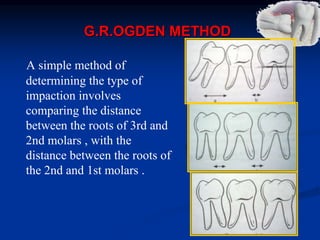
G.R.OGDEN METHOD
A simple method of
determining the type of
impaction involves
comparing the distance
between the roots of 3rd and
2nd molars , with the
distance between the roots of
the 2nd and 1st molars .
Preoperative assessment of impacted
lower 3rd molar
History :
Most patients come due to the complain pain and infection
associated with partially erupted teeth. However, many
impacted or displaced teeth are unerupted and
asymptomatic and therefore an incidental finding following
radiographic examination.
Occasionally, unerupted wisdom teeth, in the absence of
any obvious infection, can give rise to discomfort (often
described by patients as ‘pressure’ at the back of the
mouth).
It is important to exclude other possible causes such as
TMJ pain and pulpitis / periapical abscess from another
tooth.
Clinical assessment :
Compliant : Pain, exclude other causes such as
TMJ disorder, pulpitis/abscess of other teeth.
Previous medical history
Dental history : Difficult extractions, postoperative
infection bleeding, etc.
Extraoral features : Lymphadenopathy, trismus,
swelling. Panoramic radiographs of anterior
region are supplemented with occlusal or
periapical films.
Lateral oblique mandibular radiography provides
greater periapical coverage than is available on
standard periapical films.
Radiographic assessment :
Intraoral radiography is the most common imaging
method, however, for evaluating impacted teeth,
panoramic and occlusal radiographs are usually indicated.
Localization Of Impacted Teeth
Three different methods are useful in determining the
exact location of an impacted tooth with the periapical x-
ray:
The conventional method directing the central ray of the x-
ray beam at 90° to the film surface;
The use of the periapical x-ray film to record an occlusal
view as described by Donovan and
The tube shift concept as described by Clark. it is
sometimes called as The shift- skitch technique.
Uses of radiographs:
To determine the type of impaction
Access: the inclination of the external oblique ridge,
represented by the radio opaque line.
Existing pathology :
Dental caries in II and III molars
Periodontal disturbances
Presence or absence of I molar
Any fusion of crowns between II and III molars
Conical and fused of II or III molars.
Any associated dental pathology like odontome, cyst or
neoplasm.
Crown of the impacted tooth : large bulbous crown with
prominent cusps may present difficulty in smooth delivery.
Radiograph must be carefully examined with reference
with the following factors :
Fused or separate roots
Number of roots
Configuration of the roots
If curved, is curvature favorable or unfavorable ?
Long and slender or short and stout roots.
Convergent or divergent
Roots of the impacted tooth
Position and root pattern of the impacted as well as the
adjacent tooth may create difficulty while removing the
impacted tooth. These are also the factors which determine
the point of application and line of withdrawal.
Length
The ideal time to remove the impacted teeth is when the
root is two-thirds formed. In this stage, the roots will blunt
and removal is very easy.
Not indicated
When the root is one-third formed, as the tooth tends :: roll
in its crypt like ball in a socket, which prevents eas::
elevation.
Difficult :
If the tooth is not removed during the formative stage and
the entire length of the root develops, the possibility
increases for abnormal root morphology and for fracture of
the root tips during extraction.
Fusion of roots:.
. The fused, conical roots are easier to remove than widely
separated roots.
The curvature of the tooth roots
Severely curved or dilacerated roots are more difficult to
remove than straight or slightly curved roots. Convergent
roots are comparatively easier to remove than the divergent
roots.
Width of the roots :
The total width of the roots in the mesiodistal direction
should be compared with the width of the tooth at the
cervical line. If the tooth root width is greater, the
extraction will be more difficult. More bone must be
Bone texture
Bone is cancellous and elastic in the younger age group, while it tends
to become dense and sclerosed as the age advances.
The texture of the bone can be gained by noting the size of the
cancellous spaces and the density of the bone encircling them in the
radiographs.
Spaces are large and bone structure fine- elastic bone.
Spaces are small and bone shadow dense- sclerotic bone.
In patients of younger age - The bone is less dense, is more likely to
be pliable, and expands and bends some what, which allows the socket
to be expanded by elevators or by luxation forces applied. The bone is
easier to cut with a dental drill and can be removed more rapidly than
denser bone.
Patients who are older have denser bone and thus decreased flexibility
and ability to expand. So it is not possible to expand the bony socket.
It becomes more difficult to remove with a dental drill, and the bone
removal process takes longer.
Relationship with inferior alveolar
(dental) canal
Related but not involving the canal
Separate
Adjacent
Superimposed
Seven radiological signs had been
suggested by Howe And Payton as
indicative of a close relationship
between the M3 and IAN canal.
Four of these signs were seen on
the root of the tooth and the other
three were related to changes in
the appearance of the inferior
alveolar canal.
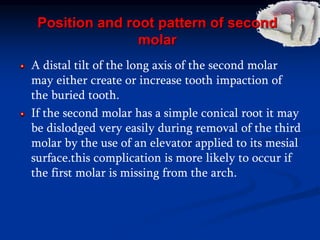
Position and root pattern of second
molar
A distal tilt of the long axis of the second molar
may either create or increase tooth impaction of
the buried tooth.
If the second molar has a simple conical root it may
be dislodged very easily during removal of the third
molar by the use of an elevator applied to its mesial
surface.this complication is more likely to occur if
the first molar is missing from the arch.
Assessment of difficulty of removal of
impacted third molar
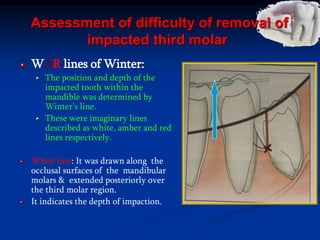
WAR lines of Winter:
The position and depth of the
impacted tooth within the
mandible was determined by
Winter’s line.
These were imaginary lines
described as white, amber and red
lines respectively.
White line: It was drawn along the
occlusal surfaces of the mandibular
molars & extended posteriorly over
the third molar region.
It indicates the depth of impaction.
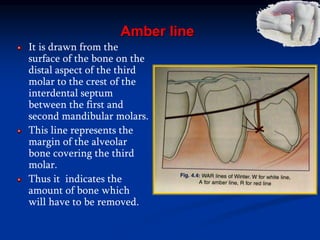
Amber line
It is drawn from the
surface of the bone on the
distal aspect of the third
molar to the crest of the
interdental septum
between the first and
second mandibular molars.
This line represents the
margin of the alveolar
bone covering the third
molar.
Thus it indicates the
amount of bone which
will have to be removed.
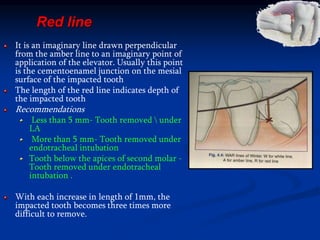
Red line
It is an imaginary line drawn perpendicular
from the amber line to an imaginary point of
application of the elevator. Usually this point
is the cementoenamel junction on the mesial
surface of the impacted tooth
The length of the red line indicates depth of
the impacted tooth
Recommendations
Less than 5 mm- Tooth removed  under
LA
More than 5 mm- Tooth removed under
endotracheal intubation
Tooth below the apices of second molar -
Tooth removed under endotracheal
intubation .
With each increase in length of 1mm, the
impacted tooth becomes three times more
difficult to remove.
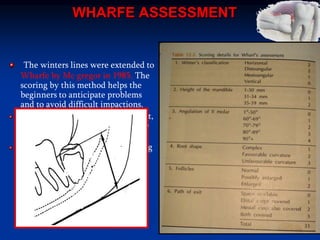
WHARFE ASSESSMENT
The winters lines were extended to
Wharfe by Mc gregor in 1985. The
scoring by this method helps the
beginners to anticipate problems
and to avoid difficult impactions.
Disadvantage of this method is that,
details of the sugical procedure are
not considered.
This assessment serves as a warning
for the surgeon by way of
precaution.
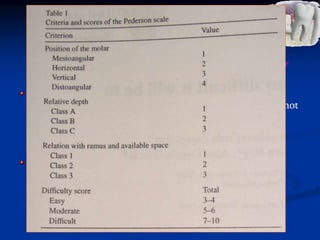
Difficulty index ( Pederson)
Pederson scale fails to predict how difficult it will be to extract lower
third molars .( Marcio Diniz et al BJOMS-2007)
Although the Pederson scale can be used for predicting
operative difficulty, it is not widely used because it does not
take various relevant factors into account, such as bone
density, flexibility of the cheek, and buccal opening..
Yuasa et al. (BJOMS 2002) proposed a new scale that takes
into account not only relative depth and relation with the
ramus of the mandible (the Pell–Gregory classification), but
also width of the root, considered the most important factor.
Root width is defined as: 'thin, where the width of the middle
root is thinner than the width of the neck – removal easy.
bulbous, the width of the middle root is thicker than the
width of the neck- difficult.
THE AUTHORS CONCLUDED THAT THEIR SCALE WAS
BETTER THAN PEDERSON SCALE.
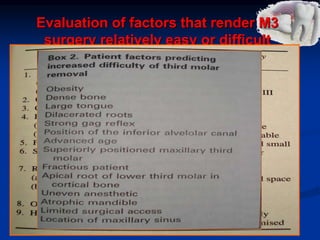
Evaluation of factors that render M3
surgery relatively easy or difficult
The 'path of withdrawal' system(Moore)
This is a dynamic form of assessment and is made in
the reverse order of the procedures used to extract
the tooth.
This is because flap design will depend on the
amount of bone to be removed, the bone removal on
both division and elevation, which in turn is the
result of considering the tooth's natural path of
withdrawal and how the surgeon considers he
should overcome the obstacles to it.
The assessment follows the sequence.
The path of withdrawal of the tooth.
Obstacles to this:
extrinsic - bone, adjacent teeth, the inferior dental nerve
etc.
intrinsic to the tooth, that is crown and root morphology.
method of overcoming the obstacle - removal of bone,
division of the tooth, etc to gain access and allow space for
elevation and the exit of the tooth.
Points of elevation required for extracting the tooth or
divided portions.
Design of the flap to allow access, bone removal and
elevation.
Opinions widely vary concerning the stage in which it is ideal to remove
Some prefer to wait until symptoms develop while others want to perform
early prophylactic "odontectomy" of the un mineralized tooth germ, even
at the age of 9 to 11 years. Those teeth which are liable to be impacted are
ideally indicated for prophylactic odontectomy soon after the eruption of
the II molar.
Early removal is considered to have the following advantages:
Root formation is yet to be completed.
Pericoronal space is wide (for these two reasons, removal is relatively
easy).
The tooth is not related to the inferior alveolar (dental) canal.
General health of the patient is good in young patients. Hence healing is
usually uneventful.
Disadvantages with advancing age:
Root formation is complete with unfavorable morphology.
Closely related to inferior alveolar canal. Hence, technically removal
becomes difficult .
The patient becomes medically compromised as the age advances.
Consequently. operative and postoperative complications are more.
Age considerations
PREOPERATIVE CONSULTATION
Malpractice claims have increasing number related to surgical removal
of impacted teeth
In order to show malpractice the patient must prove that the dentist's
actions were unreasonable and that these actions resulted in injury to
the patient. The first consideration in the prevention of malpractice
suits is the maintenance of adequate records
This includes a good medical and dental history and adequate physical
and x-ray examinations. The surgeon should consult the patient's
physician or dentist regarding any relevant positive findings in the
medical or dental history or physical examination.
It is important for the surgeon and his staff to have good professional
and public relations with his patients and the community, to prevent
misunderstandings or other problems that might develop as a result of
poor public relations.
During recent years informed consent has been an important factor in
prevention of mal practice suits.
INFORMED 'CONSENT
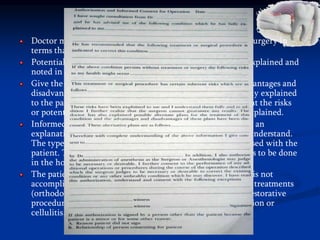
Doctor must give the patient a description of the proposed surgery in
terms that he can understand.
Potential risks related to the surgical procedure should be explained and
noted in the chart or on a consent form itself.
Give the patient alternative plans of treatment with the advantages and
disadvantages of each. These alternative plans should be fully explained
to the patient. In the event that the patient refuses treatment the risks
or potential consequences involved should also be clearly explained.
Informed consent for the difficult impaction should include an
explanation of the procedure in terms that the patient can understand.
The type of anesthesia or sedation selected should be discussed with the
patient. The patient should be told why the procedure needs to be done
in the hospital rather than in the office.
The patient should be informed of the risk if the procedure is not
accomplished such as the inability to complete other dental treatments
(orthodontics, prosthetics, periodontics, endodontics, and restorative
procedures), the possible enlargement of a cyst, acute infection or
cellulitis, and mechanical or pathologic bone fracture.
Extraction vs non-extraction
management of third molars
Two major professional organizations have made
contradictory recommend a tions toward the prophylactic
removal of impacted third molars. The American
Association of Oral and Maxillofacial Surgeons (AAOMS)
and National Health Service of Great Britain (NHS) .
The AAOMS (2005)- suggested that removing the third
molars during young adulthood may be the most prudent
option .
In contrast, the NHS with the National Institute of Clinical
Excellence (NICE), recommended that "The practice of
prophylactic removal of pathology-free impacted third
molars should be discontinued.
Evidence against prophylactic removal
2005. Mattes and colleagues - searched several databases, including
Medline and Pubmed, from 1966 to 2004. In their review of the
literature they found no evidence to support or refute prophylactic
removal of asymptomatic third molars in young adults.
2004, Iida and colleagues -reported a significant association between
remoyal of impacted lower mandibular molars and mandibular condyle
fractures.
2005, Zhu and colleagues - they provided evidence suggesting that the
removal of unerupted mandibular third molars predisposes to fractures
of the condyle.
A review of the available literature shows that most recent studies have
not been able determine a relationship between mandibular third
molars and anterior incisor crowding.
In a more recent review by Zachrisson - He suggests that the current
studies fail to isolate third molars from all the other etiologic factors and
cannot support the conclusion.
Several authors have suggested the increased incidence of complications
with extraction of third molars with advancing age, including
mandibular fractures or trigeminal nerve injuries
Evidence in support of prophylactic removal of third
molars
Extensive evidence in the literature supports - removing impacted third
molars reduces the incidence of mandibular angle fractures , which is
believed to be caused by the decreased cross-sectional area of bone at
the angle with a retained third molar and a greater susceptibility to
mandibular angle fractures.
Wagner and colleagues - Extraction of third molars in young adulthood
would reduce the incidence of mandibular angle fractures and prevent
the relatively increased likelihood of a pathologic fracture if the
procedure were to be performed at an older age.
Baykul and colleagues - Concluded that cystic changes may be
encountered in the histopathologic examination of asymptomatic third
molars, especially in patients older than 20 years of age (50% of
patients).
Salgam and Tuzum - reported an incidence of complications, such as
pain, cysts, resorption of adjacent teeth, infection, crowding, and
changes in position of the adjacent teeth, in more than 28 % of their
study group. They recommended the extraction of fully impacted third
molars before the onset of complications.
Rakprasitikul- also studied the incidence of pathologic changes .He
found incidence of pathologic changes in 59% (dentigerous cyst, 51.0%;
chronic nonspecific inflammation, 4.8%; odontogenic keratocysts. 19%).
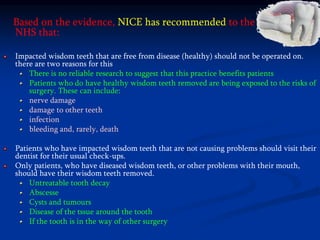
Based on the evidence, NICE has recommended to the
NHS that:
Impacted wisdom teeth that are free from disease (healthy) should not be operated on.
there are two reasons for this
There is no reliable research to suggest that this practice benefits patients
Patients who do have healthy wisdom teeth removed are being exposed to the risks of
surgery. These can include:
nerve damage
damage to other teeth
infection
bleeding and, rarely, death
Patients who have impacted wisdom teeth that are not causing problems should visit their
dentist for their usual check-ups.
Only patients, who have diseased wisdom teeth, or other problems with their mouth,
should have their wisdom teeth removed.
Untreatable tooth decay
Abscesse
Cysts and tumours
Disease of the tssue around the tooth
If the tooth is in the way of other surgery
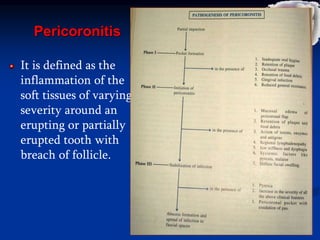
Pericoronitis
It is defined as the
inflammation of the
soft tissues of varying
severity around an
erupting or partially
erupted tooth with
breach of follicle.
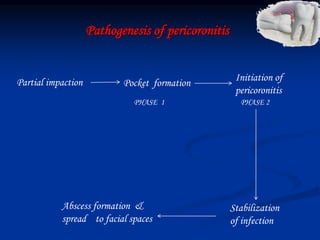
Pathogenesis of pericoronitis
Partial impaction Pocket formation
Initiation of
pericoronitis
Stabilization
of infection
Abscess formation &
spread to facial spaces
PHASE 1 PHASE 2
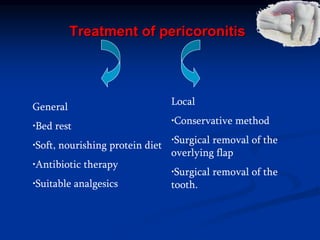
Treatment of pericoronitis
General
•Bed rest
•Soft, nourishing protein diet
•Antibiotic therapy
•Suitable analgesics
Local
•Conservative method
•Surgical removal of the
overlying flap
•Surgical removal of the
tooth.
Conservative method
Drainage of the abcess
Irrigation of warm saline in follicular space
Tabots solution of iodine is applied.
It contains- iodine, zinc iodide, glycerine and water.
Alternatively iodine lotion can also be applied which
contains-
Phenol
Tincture of aconite
Tincture of iodine
Glycerine .
Frequent warm saline gargling is advised.
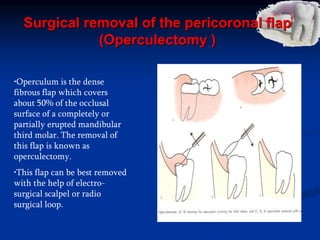
Surgical removal of the pericoronal flap
(Operculectomy )
•Operculum is the dense
fibrous flap which covers
about 50% of the occlusal
surface of a completely or
partially erupted mandibular
third molar. The removal of
this flap is known as
operculectomy.
•This flap can be best removed
with the help of electro-
surgical scalpel or radio
surgical loop.
Surgical
management
Principles of Incisions
First - A sharp blade of the proper size should be used. A sharp blade allows
incisions to be made cleanly, without unnecessary damage caused by
repeated strokes. The rate at which a blade dulls depends on the resistance of
tissues through which the blade cuts.
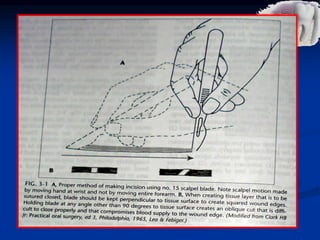
Second - A firm, continuous stroke should be used when incising. Repeated,
tentative strokes increase both the amount of damaged tissue within a wound
and the amount of bleeding, thereby impairing wound healing .
Third - The surgeon should carefully avoid cutting vital structures when
incising.
Fourth - Incisions through epithelial surfaces that the surgeon plans to
reapproximate should be made with the blade held perpendicular to the
epithelial surface. This angle produces squared wound edges that are both
easier to reorient properly during suturing and less susceptible to necrosis of
the wound edges as a result of ischemia.
Fifth - Incisions in the oral cavity should be properly placed. It is more
desirable to incise through attached gingiva and over healthy bone than
through unattached gingiva and over unhealthy or missing bone.
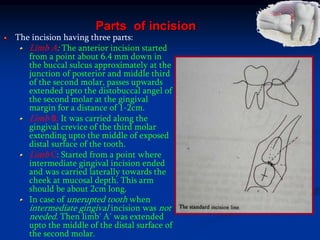
Parts of incision
The incision having three parts:
Limb A: The anterior incision started
from a point about 6.4 mm down in
the buccal sulcus approximately at the
junction of posterior and middle third
of the second molar, passes upwards
extended upto the distobuccal angel of
the second molar at the gingival
margin for a distance of 1-2cm.
Limb B: It was carried along the
gingival crevice of the third molar
extending upto the middle of exposed
distal surface of the tooth.
Limb C: Started from a point where
intermediate gingival incision ended
and was carried laterally towards the
cheek at mucosal depth. This arm
should be about 2cm long.
In case of unerupted tooth when
intermediate gingival incision was not
needed. Then limb' A' was extended
upto the middle of the distal surface of
the second molar.
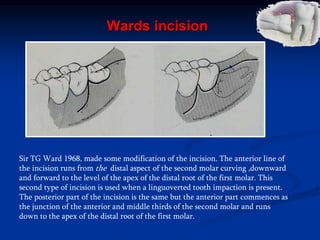
Wards incision
Sir TG Ward 1968, made some modification of the incision. The anterior line of
the incision runs from the distal aspect of the second molar curving ,downward
and forward to the level of the apex of the distal root of the first molar. This
second type of incision is used when a linguoverted tooth impaction is present.
The posterior part of the incision is the same but the anterior part commences as
the junction of the anterior and middle thirds of the second molar and runs
down to the apex of the distal root of the first molar.
FLAPS - Principles
The base of the flap must be broader than the free margin to preserve an
adequate blood supply.
Must be of adequate size - sufficient soft tissue reflection - provide
necessary visualization of the area.
The flap should be a full-thickness mucoperiosteal flap.
The incisions must be made over intact bone that will be present after
the surgical procedure is complete.
Should be designed to avoid injury to local vital structures in the area of
the surgery.
When making incisions in the posterior mandible, especially in the
region of the third molar, incisions should be well away from the lingual
aspect of the mandible. In this area the lingual nerve may be closely
adherent to the lingual aspect of the mandible, and incisions in this area
may result in the severing of that nerve, with consequent prolonged
temporary or permanent anesthesia of the tongue.
Vertical-releasing incisions should cross the free gingival margin at the
line angle of a tooth and should not be directly on the facial aspect of
the tooth nor directly in the papilla . Incisions that cross the free margin
of the gingiva directly over the facial aspect of the tooth do not heal
properly because of tension and result in defect in the attached gingiva.
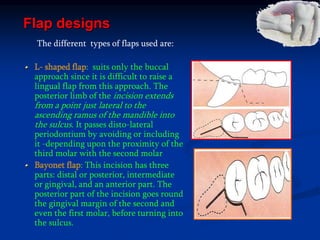
Flap designs
The different types of flaps used are:
L- shaped flap: suits only the buccal
approach since it is difficult to raise a
lingual flap from this approach. The
posterior limb of the incision extends
from a point just lateral to the
ascending ramus of the mandible into
the sulcus. It passes disto-lateral
periodontium by avoiding or including
it -depending upon the proximity of the
third molar with the second molar
Bayonet flap: This incision has three
parts: distal or posterior, intermediate
or gingival, and an anterior part. The
posterior part of the incision goes round
the gingival margin of the second and
even the first molar, before turning into
the sulcus.
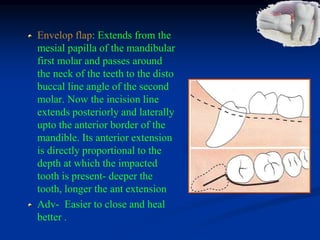
Envelop flap: Extends from the
mesial papilla of the mandibular
first molar and passes around
the neck of the teeth to the disto
buccal line angle of the second
molar. Now the incision line
extends posteriorly and laterally
upto the anterior border of the
mandible. Its anterior extension
is directly proportional to the
depth at which the impacted
tooth is present- deeper the
tooth, longer the ant extension
Adv- Easier to close and heal
better .
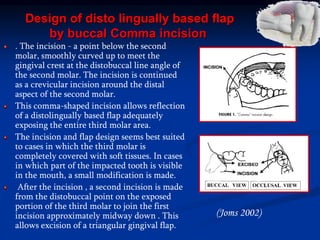
Design of disto lingually based flap
by buccal Comma incision
. The incision - a point below the second
molar, smoothly curved up to meet the
gingival crest at the distobuccal line angle of
the second molar. The incision is continued
as a crevicular incision around the distal
aspect of the second molar.
This comma-shaped incision allows reflection
of a distolingually based flap adequately
exposing the entire third molar area.
The incision and flap design seems best suited
to cases in which the third molar is
completely covered with soft tissues. In cases
in which part of the impacted tooth is visible
in the mouth, a small modification is made.
After the incision , a second incision is made
from the distobuccal point on the exposed
portion of the third molar to join the first
incision approximately midway down . This
allows excision of a triangular gingival flap.
(Joms 2002)
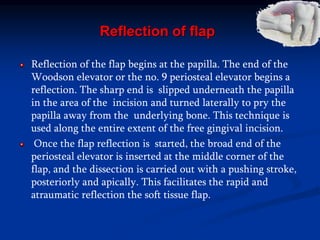
Reflection of flap
Reflection of the flap begins at the papilla. The end of the
Woodson elevator or the no. 9 periosteal elevator begins a
reflection. The sharp end is slipped underneath the papilla
in the area of the incision and turned laterally to pry the
papilla away from the underlying bone. This technique is
used along the entire extent of the free gingival incision.
Once the flap reflection is started, the broad end of the
periosteal elevator is inserted at the middle corner of the
flap, and the dissection is carried out with a pushing stroke,
posteriorly and apically. This facilitates the rapid and
atraumatic reflection the soft tissue flap.
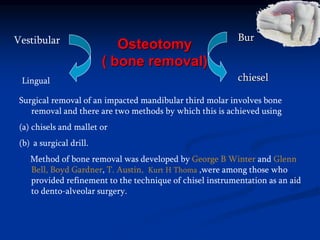
Osteotomy
( bone removal)
Lingual
Bur
chiesel
Vestibular
Surgical removal of an impacted mandibular third molar involves bone
removal and there are two methods by which this is achieved using
(a) chisels and mallet or
(b) a surgical drill.
Method of bone removal was developed by George B Winter and Glenn
Bell, Boyd Gardner, T. Austin, Kurt H Thoma ,were among those who
provided refinement to the technique of chisel instrumentation as an aid
to dento-alveolar surgery.
Aim:
To expose the crown by removing the bone overlying it.
To remove the bone obstructing the pathway for removal of
the impacted tooth.
To prepare a fulcrum for support of an elevator.
Types:
By consecutive sweeping action of bur (in layers).
By chisel or osteotomy cut (in sections).
How much bone has to be removed?
Bone should be removed till we reach below the
height of contour, or its greatest circumference where
we can apply the elevator.
Extensive bone removal can be minimized by tooth
sectioning.
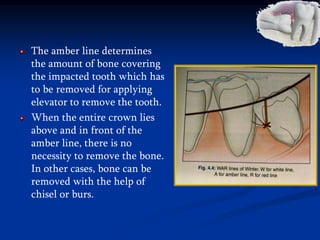
The amber line determines
the amount of bone covering
the impacted tooth which has
to be removed for applying
elevator to remove the tooth.
When the entire crown lies
above and in front of the
amber line, there is no
necessity to remove the bone.
In other cases, bone can be
removed with the help of
chisel or burs.
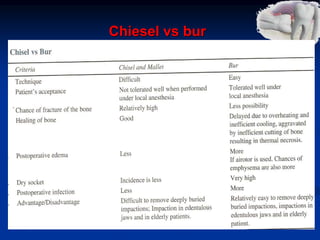
Bur technique
Most surgeons prefer to use a hand piece with adequate speed and high torque to
remove the overlying bone. A variety of 45° angle hand pieces are available which
are conveniently used by the surgeons.
The size of the bur used for the removal of the bone removal :
Ideal length – 7mm; diameter – 1.5mm.
Large rose head bur (size 12) or fissure bur (no.7) used for gross bone
removal.
The bur should rotate in correct direction and at maximum speed.
Cutting instruments that induce air should nt be used.
Handpiece should not rest on the tissues of the cheek and lips to avoid
burning.
The crown of the impacted tooth should be exposed (CEJ) by removal of
surrounding bone:
mesially – to create a point of application
Buccaly – cutting a trough or gutter around the tooth to the root furcation.
Distolingually – lingual plate should not be breached to protect the lingual
nerve.
Copious amount of normal saline is irrigated to
avoid thermal necrosis of bone.
To keep the operator field clean an efficient
suction should be used.
In the mesial side adequate bone must be removed
so that the elevator stands up an angle of 45° to the
mandible without any support.
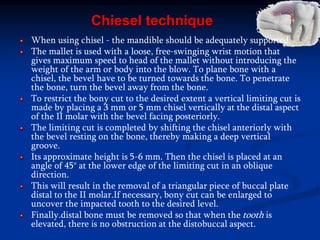
Chiesel technique
When using chisel - the mandible should be adequately supported.
The mallet is used with a loose, free-swinging wrist motion that
gives maximum speed to head of the mallet without introducing the
weight of the arm or body into the blow. To plane bone with a
chisel, the bevel have to be turned towards the bone. To penetrate
the bone, turn the bevel away from the bone.
To restrict the bony cut to the desired extent a vertical limiting cut is
made by placing a 3 mm or 5 mm chisel vertically at the distal aspect
of the II molar with the bevel facing posteriorly.
The limiting cut is completed by shifting the chisel anteriorly with
the bevel resting on the bone, thereby making a deep vertical
groove.
Its approximate height is 5-6 mm. Then the chisel is placed at an
angle of 45° at the lower edge of the limiting cut in an oblique
direction.
This will result in the removal of a triangular piece of buccal plate
distal to the II molar.If necessary, bony cut can be enlarged to
uncover the impacted tooth to the desired level.
Finally.distal bone must be removed so that when the tooth is
elevated, there is no obstruction at the distobuccal aspect.
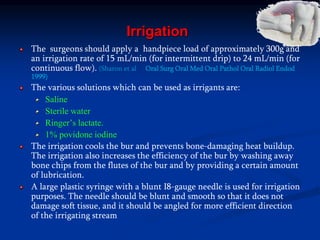
Irrigation
The surgeons should apply a handpiece load of approximately 300g and
an irrigation rate of 15 mL/min (for intermittent drip) to 24 mL/min (for
continuous flow). (Sharon et al Oral Surg Oral Med Oral Pathol Oral Radiol Endod
1999)
The various solutions which can be used as irrigants are:
Saline
Sterile water
Ringer’s lactate.
1% povidone iodine
The irrigation cools the bur and prevents bone-damaging heat buildup.
The irrigation also increases the efficiency of the bur by washing away
bone chips from the flutes of the bur and by providing a certain amount
of lubrication.
A large plastic syringe with a blunt I8-gauge needle is used for irrigation
purposes. The needle should be blunt and smooth so that it does not
damage soft tissue, and it should be angled for more efficient direction
of the irrigating stream
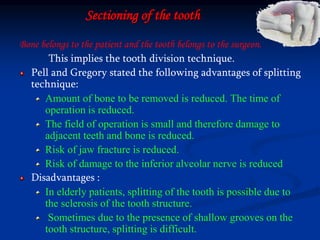
Bone belongs to the patient and the tooth belongs to the surgeon.
This implies the tooth division technique.
Pell and Gregory stated the following advantages of splitting
technique:
Amount of bone to be removed is reduced. The time of
operation is reduced.
The field of operation is small and therefore damage to
adjacent teeth and bone is reduced.
Risk of jaw fracture is reduced.
Risk of damage to the inferior alveolar nerve is reduced
Disadvantages :
In elderly patients, splitting of the tooth is possible due to
the sclerosis of the tooth structure.
Sometimes due to the presence of shallow grooves on the
tooth structure, splitting is difficult.
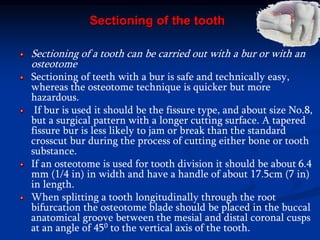
Sectioning of the tooth
Sectioning of a tooth can be carried out with a bur or with an
osteotome
Sectioning of teeth with a bur is safe and technically easy,
whereas the osteotome technique is quicker but more
hazardous.
If bur is used it should be the fissure type, and about size No.8,
but a surgical pattern with a longer cutting surface. A tapered
fissure bur is less likely to jam or break than the standard
crosscut bur during the process of cutting either bone or tooth
substance.
If an osteotome is used for tooth division it should be about 6.4
mm (1/4 in) in width and have a handle of about 17.5cm (7 in)
in length.
When splitting a tooth longitudinally through the root
bifurcation the osteotome blade should be placed in the buccal
anatomical groove between the mesial and distal coronal cusps
at an angle of 450 to the vertical axis of the tooth.
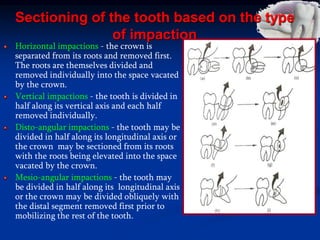
Sectioning of the tooth based on the type
of impaction
Horizontal impactions - the crown is
separated from its roots and removed first.
The roots are themselves divided and
removed individually into the space vacated
by the crown.
Vertical impactions - the tooth is divided in
half along its vertical axis and each half
removed individually.
Disto-angular impactions - the tooth may be
divided in half along its longitudinal axis or
the crown may be sectioned from its roots
with the roots being elevated into the space
vacated by the crown.
Mesio-angular impactions - the tooth may
be divided in half along its longitudinal axis
or the crown may be divided obliquely with
the distal segment removed first prior to
mobilizing the rest of the tooth.
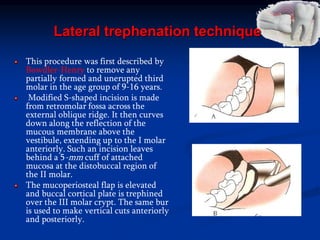
Lateral trephenation technique
This procedure was first described by
Bowdler-Henry to remove any
partially formed and unerupted third
molar in the age group of 9-16 years.
Modified S-shaped incision is made
from retromolar fossa across the
external oblique ridge. It then curves
down along the reflection of the
mucous membrane above the
vestibule, extending up to the I molar
anteriorly. Such an incision leaves
behind a 5-mm cuff of attached
mucosa at the distobuccal region of
the II molar.
The mucoperiosteal flap is elevated
and buccal cortical plate is trephined
over the III molar crypt. The same bur
is used to make vertical cuts anteriorly
and posteriorly.
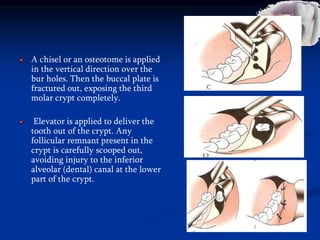
A chisel or an osteotome is applied
in the vertical direction over the
bur holes. Then the buccal plate is
fractured out, exposing the third
molar crypt completely.
Elevator is applied to deliver the
tooth out of the crypt. Any
follicular remnant present in the
crypt is carefully scooped out,
avoiding injury to the inferior
alveolar (dental) canal at the lower
part of the crypt.
Advantages:
Partially formed unerupted 3rd molar can be
removed.
Can be preformed under general or regional
anesthesia with sedation.
Post-op pain is minimal.
Bone healing is excellent and there is no loss of
alveolar bone around the 2nd molar.
Disadvantages :
Virtually every patient has some post operative buccal
swelling for 2-3 days after surgery
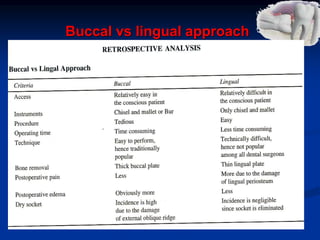
Lingual split bone technique
(Kelsey Fry , T. Ward)
Useful- removal of deeply positioned
horizontal distoangular impactions
(Rud, 1970).
First, a vertical stop cut about 5 mm in
height is made with a 3 mm width
chisel in the buccal cortex immediately
distal to the second molar.
A second vertical stop cut will be made
about 4 mm disto-buccal to the third
molar crown.
the chisel is placed horizontally with
the bevel facing downwards just below
the vertical stop cut, and a horizontal
cut is made extending backwards.
The two cuts will then be joined, and
the buccal plate covering the crown
will be removed
The distolingual bone is now
fractured inward by placing the
chisel at an angle of 45° to the
bone surface and pointing in the
direction of second premolar on
the contralateral side.
The cutting edge of the chisel is
kept parallel to the external
oblique ridge and a few light taps
are given with the mallet which
separates the lingual plate from
the alveolar bone and hinges it
inward on the soft tissue attached
to it.
The "peninsula" of bone whjch
then remains distal to the tooth
and between the buccal and
lingual cuts js excised.
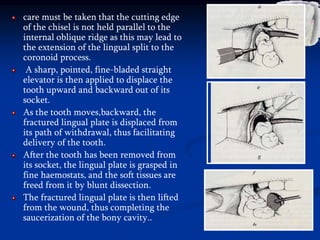
care must be taken that the cutting edge
of the chisel is not held parallel to the
internal oblique ridge as this may lead to
the extension of the lingual split to the
coronoid process.
A sharp, pointed, fine-bladed straight
elevator is then applied to displace the
tooth upward and backward out of its
socket.
As the tooth moves,backward, the
fractured lingual plate is displaced from
its path of withdrawal, thus facilitating
delivery of the tooth.
After the tooth has been removed from
its socket, the lingual plate is grasped in
fine haemostats, and the soft tissues are
freed from it by blunt dissection.
The fractured lingual plate is then lifted
from the wound, thus completing the
saucerization of the bony cavity..
ADVANTAGES
Faster tooth removal.
Less risk of inferior alveolar nerve damage.
Reduces the size of residual blood clot by means of
saucerization of the socket .
Decreased risk of damage to the periodontium of the
second molar.
Decreased risk of socket healing problems.
DRAWBACKS
Risk of damage to the lingual nerve. The incidence of lingual
nerve and inferior alveolar nerve damage has been reported as
1-6.6% .
Increased risk of postoperative infection
Patient discomfort due to the use of a chisel and mallet for
lingual bone removal or fracturing.
Only suitable for young patients with elastic bone
Modified distolingual bone splitting
technique
Davis's technique mentions not to separate the
mucoperiosteom from lingual area of bone. The bone was
released in segments to allow tactile control of osteotome to
prevent penetration of the osteotome into soft tissue. More
than one osteotome per impaction was usually used to
ensure sharp cutting edge. Wedging the osteotome between
tooth and bone should be avoided to prevent fracture of the
mandible.
Lewis technique: Lewis (1980) modified the lingual split-
bone technique by minimizing periosteal reflection and
buccal bone removal and by preserving the fractured lingual
plate. He claims that these modifications reduce the
possibility of lingual nerve damage, minimize periodontal
pocket formation, and improve the chances for primary
wound healings.
MOORE/GILLBE COLLAR TECHNIQUE
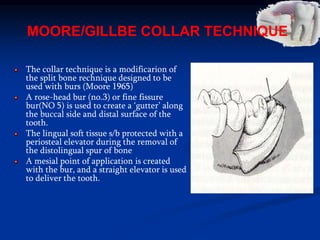
The collar technique is a modificarion of
the split bone rechnique designed to be
used with burs (Moore 1965)
A rose-head bur (no.3) or fine fissure
bur(NO 5) is used to create a ‘gutter’ along
the buccal side and distal surface of the
tooth.
The lingual soft tissue s/b protected with a
periosteal elevator during the removal of
the distolingual spur of bone
A mesial point of application is created
with the bur, and a straight elevator is used
to deliver the tooth.
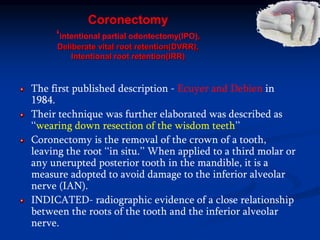
Coronectomy
‘intentional partial odontectomy(IPO),
Deliberate vital root retention(DVRR),
Intentional root retention(IRR)
The first published description - Ecuyer and Debien in
1984.
Their technique was further elaborated was described as
‘‘wearing down resection of the wisdom teeth’’
Coronectomy is the removal of the crown of a tooth,
leaving the root ‘‘in situ.’’ When applied to a third molar or
any unerupted posterior tooth in the mandible, it is a
measure adopted to avoid damage to the inferior alveolar
nerve (IAN).
INDICATED- radiographic evidence of a close relationship
between the roots of the tooth and the inferior alveolar
nerve.
Contraindications to coronectomy
When the teeth have active infection around them,
particularly infection involving the radicular portion of the
tooth.
Teeth that are mobile should be excluded from this
technique, because any retained roots may act as a mobile
foreign body and become a nidus for infection or migration.
Teeth that are horizontally impacted along the course of the
inferior alveolar nerve may be unsuitable for this technique,
because sectioning of the tooth itself could endanger the
nerve.
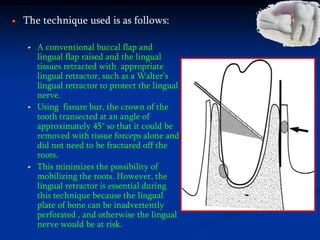
The technique used is as follows:
A conventional buccal flap and
lingual flap raised and the lingual
tissues retracted with appropriate
lingual retractor, such as a Walter’s
lingual retractor to protect the lingual
nerve.
Using fissure bur, the crown of the
tooth transected at an angle of
approximately 45° so that it could be
removed with tissue forceps alone and
did not need to be fractured off the
roots.
This minimizes the possibility of
mobilizing the roots. However, the
lingual retractor is essential during
this technique because the lingual
plate of bone can be inadvertently
perforated , and otherwise the lingual
nerve would be at risk.
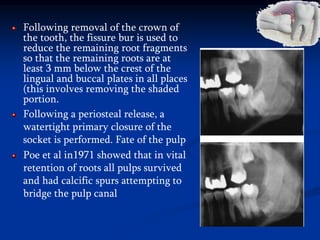
Following removal of the crown of
the tooth, the fissure bur is used to
reduce the remaining root fragments
so that the remaining roots are at
least 3 mm below the crest of the
lingual and buccal plates in all places
(this involves removing the shaded
portion.
Following a periosteal release, a
watertight primary closure of the
socket is performed. Fate of the pulp
Poe et al in1971 showed that in vital
retention of roots all pulps survived
and had calcific spurs attempting to
bridge the pulp canal
Chiesel vs bur
Buccal vs lingual approach
Elevation of tooth
Elevation of a third molar must be gentle as excessive force
is always dangerous in that it may fracture the mandible.
Where resistance is met, the tooth should be reassessed and
the cause ascertained.
Where the root pattern is adverse, the tooth should be
divided; bulbous apices require bone to be removed from
their buccal aspect until they are freed. Where two roots are
fused at the apex, the inter-radicular bone must be removed
below the bifurcation.
Once the whole tooth has apparently been extracted it must
be carefully examined to ensure that it is complete and that
no accessory roots are present which may have been left
behind.
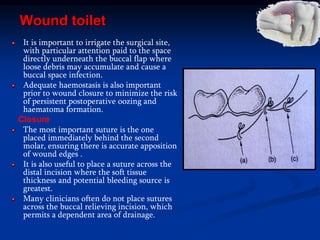
Wound toilet
It is important to irrigate the surgical site,
with particular attention paid to the space
directly underneath the buccal flap where
loose debris may accumulate and cause a
buccal space infection.
Adequate haemostasis is also important
prior to wound closure to minimize the risk
of persistent postoperative oozing and
haematoma formation.
Closure
The most important suture is the one
placed immediately behind the second
molar, ensuring there is accurate apposition
of wound edges .
It is also useful to place a suture across the
distal incision where the soft tissue
thickness and potential bleeding source is
greatest.
Many clinicians often do not place sutures
across the buccal relieving incision, which
permits a dependent area of drainage.
Watertight closure is unnecessary and may
in some cases increase postoperative pain
and swelling.
Primary closure of the wound should not
be attempted unless – atleast 5mm of a
band of buccal attached mucoperiosteum is
present.
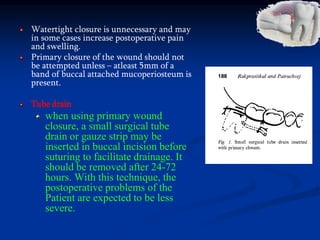
Tube drain
when using primary wound
closure, a small surgical tube
drain or gauze strip may be
inserted in buccal incision before
suturing to facilitate drainage. It
should be removed after 24-72
hours. With this technique, the
postoperative problems of the
Patient are expected to be less
severe.
Other impactions
Canines
Classification :
Vertical
Oblique
Horizontal
Unusual positions
At inferior border
In mental protuberance
Migrated to the opposite side
Mandibular canines in a labial position
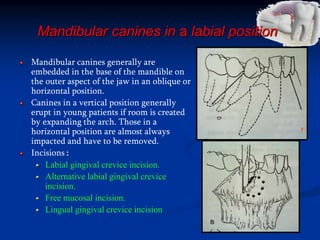
Mandibular canines generally are
embedded in the base of the mandible on
the outer aspect of the jaw in an oblique or
horizontal position.
Canines in a vertical position generally
erupt in young patients if room is created
by expanding the arch. Those in a
horizontal position are almost always
impacted and have to be removed.
Incisions :
Labial gingival crevice incision.
Alternative labial gingival crevice
incision.
Free mucosal incision.
Lingual gingival crevice incision
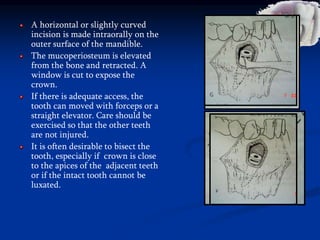
A horizontal or slightly curved
incision is made intraorally on the
outer surface of the mandible.
The mucoperiosteum is elevated
from the bone and retracted. A
window is cut to expose the
crown.
If there is adequate access, the
tooth can moved with forceps or a
straight elevator. Care should be
exercised so that the other teeth
are not injured.
It is often desirable to bisect the
tooth, especially if crown is close
to the apices of the adjacent teeth
or if the intact tooth cannot be
luxated.
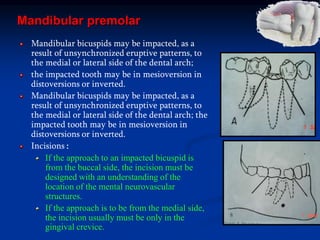
Mandibular premolar
Mandibular bicuspids may be impacted, as a
result of unsynchronized eruptive patterns, to
the medial or lateral side of the dental arch;
the impacted tooth may be in mesioversion in
distoversions or inverted.
Mandibular bicuspids may be impacted, as a
result of unsynchronized eruptive patterns, to
the medial or lateral side of the dental arch; the
impacted tooth may be in mesioversion in
distoversions or inverted.
Incisions :
If the approach to an impacted bicuspid is
from the buccal side, the incision must be
designed with an understanding of the
location of the mental neurovascular
structures.
If the approach is to be from the medial side,
the incision usually must be only in the
gingival crevice.
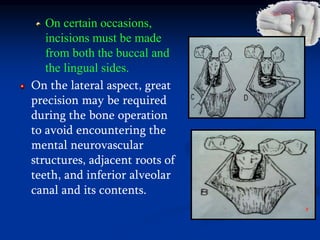
On certain occasions,
incisions must be made
from both the buccal and
the lingual sides.
On the lateral aspect, great
precision may be required
during the bone operation
to avoid encountering the
mental neurovascular
structures, adjacent roots of
teeth, and inferior alveolar
canal and its contents.
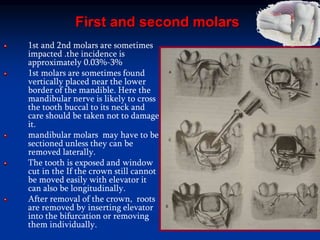
First and second molars
1st and 2nd molars are sometimes
impacted .the incidence is
approximately 0.03%-3%
1st molars are sometimes found
vertically placed near the lower
border of the mandible. Here the
mandibular nerve is likely to cross
the tooth buccal to its neck and
care should be taken not to damage
it.
mandibular molars may have to be
sectioned unless they can be
removed laterally.
The tooth is exposed and window
cut in the If the crown still cannot
be moved easily with elevator it
can also be longitudinally.
After removal of the crown, roots
are removed by inserting elevator
into the bifurcation or removing
them individually.
Complications of third molar surgery
The four most common postoperative compli-
cations of third molar extraction reported in the
literature are
Localized alveolar osteitis (ao),
Infection,
Bleeding, and
Paresthesia.
Alveolar osteitis
Alveolar osteitis is a clinical diagnosis characterized by the
development of severe, throbbing pain several days after the
removal of a tooth and often is accompanied by halitosis.
The extraction socket is often filled with debris and is
conspicuous by the partial or complete loss of the blood
clot.
The frequency of AO ranges from 0.3% to 26%. AO is
known to occur more frequently with mandibular third
molar extraction sockets.
The incidence of AO after third molar removal may be
reduced by
Third molars should be removed only when preexisting
pericoronitis has been treated adequately. Oral hygiene also
should be satisfactory before the surgical procedure.
The surgery should be completed as atraumatically as
possible using copious irrigation when a drill/bur is needed
to remove bone or section teeth.
An intraalveolar antibiotic, such as tetracycline, may be
beneficial when placed in the socket before closure. The
amount of antibiotic shq.uld be kept to a minimum to help
reduce the likelihood of a giant cell reaction or
myospheruloma formation.
Finally, chlorhexidine 0.12% mouthwash should be used
on the day of surgery and for several days thereafter .
Infections
Postoperative infections after third molar removal have
been reported to vary from 0.8% to 4.2%.
It has been suggested that age, degree of impaction, need for
bone removal or tooth sectioning, exposure of the inferior
alveolar neurovascular bundle, presence of gingivitis or
pericoronitis, surgeon experience, use of antibiotics, and
location of surgery (hospital versus office procedures), are
the risk factors for PO infections.
Odontogenic infections both pre- and postoperative are
typically mixed infections with a predominance of
anaerobic microorganisms, although streptococci are usually
the largest single group of organisms.
Mandibular third molar infections may spread to the
mandibular vestibule, buccal space, submasseteric space,
pterygomandibular space, parapharyngeal space, or
submandibular space. Parapharyngeal and submandibular
infections may produce significant airway embarrassment.
Infections also may involve the retropharyngeal tissues and
subsequently the mediastinum, with disastrous results.
The management of postoperative infection involves the
systemic administration of appropriate antibiotic and
surgical drainage
Bleeding and hemorrhage
Study conducted by AOMS - an intraoperative frequency' of
unexpected hemorrhage of 0.7% and a post-operative
frequency of unexpected or prolonged hemorrhage of 0.1 %.
Local factors that result from soft-tissue and vessel injury
represent the most common cause of postoperative
hemorrhage and respond best to local control, which
includes meticulous surgical technique with avoidance of
the inferior alveolar neurovascular bundle and particular
care at the distolingual aspect of the mandible.
Patients who experience continued postoperative bleeding
should be instructed to apply gauze pressure to the
extraction site for 45 minutes.
The patient's medical history should be reinvestigated and
vital signs should be monitored.
If the application of pressure proves unsuccessful, the
patient and the extraction site should be examined closely.
If the bleeding is from' soft tissue and is arterial in nature
but does not involve the neurovascular bundle, it is usually
amenable to cautery.
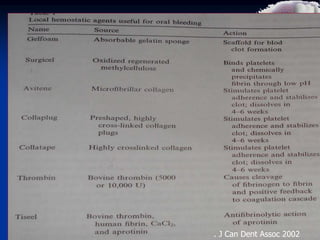
Bony bleeders may be managed with bone wax or various
hemostatic agents. These materials may be stabilized and
maintained within the socket with sutures.
. J Can Dent Assoc 2002
Damage to adjacent teeth
The incidence of damage to adjacent tooth has been
reported to be 0.3% to 0.4%.
Teeth with large restorations or carious lesions are
always at risk of fracture or damage upon elevation.
Correct use of surgical elevators and bone removal
can help prevent this occurrence.
Displacement of third molars
Mandibular third molars can be iatrogenically displaced into
the sublingual, submandibular, pterygomandibular, and
lateral pharyngeal spaces.
Anatomic considerations, such as a disto-lingual angulation
of the tooth, thin or dehisced lingual cortical plate, and
excessive or uncontrolled force upon luxation, are
important factors that can lead to this complication.
Fractured mandibular molar roots that are being removed
with apical pressures may be displaced through the lingual
cortical plate and into the submandibular fascial space. The
lingual cortical bone over the roots of the molars becomes
thinner as it progresses posteriorly mandibular third molars.
Even small amounts of apical pressure result in
displacement of the root into that space. Prevention of
displacement into the submandibular space is primarily
achieved by avoiding all apical pressures when removing
ihe mandibular roots.
Management
Pogrel recommended that the operator place his or her thumb
underneath the inferior border of the mandible in an attempt to direct
the tooth back along the lingual surface of the mandible. The lingual
gingiva may be reflected as far as the premolar region and the
mylohyoid muscle incised to gain access to the submandibular space and
deliver the tooth.
Yeh described a technique that is a combination intraoral and lateral
neck approach in which the original wound is extended lingually to the
distal of the first molar.
A 4-mm skin incision is made in the submandibular region and a
hemostat inserted along the lingual surface of the mandible to stabilize
the tooth while the surgeon palpates the tooth with an index finger. A
Kelly clamp can be inserted to deliver the tooth upward into the mouth.
Temporomandibular joint complications
Procedure of extracting mandibular third molars involves
the patient opening his or her mouth wide for an extended
period of time and exerting a variable amount of force on
the mandible, it is possible to overload or injure one or both
temporomandibular joints.
This result would be the case especially if the surgeon did
not use correct surgical technique or failed to support the
mandible while removing the mandibular third molars or if
the patient's protective mechanism for opening was
exceeded.
Care should be taken in judicious application of force and a
bite block should be used to stabilize the mandible upon
surgical mobilization of the lower third molar teeth.
Mylohyoid Ridge Exposure
A common complication associated with impacted
mandibular tooth surgery involves the exposure of the
mylohyoid ridge on the medial aspect of the mandible. This
exposure is extremely uncomfortable for the patient and
frequently requires surgical management. The exposed ridge
of bone should be reduced below the level of the mucosa.
The area should be allowed to heal secondarily, and no
attempt should be made to close over the bony ridge.
Aspiration of the tooth
Occasionally, the crown of a tooth or an entire tooth might be lost down
the oropharynx. If this occurs, the patient should be turned toward the
dentist, into a mouth-down position, as much as possible.
The suction device can then be used to help remove the tooth. The
patient should be encouraged to cough and spit the tooth out onto the
floor. In spite of these efforts, the tooth may be swallowed or aspirated.
If the patient has no coughing or respiratory distress, it is most likely
that the tooth was swallowed and has traveled down the esophagus into
the stomach.
However, if the patient has a violent episode of coughing that continues,
the tooth may have been aspirated beyond the larynx into the trachea.
In either case the patient should be transported to an emergency room
and chest and abdominal radiographs taken to determine the specific
location of the tooth.
If the tooth has been aspirated, consultation should be requested
regarding the possibility of removing the tooth with a bronchoscope.
The urgent management of aspiration is to maintain the patient's airway
and breathing.
Supplemental oxygen may be appropriate if respiratory distress appears
to be occurring. If the tooth has been swallowed, it is highly probable
that it will pass through the gastrointestinal (GI) tract within 2 to 4
days.
Nerve injuries
The incidence of lingual and IAN injuries reported ranges from 0.4% to
22%.
The incidence of neurologic injuries from third molar surgery may be
related to multiple factors, including surgeon experience and proximity
of the tooth relative to the IAN canal.
Horizontally impacted teeth are generally more difIicult to remove
because of the increased need for bone removal and soft tissue
manipulation with a higher incidence of nerve injuries.
Third molar surgery performed under general anesthesia compared with
surgery performed under local anesthesia has been reported to have a
higher incidence of nerve injuries, presumably because of the supine
position of the patient and extent of soft tissue dissection, potential
greater surgical forces that may be applied under general anesthesia.
Patients with lingual nerve injury report drooling, tongue
biting, thermal burns, changes in speech, and swallowing
and taste perception alterations.
Any surgical incisions placed too far lingually or breaching
the lingual cortex with a surgical bur may jeopardize the
lingual nerve. Other anatomic factors, such as lingual
angulation of the third molar, need for vertical sectioning,
prolonged operating time, and surgeon inexperience, have
been found to increase the risk for lingual nerve injury.
To avoid damage to ling N during surgery lingual flap must
be protected .
For this purpose Various types of lingual retractors, such as
Howarth’s, Ward’s, Meade’s, Hovell’s, and Rowe’s
retractors, have been used. (OOO 2001)
However, studies have shown that use of the conventional
lingual flap retraction with a Howarth's, resulted in a higher
incidence of temporary lingual nerve disturbance than if
this part of the procedure was avoided. (BDJ 1996)
Thus, use of a Howarth's for lingual retraction does not
afford any 'protection' to the lingual nerve and the
technique is shown to be invalid.
There are two possible explanations;
firstly the instrument may not always be correctly placed
between the bone and the lingual periosteum and may
trap the nerve against the lingual plate. Entering the
correct layer is impossible to achieve on every occasion
and is particularly difficult in the presence of scar tissue
resulting from chronic infection.
Secondly, the Howarth's may not always be positioned
correctly to intervene between the tip of the rotating bur
and the nerve.
MANDIBULAR FRACTURES AND THIRD
MOLAR
Mandibular fracture :
The incidence of mandibular fracture during or after third
molar removal has been reported to be 0.0049% .
Mandibular fracture as an intraoperative or postoperative
complication after surgical removal of the wisdom tooth is
rare. HERTEL et al have reported its incidence to be 0.19%.
Many authors have reported that patients with unerupted
mandibular third molars were more likely to have an angle
fracture than those patients without unerupted mandibular
third molars, because the mandibular angle region that
contains the unerupted third molars has a decreased cross-
sectional area of bone.
REITZIK et al have showed that the mandible with unerupted third
molars required 40% less force to be fractured than the mandible with
fully erupted third molars, and they suggested that the unerupted third
molars could weaken the mandible because the tooth occupied more of
the osseous space.
Improper instrumentation and the use of excessive force during surgery
were considered to be the main causes of intraoperative fractures.
Careless use of elevators was assumed to have caused undue force on the
bone, resulting in a fracture.
Postoperative fracture is considered unusual in the absence of infection
or a history of trauma. During surgical removal of an impacted lower
third molar, a substantial amount of bone may need to be removed.
Weakening of the mandible is, therefore, always associated with third
molar removal.
In the early postoperative period, a "cracking" sound from the jaw while
eating is indicative of fracture occurrence.
Factors affecting mandibular fractures
Injudicious use of force during removal of the tooth, a
deeply impacted tooth, and osteoporosis and other
metabolic bone disorders or lesions, such as cysts or
tumours, increase the likelihood of fracture. The presence of
an impacted tooth in a severely atrophic mandible, or
infection involving the bone surrounding the tooth, may
also predispose to fracture.
Mandibular fractures that occur during or soon after the
extraction of a mandibular third molar are usually
nondisplaced or minimally displaced.
Third molar and fracture line
Shetty and Freymiller these surgeons recommend the following
management guidelines for all teeth, erupted or unerupted, in the line of
fracture:
should be left in situ - no evidence of severe loosening or inflammatory
change.
Impacted molars, especially complete bony impactions, should be left in
place to provide a larger repositioning surface.
Teeth that prevent reduction of fractures should be removed.
Teeth with fractured roots must be removed.
Teeth with exposed root apices, or where the fracture line follows the
root surface from the apical region to the gingival margin, tend to
develop pulpal or periodontal complications. This may adversely affect
healing.
The condition of the alveolus and the periodontium is decisive for
uenventful fracture healing. Optimal healing is doubtful when there is
extensive periodontal damage, with broken alveolar walls, resulting in
the formation of a deep pocket. Primary extraction is preferred in such
situations.
Surgical considerations for impacted teeth in the
region of elective osteotomies
When impacted teeth not in the regions of the planned
osteotomies in orthognathic surgery their removal at the
time of surgery is generally advisable. This avoids additional
surgery, expenses and inconvenience for the patient.
Second, impacted teeth that exist within the path of
proposed osteotomies and are indicated for removal because
of associated pathology or teeth that will interfere with the
overall surgical plan- removed early in the presurgical
orthodontic stage of treatment. For eg, teeth associated with
pathology such as recurrent pericoronitis, cysts and tumors
specific recommendations for various surgical scenarios
Sagittal – split – ramus osteotomy
Prior to orthognathic surgery :
3rd molars that are fully developed and deeply impacted
critically are best surgically removed 6-12 months prior
to surgery
These impaction are most apt to result in pathological
fractures of the distal segments lingual plate when their
removal is attempted at the time of SSRO. Removed less
than 6 months prior to orthognathic surgery -
incomplete stage of bone healing and the associated
incidence of unfavorable splitting of mandible.
Simultaneous with orthognathic surgery :
In select instances, the tooth may be divided or left intact in the
proximal and/or distal segments, with rigid fixation accomplished
through the impaction. Such teeth with their accompanying
hardware may be removed 3 or more months postoperatively.
Impacted third molars within the line of a mandibular sagittal split
are best divided in two along the same path as the osteotomy. Once
the split is achieved, the two halves of the third molar tooth may be
carefully elevated from both the proximal and distal segments of the
sagittal split .
Following orthognathic surgery :
Impacted molar removal is rarely planned following SSRO-they can
be removed about 3 months after orthognathic surgery
Mandibular advancements fixated with screws and/or plates may
prvent the intraoperative removal of impacted 3rd molars.
After the osteotomies are completely healed so the patient has
gained full range of mandibular movement, the impacted teeth and
accompanying screws and/or plates may be removed.
Technique of SSRO IN THE PRESENCE
OF THIRD MOLAR(JOMS, 2005)
In this modification, the anterior aspect of
the horizontal medial osteotomy is open
more widely to allow better visibility of
the marrow cavity and also to permit room
for a rotary handpiece to make a lingual
back cut behind the lingula.
The addition of a lingual back cut helps
direct the lingual fracture to a favorable
split toward the inferior border of the
osteotomy.
In the area of the impacted third molar, the
osteotomy is brought lateral and inferior to
the impacted molar. This “buttresses” the
posterior aspect of the distal segment
during the SSRO and minimizes the
potential for a lingual body fracture in this
vulnerable area .
The influence of cryotherapy on reduction of
swelling, pain and trismus after third-molar
extraction( JADA 2005)
Cryotherapy or cold therapy is the local or systemic
application of cold for therapeutic purposes and has been in
use since at least the time of Hippocrates.
The first physiological response of the tissues to cryotherapy
is a fall in the local temperature that leads to reduced cell
metabolism. This causes the cells to consume less oxygen
and survive a longer period of ischemia.
The main function of the ice on the circulatory system is
reducing the blood flow affected by the vasoconstriction,
limiting the initial intra tissular hemorrhage and the extent
of the injury.
Benefits attributed to local cold applications include,
prevention of edema by
reducing the accumulation of fluid in body tissues,
reduction in inflammation,
slowing of metabolism,
controlling hemorrhage, retarding bacterial growth,
decrease in excitability of free nerve endings and peripheral
nerve fibers with resultant increase in pain threshold,
decrease in enzymatic activity,
Temporary decrease in spasticity, and
a facilitation of muscle contraction.
contraindication
patients suffering from cold hypersensitivities and
intolerances, or over regenerating nerves,
areas with impaired circulation or peripheral
vascular disease
Cold therapy should be employed with caution in
patients with hypertension, poor sensation or
mentation, and in the very old and very young as
they may frequently have impaired thermal
regulation or a limited ability to communicate.
Improper application of cryotherapy may result in
tissue death due to prolonged vasoconstriction,
ischemia, and capillary thrombosis.
THERAPEUTIC AGENTS
The removal of impacted third molars involves trauma to
soft and bony tissue, resulting in swelling. It is not clear
why some of these surgical extractions are followed by
considerable swelling, whilst others are affected to a much
lesser degree.
Inflammatory response is a pre requisite for the subsequent
healing process when present in the degree conducive to
stimulate the process of repair. However excessive post
operative edema is undesirable as it adversely affects and
delays the process of healing. Therefore its control has
become a subject of scientific enthusiasm
Several types of medications (antihistamines,
enzymes and steroids) have been used to inhibit
these post operative sequelae.
Enzymes
The enzymes that have been used widely to control post operative
inflammation are hyalurudinase and proteolytic enzymes. Trypsin,
chymotrypsin, papase, Serratiopeptidase are proteolytic enzymes.
Serratiopeptidase is an enzyme produced by microorganism,
serratio species , is a proteolytic enzyme decomposes bradykinin,
thus producing anti-inflammatory action.
Corticosteroids:
The anti-inflammatory effect of corticosteroids was first identified
by Hench and colleagues during treatment of rheumatoid arthritis.
Steroids act by interfering with capillary vasodilatation, leukocyte
migration, phagocytosis, cytokine production and prostaglandin
inhibition.
The inhibition of capillary vasodilation prevents leakage of intra-
cellular fluid into the interstitial space. The leakage of fluid and
leukocytes results in irritation of free nerve endings and the release
of pain mediators, including prostaglandin. thus corticosteroids act
to prevent inflammation and reduce pain at the site of insult.
APROTININ :
Aprotinin is a naturally occurring protease inhibitor isolated from
bovine lung tissue. discovered by Kraut et al (1930) and
Kunitz and Northrup (1936).
inhibitor -human trypsin, plasmin, plasma kallikrein and tissue
kallikrein-play major role in complement and coagulation system.
Inhibition of kinin generation and activation of complement system
through enzyme kallikrein system - potent anti-inflammatory
action.
Bradykinin, which is responsible for pain is also inhibited, as it
needs kallikrein for its activation- analgesic
Plasmin which is responsible for degradation of fibrin – hemostatic
effect.
INTRODUCED in clinical use in 1950s in the treatment of
pancreatitis.
Brennan et al in 1991 introduced aprotinin in dentistry by using
its anti inflammatory action in M3 surgery to reduce post op
oedema and pain
Stewart et al in 2001 used aprotinin in orthognathic surgery to
Preemptive analgesics (IJOMS 2004)
One concept that has been receiving much interest and
research time recently is preemptive analgesia.
Preemptive analgesia comprised of two main postulates:
Firstly, an analgesic intervention started before nociception
would be more effective than the same intervention
commenced afterwards; and
Secondly, this advantageous effect would outlast the
pharmacological duration of action of the analgesic
concerned.
The aim of such treatment is to prevent the central nervous
system from reaching a hyper excitable state known as
central sensitization. The clinical implication would be
more effective pain management, thereby reducing
postoperative pain and analgesic requirements.
The onset of PO pain may be delayed by approximately 2-
3hrs.
Prophylactic Antibiotics for Third Molar Surgery
(JOMS 1995)
An ideal prophylactic chemotherapeutic agent reduces the
risk of predictive postoperative complications without
producing serious side effects or disrupting the surgical
procedure.
Principles of prophylaxis (Peterson):
The surgical procedure should have a significant risk of
infection.
Select the correct antibiotic for the surgical procedure.
The antibiotic level must be high.
Time the antibiotic administration correctly.
Use the shortest effective antibiotic exposure.
The first principle sets the criterion for antibiotic use. If the
routine use of antibiotics for third molar surgery is to be
recommended, principle I must be proved.
Taking into consideration all surgery, the
administration of antibiotics is based on wound
classification. Wounds may be classified as
Clean – 2%,
clean-contaminated - 10%. ,
Contaminated – 20%,
Dirty – 40%.
However, third molar surgery is considered clean
contaminated and occasionally contaminated
surgery, there are few controversies in literature
regarding antibiotic prophylaxis.
Conclusion
Surgical removal of impacted tooth is a stressful
experience for many patients.. As each patient and
each surgical procedure are unique , surgeons
should carefully assess the risk factors of removal
of impacted tooth by proper diagnosis and choose
correct surgical techniques to avoid surgical
complications & minimizing adverse side effects
thereby making the surgical experience more
favorable for patients .
References
Impacted teeth – Charles C. Alling
Handbook of 3rd molar surgery- George Dimitroulis
Peterson’s Principles of oral and maxillofacial surgery, 2nd
edition, vol. 1.
Textbook of oral and maxillofacial surgery, vol. 2, Laskin.
Textbook of oral and maxillofacial surgery-Kruger
Oral and maxillofacial surgery-Archer
Surgery of the mouth and jaws-Moore
OMFSNA FEB 2007
DCNA JULY 1979.
Journals
JOMS 1995;53:1178-1181.
JOMS 2006;64:94-99
JOMS 2005;63:1443-1446
OOO 2001;92:377-83
OOO 2006;102:448-52
OOO 2006;102:300-6
JOMS 2006;64:1371-1376
OOO 2006;102:154-8
JOMS 2005;63:3-7
OOO 2004;98:274-80
JOMS 62:1447-1452, 2004
JOMS60:6544-6595,2002
JOMS 2000
JOMS59:854-858,2001.
Braz J Oral Sci. April/June 2003 - Vol. 2 - Number 5.
BJOMS(1997) ;35:170-172.
OOO 2005;100:545-9.
JCOMS 2005:164-8.
ANNALS OF EMERGENCY MEDICINE32:6 DECEMBER 1998
JOMS 62:289-291, 2004
Www.nice.org.uk
MANDIBULAR IMPACTIONS 1.ppt

MANDIBULAR IMPACTIONS 1.ppt

  • 1.
  • 2.
    Contents Introduction Definitions Etiology of impaction Orderof frequency of impaction Complications associated with retained impacted teeth Indications & contraindications for removal of impacted teeth. Impacted mandibular third molar Surgical anatomy of molar region Classification Preoperative assessment Diagnosis Evaluation of risk of removal – I/O, E/O, RADIOGRAPHS Informed consent. Extraction Vs non-extraction management of impacted third molar Various surgical procedures for removal of impacted third molar Other impacted teeth, Canine Premolars 1st & 2nd molars Surgical consideration for impacted teeth in The region of elective osteotomies In the line of fracture. Complications of removal of impacted tooth Conclusion References.
  • 3.
    Introduction The most commonlyperformed surgical procedure in most oral and maxillofacial surgery practices is the removal of impacted teeth. Surgical removal of the impacted tooth is a problem under the best circumstances. The surgeon can perform the surgery more comfortably and scientifically if he has determined in advance just what problems he will encounter. With this information he can plan a well organized surgical approach including a proper patient evaluation, an accurate diagnosis and radiographic localization and necessary preoperative consultations.
  • 4.
    Impacted tooth -Definitions Atooth which is completely or partially unerupted and is positioned against another tooth, bone or soft tissue so that its further eruption is unlikely, described according to its anatomic Position . (Archer) An impacted tooth is one that is partially erupted or unerupted , beyond the chronological date of eruption, and will not eventually assume a normal relationship with other teeth and tissues. An impacted tooth is one, which fails to either erupt partially or totally in its normal place in mouth due to inadequate space, and obstruction of an adjacent tooth or teeth or soft tissue and bone, beyond its chronological age of eruption.
  • 5.
    The term "impactedteeth" is often used incorrectly. Descriptive terms should be applied when classifying impacted teeth Malposed tooth: A tooth, unerupted or erupted, which is in an abnormal position in the maxilla or mandible. Unerupted tooth: A tooth not having perforated the oral mucosa. Early loss of deciduous teeth may cause arrested development teeth. Embedded tooth: This term is synonymous with the term impacted tooth. Partial impaction: A tooth that is incompletely erupted is a partial eruption. The tooth may be seen clinically but is frequently malposed and always covered with soft tissue to some extent. Complete bony impaction: The tooth is completely contained within the bone
  • 6.
    Partial bony impaction:The tooth is partially covered with the bone. The tooth may be a complete soft tissue impaction & a partial bony impaction. Potential impaction: An unerupted tooth that still retains the potential for eruption, but which will most likely not erupt into normal position & function because of obstruction, unless surgical intervention occurs – is referred to as potential impaction. Ectopic/ displaced teeth: a tooth is ectopic if malposed due to congenital factors or displaced by the presence of pathology. Ankylosed teeth: when the cementum of the teeth is fused to the bone and there is no periodontal soft tissue in between, a tooth is considered to be ankylosed
  • 7.
    Etilogy of impaction Nodinepoints out that for at least 200 years it has been believed that civilization could be held responsible for the withdrawal or elimination of a stimulus that is necessary for development of the human jaws. This lost stimulus is the force demanded for the mastication of hard food. The modern soft diet does not require a decided effort in mastication. And so, this growth stimulus of the jaws is lost- gradual evolutionary reduction in the size of the human jaw which is too small to accommodate third molars. and thus modern man has impacted teeth.
  • 8.
    Theories of impaction (DURBECK) Orthodontictheory The normal growth of the jaws and movement of teeth is in a forward direction and anything interfering with such development will cause an impaction of teeth. Dense bone and many pathologic conditions like acute infections, fever, severe trauma ,malocclusion ,inflammation of the periodontal membrane etc which can cause increased bone density - retards such forward growth of the jaws Constant mouth breathing - contracted arches. Thus leaving insufficient room for erupting M3. Early loss of deciduous teeth - arrested development of teeth, resulting in impactions.
  • 9.
    Nature tries toeliminate that what is not used, and our civilization with its changing nutritional habits has practically eliminated the human need for large powerful jaws. As a result, the size of jaws has decreased - abnormal position of M3 leading to impaction Phylogenic theory Heredity – such as transmission of small jaws from parent and large teeth from the other parent– may be an important etiologic factor in impactions. Mendelian theory
  • 10.
  • 11.
    local causes (Berger) Irregularityin the position and presence of an adjacent tooth. Density of the overlying or surrounding bone. Long – continued chronic inflammation with resultant increase in density of the overlying mucous membrane. Lack of space due to underdeveloped jaws. Unduly long retention of the primary teeth. Premature loss of the primary teeth. Acquired diseases, such as necrosis due to infection or abscesses and inflammatory changes in the bone due to exanthematous diseases in children
  • 12.
    Systemic causes (Berger) Prenatalcauses Heredity Miscegenation Postnatal causes Rickets Anemia Congenital syphilis T.B Endocrine dysfunctions Malnutrition Rare conditions Cleidocranial dysostosis Oxycephaly Progeria Achondroplasia Cleft palate
  • 13.
    Order of impaction Accordingto Archer impacted teeth occur in the following order of frequency: Maxillary 3rd molars. Mandibular 3rd molars. Maxillary cuspids. Mandibular bicuspids. Mandibular cuspids. Maxillary bicuspids. Maxillary central incisors. Maxillary lateral incisors
  • 14.
    Complications associated withretained impacted teeth: Dental caries Pericoronal infection Pain Fascial space infections Risk of development of cysts and tumors Fractures Trismus Other complications
  • 15.
    Dental caries Partially erupted-Usually potential space for food impaction and pressure exerted by impacted M3 on M2 can initiate dental caries When invaded by microorganisms, the dental pulp undergoes an inflammatory response -pulpal ischemia and necrosis. Bacteria then spread from the pulp canals into the surrounding periapical tissues. Chronic periapical infections results when the infection remains localized by body defenses. This infection may penetrate the cortical bone and spread to varies
  • 16.
    pain Pain may bereferred not only to the areas of distribution of the nerve involved and even to the associated nerve plexus, but also to remote regions. Pain is often referred to the ear. Pain may be slight and restricted to the immediate area of the impacted tooth, or it may be severe, even excruciating, involving all the lower and upper teeth on the affected side, the ear, the post-auricular area, any part of the area supplied by the trigeminal nerve, or even the entire area supplied by this nerve.
  • 17.
    Fascial space infections Infectionsarising from M3 may be spread through various tissue planes: Buccinator – external to body of mandible Below attachment- Facial swelling Above attachment- Intra-oral swelling Mylohyoid- internal to the body of mandible Below- Deep sublingual space Above- Superficial sublingual space Anteriorly- Submental space Masseter- external to the ramus In- between- Submasseteric space Laterally – Temporal space Medial pterygoid – internal to the ramus of mandible Lateral – Pterygomandibular space Medially – Lateral pharyngeal space Posteriorly – Retropharyngeal space
  • 18.
    Risk of developmentof cysts and tumors Most cystic changes were found in patients between20 and 25 years, and the various studies therefore concluded that age may be used as an indication for surgical removal of impacted lower third molars , as the risk of surgical morbidity also increases with the increasing age. Incidence of dentigerous cyst- 1.6% (KEITH,1973) Incidence of cyst and tumour formation- 2.31%(Guven et al,2000) Incidence of ameloblastoma – 0.14 - 2 %(Shear,1978) Risk of surgical morbidity increases with age.
  • 19.
    Other complications Ringing, singingor buzzing sound in the ear. Otitis Affections of the eye, such as dimness of vision, blindness, iritis, pain simulating that of glaucoma. Trismus Cheek bite etc.
  • 20.
    Indications for removalof impacted teeth Disparity in Size or Number of Teeth and Jaw Structure : If disparity exists between the size or number of teeth and the size of the jaw and when alternative modalities of treatment such as' orthodontics or transplantation of the tooth are not feasible Lack of space in the jaw is probably the most common indication for removal of impacted teeth of all types. Facilitation of Orthodontic Treatment : Removal of unerupted permanent teeth early in the course of orthodontic treatment is indicated when the orthodontist has determined that such removal will facilitate the overall treatment of the case .
  • 21.
    Damage to AdjacentTeeth : Entrapment of food, development of caries and elimination of bony support to a functional tooth immediately adjacent to it indicates its removal. The removal of impacted M3 early results in better prognosis for the second molar because bony defects created by surgical removal of teeth in young adults fill rapidly and more completely than in older individuals . Impacted Teeth under Prosthetic Appliances Impacted teeth in edentulous areas may be discovered radiographically when construction of a prosthesis is being contemplated. Removal of symptomatic impacted teeth under a prosthesis is almost always indicated. It is usually advisable to remove impacted teeth in apparently edentulous mandibles prior to denture construction.
  • 22.
    Impacted Teeth Associatedwith Qdontogenic Tumors or Cyst of the Jaw A tooth displaced by a cyst may erupt following the removal of a cyst -removal is not necessary. Impacted Teeth with Recurrent Infection Partially impacted teeth often become infected repeatedly. Impacted teeth under prosthetic appliances and those associated with odontogenic cysts and tumours may make their initial presence known by an infection. Internal Resorption or Caries Associated with an Impacted Tooth Dental caries or internal or external resorption of an impacted tooth is an indication for its removal. It is not uncommon to find caries in the crown of an uncovered impacted third molar. Although the tooth did not appear to have contact with the oral cavity, a communication existed permitting bacteria to reach it.
  • 23.
    Pain of UnknownEtiology : Pain in the temporomandibular joint, the ear, neck, and opposing dental arch on the same side, and occasionally headache, may be eliminated by removal of an impacted tooth. Because of the multiplicity of factors which result in pain, one cannot make guarantees that removal of an impacted tooth will solve an atypical pain problem, but removal of impacted teeth is a rational positive step that often solves an unexplained problem of vague head pain. Removal of Impacted Teeth in Preparation for Irradiation of the Jaws and Surrounding Tissues If the ports of delivery of the radiation include the teeth, especially partially impacted teeth, the teeth should be removed prior to radiation therapy. During the last 20 years, removal of teeth prior to radiation therapy has become less popular, but the pendulum is beginning to swing back because a number of patients have been seen with osteoradionecrosis following postradiation removal of teeth. Lack of Function. as an Indication for Removal of Impacted Teeth When it is determined that an impacted tooth does not and will not perform a useful function in the oral cavity the tooth should be removed immediately if no contraindications to surgery .
  • 24.
    Contraindications for removalof impacted teeth Possible Damage to Adjacent Structures If the removal of an asymptomatic impaction is likely to result in the loss of adjacent teeth, damage to the vital structures like neurovascular bundle, the tooth should be left in place. Compromised Physical Status One of the most significant factors to be considered when removing of an impacted tooth is the patient's physical condition and life expectancy. Surgical removal is contra indicated if the patient is not fit to undergo minor oral surgical procedure.
  • 25.
    Prosthetic consideration Sometimes, partiallyerupted tooth has to be retained since such a tooth has to be could be utilized as an abutment for a fixed partial denture. Availability of adequate space: If adequate space is available for the eruption of the unerupted tooth, it is better to retain it. Socioeconomic reasons: The patient may not be willing for removal due to fear or socioeconomic reasons.
  • 26.
    According to LarryJ. Peterson the general contraindications for removal of impacted teeth can be grouped into 3 primary areas : Patients age – extremes of age, Poor heath. Surgical damage to adjacent structures. Local factors Radiotherapy Teeth in close proximity to tumour Acute gingivitis Systemic factors Uncontrolled diabetes Pregnancy Underlying bleeding disorders Acute blood dyscrasias Cardiac conditions Patients on anticoagulants, steroids,etc
  • 27.
  • 28.
    Surgical anatomy The mainexternal osseous features of the mandibular first and second molar region are the very thick roll of convex lateral bone extending from the crest of the alveolus to the base of the mandible and On the medial (lingual) aspect the alveolar process area declines in height as it passes posteriorly, and it is convex with a thick roll of cortical bone. The base of the alveolar process, with many normal variations, is in the vicinity of the level of the mylohyoid muscle attachment to the mylohyoid ridge. The mylohyoid ridge continues posteriorly in an upward sweep toward the third molar region. Below the mylohyoid ridge there is usually a concavity in the medial aspect of the mandible, the submandibular fossa. However, normal variations of the anatomy below the mylohyoid ridge include the area’s being convex rather than concave.
  • 29.
    The Retromolar Triangle Behindthe third molar is a depressed roughened area on the upper surface of the mandible which is bounded by the lingual and buccal crests of the alveolar ridge this is the retromolar triangle. Lying lateral to the retromolar triangle is a shallow, hollow depression, the retromolar fossa, which is bounded by the anterior border of the ascending ramus and the temporal crest. This is the area into which a third molar would erupt if the usual dental arch were shrunk by abrasive and attritive foods. Spread of acute inflammatory processes may occur in any transverse plane from the retromolr triangle. The retromolar triangle is the site for initial surgical procedures to remove the usual impacted mandibular third molars.
  • 30.
    Retromolar canal andforamen It is a rare anatomic variation, found In the retromolar triangle through which emerges branches of the mandibular vessels which, according to Schejtman, Devoto and Arias (1967), are distributed over the temporalis tendon, buccinator and adjacent alveolus. Contents of this canal originates from mandibular neurovascular bundle before it enters the mandibular canal. Anderson et al. (1991) – innervate and supply temporalis M, part of buccinator M, retromolar trigone. Although these are small vessels a brisk hemorrhage can occur during the surgical exposure of the third molar region if the distal incision is carried up the ramus and not taken laterally towards the cheek.
  • 31.
    Schejtmann et al.(1967)– 27% Narayana et.al – the retromolar foramen and canal in South Indian dry mandible( Eur J anat 2002)- 24%. Burak et.al(2006) - 23%
  • 32.
    Inferior Alveolar Nerveand Vessels The inferior alveolar canal may be present as a single cortical bony tube that can be in various locations lateral to, medial to, inferior to, and, possibly, through the roots of the mandibular teeth. Instead of a single canal, multiple tubes may be present, carrying nerves and vessels to single teeth or to groups of teeth and to the mental foramen or foramina. Various routes and patterns of IAN.
  • 33.
    Lingual Nerve The lingualnerve may be hidden beneath or in the mucosa lateral to the location of a mandibular third molar near the crest in an abnormal, superior position. The studies reported by Kisselbach and Chamberlain demonstrated that the lingual nerve may be located at and sometimes slightly superior to the crest of bony ridge medial to the mandibular third molar region and only 1 or 2 mm toward the midline in the lingual soft tissues. The lingual nerve is relatively more superior and more directly associated with the soft tissues immediately adjacent to the mandible.
  • 34.
    Variations in lingualnerve: running from the crest of the lingual bone to below the floor of the mouth In regard to the horizontal & vertical distance, Kiesselbach and Chamberlain(1984) found that the lingual nerve was 0.58mm H & 2.26mm V medial to the lingual plate.  Pogrel et al’s (2000)- 3.45mm H &3.01mm V . Miloro et al’s(1995) measurement 2.53mm H & 2.75mm V.
  • 35.
    Variation in relationto retromolar pad normal- along the medial surface of the mandibular ramus and lying near the roots of the third molar tooth, variation : It turned away to the retromolar pad then posterior to the third molar, and finally descended with a sharp angle toward the medial surface of the mandible.
  • 36.
    Various pathways ofthe lingual nerve In relation to the submandibular duct: It may run close to the third molar region and above the submandibular duct. It may run below the dut but above the gland, far from the third molar area. It may run below the duct and gland far from the third molar area.
  • 37.
    Classification of thirdmolar impactions Winters classification : G.B WINTER IN THE YEAR 1925 was the first one to devise a satisfactory classification of the third molar on the basis of the long axis of the impacted mandibular 3rd molar in relation to the long axis of the 2nd molar . Vertical. Horizontal Inverted Mesioangular Distrangular Buccoangular Linguoangular These may also occur simultaneously in : Buccal version Lingual version Torsiversion
  • 38.
    Degree of angulation(αangle) The degree of angulation was determined by measurement of the angle between the longitudinal axis of the wisdom tooth and the occlusal plane. Vertical – 80 and 100, Mesioangular - 10 and 80 Distoangular - 100, and Horizontal- 350 and 10.
  • 39.
    According to Pelland Gregory (1933) Relation of the tooth to ramus of mandible and 2nd molar : Class I : There is a sufficient amount of space between the ramus and distal side of 2nd molar for the accommodation of the mesiodistal diameter of the crown of 3rd molar. Class II : The space between the ramus and the distal side of the 2nd less than the mesiodistal diameter of the crown of 3rd molar. Class III : All or most of the 3rd molar is located within the ramus.
  • 40.
    Relative depth ofthe 3rd in bone : Position A : The highest position of the tooth is on a level with the or above the occlusal line. Position B : The highest portion of the tooth is below the occlusal plane, but above the cervical line of the 2nd molar. Position C : The highest position of the tooth is below the cervical line of the 2nd molar.
  • 41.
    ADA code onprocedures and nomenclature The American Dental Association (ADA) Code describes the amount of soft and hard tissues over the coronal surface of an impacted tooth. These are described as Soft tissue impactions, Partial bony impactions, Completely bony impactions, and Completely bony impactions with unusual surgical complications.
  • 42.
    Combined ADA andAAOMS classifications The AAOMS published the ADA coding with explanations from the AAOMS procedural terminology, in parentheses, as follows: 07220 : Removal of impacted tooth – (overlying) soft tissue.Impaction that requires incision of overlying soft tissue and the removal of the tooth. 07230 : Removal of impacted tooth – partially bony impacted Impaction that requires incision of overlying soft tissue, elevation of a flap, and either removal of bone and tooth or sectioning and removal of tooth. 07240 : Removal of impacted tooth – completely bony.Impaction that requires incision of overlying soft tissue, elevation of a flap, removal of bone, and sectioning of tooth for removal. 07241 : Removal of impacted tooth – completely bony, with unusual surgical complications. Impaction that requires incision of overlying soft tissue, elevation of a flap, removal of bone, sectioning of the tooth for removal, and/or presents unusual difficulties and circumstances.
  • 43.
    G.R.OGDEN METHOD A simplemethod of determining the type of impaction involves comparing the distance between the roots of 3rd and 2nd molars , with the distance between the roots of the 2nd and 1st molars .
  • 44.
    Preoperative assessment ofimpacted lower 3rd molar History : Most patients come due to the complain pain and infection associated with partially erupted teeth. However, many impacted or displaced teeth are unerupted and asymptomatic and therefore an incidental finding following radiographic examination. Occasionally, unerupted wisdom teeth, in the absence of any obvious infection, can give rise to discomfort (often described by patients as ‘pressure’ at the back of the mouth). It is important to exclude other possible causes such as TMJ pain and pulpitis / periapical abscess from another tooth.
  • 45.
    Clinical assessment : Compliant: Pain, exclude other causes such as TMJ disorder, pulpitis/abscess of other teeth. Previous medical history Dental history : Difficult extractions, postoperative infection bleeding, etc. Extraoral features : Lymphadenopathy, trismus, swelling. Panoramic radiographs of anterior region are supplemented with occlusal or periapical films. Lateral oblique mandibular radiography provides greater periapical coverage than is available on standard periapical films.
  • 46.
    Radiographic assessment : Intraoralradiography is the most common imaging method, however, for evaluating impacted teeth, panoramic and occlusal radiographs are usually indicated. Localization Of Impacted Teeth Three different methods are useful in determining the exact location of an impacted tooth with the periapical x- ray: The conventional method directing the central ray of the x- ray beam at 90° to the film surface; The use of the periapical x-ray film to record an occlusal view as described by Donovan and The tube shift concept as described by Clark. it is sometimes called as The shift- skitch technique.
  • 47.
    Uses of radiographs: Todetermine the type of impaction Access: the inclination of the external oblique ridge, represented by the radio opaque line. Existing pathology : Dental caries in II and III molars Periodontal disturbances Presence or absence of I molar Any fusion of crowns between II and III molars Conical and fused of II or III molars. Any associated dental pathology like odontome, cyst or neoplasm. Crown of the impacted tooth : large bulbous crown with prominent cusps may present difficulty in smooth delivery.
  • 48.
    Radiograph must becarefully examined with reference with the following factors : Fused or separate roots Number of roots Configuration of the roots If curved, is curvature favorable or unfavorable ? Long and slender or short and stout roots. Convergent or divergent
  • 49.
    Roots of theimpacted tooth Position and root pattern of the impacted as well as the adjacent tooth may create difficulty while removing the impacted tooth. These are also the factors which determine the point of application and line of withdrawal. Length The ideal time to remove the impacted teeth is when the root is two-thirds formed. In this stage, the roots will blunt and removal is very easy. Not indicated When the root is one-third formed, as the tooth tends :: roll in its crypt like ball in a socket, which prevents eas:: elevation.
  • 50.
    Difficult : If thetooth is not removed during the formative stage and the entire length of the root develops, the possibility increases for abnormal root morphology and for fracture of the root tips during extraction. Fusion of roots:. . The fused, conical roots are easier to remove than widely separated roots. The curvature of the tooth roots Severely curved or dilacerated roots are more difficult to remove than straight or slightly curved roots. Convergent roots are comparatively easier to remove than the divergent roots. Width of the roots : The total width of the roots in the mesiodistal direction should be compared with the width of the tooth at the cervical line. If the tooth root width is greater, the extraction will be more difficult. More bone must be
  • 51.
    Bone texture Bone iscancellous and elastic in the younger age group, while it tends to become dense and sclerosed as the age advances. The texture of the bone can be gained by noting the size of the cancellous spaces and the density of the bone encircling them in the radiographs. Spaces are large and bone structure fine- elastic bone. Spaces are small and bone shadow dense- sclerotic bone. In patients of younger age - The bone is less dense, is more likely to be pliable, and expands and bends some what, which allows the socket to be expanded by elevators or by luxation forces applied. The bone is easier to cut with a dental drill and can be removed more rapidly than denser bone. Patients who are older have denser bone and thus decreased flexibility and ability to expand. So it is not possible to expand the bony socket. It becomes more difficult to remove with a dental drill, and the bone removal process takes longer.
  • 52.
    Relationship with inferioralveolar (dental) canal Related but not involving the canal Separate Adjacent Superimposed Seven radiological signs had been suggested by Howe And Payton as indicative of a close relationship between the M3 and IAN canal. Four of these signs were seen on the root of the tooth and the other three were related to changes in the appearance of the inferior alveolar canal.
  • 53.
    Position and rootpattern of second molar A distal tilt of the long axis of the second molar may either create or increase tooth impaction of the buried tooth. If the second molar has a simple conical root it may be dislodged very easily during removal of the third molar by the use of an elevator applied to its mesial surface.this complication is more likely to occur if the first molar is missing from the arch.
  • 54.
    Assessment of difficultyof removal of impacted third molar WAR lines of Winter: The position and depth of the impacted tooth within the mandible was determined by Winter’s line. These were imaginary lines described as white, amber and red lines respectively. White line: It was drawn along the occlusal surfaces of the mandibular molars & extended posteriorly over the third molar region. It indicates the depth of impaction.
  • 55.
    Amber line It isdrawn from the surface of the bone on the distal aspect of the third molar to the crest of the interdental septum between the first and second mandibular molars. This line represents the margin of the alveolar bone covering the third molar. Thus it indicates the amount of bone which will have to be removed.
  • 56.
    Red line It isan imaginary line drawn perpendicular from the amber line to an imaginary point of application of the elevator. Usually this point is the cementoenamel junction on the mesial surface of the impacted tooth The length of the red line indicates depth of the impacted tooth Recommendations Less than 5 mm- Tooth removed under LA More than 5 mm- Tooth removed under endotracheal intubation Tooth below the apices of second molar - Tooth removed under endotracheal intubation . With each increase in length of 1mm, the impacted tooth becomes three times more difficult to remove.
  • 57.
    WHARFE ASSESSMENT The winterslines were extended to Wharfe by Mc gregor in 1985. The scoring by this method helps the beginners to anticipate problems and to avoid difficult impactions. Disadvantage of this method is that, details of the sugical procedure are not considered. This assessment serves as a warning for the surgeon by way of precaution.
  • 58.
    Difficulty index (Pederson) Pederson scale fails to predict how difficult it will be to extract lower third molars .( Marcio Diniz et al BJOMS-2007) Although the Pederson scale can be used for predicting operative difficulty, it is not widely used because it does not take various relevant factors into account, such as bone density, flexibility of the cheek, and buccal opening..
  • 59.
    Yuasa et al.(BJOMS 2002) proposed a new scale that takes into account not only relative depth and relation with the ramus of the mandible (the Pell–Gregory classification), but also width of the root, considered the most important factor. Root width is defined as: 'thin, where the width of the middle root is thinner than the width of the neck – removal easy. bulbous, the width of the middle root is thicker than the width of the neck- difficult. THE AUTHORS CONCLUDED THAT THEIR SCALE WAS BETTER THAN PEDERSON SCALE.
  • 60.
    Evaluation of factorsthat render M3 surgery relatively easy or difficult
  • 61.
    The 'path ofwithdrawal' system(Moore) This is a dynamic form of assessment and is made in the reverse order of the procedures used to extract the tooth. This is because flap design will depend on the amount of bone to be removed, the bone removal on both division and elevation, which in turn is the result of considering the tooth's natural path of withdrawal and how the surgeon considers he should overcome the obstacles to it. The assessment follows the sequence.
  • 62.
    The path ofwithdrawal of the tooth. Obstacles to this: extrinsic - bone, adjacent teeth, the inferior dental nerve etc. intrinsic to the tooth, that is crown and root morphology. method of overcoming the obstacle - removal of bone, division of the tooth, etc to gain access and allow space for elevation and the exit of the tooth. Points of elevation required for extracting the tooth or divided portions. Design of the flap to allow access, bone removal and elevation.
  • 63.
    Opinions widely varyconcerning the stage in which it is ideal to remove Some prefer to wait until symptoms develop while others want to perform early prophylactic "odontectomy" of the un mineralized tooth germ, even at the age of 9 to 11 years. Those teeth which are liable to be impacted are ideally indicated for prophylactic odontectomy soon after the eruption of the II molar. Early removal is considered to have the following advantages: Root formation is yet to be completed. Pericoronal space is wide (for these two reasons, removal is relatively easy). The tooth is not related to the inferior alveolar (dental) canal. General health of the patient is good in young patients. Hence healing is usually uneventful. Disadvantages with advancing age: Root formation is complete with unfavorable morphology. Closely related to inferior alveolar canal. Hence, technically removal becomes difficult . The patient becomes medically compromised as the age advances. Consequently. operative and postoperative complications are more. Age considerations
  • 64.
    PREOPERATIVE CONSULTATION Malpractice claimshave increasing number related to surgical removal of impacted teeth In order to show malpractice the patient must prove that the dentist's actions were unreasonable and that these actions resulted in injury to the patient. The first consideration in the prevention of malpractice suits is the maintenance of adequate records This includes a good medical and dental history and adequate physical and x-ray examinations. The surgeon should consult the patient's physician or dentist regarding any relevant positive findings in the medical or dental history or physical examination. It is important for the surgeon and his staff to have good professional and public relations with his patients and the community, to prevent misunderstandings or other problems that might develop as a result of poor public relations. During recent years informed consent has been an important factor in prevention of mal practice suits.
  • 65.
    INFORMED 'CONSENT Doctor mustgive the patient a description of the proposed surgery in terms that he can understand. Potential risks related to the surgical procedure should be explained and noted in the chart or on a consent form itself. Give the patient alternative plans of treatment with the advantages and disadvantages of each. These alternative plans should be fully explained to the patient. In the event that the patient refuses treatment the risks or potential consequences involved should also be clearly explained. Informed consent for the difficult impaction should include an explanation of the procedure in terms that the patient can understand. The type of anesthesia or sedation selected should be discussed with the patient. The patient should be told why the procedure needs to be done in the hospital rather than in the office. The patient should be informed of the risk if the procedure is not accomplished such as the inability to complete other dental treatments (orthodontics, prosthetics, periodontics, endodontics, and restorative procedures), the possible enlargement of a cyst, acute infection or cellulitis, and mechanical or pathologic bone fracture.
  • 66.
    Extraction vs non-extraction managementof third molars Two major professional organizations have made contradictory recommend a tions toward the prophylactic removal of impacted third molars. The American Association of Oral and Maxillofacial Surgeons (AAOMS) and National Health Service of Great Britain (NHS) . The AAOMS (2005)- suggested that removing the third molars during young adulthood may be the most prudent option . In contrast, the NHS with the National Institute of Clinical Excellence (NICE), recommended that "The practice of prophylactic removal of pathology-free impacted third molars should be discontinued.
  • 67.
    Evidence against prophylacticremoval 2005. Mattes and colleagues - searched several databases, including Medline and Pubmed, from 1966 to 2004. In their review of the literature they found no evidence to support or refute prophylactic removal of asymptomatic third molars in young adults. 2004, Iida and colleagues -reported a significant association between remoyal of impacted lower mandibular molars and mandibular condyle fractures. 2005, Zhu and colleagues - they provided evidence suggesting that the removal of unerupted mandibular third molars predisposes to fractures of the condyle. A review of the available literature shows that most recent studies have not been able determine a relationship between mandibular third molars and anterior incisor crowding. In a more recent review by Zachrisson - He suggests that the current studies fail to isolate third molars from all the other etiologic factors and cannot support the conclusion. Several authors have suggested the increased incidence of complications with extraction of third molars with advancing age, including mandibular fractures or trigeminal nerve injuries
  • 68.
    Evidence in supportof prophylactic removal of third molars Extensive evidence in the literature supports - removing impacted third molars reduces the incidence of mandibular angle fractures , which is believed to be caused by the decreased cross-sectional area of bone at the angle with a retained third molar and a greater susceptibility to mandibular angle fractures. Wagner and colleagues - Extraction of third molars in young adulthood would reduce the incidence of mandibular angle fractures and prevent the relatively increased likelihood of a pathologic fracture if the procedure were to be performed at an older age. Baykul and colleagues - Concluded that cystic changes may be encountered in the histopathologic examination of asymptomatic third molars, especially in patients older than 20 years of age (50% of patients). Salgam and Tuzum - reported an incidence of complications, such as pain, cysts, resorption of adjacent teeth, infection, crowding, and changes in position of the adjacent teeth, in more than 28 % of their study group. They recommended the extraction of fully impacted third molars before the onset of complications. Rakprasitikul- also studied the incidence of pathologic changes .He found incidence of pathologic changes in 59% (dentigerous cyst, 51.0%; chronic nonspecific inflammation, 4.8%; odontogenic keratocysts. 19%).
  • 69.
    Based on theevidence, NICE has recommended to the NHS that: Impacted wisdom teeth that are free from disease (healthy) should not be operated on. there are two reasons for this There is no reliable research to suggest that this practice benefits patients Patients who do have healthy wisdom teeth removed are being exposed to the risks of surgery. These can include: nerve damage damage to other teeth infection bleeding and, rarely, death Patients who have impacted wisdom teeth that are not causing problems should visit their dentist for their usual check-ups. Only patients, who have diseased wisdom teeth, or other problems with their mouth, should have their wisdom teeth removed. Untreatable tooth decay Abscesse Cysts and tumours Disease of the tssue around the tooth If the tooth is in the way of other surgery
  • 70.
    Pericoronitis It is definedas the inflammation of the soft tissues of varying severity around an erupting or partially erupted tooth with breach of follicle.
  • 71.
    Pathogenesis of pericoronitis Partialimpaction Pocket formation Initiation of pericoronitis Stabilization of infection Abscess formation & spread to facial spaces PHASE 1 PHASE 2
  • 72.
    Treatment of pericoronitis General •Bedrest •Soft, nourishing protein diet •Antibiotic therapy •Suitable analgesics Local •Conservative method •Surgical removal of the overlying flap •Surgical removal of the tooth.
  • 73.
    Conservative method Drainage ofthe abcess Irrigation of warm saline in follicular space Tabots solution of iodine is applied. It contains- iodine, zinc iodide, glycerine and water. Alternatively iodine lotion can also be applied which contains- Phenol Tincture of aconite Tincture of iodine Glycerine . Frequent warm saline gargling is advised.
  • 74.
    Surgical removal ofthe pericoronal flap (Operculectomy ) •Operculum is the dense fibrous flap which covers about 50% of the occlusal surface of a completely or partially erupted mandibular third molar. The removal of this flap is known as operculectomy. •This flap can be best removed with the help of electro- surgical scalpel or radio surgical loop.
  • 75.
  • 76.
    Principles of Incisions First- A sharp blade of the proper size should be used. A sharp blade allows incisions to be made cleanly, without unnecessary damage caused by repeated strokes. The rate at which a blade dulls depends on the resistance of tissues through which the blade cuts. Second - A firm, continuous stroke should be used when incising. Repeated, tentative strokes increase both the amount of damaged tissue within a wound and the amount of bleeding, thereby impairing wound healing . Third - The surgeon should carefully avoid cutting vital structures when incising. Fourth - Incisions through epithelial surfaces that the surgeon plans to reapproximate should be made with the blade held perpendicular to the epithelial surface. This angle produces squared wound edges that are both easier to reorient properly during suturing and less susceptible to necrosis of the wound edges as a result of ischemia. Fifth - Incisions in the oral cavity should be properly placed. It is more desirable to incise through attached gingiva and over healthy bone than through unattached gingiva and over unhealthy or missing bone.
  • 77.
    Parts of incision Theincision having three parts: Limb A: The anterior incision started from a point about 6.4 mm down in the buccal sulcus approximately at the junction of posterior and middle third of the second molar, passes upwards extended upto the distobuccal angel of the second molar at the gingival margin for a distance of 1-2cm. Limb B: It was carried along the gingival crevice of the third molar extending upto the middle of exposed distal surface of the tooth. Limb C: Started from a point where intermediate gingival incision ended and was carried laterally towards the cheek at mucosal depth. This arm should be about 2cm long. In case of unerupted tooth when intermediate gingival incision was not needed. Then limb' A' was extended upto the middle of the distal surface of the second molar.
  • 78.
    Wards incision Sir TGWard 1968, made some modification of the incision. The anterior line of the incision runs from the distal aspect of the second molar curving ,downward and forward to the level of the apex of the distal root of the first molar. This second type of incision is used when a linguoverted tooth impaction is present. The posterior part of the incision is the same but the anterior part commences as the junction of the anterior and middle thirds of the second molar and runs down to the apex of the distal root of the first molar.
  • 79.
    FLAPS - Principles Thebase of the flap must be broader than the free margin to preserve an adequate blood supply. Must be of adequate size - sufficient soft tissue reflection - provide necessary visualization of the area. The flap should be a full-thickness mucoperiosteal flap. The incisions must be made over intact bone that will be present after the surgical procedure is complete. Should be designed to avoid injury to local vital structures in the area of the surgery. When making incisions in the posterior mandible, especially in the region of the third molar, incisions should be well away from the lingual aspect of the mandible. In this area the lingual nerve may be closely adherent to the lingual aspect of the mandible, and incisions in this area may result in the severing of that nerve, with consequent prolonged temporary or permanent anesthesia of the tongue. Vertical-releasing incisions should cross the free gingival margin at the line angle of a tooth and should not be directly on the facial aspect of the tooth nor directly in the papilla . Incisions that cross the free margin of the gingiva directly over the facial aspect of the tooth do not heal properly because of tension and result in defect in the attached gingiva.
  • 80.
    Flap designs The differenttypes of flaps used are: L- shaped flap: suits only the buccal approach since it is difficult to raise a lingual flap from this approach. The posterior limb of the incision extends from a point just lateral to the ascending ramus of the mandible into the sulcus. It passes disto-lateral periodontium by avoiding or including it -depending upon the proximity of the third molar with the second molar Bayonet flap: This incision has three parts: distal or posterior, intermediate or gingival, and an anterior part. The posterior part of the incision goes round the gingival margin of the second and even the first molar, before turning into the sulcus.
  • 81.
    Envelop flap: Extendsfrom the mesial papilla of the mandibular first molar and passes around the neck of the teeth to the disto buccal line angle of the second molar. Now the incision line extends posteriorly and laterally upto the anterior border of the mandible. Its anterior extension is directly proportional to the depth at which the impacted tooth is present- deeper the tooth, longer the ant extension Adv- Easier to close and heal better .
  • 82.
    Design of distolingually based flap by buccal Comma incision . The incision - a point below the second molar, smoothly curved up to meet the gingival crest at the distobuccal line angle of the second molar. The incision is continued as a crevicular incision around the distal aspect of the second molar. This comma-shaped incision allows reflection of a distolingually based flap adequately exposing the entire third molar area. The incision and flap design seems best suited to cases in which the third molar is completely covered with soft tissues. In cases in which part of the impacted tooth is visible in the mouth, a small modification is made. After the incision , a second incision is made from the distobuccal point on the exposed portion of the third molar to join the first incision approximately midway down . This allows excision of a triangular gingival flap. (Joms 2002)
  • 83.
    Reflection of flap Reflectionof the flap begins at the papilla. The end of the Woodson elevator or the no. 9 periosteal elevator begins a reflection. The sharp end is slipped underneath the papilla in the area of the incision and turned laterally to pry the papilla away from the underlying bone. This technique is used along the entire extent of the free gingival incision. Once the flap reflection is started, the broad end of the periosteal elevator is inserted at the middle corner of the flap, and the dissection is carried out with a pushing stroke, posteriorly and apically. This facilitates the rapid and atraumatic reflection the soft tissue flap.
  • 84.
    Osteotomy ( bone removal) Lingual Bur chiesel Vestibular Surgicalremoval of an impacted mandibular third molar involves bone removal and there are two methods by which this is achieved using (a) chisels and mallet or (b) a surgical drill. Method of bone removal was developed by George B Winter and Glenn Bell, Boyd Gardner, T. Austin, Kurt H Thoma ,were among those who provided refinement to the technique of chisel instrumentation as an aid to dento-alveolar surgery.
  • 85.
    Aim: To expose thecrown by removing the bone overlying it. To remove the bone obstructing the pathway for removal of the impacted tooth. To prepare a fulcrum for support of an elevator. Types: By consecutive sweeping action of bur (in layers). By chisel or osteotomy cut (in sections). How much bone has to be removed? Bone should be removed till we reach below the height of contour, or its greatest circumference where we can apply the elevator. Extensive bone removal can be minimized by tooth sectioning.
  • 86.
    The amber linedetermines the amount of bone covering the impacted tooth which has to be removed for applying elevator to remove the tooth. When the entire crown lies above and in front of the amber line, there is no necessity to remove the bone. In other cases, bone can be removed with the help of chisel or burs.
  • 87.
    Bur technique Most surgeonsprefer to use a hand piece with adequate speed and high torque to remove the overlying bone. A variety of 45° angle hand pieces are available which are conveniently used by the surgeons. The size of the bur used for the removal of the bone removal : Ideal length – 7mm; diameter – 1.5mm. Large rose head bur (size 12) or fissure bur (no.7) used for gross bone removal. The bur should rotate in correct direction and at maximum speed. Cutting instruments that induce air should nt be used. Handpiece should not rest on the tissues of the cheek and lips to avoid burning. The crown of the impacted tooth should be exposed (CEJ) by removal of surrounding bone: mesially – to create a point of application Buccaly – cutting a trough or gutter around the tooth to the root furcation. Distolingually – lingual plate should not be breached to protect the lingual nerve.
  • 88.
    Copious amount ofnormal saline is irrigated to avoid thermal necrosis of bone. To keep the operator field clean an efficient suction should be used. In the mesial side adequate bone must be removed so that the elevator stands up an angle of 45° to the mandible without any support.
  • 89.
    Chiesel technique When usingchisel - the mandible should be adequately supported. The mallet is used with a loose, free-swinging wrist motion that gives maximum speed to head of the mallet without introducing the weight of the arm or body into the blow. To plane bone with a chisel, the bevel have to be turned towards the bone. To penetrate the bone, turn the bevel away from the bone. To restrict the bony cut to the desired extent a vertical limiting cut is made by placing a 3 mm or 5 mm chisel vertically at the distal aspect of the II molar with the bevel facing posteriorly. The limiting cut is completed by shifting the chisel anteriorly with the bevel resting on the bone, thereby making a deep vertical groove. Its approximate height is 5-6 mm. Then the chisel is placed at an angle of 45° at the lower edge of the limiting cut in an oblique direction. This will result in the removal of a triangular piece of buccal plate distal to the II molar.If necessary, bony cut can be enlarged to uncover the impacted tooth to the desired level. Finally.distal bone must be removed so that when the tooth is elevated, there is no obstruction at the distobuccal aspect.
  • 90.
    Irrigation The surgeons shouldapply a handpiece load of approximately 300g and an irrigation rate of 15 mL/min (for intermittent drip) to 24 mL/min (for continuous flow). (Sharon et al Oral Surg Oral Med Oral Pathol Oral Radiol Endod 1999) The various solutions which can be used as irrigants are: Saline Sterile water Ringer’s lactate. 1% povidone iodine The irrigation cools the bur and prevents bone-damaging heat buildup. The irrigation also increases the efficiency of the bur by washing away bone chips from the flutes of the bur and by providing a certain amount of lubrication. A large plastic syringe with a blunt I8-gauge needle is used for irrigation purposes. The needle should be blunt and smooth so that it does not damage soft tissue, and it should be angled for more efficient direction of the irrigating stream
  • 91.
    Bone belongs tothe patient and the tooth belongs to the surgeon. This implies the tooth division technique. Pell and Gregory stated the following advantages of splitting technique: Amount of bone to be removed is reduced. The time of operation is reduced. The field of operation is small and therefore damage to adjacent teeth and bone is reduced. Risk of jaw fracture is reduced. Risk of damage to the inferior alveolar nerve is reduced Disadvantages : In elderly patients, splitting of the tooth is possible due to the sclerosis of the tooth structure. Sometimes due to the presence of shallow grooves on the tooth structure, splitting is difficult. Sectioning of the tooth
  • 92.
    Sectioning of thetooth Sectioning of a tooth can be carried out with a bur or with an osteotome Sectioning of teeth with a bur is safe and technically easy, whereas the osteotome technique is quicker but more hazardous. If bur is used it should be the fissure type, and about size No.8, but a surgical pattern with a longer cutting surface. A tapered fissure bur is less likely to jam or break than the standard crosscut bur during the process of cutting either bone or tooth substance. If an osteotome is used for tooth division it should be about 6.4 mm (1/4 in) in width and have a handle of about 17.5cm (7 in) in length. When splitting a tooth longitudinally through the root bifurcation the osteotome blade should be placed in the buccal anatomical groove between the mesial and distal coronal cusps at an angle of 450 to the vertical axis of the tooth.
  • 93.
    Sectioning of thetooth based on the type of impaction Horizontal impactions - the crown is separated from its roots and removed first. The roots are themselves divided and removed individually into the space vacated by the crown. Vertical impactions - the tooth is divided in half along its vertical axis and each half removed individually. Disto-angular impactions - the tooth may be divided in half along its longitudinal axis or the crown may be sectioned from its roots with the roots being elevated into the space vacated by the crown. Mesio-angular impactions - the tooth may be divided in half along its longitudinal axis or the crown may be divided obliquely with the distal segment removed first prior to mobilizing the rest of the tooth.
  • 94.
    Lateral trephenation technique Thisprocedure was first described by Bowdler-Henry to remove any partially formed and unerupted third molar in the age group of 9-16 years. Modified S-shaped incision is made from retromolar fossa across the external oblique ridge. It then curves down along the reflection of the mucous membrane above the vestibule, extending up to the I molar anteriorly. Such an incision leaves behind a 5-mm cuff of attached mucosa at the distobuccal region of the II molar. The mucoperiosteal flap is elevated and buccal cortical plate is trephined over the III molar crypt. The same bur is used to make vertical cuts anteriorly and posteriorly.
  • 95.
    A chisel oran osteotome is applied in the vertical direction over the bur holes. Then the buccal plate is fractured out, exposing the third molar crypt completely. Elevator is applied to deliver the tooth out of the crypt. Any follicular remnant present in the crypt is carefully scooped out, avoiding injury to the inferior alveolar (dental) canal at the lower part of the crypt.
  • 96.
    Advantages: Partially formed unerupted3rd molar can be removed. Can be preformed under general or regional anesthesia with sedation. Post-op pain is minimal. Bone healing is excellent and there is no loss of alveolar bone around the 2nd molar. Disadvantages : Virtually every patient has some post operative buccal swelling for 2-3 days after surgery
  • 97.
    Lingual split bonetechnique (Kelsey Fry , T. Ward) Useful- removal of deeply positioned horizontal distoangular impactions (Rud, 1970). First, a vertical stop cut about 5 mm in height is made with a 3 mm width chisel in the buccal cortex immediately distal to the second molar. A second vertical stop cut will be made about 4 mm disto-buccal to the third molar crown. the chisel is placed horizontally with the bevel facing downwards just below the vertical stop cut, and a horizontal cut is made extending backwards. The two cuts will then be joined, and the buccal plate covering the crown will be removed
  • 98.
    The distolingual boneis now fractured inward by placing the chisel at an angle of 45° to the bone surface and pointing in the direction of second premolar on the contralateral side. The cutting edge of the chisel is kept parallel to the external oblique ridge and a few light taps are given with the mallet which separates the lingual plate from the alveolar bone and hinges it inward on the soft tissue attached to it. The "peninsula" of bone whjch then remains distal to the tooth and between the buccal and lingual cuts js excised.
  • 99.
    care must betaken that the cutting edge of the chisel is not held parallel to the internal oblique ridge as this may lead to the extension of the lingual split to the coronoid process. A sharp, pointed, fine-bladed straight elevator is then applied to displace the tooth upward and backward out of its socket. As the tooth moves,backward, the fractured lingual plate is displaced from its path of withdrawal, thus facilitating delivery of the tooth. After the tooth has been removed from its socket, the lingual plate is grasped in fine haemostats, and the soft tissues are freed from it by blunt dissection. The fractured lingual plate is then lifted from the wound, thus completing the saucerization of the bony cavity..
  • 100.
    ADVANTAGES Faster tooth removal. Lessrisk of inferior alveolar nerve damage. Reduces the size of residual blood clot by means of saucerization of the socket . Decreased risk of damage to the periodontium of the second molar. Decreased risk of socket healing problems. DRAWBACKS Risk of damage to the lingual nerve. The incidence of lingual nerve and inferior alveolar nerve damage has been reported as 1-6.6% . Increased risk of postoperative infection Patient discomfort due to the use of a chisel and mallet for lingual bone removal or fracturing. Only suitable for young patients with elastic bone
  • 101.
    Modified distolingual bonesplitting technique Davis's technique mentions not to separate the mucoperiosteom from lingual area of bone. The bone was released in segments to allow tactile control of osteotome to prevent penetration of the osteotome into soft tissue. More than one osteotome per impaction was usually used to ensure sharp cutting edge. Wedging the osteotome between tooth and bone should be avoided to prevent fracture of the mandible. Lewis technique: Lewis (1980) modified the lingual split- bone technique by minimizing periosteal reflection and buccal bone removal and by preserving the fractured lingual plate. He claims that these modifications reduce the possibility of lingual nerve damage, minimize periodontal pocket formation, and improve the chances for primary wound healings.
  • 102.
    MOORE/GILLBE COLLAR TECHNIQUE Thecollar technique is a modificarion of the split bone rechnique designed to be used with burs (Moore 1965) A rose-head bur (no.3) or fine fissure bur(NO 5) is used to create a ‘gutter’ along the buccal side and distal surface of the tooth. The lingual soft tissue s/b protected with a periosteal elevator during the removal of the distolingual spur of bone A mesial point of application is created with the bur, and a straight elevator is used to deliver the tooth.
  • 103.
    Coronectomy ‘intentional partial odontectomy(IPO), Deliberatevital root retention(DVRR), Intentional root retention(IRR) The first published description - Ecuyer and Debien in 1984. Their technique was further elaborated was described as ‘‘wearing down resection of the wisdom teeth’’ Coronectomy is the removal of the crown of a tooth, leaving the root ‘‘in situ.’’ When applied to a third molar or any unerupted posterior tooth in the mandible, it is a measure adopted to avoid damage to the inferior alveolar nerve (IAN). INDICATED- radiographic evidence of a close relationship between the roots of the tooth and the inferior alveolar nerve.
  • 104.
    Contraindications to coronectomy Whenthe teeth have active infection around them, particularly infection involving the radicular portion of the tooth. Teeth that are mobile should be excluded from this technique, because any retained roots may act as a mobile foreign body and become a nidus for infection or migration. Teeth that are horizontally impacted along the course of the inferior alveolar nerve may be unsuitable for this technique, because sectioning of the tooth itself could endanger the nerve.
  • 105.
    The technique usedis as follows: A conventional buccal flap and lingual flap raised and the lingual tissues retracted with appropriate lingual retractor, such as a Walter’s lingual retractor to protect the lingual nerve. Using fissure bur, the crown of the tooth transected at an angle of approximately 45° so that it could be removed with tissue forceps alone and did not need to be fractured off the roots. This minimizes the possibility of mobilizing the roots. However, the lingual retractor is essential during this technique because the lingual plate of bone can be inadvertently perforated , and otherwise the lingual nerve would be at risk.
  • 106.
    Following removal ofthe crown of the tooth, the fissure bur is used to reduce the remaining root fragments so that the remaining roots are at least 3 mm below the crest of the lingual and buccal plates in all places (this involves removing the shaded portion. Following a periosteal release, a watertight primary closure of the socket is performed. Fate of the pulp Poe et al in1971 showed that in vital retention of roots all pulps survived and had calcific spurs attempting to bridge the pulp canal
  • 107.
  • 108.
  • 109.
    Elevation of tooth Elevationof a third molar must be gentle as excessive force is always dangerous in that it may fracture the mandible. Where resistance is met, the tooth should be reassessed and the cause ascertained. Where the root pattern is adverse, the tooth should be divided; bulbous apices require bone to be removed from their buccal aspect until they are freed. Where two roots are fused at the apex, the inter-radicular bone must be removed below the bifurcation. Once the whole tooth has apparently been extracted it must be carefully examined to ensure that it is complete and that no accessory roots are present which may have been left behind.
  • 110.
    Wound toilet It isimportant to irrigate the surgical site, with particular attention paid to the space directly underneath the buccal flap where loose debris may accumulate and cause a buccal space infection. Adequate haemostasis is also important prior to wound closure to minimize the risk of persistent postoperative oozing and haematoma formation. Closure The most important suture is the one placed immediately behind the second molar, ensuring there is accurate apposition of wound edges . It is also useful to place a suture across the distal incision where the soft tissue thickness and potential bleeding source is greatest. Many clinicians often do not place sutures across the buccal relieving incision, which permits a dependent area of drainage.
  • 111.
    Watertight closure isunnecessary and may in some cases increase postoperative pain and swelling. Primary closure of the wound should not be attempted unless – atleast 5mm of a band of buccal attached mucoperiosteum is present. Tube drain when using primary wound closure, a small surgical tube drain or gauze strip may be inserted in buccal incision before suturing to facilitate drainage. It should be removed after 24-72 hours. With this technique, the postoperative problems of the Patient are expected to be less severe.
  • 112.
    Other impactions Canines Classification : Vertical Oblique Horizontal Unusualpositions At inferior border In mental protuberance Migrated to the opposite side
  • 113.
    Mandibular canines ina labial position Mandibular canines generally are embedded in the base of the mandible on the outer aspect of the jaw in an oblique or horizontal position. Canines in a vertical position generally erupt in young patients if room is created by expanding the arch. Those in a horizontal position are almost always impacted and have to be removed. Incisions : Labial gingival crevice incision. Alternative labial gingival crevice incision. Free mucosal incision. Lingual gingival crevice incision
  • 114.
    A horizontal orslightly curved incision is made intraorally on the outer surface of the mandible. The mucoperiosteum is elevated from the bone and retracted. A window is cut to expose the crown. If there is adequate access, the tooth can moved with forceps or a straight elevator. Care should be exercised so that the other teeth are not injured. It is often desirable to bisect the tooth, especially if crown is close to the apices of the adjacent teeth or if the intact tooth cannot be luxated.
  • 115.
    Mandibular premolar Mandibular bicuspidsmay be impacted, as a result of unsynchronized eruptive patterns, to the medial or lateral side of the dental arch; the impacted tooth may be in mesioversion in distoversions or inverted. Mandibular bicuspids may be impacted, as a result of unsynchronized eruptive patterns, to the medial or lateral side of the dental arch; the impacted tooth may be in mesioversion in distoversions or inverted. Incisions : If the approach to an impacted bicuspid is from the buccal side, the incision must be designed with an understanding of the location of the mental neurovascular structures. If the approach is to be from the medial side, the incision usually must be only in the gingival crevice.
  • 116.
    On certain occasions, incisionsmust be made from both the buccal and the lingual sides. On the lateral aspect, great precision may be required during the bone operation to avoid encountering the mental neurovascular structures, adjacent roots of teeth, and inferior alveolar canal and its contents.
  • 117.
    First and secondmolars 1st and 2nd molars are sometimes impacted .the incidence is approximately 0.03%-3% 1st molars are sometimes found vertically placed near the lower border of the mandible. Here the mandibular nerve is likely to cross the tooth buccal to its neck and care should be taken not to damage it. mandibular molars may have to be sectioned unless they can be removed laterally. The tooth is exposed and window cut in the If the crown still cannot be moved easily with elevator it can also be longitudinally. After removal of the crown, roots are removed by inserting elevator into the bifurcation or removing them individually.
  • 118.
    Complications of thirdmolar surgery The four most common postoperative compli- cations of third molar extraction reported in the literature are Localized alveolar osteitis (ao), Infection, Bleeding, and Paresthesia.
  • 119.
    Alveolar osteitis Alveolar osteitisis a clinical diagnosis characterized by the development of severe, throbbing pain several days after the removal of a tooth and often is accompanied by halitosis. The extraction socket is often filled with debris and is conspicuous by the partial or complete loss of the blood clot. The frequency of AO ranges from 0.3% to 26%. AO is known to occur more frequently with mandibular third molar extraction sockets.
  • 120.
    The incidence ofAO after third molar removal may be reduced by Third molars should be removed only when preexisting pericoronitis has been treated adequately. Oral hygiene also should be satisfactory before the surgical procedure. The surgery should be completed as atraumatically as possible using copious irrigation when a drill/bur is needed to remove bone or section teeth. An intraalveolar antibiotic, such as tetracycline, may be beneficial when placed in the socket before closure. The amount of antibiotic shq.uld be kept to a minimum to help reduce the likelihood of a giant cell reaction or myospheruloma formation. Finally, chlorhexidine 0.12% mouthwash should be used on the day of surgery and for several days thereafter .
  • 121.
    Infections Postoperative infections afterthird molar removal have been reported to vary from 0.8% to 4.2%. It has been suggested that age, degree of impaction, need for bone removal or tooth sectioning, exposure of the inferior alveolar neurovascular bundle, presence of gingivitis or pericoronitis, surgeon experience, use of antibiotics, and location of surgery (hospital versus office procedures), are the risk factors for PO infections. Odontogenic infections both pre- and postoperative are typically mixed infections with a predominance of anaerobic microorganisms, although streptococci are usually the largest single group of organisms.
  • 122.
    Mandibular third molarinfections may spread to the mandibular vestibule, buccal space, submasseteric space, pterygomandibular space, parapharyngeal space, or submandibular space. Parapharyngeal and submandibular infections may produce significant airway embarrassment. Infections also may involve the retropharyngeal tissues and subsequently the mediastinum, with disastrous results. The management of postoperative infection involves the systemic administration of appropriate antibiotic and surgical drainage
  • 123.
    Bleeding and hemorrhage Studyconducted by AOMS - an intraoperative frequency' of unexpected hemorrhage of 0.7% and a post-operative frequency of unexpected or prolonged hemorrhage of 0.1 %. Local factors that result from soft-tissue and vessel injury represent the most common cause of postoperative hemorrhage and respond best to local control, which includes meticulous surgical technique with avoidance of the inferior alveolar neurovascular bundle and particular care at the distolingual aspect of the mandible. Patients who experience continued postoperative bleeding should be instructed to apply gauze pressure to the extraction site for 45 minutes. The patient's medical history should be reinvestigated and vital signs should be monitored.
  • 124.
    If the applicationof pressure proves unsuccessful, the patient and the extraction site should be examined closely. If the bleeding is from' soft tissue and is arterial in nature but does not involve the neurovascular bundle, it is usually amenable to cautery. Bony bleeders may be managed with bone wax or various hemostatic agents. These materials may be stabilized and maintained within the socket with sutures. . J Can Dent Assoc 2002
  • 125.
    Damage to adjacentteeth The incidence of damage to adjacent tooth has been reported to be 0.3% to 0.4%. Teeth with large restorations or carious lesions are always at risk of fracture or damage upon elevation. Correct use of surgical elevators and bone removal can help prevent this occurrence.
  • 126.
    Displacement of thirdmolars Mandibular third molars can be iatrogenically displaced into the sublingual, submandibular, pterygomandibular, and lateral pharyngeal spaces. Anatomic considerations, such as a disto-lingual angulation of the tooth, thin or dehisced lingual cortical plate, and excessive or uncontrolled force upon luxation, are important factors that can lead to this complication. Fractured mandibular molar roots that are being removed with apical pressures may be displaced through the lingual cortical plate and into the submandibular fascial space. The lingual cortical bone over the roots of the molars becomes thinner as it progresses posteriorly mandibular third molars. Even small amounts of apical pressure result in displacement of the root into that space. Prevention of displacement into the submandibular space is primarily achieved by avoiding all apical pressures when removing ihe mandibular roots.
  • 127.
    Management Pogrel recommended thatthe operator place his or her thumb underneath the inferior border of the mandible in an attempt to direct the tooth back along the lingual surface of the mandible. The lingual gingiva may be reflected as far as the premolar region and the mylohyoid muscle incised to gain access to the submandibular space and deliver the tooth. Yeh described a technique that is a combination intraoral and lateral neck approach in which the original wound is extended lingually to the distal of the first molar. A 4-mm skin incision is made in the submandibular region and a hemostat inserted along the lingual surface of the mandible to stabilize the tooth while the surgeon palpates the tooth with an index finger. A Kelly clamp can be inserted to deliver the tooth upward into the mouth.
  • 128.
    Temporomandibular joint complications Procedureof extracting mandibular third molars involves the patient opening his or her mouth wide for an extended period of time and exerting a variable amount of force on the mandible, it is possible to overload or injure one or both temporomandibular joints. This result would be the case especially if the surgeon did not use correct surgical technique or failed to support the mandible while removing the mandibular third molars or if the patient's protective mechanism for opening was exceeded. Care should be taken in judicious application of force and a bite block should be used to stabilize the mandible upon surgical mobilization of the lower third molar teeth.
  • 129.
    Mylohyoid Ridge Exposure Acommon complication associated with impacted mandibular tooth surgery involves the exposure of the mylohyoid ridge on the medial aspect of the mandible. This exposure is extremely uncomfortable for the patient and frequently requires surgical management. The exposed ridge of bone should be reduced below the level of the mucosa. The area should be allowed to heal secondarily, and no attempt should be made to close over the bony ridge.
  • 130.
    Aspiration of thetooth Occasionally, the crown of a tooth or an entire tooth might be lost down the oropharynx. If this occurs, the patient should be turned toward the dentist, into a mouth-down position, as much as possible. The suction device can then be used to help remove the tooth. The patient should be encouraged to cough and spit the tooth out onto the floor. In spite of these efforts, the tooth may be swallowed or aspirated. If the patient has no coughing or respiratory distress, it is most likely that the tooth was swallowed and has traveled down the esophagus into the stomach. However, if the patient has a violent episode of coughing that continues, the tooth may have been aspirated beyond the larynx into the trachea. In either case the patient should be transported to an emergency room and chest and abdominal radiographs taken to determine the specific location of the tooth. If the tooth has been aspirated, consultation should be requested regarding the possibility of removing the tooth with a bronchoscope. The urgent management of aspiration is to maintain the patient's airway and breathing. Supplemental oxygen may be appropriate if respiratory distress appears to be occurring. If the tooth has been swallowed, it is highly probable that it will pass through the gastrointestinal (GI) tract within 2 to 4 days.
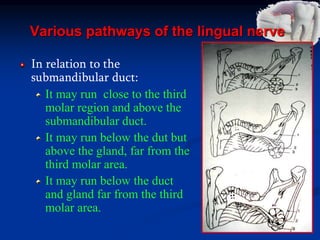
  • 131.
    Nerve injuries The incidenceof lingual and IAN injuries reported ranges from 0.4% to 22%. The incidence of neurologic injuries from third molar surgery may be related to multiple factors, including surgeon experience and proximity of the tooth relative to the IAN canal. Horizontally impacted teeth are generally more difIicult to remove because of the increased need for bone removal and soft tissue manipulation with a higher incidence of nerve injuries. Third molar surgery performed under general anesthesia compared with surgery performed under local anesthesia has been reported to have a higher incidence of nerve injuries, presumably because of the supine position of the patient and extent of soft tissue dissection, potential greater surgical forces that may be applied under general anesthesia.
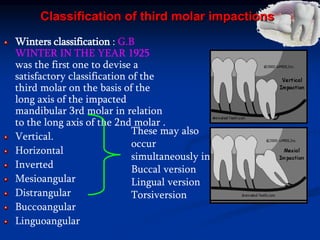
  • 132.
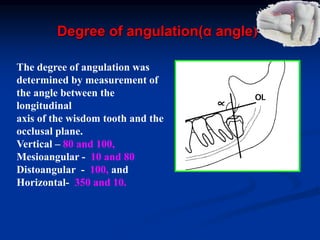
    Patients with lingualnerve injury report drooling, tongue biting, thermal burns, changes in speech, and swallowing and taste perception alterations. Any surgical incisions placed too far lingually or breaching the lingual cortex with a surgical bur may jeopardize the lingual nerve. Other anatomic factors, such as lingual angulation of the third molar, need for vertical sectioning, prolonged operating time, and surgeon inexperience, have been found to increase the risk for lingual nerve injury. To avoid damage to ling N during surgery lingual flap must be protected . For this purpose Various types of lingual retractors, such as Howarth’s, Ward’s, Meade’s, Hovell’s, and Rowe’s retractors, have been used. (OOO 2001)
  • 133.
    However, studies haveshown that use of the conventional lingual flap retraction with a Howarth's, resulted in a higher incidence of temporary lingual nerve disturbance than if this part of the procedure was avoided. (BDJ 1996) Thus, use of a Howarth's for lingual retraction does not afford any 'protection' to the lingual nerve and the technique is shown to be invalid. There are two possible explanations; firstly the instrument may not always be correctly placed between the bone and the lingual periosteum and may trap the nerve against the lingual plate. Entering the correct layer is impossible to achieve on every occasion and is particularly difficult in the presence of scar tissue resulting from chronic infection. Secondly, the Howarth's may not always be positioned correctly to intervene between the tip of the rotating bur and the nerve.
  • 134.
    MANDIBULAR FRACTURES ANDTHIRD MOLAR Mandibular fracture : The incidence of mandibular fracture during or after third molar removal has been reported to be 0.0049% . Mandibular fracture as an intraoperative or postoperative complication after surgical removal of the wisdom tooth is rare. HERTEL et al have reported its incidence to be 0.19%. Many authors have reported that patients with unerupted mandibular third molars were more likely to have an angle fracture than those patients without unerupted mandibular third molars, because the mandibular angle region that contains the unerupted third molars has a decreased cross- sectional area of bone.
  • 135.
    REITZIK et alhave showed that the mandible with unerupted third molars required 40% less force to be fractured than the mandible with fully erupted third molars, and they suggested that the unerupted third molars could weaken the mandible because the tooth occupied more of the osseous space. Improper instrumentation and the use of excessive force during surgery were considered to be the main causes of intraoperative fractures. Careless use of elevators was assumed to have caused undue force on the bone, resulting in a fracture. Postoperative fracture is considered unusual in the absence of infection or a history of trauma. During surgical removal of an impacted lower third molar, a substantial amount of bone may need to be removed. Weakening of the mandible is, therefore, always associated with third molar removal. In the early postoperative period, a "cracking" sound from the jaw while eating is indicative of fracture occurrence.
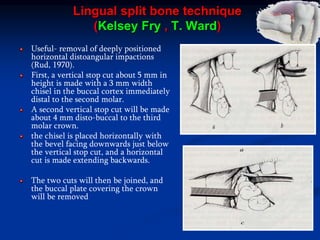
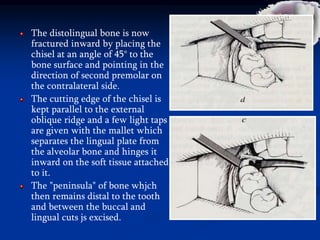
  • 136.
    Factors affecting mandibularfractures Injudicious use of force during removal of the tooth, a deeply impacted tooth, and osteoporosis and other metabolic bone disorders or lesions, such as cysts or tumours, increase the likelihood of fracture. The presence of an impacted tooth in a severely atrophic mandible, or infection involving the bone surrounding the tooth, may also predispose to fracture. Mandibular fractures that occur during or soon after the extraction of a mandibular third molar are usually nondisplaced or minimally displaced.
  • 137.
    Third molar andfracture line Shetty and Freymiller these surgeons recommend the following management guidelines for all teeth, erupted or unerupted, in the line of fracture: should be left in situ - no evidence of severe loosening or inflammatory change. Impacted molars, especially complete bony impactions, should be left in place to provide a larger repositioning surface. Teeth that prevent reduction of fractures should be removed. Teeth with fractured roots must be removed. Teeth with exposed root apices, or where the fracture line follows the root surface from the apical region to the gingival margin, tend to develop pulpal or periodontal complications. This may adversely affect healing. The condition of the alveolus and the periodontium is decisive for uenventful fracture healing. Optimal healing is doubtful when there is extensive periodontal damage, with broken alveolar walls, resulting in the formation of a deep pocket. Primary extraction is preferred in such situations.
  • 138.
    Surgical considerations forimpacted teeth in the region of elective osteotomies When impacted teeth not in the regions of the planned osteotomies in orthognathic surgery their removal at the time of surgery is generally advisable. This avoids additional surgery, expenses and inconvenience for the patient. Second, impacted teeth that exist within the path of proposed osteotomies and are indicated for removal because of associated pathology or teeth that will interfere with the overall surgical plan- removed early in the presurgical orthodontic stage of treatment. For eg, teeth associated with pathology such as recurrent pericoronitis, cysts and tumors
  • 139.
    specific recommendations forvarious surgical scenarios Sagittal – split – ramus osteotomy Prior to orthognathic surgery : 3rd molars that are fully developed and deeply impacted critically are best surgically removed 6-12 months prior to surgery These impaction are most apt to result in pathological fractures of the distal segments lingual plate when their removal is attempted at the time of SSRO. Removed less than 6 months prior to orthognathic surgery - incomplete stage of bone healing and the associated incidence of unfavorable splitting of mandible.
  • 140.
    Simultaneous with orthognathicsurgery : In select instances, the tooth may be divided or left intact in the proximal and/or distal segments, with rigid fixation accomplished through the impaction. Such teeth with their accompanying hardware may be removed 3 or more months postoperatively. Impacted third molars within the line of a mandibular sagittal split are best divided in two along the same path as the osteotomy. Once the split is achieved, the two halves of the third molar tooth may be carefully elevated from both the proximal and distal segments of the sagittal split . Following orthognathic surgery : Impacted molar removal is rarely planned following SSRO-they can be removed about 3 months after orthognathic surgery Mandibular advancements fixated with screws and/or plates may prvent the intraoperative removal of impacted 3rd molars. After the osteotomies are completely healed so the patient has gained full range of mandibular movement, the impacted teeth and accompanying screws and/or plates may be removed.
  • 141.
    Technique of SSROIN THE PRESENCE OF THIRD MOLAR(JOMS, 2005) In this modification, the anterior aspect of the horizontal medial osteotomy is open more widely to allow better visibility of the marrow cavity and also to permit room for a rotary handpiece to make a lingual back cut behind the lingula. The addition of a lingual back cut helps direct the lingual fracture to a favorable split toward the inferior border of the osteotomy. In the area of the impacted third molar, the osteotomy is brought lateral and inferior to the impacted molar. This “buttresses” the posterior aspect of the distal segment during the SSRO and minimizes the potential for a lingual body fracture in this vulnerable area .
  • 142.
    The influence ofcryotherapy on reduction of swelling, pain and trismus after third-molar extraction( JADA 2005) Cryotherapy or cold therapy is the local or systemic application of cold for therapeutic purposes and has been in use since at least the time of Hippocrates. The first physiological response of the tissues to cryotherapy is a fall in the local temperature that leads to reduced cell metabolism. This causes the cells to consume less oxygen and survive a longer period of ischemia. The main function of the ice on the circulatory system is reducing the blood flow affected by the vasoconstriction, limiting the initial intra tissular hemorrhage and the extent of the injury.
  • 143.
    Benefits attributed tolocal cold applications include, prevention of edema by reducing the accumulation of fluid in body tissues, reduction in inflammation, slowing of metabolism, controlling hemorrhage, retarding bacterial growth, decrease in excitability of free nerve endings and peripheral nerve fibers with resultant increase in pain threshold, decrease in enzymatic activity, Temporary decrease in spasticity, and a facilitation of muscle contraction.
  • 144.
    contraindication patients suffering fromcold hypersensitivities and intolerances, or over regenerating nerves, areas with impaired circulation or peripheral vascular disease Cold therapy should be employed with caution in patients with hypertension, poor sensation or mentation, and in the very old and very young as they may frequently have impaired thermal regulation or a limited ability to communicate. Improper application of cryotherapy may result in tissue death due to prolonged vasoconstriction, ischemia, and capillary thrombosis.
  • 145.
    THERAPEUTIC AGENTS The removalof impacted third molars involves trauma to soft and bony tissue, resulting in swelling. It is not clear why some of these surgical extractions are followed by considerable swelling, whilst others are affected to a much lesser degree. Inflammatory response is a pre requisite for the subsequent healing process when present in the degree conducive to stimulate the process of repair. However excessive post operative edema is undesirable as it adversely affects and delays the process of healing. Therefore its control has become a subject of scientific enthusiasm Several types of medications (antihistamines, enzymes and steroids) have been used to inhibit these post operative sequelae.
  • 146.
    Enzymes The enzymes thathave been used widely to control post operative inflammation are hyalurudinase and proteolytic enzymes. Trypsin, chymotrypsin, papase, Serratiopeptidase are proteolytic enzymes. Serratiopeptidase is an enzyme produced by microorganism, serratio species , is a proteolytic enzyme decomposes bradykinin, thus producing anti-inflammatory action. Corticosteroids: The anti-inflammatory effect of corticosteroids was first identified by Hench and colleagues during treatment of rheumatoid arthritis. Steroids act by interfering with capillary vasodilatation, leukocyte migration, phagocytosis, cytokine production and prostaglandin inhibition. The inhibition of capillary vasodilation prevents leakage of intra- cellular fluid into the interstitial space. The leakage of fluid and leukocytes results in irritation of free nerve endings and the release of pain mediators, including prostaglandin. thus corticosteroids act to prevent inflammation and reduce pain at the site of insult.
  • 147.
    APROTININ : Aprotinin isa naturally occurring protease inhibitor isolated from bovine lung tissue. discovered by Kraut et al (1930) and Kunitz and Northrup (1936). inhibitor -human trypsin, plasmin, plasma kallikrein and tissue kallikrein-play major role in complement and coagulation system. Inhibition of kinin generation and activation of complement system through enzyme kallikrein system - potent anti-inflammatory action. Bradykinin, which is responsible for pain is also inhibited, as it needs kallikrein for its activation- analgesic Plasmin which is responsible for degradation of fibrin – hemostatic effect. INTRODUCED in clinical use in 1950s in the treatment of pancreatitis. Brennan et al in 1991 introduced aprotinin in dentistry by using its anti inflammatory action in M3 surgery to reduce post op oedema and pain Stewart et al in 2001 used aprotinin in orthognathic surgery to
  • 148.
    Preemptive analgesics (IJOMS2004) One concept that has been receiving much interest and research time recently is preemptive analgesia. Preemptive analgesia comprised of two main postulates: Firstly, an analgesic intervention started before nociception would be more effective than the same intervention commenced afterwards; and Secondly, this advantageous effect would outlast the pharmacological duration of action of the analgesic concerned. The aim of such treatment is to prevent the central nervous system from reaching a hyper excitable state known as central sensitization. The clinical implication would be more effective pain management, thereby reducing postoperative pain and analgesic requirements. The onset of PO pain may be delayed by approximately 2- 3hrs.
  • 149.
    Prophylactic Antibiotics forThird Molar Surgery (JOMS 1995) An ideal prophylactic chemotherapeutic agent reduces the risk of predictive postoperative complications without producing serious side effects or disrupting the surgical procedure. Principles of prophylaxis (Peterson): The surgical procedure should have a significant risk of infection. Select the correct antibiotic for the surgical procedure. The antibiotic level must be high. Time the antibiotic administration correctly. Use the shortest effective antibiotic exposure. The first principle sets the criterion for antibiotic use. If the routine use of antibiotics for third molar surgery is to be recommended, principle I must be proved.
  • 150.
    Taking into considerationall surgery, the administration of antibiotics is based on wound classification. Wounds may be classified as Clean – 2%, clean-contaminated - 10%. , Contaminated – 20%, Dirty – 40%. However, third molar surgery is considered clean contaminated and occasionally contaminated surgery, there are few controversies in literature regarding antibiotic prophylaxis.
  • 151.
    Conclusion Surgical removal ofimpacted tooth is a stressful experience for many patients.. As each patient and each surgical procedure are unique , surgeons should carefully assess the risk factors of removal of impacted tooth by proper diagnosis and choose correct surgical techniques to avoid surgical complications & minimizing adverse side effects thereby making the surgical experience more favorable for patients .
  • 152.
    References Impacted teeth –Charles C. Alling Handbook of 3rd molar surgery- George Dimitroulis Peterson’s Principles of oral and maxillofacial surgery, 2nd edition, vol. 1. Textbook of oral and maxillofacial surgery, vol. 2, Laskin. Textbook of oral and maxillofacial surgery-Kruger Oral and maxillofacial surgery-Archer Surgery of the mouth and jaws-Moore OMFSNA FEB 2007 DCNA JULY 1979.
  • 153.
    Journals JOMS 1995;53:1178-1181. JOMS 2006;64:94-99 JOMS2005;63:1443-1446 OOO 2001;92:377-83 OOO 2006;102:448-52 OOO 2006;102:300-6 JOMS 2006;64:1371-1376 OOO 2006;102:154-8 JOMS 2005;63:3-7 OOO 2004;98:274-80 JOMS 62:1447-1452, 2004 JOMS60:6544-6595,2002 JOMS 2000 JOMS59:854-858,2001. Braz J Oral Sci. April/June 2003 - Vol. 2 - Number 5. BJOMS(1997) ;35:170-172. OOO 2005;100:545-9. JCOMS 2005:164-8. ANNALS OF EMERGENCY MEDICINE32:6 DECEMBER 1998 JOMS 62:289-291, 2004 Www.nice.org.uk