Diversity Management
DIVERSITY
 Diversity is characteristic of people who bring a
variety of backgrounds, styles, perspectives, values
and beliefs as assets to the groups with which they
interact.
 Diversity Management-- A comprehensive
organizational and managerial process of planning
for, organizing, directing, and supporting a collective
mixture in a way that adds a measureable difference
to organizational performance.
DIVERSITY
Workplace diversity is an asset to any organization
when appropriately governed and fully utilized.
A diverse workforce is a reflection of a changing
world and marketplace.
Diverse work teams bring high value to organizations.
Respecting individual differences will benefit the
workplace by creating a competitive edge and
increasing work productivity.
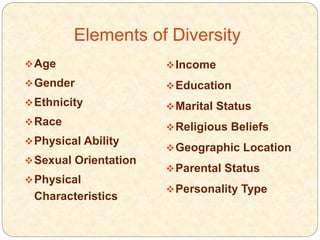
Elements of Diversity
Age
Gender
Ethnicity
Race
Physical Ability
Sexual Orientation
Physical
Characteristics
Income
Education
Marital Status
Religious Beliefs
Geographic Location
Parental Status
Personality Type
WAYS TO INCORPORATE DIVERSITY:
Incorporating diversity practices in a workplace can
include
Recruiting from diverse talent pools to make the
company open to employees from various
backgrounds.
Diversity may be infused into advertising practices to
ensure products and services are targeted to all
consumers who represent the target market, whether
through print, online, television or radio.
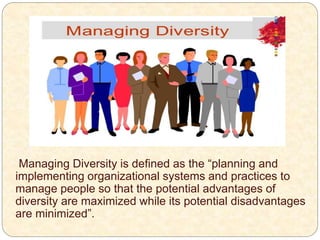
Managing Diversity is defined as the “planning and
implementing organizational systems and practices to
manage people so that the potential advantages of
diversity are maximized while its potential disadvantages
are minimized”.
Diversity management is the key to growth in today’s
fiercely competitive global marketplace.
Organizations that seek global market must embrace
diversity – in how they think, act and innovate.
Diversity can no longer just be about making the
numbers, but rather how an organization treats its people
authentically down to the roots of its business model.
MANAGING DIVERSITY
5-8
Provide members with accurate information
about diversity
Uncover personal biases and stereotypes
Assess personal beliefs, attitudes, and values
and learning about other points of view
Develop an atmosphere in which people feel
free to share their differing perspectives
Improve understanding of others who are
different
GOALS OF DIVERSITY
 Improves corporate
culture
 Improves employee
morale
 Easier recruitment of
employees
 Enables the
organization to move
into emerging markets
 Increases creativity
 Reduction in skill
shortages.
 Decreased interpersonal
conflict among employees
 Improves client relations
 Increases productivity
 Maximizes brand identity
 Responsive service
delivery and enhanced
staff skills
Benefits of Diverse workplace:
Customer service improves when staff understand
and can communicate skillfully with customers from
a range of backgrounds.
The community is also more likely to identify with
and relate to companies that reflect its level of
diversity
 Staff are encouraged to work in their areas of
strength and capability.
Different experience, perspectives, skills and
innovation are shared.
Consequences of Ignoring Diversity:
Ignoring diversity issues costs time, money, and
efficiency.
 Some of the consequences can include
Unhealthy tensions between people of differing
gender, race, ethnicity, age, abilities, etc.;
Loss of productivity because of increased conflict;
Inability to attract and retain talented people of all
kinds;
Complaints and legal actions;
Inability to retain.
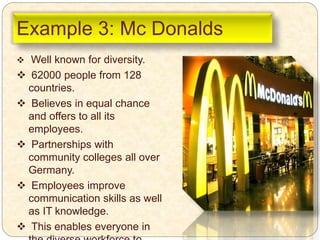
Example 3: Mc Donalds
 Well known for diversity.
 62000 people from 128
countries.
 Believes in equal chance
and offers to all its
employees.
 Partnerships with
community colleges all over
Germany.
 Employees improve
communication skills as well
as IT knowledge.
 This enables everyone in

managingdiversityatworkplace-130901090115-phpapp01.ppt

  • 1.
  • 2.
    DIVERSITY  Diversity ischaracteristic of people who bring a variety of backgrounds, styles, perspectives, values and beliefs as assets to the groups with which they interact.  Diversity Management-- A comprehensive organizational and managerial process of planning for, organizing, directing, and supporting a collective mixture in a way that adds a measureable difference to organizational performance.
  • 3.
    DIVERSITY Workplace diversity isan asset to any organization when appropriately governed and fully utilized. A diverse workforce is a reflection of a changing world and marketplace. Diverse work teams bring high value to organizations. Respecting individual differences will benefit the workplace by creating a competitive edge and increasing work productivity.
  • 4.
    Elements of Diversity Age Gender Ethnicity Race PhysicalAbility Sexual Orientation Physical Characteristics Income Education Marital Status Religious Beliefs Geographic Location Parental Status Personality Type
  • 5.
    WAYS TO INCORPORATEDIVERSITY: Incorporating diversity practices in a workplace can include Recruiting from diverse talent pools to make the company open to employees from various backgrounds. Diversity may be infused into advertising practices to ensure products and services are targeted to all consumers who represent the target market, whether through print, online, television or radio.
  • 6.
    Managing Diversity isdefined as the “planning and implementing organizational systems and practices to manage people so that the potential advantages of diversity are maximized while its potential disadvantages are minimized”.
  • 7.
    Diversity management isthe key to growth in today’s fiercely competitive global marketplace. Organizations that seek global market must embrace diversity – in how they think, act and innovate. Diversity can no longer just be about making the numbers, but rather how an organization treats its people authentically down to the roots of its business model.
  • 8.
    MANAGING DIVERSITY 5-8 Provide memberswith accurate information about diversity Uncover personal biases and stereotypes Assess personal beliefs, attitudes, and values and learning about other points of view Develop an atmosphere in which people feel free to share their differing perspectives Improve understanding of others who are different
  • 9.
    GOALS OF DIVERSITY Improves corporate culture  Improves employee morale  Easier recruitment of employees  Enables the organization to move into emerging markets  Increases creativity  Reduction in skill shortages.  Decreased interpersonal conflict among employees  Improves client relations  Increases productivity  Maximizes brand identity  Responsive service delivery and enhanced staff skills
  • 10.
    Benefits of Diverseworkplace: Customer service improves when staff understand and can communicate skillfully with customers from a range of backgrounds. The community is also more likely to identify with and relate to companies that reflect its level of diversity  Staff are encouraged to work in their areas of strength and capability. Different experience, perspectives, skills and innovation are shared.
  • 11.
    Consequences of IgnoringDiversity: Ignoring diversity issues costs time, money, and efficiency.  Some of the consequences can include Unhealthy tensions between people of differing gender, race, ethnicity, age, abilities, etc.; Loss of productivity because of increased conflict; Inability to attract and retain talented people of all kinds; Complaints and legal actions; Inability to retain.
  • 12.
    Example 3: McDonalds  Well known for diversity.  62000 people from 128 countries.  Believes in equal chance and offers to all its employees.  Partnerships with community colleges all over Germany.  Employees improve communication skills as well as IT knowledge.  This enables everyone in