Best Foot Forward
Diabetes Speciality
Services
Dr Sanjay K Shah
Narayana Multispecality Hospital
Howrah
Complications of diabetes
• Diabetes can cause increased risk of:
– Heart Problems
– Stroke
– Eye sight problems
– Kidney problems
– Foot problems
Multidisciplinary teamworkwith
holistic approach
podiatry
Therapeutic
footwear
Consultant
in
orthopaedics
diabetes
nurse
orthotics
Consultant
in
vascular
surgery
Consultant
in
diabetes
patient
GP and
community
services
Hospital
services
Why do Foot problems occur
• The feet can be affected by:
– Decreased blood supply poor healing
– Nerve damage loss of feeling
– High Blood Sugar levels infection & healing
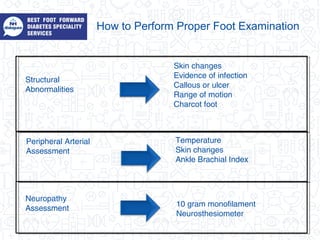
Structural
Abnormalities
Peripheral Arterial
Assessment
Skin changes
Evidence of infection
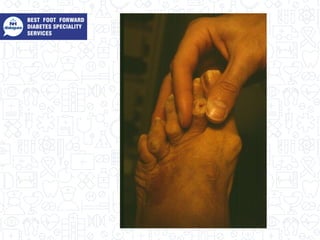
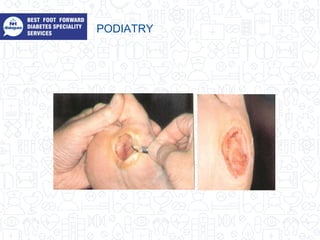
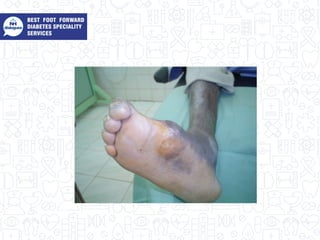
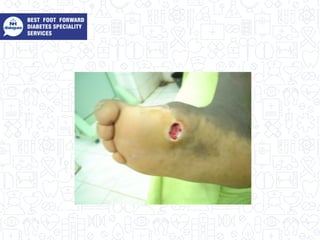
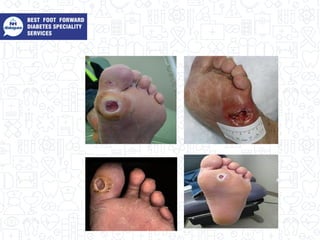
Callous or ulcer
Range of motion
Charcot foot
Temperature
Skin changes
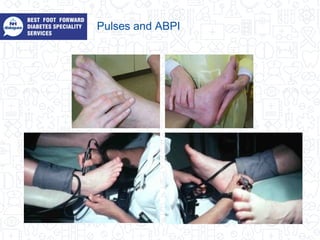
Ankle Brachial Index
Neuropathy
Assessment
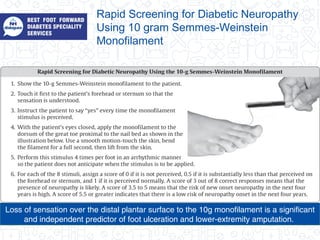
10 gram monofilament
Neurosthesiometer
How to Perform Proper Foot Examination
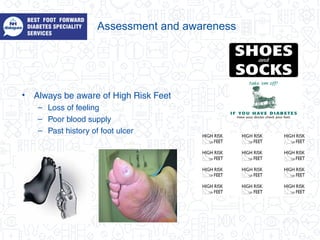
Assessment and awareness
• Always be aware of High Risk Feet
– Loss of feeling
– Poor blood supply
– Past history of foot ulcer
Rapid Screening for Diabetic Neuropathy
Using 10 gram Semmes-Weinstein
Monofilament
Loss of sensation over the distal plantar surface to the 10g monofilament is a significant
and independent predictor of foot ulceration and lower-extremity amputation.
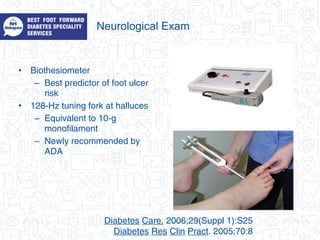
Neurological Exam
• Biothesiometer
– Best predictor of foot ulcer
risk
• 128-Hz tuning fork at halluces
– Equivalent to 10-g
monofilament
– Newly recommended by
ADA
Diabetes Care. 2006;29(Suppl 1):S25
Diabetes Res Clin Pract. 2005;70:8
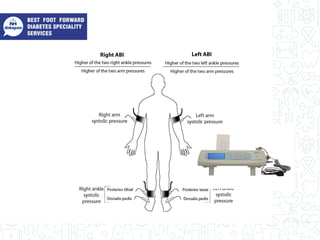
Pulses and ABPI
Adapted from: Norman PE, Eikelboom JW, Hankey GJ. Peripheral arterial disease: prognostic significance and
prevention of atherothrombotic complications. Medical Journal of Australia 2004; 181:150-154. Figure 1, p.151
FOOTWEAR EXAMINATION
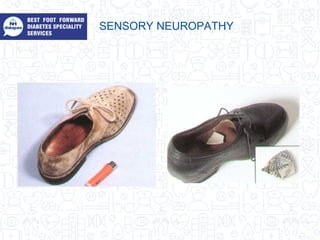
SENSORY NEUROPATHY
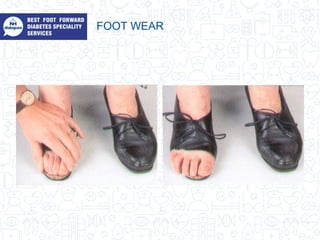
Bad Footwear
FOOT WEAR
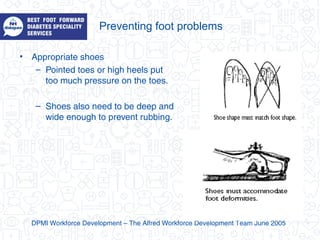
Preventing foot problems
• Appropriate shoes
– Pointed toes or high heels put
too much pressure on the toes.
– Shoes also need to be deep and
wide enough to prevent rubbing.
DPMI Workforce Development – The Alfred Workforce Development Team June 2005
PODIATRY
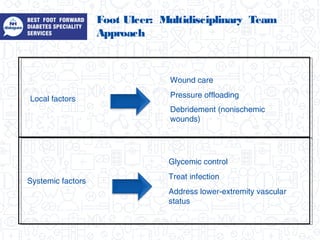
Local factors
Systemic factors
Wound care
Pressure offloading
Debridement (nonischemic
wounds)
Glycemic control
Treat infection
Address lower-extremity vascular
status
Foot Ulcer: Multidisciplinary Team
Approach
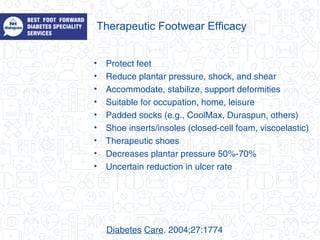
Therapeutic Footwear Efficacy
• Protect feet
• Reduce plantar pressure, shock, and shear
• Accommodate, stabilize, support deformities
• Suitable for occupation, home, leisure
• Padded socks (e.g., CoolMax, Duraspun, others)
• Shoe inserts/insoles (closed-cell foam, viscoelastic)
• Therapeutic shoes
• Decreases plantar pressure 50%-70%
• Uncertain reduction in ulcer rate
Diabetes Care. 2004;27:1774
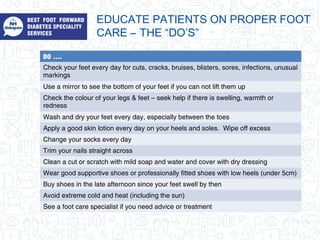
DO ….
Check your feet every day for cuts, cracks, bruises, blisters, sores, infections, unusual
markings
Use a mirror to see the bottom of your feet if you can not lift them up
Check the colour of your legs & feet – seek help if there is swelling, warmth or
redness
Wash and dry your feet every day, especially between the toes
Apply a good skin lotion every day on your heels and soles. Wipe off excess
Change your socks every day
Trim your nails straight across
Clean a cut or scratch with mild soap and water and cover with dry dressing
Wear good supportive shoes or professionally fitted shoes with low heels (under 5cm)
Buy shoes in the late afternoon since your feet swell by then
Avoid extreme cold and heat (including the sun)
See a foot care specialist if you need advice or treatment
EDUCATE PATIENTS ON PROPER FOOT
CARE – THE “DO’S”
DO NOT …
Cut your own corns or callouses
Treat your own in-growing toenails or slivers with a razor or scissors. See your doctor or
foot care specialist
Use over-the-counter medications to treat corns and warts
Apply heat with a hot water bottle or electric blanket – may cause burns unknowingly
Soak your feet
Take very hot baths
Use lotion between your toes
Walk barefoot inside or outside
Wear tight socks, garter or elastics or knee highs
Wear over-the-counter insoles – may cause blisters if not right for your feet
Sit for long periods of time
Smoke
Educate Patients on Proper Foot Care – The
“DON’Ts”
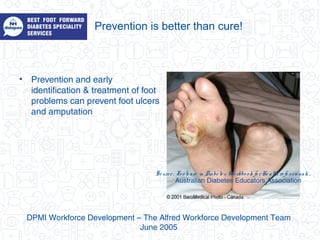
Prevention is better than cure!
• Prevention and early
identification & treatment of foot
problems can prevent foot ulcers
and amputation
DPMI Workforce Development – The Alfred Workforce Development Team
June 2005
So urce : Fo o tcare in Diabe te s Wo rkbo o k fo rHe alth ro fe ssio nals .
Australian Diabetes Educators Association
Rest Assured

Best Foot Forward - Diabetes Speciality Services

  • 1.
    Best Foot Forward DiabetesSpeciality Services Dr Sanjay K Shah Narayana Multispecality Hospital Howrah
  • 2.
    Complications of diabetes •Diabetes can cause increased risk of: – Heart Problems – Stroke – Eye sight problems – Kidney problems – Foot problems
  • 4.
  • 5.
    Why do Footproblems occur • The feet can be affected by: – Decreased blood supply poor healing – Nerve damage loss of feeling – High Blood Sugar levels infection & healing
  • 6.
    Structural Abnormalities Peripheral Arterial Assessment Skin changes Evidenceof infection Callous or ulcer Range of motion Charcot foot Temperature Skin changes Ankle Brachial Index Neuropathy Assessment 10 gram monofilament Neurosthesiometer How to Perform Proper Foot Examination
  • 7.
    Assessment and awareness •Always be aware of High Risk Feet – Loss of feeling – Poor blood supply – Past history of foot ulcer
  • 8.
    Rapid Screening forDiabetic Neuropathy Using 10 gram Semmes-Weinstein Monofilament Loss of sensation over the distal plantar surface to the 10g monofilament is a significant and independent predictor of foot ulceration and lower-extremity amputation.
  • 9.
    Neurological Exam • Biothesiometer –Best predictor of foot ulcer risk • 128-Hz tuning fork at halluces – Equivalent to 10-g monofilament – Newly recommended by ADA Diabetes Care. 2006;29(Suppl 1):S25 Diabetes Res Clin Pract. 2005;70:8
  • 10.
  • 11.
    Adapted from: NormanPE, Eikelboom JW, Hankey GJ. Peripheral arterial disease: prognostic significance and prevention of atherothrombotic complications. Medical Journal of Australia 2004; 181:150-154. Figure 1, p.151
  • 12.
  • 13.
  • 14.
  • 15.
  • 16.
    Preventing foot problems •Appropriate shoes – Pointed toes or high heels put too much pressure on the toes. – Shoes also need to be deep and wide enough to prevent rubbing. DPMI Workforce Development – The Alfred Workforce Development Team June 2005
  • 18.
  • 22.
    Local factors Systemic factors Woundcare Pressure offloading Debridement (nonischemic wounds) Glycemic control Treat infection Address lower-extremity vascular status Foot Ulcer: Multidisciplinary Team Approach
  • 23.
    Therapeutic Footwear Efficacy •Protect feet • Reduce plantar pressure, shock, and shear • Accommodate, stabilize, support deformities • Suitable for occupation, home, leisure • Padded socks (e.g., CoolMax, Duraspun, others) • Shoe inserts/insoles (closed-cell foam, viscoelastic) • Therapeutic shoes • Decreases plantar pressure 50%-70% • Uncertain reduction in ulcer rate Diabetes Care. 2004;27:1774
  • 24.
    DO …. Check yourfeet every day for cuts, cracks, bruises, blisters, sores, infections, unusual markings Use a mirror to see the bottom of your feet if you can not lift them up Check the colour of your legs & feet – seek help if there is swelling, warmth or redness Wash and dry your feet every day, especially between the toes Apply a good skin lotion every day on your heels and soles. Wipe off excess Change your socks every day Trim your nails straight across Clean a cut or scratch with mild soap and water and cover with dry dressing Wear good supportive shoes or professionally fitted shoes with low heels (under 5cm) Buy shoes in the late afternoon since your feet swell by then Avoid extreme cold and heat (including the sun) See a foot care specialist if you need advice or treatment EDUCATE PATIENTS ON PROPER FOOT CARE – THE “DO’S”
  • 25.
    DO NOT … Cutyour own corns or callouses Treat your own in-growing toenails or slivers with a razor or scissors. See your doctor or foot care specialist Use over-the-counter medications to treat corns and warts Apply heat with a hot water bottle or electric blanket – may cause burns unknowingly Soak your feet Take very hot baths Use lotion between your toes Walk barefoot inside or outside Wear tight socks, garter or elastics or knee highs Wear over-the-counter insoles – may cause blisters if not right for your feet Sit for long periods of time Smoke Educate Patients on Proper Foot Care – The “DON’Ts”
  • 26.
    Prevention is betterthan cure! • Prevention and early identification & treatment of foot problems can prevent foot ulcers and amputation DPMI Workforce Development – The Alfred Workforce Development Team June 2005 So urce : Fo o tcare in Diabe te s Wo rkbo o k fo rHe alth ro fe ssio nals . Australian Diabetes Educators Association
  • 27.

Editor's Notes

  • #6 Foot care is very important for each person with diabetes, but especially if there is: Loss of feeling in your feet. Changes in the shape of your feet. Foot ulcers or sores that do not heal. Nerve damage can cause you to lose feeling in the feet. You may not feel a pebble inside your sock that is causing a sore. You may not feel a blister caused by poorly fitting shoes. Foot injuries such as these can cause ulcers which may lead to amputation.Keeping your blood glucose (sugar) in good control and taking care of your feet every day can help you avoid serious foot problems.
  • #7 Loss of sensation over the distal plantar surface to the 10 gram Semmes Weinstein monofilament is a significant and independent predictor of future foot ulceration and the possibility of lower-extremity amputation Caution with interpretation of ABI: may underestimate the degree of peripheral arterial obstruction in some individuals with diabetes partly due to medial arterial-wall calcification in lower-extremity arteries Advanced magnetic resonance angiography (MRA) and computed tomographic angiography (CTA) do not require arterial access, and have therefore gained popularity as reliable alternatives to iodinated contrast studies due to their less invasive approaches List preamble of who is high risk Who? When? How? Abx table (show picture – table available) Lack of evidence for
  • #12 A much more useful noninvasive test to diagnose PAD in diabetes is the Ankle-Brachial Index (ABI). The (ABI) is performed with a handheld Doppler Flow meter to measure systolic blood pressure in both arms and in the DP and PT arteries. The ABI is calculated by dividing the highest pressure measured at the ankle by the highest brachial pressure. [PATRICK AND TED: DO NOT HAVE PERMISSION TO USE. REFERENCE IS: Norman PE, Eikelboom JW, Hankey GJ. Peripheral arterial disease: prognostic significance and prevention of atherothrombotic complications. Medical Journal of Australia 2004; 181:150-154. Figure 1, p.151
  • #18 Slide 54
  • #28 Slide 44