Want to learn more about Recruitment? Call
Pathway on 0121 707 0550 or visit
www.Elearning.pathwaycourses.co.uk
 Prevents unnecessary recruitment
 Ensures key tasks and skills are catered for in an
organisation
 Avoids recruiting the wrong candidates, which can
cause:
 Reduced organisational effectiveness
 Unfair on the recruited person if they aren’t right for the
job
 Makes managers’ jobs much harder
Want to learn more about Recruitment? Call
Pathway on 0121 707 0550 or visit
www.Elearning.pathwaycourses.co.uk
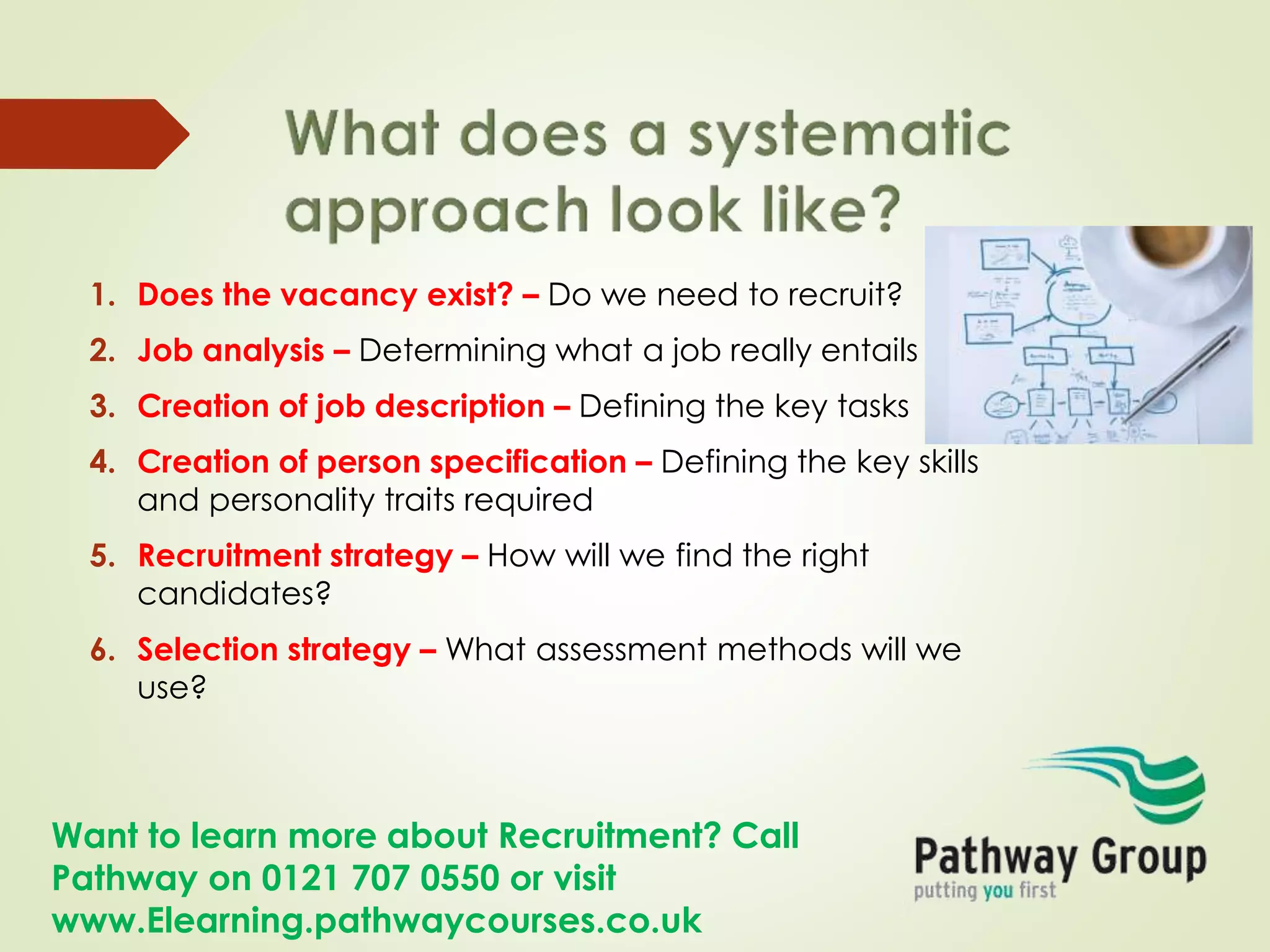
1. Does the vacancy exist? – Do we need to recruit?
2. Job analysis – Determining what a job really entails
3. Creation of job description – Defining the key tasks
4. Creation of person specification – Defining the key skills
and personality traits required
5. Recruitment strategy – How will we find the right
candidates?
6. Selection strategy – What assessment methods will we
use?
Want to learn more about Recruitment? Call
Pathway on 0121 707 0550 or visit
www.Elearning.pathwaycourses.co.uk
“The procedure for determining
the duties and skill requirements
of a job and the kind of person
who should be hired for it”
Want to learn more about Recruitment? Call
Pathway on 0121 707 0550 or visit
www.Elearning.pathwaycourses.co.uk
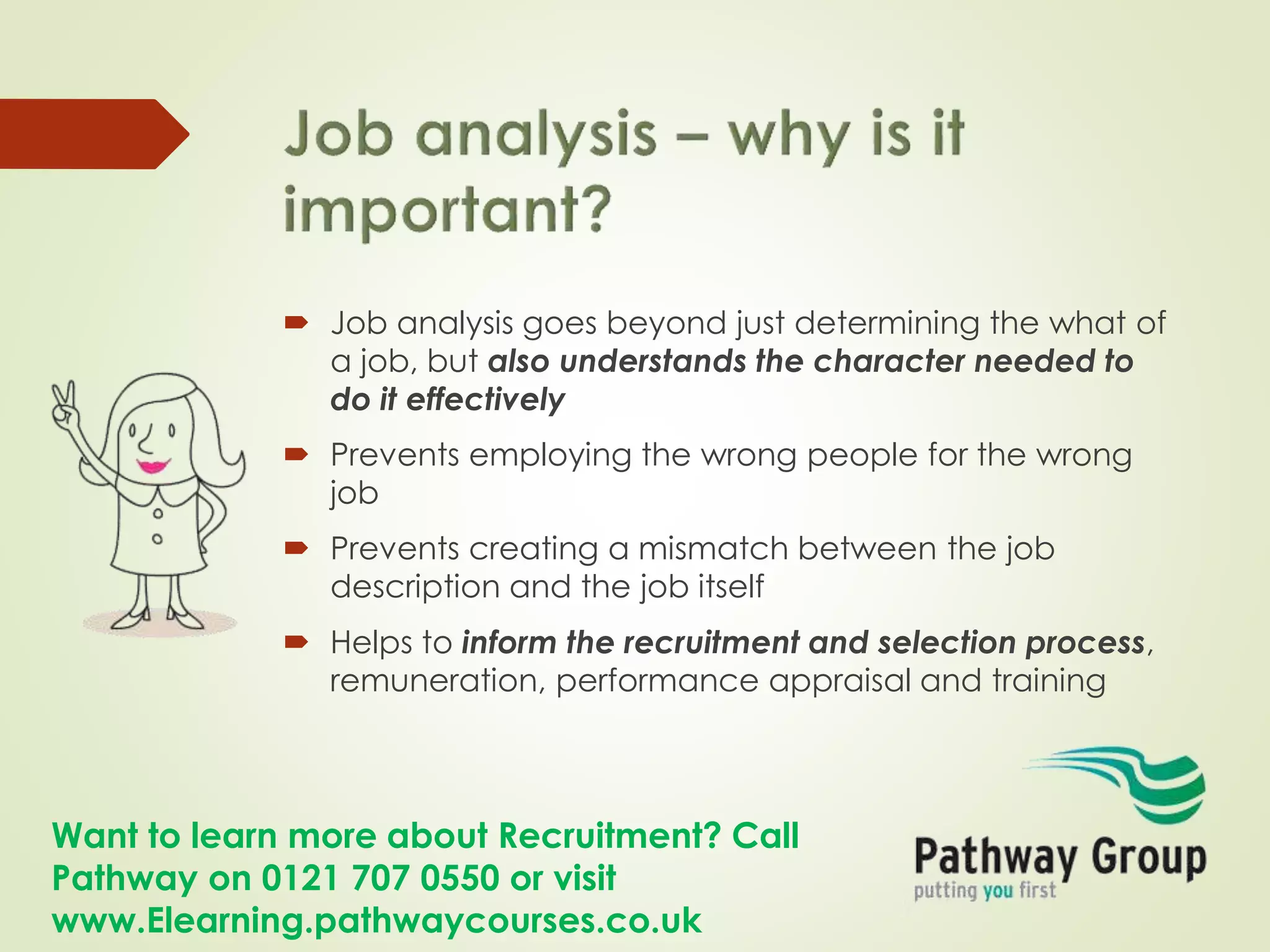
 Job analysis goes beyond just determining the what of
a job, but also understands the character needed to
do it effectively
 Prevents employing the wrong people for the wrong
job
 Prevents creating a mismatch between the job
description and the job itself
 Helps to inform the recruitment and selection process,
remuneration, performance appraisal and training
Want to learn more about Recruitment? Call
Pathway on 0121 707 0550 or visit
www.Elearning.pathwaycourses.co.uk
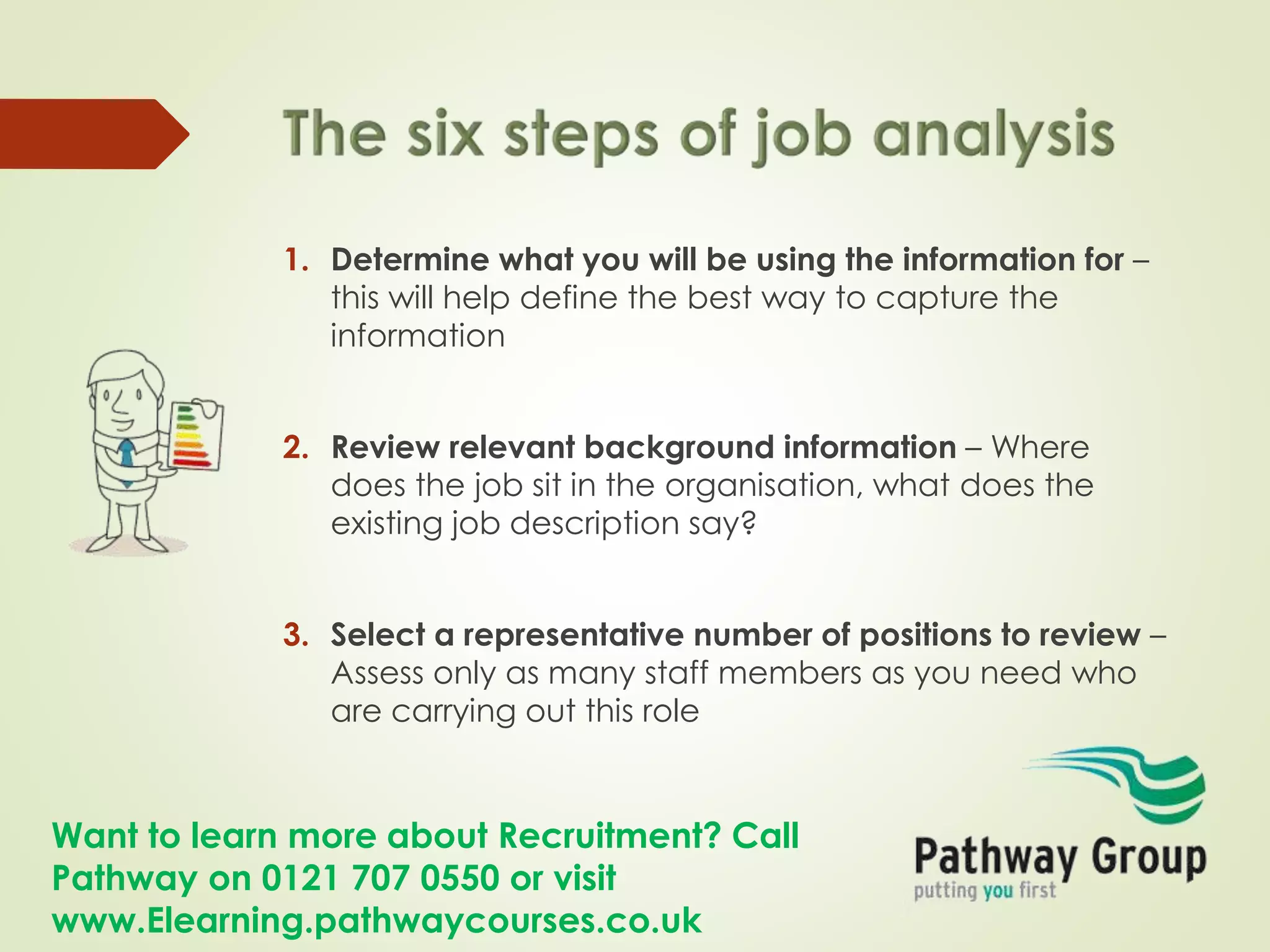
1. Determine what you will be using the information for –
this will help define the best way to capture the
information
2. Review relevant background information – Where
does the job sit in the organisation, what does the
existing job description say?
3. Select a representative number of positions to review –
Assess only as many staff members as you need who
are carrying out this role
Want to learn more about Recruitment? Call
Pathway on 0121 707 0550 or visit
www.Elearning.pathwaycourses.co.uk
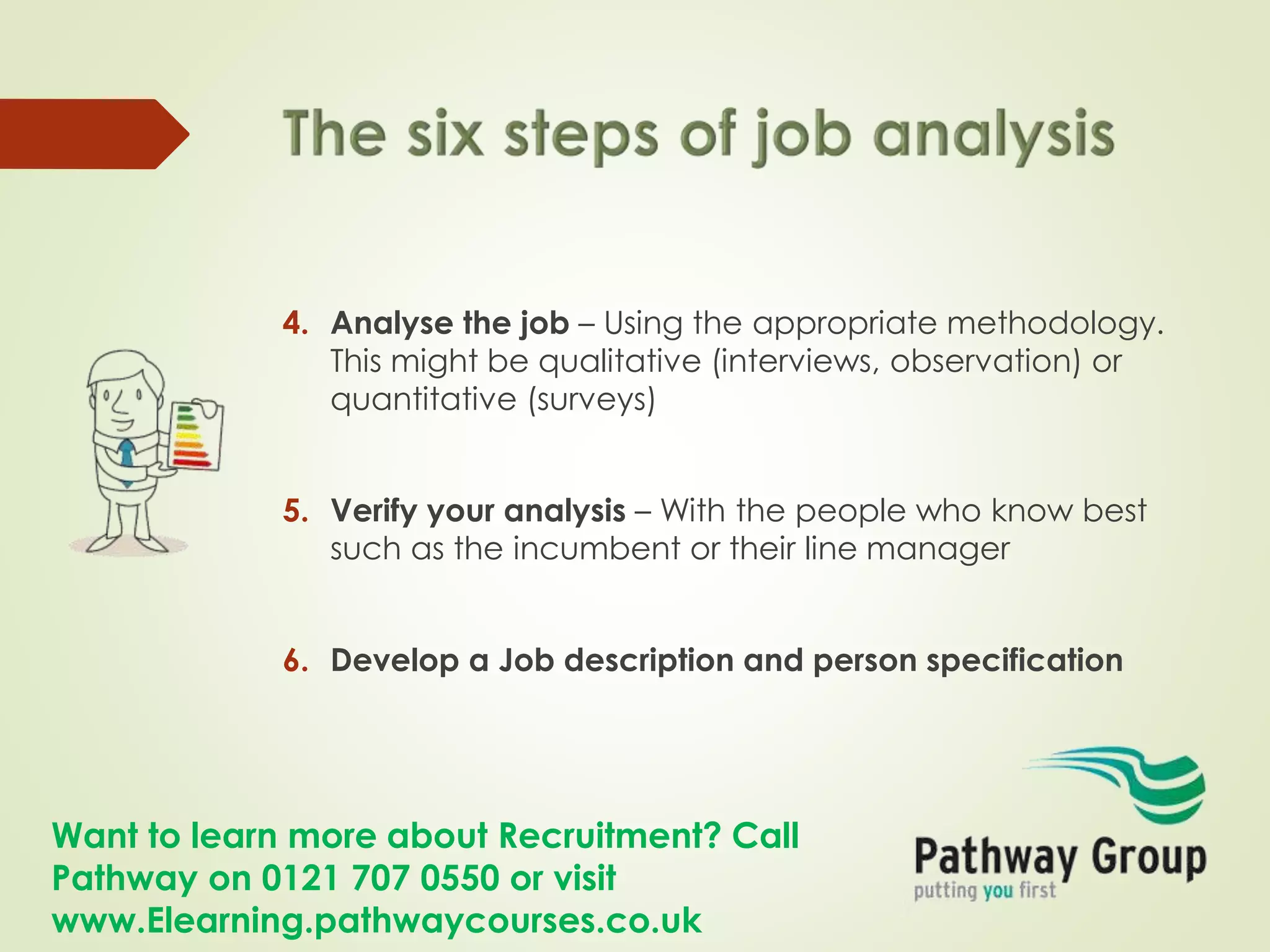
4. Analyse the job – Using the appropriate methodology.
This might be qualitative (interviews, observation) or
quantitative (surveys)
5. Verify your analysis – With the people who know best
such as the incumbent or their line manager
6. Develop a Job description and person specification
Want to learn more about Recruitment? Call
Pathway on 0121 707 0550 or visit
www.Elearning.pathwaycourses.co.uk
“A written statement of what
the worker actually does, how
they do it and what the working
conditions are”
Want to learn more about Recruitment? Call
Pathway on 0121 707 0550 or visit
www.Elearning.pathwaycourses.co.uk
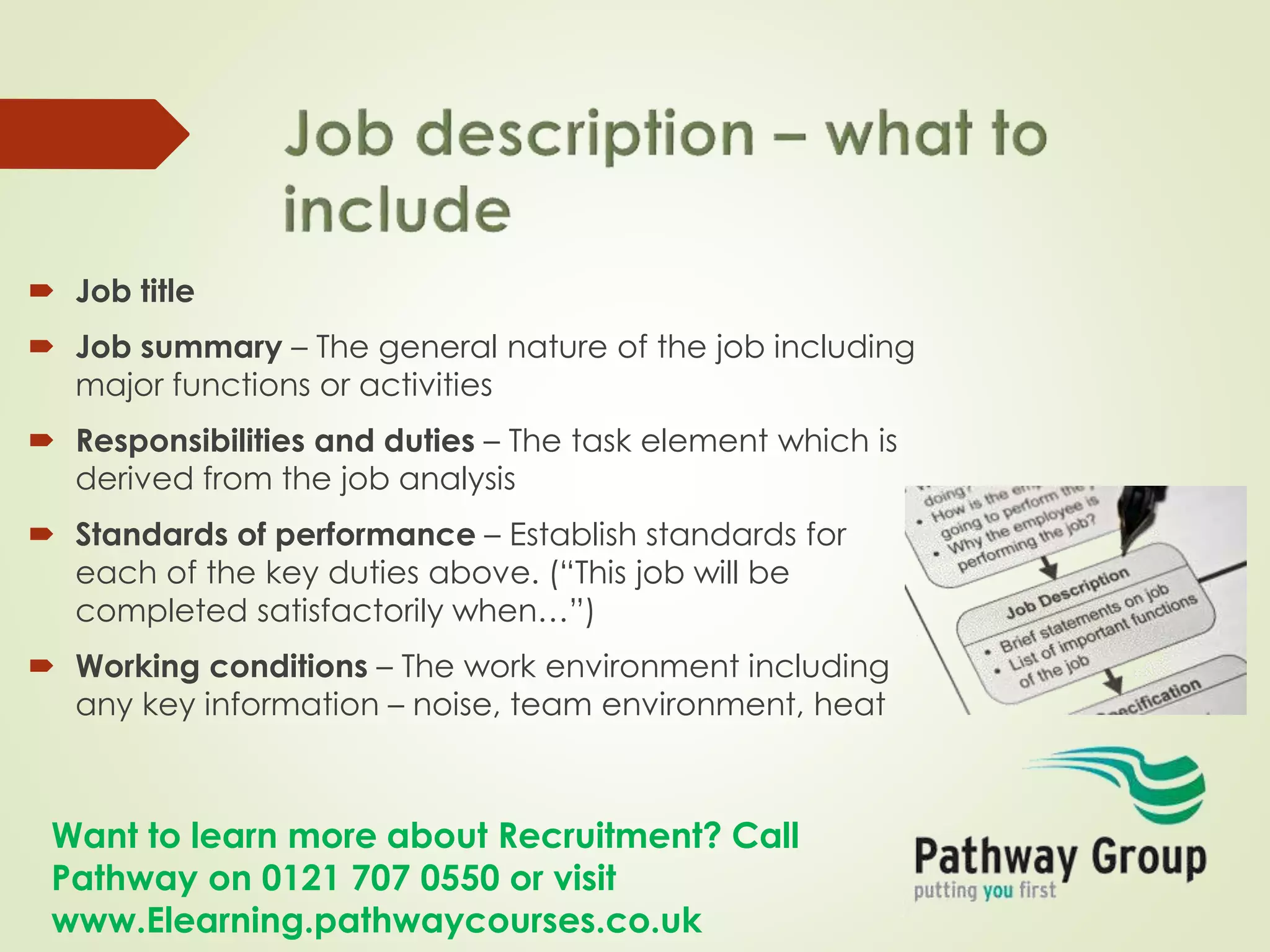
 Job title
 Job summary – The general nature of the job including
major functions or activities
 Responsibilities and duties – The task element which is
derived from the job analysis
 Standards of performance – Establish standards for
each of the key duties above. (“This job will be
completed satisfactorily when…”)
 Working conditions – The work environment including
any key information – noise, team environment, heat
Want to learn more about Recruitment? Call
Pathway on 0121 707 0550 or visit
www.Elearning.pathwaycourses.co.uk
“A list of the ‘human requirements’
for a job including education, skills,
experience and personality”
Want to learn more about Recruitment? Call
Pathway on 0121 707 0550 or visit
www.Elearning.pathwaycourses.co.uk
It is used throughout the recruitment process
 By individuals deciding if they are suitable for
the role
 When selecting candidates for interview
 When determining the appropriate selection
methods
 When interviewing
 When selecting
Want to learn more about Recruitment? Call
Pathway on 0121 707 0550 or visit
www.Elearning.pathwaycourses.co.uk
 Essential Criteria – The requirements the applicant
needs to be able to fulfil the role
 Desirable criteria – Criteria which are non-essential but
may help the person do the job better and helped
you differentiate between candidates
DON’T MAKE IT TOO
 Narrow – limiting who you can shortlist
 Broad – too many people meet the essential criteria
Want to learn more about Recruitment? Call
Pathway on 0121 707 0550 or visit
www.Elearning.pathwaycourses.co.uk
 The recruitment process needs to align with your
marketing strategy, because…
 Your reputation will be affected by how you run the
recruitment process
 Contributing to the ongoing learning of candidates is
important
 Adds weight to the process being transparent and fair
Want to learn more about Recruitment? Call
Pathway on 0121 707 0550 or visit
www.Elearning.pathwaycourses.co.uk
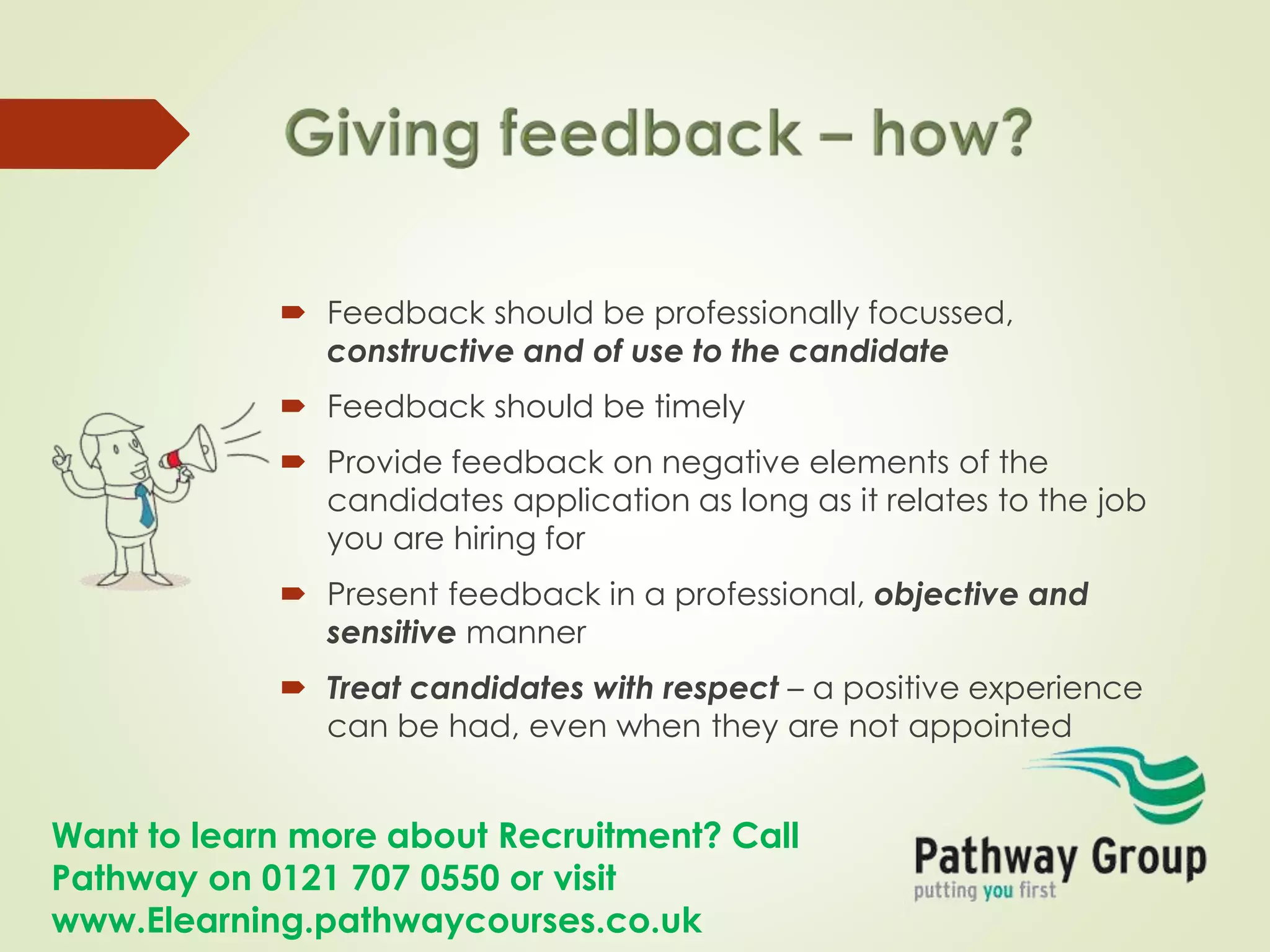
 Feedback should be professionally focussed,
constructive and of use to the candidate
 Feedback should be timely
 Provide feedback on negative elements of the
candidates application as long as it relates to the job
you are hiring for
 Present feedback in a professional, objective and
sensitive manner
 Treat candidates with respect – a positive experience
can be had, even when they are not appointed
Want to learn more about Recruitment? Call
Pathway on 0121 707 0550 or visit
www.Elearning.pathwaycourses.co.uk
“In the United Kingdom it is unlawful for
an employer to discriminate against a
candidate for a job because of age,
disability, race, belief, sexual orientation
or gender”
Want to learn more about Recruitment? Call
Pathway on 0121 707 0550 or visit
www.Elearning.pathwaycourses.co.uk
It is vital to avoid direct or indirect discrimination
throughout the recruitment process – some examples:
 Stating a preference for a male or female unless the
requirements are clear. Avoid phrases like
‘handyman’ or ‘salesgirl’
 Avoid age limits unless justifiable, and phrases such as
‘mature’ or ‘young and dynamic’
 During interviews avoid asking about a woman’s plans
for a family
Want to learn more about Recruitment? Call
Pathway on 0121 707 0550 or visit
www.Elearning.pathwaycourses.co.uk
Offers training courses on the recruitment and
selection process, helping you to understand the
process of recruitment and selection and how to
deliver each element
Looking at:
Creating a systematic process
The importance and methods of job analysis
Writing Job descriptions and job specifications
The importance of giving feedback and how
to do it well
Staying within the law when recruiting
Pathway Group

Effectively managing recruitment & selection - employing the right person

  • 2.
    Want to learnmore about Recruitment? Call Pathway on 0121 707 0550 or visit www.Elearning.pathwaycourses.co.uk  Prevents unnecessary recruitment  Ensures key tasks and skills are catered for in an organisation  Avoids recruiting the wrong candidates, which can cause:  Reduced organisational effectiveness  Unfair on the recruited person if they aren’t right for the job  Makes managers’ jobs much harder
  • 3.
    Want to learnmore about Recruitment? Call Pathway on 0121 707 0550 or visit www.Elearning.pathwaycourses.co.uk 1. Does the vacancy exist? – Do we need to recruit? 2. Job analysis – Determining what a job really entails 3. Creation of job description – Defining the key tasks 4. Creation of person specification – Defining the key skills and personality traits required 5. Recruitment strategy – How will we find the right candidates? 6. Selection strategy – What assessment methods will we use?
  • 4.
    Want to learnmore about Recruitment? Call Pathway on 0121 707 0550 or visit www.Elearning.pathwaycourses.co.uk “The procedure for determining the duties and skill requirements of a job and the kind of person who should be hired for it”
  • 5.
    Want to learnmore about Recruitment? Call Pathway on 0121 707 0550 or visit www.Elearning.pathwaycourses.co.uk  Job analysis goes beyond just determining the what of a job, but also understands the character needed to do it effectively  Prevents employing the wrong people for the wrong job  Prevents creating a mismatch between the job description and the job itself  Helps to inform the recruitment and selection process, remuneration, performance appraisal and training
  • 6.
    Want to learnmore about Recruitment? Call Pathway on 0121 707 0550 or visit www.Elearning.pathwaycourses.co.uk 1. Determine what you will be using the information for – this will help define the best way to capture the information 2. Review relevant background information – Where does the job sit in the organisation, what does the existing job description say? 3. Select a representative number of positions to review – Assess only as many staff members as you need who are carrying out this role
  • 7.
    Want to learnmore about Recruitment? Call Pathway on 0121 707 0550 or visit www.Elearning.pathwaycourses.co.uk 4. Analyse the job – Using the appropriate methodology. This might be qualitative (interviews, observation) or quantitative (surveys) 5. Verify your analysis – With the people who know best such as the incumbent or their line manager 6. Develop a Job description and person specification
  • 8.
    Want to learnmore about Recruitment? Call Pathway on 0121 707 0550 or visit www.Elearning.pathwaycourses.co.uk “A written statement of what the worker actually does, how they do it and what the working conditions are”
  • 9.
    Want to learnmore about Recruitment? Call Pathway on 0121 707 0550 or visit www.Elearning.pathwaycourses.co.uk  Job title  Job summary – The general nature of the job including major functions or activities  Responsibilities and duties – The task element which is derived from the job analysis  Standards of performance – Establish standards for each of the key duties above. (“This job will be completed satisfactorily when…”)  Working conditions – The work environment including any key information – noise, team environment, heat
  • 10.
    Want to learnmore about Recruitment? Call Pathway on 0121 707 0550 or visit www.Elearning.pathwaycourses.co.uk “A list of the ‘human requirements’ for a job including education, skills, experience and personality”
  • 11.
    Want to learnmore about Recruitment? Call Pathway on 0121 707 0550 or visit www.Elearning.pathwaycourses.co.uk It is used throughout the recruitment process  By individuals deciding if they are suitable for the role  When selecting candidates for interview  When determining the appropriate selection methods  When interviewing  When selecting
  • 12.
    Want to learnmore about Recruitment? Call Pathway on 0121 707 0550 or visit www.Elearning.pathwaycourses.co.uk  Essential Criteria – The requirements the applicant needs to be able to fulfil the role  Desirable criteria – Criteria which are non-essential but may help the person do the job better and helped you differentiate between candidates DON’T MAKE IT TOO  Narrow – limiting who you can shortlist  Broad – too many people meet the essential criteria
  • 13.
    Want to learnmore about Recruitment? Call Pathway on 0121 707 0550 or visit www.Elearning.pathwaycourses.co.uk  The recruitment process needs to align with your marketing strategy, because…  Your reputation will be affected by how you run the recruitment process  Contributing to the ongoing learning of candidates is important  Adds weight to the process being transparent and fair
  • 14.
    Want to learnmore about Recruitment? Call Pathway on 0121 707 0550 or visit www.Elearning.pathwaycourses.co.uk  Feedback should be professionally focussed, constructive and of use to the candidate  Feedback should be timely  Provide feedback on negative elements of the candidates application as long as it relates to the job you are hiring for  Present feedback in a professional, objective and sensitive manner  Treat candidates with respect – a positive experience can be had, even when they are not appointed
  • 15.
    Want to learnmore about Recruitment? Call Pathway on 0121 707 0550 or visit www.Elearning.pathwaycourses.co.uk “In the United Kingdom it is unlawful for an employer to discriminate against a candidate for a job because of age, disability, race, belief, sexual orientation or gender”
  • 16.
    Want to learnmore about Recruitment? Call Pathway on 0121 707 0550 or visit www.Elearning.pathwaycourses.co.uk It is vital to avoid direct or indirect discrimination throughout the recruitment process – some examples:  Stating a preference for a male or female unless the requirements are clear. Avoid phrases like ‘handyman’ or ‘salesgirl’  Avoid age limits unless justifiable, and phrases such as ‘mature’ or ‘young and dynamic’  During interviews avoid asking about a woman’s plans for a family
  • 17.
    Want to learnmore about Recruitment? Call Pathway on 0121 707 0550 or visit www.Elearning.pathwaycourses.co.uk Offers training courses on the recruitment and selection process, helping you to understand the process of recruitment and selection and how to deliver each element Looking at: Creating a systematic process The importance and methods of job analysis Writing Job descriptions and job specifications The importance of giving feedback and how to do it well Staying within the law when recruiting Pathway Group