Source: THE OTHER SIDE OF INNOVATION,
SOLVING THE EXECUTION CHALLENGE
Harvard Business Review Press, Copyright, 2010 Govindarajan and Trimble
Managing
Execution
and getting
new decisions done
Innovation
is
putting ideas into action.
1
Ron McFarland, Ota-ku, Tokyo, Japan
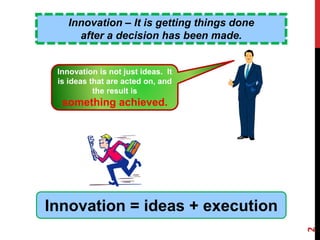
Innovation – It is getting things done
after a decision has been made.
Innovation = ideas + execution
Innovation is not just ideas. It
is ideas that are acted on, and
the result is
something achieved.
2
Ron McFarland, Ota-ku, Tokyo, Japan
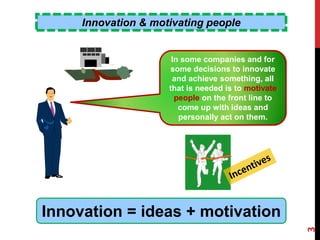
Innovation & motivating people
Innovation = ideas + motivation
In some companies and for
some decisions to innovate
and achieve something, all
that is needed is to motivate
people on the front line to
come up with ideas and
personally act on them.
3
Ron McFarland, Ota-ku, Tokyo, Japan
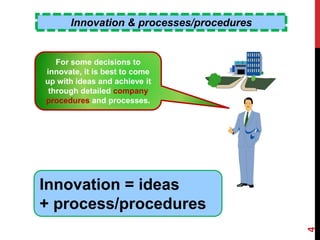
Innovation & processes/procedures
Innovation = ideas
+ process/procedures
For some decisions to
innovate, it is best to come
up with ideas and achieve it
through detailed company
procedures and processes.
4
Ron McFarland, Ota-ku, Tokyo, Japan
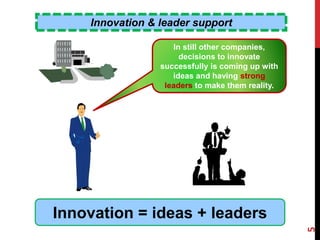
Innovation & leader support
Innovation = ideas + leaders
In still other companies,
decisions to innovate
successfully is coming up with
ideas and having strong
leaders to make them reality.
5
Ron McFarland, Ota-ku, Tokyo, Japan
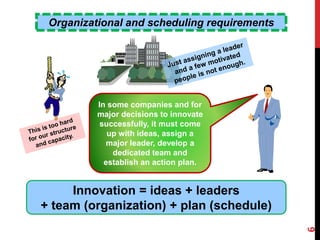
Organizational and scheduling requirements
Innovation = ideas + leaders
+ team (organization) + plan (schedule)
In some companies and for
major decisions to innovate
successfully, it must come
up with ideas, assign a
major leader, develop a
dedicated team and
establish an action plan.
6
Ron McFarland, Ota-ku, Tokyo, Japan
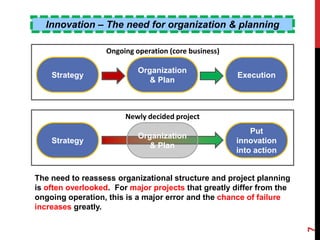
Innovation – The need for organization & planning
The need to reassess organizational structure and project planning
is often overlooked. For major projects that greatly differ from the
ongoing operation, this is a major error and the chance of failure
increases greatly.
Put
innovation
into action
Strategy
Organization
& Plan
ExecutionStrategy
Organization
& Plan
Newly decided project
Ongoing operation (core business)
7
Ron McFarland, Ota-ku, Tokyo, Japan
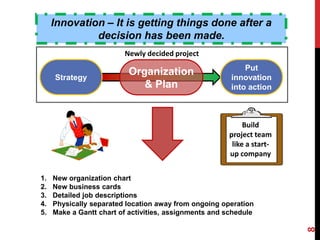
Innovation – It is getting things done after a
decision has been made.
1. New organization chart
2. New business cards
3. Detailed job descriptions
4. Physically separated location away from ongoing operation
5. Make a Gantt chart of activities, assignments and schedule
Organization
& Plan
Newly decided project
Strategy
Put
innovation
into action
Build
project team
like a start-
up company
8
Ron McFarland, Ota-ku, Tokyo, Japan
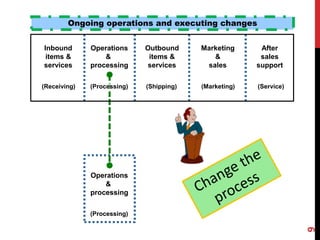
Ongoing operations and executing changes
Operations
&
processing
(Processing)
Operations
&
processing
Outbound
items &
services
Marketing
&
sales
After
sales
support
Inbound
items &
services
(Processing) (Shipping) (Service)(Receiving) (Marketing)
9
Ron McFarland, Ota-ku, Tokyo, Japan
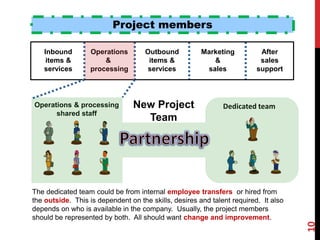
Project members
Operations & processing
shared staff
Dedicated team
Operations
&
processing
Outbound
items &
services
Marketing
&
sales
After
sales
support
Inbound
items &
services
New Project
Team
The dedicated team could be from internal employee transfers or hired from
the outside. This is dependent on the skills, desires and talent required. It also
depends on who is available in the company. Usually, the project members
should be represented by both. All should want change and improvement.
10
Ron McFarland, Ota-ku, Tokyo, Japan
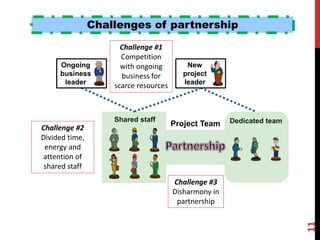
Challenges of partnership
Shared staff Dedicated teamProject Team
Ongoing
business
leader
New
project
leader
Challenge #1
Competition
with ongoing
business for
scarce resources
Challenge #2
Divided time,
energy and
attention of
shared staff
Challenge #3
Disharmony in
partnership
11
Ron McFarland, Ota-ku, Tokyo, Japan
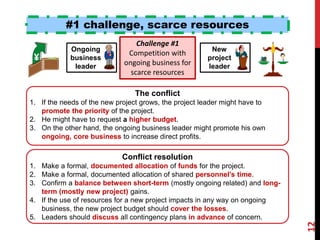
#1 challenge, scarce resources
Ongoing
business
leader
New
project
leader
Challenge #1
Competition with
ongoing business for
scarce resources
Conflict resolution
1. Make a formal, documented allocation of funds for the project.
2. Make a formal, documented allocation of shared personnel’s time.
3. Confirm a balance between short-term (mostly ongoing related) and long-
term (mostly new project) gains.
4. If the use of resources for a new project impacts in any way on ongoing
business, the new project budget should cover the losses.
5. Leaders should discuss all contingency plans in advance of concern.
The conflict
1. If the needs of the new project grows, the project leader might have to
promote the priority of the project.
2. He might have to request a higher budget.
3. On the other hand, the ongoing business leader might promote his own
ongoing, core business to increase direct profits.
¥
12
Ron McFarland, Ota-ku, Tokyo, Japan
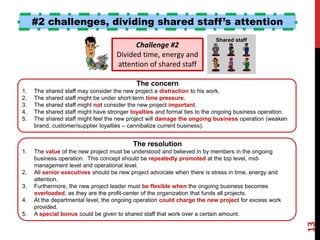
#2 challenges, dividing shared staff’s attention
Shared staff
Challenge #2
Divided time, energy and
attention of shared staff
The resolution
1. The value of the new project must be understood and believed in by members in the ongoing
business operation. This concept should be repeatedly promoted at the top level, mid-
management level and operational level.
2. All senior executives should be new project advocate when there is stress in time, energy and
attention.
3. Furthermore, the new project leader must be flexible when the ongoing business becomes
overloaded, as they are the profit-center of the organization that funds all projects.
4. At the departmental level, the ongoing operation could charge the new project for excess work
provided.
5. A special bonus could be given to shared staff that work over a certain amount.
The concern
1. The shared staff may consider the new project a distraction to his work.
2. The shared staff might be under short-term time pressure.
3. The shared staff might not consider the new project important.
4. The shared staff might have stronger loyalties and formal ties to the ongoing business operation.
5. The shared staff might feel the new project will damage the ongoing business operation (weaken
brand, customer/supplier loyalties – cannibalize current business).
13
Ron McFarland, Ota-ku, Tokyo, Japan
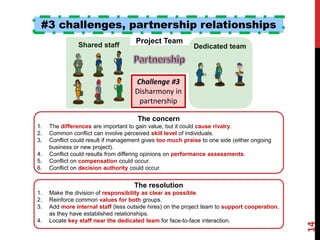
#3 challenges, partnership relationships
Shared staff Dedicated team
Project Team
Challenge #3
Disharmony in
partnership
The resolution
1. Make the division of responsibility as clear as possible.
2. Reinforce common values for both groups.
3. Add more internal staff (less outside hires) on the project team to support cooperation,
as they have established relationships.
4. Locate key staff near the dedicated team for face-to-face interaction.
The concern
1. The differences are important to gain value, but it could cause rivalry.
2. Common conflict can involve perceived skill level of individuals.
3. Conflict could result if management gives too much praise to one side (either ongoing
business or new project).
4. Conflict could results from differing opinions on performance assessments.
5. Conflict on compensation could occur.
6. Conflict on decision authority could occur.
14
Ron McFarland, Ota-ku, Tokyo, Japan
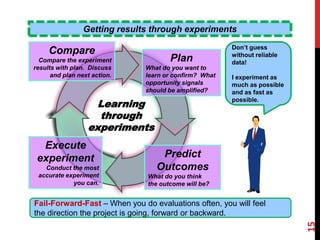
Getting results through experiments
Plan
What do you want to
learn or confirm? What
opportunity signals
should be amplified?
Predict
Outcomes
What do you think
the outcome will be?
Execute
experiment
Conduct the most
accurate experiment
you can.
Compare
Compare the experiment
results with plan. Discuss
and plan next action.
Learning
through
experiments
Don’t guess
without reliable
data!
I experiment as
much as possible
and as fast as
possible.
Fail-Forward-Fast – When you do evaluations often, you will feel
the direction the project is going, forward or backward.
15
Ron McFarland, Ota-ku, Tokyo, Japan
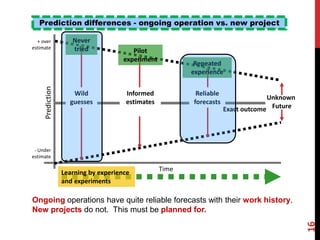
Prediction differences - ongoing operation vs. new project
Time
Prediction
- Under
estimate
+ over
estimate
Informed
estimates
Pilot
experiment
Wild
guesses
Never
tried
Reliable
forecasts
Repeated
experience
Ongoing operations have quite reliable forecasts with their work history.
New projects do not. This must be planned for.
Exact outcome
Learning by experience
and experiments
Unknown
Future
16
Ron McFarland, Ota-ku, Tokyo, Japan
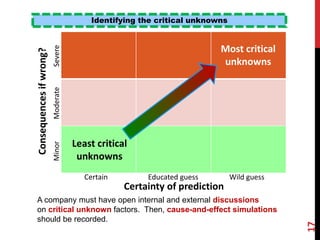
Identifying the critical unknowns
A company must have open internal and external discussions
on critical unknown factors. Then, cause-and-effect simulations
should be recorded.
Consequencesifwrong?
MinorModerateSevere
Certainty of prediction
Certain Educated guess Wild guess
Least critical
unknowns
Most critical
unknowns
17
Ron McFarland, Ota-ku, Tokyo, Japan
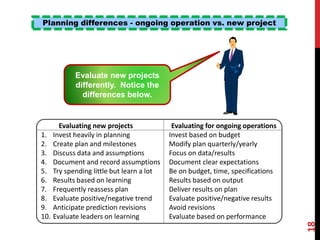
Planning differences - ongoing operation vs. new project
Evaluating new projects Evaluating for ongoing operations
1. Invest heavily in planning Invest based on budget
2. Create plan and milestones Modify plan quarterly/yearly
3. Discuss data and assumptions Focus on data/results
4. Document and record assumptions Document clear expectations
5. Try spending little but learn a lot Be on budget, time, specifications
6. Results based on learning Results based on output
7. Frequently reassess plan Deliver results on plan
8. Evaluate positive/negative trend Evaluate positive/negative results
9. Anticipate prediction revisions Avoid revisions
10. Evaluate leaders on learning Evaluate based on performance
Evaluate new projects
differently. Notice the
differences below.
18
Ron McFarland, Ota-ku, Tokyo, Japan
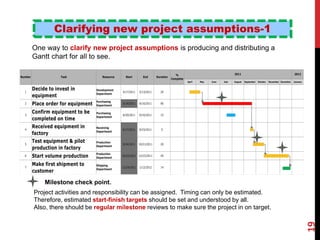
Clarifying new project assumptions-1
One way to clarify new project assumptions is producing and distributing a
Gantt chart for all to see.
Milestone check point.
Project activities and responsibility can be assigned. Timing can only be estimated.
Therefore, estimated start-finish targets should be set and understood by all.
Also, there should be regular milestone reviews to make sure the project in on target.
19
Ron McFarland, Ota-ku, Tokyo, Japan
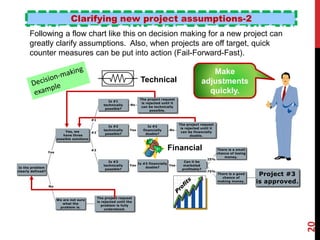
Clarifying new project assumptions-2
Following a flow chart like this on decision making for a new project can
greatly clarify assumptions. Also, when projects are off target, quick
counter measures can be put into action (Fail-Forward-Fast).
Technical
Financial
Make
adjustments
quickly.
20
Ron McFarland, Ota-ku, Tokyo, Japan
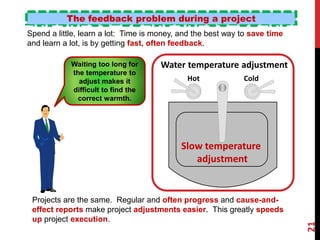
The feedback problem during a project
ColdHot
Projects are the same. Regular and often progress and cause-and-
effect reports make project adjustments easier. This greatly speeds
up project execution.
Waiting too long for
the temperature to
adjust makes it
difficult to find the
correct warmth.
Slow temperature
adjustment
Spend a little, learn a lot: Time is money, and the best way to save time
and learn a lot, is by getting fast, often feedback.
Water temperature adjustment
21
Ron McFarland, Ota-ku, Tokyo, Japan
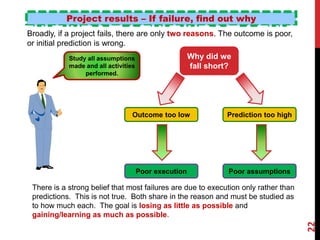
Project results – If failure, find out why
There is a strong belief that most failures are due to execution only rather than
predictions. This is not true. Both share in the reason and must be studied as
to how much each. The goal is losing as little as possible and
gaining/learning as much as possible.
Study all assumptions
made and all activities
performed.
Broadly, if a project fails, there are only two reasons. The outcome is poor,
or initial prediction is wrong.
Why did we
fall short?
Poor assumptionsPoor execution
Prediction too highOutcome too low
22
Ron McFarland, Ota-ku, Tokyo, Japan
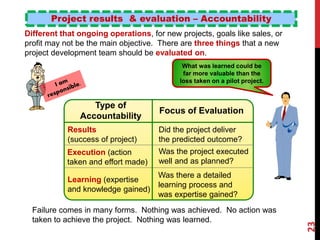
Project results & evaluation – Accountability
Failure comes in many forms. Nothing was achieved. No action was
taken to achieve the project. Nothing was learned.
What was learned could be
far more valuable than the
loss taken on a pilot project.
Different than ongoing operations, for new projects, goals like sales, or
profit may not be the main objective. There are three things that a new
project development team should be evaluated on.
Type of
Accountability
Results
(success of project)
Learning (expertise
and knowledge gained)
Execution (action
taken and effort made)
Did the project deliver
the predicted outcome?
Was the project executed
well and as planned?
Was there a detailed
learning process and
was expertise gained?
Focus of Evaluation
23
Ron McFarland, Ota-ku, Tokyo, Japan
Source: THE OTHER SIDE OF INNOVATION,
SOLVING THE EXECUTION CHALLENGE
Harvard Business Review Press, Copyright, 2010 Govindarajan and Trimble
Managing
Execution
and getting new decisions done
I hope the ideas in this
presentation will help
you get major projects
done on time and with
little expense.
Thank you
24
Ron McFarland, Ota-ku, Tokyo, Japan

Managing innovation

  • 1.
    Source: THE OTHERSIDE OF INNOVATION, SOLVING THE EXECUTION CHALLENGE Harvard Business Review Press, Copyright, 2010 Govindarajan and Trimble Managing Execution and getting new decisions done Innovation is putting ideas into action. 1 Ron McFarland, Ota-ku, Tokyo, Japan
  • 2.
    Innovation – Itis getting things done after a decision has been made. Innovation = ideas + execution Innovation is not just ideas. It is ideas that are acted on, and the result is something achieved. 2 Ron McFarland, Ota-ku, Tokyo, Japan
  • 3.
    Innovation & motivatingpeople Innovation = ideas + motivation In some companies and for some decisions to innovate and achieve something, all that is needed is to motivate people on the front line to come up with ideas and personally act on them. 3 Ron McFarland, Ota-ku, Tokyo, Japan
  • 4.
    Innovation & processes/procedures Innovation= ideas + process/procedures For some decisions to innovate, it is best to come up with ideas and achieve it through detailed company procedures and processes. 4 Ron McFarland, Ota-ku, Tokyo, Japan
  • 5.
    Innovation & leadersupport Innovation = ideas + leaders In still other companies, decisions to innovate successfully is coming up with ideas and having strong leaders to make them reality. 5 Ron McFarland, Ota-ku, Tokyo, Japan
  • 6.
    Organizational and schedulingrequirements Innovation = ideas + leaders + team (organization) + plan (schedule) In some companies and for major decisions to innovate successfully, it must come up with ideas, assign a major leader, develop a dedicated team and establish an action plan. 6 Ron McFarland, Ota-ku, Tokyo, Japan
  • 7.
    Innovation – Theneed for organization & planning The need to reassess organizational structure and project planning is often overlooked. For major projects that greatly differ from the ongoing operation, this is a major error and the chance of failure increases greatly. Put innovation into action Strategy Organization & Plan ExecutionStrategy Organization & Plan Newly decided project Ongoing operation (core business) 7 Ron McFarland, Ota-ku, Tokyo, Japan
  • 8.
    Innovation – Itis getting things done after a decision has been made. 1. New organization chart 2. New business cards 3. Detailed job descriptions 4. Physically separated location away from ongoing operation 5. Make a Gantt chart of activities, assignments and schedule Organization & Plan Newly decided project Strategy Put innovation into action Build project team like a start- up company 8 Ron McFarland, Ota-ku, Tokyo, Japan
  • 9.
    Ongoing operations andexecuting changes Operations & processing (Processing) Operations & processing Outbound items & services Marketing & sales After sales support Inbound items & services (Processing) (Shipping) (Service)(Receiving) (Marketing) 9 Ron McFarland, Ota-ku, Tokyo, Japan
  • 10.
    Project members Operations &processing shared staff Dedicated team Operations & processing Outbound items & services Marketing & sales After sales support Inbound items & services New Project Team The dedicated team could be from internal employee transfers or hired from the outside. This is dependent on the skills, desires and talent required. It also depends on who is available in the company. Usually, the project members should be represented by both. All should want change and improvement. 10 Ron McFarland, Ota-ku, Tokyo, Japan
  • 11.
    Challenges of partnership Sharedstaff Dedicated teamProject Team Ongoing business leader New project leader Challenge #1 Competition with ongoing business for scarce resources Challenge #2 Divided time, energy and attention of shared staff Challenge #3 Disharmony in partnership 11 Ron McFarland, Ota-ku, Tokyo, Japan
  • 12.
    #1 challenge, scarceresources Ongoing business leader New project leader Challenge #1 Competition with ongoing business for scarce resources Conflict resolution 1. Make a formal, documented allocation of funds for the project. 2. Make a formal, documented allocation of shared personnel’s time. 3. Confirm a balance between short-term (mostly ongoing related) and long- term (mostly new project) gains. 4. If the use of resources for a new project impacts in any way on ongoing business, the new project budget should cover the losses. 5. Leaders should discuss all contingency plans in advance of concern. The conflict 1. If the needs of the new project grows, the project leader might have to promote the priority of the project. 2. He might have to request a higher budget. 3. On the other hand, the ongoing business leader might promote his own ongoing, core business to increase direct profits. ¥ 12 Ron McFarland, Ota-ku, Tokyo, Japan
  • 13.
    #2 challenges, dividingshared staff’s attention Shared staff Challenge #2 Divided time, energy and attention of shared staff The resolution 1. The value of the new project must be understood and believed in by members in the ongoing business operation. This concept should be repeatedly promoted at the top level, mid- management level and operational level. 2. All senior executives should be new project advocate when there is stress in time, energy and attention. 3. Furthermore, the new project leader must be flexible when the ongoing business becomes overloaded, as they are the profit-center of the organization that funds all projects. 4. At the departmental level, the ongoing operation could charge the new project for excess work provided. 5. A special bonus could be given to shared staff that work over a certain amount. The concern 1. The shared staff may consider the new project a distraction to his work. 2. The shared staff might be under short-term time pressure. 3. The shared staff might not consider the new project important. 4. The shared staff might have stronger loyalties and formal ties to the ongoing business operation. 5. The shared staff might feel the new project will damage the ongoing business operation (weaken brand, customer/supplier loyalties – cannibalize current business). 13 Ron McFarland, Ota-ku, Tokyo, Japan
  • 14.
    #3 challenges, partnershiprelationships Shared staff Dedicated team Project Team Challenge #3 Disharmony in partnership The resolution 1. Make the division of responsibility as clear as possible. 2. Reinforce common values for both groups. 3. Add more internal staff (less outside hires) on the project team to support cooperation, as they have established relationships. 4. Locate key staff near the dedicated team for face-to-face interaction. The concern 1. The differences are important to gain value, but it could cause rivalry. 2. Common conflict can involve perceived skill level of individuals. 3. Conflict could result if management gives too much praise to one side (either ongoing business or new project). 4. Conflict could results from differing opinions on performance assessments. 5. Conflict on compensation could occur. 6. Conflict on decision authority could occur. 14 Ron McFarland, Ota-ku, Tokyo, Japan
  • 15.
    Getting results throughexperiments Plan What do you want to learn or confirm? What opportunity signals should be amplified? Predict Outcomes What do you think the outcome will be? Execute experiment Conduct the most accurate experiment you can. Compare Compare the experiment results with plan. Discuss and plan next action. Learning through experiments Don’t guess without reliable data! I experiment as much as possible and as fast as possible. Fail-Forward-Fast – When you do evaluations often, you will feel the direction the project is going, forward or backward. 15 Ron McFarland, Ota-ku, Tokyo, Japan
  • 16.
    Prediction differences -ongoing operation vs. new project Time Prediction - Under estimate + over estimate Informed estimates Pilot experiment Wild guesses Never tried Reliable forecasts Repeated experience Ongoing operations have quite reliable forecasts with their work history. New projects do not. This must be planned for. Exact outcome Learning by experience and experiments Unknown Future 16 Ron McFarland, Ota-ku, Tokyo, Japan
  • 17.
    Identifying the criticalunknowns A company must have open internal and external discussions on critical unknown factors. Then, cause-and-effect simulations should be recorded. Consequencesifwrong? MinorModerateSevere Certainty of prediction Certain Educated guess Wild guess Least critical unknowns Most critical unknowns 17 Ron McFarland, Ota-ku, Tokyo, Japan
  • 18.
    Planning differences -ongoing operation vs. new project Evaluating new projects Evaluating for ongoing operations 1. Invest heavily in planning Invest based on budget 2. Create plan and milestones Modify plan quarterly/yearly 3. Discuss data and assumptions Focus on data/results 4. Document and record assumptions Document clear expectations 5. Try spending little but learn a lot Be on budget, time, specifications 6. Results based on learning Results based on output 7. Frequently reassess plan Deliver results on plan 8. Evaluate positive/negative trend Evaluate positive/negative results 9. Anticipate prediction revisions Avoid revisions 10. Evaluate leaders on learning Evaluate based on performance Evaluate new projects differently. Notice the differences below. 18 Ron McFarland, Ota-ku, Tokyo, Japan
  • 19.
    Clarifying new projectassumptions-1 One way to clarify new project assumptions is producing and distributing a Gantt chart for all to see. Milestone check point. Project activities and responsibility can be assigned. Timing can only be estimated. Therefore, estimated start-finish targets should be set and understood by all. Also, there should be regular milestone reviews to make sure the project in on target. 19 Ron McFarland, Ota-ku, Tokyo, Japan
  • 20.
    Clarifying new projectassumptions-2 Following a flow chart like this on decision making for a new project can greatly clarify assumptions. Also, when projects are off target, quick counter measures can be put into action (Fail-Forward-Fast). Technical Financial Make adjustments quickly. 20 Ron McFarland, Ota-ku, Tokyo, Japan
  • 21.
    The feedback problemduring a project ColdHot Projects are the same. Regular and often progress and cause-and- effect reports make project adjustments easier. This greatly speeds up project execution. Waiting too long for the temperature to adjust makes it difficult to find the correct warmth. Slow temperature adjustment Spend a little, learn a lot: Time is money, and the best way to save time and learn a lot, is by getting fast, often feedback. Water temperature adjustment 21 Ron McFarland, Ota-ku, Tokyo, Japan
  • 22.
    Project results –If failure, find out why There is a strong belief that most failures are due to execution only rather than predictions. This is not true. Both share in the reason and must be studied as to how much each. The goal is losing as little as possible and gaining/learning as much as possible. Study all assumptions made and all activities performed. Broadly, if a project fails, there are only two reasons. The outcome is poor, or initial prediction is wrong. Why did we fall short? Poor assumptionsPoor execution Prediction too highOutcome too low 22 Ron McFarland, Ota-ku, Tokyo, Japan
  • 23.
    Project results &evaluation – Accountability Failure comes in many forms. Nothing was achieved. No action was taken to achieve the project. Nothing was learned. What was learned could be far more valuable than the loss taken on a pilot project. Different than ongoing operations, for new projects, goals like sales, or profit may not be the main objective. There are three things that a new project development team should be evaluated on. Type of Accountability Results (success of project) Learning (expertise and knowledge gained) Execution (action taken and effort made) Did the project deliver the predicted outcome? Was the project executed well and as planned? Was there a detailed learning process and was expertise gained? Focus of Evaluation 23 Ron McFarland, Ota-ku, Tokyo, Japan
  • 24.
    Source: THE OTHERSIDE OF INNOVATION, SOLVING THE EXECUTION CHALLENGE Harvard Business Review Press, Copyright, 2010 Govindarajan and Trimble Managing Execution and getting new decisions done I hope the ideas in this presentation will help you get major projects done on time and with little expense. Thank you 24 Ron McFarland, Ota-ku, Tokyo, Japan