MANAGEMENT

RICHARD L. DAFT
Innovative Management
   for Turbulent Times
  CHAPTER 1
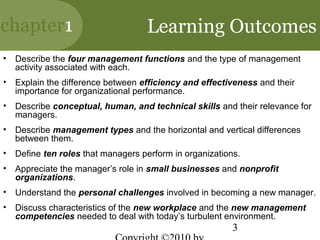
chapter1                            Learning Outcomes
•   Describe the four management functions and the type of management
    activity associated with each.
•   Explain the difference between efficiency and effectiveness and their
    importance for organizational performance.
•   Describe conceptual, human, and technical skills and their relevance for
    managers.
•   Describe management types and the horizontal and vertical differences
    between them.
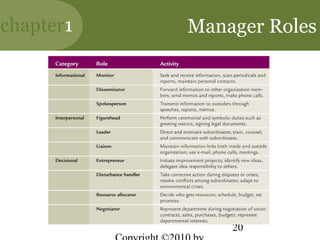
•   Define ten roles that managers perform in organizations.
•   Appreciate the manager’s role in small businesses and nonprofit
    organizations.
•   Understand the personal challenges involved in becoming a new manager.
•   Discuss characteristics of the new workplace and the new management
    competencies needed to deal with today’s turbulent environment.
                                                          3
Are Your Ready
chapter1
                              to Be a Manager?
 • Today’s environment is diverse, dynamic and
   ever-changing
 • Organizations need managers who can build
   networks and pull people together
 • Managers must motivate and coordinate
   others
 • Managers are dependent upon subordinates
   – They are evaluated on the work of others
                                       4
chapter1        Why Innovation Matters
  • Managers must focus on innovation to
    stay competitive
  • In a hypercompetitive, global environment,
    organizations must innovate more
  • Innovations may include:
    – New products, services, technologies
    – Controlling costs
    – Investing in the future
    – Corporate values
                                      5
chapter1                    Defining Management
• Managers are the executive function of the organization
• Building and coordinating and entire system
• Create systems and conditions that enable others to perform those
  tasks
• Create the right systems and environment, managers ensure that
  the department or organization will survive and thrive
• Recognize the key role of people

  “The art of getting things done through people” –Mary Parker Follett
 “Give direction to their organization, provide leadership,
  and decide how to use organizational resources to
                         accomplish goals” -Peter Drucker
                                                      6
The Definition of
chapter1
                             Management

      Management is the attainment of
      Management is the attainment of
   organizational goals in an effective and
   organizational goals in an effective and
     efficient manner through planning,
      efficient manner through planning,
     organizing, leading, and controlling
     organizing, leading, and controlling
           organizational resources.
            organizational resources.


                                  7
The Four Management
chapter1
                               Functions
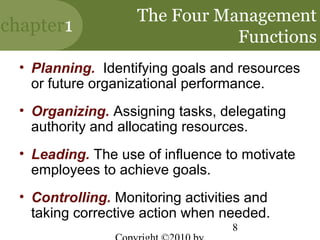
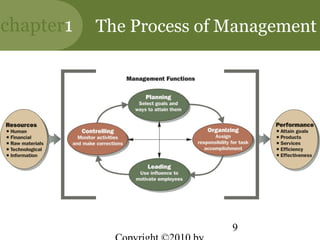
  • Planning. Identifying goals and resources
    or future organizational performance.
  • Organizing. Assigning tasks, delegating
    authority and allocating resources.
  • Leading. The use of influence to motivate
    employees to achieve goals.
  • Controlling. Monitoring activities and
    taking corrective action when needed.
                                   8
chapter1   The Process of Management


                          9
chapter1       Organizational Performance

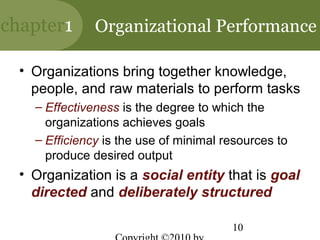
  • Organizations bring together knowledge,
    people, and raw materials to perform tasks
    – Effectiveness is the degree to which the
      organizations achieves goals
    – Efficiency is the use of minimal resources to
      produce desired output
  • Organization is a social entity that is goal
    directed and deliberately structured

                                        10
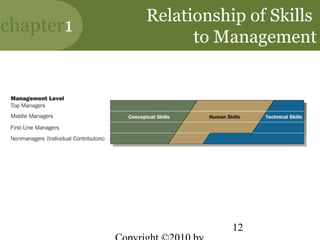
chapter1               Management Skills

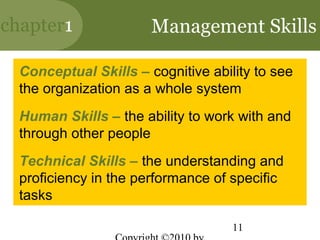
  Conceptual Skills – cognitive ability to see
  the organization as a whole system
  Human Skills – the ability to work with and
  through other people
  Technical Skills – the understanding and
  proficiency in the performance of specific
  tasks

                                    11
Relationship of Skills
chapter1
                 to Management


                      12
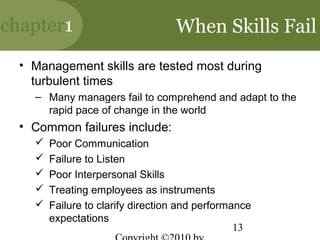
chapter1                           When Skills Fail
  • Management skills are tested most during
    turbulent times
    – Many managers fail to comprehend and adapt to the
      rapid pace of change in the world
  • Common failures include:
       Poor Communication
       Failure to Listen
       Poor Interpersonal Skills
       Treating employees as instruments
       Failure to clarify direction and performance
        expectations
                                                 13
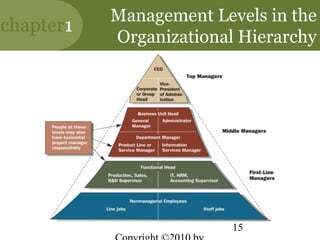
chapter1                 Management Types

 • Vertical Differences
   – Top Managers
   – Middle Managers
   – First-Line Managers

 • Horizontal Differences
   – Functional departments like advertising,
     manufacturing, sales
   – Include both line and staff functions

                                        14
Management Levels in the
chapter1
           Organizational Hierarchy


                         15
What is it Like
chapter1
                          to Be a Manager?
   The manager’s job is diverse
   Managerial tasks can be characterized
    into characteristics and roles
   Most managers enjoy activities such as
    leading others, networking and leading
    innovation
   Managers dislike controlling
    subordinates, handling paperwork and
    managing time pressure
                                   16
Making the Leap: Becoming
chapter1
                         a New Manager

  First-line supervisors experience the most
   job burnout and attrition
  Shifting from contributor to manager is
   often tricky
  Managers must establish strong personal
   identity


                                   17
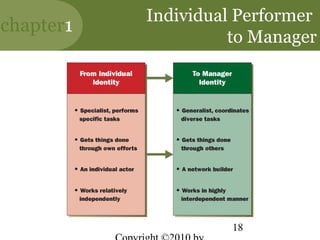
Individual Performer
chapter1
                     to Manager


                     18
chapter1             Manager Activities

       Managers perform a diverse
        amount of work—fast
       The variety, fragmentation
        and brevity of tasks require
        multitasking
       Managers shift gears
        quickly

                                 19
chapter1   Manager Roles


               20
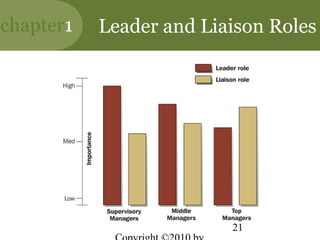
chapter1   Leader and Liaison Roles


                         21
Managing Small Businesses
chapter1          and Nonprofit Organizations
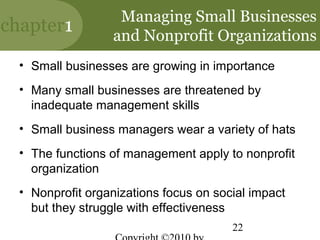
  • Small businesses are growing in importance
  • Many small businesses are threatened by
    inadequate management skills
  • Small business managers wear a variety of hats
  • The functions of management apply to nonprofit
    organization
  • Nonprofit organizations focus on social impact
    but they struggle with effectiveness
                                        22
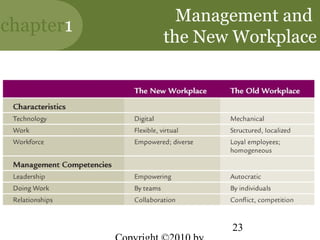
Management and
chapter1
           the New Workplace


                  23
The Transition to
chapter1
                        a New Workplace

     Today’s best managers give up their
  command-and-control mind-set to focus on
     coaching and providing guidance,
     creating organizations that are fast,
   flexible, innovative, and relationship-
                  oriented.


                                24

9e daftchapter1

  • 1.
  • 2.
    Innovative Management for Turbulent Times CHAPTER 1
  • 3.
    chapter1 Learning Outcomes • Describe the four management functions and the type of management activity associated with each. • Explain the difference between efficiency and effectiveness and their importance for organizational performance. • Describe conceptual, human, and technical skills and their relevance for managers. • Describe management types and the horizontal and vertical differences between them. • Define ten roles that managers perform in organizations. • Appreciate the manager’s role in small businesses and nonprofit organizations. • Understand the personal challenges involved in becoming a new manager. • Discuss characteristics of the new workplace and the new management competencies needed to deal with today’s turbulent environment. 3
  • 4.
    Are Your Ready chapter1 to Be a Manager? • Today’s environment is diverse, dynamic and ever-changing • Organizations need managers who can build networks and pull people together • Managers must motivate and coordinate others • Managers are dependent upon subordinates – They are evaluated on the work of others 4
  • 5.
    chapter1 Why Innovation Matters • Managers must focus on innovation to stay competitive • In a hypercompetitive, global environment, organizations must innovate more • Innovations may include: – New products, services, technologies – Controlling costs – Investing in the future – Corporate values 5
  • 6.
    chapter1 Defining Management • Managers are the executive function of the organization • Building and coordinating and entire system • Create systems and conditions that enable others to perform those tasks • Create the right systems and environment, managers ensure that the department or organization will survive and thrive • Recognize the key role of people “The art of getting things done through people” –Mary Parker Follett “Give direction to their organization, provide leadership, and decide how to use organizational resources to accomplish goals” -Peter Drucker 6
  • 7.
    The Definition of chapter1 Management Management is the attainment of Management is the attainment of organizational goals in an effective and organizational goals in an effective and efficient manner through planning, efficient manner through planning, organizing, leading, and controlling organizing, leading, and controlling organizational resources. organizational resources. 7
  • 8.
    The Four Management chapter1 Functions • Planning. Identifying goals and resources or future organizational performance. • Organizing. Assigning tasks, delegating authority and allocating resources. • Leading. The use of influence to motivate employees to achieve goals. • Controlling. Monitoring activities and taking corrective action when needed. 8
  • 9.
    chapter1 The Process of Management 9
  • 10.
    chapter1 Organizational Performance • Organizations bring together knowledge, people, and raw materials to perform tasks – Effectiveness is the degree to which the organizations achieves goals – Efficiency is the use of minimal resources to produce desired output • Organization is a social entity that is goal directed and deliberately structured 10
  • 11.
    chapter1 Management Skills Conceptual Skills – cognitive ability to see the organization as a whole system Human Skills – the ability to work with and through other people Technical Skills – the understanding and proficiency in the performance of specific tasks 11
  • 12.
  • 13.
    chapter1 When Skills Fail • Management skills are tested most during turbulent times – Many managers fail to comprehend and adapt to the rapid pace of change in the world • Common failures include:  Poor Communication  Failure to Listen  Poor Interpersonal Skills  Treating employees as instruments  Failure to clarify direction and performance expectations 13
  • 14.
    chapter1 Management Types • Vertical Differences – Top Managers – Middle Managers – First-Line Managers • Horizontal Differences – Functional departments like advertising, manufacturing, sales – Include both line and staff functions 14
  • 15.
    Management Levels inthe chapter1 Organizational Hierarchy 15
  • 16.
    What is itLike chapter1 to Be a Manager?  The manager’s job is diverse  Managerial tasks can be characterized into characteristics and roles  Most managers enjoy activities such as leading others, networking and leading innovation  Managers dislike controlling subordinates, handling paperwork and managing time pressure 16
  • 17.
    Making the Leap:Becoming chapter1 a New Manager First-line supervisors experience the most job burnout and attrition Shifting from contributor to manager is often tricky Managers must establish strong personal identity 17
  • 18.
  • 19.
    chapter1 Manager Activities  Managers perform a diverse amount of work—fast  The variety, fragmentation and brevity of tasks require multitasking  Managers shift gears quickly 19
  • 20.
    chapter1 Manager Roles 20
  • 21.
    chapter1 Leader and Liaison Roles 21
  • 22.
    Managing Small Businesses chapter1 and Nonprofit Organizations • Small businesses are growing in importance • Many small businesses are threatened by inadequate management skills • Small business managers wear a variety of hats • The functions of management apply to nonprofit organization • Nonprofit organizations focus on social impact but they struggle with effectiveness 22
  • 23.
    Management and chapter1 the New Workplace 23
  • 24.
    The Transition to chapter1 a New Workplace Today’s best managers give up their command-and-control mind-set to focus on coaching and providing guidance, creating organizations that are fast, flexible, innovative, and relationship- oriented. 24