
Recent advances in management
of Ewings sarcoma
Dr Sameer Rastogi
MD, DM Medical Oncology
Assistant Professor,
AIIMS, New Delhi
Samdoc_mamc@yahoo.com
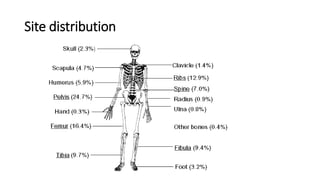
Site distribution
Points to be covered
• Importance of molecular testing
• Prognostic factors
• Current therapy – Addition of IE
Dose intense protocol
Dose dense protocol
• Role of autologous transplant in localized high risk
• Role of Autologous stem cell transplant in patients with lung metastasis
• Long term survivorship issues
Genomic information
• Recurrent balanced translocation between EWSR1 gene on
chromosome 22 and genes belonging to ETS family
• In 10 percent of patients EWSR1 is fused with ETV1, ETV 4, ERG or
FEV
• Three independent studies have described the genomic landscape of
Ewing sarcoma, and all uniformly showed that Ewing sarcoma has a
low mutational rate (0.15/megabase)
Albert Pappo et al. J Clin Oncol 36:168-179. 2017
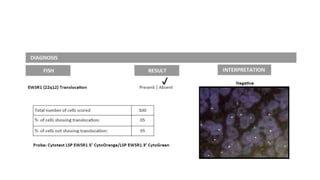
Beyond EWSR- ETS fusion genes-
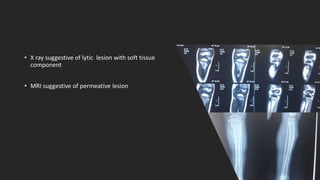
• 6 year boy presented with left proximal tibia mass
• MRI and X ray suggestive of
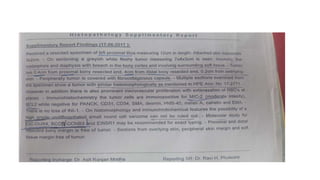
• Biopsy suggestive of Ewings sarcoma
• Post one cycle of chemotherapy it doubled in size
• X ray suggestive of lytic lesion with soft tissue
component
• MRI suggestive of permeative lesion
Ewings like sarcomas
• The most common translocation in non EWSR1- ETS occur between
CIC gene on chromosome 19 DUX on chromosome 4.
• These tumor occur primarily in young men around 40 years and
most commonly arise in soft tissues of trunk and extremity
• Optimal therapy not known and poor outcomes.
• Another is BCOR – CCNB3 seems to effect younger children and arise
in bone
Albert Pappo et al. J Clin Oncol 36:168-179. 2017
Points to be covered
• Importance of molecular testing
• Prognostic factors
• Current protocol – Addition of IE
Dose intense protocol
Dose dense protocol
• Role of autologous transplant in localized high risk
• Role of Autologous stem cell transplant in patients with lung metastasis
• Long term survivorship issues
Prognosis
• Metastatic vs non metastatic – Most important
• Tumor volume or tumor size - Irrespective of age/ irrespective of site??2
• Percentage necrosis
• No prognostic impact of type of EWS- ETG transcript3
• A current European study is prospectively validating biomarkers, such as--
copy number alterations, 1q gain, 16q loss, mir-34a, STEAP or MGST1
expression, and circulating tumor DNA
1.Journal of clinical oncology 2004 22:4,2873-2876 2. J Cancer Res Clin Oncol. 1987;113(2):187-91.3. Impact of
EWS-ETS fusion type on disease progression in : prospective results from the cooperative Euro-E.W.I.N.G. 99 trial.
Points to be covered
• Importance of molecular testing
• Prognostic factors
• Current protocol – Addition of IE
Dose intense protocol
Dose dense protocol
• Role of autologous transplant in localized high risk
• Role of Autologous stem cell transplant in patients with lung metastasis
• Long term survivorship issues
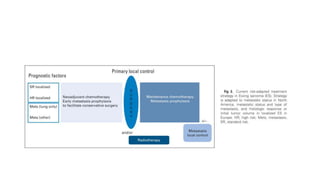
Non metastatic Ewings sarcoma
• Goal of the treatment
• As overall survival is reaching 65 to 70%
• The acute and chronic toxicities of treatment are substantial
The introduction of VAC/ IE
• IESS 1 and IESS 2 showed the importance of doxorubicin in the
treatment of Ewings sarcoma 1
• VACD vs VAC (5 year RFS =60% vs 24%)
(5 year OS 65% vs 28%) p =0.001
• INT 0091 - vincristine-doxorubicin-cyclophosphamide (VDC) and
ifosfamide-etoposide (IE) was superior to VDC
• Rationale
1. J Clin Oncol. 1990 Oct;8(10):1664-74.
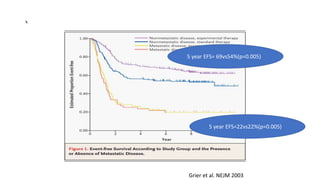
• N= 518
• Non metastatic = 398
• Metastatic = 120
• >18 years – only 13% of all the patients
Grier et al. NEJM 2003
`
5 year EFS= 69vs54%(p=0.005)
5 year EFS=22vs22%(p=0.005)
Grier et al. NEJM 2003
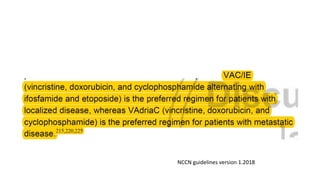
NCCN guidelines version 1.2018
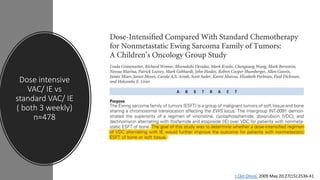
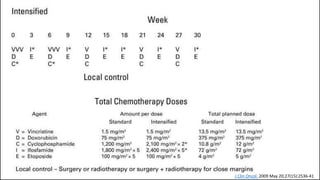
Dose intensive
VAC/ IE vs
standard VAC/ IE
( both 3 weekly)
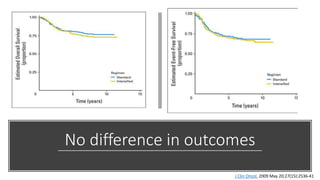
n=478
J Clin Oncol. 2009 May 20;27(15):2536-41
No difference in outcomes
J Clin Oncol. 2009 May 20;27(15):2536-41
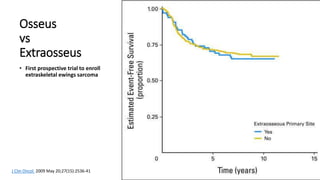
Osseus
vs
Extraosseus
• First prospective trial to enroll
extraskeletal ewings sarcoma
J Clin Oncol. 2009 May 20;27(15):2536-41
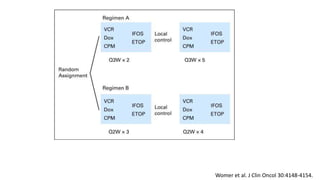
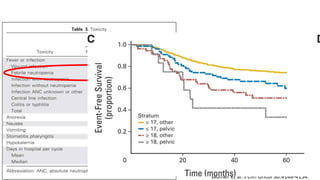
• Different method of dose intensification – Dose compression
• Standard chemotherapy doses at 14 days vs 21 days
• N=568
• Chemotherapy could be started if ANC =750 and platlet count 75,000
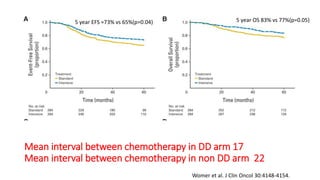
Womer et al. J Clin Oncol 30:4148-4154.
Mean interval between chemotherapy in DD arm 17
Mean interval between chemotherapy in non DD arm 22
Womer et al. J Clin Oncol 30:4148-4154.
5 year EFS =73% vs 65%(p=0.04) 5 year OS 83% vs 77%(p=0.05)
Womer et al. J Clin Oncol 30:4148-4154.
Points to be covered
• Importance of molecular testing
• Prognostic factors
• Current protocol – Addition of IE
Dose intense protocol
Dose dense protocol
• Role of autologous transplant in localized high risk
• Role of Autologous stem cell transplant in patients with lung metastasis
• Long term survivorship issues
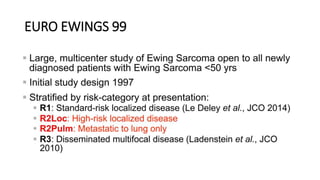
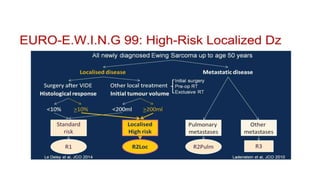
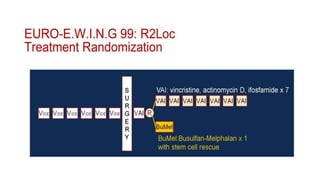
EURO EWINGS 99
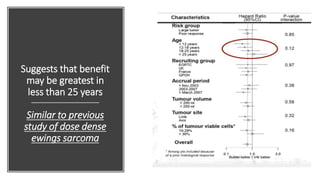
Suggests that benefit
may be greatest in
less than 25 years
Similar to previous
study of dose dense
ewings sarcoma
Points to be covered
• Importance of molecular testing
• Prognostic factors
• Current protocol – Addition of IE
Dose intense protocol
Dose dense protocol
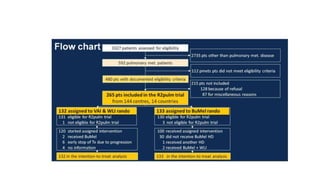
• Role of autologous transplant in localized high risk
• Role of Autologous stem cell transplant in patients with lung metastasis
• Long term survivorship issues
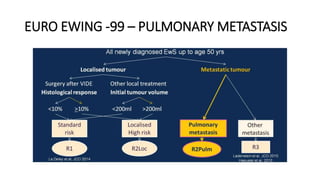
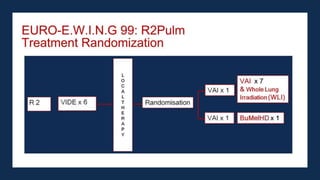
EURO EWING -99 – PULMONARY METASTASIS
Points to be covered
• Importance of molecular testing
• Prognostic factors
• Current protocol – Addition of IE
Dose intense protocol
Dose dense protocol
• Role of autologous transplant in localized high risk
• Role of Autologous stem cell transplant in patients with lung metastasis
• Long term survivorship issues
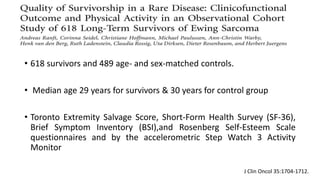
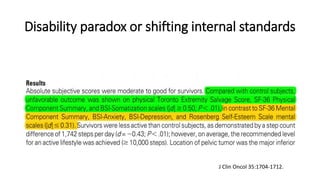
• 618 survivors and 489 age- and sex-matched controls.
• Median age 29 years for survivors & 30 years for control group
• Toronto Extremity Salvage Score, Short-Form Health Survey (SF-36),
Brief Symptom Inventory (BSI),and Rosenberg Self-Esteem Scale
questionnaires and by the accelerometric Step Watch 3 Activity
Monitor
J Clin Oncol 35:1704-1712.
Disability paradox or shifting internal standards
J Clin Oncol 35:1704-1712.
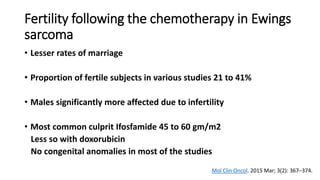
Fertility following the chemotherapy in Ewings
sarcoma
• Lesser rates of marriage
• Proportion of fertile subjects in various studies 21 to 41%
• Males significantly more affected due to infertility
• Most common culprit Ifosfamide 45 to 60 gm/m2
Less so with doxorubicin
No congenital anomalies in most of the studies
Mol Clin Oncol. 2015 Mar; 3(2): 367–374.
Points to be covered
• Importance of molecular testing
• Prognostic factors
• Current protocol – Addition of IE
Dose intense protocol
Dose dense protocol
• Role of autologous transplant in localized high risk
• Role of Autologous stem cell transplant in patients with lung metastasis
• Long term survivorship issues
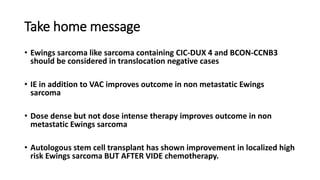
Take home message
• Ewings sarcoma like sarcoma containing CIC-DUX 4 and BCON-CCNB3
should be considered in translocation negative cases
• IE in addition to VAC improves outcome in non metastatic Ewings
sarcoma
• Dose dense but not dose intense therapy improves outcome in non
metastatic Ewings sarcoma
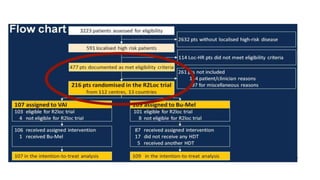
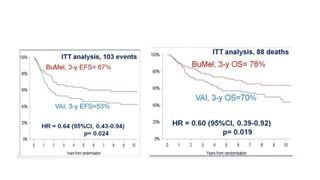
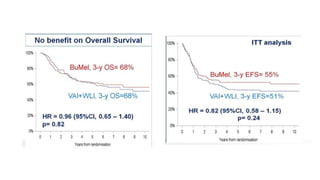
• Autologous stem cell transplant has shown improvement in localized high
risk Ewings sarcoma BUT AFTER VIDE chemotherapy.
Take home message
• Autologous stem cell transplant can be an option for high risk
localized Ewings sarcoma patients but not with pulmonary
metastasis
• Long term quality of survivorship might not be very bad though
physical difficulties remain
• Fertility remains an issue

Management of ewings sarcoma

  • 1.
    Recent advances inmanagement of Ewings sarcoma Dr Sameer Rastogi MD, DM Medical Oncology Assistant Professor, AIIMS, New Delhi Samdoc_mamc@yahoo.com
  • 3.
  • 4.
    Points to becovered • Importance of molecular testing • Prognostic factors • Current therapy – Addition of IE Dose intense protocol Dose dense protocol • Role of autologous transplant in localized high risk • Role of Autologous stem cell transplant in patients with lung metastasis • Long term survivorship issues
  • 5.
    Genomic information • Recurrentbalanced translocation between EWSR1 gene on chromosome 22 and genes belonging to ETS family • In 10 percent of patients EWSR1 is fused with ETV1, ETV 4, ERG or FEV • Three independent studies have described the genomic landscape of Ewing sarcoma, and all uniformly showed that Ewing sarcoma has a low mutational rate (0.15/megabase) Albert Pappo et al. J Clin Oncol 36:168-179. 2017
  • 6.
    Beyond EWSR- ETSfusion genes- • 6 year boy presented with left proximal tibia mass • MRI and X ray suggestive of • Biopsy suggestive of Ewings sarcoma • Post one cycle of chemotherapy it doubled in size
  • 7.
    • X raysuggestive of lytic lesion with soft tissue component • MRI suggestive of permeative lesion
  • 10.
    Ewings like sarcomas •The most common translocation in non EWSR1- ETS occur between CIC gene on chromosome 19 DUX on chromosome 4. • These tumor occur primarily in young men around 40 years and most commonly arise in soft tissues of trunk and extremity • Optimal therapy not known and poor outcomes. • Another is BCOR – CCNB3 seems to effect younger children and arise in bone Albert Pappo et al. J Clin Oncol 36:168-179. 2017
  • 11.
    Points to becovered • Importance of molecular testing • Prognostic factors • Current protocol – Addition of IE Dose intense protocol Dose dense protocol • Role of autologous transplant in localized high risk • Role of Autologous stem cell transplant in patients with lung metastasis • Long term survivorship issues
  • 12.
    Prognosis • Metastatic vsnon metastatic – Most important • Tumor volume or tumor size - Irrespective of age/ irrespective of site??2 • Percentage necrosis • No prognostic impact of type of EWS- ETG transcript3 • A current European study is prospectively validating biomarkers, such as-- copy number alterations, 1q gain, 16q loss, mir-34a, STEAP or MGST1 expression, and circulating tumor DNA 1.Journal of clinical oncology 2004 22:4,2873-2876 2. J Cancer Res Clin Oncol. 1987;113(2):187-91.3. Impact of EWS-ETS fusion type on disease progression in : prospective results from the cooperative Euro-E.W.I.N.G. 99 trial.
  • 13.
    Points to becovered • Importance of molecular testing • Prognostic factors • Current protocol – Addition of IE Dose intense protocol Dose dense protocol • Role of autologous transplant in localized high risk • Role of Autologous stem cell transplant in patients with lung metastasis • Long term survivorship issues
  • 14.
    Non metastatic Ewingssarcoma • Goal of the treatment • As overall survival is reaching 65 to 70% • The acute and chronic toxicities of treatment are substantial
  • 16.
    The introduction ofVAC/ IE • IESS 1 and IESS 2 showed the importance of doxorubicin in the treatment of Ewings sarcoma 1 • VACD vs VAC (5 year RFS =60% vs 24%) (5 year OS 65% vs 28%) p =0.001 • INT 0091 - vincristine-doxorubicin-cyclophosphamide (VDC) and ifosfamide-etoposide (IE) was superior to VDC • Rationale 1. J Clin Oncol. 1990 Oct;8(10):1664-74.
  • 17.
    • N= 518 •Non metastatic = 398 • Metastatic = 120 • >18 years – only 13% of all the patients Grier et al. NEJM 2003
  • 18.
    ` 5 year EFS=69vs54%(p=0.005) 5 year EFS=22vs22%(p=0.005) Grier et al. NEJM 2003
  • 19.
  • 20.
    Dose intensive VAC/ IEvs standard VAC/ IE ( both 3 weekly) n=478 J Clin Oncol. 2009 May 20;27(15):2536-41
  • 21.
    J Clin Oncol.2009 May 20;27(15):2536-41
  • 22.
    No difference inoutcomes J Clin Oncol. 2009 May 20;27(15):2536-41
  • 23.
    Osseus vs Extraosseus • First prospectivetrial to enroll extraskeletal ewings sarcoma J Clin Oncol. 2009 May 20;27(15):2536-41
  • 24.
    • Different methodof dose intensification – Dose compression • Standard chemotherapy doses at 14 days vs 21 days • N=568 • Chemotherapy could be started if ANC =750 and platlet count 75,000 Womer et al. J Clin Oncol 30:4148-4154.
  • 25.
    Womer et al.J Clin Oncol 30:4148-4154.
  • 26.
    Mean interval betweenchemotherapy in DD arm 17 Mean interval between chemotherapy in non DD arm 22 Womer et al. J Clin Oncol 30:4148-4154. 5 year EFS =73% vs 65%(p=0.04) 5 year OS 83% vs 77%(p=0.05)
  • 27.
    Womer et al.J Clin Oncol 30:4148-4154.
  • 28.
    Points to becovered • Importance of molecular testing • Prognostic factors • Current protocol – Addition of IE Dose intense protocol Dose dense protocol • Role of autologous transplant in localized high risk • Role of Autologous stem cell transplant in patients with lung metastasis • Long term survivorship issues
  • 29.
  • 34.
    Suggests that benefit maybe greatest in less than 25 years Similar to previous study of dose dense ewings sarcoma
  • 35.
    Points to becovered • Importance of molecular testing • Prognostic factors • Current protocol – Addition of IE Dose intense protocol Dose dense protocol • Role of autologous transplant in localized high risk • Role of Autologous stem cell transplant in patients with lung metastasis • Long term survivorship issues
  • 36.
    EURO EWING -99– PULMONARY METASTASIS
  • 40.
    Points to becovered • Importance of molecular testing • Prognostic factors • Current protocol – Addition of IE Dose intense protocol Dose dense protocol • Role of autologous transplant in localized high risk • Role of Autologous stem cell transplant in patients with lung metastasis • Long term survivorship issues
  • 41.
    • 618 survivorsand 489 age- and sex-matched controls. • Median age 29 years for survivors & 30 years for control group • Toronto Extremity Salvage Score, Short-Form Health Survey (SF-36), Brief Symptom Inventory (BSI),and Rosenberg Self-Esteem Scale questionnaires and by the accelerometric Step Watch 3 Activity Monitor J Clin Oncol 35:1704-1712.
  • 42.
    Disability paradox orshifting internal standards J Clin Oncol 35:1704-1712.
  • 43.
    Fertility following thechemotherapy in Ewings sarcoma • Lesser rates of marriage • Proportion of fertile subjects in various studies 21 to 41% • Males significantly more affected due to infertility • Most common culprit Ifosfamide 45 to 60 gm/m2 Less so with doxorubicin No congenital anomalies in most of the studies Mol Clin Oncol. 2015 Mar; 3(2): 367–374.
  • 44.
    Points to becovered • Importance of molecular testing • Prognostic factors • Current protocol – Addition of IE Dose intense protocol Dose dense protocol • Role of autologous transplant in localized high risk • Role of Autologous stem cell transplant in patients with lung metastasis • Long term survivorship issues
  • 45.
    Take home message •Ewings sarcoma like sarcoma containing CIC-DUX 4 and BCON-CCNB3 should be considered in translocation negative cases • IE in addition to VAC improves outcome in non metastatic Ewings sarcoma • Dose dense but not dose intense therapy improves outcome in non metastatic Ewings sarcoma • Autologous stem cell transplant has shown improvement in localized high risk Ewings sarcoma BUT AFTER VIDE chemotherapy.
  • 46.
    Take home message •Autologous stem cell transplant can be an option for high risk localized Ewings sarcoma patients but not with pulmonary metastasis • Long term quality of survivorship might not be very bad though physical difficulties remain • Fertility remains an issue

Editor's Notes

  • #3 United states leading news magazine. Notability and fame. 'Every institution is but the lengthening shadow of some man. Memorial sloan kettering
  • #4 In 1931, Ewing’s broad contribution to the cancer field was recognized by Time magazine, which featured a sketch of his visage on the cover, calling him “Cancer Man Ewing” [3].
  • #6 This is the main driver of ewings sarcoma.
  • #17 The rationale for this combination is that eto- poside might potentiate the cytotoxicity of alkylat- ing agents (such as ifosfamide) by inhibition of to- poisomerase II and consequent impairment of the DNA uncoiling that is necessary for the repair of al-kylating-agent–induced DNA damage.
  • #19 Unfortunately these two lines are superimposable.
  • #22 Ifosfamide control arm 1.8 and cyclo 1200 however compare with intensified arm. (2400 and 4200), unfortunately didn’t improve the outcome
  • #23 The manner in which the dose intensification of alkylating agents was done didn’t improve the outcome
  • #24 b
  • #25 Unflinchingly they are setting the threshold low. Gutsy and audacious move
  • #33 This might be viewed, perhaps, as the acceptability—both to clinicians and to patients—of the test regimen,” Dr. Whelan said. Even among the 109 patients with localized disease assigned to busulfan-melphalan, only 80% ultimately received the intervention.
  • #34 but acknowledge that these results are intriguing and need further validation.”
  • #42 suggests that persons with disabilities may judge their situation more positively than would an observer or than they themselves might have judged before the occurrence of a severe disease