WELCOME
MANAGEMENT
INFORMATION
SYSTEMS
•Fundamentals of Information Systems
•Data, Information and Information Systems
•Types of Information Systems
•Solving Business Problems with Information Systems
•Telecommunication and Networks
•Database Management Systems
•Management Information Systems
•Decision Support Systems
•Executive Information Systems
•Business Information Systems
•Information Systems Security and Control.
Areas of Discussion are
This lecture will cover following topics:
•What is an information system?
•Why study information systems?
•What managerial end users need to know?
•Benefits of use network computer.
INTRODUCTION TO INFORMATION
SYSTEMS IN BUSINESS
Lecture: ONE
WHAT IS AN INFORMATION
SYSTEM?An information system (IS) can be any
organized combination of people, hardware,
software, communications networks, data
resources, and policies and procedures that
collects, stores, retrieves, transforms, and
disseminates information in an organization.
People rely on modern information systems to
communicate with each other using a variety of
physical devices (hardware), information
processing instructions and procedures
(software), communications channels
(networks), and stored data (data management).
WHAT IS AN INFORMATION
SYSTEM?Today end users rely on many types of
information systems (IS). They might include
simple manual (paper-and-pencil) hardware
devices and informal (word-of-mouth)
communications channels. However, in this
course, we will concentrate on computer-
based information systems that use
computer hardware and software,
telecommunications networks, computer-
based data management techniques, and
other forms of information technology to
transform data resources into a variety of
information products.
WHY STUDY INFORMATION SYSTEMS AND
INFORMATION TECHNOLOGY?
Information technologies, including Internet-based
information systems, are playing a vital and expanding
role in business. Information technology can help all
kinds of businesses improve the efficiency and
effectiveness of their business processes, managerial
decision making, and workgroup collaboration, thus
strengthening their competitive positions in a rapidly
changing marketplace. This is true whether information
technology is used to support product development
teams, customers support processes, electronic
commerce transaction, or any other business activity.
Information technologies and systems are, quite simply, a
necessary ingredient for business success in today’s
dynamic global environment.
WHY STUDY INFORMATION SYSTEMS AND INFORMATION TECHNOLOGY?
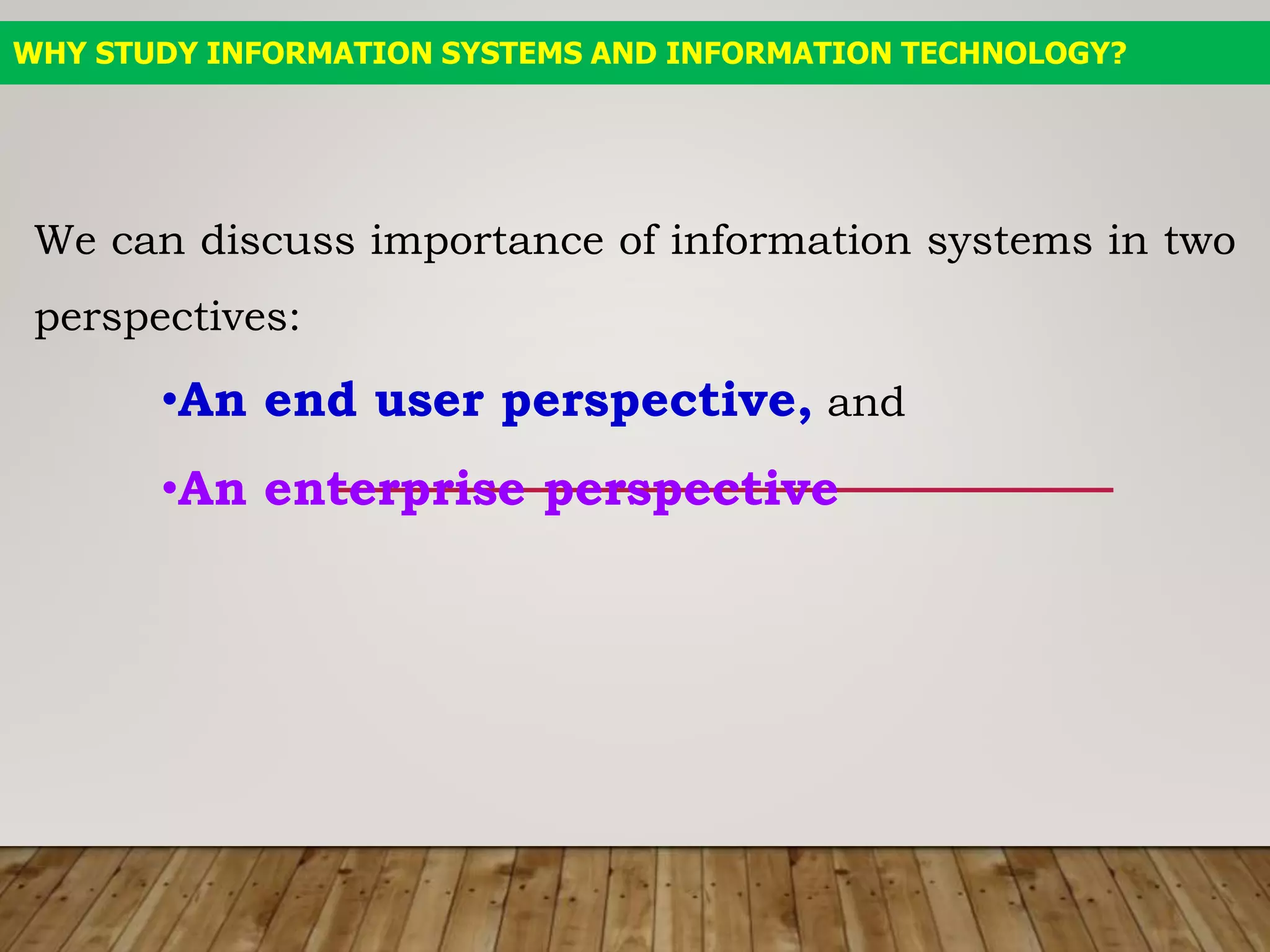
We can discuss importance of information systems in two
perspectives:
•An end user perspective, and
•An enterprise perspective
WHY STUDY INFORMATION SYSTEMS AND INFORMATION TECHNOLOGY?
An end user perspective
Anyone who uses an information system or the information
it produces is an end users. This usually applies to most
people in an organization, as distinguished from the smaller
number of people who are information systems specialists, such
as systems analysts or professional computer programmers. A
managerial end user is a manager, entrepreneur, or
managerial-level professional who personally uses
information systems. So, most managers are managerial end
users.
WHY STUDY INFORMATION SYSTEMS AND INFORMATION TECHNOLOGY?
Business and other organizations need people who can
use networked computer workstations to enhance their
own personal productivity and the productivity of their
work groups, departments, and organizations.
For example,
•you should be able to use word processing and electronic
mail to communicate more effectively.
•You should also be aware of the management problems
and opportunities presented by the use of information
technology, and how you can effectively confront such
challenges.
•Then you can play a major role in seeing that
information system resources are used efficiently and
effectively to benefit your career goals and the goals of the
business firms or other organizations you may work for in
the future.
WHY STUDY INFORMATION SYSTEMS AND INFORMATION TECHNOLOGY?
An enterprise perspective
Information systems play a vital role in the business
success of an enterprise. Information technology can
provide the information a business needs for efficient
operations, effective management, and competitive
advantage. However, if information systems do not
properly support the strategic objectives, business
operations, or management needs of an enterprise, they
can seriously damage its prospects for survival and
success. So, the proper management of information
systems is a major challenge for managers.
WHY STUDY INFORMATION SYSTEMS AND INFORMATION TECHNOLOGY?
Thus, the information systems function represents:
•A major functional area of business that is as important
to business success.
•A major part of the resources of an enterprise and its
cost of doing business.
•An important factor affecting operational efficiency,
employee productivity and morale, and customer service
and satisfaction.
•A major source of information and support needed to
promote effective decision making by managers.
•An important ingredient in developing competitive
products and services that give an organization a
strategic advantage in the global marketplace.
•A vital, dynamic, and challenging career opportunity for
millions of men and women.
WHAT MANAGERIAL END USERS NEED TO KNOW?
Management
Challenges
Information
Systems
Information
Technologies
Foundation
Concepts
Development
Processes
Business
Applications
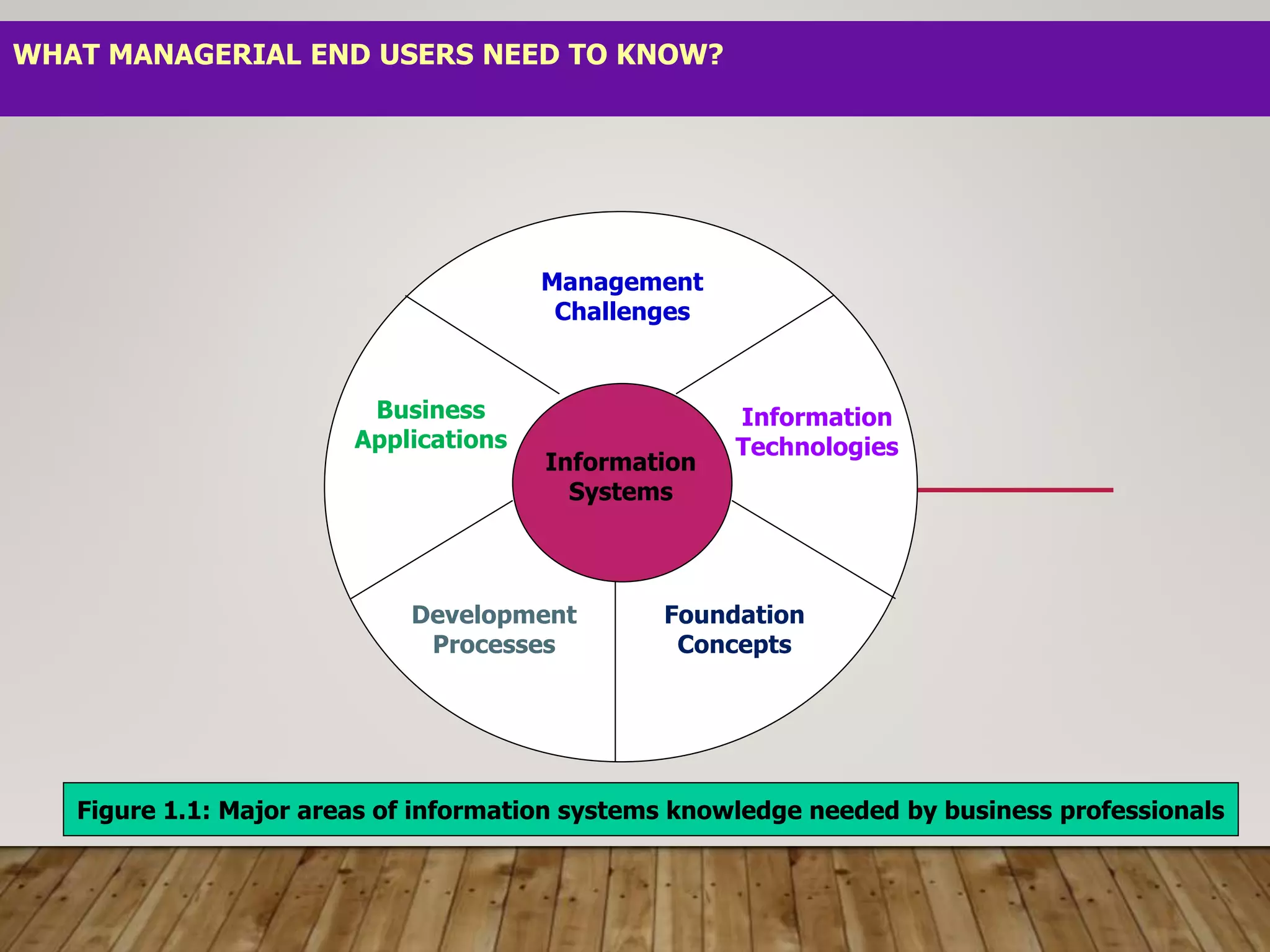
Figure 1.1: Major areas of information systems knowledge needed by business professionals
Foundation Concepts:
What are information systems, and why are they
important to end users and their organizations? In order
to answer this question, you need to understand what the
basic components and types of information systems are.
You should learn some fundamental behavioral and
technical concepts that will help you understand how
information systems can support the business
operations, managerial decision-making, and strategic
advantage of business firms and other organizations.
What managerial end users need to know?
Technology:
What should end users know about the technologies used in
computer-based information systems? The answer to this
question is that they should have an understanding of major
concepts, developments, and management issues in
information technology- that is, hardware, software,
telecommunications, database management, and other
information processing technologies.
What managerial end users need to know?
Applications:
In what ways can information systems assist end users
and organizations in accomplishing their work activities
and meeting their strategic objectives? Answer this
question requires a knowledge of the major applications
of information systems for end user activities and the
operations, management, and competitive advantage of
business firms and other organizations. You should gain
a basic understanding of information systems concepts
and applications in areas such as end-user computing,
office automation, transaction processing, the functional
areas of business, management reporting, decision
support, executive support, competitive advantage, and
artificial intelligence.
What managerial end users need to know?
Development:
How should end users or information specialists develop
information systems solutions to business problems? To
answer this question, you should learn some
fundamental problem-solving and development concepts.
You should understand how methodologies such as the
system approach, the system development life cycle, and
prototyping can used by end users and IS specialists to
construct information systems applications that
successfully meet end user and organizational needs
What managerial end users need to know?
Management:
How should business end users meet the major
challenges they face in managing information technology
in their organization? Answering this question requires
understanding what methods you can use to manage the
resources, technologies, and activities of information
systems.
What managerial end users need to know?
Benefits of use network computers
Industry or
Function
Application Benefits
Marketing Track status of promotions
Identify purchase influences
and timing of decisions
Prepare reports on site
Better information on
sales activities
Reports get done
more quickly
Distribution Bill of leading data and
calculations
Delivery and field sales data
collection
Enter and track parcel data
More timely
information on field
operations
Better customer
service
Field
Service
Remote access to parts
catalog and availability
Troubleshooting support
Repair handbooks
Scheduling and dispatching
Service records
Payment and receipt records
Better service to
customer
More efficient
scheduling
Benefits of use network computers
Transportation Airline and train schedules
Reservations
Rental car check-in and receipt
generation
Monitor on time performance
Convenience to
customers
Replace paper forms and
records
More timely information
Financial
Services
Stock exchange floor trader
support
More accurate records
Reduces risk of fraud
Wholesale Record sales results
Send results to corporate
mainframe
Receive updates on product
prices and availability
More accurate and timely
information
Eliminate unnecessary
phone contracts
Cuts paperwork
Retail Sales Capture sales and demographic
data
Update inventory data
Assesses promotional
results
Tighter control over field
operations
Insurance Access corporate data for quotes
Perform complex rate
calculations.
Quicker quotations to
customers.
THANK YOU

Management Information System

  • 1.
  • 2.
  • 3.
    •Fundamentals of InformationSystems •Data, Information and Information Systems •Types of Information Systems •Solving Business Problems with Information Systems •Telecommunication and Networks •Database Management Systems •Management Information Systems •Decision Support Systems •Executive Information Systems •Business Information Systems •Information Systems Security and Control. Areas of Discussion are
  • 4.
    This lecture willcover following topics: •What is an information system? •Why study information systems? •What managerial end users need to know? •Benefits of use network computer. INTRODUCTION TO INFORMATION SYSTEMS IN BUSINESS Lecture: ONE
  • 5.
    WHAT IS ANINFORMATION SYSTEM?An information system (IS) can be any organized combination of people, hardware, software, communications networks, data resources, and policies and procedures that collects, stores, retrieves, transforms, and disseminates information in an organization. People rely on modern information systems to communicate with each other using a variety of physical devices (hardware), information processing instructions and procedures (software), communications channels (networks), and stored data (data management).
  • 6.
    WHAT IS ANINFORMATION SYSTEM?Today end users rely on many types of information systems (IS). They might include simple manual (paper-and-pencil) hardware devices and informal (word-of-mouth) communications channels. However, in this course, we will concentrate on computer- based information systems that use computer hardware and software, telecommunications networks, computer- based data management techniques, and other forms of information technology to transform data resources into a variety of information products.
  • 7.
    WHY STUDY INFORMATIONSYSTEMS AND INFORMATION TECHNOLOGY? Information technologies, including Internet-based information systems, are playing a vital and expanding role in business. Information technology can help all kinds of businesses improve the efficiency and effectiveness of their business processes, managerial decision making, and workgroup collaboration, thus strengthening their competitive positions in a rapidly changing marketplace. This is true whether information technology is used to support product development teams, customers support processes, electronic commerce transaction, or any other business activity. Information technologies and systems are, quite simply, a necessary ingredient for business success in today’s dynamic global environment.
  • 8.
    WHY STUDY INFORMATIONSYSTEMS AND INFORMATION TECHNOLOGY? We can discuss importance of information systems in two perspectives: •An end user perspective, and •An enterprise perspective
  • 9.
    WHY STUDY INFORMATIONSYSTEMS AND INFORMATION TECHNOLOGY? An end user perspective Anyone who uses an information system or the information it produces is an end users. This usually applies to most people in an organization, as distinguished from the smaller number of people who are information systems specialists, such as systems analysts or professional computer programmers. A managerial end user is a manager, entrepreneur, or managerial-level professional who personally uses information systems. So, most managers are managerial end users.
  • 10.
    WHY STUDY INFORMATIONSYSTEMS AND INFORMATION TECHNOLOGY? Business and other organizations need people who can use networked computer workstations to enhance their own personal productivity and the productivity of their work groups, departments, and organizations. For example, •you should be able to use word processing and electronic mail to communicate more effectively. •You should also be aware of the management problems and opportunities presented by the use of information technology, and how you can effectively confront such challenges. •Then you can play a major role in seeing that information system resources are used efficiently and effectively to benefit your career goals and the goals of the business firms or other organizations you may work for in the future.
  • 11.
    WHY STUDY INFORMATIONSYSTEMS AND INFORMATION TECHNOLOGY? An enterprise perspective Information systems play a vital role in the business success of an enterprise. Information technology can provide the information a business needs for efficient operations, effective management, and competitive advantage. However, if information systems do not properly support the strategic objectives, business operations, or management needs of an enterprise, they can seriously damage its prospects for survival and success. So, the proper management of information systems is a major challenge for managers.
  • 12.
    WHY STUDY INFORMATIONSYSTEMS AND INFORMATION TECHNOLOGY? Thus, the information systems function represents: •A major functional area of business that is as important to business success. •A major part of the resources of an enterprise and its cost of doing business. •An important factor affecting operational efficiency, employee productivity and morale, and customer service and satisfaction. •A major source of information and support needed to promote effective decision making by managers. •An important ingredient in developing competitive products and services that give an organization a strategic advantage in the global marketplace. •A vital, dynamic, and challenging career opportunity for millions of men and women.
  • 13.
    WHAT MANAGERIAL ENDUSERS NEED TO KNOW? Management Challenges Information Systems Information Technologies Foundation Concepts Development Processes Business Applications Figure 1.1: Major areas of information systems knowledge needed by business professionals
  • 14.
    Foundation Concepts: What areinformation systems, and why are they important to end users and their organizations? In order to answer this question, you need to understand what the basic components and types of information systems are. You should learn some fundamental behavioral and technical concepts that will help you understand how information systems can support the business operations, managerial decision-making, and strategic advantage of business firms and other organizations. What managerial end users need to know?
  • 15.
    Technology: What should endusers know about the technologies used in computer-based information systems? The answer to this question is that they should have an understanding of major concepts, developments, and management issues in information technology- that is, hardware, software, telecommunications, database management, and other information processing technologies. What managerial end users need to know?
  • 16.
    Applications: In what wayscan information systems assist end users and organizations in accomplishing their work activities and meeting their strategic objectives? Answer this question requires a knowledge of the major applications of information systems for end user activities and the operations, management, and competitive advantage of business firms and other organizations. You should gain a basic understanding of information systems concepts and applications in areas such as end-user computing, office automation, transaction processing, the functional areas of business, management reporting, decision support, executive support, competitive advantage, and artificial intelligence. What managerial end users need to know?
  • 17.
    Development: How should endusers or information specialists develop information systems solutions to business problems? To answer this question, you should learn some fundamental problem-solving and development concepts. You should understand how methodologies such as the system approach, the system development life cycle, and prototyping can used by end users and IS specialists to construct information systems applications that successfully meet end user and organizational needs What managerial end users need to know?
  • 18.
    Management: How should businessend users meet the major challenges they face in managing information technology in their organization? Answering this question requires understanding what methods you can use to manage the resources, technologies, and activities of information systems. What managerial end users need to know?
  • 19.
    Benefits of usenetwork computers Industry or Function Application Benefits Marketing Track status of promotions Identify purchase influences and timing of decisions Prepare reports on site Better information on sales activities Reports get done more quickly Distribution Bill of leading data and calculations Delivery and field sales data collection Enter and track parcel data More timely information on field operations Better customer service Field Service Remote access to parts catalog and availability Troubleshooting support Repair handbooks Scheduling and dispatching Service records Payment and receipt records Better service to customer More efficient scheduling
  • 20.
    Benefits of usenetwork computers Transportation Airline and train schedules Reservations Rental car check-in and receipt generation Monitor on time performance Convenience to customers Replace paper forms and records More timely information Financial Services Stock exchange floor trader support More accurate records Reduces risk of fraud Wholesale Record sales results Send results to corporate mainframe Receive updates on product prices and availability More accurate and timely information Eliminate unnecessary phone contracts Cuts paperwork Retail Sales Capture sales and demographic data Update inventory data Assesses promotional results Tighter control over field operations Insurance Access corporate data for quotes Perform complex rate calculations. Quicker quotations to customers.
  • 21.