Management Process
Dr. Nimisha Nandan
Assistant Professor
Department of Management Studies
St.Aloysius College
Management Process
• Management is a process of reaching organizational goals by working
with and through people.
• Process means a course of action or proceeding. It involves a series of
steps to carry out an activity. “Management is the process of planning
organizing, leading, and controlling the efforts of organization
members and of using all other organizational resources to achieve
stated organizational goals.” The process defines management as a
set of functions performed by managers regardless of their levels,
aptitude and skills.
Management is a social process
• Management deals with people. It is done by people ,through people
and for people.
• Management makes the best use of its human resource to convert its
inactive resources into productive output(goods and services).
• Social processes are the ways in which individuals and groups
interact, adjust, readjust and establish relationships and pattern of
behaviour which are again modified through social interactions.
• It is the duty of management to make interaction between people -
productive and useful for obtaining organizational goals.
• Management understands human needs and satisfies them through
various motivational factors, both financial (money) and non-financial
(power, prestige, recognition etc.)
• Management being a social process seeks to develop a comfortable
work environment that promotes healthy relationships amongst the
employees within the firm.
Management is a continuous process
• Management is considered as a series of continuous, inter-related
functions with no pre-determined sequence. The management
process includes planning, organising, staffing, directing and
controlling functions.
• Management is a process that will never end as long as the
organization remains. There will always be projects, goals, and
challenges managers would push themselves to solve at some point
in time. So, it’s a continuous process that will never come to an end.
Management is an integrating process
• Management coordinates the activities of its departments
(production, personnel, marketing and finance) and resources
(human and non-human) to achieve maximum output at minimum
cost.
• Management also involves the integrating process whereby human
resource work together in harmony to achieve the firm’s objective. It
also deals with the integration of both human and financial resources
and also making sure that both factors are put to good use so the firm
can achieve the targeted goal.
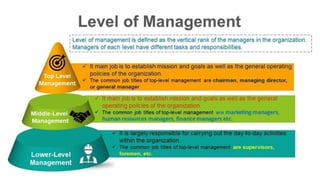
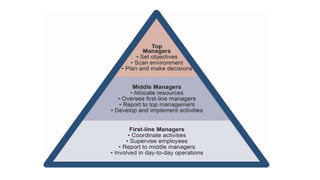
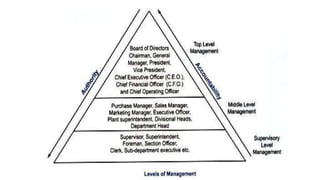
Functions of top level management
• To determine the objectives of organizations.
• To integrate diverse elements and to coordinate the activities of
different departments to overall objectives of organization.
• To frame plans and policies for the organization.
• To appoint executives for middle level
Functions of middle level management
• To explain the objectives and policies to lower level management.
• To ensure that their departments have necessary personnel.
• To assign necessary duties and responsibilities to them.
• To maintain coordination among different department of
organization.
• To submit the progress report and other information to top level
management which helps in making future plans.
Functions of lower level management
• To translate the policies and decisions of top & middle management
to workers.
• To make plans to distribute the work.
• To maintain quality of output, safety standards and to minimise the
wastage of materials.
• To arrange necessaries like tools, materials, working environment etc
• To inform the higher authorities about the progress and problems of
employees.
Conceptual skills are
• Central to creating a vision and strategic plan for an organization.
• The mental ability to analyse and diagnose situations.
• The ability find the cause and effect
• The ability to shape organizational policy ( what company stands for
and where it’s going)
• The understanding what an organization stands for and where it is or
should be going.
• Recognizing how various functions of the organizational and how
changes in one part affect all the others.
• Most important at top and middle level management
Conceptual skills
The skills that help managers understand how different parts of a business
relate to one another and to the business as a whole.
• Planning
• Problem solving
• Decision making
• Strategic thinking
• Ethical judgment
• Brain storming
• Creativity
• Innovation
• Time management skills
• Organizing
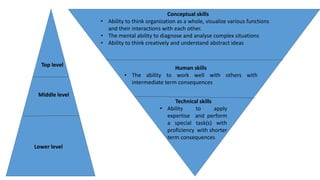
Top level
Middle level
Lower level
Conceptual skills
• Ability to think organization as a whole, visualize various functions
and their interactions with each other.
• The mental ability to diagnose and analyse complex situations
• Ability to think creatively and understand abstract ideas
Human skills
• The ability to work well with others with
intermediate term consequences
Technical skills
• Ability to apply
expertise and perform
a special task(s) with
proficiency with shorter
term consequences
Human skills / Interpersonal skills are
• “Good people skills” help a manager to assist group members in
working cooperatively to achieve common goals.
• Awareness of one’s own perspective and others perspectives at the
same time.
• Creates an atmosphere of trust where members feel they can become
involved and impact decisions in the organization.
• The ability to interact and work effectively with other people
• The ability to motivate, communicate with others, resolve conflicts,
understand others feelings and needs
• The ability to understand, lead, and control people’s behaviour
• Important at all the levels of the organization
Human skills or interpersonal skills
• Leadership
• Adaptability
• Ownership
• Effective communication
• Active listening
• Work style conflicts
• Empathy and compassion
• Organized workflow
• Public speaking
• Stress Management
Technical skills
• The ability to apply specialized knowledge or expertise is called technical skills.
• Technical skills are the abilities and knowledge needed to accomplish complex
actions, tasks, and processes.
• Technical skills are known as “hard skills”
• Technical skills are specific abilities and knowledge acquire through training,
education and experience that enable individuals to perform tasks within a
particular field.
• Technical skills are practical, job specific competencies that involve applying
specialized techniques, tools, or methodologies to solve problems or complete
tasks effectively.
• Technical skills are often specific to a particular industry or profession and are
essential for performing tasks related to technology, engineering, finance,
healthcare or other specialized areas.
• Technical skills are most important at middle and lower level
management, as top management usually depend on skilled
subordinates to handle technical issues.
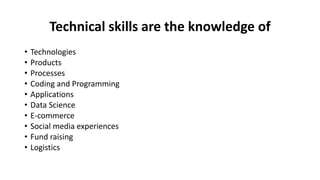
Technical skills are the knowledge of
• Technologies
• Products
• Processes
• Coding and Programming
• Applications
• Data Science
• E-commerce
• Social media experiences
• Fund raising
• Logistics
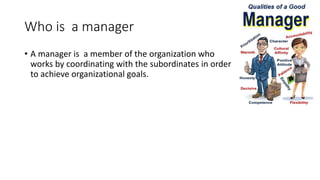
Who is a manager
• A manager is a member of the organization who
works by coordinating with the subordinates in order
to achieve organizational goals.
What does a manager do?
• Responsible to make efficient utilisation of
resources
• Decision making and problem solving
• Strategic planning and goal setting for the
organization
• Builds and maintain relationship with
customers
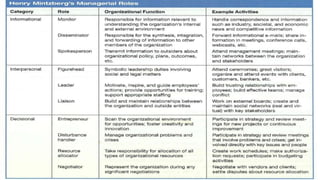
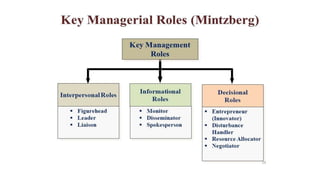
Managerial Roles
• A role is an organized set of behaviours associated with a particular
job.
• Skills are abilities crucial to success in a managerial position.
• Henry Mintzberg created a scheme to define what managers do on
the job. These are commonly referred to as Mintzberg Managerial
Roles. These can be grouped into three primary heading -
Interpersonal, Informational and Decisional roles
Interpersonal Role
• The ability to work with, understand, mentor and motivate other
people.
• Interviewing job applications, forming partnership with other
businesses and resolving conflicts all require these skills.
• Interact with their employees for the purpose of achieving
organizational goals
 Figurehead
Leader
Laison
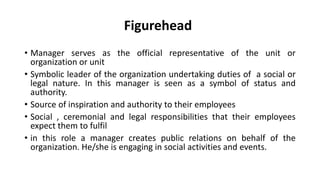
Figurehead
• Manager serves as the official representative of the unit or
organization or unit
• Symbolic leader of the organization undertaking duties of a social or
legal nature. In this manager is seen as a symbol of status and
authority.
• Source of inspiration and authority to their employees
• Social , ceremonial and legal responsibilities that their employees
expect them to fulfil
• in this role a manager creates public relations on behalf of the
organization. He/she is engaging in social activities and events.
Leader
• In this role manager supports, guides and motivates staffs and act as
a positive influence in the workplace.
• The leader builds relationships with employees and communicate
with, motivates and coaches them.
• Duties includes structuring and motivating subordinates, overseeing
their progress, promoting and encouraging their development, and
balance effectiveness.
Liasion
• Manager interacts with peers and with people outside the organization to
gain information
• Describes the information and communication obligations of a manager.
• Linking with managers and leaders of other divisions of the business and
other organisations
• Communicates with internal and external members of the organization
• Develops and maintains a network of external contacts to gather
information
• This networking activity is a critical step in reaching organizational goals,
especially those concerned with customers
• Manager builds rapport with stakeholders.
Informational Role
• Generate and share knowledge successfully achieve organizational
goals.
• Informational roles involve receiving, collecting and disseminating
information.
Monitor
Disseminator
Spokesperson
Monitor
• Manager receives and collects information relevant to the
organization’s operations.
• Duties include researching, locating, choosing useful information and
assessing internal operations.
• Monitoring performance of employees and level productivity.
• A manager should collect information from inside and outside the
workplace. On the base on this information, they address issues in
due time and changes accruing in the both internal and external
business environments.
Disseminator
• The disseminator transmits factual and value based information
internally that is obtained from either internal or external sources.
This requires both filtering and delegation skills.
• Sending information collected from external and internal sources to
the relevant people within the organization.
• Managers should convey the proper information to their staff
members.
Spokesperson
• The manager has a role of a brand ambassador to convey information
about the organization (Organization’s performance and policies) to
outside the workplace.
• The manager serves in a Public Relations capacity by informing and
lobbying others to keep stakeholders updated about the operations of
the organization.
Decisional Role
• Decisional roles revolves around making choices.
• Information and resources that are collected and gathered by the
interpersonal make a manager able to paly the decisional role or
responsibilities that they are obligated to.
• Generate a real action to successfully achieve organizational goals.
Entrepreneur
Disturbance handler
Resource allocation
Negotiator
Entrepreneur
• The entrepreneur acts as an initiator, designer and encourage of
change and innovation.
• Roles encourage managers to create improvement projects and work
to delegate, empower and supervise teams in the development
process.
• Seek opportunities and overseeing the business of the project within
the organization and its environment as well as initiating
“improvement projects” to cause change.
• A manager should lead the company by implementing innovative ideas
and encouraging creativity.
Disturbance Handler
• Manager deals with unexpected events and
operational breakdowns and should try to avoid
disruptions.
• Manager decides how conflicts between
subordinates should be resolved.
• The disturbance handler takes corrective action
when the organization faces corrective action when
the organization faces important ,unexpected
difficulties.
Resource Allocator
• Manager decides how the organization will use its resources.
• Deciding on the spending of the organization’s financial resources and
the allocation of its physical and human resources
• Controls and authorizes the use of organizational resources
• Responsible for the allocation of all resources of the organization in the
implementation , the entire decision making or approval of important
organizations
Negotiator
• Manager decides to negotiate major contracts with other organizations
or individuals.
• Representing organization in all important negotiation. Example :with
govt.
• Participates in negotiation activities with other organization and
individuals.
• Responsible for representing the organization on major negotiation
• A manager should be a negotiator within the department and
organization.
Management Process- Management Theory and Practices.pptx

Management Process- Management Theory and Practices.pptx

  • 1.
    Management Process Dr. NimishaNandan Assistant Professor Department of Management Studies St.Aloysius College
  • 2.
    Management Process • Managementis a process of reaching organizational goals by working with and through people. • Process means a course of action or proceeding. It involves a series of steps to carry out an activity. “Management is the process of planning organizing, leading, and controlling the efforts of organization members and of using all other organizational resources to achieve stated organizational goals.” The process defines management as a set of functions performed by managers regardless of their levels, aptitude and skills.
  • 3.
    Management is asocial process • Management deals with people. It is done by people ,through people and for people. • Management makes the best use of its human resource to convert its inactive resources into productive output(goods and services). • Social processes are the ways in which individuals and groups interact, adjust, readjust and establish relationships and pattern of behaviour which are again modified through social interactions. • It is the duty of management to make interaction between people - productive and useful for obtaining organizational goals.
  • 4.
    • Management understandshuman needs and satisfies them through various motivational factors, both financial (money) and non-financial (power, prestige, recognition etc.) • Management being a social process seeks to develop a comfortable work environment that promotes healthy relationships amongst the employees within the firm.
  • 5.
    Management is acontinuous process • Management is considered as a series of continuous, inter-related functions with no pre-determined sequence. The management process includes planning, organising, staffing, directing and controlling functions. • Management is a process that will never end as long as the organization remains. There will always be projects, goals, and challenges managers would push themselves to solve at some point in time. So, it’s a continuous process that will never come to an end.
  • 6.
    Management is anintegrating process • Management coordinates the activities of its departments (production, personnel, marketing and finance) and resources (human and non-human) to achieve maximum output at minimum cost. • Management also involves the integrating process whereby human resource work together in harmony to achieve the firm’s objective. It also deals with the integration of both human and financial resources and also making sure that both factors are put to good use so the firm can achieve the targeted goal.
  • 9.
    Functions of toplevel management • To determine the objectives of organizations. • To integrate diverse elements and to coordinate the activities of different departments to overall objectives of organization. • To frame plans and policies for the organization. • To appoint executives for middle level
  • 10.
    Functions of middlelevel management • To explain the objectives and policies to lower level management. • To ensure that their departments have necessary personnel. • To assign necessary duties and responsibilities to them. • To maintain coordination among different department of organization. • To submit the progress report and other information to top level management which helps in making future plans.
  • 11.
    Functions of lowerlevel management • To translate the policies and decisions of top & middle management to workers. • To make plans to distribute the work. • To maintain quality of output, safety standards and to minimise the wastage of materials. • To arrange necessaries like tools, materials, working environment etc • To inform the higher authorities about the progress and problems of employees.
  • 12.
    Conceptual skills are •Central to creating a vision and strategic plan for an organization. • The mental ability to analyse and diagnose situations. • The ability find the cause and effect • The ability to shape organizational policy ( what company stands for and where it’s going) • The understanding what an organization stands for and where it is or should be going. • Recognizing how various functions of the organizational and how changes in one part affect all the others. • Most important at top and middle level management
  • 13.
    Conceptual skills The skillsthat help managers understand how different parts of a business relate to one another and to the business as a whole. • Planning • Problem solving • Decision making • Strategic thinking • Ethical judgment • Brain storming • Creativity • Innovation • Time management skills • Organizing
  • 14.
    Top level Middle level Lowerlevel Conceptual skills • Ability to think organization as a whole, visualize various functions and their interactions with each other. • The mental ability to diagnose and analyse complex situations • Ability to think creatively and understand abstract ideas Human skills • The ability to work well with others with intermediate term consequences Technical skills • Ability to apply expertise and perform a special task(s) with proficiency with shorter term consequences
  • 15.
    Human skills /Interpersonal skills are • “Good people skills” help a manager to assist group members in working cooperatively to achieve common goals. • Awareness of one’s own perspective and others perspectives at the same time. • Creates an atmosphere of trust where members feel they can become involved and impact decisions in the organization. • The ability to interact and work effectively with other people • The ability to motivate, communicate with others, resolve conflicts, understand others feelings and needs • The ability to understand, lead, and control people’s behaviour • Important at all the levels of the organization
  • 16.
    Human skills orinterpersonal skills • Leadership • Adaptability • Ownership • Effective communication • Active listening • Work style conflicts • Empathy and compassion • Organized workflow • Public speaking • Stress Management
  • 17.
    Technical skills • Theability to apply specialized knowledge or expertise is called technical skills. • Technical skills are the abilities and knowledge needed to accomplish complex actions, tasks, and processes. • Technical skills are known as “hard skills” • Technical skills are specific abilities and knowledge acquire through training, education and experience that enable individuals to perform tasks within a particular field. • Technical skills are practical, job specific competencies that involve applying specialized techniques, tools, or methodologies to solve problems or complete tasks effectively. • Technical skills are often specific to a particular industry or profession and are essential for performing tasks related to technology, engineering, finance, healthcare or other specialized areas.
  • 18.
    • Technical skillsare most important at middle and lower level management, as top management usually depend on skilled subordinates to handle technical issues.
  • 19.
    Technical skills arethe knowledge of • Technologies • Products • Processes • Coding and Programming • Applications • Data Science • E-commerce • Social media experiences • Fund raising • Logistics
  • 21.
    Who is amanager • A manager is a member of the organization who works by coordinating with the subordinates in order to achieve organizational goals.
  • 22.
    What does amanager do? • Responsible to make efficient utilisation of resources • Decision making and problem solving • Strategic planning and goal setting for the organization • Builds and maintain relationship with customers
  • 23.
    Managerial Roles • Arole is an organized set of behaviours associated with a particular job. • Skills are abilities crucial to success in a managerial position. • Henry Mintzberg created a scheme to define what managers do on the job. These are commonly referred to as Mintzberg Managerial Roles. These can be grouped into three primary heading - Interpersonal, Informational and Decisional roles
  • 25.
    Interpersonal Role • Theability to work with, understand, mentor and motivate other people. • Interviewing job applications, forming partnership with other businesses and resolving conflicts all require these skills. • Interact with their employees for the purpose of achieving organizational goals  Figurehead Leader Laison
  • 26.
    Figurehead • Manager servesas the official representative of the unit or organization or unit • Symbolic leader of the organization undertaking duties of a social or legal nature. In this manager is seen as a symbol of status and authority. • Source of inspiration and authority to their employees • Social , ceremonial and legal responsibilities that their employees expect them to fulfil • in this role a manager creates public relations on behalf of the organization. He/she is engaging in social activities and events.
  • 27.
    Leader • In thisrole manager supports, guides and motivates staffs and act as a positive influence in the workplace. • The leader builds relationships with employees and communicate with, motivates and coaches them. • Duties includes structuring and motivating subordinates, overseeing their progress, promoting and encouraging their development, and balance effectiveness.
  • 28.
    Liasion • Manager interactswith peers and with people outside the organization to gain information • Describes the information and communication obligations of a manager. • Linking with managers and leaders of other divisions of the business and other organisations • Communicates with internal and external members of the organization • Develops and maintains a network of external contacts to gather information • This networking activity is a critical step in reaching organizational goals, especially those concerned with customers • Manager builds rapport with stakeholders.
  • 29.
    Informational Role • Generateand share knowledge successfully achieve organizational goals. • Informational roles involve receiving, collecting and disseminating information. Monitor Disseminator Spokesperson
  • 30.
    Monitor • Manager receivesand collects information relevant to the organization’s operations. • Duties include researching, locating, choosing useful information and assessing internal operations. • Monitoring performance of employees and level productivity. • A manager should collect information from inside and outside the workplace. On the base on this information, they address issues in due time and changes accruing in the both internal and external business environments.
  • 31.
    Disseminator • The disseminatortransmits factual and value based information internally that is obtained from either internal or external sources. This requires both filtering and delegation skills. • Sending information collected from external and internal sources to the relevant people within the organization. • Managers should convey the proper information to their staff members.
  • 32.
    Spokesperson • The managerhas a role of a brand ambassador to convey information about the organization (Organization’s performance and policies) to outside the workplace. • The manager serves in a Public Relations capacity by informing and lobbying others to keep stakeholders updated about the operations of the organization.
  • 33.
    Decisional Role • Decisionalroles revolves around making choices. • Information and resources that are collected and gathered by the interpersonal make a manager able to paly the decisional role or responsibilities that they are obligated to. • Generate a real action to successfully achieve organizational goals. Entrepreneur Disturbance handler Resource allocation Negotiator
  • 34.
    Entrepreneur • The entrepreneuracts as an initiator, designer and encourage of change and innovation. • Roles encourage managers to create improvement projects and work to delegate, empower and supervise teams in the development process. • Seek opportunities and overseeing the business of the project within the organization and its environment as well as initiating “improvement projects” to cause change. • A manager should lead the company by implementing innovative ideas and encouraging creativity.
  • 35.
    Disturbance Handler • Managerdeals with unexpected events and operational breakdowns and should try to avoid disruptions. • Manager decides how conflicts between subordinates should be resolved. • The disturbance handler takes corrective action when the organization faces corrective action when the organization faces important ,unexpected difficulties.
  • 36.
    Resource Allocator • Managerdecides how the organization will use its resources. • Deciding on the spending of the organization’s financial resources and the allocation of its physical and human resources • Controls and authorizes the use of organizational resources • Responsible for the allocation of all resources of the organization in the implementation , the entire decision making or approval of important organizations
  • 37.
    Negotiator • Manager decidesto negotiate major contracts with other organizations or individuals. • Representing organization in all important negotiation. Example :with govt. • Participates in negotiation activities with other organization and individuals. • Responsible for representing the organization on major negotiation • A manager should be a negotiator within the department and organization.