The Business
Journey
February 2019
Social Media
Follow: @TheBusJourney
Hashtag: #SMEJourney
Business Journey Partner
Simon Murrison
@simonmurrison
Death &Taxes
…
For those that
don’t know
who we are
…. ‘Team
Bald’ ..
PUBLIC
HEALTH
WARNING
Deal or no
Deal...
Deal or no
Deal... Brexit – Duties &VAT
Before 29th
March 2019
The UK is currently a member of the European Union, its Single Market and
Customs Union, and so applies the EU’s Common CustomsTariff (CCT) at the
external EU border.
• For goods moving between EU countries, there are no customs duties, and no
routine intervention during the movement of goods.
• For goods entering the EU’s CustomsTerritory from the rest of the world
(“third country goods”), an import declaration is required, customs formalities
and checks are carried out – for example for compliance with EU regulations –
and any customs duties must be paid.
• Imports from a country with which the EU has a free trade agreement may
qualify for preferential rates of duty and rules of origin.
• Imports from a country with which the EU does not have a free trade
agreement will be subject to the EU’s Most Favoured Nation (MFN) rates of
duty and non-preferential rules of origin.
What if no deal
…
Free circulation of goods between the
UK and EU would stop
For those trading with the EU the impacts are
• Need to apply the same rules as if trading outwith the
EU – import and export declarations
• The EU applying import and export declarations
• Potential duty charges
What if no deal
…
In preparing for “no deal” businesses will want to be aware of the following:
• theTaxation (Cross-BorderTrade) Bill will provide the necessary powers for
the UK to set its own tariff once it leaves the EU
• in a ‘no deal’ scenario, trade with the EU will be on non-
preferential,WTO terms.This means that MFN tariffs and non-preferential
rules of origin would apply to consignments between the UK and EU
• the EU will apply its MFN rates to goods imported into the EU from the UK.
The EU MFN rates are set out in the CCT, where they are listed as “erga
omnes” (which translates as “towards all”), rather than stating a specific
country.The EU may change these rates between now and March 2019, but
this provides an indication
• the UK will apply its MFN rates to goods imported into the UK from the EU.
The government will determine and publish these new UK duty rates before
we leave the EU.They may be different from the rates in the EU’s CCT
What if no deal
…
In preparing for “no deal” businesses will want to be aware of the following:
• the UK intends to continue offering unilateral preferences to developing
countries, and to seek to transition all EU FreeTrade Agreements for day 1 in
order to ensure continuity for both goods imported to the UK, and for UK
exports. Maintaining these benefits is of clear importance to businesses,
consumers and investors, and will ensure a smooth transition for users of
these provisions as we leave the EU. Further information on preferential trade
under the UK’s existing trade agreements will be captured in theTrade
Agreement Continuity technical notice
• the UKTradeTariff, detailing the import duty rates and rules that will be
applicable to each good, will be made available free on GOV.UK in the same
way as now. Importers of goods into the UK will no longer use EUTariff
information published by the EU
• the UK does not intend to immediately change the classification of goods in a
“no deal” scenario.The UK does not plan any immediate deviation from the
current commodity code list published in the UKTradeTariff, which is
currently applied by the EU, except where necessary to maintain alignment
with international standards, or for trade remedies purposes.
What if no deal
…
Before importing any goods from the
EU a business will need to
• Register for an UK EconomicOperator Registration
(EORI) Number
• Ensure their contracts and terms & conditions reflect
they are an importer
• Consider how they submit import declarations
• Decide on the classification of their goods
• Perhaps payVAT and import duties on imports
(depending on how the goods enter the country)
What if no deal
…
Before exporting any goods to the EU a
business will need to
• Register for an UK EconomicOperator Registration
(EORI) Number
• Ensure their contracts and terms & conditions reflect
they are an exporter
• Consider how they submit export declarations
• Decide on the classification of their goods
• Perhaps engage the services of a customs broker
What if no deal
…
Mitigations businesses may need to
consider
• Customs warehousing – business can store goods with
duty or import payments suspended
• Inward processing – allows businesses to import goods
from non-eu countries for work or modification in the
EU
• Temporary admission - allows business to temporarily
import or export goods such as samples
• Authorised use – allows a zero or reduced rate of
customs duty
VAT and Brexit
…
The UK’sVAT rules are set down mainly within theVAT Act 1994, which is
derived from the EUVAT Directive 2006/112/EC (“EVD”).The EVD has
direct and over-riding effect on all EU Member States but local legislation
is required because the EVD allows for countries to pick and choose
certain rules.
Why is this important when thinking about Brexit? It’s important because
once the UK leaves the EU it will theoretically (but this is not certain) no
longer be bound by the EVD.This means that the UK could have free rein
to amend itsVAT rules as it sees fit.
VAT and Brexit
…
Services
Post-Brexit we would expect there to be little difference concerning supplies of
services.
Generally, B2B services are treated as supplied where the customer belongs and
that customer must account for the localVAT itself.
Once the UK is outside of the EU, if the same rules continue to apply there will be
no change for UK suppliers – they will continue to not charge UKVAT. For B2C
supplies,UKVAT generally applies and again, we expect this to stay the same.
When receiving services, we would expect to see UK businesses still having to
apply a reverse charge to the receipt of services from non-UK suppliers.This
would ensure that there is no competitive advantage from sourcing services via
non-UK suppliers.
VAT and Brexit
…
Goods
Presently intra-community B2B supplies of goods are treated as being zero rated
in the UK if the certain conditions can be met.That customer then must account
for acquisition tax in the EU country where the goods are acquired.
The same currently applies when UK businesses buy goods which are delivered
from the EU. If the UK leaves the EU free trade area then this treatment will no
longer apply to UK businesses. Instead, exports and imports will take place.
For B2C supplies of goods, UK businesses currently charge UKVAT on these
supplies until they exceed a “distance selling” threshold.These vary from
between €35,000 – €100,000 across the different EU Member States. Once the
threshold is exceeded in a calendar year, the supplier stops charging UKVAT and
must register and account forVAT in the country where the goods are delivered
to.
Once the UK leaves the EU distance selling rules will not apply.Theoretically, this
could lead to a reduction in the number of registrations that are required.
VAT and Brexit
…
Summary
If the UK ends up outside the EU free trade area then all supplies of goods to the
EU will become exports.
Under existing UKVAT law these would continue to be zero rated. However,
instead of having to account for acquisition tax, the EU customers will probably
incur importVAT and, more importantly, import duty (subject to the classification
of the goods).
The importVAT should be recoverable by most businesses and hence only be a
cash flow issue but duty costs are irrecoverable.Therefore, if duty does apply EU
businesses will see an increase in the cost of products originating from the UK.
Additional care will have to be taken to make sure that the correct classification is
given to goods, in order that the right amount of duty is levied.
VAT and Brexit
…
Summary
When goods are purchased from EU suppliers, they will be treated as imports into
the UK.
Again, importVAT will probably apply and this will create a cash flow issue, even
if an importVAT deferment account is in place.
In theory, import duties will also apply and as for EU businesses purchasing from
the UK, the cost of imported products from the EU will increase.
It may be that the UK government reduces duties to assist UK businesses, but at
this stage there has been no comment on this issue and hence plans for post
Brexit trading should not assume this will happen.
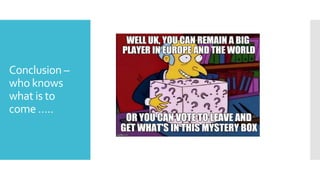
Conclusion –
who knows
what is to
come …..
Discussion
time …..
Simpler
system?
Get inTouch
If you would like to chat about your
business or your personal finances
Call: 0141 290 0262
Email: simon@muwca.co.uk
Visit: www.muwca.co.uk for more info
about our services
Questions for Simon
Date for the diary
The next Business Journey
event
May 14, 2019

Manage your taxes

  • 1.
  • 2.
  • 3.
    Business Journey Partner SimonMurrison @simonmurrison
  • 4.
  • 5.
    For those that don’tknow who we are …. ‘Team Bald’ ..
  • 6.
  • 7.
  • 8.
    Deal or no Deal...Brexit – Duties &VAT
  • 9.
    Before 29th March 2019 TheUK is currently a member of the European Union, its Single Market and Customs Union, and so applies the EU’s Common CustomsTariff (CCT) at the external EU border. • For goods moving between EU countries, there are no customs duties, and no routine intervention during the movement of goods. • For goods entering the EU’s CustomsTerritory from the rest of the world (“third country goods”), an import declaration is required, customs formalities and checks are carried out – for example for compliance with EU regulations – and any customs duties must be paid. • Imports from a country with which the EU has a free trade agreement may qualify for preferential rates of duty and rules of origin. • Imports from a country with which the EU does not have a free trade agreement will be subject to the EU’s Most Favoured Nation (MFN) rates of duty and non-preferential rules of origin.
  • 10.
    What if nodeal … Free circulation of goods between the UK and EU would stop For those trading with the EU the impacts are • Need to apply the same rules as if trading outwith the EU – import and export declarations • The EU applying import and export declarations • Potential duty charges
  • 11.
    What if nodeal … In preparing for “no deal” businesses will want to be aware of the following: • theTaxation (Cross-BorderTrade) Bill will provide the necessary powers for the UK to set its own tariff once it leaves the EU • in a ‘no deal’ scenario, trade with the EU will be on non- preferential,WTO terms.This means that MFN tariffs and non-preferential rules of origin would apply to consignments between the UK and EU • the EU will apply its MFN rates to goods imported into the EU from the UK. The EU MFN rates are set out in the CCT, where they are listed as “erga omnes” (which translates as “towards all”), rather than stating a specific country.The EU may change these rates between now and March 2019, but this provides an indication • the UK will apply its MFN rates to goods imported into the UK from the EU. The government will determine and publish these new UK duty rates before we leave the EU.They may be different from the rates in the EU’s CCT
  • 12.
    What if nodeal … In preparing for “no deal” businesses will want to be aware of the following: • the UK intends to continue offering unilateral preferences to developing countries, and to seek to transition all EU FreeTrade Agreements for day 1 in order to ensure continuity for both goods imported to the UK, and for UK exports. Maintaining these benefits is of clear importance to businesses, consumers and investors, and will ensure a smooth transition for users of these provisions as we leave the EU. Further information on preferential trade under the UK’s existing trade agreements will be captured in theTrade Agreement Continuity technical notice • the UKTradeTariff, detailing the import duty rates and rules that will be applicable to each good, will be made available free on GOV.UK in the same way as now. Importers of goods into the UK will no longer use EUTariff information published by the EU • the UK does not intend to immediately change the classification of goods in a “no deal” scenario.The UK does not plan any immediate deviation from the current commodity code list published in the UKTradeTariff, which is currently applied by the EU, except where necessary to maintain alignment with international standards, or for trade remedies purposes.
  • 13.
    What if nodeal … Before importing any goods from the EU a business will need to • Register for an UK EconomicOperator Registration (EORI) Number • Ensure their contracts and terms & conditions reflect they are an importer • Consider how they submit import declarations • Decide on the classification of their goods • Perhaps payVAT and import duties on imports (depending on how the goods enter the country)
  • 14.
    What if nodeal … Before exporting any goods to the EU a business will need to • Register for an UK EconomicOperator Registration (EORI) Number • Ensure their contracts and terms & conditions reflect they are an exporter • Consider how they submit export declarations • Decide on the classification of their goods • Perhaps engage the services of a customs broker
  • 15.
    What if nodeal … Mitigations businesses may need to consider • Customs warehousing – business can store goods with duty or import payments suspended • Inward processing – allows businesses to import goods from non-eu countries for work or modification in the EU • Temporary admission - allows business to temporarily import or export goods such as samples • Authorised use – allows a zero or reduced rate of customs duty
  • 16.
    VAT and Brexit … TheUK’sVAT rules are set down mainly within theVAT Act 1994, which is derived from the EUVAT Directive 2006/112/EC (“EVD”).The EVD has direct and over-riding effect on all EU Member States but local legislation is required because the EVD allows for countries to pick and choose certain rules. Why is this important when thinking about Brexit? It’s important because once the UK leaves the EU it will theoretically (but this is not certain) no longer be bound by the EVD.This means that the UK could have free rein to amend itsVAT rules as it sees fit.
  • 17.
    VAT and Brexit … Services Post-Brexitwe would expect there to be little difference concerning supplies of services. Generally, B2B services are treated as supplied where the customer belongs and that customer must account for the localVAT itself. Once the UK is outside of the EU, if the same rules continue to apply there will be no change for UK suppliers – they will continue to not charge UKVAT. For B2C supplies,UKVAT generally applies and again, we expect this to stay the same. When receiving services, we would expect to see UK businesses still having to apply a reverse charge to the receipt of services from non-UK suppliers.This would ensure that there is no competitive advantage from sourcing services via non-UK suppliers.
  • 18.
    VAT and Brexit … Goods Presentlyintra-community B2B supplies of goods are treated as being zero rated in the UK if the certain conditions can be met.That customer then must account for acquisition tax in the EU country where the goods are acquired. The same currently applies when UK businesses buy goods which are delivered from the EU. If the UK leaves the EU free trade area then this treatment will no longer apply to UK businesses. Instead, exports and imports will take place. For B2C supplies of goods, UK businesses currently charge UKVAT on these supplies until they exceed a “distance selling” threshold.These vary from between €35,000 – €100,000 across the different EU Member States. Once the threshold is exceeded in a calendar year, the supplier stops charging UKVAT and must register and account forVAT in the country where the goods are delivered to. Once the UK leaves the EU distance selling rules will not apply.Theoretically, this could lead to a reduction in the number of registrations that are required.
  • 19.
    VAT and Brexit … Summary Ifthe UK ends up outside the EU free trade area then all supplies of goods to the EU will become exports. Under existing UKVAT law these would continue to be zero rated. However, instead of having to account for acquisition tax, the EU customers will probably incur importVAT and, more importantly, import duty (subject to the classification of the goods). The importVAT should be recoverable by most businesses and hence only be a cash flow issue but duty costs are irrecoverable.Therefore, if duty does apply EU businesses will see an increase in the cost of products originating from the UK. Additional care will have to be taken to make sure that the correct classification is given to goods, in order that the right amount of duty is levied.
  • 20.
    VAT and Brexit … Summary Whengoods are purchased from EU suppliers, they will be treated as imports into the UK. Again, importVAT will probably apply and this will create a cash flow issue, even if an importVAT deferment account is in place. In theory, import duties will also apply and as for EU businesses purchasing from the UK, the cost of imported products from the EU will increase. It may be that the UK government reduces duties to assist UK businesses, but at this stage there has been no comment on this issue and hence plans for post Brexit trading should not assume this will happen.
  • 21.
  • 22.
  • 23.
    Get inTouch If youwould like to chat about your business or your personal finances Call: 0141 290 0262 Email: simon@muwca.co.uk Visit: www.muwca.co.uk for more info about our services
  • 24.
  • 25.
    Date for thediary The next Business Journey event May 14, 2019