

EU Anti-Bribery, Trade and Customs Webinar Series 
2014 
Union Customs Code: What to expect from the draft 
implementing provisions and how to take part in the 
negotiations 
27 February 2014 
Jennifer Revis, Of Counsel, Baker & McKenzie, London 
Peter Starling, Senior Policy Advisor, UK Lead to UCC 
negotiations 
Baker & McKenzie LLP is a member firm of Baker & McKenzie International, a Swiss Verein with member law firms around the world. In accordance with the common terminology 
used in professional service organisations, reference to a "partner" means a person who is a partner, or equivalent, in such a law firm. Similarly, reference to an "office" means an 
office of any such law firm. 
© 2014 Baker & McKenzie LLP
Speakers
Moderator 
Speakers 
Jennifer is Of Counsel in the EU, Competition and Trade Practice of Baker & McKenzie's London Office. She 
specialises in customs, trade sanctions and anti-bribery and corruption matters. Jennifer has extensive 
experience in advising clients on compliance issues (including third party due diligence and in M&A 
transactions). Jennifer routinely undertakes compliance audits for clients and advises on preparation of 
voluntary disclosures to government authorities. Jennifer has been on secondment to the UK customs 
authorities (Her Majesty's Revenue and Customs) in their Tax and Excise Litigation department and to the 
firm's European Law Centre in Brussels. Jennifer is a member of the London office Anti-Bribery and 
Corruption Unit. Jennifer is frequently invited to speak at external conferences on trade matters and regularly 
contributes articles to tax journals. 
3 
Baker & McKenzie were ranked Tier 1 for Customs & Excise in Legal 500 (2013). 
Jennifer Revis 
Of Counsel, London 
Tel: +44 20 7919 1381 
jennifer.revis@bakermckenzie.com 
Peter Starling 
Senior Policy Advisor, UK Lead to UCC 
negotiations 
100 Parliament Street 
London 
SW1A 2BQ 
international.documents@hmrc.gsi.gov.uk
UNION CUSTOMS CODE (UCC) 
What is complete & What is still to do
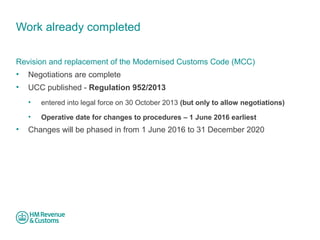
Work already completed 
Revision and replacement of the Modernised Customs Code (MCC) 
• Negotiations are complete 
• UCC published - Regulation 952/2013 
• entered into legal force on 30 October 2013 (but only to allow negotiations) 
• Operative date for changes to procedures – 1 June 2016 earliest 
• Changes will be phased in from 1 June 2016 to 31 December 2020
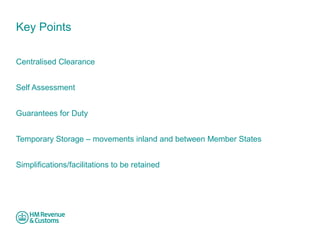
Key Points 
Centralised Clearance 
Self Assessment 
Guarantees for Duty 
Temporary Storage – movements inland and between Member States 
Simplifications/facilitations to be retained
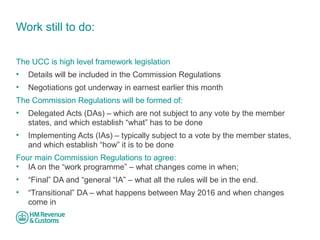
Work still to do: 
The UCC is high level framework legislation 
• Details will be included in the Commission Regulations 
• Negotiations got underway in earnest earlier this month 
The Commission Regulations will be formed of: 
• Delegated Acts (DAs) – which are not subject to any vote by the member 
states, and which establish “what” has to be done 
• Implementing Acts (IAs) – typically subject to a vote by the member states, 
and which establish “how” it is to be done 
Four main Commission Regulations to agree: 
• IA on the “work programme” – what changes come in when; 
• “Final” DA and “general “IA” – what all the rules will be in the end. 
• “Transitional” DA – what happens between May 2016 and when changes 
come in
What will the Commission Acts specify: 
Whether an authorisation is required; and if so 
• how a trader applies, how Customs process applications and grant 
authorisations 
• Thus whether the requirements are different to now 
All the detail on temporary storage, for example 
• What records the trader needs to hold, and how, and where 
How Centralised Clearance and Self Assessment will work
Size of the task on hand: 
UCC contains 288 Articles 
• Quite a lot was “stable” from earlier MCC negotiations 
• Still took a year, with meetings most weeks, including week-long meetings 
The Commission Acts are likely to be 
• “Final DA and “general” IA – 800 Articles plus, and 100 plus Annexes – 
basically the size of the existing IPs 
• “Transitional” DA – possibly as much again 
• “Work Programme” IA – happily short in Articles! 
Commission Acts will also generate 
• EU Guidelines on what the law means.
Timescales 
This year: 
• 13 January – The Commission’s proposed text was issued 
• 10 - 14 February – Negotiations began on the IAs and DAs (monthly, week-long 
meetings with possibly extra “expert meetings” as well; continuing 
through the year). Meetings with member states scheduled for the second 
week of each month. 
• Commission have also scheduled meetings with the “Trade Contact Group” 
• To focus discussion in those meetings, Commission have produced a 
timetable for member states and trade to provide written comments.
Timescales 
2015 
• The “final” DA and “general” IA should published by 1 May 2015 – that’s the 
aim. To do this, they have to be agreed by the end of this year. 
• Once those are agreed, attention moves to the “transition” DA. 
2016: UCC, the “transitional” and “final” DA and the “general” IA enters into force 
• We may well have to agree some further “specific” IAs covering, for example, 
exemptions from use of IT systems. 
Beyond 2016: 
• Changes delivered on a transitional timetable (set in the work programme) 
until end 2020
Main Elements of the UCC 
Implementing and Delegated Acts (IAs and DAs) 
Centralised Clearance 
Self Assessment 
Guarantees for Duty 
Temporary Storage 
Simplifications
Implementing Acts 
Similar to current implementing provision process 
EU Commission makes a proposal 
Discussed within Customs Code Committee 
Formal vote
Delegated Acts 
No mandatory consultation with MS or other experts 
But the Commission are consulting 
Some recourse to EU Council and/or European Parliament
Centralised Clearance (CC) 
Differing views across the EU about what CC should look like 
IT developments will be necessary 
We don’t expect it to be introduced before the end of transition – end 2020 
Operator MUST be an AEO (c)
Self Assessment (SA) 
Operator MUST be an AEO (c) to use SA 
• (note – this is where the replacement for the single transport contract at 
export appears)
Guarantees for Duty 
A guarantee will be mandatory for all Special Procedures authorisations 
Also for Temporary Storage authorisations 
Waivers available where the AEO criteria is met 
Duty deferment – guarantee will be able to be reduced for AEO(c) traders 
• 30% is proposed.
Temporary Storage 
Will operate much as now – that is the plan 
Can use commercial records, manifests and port systems 
Major change – goods can move inland and between MS under TS control
Simplifications 
For example 
Single Transport Contract (export) – under SA 
Level II simplifications (transit) 
BUT – no proposal from the Commission regarding valuation / earlier sales
What do you need to do now? 
Trade input will be vital 
Look at what you want (and don’t want) in the draft IAs and DAs 
Talk to trade associations, Commission, MEPs, and of course us 
Where AEO criteria needs to be met (or you need to be an AEO) – look now 
Don’t wait for the last minute rush
Thank you 
Pete Starling 
100 Parliament Street 
London 
SW1A 2BQ 
international.documents@hmrc.gsi.gov.uk
22 
Questions?
EU Anti-Bribery, Trade and Customs Webinar Series 
2014 
Union Customs Code: What to expect from the draft 
implementing provisions and how to take part in the 
negotiations 
27 February 2014 
jennifer.revis@bakermckenzie.com 
international.documents@hmrc.gsi.gov.uk 
The webinar recording for this presentation is available here: 
http://www.bakermckenzie.com/WBTCEUCustomsWebinarSeries/ 
Baker & McKenzie LLP is a member firm of Baker & McKenzie International, a Swiss Verein with member law firms around the world. In accordance with the common terminology 
used in professional service organisations, reference to a "partner" means a person who is a partner, or equivalent, in such a law firm. Similarly, reference to an "office" means an 
office of any such law firm. 
© 2014 Baker & McKenzie LLP

Union Customs Code: What to expect from the draft implementing provisions and how to take part in the negotiations

  • 1.
    EU Anti-Bribery, Tradeand Customs Webinar Series 2014 Union Customs Code: What to expect from the draft implementing provisions and how to take part in the negotiations 27 February 2014 Jennifer Revis, Of Counsel, Baker & McKenzie, London Peter Starling, Senior Policy Advisor, UK Lead to UCC negotiations Baker & McKenzie LLP is a member firm of Baker & McKenzie International, a Swiss Verein with member law firms around the world. In accordance with the common terminology used in professional service organisations, reference to a "partner" means a person who is a partner, or equivalent, in such a law firm. Similarly, reference to an "office" means an office of any such law firm. © 2014 Baker & McKenzie LLP
  • 2.
  • 3.
    Moderator Speakers Jenniferis Of Counsel in the EU, Competition and Trade Practice of Baker & McKenzie's London Office. She specialises in customs, trade sanctions and anti-bribery and corruption matters. Jennifer has extensive experience in advising clients on compliance issues (including third party due diligence and in M&A transactions). Jennifer routinely undertakes compliance audits for clients and advises on preparation of voluntary disclosures to government authorities. Jennifer has been on secondment to the UK customs authorities (Her Majesty's Revenue and Customs) in their Tax and Excise Litigation department and to the firm's European Law Centre in Brussels. Jennifer is a member of the London office Anti-Bribery and Corruption Unit. Jennifer is frequently invited to speak at external conferences on trade matters and regularly contributes articles to tax journals. 3 Baker & McKenzie were ranked Tier 1 for Customs & Excise in Legal 500 (2013). Jennifer Revis Of Counsel, London Tel: +44 20 7919 1381 jennifer.revis@bakermckenzie.com Peter Starling Senior Policy Advisor, UK Lead to UCC negotiations 100 Parliament Street London SW1A 2BQ international.documents@hmrc.gsi.gov.uk
  • 4.
    UNION CUSTOMS CODE(UCC) What is complete & What is still to do
  • 5.
    Work already completed Revision and replacement of the Modernised Customs Code (MCC) • Negotiations are complete • UCC published - Regulation 952/2013 • entered into legal force on 30 October 2013 (but only to allow negotiations) • Operative date for changes to procedures – 1 June 2016 earliest • Changes will be phased in from 1 June 2016 to 31 December 2020
  • 6.
    Key Points CentralisedClearance Self Assessment Guarantees for Duty Temporary Storage – movements inland and between Member States Simplifications/facilitations to be retained
  • 7.
    Work still todo: The UCC is high level framework legislation • Details will be included in the Commission Regulations • Negotiations got underway in earnest earlier this month The Commission Regulations will be formed of: • Delegated Acts (DAs) – which are not subject to any vote by the member states, and which establish “what” has to be done • Implementing Acts (IAs) – typically subject to a vote by the member states, and which establish “how” it is to be done Four main Commission Regulations to agree: • IA on the “work programme” – what changes come in when; • “Final” DA and “general “IA” – what all the rules will be in the end. • “Transitional” DA – what happens between May 2016 and when changes come in
  • 8.
    What will theCommission Acts specify: Whether an authorisation is required; and if so • how a trader applies, how Customs process applications and grant authorisations • Thus whether the requirements are different to now All the detail on temporary storage, for example • What records the trader needs to hold, and how, and where How Centralised Clearance and Self Assessment will work
  • 9.
    Size of thetask on hand: UCC contains 288 Articles • Quite a lot was “stable” from earlier MCC negotiations • Still took a year, with meetings most weeks, including week-long meetings The Commission Acts are likely to be • “Final DA and “general” IA – 800 Articles plus, and 100 plus Annexes – basically the size of the existing IPs • “Transitional” DA – possibly as much again • “Work Programme” IA – happily short in Articles! Commission Acts will also generate • EU Guidelines on what the law means.
  • 10.
    Timescales This year: • 13 January – The Commission’s proposed text was issued • 10 - 14 February – Negotiations began on the IAs and DAs (monthly, week-long meetings with possibly extra “expert meetings” as well; continuing through the year). Meetings with member states scheduled for the second week of each month. • Commission have also scheduled meetings with the “Trade Contact Group” • To focus discussion in those meetings, Commission have produced a timetable for member states and trade to provide written comments.
  • 11.
    Timescales 2015 •The “final” DA and “general” IA should published by 1 May 2015 – that’s the aim. To do this, they have to be agreed by the end of this year. • Once those are agreed, attention moves to the “transition” DA. 2016: UCC, the “transitional” and “final” DA and the “general” IA enters into force • We may well have to agree some further “specific” IAs covering, for example, exemptions from use of IT systems. Beyond 2016: • Changes delivered on a transitional timetable (set in the work programme) until end 2020
  • 12.
    Main Elements ofthe UCC Implementing and Delegated Acts (IAs and DAs) Centralised Clearance Self Assessment Guarantees for Duty Temporary Storage Simplifications
  • 13.
    Implementing Acts Similarto current implementing provision process EU Commission makes a proposal Discussed within Customs Code Committee Formal vote
  • 14.
    Delegated Acts Nomandatory consultation with MS or other experts But the Commission are consulting Some recourse to EU Council and/or European Parliament
  • 15.
    Centralised Clearance (CC) Differing views across the EU about what CC should look like IT developments will be necessary We don’t expect it to be introduced before the end of transition – end 2020 Operator MUST be an AEO (c)
  • 16.
    Self Assessment (SA) Operator MUST be an AEO (c) to use SA • (note – this is where the replacement for the single transport contract at export appears)
  • 17.
    Guarantees for Duty A guarantee will be mandatory for all Special Procedures authorisations Also for Temporary Storage authorisations Waivers available where the AEO criteria is met Duty deferment – guarantee will be able to be reduced for AEO(c) traders • 30% is proposed.
  • 18.
    Temporary Storage Willoperate much as now – that is the plan Can use commercial records, manifests and port systems Major change – goods can move inland and between MS under TS control
  • 19.
    Simplifications For example Single Transport Contract (export) – under SA Level II simplifications (transit) BUT – no proposal from the Commission regarding valuation / earlier sales
  • 20.
    What do youneed to do now? Trade input will be vital Look at what you want (and don’t want) in the draft IAs and DAs Talk to trade associations, Commission, MEPs, and of course us Where AEO criteria needs to be met (or you need to be an AEO) – look now Don’t wait for the last minute rush
  • 21.
    Thank you PeteStarling 100 Parliament Street London SW1A 2BQ international.documents@hmrc.gsi.gov.uk
  • 22.
  • 23.
    EU Anti-Bribery, Tradeand Customs Webinar Series 2014 Union Customs Code: What to expect from the draft implementing provisions and how to take part in the negotiations 27 February 2014 jennifer.revis@bakermckenzie.com international.documents@hmrc.gsi.gov.uk The webinar recording for this presentation is available here: http://www.bakermckenzie.com/WBTCEUCustomsWebinarSeries/ Baker & McKenzie LLP is a member firm of Baker & McKenzie International, a Swiss Verein with member law firms around the world. In accordance with the common terminology used in professional service organisations, reference to a "partner" means a person who is a partner, or equivalent, in such a law firm. Similarly, reference to an "office" means an office of any such law firm. © 2014 Baker & McKenzie LLP