InfraRisk Pty Ltd.
#203a, 757 Bourke Street
Docklands VIC 3008

White Paper
The Cloud and Credit Risk Systems
Is there a fit?

Series 1.1

4th Quarter, 2010

P: +61 3 9602 3396
F: +61 3 9867 7750
E: info@infrarisk.com
InfraRisk
Table of Contents
1.

Executive Summary

1

2.

How does it Work?

2

3.

Benefits to Banks?

3

3.1
3.2

4.

Impact Analysis – Project
Impact Analysis – Financial

5
6

Conclusion

8

Confidential
No part of this document may be reproduced or transmitted in any form or by any
means electronic or mechanical, for any purpose, without the express written
permission of InfraRisk Pty Ltd.

InfraRisk Contact
Any questions or requests for clarification or additional information should be
addressed in the first instance to:
Bao Nguyen, Executive Director
Nic Davies, Executive Director
Telephone:

+61 3 9602 3396

Fax:

+61 3 9867 7750

Email:

bnguyen@infrarisk.com

Email:

ndavies@infrarisk.com

Page i of 11
InfraRisk
1.

Executive Summary

The concept of cloud computing has created a lot of buzz, and naturally financial
institutions as significant technology investors are considering what benefits they
might derive from adopting cloud solutions.
Although there are a range of different cloud solutions that may be available to
financial institutions – we will focus on the Software as a Service (SaaS) option to
use as a case study.
The key features of a cloud based SaaS solution are:


Dynamic use of technology for ebbs and flows in demand;



Substantially mitigates Project Implementation Risk;



Removes the worry about infrastructure management for the end user; and



Enables sharing principles to leverage investment.

These fundamental drivers of cloud benefits are particularly pertinent for lenders
given the dynamic business environment they operate in, and the higher regulatory
compliance burden they face compared with other industries.
In addition to the above benefits explicitly driven from cloud based business
models, lenders are also able to achieve an added bonus not typically available to
other industries, as driven by the leverage affect achievable from the
redeployment of capital.
This paper looks at a hypothetical $1m project, and using a classic Net Present
Value calculation framework with some consistent assumptions – we can compare
the outcome of a traditional buy and own approach to that of a SaaS option.
In our example, using conservative assumptions – the results on a five year NPV
basis show:
Scenario 1 Buy and Own –

NPV $ 109k

Scenario 2 SaaS –

NPV $1,554k

Both options are NPV positive, and thus desirable, but the SaaS generated NPV is
substantially higher. This is driven in part by the lower up front capex, but also
from the extra income gained by a more effective use of the Capital.

The Cloud & Credit Risk Systems

Page 1 of 8

© InfraRisk Pty Ltd
InfraRisk
2.

How does it Work?

There is a lot of buzz about Cloud computing and the potential impact it will have
on many industries, including banks. According to Gartner, the banking industry is
already amongst the fastest adopters of cloud computing.
Will cloud computing live up to the hype, particularly for lenders? Before
answering this question, it is important to consider some of the specifics about
what we mean by cloud computing. This is not intended to be a technical paper –
so the points below are not exhaustive and designed to reflect the particular view
point of lenders:
Some of the key Cloud characteristics include:


Dynamic use of technology for ebbs and flows in demand;



Remove the worry about infrastructure management for the end user; and



Enable sharing principles to leverage investment.

There are three different service models – Software, Platform or Infrastructure as
a Service - Saas, PaaS or IaaS respectively. At present, the range and use of SaaS
is the most prominent of these three categories and the area where a number of
options exist for banks. We will look at SaaS benefits in this paper as they are they
more directly observable – however the principles apply for PaaS and IaaS as well.
Deployment via the cloud can be done in a range of different ways including the
use of publicly available infrastructure, through to a private cloud – and hybrids
thereof. Deployment method will impact cost – but the variability in these options
does enable banks to choose the right approach for the diverse range of software
applications they use from core banking through to say a loan payment calculator
that may be made available internally and externally to third parties.

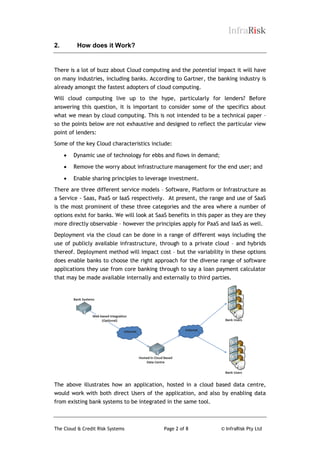
The above illustrates how an application, hosted in a cloud based data centre,
would work with both direct Users of the application, and also by enabling data
from existing bank systems to be integrated in the same tool.

The Cloud & Credit Risk Systems

Page 2 of 8

© InfraRisk Pty Ltd
InfraRisk
3.

Benefits to Banks?

There is no doubt that there is a lot of hype around cloud computing. Gartner has
cloud computing at the peak of it‟s just released 2010 Hype Cycle (it was also
there in 2009) – still yet to move from current “inflated expectations” to the
“trough of disillusionment” then “slope of enlightenment” and finally “plateau of
productivity”.
Whether cloud computing will live up to the lofty expectations set for it is still
hard to say – however there is no doubt that it does offer some significant benefits
more generally, and as this paper will demonstrate – for banks in particular.
First – the general benefits that are driving the broader industry:


“Sharing” of commodity infrastructure / services to lower the individual
cost, both at the outset of implementation and over time;



Lower the level of management oversight and op risk, leaving businesses to
focus on their core competencies.



Flexibility for infrastructure requirements.



Speed to market and reduced project risk.

In an environment where the cost of managing technology is becoming both an
ever increasing proportion of overall expenses and is a key differentiator for many
institutions – as it is in banking – these are significant benefits in their own right.
Particularly the ability to reduce project risk – as the track record of banking IT
projects is not stellar!
Banks are enhancing Credit Risk systems in response to regulatory, market and
economic pressures and these changes require agility, however traditional
approaches leave most banks with very few options to be agile. Cloud computing
offers some very important advantages in this respect.
Cloud based solutions typically require lower capital and project investment and
most importantly provide very quick implementations. As a bank can scale up or
scale down the commitment to a cloud based solution quickly, the necessity to
ensure deep levels of integration and alignment with all areas of technology and
business is reduced.
A bank can have more tactical responses using cloud based solutions while
evaluating strategic solutions. The deployment of a tool does not have to wait for
the ultimate strategic solution. The need to align with current and future
enterprise architectures is normally a significant cost of choosing and
implementing strategic solutions.
Operationally,

SaaS

eliminates

costs

for

database

administration,

server

management, disaster recovery management, software administration.

The Cloud & Credit Risk Systems

Page 3 of 8

© InfraRisk Pty Ltd
InfraRisk
In addition to the imperative from these general benefits, banks have an added
more potent reason for considering cloud solutions – Capital.
Bankers manage their capital very carefully given the leverage effect banks are
able to enjoy, and the associated regulatory oversight that comes with it. Most
non financial Assets – like Property – are rarely seen on balance sheet as banks are
much better off leasing such items and deploying the capital in their core business
of lending.
However, to date that logic has not always been applied to software despite it
arguably being more compelling giving the relative depreciation rate! This is partly
due to the traditional model of software supplied on a licence / installation /
support model, and partly because the technology to support a „rented‟ solution is
still considered relatively new.

The Cloud & Credit Risk Systems

Page 4 of 8

© InfraRisk Pty Ltd
InfraRisk
3.1

Impact Analysis – Project

The scenario below illustrates the comparable effort and timelines for a tactical
SaaS Solution as compared with a more strategic on-premise enterprise software
deployment. Note, many institutions may look at a third option such as an internal
development – but for comparative purposes we have just focussed on the options
in relation to an existing product with some typical implementation /
parameterisation requirements.

On-Premise
Solution
Planning
Requirements Definition
Enterprise Architecture
Solution Architecture
Integration requirements
Infrastructure planning
DB & Sys Admin requirements
Project Funding, Business case
Total
Internal resources required

40 days
10 days
10 days
10 days
5 days
5 days
10 days
90 days
12

The Cloud & Credit Risk Systems

40 days
5 days
5 days
5 days
55 days
6

10 days
10 days
5 days

10 days
2 days
1 days

10 days
45 days
8

2 days
20 days
6

10 days
3 days
10 days
10 days
5 days
20 days
5 days
66 days
8

Solution Evaluation
Functional Review
Align with Enterprise architecture
Solution Design
Infrastructure, Availability, Disaster
recovery
Total
Internal resources required
Deployment
Hardware Acquisition
Server, Database configuration
Infrastructure, Disaster Recovery
Integration
System Integration testing
DBA, Sys admin training
User Acceptance Testing
Training
Total
Internal resources required

SaaS Tactical
Solution

1 days
5 days
5 days
20 days
5 days
36 days
4

3 days

Page 5 of 8

© InfraRisk Pty Ltd
InfraRisk
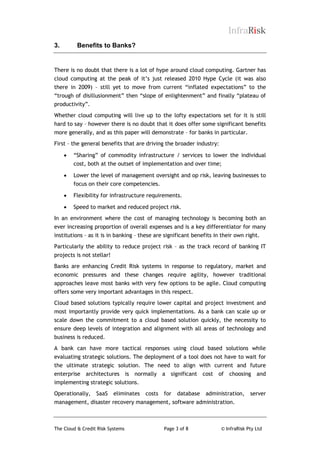
3.2

Impact Analysis – Financial

Consider a project with the following characteristics:
External Costs:

$1,000,000 (Purchase, installation, licence fee etc..)

Internal Costs:

$ 500,000 (Project mgmt., internal implementation)

Ongoing support:

$ 200,000 (Say 20% of external costs, recurring per annum)

And where the business environment has the following characteristics:
Tax Rate:

30%

Amortisation:

5 years (limited cashflow impact)

Interest Income:

0.75% (Assumes 1.5% Net Int. Margin, and Cost to Income
ratio of 50%)

Capitalisation Rate:

10% (assume 100% Risk Weighted Assets for ease)

Discount Rate:

15% (Cost of Capital for a typical bank)

Using the above characteristics, we can construct cashflows and compare the
outcome for either Scenario 1: a traditional purchase, or Scenario 2: as a Software
as a Service proposition.

Scenario 1 – Purchase
Yr 1
External Cost
Internal Cost
Maintenance
Business Benefit
Profit / (Loss)

NPV

Yr 3

Yr 4

Yr 5

-$1,500,000

-$200,000
$800,000
$600,000

-$200,000
$800,000
$600,000

-$200,000
$800,000
$600,000

-$200,000
$800,000
$600,000

-$200,000
$800,000
$600,000

-$200,000
-$120,000
$280,000

-$1,500,000

Amortisation
Tax
NPAT
Cashflow Basis

Yr 2

-$1,000,000
-$500,000

-$200,000
-$120,000
$280,000

-$200,000
-$120,000
$280,000

-$200,000
-$120,000
$280,000

-$200,000
-$120,000
$280,000

$480,000

$480,000

$480,000

$480,000

$480,000

$109,034

With a discount rate of 15%, the Net Present Value for the above cashflows
(Amortisation added back in, but note Profitability is of course much lower) is
positive, and thus this is a desirable project for the Bank evaluating it. The above
is a fairly typical analysis for, comparatively, a reasonable project that many
institutions might be faced with.

The Cloud & Credit Risk Systems

Page 6 of 8

© InfraRisk Pty Ltd
InfraRisk
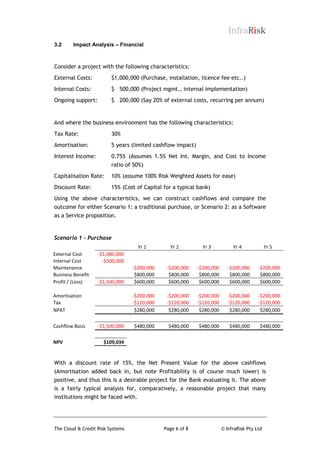
Scenario 2 – Software As a Service
Looking now at the SaaS option, we can see a number of differences driven from
the fact that the software and associated implementation expense do not have any
Balance Sheet impact, and that Capital can be effectively redeployed to support
lending activities. For analysis purposes, we‟ll assume that the SaaS expense
amortised over 4 years i.e. $250k p.a. for an alternative $1m investment.

Yr 1
External Cost
Internal Cost
Rental
Business Benefit
Profit / (Loss)
Capital
Lending
NIM
Amortisation
Tax
NPAT
Cashflow Basis
NPV

Yr 2

Yr 3

Yr 4

Yr 5

$0
$0
-$250,000
$800,000
$550,000

-$250,000
$800,000
$550,000

-$250,000
$800,000
$550,000

-$250,000
$800,000
$550,000

-$250,000
$800,000
$550,000

$1,500,000
$15,000,000

$1,500,000
$15,000,000
$112,500
$0
-$198,750
$463,750

$1,500,000
$15,000,000
$112,500
$0
-$198,750
$463,750

$1,500,000
$15,000,000
$112,500
$0
-$198,750
$463,750

$1,500,000
$15,000,000
$112,500
$0
-$198,750
$463,750

$1,500,000
$15,000,000
$112,500
$0
-$198,750
$463,750

$0

$463,750

$463,750

$463,750

$463,750

$463,750

$0

$1,554,562

As per the above, the difference in NPV amounts between the two scenarios is
substantial. Even doubling or tripling the Rental as a proportion of the initial
Investment still results in a greater NPV for the SaaS option on a 5 year horizon.
For credit providers, the leverage effect available from the redeployment of
Capital is an important factor in project assessment and results in SaaS options
having a much more significant financial benefit than would typically be seen in
other industries.

Note: The above has focussed on the widely used Net Present Value approach to
comparing the relative attractiveness of two Projects, and this does provide a
useful outcome. A similar analysis can be undertaken using Shareholder Value
impact studies, however the number of variables required become more complex
and the results less generic. Also, further complexity, and benefit, can be
introduced by looking at reinvestment and growth rates.
If you would like InfraRisk to undertake such an analysis for your institution, we
are happy to do so with variables specific to your business characteristics.

The Cloud & Credit Risk Systems

Page 7 of 8

© InfraRisk Pty Ltd
InfraRisk
4.

Conclusion

Although the numbers will change from project to project, our framework
demonstrates substantial economic benefits to banks from keeping software off
balance sheet and shows that the Cloud does offer significant potential to Credit
providers to create added value for their institutions.
Whether a SaaS arrangement is entered into for say:


the purpose of minimising initial cash outlay,



mitigating project risk, or



to achieve a faster time to market

– the end Net Present Value impact can be substantial.

About IR
InfraRisk is a thought leader in the Commercial Credit space founded on the
principles of integrating Risk and Return in an efficient framework. Our expertise
is assisting Commercial and Corporate lenders to process credit applications more
accurately, streamlined and focused on improving risk adjusted profit and
shareholder value.

InfraRisk offers domain knowledge and integrated solutions

built specifically for the demanding commercial banking environment.
To explore more about InfraRisk, visit our interactive website, request access to
our Premium Content or request a demonstration. Further information about
InfraRisk can be viewed at www.infrarisk.com/about.html

InfraRisk Assessment Evaluation
Please call or eMail for a complete description of the InfraRisk Assessment
Evaluation and what information, resources and Associates from the Bank would
need to be involved.
Telephone:

+61 3 9602 3396

Fax:

+61 3 9867 7750

Email:

info@infrarisk.com

The Cloud & Credit Risk Systems

Page 8 of 8

© InfraRisk Pty Ltd

SaaS for Credit Origination

  • 1.
    InfraRisk Pty Ltd. #203a,757 Bourke Street Docklands VIC 3008 White Paper The Cloud and Credit Risk Systems Is there a fit? Series 1.1 4th Quarter, 2010 P: +61 3 9602 3396 F: +61 3 9867 7750 E: info@infrarisk.com
  • 2.
    InfraRisk Table of Contents 1. ExecutiveSummary 1 2. How does it Work? 2 3. Benefits to Banks? 3 3.1 3.2 4. Impact Analysis – Project Impact Analysis – Financial 5 6 Conclusion 8 Confidential No part of this document may be reproduced or transmitted in any form or by any means electronic or mechanical, for any purpose, without the express written permission of InfraRisk Pty Ltd. InfraRisk Contact Any questions or requests for clarification or additional information should be addressed in the first instance to: Bao Nguyen, Executive Director Nic Davies, Executive Director Telephone: +61 3 9602 3396 Fax: +61 3 9867 7750 Email: bnguyen@infrarisk.com Email: ndavies@infrarisk.com Page i of 11
  • 3.
    InfraRisk 1. Executive Summary The conceptof cloud computing has created a lot of buzz, and naturally financial institutions as significant technology investors are considering what benefits they might derive from adopting cloud solutions. Although there are a range of different cloud solutions that may be available to financial institutions – we will focus on the Software as a Service (SaaS) option to use as a case study. The key features of a cloud based SaaS solution are:  Dynamic use of technology for ebbs and flows in demand;  Substantially mitigates Project Implementation Risk;  Removes the worry about infrastructure management for the end user; and  Enables sharing principles to leverage investment. These fundamental drivers of cloud benefits are particularly pertinent for lenders given the dynamic business environment they operate in, and the higher regulatory compliance burden they face compared with other industries. In addition to the above benefits explicitly driven from cloud based business models, lenders are also able to achieve an added bonus not typically available to other industries, as driven by the leverage affect achievable from the redeployment of capital. This paper looks at a hypothetical $1m project, and using a classic Net Present Value calculation framework with some consistent assumptions – we can compare the outcome of a traditional buy and own approach to that of a SaaS option. In our example, using conservative assumptions – the results on a five year NPV basis show: Scenario 1 Buy and Own – NPV $ 109k Scenario 2 SaaS – NPV $1,554k Both options are NPV positive, and thus desirable, but the SaaS generated NPV is substantially higher. This is driven in part by the lower up front capex, but also from the extra income gained by a more effective use of the Capital. The Cloud & Credit Risk Systems Page 1 of 8 © InfraRisk Pty Ltd
  • 4.
    InfraRisk 2. How does itWork? There is a lot of buzz about Cloud computing and the potential impact it will have on many industries, including banks. According to Gartner, the banking industry is already amongst the fastest adopters of cloud computing. Will cloud computing live up to the hype, particularly for lenders? Before answering this question, it is important to consider some of the specifics about what we mean by cloud computing. This is not intended to be a technical paper – so the points below are not exhaustive and designed to reflect the particular view point of lenders: Some of the key Cloud characteristics include:  Dynamic use of technology for ebbs and flows in demand;  Remove the worry about infrastructure management for the end user; and  Enable sharing principles to leverage investment. There are three different service models – Software, Platform or Infrastructure as a Service - Saas, PaaS or IaaS respectively. At present, the range and use of SaaS is the most prominent of these three categories and the area where a number of options exist for banks. We will look at SaaS benefits in this paper as they are they more directly observable – however the principles apply for PaaS and IaaS as well. Deployment via the cloud can be done in a range of different ways including the use of publicly available infrastructure, through to a private cloud – and hybrids thereof. Deployment method will impact cost – but the variability in these options does enable banks to choose the right approach for the diverse range of software applications they use from core banking through to say a loan payment calculator that may be made available internally and externally to third parties. The above illustrates how an application, hosted in a cloud based data centre, would work with both direct Users of the application, and also by enabling data from existing bank systems to be integrated in the same tool. The Cloud & Credit Risk Systems Page 2 of 8 © InfraRisk Pty Ltd
  • 5.
    InfraRisk 3. Benefits to Banks? Thereis no doubt that there is a lot of hype around cloud computing. Gartner has cloud computing at the peak of it‟s just released 2010 Hype Cycle (it was also there in 2009) – still yet to move from current “inflated expectations” to the “trough of disillusionment” then “slope of enlightenment” and finally “plateau of productivity”. Whether cloud computing will live up to the lofty expectations set for it is still hard to say – however there is no doubt that it does offer some significant benefits more generally, and as this paper will demonstrate – for banks in particular. First – the general benefits that are driving the broader industry:  “Sharing” of commodity infrastructure / services to lower the individual cost, both at the outset of implementation and over time;  Lower the level of management oversight and op risk, leaving businesses to focus on their core competencies.  Flexibility for infrastructure requirements.  Speed to market and reduced project risk. In an environment where the cost of managing technology is becoming both an ever increasing proportion of overall expenses and is a key differentiator for many institutions – as it is in banking – these are significant benefits in their own right. Particularly the ability to reduce project risk – as the track record of banking IT projects is not stellar! Banks are enhancing Credit Risk systems in response to regulatory, market and economic pressures and these changes require agility, however traditional approaches leave most banks with very few options to be agile. Cloud computing offers some very important advantages in this respect. Cloud based solutions typically require lower capital and project investment and most importantly provide very quick implementations. As a bank can scale up or scale down the commitment to a cloud based solution quickly, the necessity to ensure deep levels of integration and alignment with all areas of technology and business is reduced. A bank can have more tactical responses using cloud based solutions while evaluating strategic solutions. The deployment of a tool does not have to wait for the ultimate strategic solution. The need to align with current and future enterprise architectures is normally a significant cost of choosing and implementing strategic solutions. Operationally, SaaS eliminates costs for database administration, server management, disaster recovery management, software administration. The Cloud & Credit Risk Systems Page 3 of 8 © InfraRisk Pty Ltd
  • 6.
    InfraRisk In addition tothe imperative from these general benefits, banks have an added more potent reason for considering cloud solutions – Capital. Bankers manage their capital very carefully given the leverage effect banks are able to enjoy, and the associated regulatory oversight that comes with it. Most non financial Assets – like Property – are rarely seen on balance sheet as banks are much better off leasing such items and deploying the capital in their core business of lending. However, to date that logic has not always been applied to software despite it arguably being more compelling giving the relative depreciation rate! This is partly due to the traditional model of software supplied on a licence / installation / support model, and partly because the technology to support a „rented‟ solution is still considered relatively new. The Cloud & Credit Risk Systems Page 4 of 8 © InfraRisk Pty Ltd
  • 7.
    InfraRisk 3.1 Impact Analysis –Project The scenario below illustrates the comparable effort and timelines for a tactical SaaS Solution as compared with a more strategic on-premise enterprise software deployment. Note, many institutions may look at a third option such as an internal development – but for comparative purposes we have just focussed on the options in relation to an existing product with some typical implementation / parameterisation requirements. On-Premise Solution Planning Requirements Definition Enterprise Architecture Solution Architecture Integration requirements Infrastructure planning DB & Sys Admin requirements Project Funding, Business case Total Internal resources required 40 days 10 days 10 days 10 days 5 days 5 days 10 days 90 days 12 The Cloud & Credit Risk Systems 40 days 5 days 5 days 5 days 55 days 6 10 days 10 days 5 days 10 days 2 days 1 days 10 days 45 days 8 2 days 20 days 6 10 days 3 days 10 days 10 days 5 days 20 days 5 days 66 days 8 Solution Evaluation Functional Review Align with Enterprise architecture Solution Design Infrastructure, Availability, Disaster recovery Total Internal resources required Deployment Hardware Acquisition Server, Database configuration Infrastructure, Disaster Recovery Integration System Integration testing DBA, Sys admin training User Acceptance Testing Training Total Internal resources required SaaS Tactical Solution 1 days 5 days 5 days 20 days 5 days 36 days 4 3 days Page 5 of 8 © InfraRisk Pty Ltd
  • 8.
    InfraRisk 3.2 Impact Analysis –Financial Consider a project with the following characteristics: External Costs: $1,000,000 (Purchase, installation, licence fee etc..) Internal Costs: $ 500,000 (Project mgmt., internal implementation) Ongoing support: $ 200,000 (Say 20% of external costs, recurring per annum) And where the business environment has the following characteristics: Tax Rate: 30% Amortisation: 5 years (limited cashflow impact) Interest Income: 0.75% (Assumes 1.5% Net Int. Margin, and Cost to Income ratio of 50%) Capitalisation Rate: 10% (assume 100% Risk Weighted Assets for ease) Discount Rate: 15% (Cost of Capital for a typical bank) Using the above characteristics, we can construct cashflows and compare the outcome for either Scenario 1: a traditional purchase, or Scenario 2: as a Software as a Service proposition. Scenario 1 – Purchase Yr 1 External Cost Internal Cost Maintenance Business Benefit Profit / (Loss) NPV Yr 3 Yr 4 Yr 5 -$1,500,000 -$200,000 $800,000 $600,000 -$200,000 $800,000 $600,000 -$200,000 $800,000 $600,000 -$200,000 $800,000 $600,000 -$200,000 $800,000 $600,000 -$200,000 -$120,000 $280,000 -$1,500,000 Amortisation Tax NPAT Cashflow Basis Yr 2 -$1,000,000 -$500,000 -$200,000 -$120,000 $280,000 -$200,000 -$120,000 $280,000 -$200,000 -$120,000 $280,000 -$200,000 -$120,000 $280,000 $480,000 $480,000 $480,000 $480,000 $480,000 $109,034 With a discount rate of 15%, the Net Present Value for the above cashflows (Amortisation added back in, but note Profitability is of course much lower) is positive, and thus this is a desirable project for the Bank evaluating it. The above is a fairly typical analysis for, comparatively, a reasonable project that many institutions might be faced with. The Cloud & Credit Risk Systems Page 6 of 8 © InfraRisk Pty Ltd
  • 9.
    InfraRisk Scenario 2 –Software As a Service Looking now at the SaaS option, we can see a number of differences driven from the fact that the software and associated implementation expense do not have any Balance Sheet impact, and that Capital can be effectively redeployed to support lending activities. For analysis purposes, we‟ll assume that the SaaS expense amortised over 4 years i.e. $250k p.a. for an alternative $1m investment. Yr 1 External Cost Internal Cost Rental Business Benefit Profit / (Loss) Capital Lending NIM Amortisation Tax NPAT Cashflow Basis NPV Yr 2 Yr 3 Yr 4 Yr 5 $0 $0 -$250,000 $800,000 $550,000 -$250,000 $800,000 $550,000 -$250,000 $800,000 $550,000 -$250,000 $800,000 $550,000 -$250,000 $800,000 $550,000 $1,500,000 $15,000,000 $1,500,000 $15,000,000 $112,500 $0 -$198,750 $463,750 $1,500,000 $15,000,000 $112,500 $0 -$198,750 $463,750 $1,500,000 $15,000,000 $112,500 $0 -$198,750 $463,750 $1,500,000 $15,000,000 $112,500 $0 -$198,750 $463,750 $1,500,000 $15,000,000 $112,500 $0 -$198,750 $463,750 $0 $463,750 $463,750 $463,750 $463,750 $463,750 $0 $1,554,562 As per the above, the difference in NPV amounts between the two scenarios is substantial. Even doubling or tripling the Rental as a proportion of the initial Investment still results in a greater NPV for the SaaS option on a 5 year horizon. For credit providers, the leverage effect available from the redeployment of Capital is an important factor in project assessment and results in SaaS options having a much more significant financial benefit than would typically be seen in other industries. Note: The above has focussed on the widely used Net Present Value approach to comparing the relative attractiveness of two Projects, and this does provide a useful outcome. A similar analysis can be undertaken using Shareholder Value impact studies, however the number of variables required become more complex and the results less generic. Also, further complexity, and benefit, can be introduced by looking at reinvestment and growth rates. If you would like InfraRisk to undertake such an analysis for your institution, we are happy to do so with variables specific to your business characteristics. The Cloud & Credit Risk Systems Page 7 of 8 © InfraRisk Pty Ltd
  • 10.
    InfraRisk 4. Conclusion Although the numberswill change from project to project, our framework demonstrates substantial economic benefits to banks from keeping software off balance sheet and shows that the Cloud does offer significant potential to Credit providers to create added value for their institutions. Whether a SaaS arrangement is entered into for say:  the purpose of minimising initial cash outlay,  mitigating project risk, or  to achieve a faster time to market – the end Net Present Value impact can be substantial. About IR InfraRisk is a thought leader in the Commercial Credit space founded on the principles of integrating Risk and Return in an efficient framework. Our expertise is assisting Commercial and Corporate lenders to process credit applications more accurately, streamlined and focused on improving risk adjusted profit and shareholder value. InfraRisk offers domain knowledge and integrated solutions built specifically for the demanding commercial banking environment. To explore more about InfraRisk, visit our interactive website, request access to our Premium Content or request a demonstration. Further information about InfraRisk can be viewed at www.infrarisk.com/about.html InfraRisk Assessment Evaluation Please call or eMail for a complete description of the InfraRisk Assessment Evaluation and what information, resources and Associates from the Bank would need to be involved. Telephone: +61 3 9602 3396 Fax: +61 3 9867 7750 Email: info@infrarisk.com The Cloud & Credit Risk Systems Page 8 of 8 © InfraRisk Pty Ltd