MAN: A MODERN PERSPECTIVEPrepared by: micheldelacruzMAED – Educational managementbatangas state university
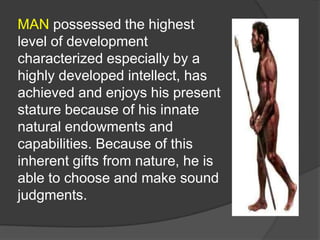
MAN possessed the highest level of development characterized especially by a highly developed intellect, has achieved and enjoys his present stature because of his innate natural endowments and capabilities. Because of this inherent gifts from nature, he is able to choose and make sound judgments.
The modern upright man is a man who participates actively in the total processes of social interaction in the society to be a better place to live in.Interpersonal Relation and Effective Participation is through:The improvement of basic knowledge
Intellectual and manual skills
Power of reason and criticism
Acquisition of desirable values, attitudes and motivationsPower of creativity and innovation
Cultural appreciation
A sense of responsibility
understanding of the modern worldMORAL ASSUMPTION OF MAN’S NATUREMan, as a social being, is born into the company of others and attains his full stature only by engaging in activities in the society.
Some philosophical thinkers believe that man is essentially a lonely creature.(Man is essentially alone and irredeemably lost. –Mijuscovic)(When we are born we cry,and that cry is the cry of loneliness. –Powys)
Others believe that man becomes himself only through social, political and religious institutions.Existentialists believe that institutions are taking humanity out of a human beings and that each person must strive to be himself and to find his own destiny through existence.
Educators maintain that the distinguishing characteristic of man is his rational faculty; and therefore, all educational purposes should lead to the development of his power to reason, to discriminate between what is right and what is wrong.
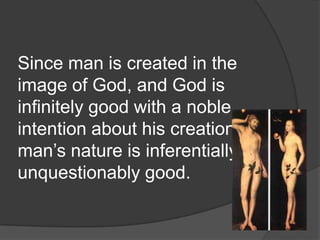
Since man is created in the image of God, and God is infinitely good with a noble intention about his creation, man’s nature is inferentially unquestionably good.
This assumption is upheld by Rousseau who asserts that, by nature, man is good.(In his early writing, Rousseau contended that man is essentially good, a "noble savage" when in the "state of nature" (the state of all the other animals, and the condition man was in before the creation of civilization and society), and that good people are made unhappy and corrupted by their experiences in society. He viewed society as "artificial" and "corrupt" and that the furthering of society results in the continuing unhappiness of man. )
   If he becomes evil, perhaps it is because he virtually succumbs to the forces of evil that influence him. Since man has the power of the will; judgment will depend on him. It is “nature of man to make and remake himself by his free acts of choice.”
 CAN MAN’S NATURE BE MODIFIED OR CHANGED?“Human nature is undoubtedly the most plastic of the living world, the most adaptable, the most educable.”–William Ernest Hocking
It is in this context that the nature of man can really be changed; to wit:Studies of children that are isolated for a long period from other fellowmen human beings showed that they do not develop a healthy and balanced personality. This is because the elements of culture.e.g., language, art, values and customs and traditions which are essential to man’s existence are not felt and shared.
2. Education from the sociological perspective is “the consciously controlled process whereby changes in the person and through the person, occur. It means a deliberate process which is specifically directed to produce change.”
3. There are other similar studies on delinquents and inmates in rehabilitation centers which provided sufficient evidence that human behavior in response to external stimuli can be corrected.
What conditions and circumstances make man become vulnerable to evil?How can he fight the forces of evil in the society?
THE PROBLEM OF EVILSome social thinkers hypothize that the problems of evil are the results of man’s greed, selfishness, arrogance, rapacious desires, excessive desire for wealth, avarice, and extreme obsession for something.
Man’s nature is essentially tainted with evil is the doctrine that the first man and woman, Adam and Eve, have sinned. (Genesis 3:1-6)Man’s nature is susceptible to succumb to evil is viewed by economist that he is essentially corrupt and selfish since his behavior and attitude are determined, to  great extent, by the desire to gain a big profit and to accumulate wealth for himself.
For biologist, evil is a part of man’s existence because “he inherits a great array of fixed instincts acquired in the struggle for existence and sheer survival; he must be expected to exhibit all the animal tendencies.
THE HIGHEST  GOODThe highest good is perceived by different people in different ways.being at oneself, with one’s fellowmen, and with God
clarity of mind
being of service to humanityIn serving humanity, the highest good, is one that gives the greatest good, benefits, and happiness to the greatest number of people, especially the good for every individual in society. What may be good to some may be bad to others.

Man modern perspective

  • 1.
    MAN: A MODERNPERSPECTIVEPrepared by: micheldelacruzMAED – Educational managementbatangas state university
  • 2.
    MAN possessed thehighest level of development characterized especially by a highly developed intellect, has achieved and enjoys his present stature because of his innate natural endowments and capabilities. Because of this inherent gifts from nature, he is able to choose and make sound judgments.
  • 3.
    The modern uprightman is a man who participates actively in the total processes of social interaction in the society to be a better place to live in.Interpersonal Relation and Effective Participation is through:The improvement of basic knowledge
  • 4.
  • 5.
    Power of reasonand criticism
  • 6.
    Acquisition of desirablevalues, attitudes and motivationsPower of creativity and innovation
  • 7.
  • 8.
    A sense ofresponsibility
  • 9.
    understanding of themodern worldMORAL ASSUMPTION OF MAN’S NATUREMan, as a social being, is born into the company of others and attains his full stature only by engaging in activities in the society.
  • 10.
    Some philosophical thinkersbelieve that man is essentially a lonely creature.(Man is essentially alone and irredeemably lost. –Mijuscovic)(When we are born we cry,and that cry is the cry of loneliness. –Powys)
  • 11.
    Others believe thatman becomes himself only through social, political and religious institutions.Existentialists believe that institutions are taking humanity out of a human beings and that each person must strive to be himself and to find his own destiny through existence.
  • 12.
    Educators maintain thatthe distinguishing characteristic of man is his rational faculty; and therefore, all educational purposes should lead to the development of his power to reason, to discriminate between what is right and what is wrong.
  • 13.
    Since man iscreated in the image of God, and God is infinitely good with a noble intention about his creation, man’s nature is inferentially unquestionably good.
  • 14.
    This assumption isupheld by Rousseau who asserts that, by nature, man is good.(In his early writing, Rousseau contended that man is essentially good, a "noble savage" when in the "state of nature" (the state of all the other animals, and the condition man was in before the creation of civilization and society), and that good people are made unhappy and corrupted by their experiences in society. He viewed society as "artificial" and "corrupt" and that the furthering of society results in the continuing unhappiness of man. )
  • 15.
    If he becomes evil, perhaps it is because he virtually succumbs to the forces of evil that influence him. Since man has the power of the will; judgment will depend on him. It is “nature of man to make and remake himself by his free acts of choice.”
  • 16.
    CAN MAN’SNATURE BE MODIFIED OR CHANGED?“Human nature is undoubtedly the most plastic of the living world, the most adaptable, the most educable.”–William Ernest Hocking
  • 17.
    It is inthis context that the nature of man can really be changed; to wit:Studies of children that are isolated for a long period from other fellowmen human beings showed that they do not develop a healthy and balanced personality. This is because the elements of culture.e.g., language, art, values and customs and traditions which are essential to man’s existence are not felt and shared.
  • 18.
    2. Education fromthe sociological perspective is “the consciously controlled process whereby changes in the person and through the person, occur. It means a deliberate process which is specifically directed to produce change.”
  • 19.
    3. There areother similar studies on delinquents and inmates in rehabilitation centers which provided sufficient evidence that human behavior in response to external stimuli can be corrected.
  • 20.
    What conditions andcircumstances make man become vulnerable to evil?How can he fight the forces of evil in the society?
  • 21.
    THE PROBLEM OFEVILSome social thinkers hypothize that the problems of evil are the results of man’s greed, selfishness, arrogance, rapacious desires, excessive desire for wealth, avarice, and extreme obsession for something.
  • 22.
    Man’s nature isessentially tainted with evil is the doctrine that the first man and woman, Adam and Eve, have sinned. (Genesis 3:1-6)Man’s nature is susceptible to succumb to evil is viewed by economist that he is essentially corrupt and selfish since his behavior and attitude are determined, to great extent, by the desire to gain a big profit and to accumulate wealth for himself.
  • 23.
    For biologist, evilis a part of man’s existence because “he inherits a great array of fixed instincts acquired in the struggle for existence and sheer survival; he must be expected to exhibit all the animal tendencies.
  • 24.
    THE HIGHEST GOODThe highest good is perceived by different people in different ways.being at oneself, with one’s fellowmen, and with God
  • 25.
  • 26.
    being of serviceto humanityIn serving humanity, the highest good, is one that gives the greatest good, benefits, and happiness to the greatest number of people, especially the good for every individual in society. What may be good to some may be bad to others.