At the endof this lesson, the
students should be able to:
examine what is meant by a
good life;
identify how humans attempt
to attain what is deemed to be
a good life; and
recognize possibilities
available to human being to
attain the good life
Lesson Objectives
3.
Introduction
In Ancient Greece,long before the word "seience" has been coined, the need to
understand the world and reality was bound with the need to understand the self
and the good life. For Plato, the task of understanding the things in the world runs
parallel with the job of truly getting into what will make the soul flourish. In an
attempt to understand reality and the external world, man must seek to
understand himself, too. It was Aristotle who gave a definitive distinction between
the theoretical and practical sciences. Among the theoretical disciplines, Aristotle
included logic, biology, physics, and metaphysics, among others. Among the
practical ones, Aristotle counted ethics and politics. Whereas "truth" is the aim of
the theoretical sciences, the "good" is the end goal of the practical ones. Every
attempt to know is connected in some way in an attempt to find the "good" oras
said in the previous lesson, the attainment of human flourishing. Rightly so,
onemust find the truth about what the good is before one can even try to locate
that which is good.
Plato and Aristotle,two towering figures in philosophy, offered divergent
perspectives on the nature of reality and the ultimate aim of human
existence. Plato posited a dual reality, distinguishing between the ephemeral
"world of matter" perceivable by our senses, and the unchanging, ideal "world
of forms." In this view, observable objects are mere imperfect copies of their
true, perfect forms, which alone constitute true reality. While acknowledging
constant change in the material world, Plato maintained that things
nonetheless retain their essential identity. Aristotle, however, rejected this
dualism, asserting that reality is singular and accessible only through sensory
experience and observation of the external world. He viewed change as an
intrinsic process of development, where entities move from a state of
"potentiality" to "actuality." Extending this concept to human beings,
Aristotle argued that every human action is purposeful, driven by a "telos" or
ultimate end. This ultimate end, he concluded, is "happiness" or "human
flourishing"—a profound contentment achieved by realizing one's full
potential and living a life that maximizes one's humanity, serving as the
overarching motivator for all human endeavors.
6.
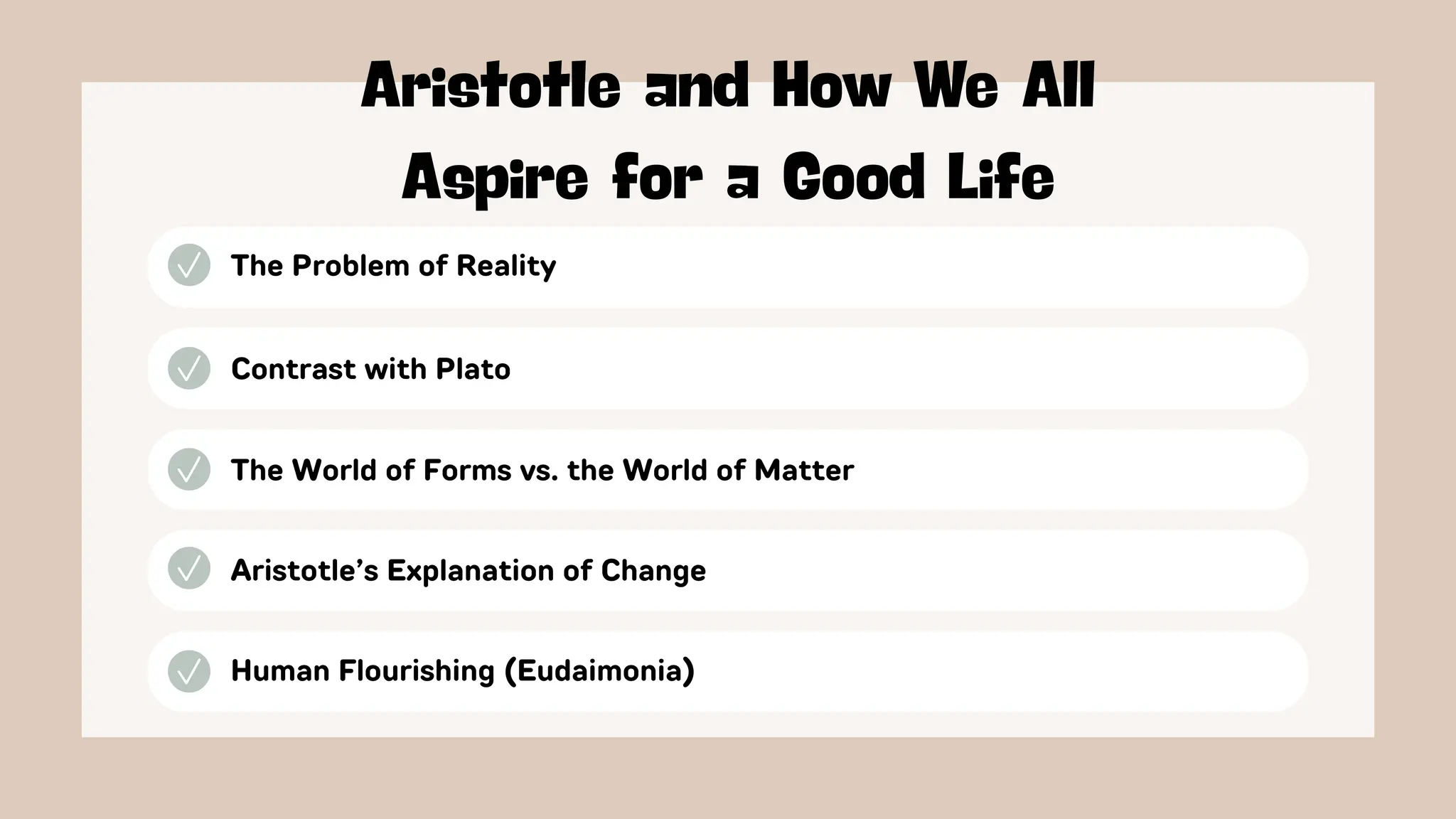
The Problem ofReality
Aristotle and How We All
Aspire for a Good Life
Contrast with Plato
The World of Forms vs. the World of Matter
Aristotle’s Explanation of Change
Human Flourishing (Eudaimonia)
7.
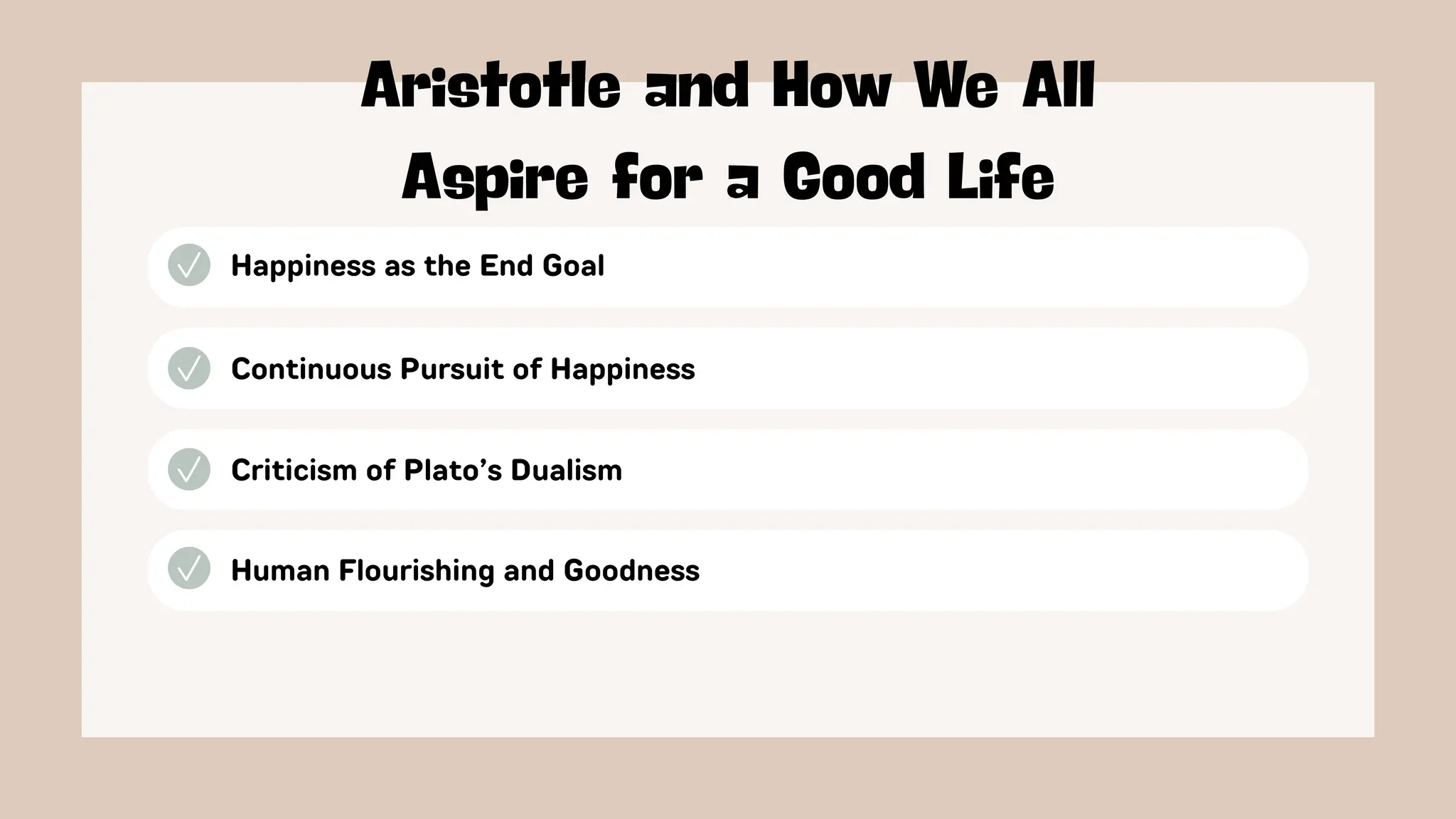
Happiness as theEnd Goal
Aristotle and How We All
Aspire for a Good Life
Continuous Pursuit of Happiness
Criticism of Plato’s Dualism
Human Flourishing and Goodness
In the eighteenthcentury, John Stuart Mill declared the Greatest Happiness
Principle by saying that an action is right as far as it maximizes the attainment
of happiness for the greatest number of people. At a time when people were
skeptical about claims on the metaphysical, people could not make sense of the
human flourishing that Aristotle talked about in the days of old. Mill said that
individual happiness of each individual should be prioritized and collectively
dictates the kind of action that should be endorsed. Consider the
pronouncements against mining. When an action benefits the greatest number
of people, said action is deemed ethical. Does mining benefit rather than hurt
the majority? Does it offer more benefits rather than disadvantages? Does
mining result in more people getting happy rather than sad? If the answers to
the said questions are in the affirmative, then the said action, mining, is deemed
ethical.
The ethical is, of course, meant to lead us to the good and happy life. Through
the ages, as has been expounded in the previous chapters, man has constantly
struggled with the external world in order to reach human flourishing. History
has given birth to different schools of thought. all of which aim for the good and
happy life.
10.
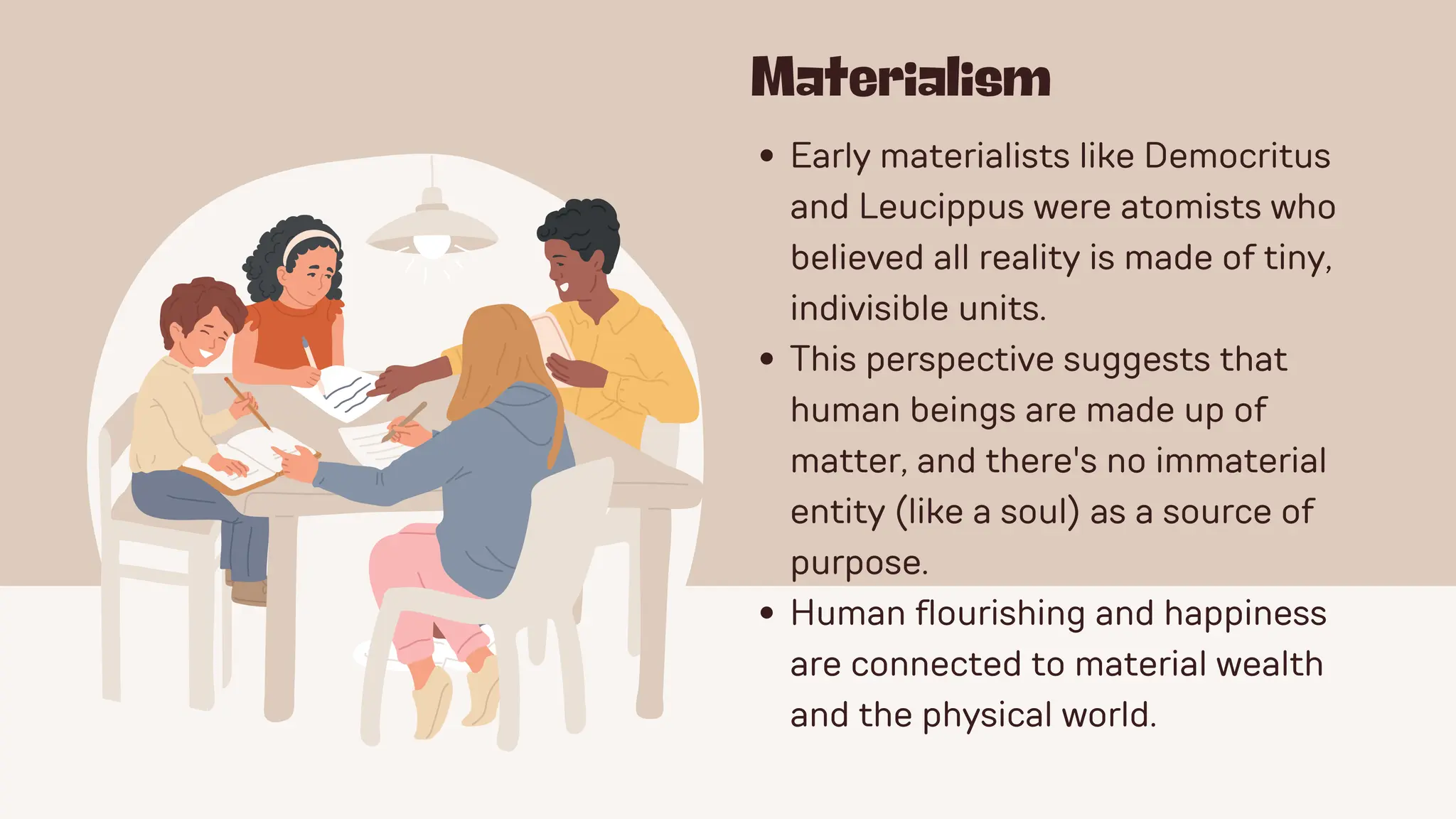
Materialism
Early materialists likeDemocritus
and Leucippus were atomists who
believed all reality is made of tiny,
indivisible units.
This perspective suggests that
human beings are made up of
matter, and there's no immaterial
entity (like a soul) as a source of
purpose.
Human flourishing and happiness
are connected to material wealth
and the physical world.
11.
Hedonism
Hedonists believe theend goal of
life is to acquire pleasure.
Life is about obtaining and
indulging in pleasure because it is
limited.
The core mantra of this school of
thought, championed by Epicurus, is
"Eat, drink, and be merry for
tomorrow we die."
Hedonism suggests that after-life
considerations are irrelevant,
focusing solely on present material
enjoyment
12.
Stoicism
Stoicism, another schoolof thought by Epicurus
(though historically distinct, this text groups
them), aims to generate happiness through self-
control and detachment.
The original term, apatheia, means being
indifferent or unaffected by external
circumstances.
Stoics believe happiness is achieved by being
careful and practicing apathy (in the sense of
not being disturbed by passions).
In this worldview, adopting things outside one's
control is rejected; understanding and accepting
what one can control leads to happiness.
13.
Theism
Theism generally refersto belief in a god
or gods.
Most people find meaning in their lives
through a belief in God, often as the
ultimate purpose of their existence.
The Philippines, as a predominantly
Catholic country, exemplifies how people
base their life goals on supernatural
reality and heaven.
The ultimate basis for happiness for
theists is "communion with God." The
world is seen as a temporary reality,
awaiting a return to God.
14.
Humanism
Humanism is aschool of thought that
advocates for human freedom to shape one's
own destiny and create one's own laws, free
from divine authority.
For humanists, humanity itself is the
ultimate authority.
Inspired by the Enlightenment, humanists
believe they are not merely stewards of
creation but individuals in control of
themselves and the world.
This perspective emphasizes that the world
is a place for humans to freely inhabit and
improve their lives.
15.
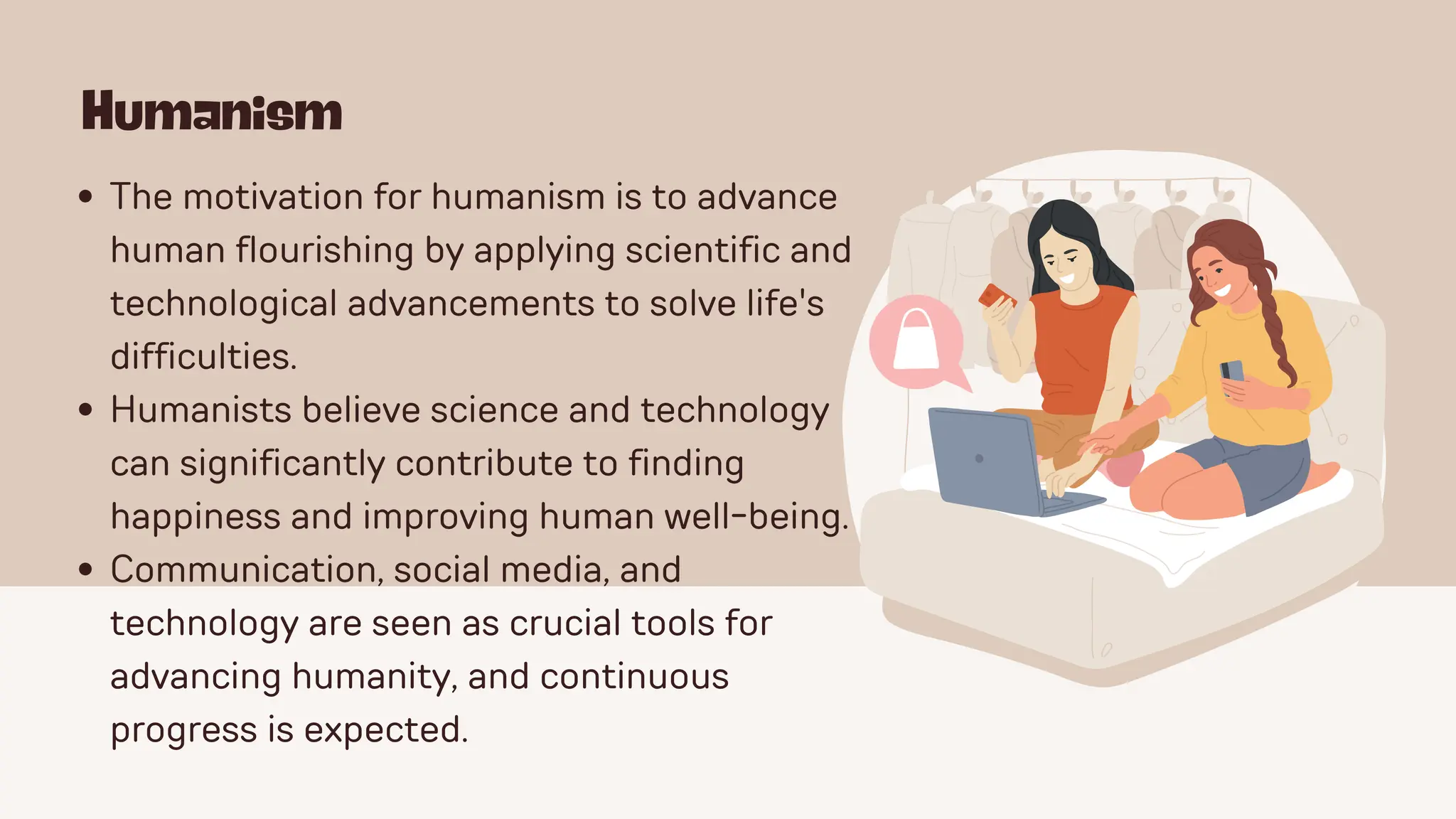
Humanism
The motivation forhumanism is to advance
human flourishing by applying scientific and
technological advancements to solve life's
difficulties.
Humanists believe science and technology
can significantly contribute to finding
happiness and improving human well-being.
Communication, social media, and
technology are seen as crucial tools for
advancing humanity, and continuous
progress is expected.