Download as PDF, PPTX
![International Journal of Network Security & Its Applications (IJNSA), Vol.5, No.4, July 2013
DOI : 10.5121/ijnsa.2013.5409 115
Malware Risk Analysis on the Campus Network
with Bayesian Belief Network
Aliyu Mohammed, Haitham A. Jamil, Sulaiman Mohd Nor, Muhammad Nadzir
Marsono
Department of Microelectronic and Computer Engineering
Universiti Teknologi Malaysia
Faculty of Electrical Engineering,
Skudai, 81310, Johor Malaysia
maliyyu@fkegraduate.utm.my, sulaiman@fke.utm.my, nadzir@fke.utm.my
haithamjamil@gmail.com
ABSTRACT
A security network management system is for providing clear guidelines on risk evaluation and assessment
for enterprise networks. The threat and risk assessment is conducted to safeguard enterprise network
services to maintain system confidentiality, integrity, and availability through effective control strategies.
In this paper, based on our previous work in analyzing integrated information security management and
malware propagation on the campus network through mathematical modelling, we proposed Bayesian
Belief Network with inference level indicator to enable the decision maker to understand and provide
appropriate mitigation decisions on the risks posed. We experimentally placed monitoring sensors on the
campus network that gives the threat alert priority levels and magnitude on the vulnerable information
assets. These methods will give a direction on the belief inferred due to malware prevalence on the
information security assets for better understanding.
KEYWORDS
Network security; malware propagation modelling; Bayesian Belief Network; risk and threats
1. INTRODUCTION
Most available malicious software (adware and spyware) affect users’ productivity, compromise
their privacy, and modify (damage) system assets. We determine relations between the infection
distribution and also the status of the infected system to estimate the general effect on the
enterprise network. The methodology presented within this paper determines and discusses the
following concepts: (i) Infections and probability types of occurrences triggered by malware. (ii)
Risk computation with uncertainty compensation of infection and recovery models based on
Bayesian Belief Network. The risk evaluation is based on the relationships among the most
critical assets, and threats that are likely to those assets and their vulnerability impacts. This
findings can then be applied for mitigation and control countermeasures for the organizations
infrastructural assets being at risk[1].
The prevalence of malware propagation on the Internet and the campus network in general has
caused the loss of data and vital information. Experts in information security agree that data
breaches are one of the inherent costs of doing business online[2]. Organizations must take
necessary steps to safeguard customer information and provide proper risk management processes
that could be carried out should a data breach occur. The recent data breach report indicates that
the Federal Trade Commission (FTC - US) brought suit against hospitality giant Wyndham
Worldwide in late June 2012 for allegedly exposing 619,000 consumer payment account numbers](https://image.slidesharecdn.com/5413nsa09-130816042606-phpapp02/75/Malware-Risk-Analysis-on-the-Campus-Network-with-Bayesian-Belief-Network-1-2048.jpg)
![International Journal of Network Security & Its Applications (IJNSA), Vol.5, No.4, July 2013
116
to a domain in Russia. This is despite the FTC claims on the defendants’ failure to maintain
reasonable security allowing intruders to obtain unauthorized access. This results in $10.6 million
fraudulent charges dating back to 2008 according to court documents. The FTC reported that
identity theft and other scams cost Americans $1.52 billion in 2011. This is despite all efforts to
combat such theft, it is still on the rise[2].
Bayesian Belief Network provides the understanding to enable the containment of malware
propagation based on the risk posed by the malware threat. The BBN has both the quantitative
and qualitative abilities to effectively measure the prevalence of the malware risk factor on the
vulnerable assets. The BBN inference support system is a tool that correlates and give causal
relationships that exist between risk factors and risk key indicators with their associated
operational attributes [3].
The paramount question that is always being asked is how do we effectively understand the
magnitude of malware propagation and prevalence on the network assets? How do we present an
understandable risk assessment to the decision maker for easy decision? To answer these
questions we have to look at the inner operations of BBN and the enterprise risk assessment and
evaluation with a view to understand the effects of malware prevalence on network assets.
Risk assessment handles the evaluation of the current risk factor status that is based on the
probability and also the consequence of occurrence. It suggests that when the Bayesian Network
model is built, it allows the organization to have the understanding of various choices in the
network structure. This network probability updating will not only continuously cuts down on the
data uncertainty, it offers the enterprise the risk scenario with real-time and up-to-date
analysis[4].The composite risk probability concept for the generation of attack data, as well as
connected risk assessment approach utilizing a homogeneity method for fast evaluation of large
systems needs to be considered[5]. A technique for lifecycle information security risk assessment
which provides helpful guidance just before beginning a risk assessment process is desirable. At
the moment, within our knowledge, research regarding how to utilize Bayesian Belief Network
(BBN) inference using both available data and evidence based information on malware
prevalence on the network infrastructure is very limited. However, there is an increasing curiosity
about how we can apply Bayesian Network (BNs) using both data plus some evidence
information to understand the magnitude of malware propagation prevalence and damages to
network infrastructure[6].A good example of decision analysis of statistical distribution denial-of-
service (DoS) flooding attacks was presented by Li et.al[7].
The remainder of this paper is structured as follows. Section II describes briefly the mathematical
modelling and tools for the malware propagation capture and analysis. The section also describes
the basic principles of Bayesian Belief Network (BBN). This includes the probabilistic
conditional inferences and decision analysis on risk due to threats and vulnerability issues.
Section III discusses the implementation of Bayesian Belief Network and its application towards
the prevalence of malware on the network. This is to assess risk as a factor of threat, vulnerability
and cost impact on the enterprise assets; based on the malware propagation prevalence on the
campus network. Finally, some concluding remarks for future works is made in section IV.](https://image.slidesharecdn.com/5413nsa09-130816042606-phpapp02/75/Malware-Risk-Analysis-on-the-Campus-Network-with-Bayesian-Belief-Network-2-2048.jpg)
![International Journal of Network Security & Its Applications (IJNSA), Vol.5, No.4, July 2013
117
2.MODELLING OF MALWARE PROPAGATION AND
STATISTICAL CAPTURE TOOLS
2.1 Identifying Threats to Information Assets
The question to ask when conducting a risk analysis on how to prevent information theft is,
“What can happen to our information?” The answers are long but broadly classified to include the
following: (i) Virus infecting server that stores the data and tries to corrupt the files (ii) Trojan
horse copying sensitive and personally identifying information to be transmitted to an attacker’s
FTP site. (iii) Staff leaving a backdoor in an application to steal or destroy information, (iv)
Employee can lose a laptop with vital information; (v) Denial of Service (DoS) attacks can affect
key database and applications. Enterprises must protect the privacy of information regardless of
where or how it is stored. Figure 1 shows a typical scenario for a campus network on how
sensors are placed with other articulated control measures and mitigation strategies. We are
interested to know in this typical scenario, how malware propagates through a campus network.
With appropriate mathematical SIR (susceptible, infectious and recovered) epidemiological
model parameter analysis will allow for observing the propagation trend as explained in the next
section.
Figure1. Tools for statistical data collection on the campus network
2.2 Modelling of Malware Propagation on the campus network
The simplest SIR model that was described by Kermack and Mckendrick in 1927[8] is regarded
as the most famous mathematical model for the spread of infectious disease. The population is
grouped into three: susceptible (S), infected (I), and recovered (R). A susceptible host (S) is a host
in which the operating system, applications and anti-virus are not updated and thus is vulnerable
to attacks. With the right code triggered, a susceptible host can be changed to be in the infected
state easily. This happens when the user (host) visits a malicious web site, when a malware is
transferred to the rest via a thumb drive or re-infected via the network (including mail
attachment). An infected host (I) will remain in this state until the host is cleaned. The
prerequisite for the host to be cleaned is that the signature must be available and the host scanned
and cleaned of the malware. This will move the host from the infected state to the recovered state.
The recovery state (R) takes place when the host has now recovered and is cleaned from the
particular malware type. The recovery is through the use of end-user antivirus, updates and patch
management. At this stage it is assumed that the host is immune from this malware. However, the
host is still considered susceptible from other malware especially zero-day malware. The SIR
model is easily written using ordinary differential equation which implies a deterministic model](https://image.slidesharecdn.com/5413nsa09-130816042606-phpapp02/75/Malware-Risk-Analysis-on-the-Campus-Network-with-Bayesian-Belief-Network-3-2048.jpg)
![International Journal of Network Security & Its Applications (IJNSA), Vol.5, No.4, July 2013
118
with continuous time. The SIR model for spread of disease was considered and based on the
background of the virulent new strains. The population is assumed fixed during the epidemic in
the SIR model. Based on this, the modelling is to first identify the independent and dependent
variables, where the independent variable is time t to be measured in days or weeks. Further
modelling works that consider the two-factor model is discussed in[9-11] while the handling of
removal rate with effects of quarantine is discussed in [12,13].
The parameters used for the SIR modelling are described as: Sn (t) is the number of susceptible
hosts at time t, In (t) is the number of infected hosts at time t, Rn (t) is the number of recovered
hosts at time t, β is the average number of adequate contacts (i.e. Contacts sufficient for infection)
of host per unit time. Thus, β is also known as the infection rate, r is the recovery rate, t is the unit
time and N is the total number of host on the network with n as the infinitesimal increase in the
total population of hosts[14,15]. Thus, the SIR model ordinary differential equations are:
1N
S
dt
dS nn
−= (1)
When rationalized with n changes to (i) susceptible, thus
dt
N
S
dS
i
i
−= , and the susceptible increases from i to i+1
iii dSSS −=+1
Also the infectious hosts are differentiated with respect to Sn/N1
( ) 1
1
11
N
SN
r
N
S
d
dIn nn
N
S n
−
−= (2)
Rationalizing from n==i, and i+1==n
i
i
i
ii
i
i
N
S
d
N
SN
r
N
S
dI
−
−−= 22
Where dIII ii +=+1
1
1
N
SN
rIn
dt
dRn n−
−= (3)
dt
N
SN
rIdR
i
ii
i
−
−=
where iii dRRR +=+1
2.3 The Bayesian Belief Network Principles
The essence of the Bayesian approach is to provide a mathematical rule explaining how it should
change existing beliefs in the light of new evidence. In other words, it allows scientists to
combine new data with their existing knowledge or expertise.
Mathematically, the Bayes' rule states](https://image.slidesharecdn.com/5413nsa09-130816042606-phpapp02/75/Malware-Risk-Analysis-on-the-Campus-Network-with-Bayesian-Belief-Network-4-2048.jpg)
![International Journal of Network Security & Its Applications (IJNSA), Vol.5, No.4, July 2013
119
.arg
*
likelihoodinalm
priorLikelihood
Posterior
⋅
= ; ( ) ( ) ( )
( )eP
rRPrReP
erRP
==
==
|
| (4)
Where ( )erRP |= denotes the probability that random variable R with value r given the
evidence e. The factor in the denominator is just a normalizing constant that ensures that the
posterior adds up to 1. These can be computed by summing up the numerator over all possible
values of R; meaning that:
( ) ( ) ( ) ( ) ( )rRPrRerPsumeRPeRPeP ==⋅=+=+== |..,1,0 (5)
This procedure in equation (5) is termed as the marginal likelihood (as we have marginalized out
over R) and provides the prior probability of the evidence. Thus, the concept of the child, parent,
consequence and the conditionality’s are as depicted through the deduction and abduction process
as in [16] and discussed further in [16,17].
Bayesian Belief Network inference System is a theory that complements reasoning under
uncertainty by delivering a coherent framework to create a decision in compliance while using
preferences from the decision manager [18]. Decision theories provided an axiomatic reason for
preferences and represented graphically by decision trees and influence diagrams. The influence
diagram includes probabilistic dependencies between variables, such as the Bayesian Belief
Network. However, influence diagrams contain decision nodes that provide choices and value
nodes that provide utility measures.
A Bayesian network consists of a graphical structure that encodes domain variables, were the
qualitative and quantitative relationships between them provides for the encoding probabilities
over the given variable[19]. According to Heckerman [20],a Bayesian network can be considered
as a set of variables X that relates to network structure S that tries to encode a set of conditional
independence factors about the variables in X, and a set of P being a local probability
distributions associated with each set of the variable. Conditional independencies in S encodes
that there are no arcs that relate them. In a given structure S, the joint probability distribution for
X can be depicted by the equation:-
( ) ( )∏−
=
n
i
ii paxpxp
1
| (6)
These local probability distributions P corresponds to the terms of the products indicated in
equation 6 above. This show the pair of (S, P) are the joint distribution of p(x).
These Bayesian Network can be defined as follows: -
( )PSBN ,= ( ) }{ ijiij paXXXXXS ∈∈= ,|, ; ( ){ }XXpaXpP iii ∈= || (7)
The quantitative aspect of Bayesian Belief networks enables for accommodating subjective
judgments (expert opinions) as well as probabilities that are based on objective data[21]. In
general, we use the Bayesian network typically to compute all probabilities of interest since a
Bayesian network for X determines a joint probability distribution for X. For example, P (f | a, b,
c, d, e), is the probability of f following the observations of the other variables (a, b, c, d, e), and
can be computed as follows:
( ) ( )
( )edcbaP
fedcbaP
edcbafP
,,,,
,,,,,
,,,,| = ( )
( )∑
=
'
,,,,,
,,,,,
'
f
edcbafP
fedcbaP (8)](https://image.slidesharecdn.com/5413nsa09-130816042606-phpapp02/75/Malware-Risk-Analysis-on-the-Campus-Network-with-Bayesian-Belief-Network-5-2048.jpg)
![International Journal of Network Security & Its Applications (IJNSA), Vol.5, No.4, July 2013
120
2.3.1 Modelling Process in Bayesian Network
Figure2. Modelling parameter with Bayesian Network.
Figure2 shows concise principles of Bayesian network. It indicates the relations that exist
between two variables X1 and X2. The two variables are in binary structure whose values ranges
from 0 (false) or 1 (true). The causality response that exists between each node is represented
through a conditional probability table (CPT). The table brings out the relationship between the
parent node X1 and the child node X2 with an arrow that shows their relationship.
Given the value of the variable X1=1 on the parent node, the conditional probability effect of the
child node P(X2/X1) is determined through the CPT. Based on the marginalization process
outlined by authors in[22], the probability of P(X2=1) can be derived and computed from the
equation 9 as:
∑ ∑
∑
= =
=
=
== 1
0
1
0
112
1
0
112
2
1 2
1
)(*)/(
)(*)/1(
)1(
X X
X
XPXXP
XPXXP
XP (9)
In this case the causal relations between risk events can be defined with Bayesian network with
only two or more nodes. This includes the two nodes of Figure 2 as minimum units. The
conditional probability of the target node will be improved based on additional observation on the
information from the parent or the child nodes. Further details on Bayesian network modelling
can be found in [22][3].
2.4 Effects of Connectivity and control countermeasures
The malware propagation ability can be understood through the factor of connectivity and control
as it relates to cause effect consequences. The connectivity is the measure of rate of propagation
of the malware on the network that results in determining the risk due to the threats posed on the
network. In order to understand and appreciate the cause effect due to connectivity and control
measures, we employ the Bayesian Network modelling tool GeNIe. This is indicated with the
cause (trigger), the risk event (effect) and the consequence (resulting factor). The magnitude is
checked through the control measure as in Figure 3.](https://image.slidesharecdn.com/5413nsa09-130816042606-phpapp02/75/Malware-Risk-Analysis-on-the-Campus-Network-with-Bayesian-Belief-Network-6-2048.jpg)
![International Journal of Network Security & Its Applications (IJNSA), Vol.5, No.4, July 2013
121
Figure 3. E-mail connectivity through cause effect factor
The issue of control is a measure of effectiveness of the available countermeasure that can be
applied to reduce the impact before it happens. While mitigation process takes place after the
consequence in order to proffer for possible remedy. The cause, effect, and consequence depicted
in the Figure 3 through the use of the rate of propagation parameter considered in the modeling
section. The mitigation helps to finding remedy for the aftermath effect.
3.Implementation using Bayesian Belief Network System to Model
Malware Risk
The Bayesian Belief Network is effective and has adequate technique for modelling, measuring
and to a certain extent managing the characteristics of malware propagation risk on the network
environment. This is with a view to protect the campus information assets. This is achieved
through the use of prior knowledge of the causal risk factors and the possible probabilistic
reasoning concept of the systems. In a nut shell, the Bayesian Belief analysis is to allow for
improving the prior determined factors values in the effect of any additional information obtained
about the variables in the network. This is for building the conditional probability table (CPT),
when such similar information’s are not available; the tables could be built based on opinion
results. The assets risk models might be readily developed utilizing a graphical Bayes internet
editor like the GeNIe application program [23].
Let’s look at a situation when a Trojan malware propagates through a network of nodes. A model
developed with the basic SIR model based on the typical epidemic modelling is considered and
applied. The epidemic models generally explain the rapid outbreak that occurs in the network
environment for a period of less than one year. While it becomes endemic if the scenario persist
and extend to a longer period. The present situation is that we based our study on situation that
the propagation malware attack in the analysis is a single class type. The experimental modelling
simulation of worm propagation based on the SIR model is discussed in the next section.
3.1 Worm Propagation based on SIR Model Simulation
The three worm propagation parameters S, I, and R derived from equations (1), (2) and (3) were
coded with MATLAB simulation. The parameters were based the experimental data obtained](https://image.slidesharecdn.com/5413nsa09-130816042606-phpapp02/75/Malware-Risk-Analysis-on-the-Campus-Network-with-Bayesian-Belief-Network-7-2048.jpg)
![International Journal of Network Security & Its Applications (IJNSA), Vol.5, No.4, July 2013
122
from Snort sensors placed on the campus network. The Experiment was for a period of seven
days. The propagation rate parameter β and r are infection rate and removal rate respectively were
determined through the generated data from the sensor and simulated. The same parameters were
simulated using the Netlogo system software to provide for similarity understanding as shown in
Figures 4 (a) and (b). The initial condition for the parameters is as follows: - 1=∆t
; 7:1=t ; 50=iS ; 0=iI ; 0=iR ; 100=N ; 2.0;50 == r . While the initial values are
based on the campus network segment with N number of hosts, time t is for seven days. The
infection rate and removal rate are conceptualized for the purpose of simulation based on the
population considered during the experiment. Further details on the campus network worm
propagation modelling can be found in [24].
(a)
(b)
Figure4. (a) Mathematical and (b) Simulation Model Parameters
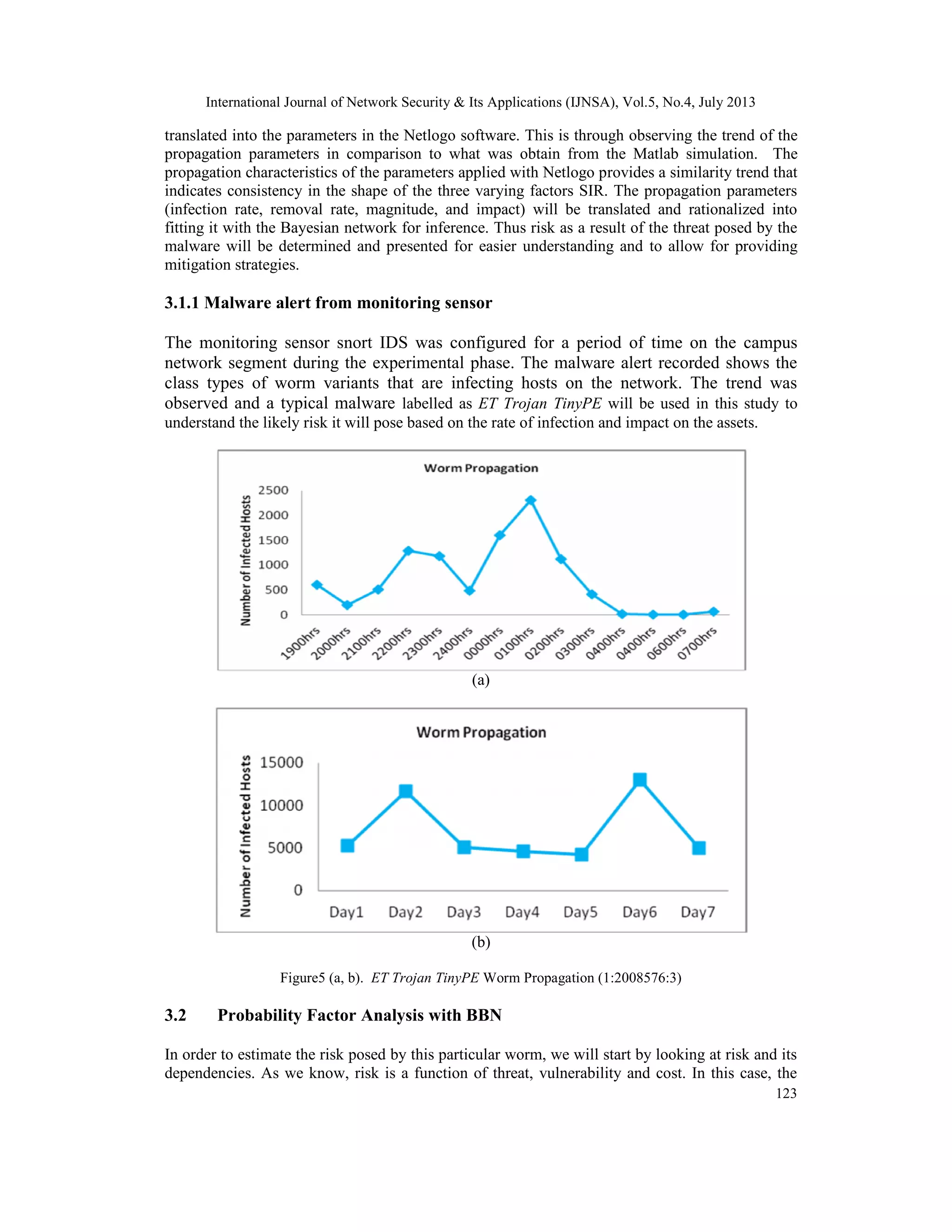
The Figures 4(a, b) above shows the typical worm spread observed for a period of some days on
the campus network environment. The Snort sensor was used on the various campus network
segments, which includes the colleges, academic areas, and the administrative environment. The
results are analyzed to see the effect as it applies to the topological trend of the network. The
characteristics for the worms are based on the propagation effect for a period of seven days in
Figure 4(a), and that of (b) is for a time tick scenario. The parameters of the model was used and](https://image.slidesharecdn.com/5413nsa09-130816042606-phpapp02/75/Malware-Risk-Analysis-on-the-Campus-Network-with-Bayesian-Belief-Network-8-2048.jpg)

![International Journal of Network Security & Its Applications (IJNSA), Vol.5, No.4, July 2013
125
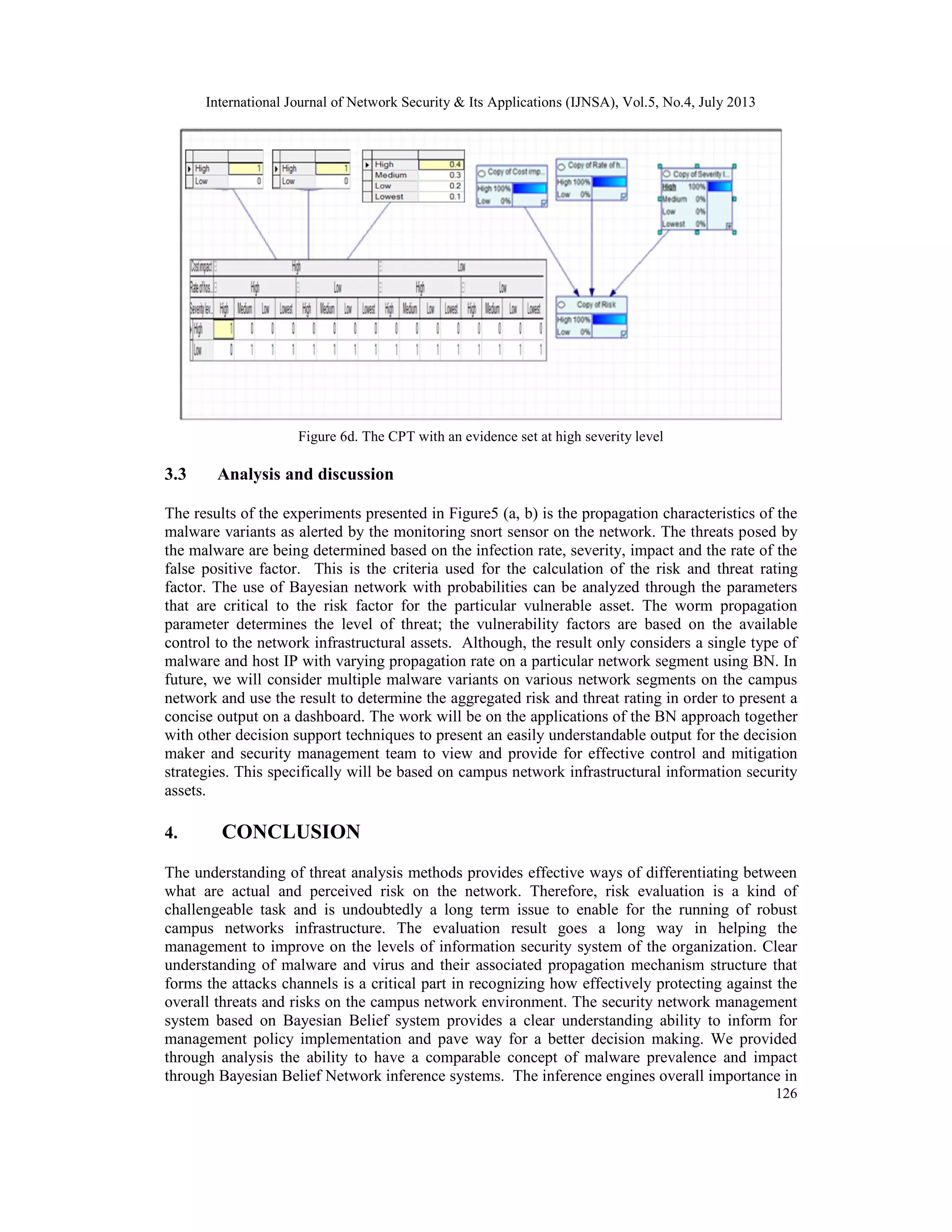
where we expect the risk generated to be the highest to all low where the risk will be the lowest
and in between.
The following is the BBN model with the CPT and the resulting risks.
Figure 6a. BBN Malware Propagation Risk Analysis (highest risk)[23].
Figure 6b. BBN Malware Propagation Risk Analysis (lowest risk)
Figure 6c. BBN Malware Propagation Risk Analysis (lowest risk)](https://image.slidesharecdn.com/5413nsa09-130816042606-phpapp02/75/Malware-Risk-Analysis-on-the-Campus-Network-with-Bayesian-Belief-Network-11-2048.jpg)
![International Journal of Network Security & Its Applications (IJNSA), Vol.5, No.4, July 2013
127
measuring and understanding of threats and information security risk management as a view point
of enterprise and academic computing environment. These consequences provide the enabling
ground for effective control and mitigation strategies to be in place. With this concept, it can
provide for understanding whether organizational security investments paid off or not through a
measure based on belief network inference decision[25]. As an on-going research activity, it is
expected that we will extend the inference analysis and decision support system with the campus
network assets assessment results through a comprehensive network security framework. The
framework will aim at providing an enabling ground for effective control and safeguards of the
infrastructural assets on the network.
REFERENCES
[1] O. Oriola, A. B. Adeyemo, and O. Osunade, "Network Threat Characterization in Multiple
Intrusion Perspectives using Data Mining Technique," International Journal of Network Security &
Its Applications (IJNSA), vol. Vol.4, No.6, 2012.
[2] K. Liyakasa, "Cracking the Code on cyber crimes," www.detinationCRM.com 2012.
[3] N. Fenton and M. Neil, "The use of Bayes and causal modelling in decision making, uncertainty
and risk " 2011.
[4] P. Weber, G.Medina-Oliva, C.Simon, and B.Iung, "Overview on Bayesian networks applications
for dependability,risk analysis and maintenance areas," Elsevier -Engineering Applications of
Artificial Intelligence, 2012.
[5] S. Kondakci, "A Composite Network Security Assessment," The Fourth International Conference
on Information Assurance and Security,IEEE, 2008.
[6] R. Bernard, "Information Lifecycle Security Risk Assessment: A tool for closing security gaps,"
Science Direct- Computers and Security, 2007.
[7] M. Li. and C. Chi., "Decision analysis of statistically detecting distributed denial-of-service
flooding attacks," International Journal of Information Technology & Decision Making, vol. Vol. 2,
No. 3, 2003.
[8] W. O. Kermack and A.G.Mckendrick, "Contributions of Mathematical Theory to epidemics,,"
proceeding of the Royal Society of London, vol. vol.141, pp. 94 - 122, 1933.
[9] C. Shin-Ming, A. Weng-Chon, C. Pin-Yu, and C. Kwang-Cheng, "On Modeling Malware
Propagation in Generalized Social Networks," Communications Letters, IEEE, vol. 15, pp. 25-27,
2011.
[10] J. Wang, C. Xia, and Q. Liu, "A novel Model for the Internet Worm Propagation," IEEE, 2010.
[11] S. Fei, L. Zhaowen, and M. Yan, "Modeling and Analysis of Internet worm propagation," Scince
Direct, vol. 17(4), pp. 63-68, 2010.
[12] Y. Yao, H. Guo, G. Yu, and F.-x. Gao, "Discrete-Time Simulation Method for Worm Propagation
Model with Pulse Quarantine Strategy," Procedia Engineering, vol. 15, pp. 4162-4167, // 2011.
[13] C. C. Zou, W. Gong, and C. Towsley, "Worm Propagation Modelling and Analysis under Dynamic
Quarantine Defense," ACM, 2003.
[14] M. G. Roberts and J.A.P.Heesterbeek, "Mathematical Models in Epidemology," In mathematical
models, in Encyclopedia of ilfe Support System ( EOLSS), 2003.](https://image.slidesharecdn.com/5413nsa09-130816042606-phpapp02/75/Malware-Risk-Analysis-on-the-Campus-Network-with-Bayesian-Belief-Network-13-2048.jpg)
![International Journal of Network Security & Its Applications (IJNSA), Vol.5, No.4, July 2013
128
[15] Y. Wang, J. Li, K. Meng, C. Lin, and X. Cheng, "Modeling and security analysis of enterprise
network using attack–defense stochastic game Petri nets," Security and Communication Networks,
Published online in Wiley Library, 2012.
[16] A. Josang, "Conditional Reasoning with Subjective Logic," Journal of Multiple-Valued Logic and
Soft Computing vol. 15(1), pp. pp. 5-38, 2008
[17] R. C. Stalnaker, "A theory of Conditionals," 1970.
[18] G. Yap, A. Tan, and H. Pang, "Explaining Inferences in Bayesian Networks," 2007.
[19] J. Pearl, " Probabilistic reasoning in intelligent systems " Morgan Kaufmann, San Mateo, CA, ,
1988.
[20] D. Heckerman, "Bayesian Networks for Data Mining," Data Mining and Knowledge Discovery,
1997.
[21] A. Janjic, Z. Stajic, and I. Radovic, "A Practical Inference Engine for Risk Assessment of Power
Systems based on Hybrid Fuzzy Influence Diagrams," Latest Advances in Information Science,
Circuits and Systems, 2011.
[22] S. Russell and P. Norvig, Eds., Artificial intelligence: A modern approach. Prentice Hall, 1995.
[23] Decision Systems Laboratory, University of Pittsburgh, and N. B. f. Avenue, "GeNIe," 2007.
[24] A. Mohammed, S. M. Nor, and M. N. Marsono, "Network Worm Propagation Model Based on a
Campus Network Topology," in Internet of Things (iThings/CPSCom), 2011 International
Conference on and 4th International Conference on Cyber, Physical and Social Computing, 2011,
pp. 653-659.
[25] T. K. Tsiakis and G. D. Pekos, "Analysing and determining Return on Investment for Information
Security," International Conference on Applied Economics – ICOAE, 2008.](https://image.slidesharecdn.com/5413nsa09-130816042606-phpapp02/75/Malware-Risk-Analysis-on-the-Campus-Network-with-Bayesian-Belief-Network-14-2048.jpg)

This document discusses using a Bayesian Belief Network (BBN) to analyze malware risk on a university campus network. It begins by introducing the campus network monitoring tools and SIR epidemiological model used to model malware propagation. It then provides background on BBN principles, including defining nodes, conditional probabilities, and using the network to compute joint probabilities. The document proposes applying a BBN to assess malware prevalence risk by relating threat, vulnerability, and cost impact on network assets. It aims to provide understandable risk assessments to inform decision making.


![Vibe Coding vs. Spec-Driven Development [Free Meetup]](https://cdn.slidesharecdn.com/ss_thumbnails/vibecodingvsspecdrivendevelopment-251209105622-43f455e7-thumbnail.jpg?width=640&height=640&fit=bounds)


