International Research Journal of Engineering and Technology (IRJET) e-ISSN: 2395-0056
Volume: 09 Issue: 07 | July 2022 www.irjet.net p-ISSN: 2395-0072
© 2022, IRJET | Impact Factor value: 7.529 | ISO 9001:2008 Certified Journal | Page 29
MALWARE DETECTION AND SUPPRESSION USING BLOCKCHAIN
TECHNOLOGY
Sweeten Bandodkar1, Ganesh Manerkar2
1Student, Dept. of Information Technology and Engineering, Goa College of Engineering, Farmagudi, Goa, India
2 Assistant Professor, Dept. of Information Technology and Engineering, Goa College of Engineering, Farmagudi,
Goa, India
---------------------------------------------------------------------***---------------------------------------------------------------------
Abstract –MaliciousSoftware, also, knownasMalware, can
pose serious cybersecurity threats. This can have significant
consequences not only for individuals and organisations but,
also, for the nation at large. The meteoric surge in malware
types and its magnitude dampens the efficacy of traditional
techniques, that usefeatureextractionandcomparison, for the
detection of cyber threats, thus rendering the identification of
malware extremely difficult. Malwaredetectionchallengesare
intensified by the sizeable increase in the intricacies, in the
type and structure, in recent years, including instructions,
settings, source code, binary files, and others. The increased
intricacies encourage misjudgement. This study adopts
Convolutional Neural Networks (CNN) and Blockchain to
enhance the security of cyber networks by increasing the
efficiency and accuracy of malware detection under largeand
numerous types of malware. The experimentoffersthatCNNis
extremely effective with sourcecodeandbinarycode detection
and, it can recognize malware that is embedded into benign
code, making malware impossible to hide. This research
suggests a viable solution for network administrators to
identify malware at the very start in the complex network
environment, so as to enable information technology
personnel to engage in timely protective actions and prepare
for potential additional cyberattacks.
Key Words: Malware, Blockchain,CNN,Binarycode, Benign,
Malign
1.INTRODUCTION
In the world where ‘information’ is one of the most prized
assets, a significant threat is posed to it by the ever-evolving
and sophisticated malwares (Sewak, Sahay, & Rathore,
2018). The malware is an industry with ulterior profit
motives, although it was initially created for fun (Statista,
2022). The identified malware, as per AV-Test, greatly
increased from 182.90 million in the year 2013 to 1332.56
million in 2022 (AV-TEST). The malware file type and
structure also grew in complexity with the increase in
volume as well as variety of malware. The malicious source
files contain source code files, binary files, shell script files,
perl script files, make files and read me files, along with
several hierarchical directories. There are many types of
malwares such as Adware, Rootkit, Virus, Ransomware,
Backdoor, Worm and Trojan (Gandotra, Bansal, & Sofat,
2014). Hybrid malwares are embedded in cyber-attacks to
compromise the security of the information system. A wide
variety of techniquesareproposedfordetectionofmalwares
(Sewak, Sahay, & Rathore, 2018).
A wide variety of techniques were employed by the
researchers and industries for detection of malwares. This
includes heuristic-based methods and signature-based
methods (Nawroozi & SaravanaGuru, 2020). The signature-
based method, considered the simplest method ofdetection,
considers and compares the traffic network or malware for
possible attacks with known signature. Antivirus softwares
have been used for many years for identification of a
particular type of virus.
The authors of malware try to dodge the antivirus with the
use of metamorphic and polymorphic malware to bypass
virus signatures (Nawroozi & SaravanaGuru, 2020).
However, this method is not free of drawbacks. Its
inefficiency in detection of unknown malwares and security
threats compel the antivirus vendors to rely on heuristic
methods, which is based on rules determinedbytheexperts.
It relies on static and dynamic methods of analysis. The
heuristic method for examining the malware before writing
the signature is required to analyse whether it is based on
the behaviour or by testing the code in a safe environment.
The methods employed in the analysis of the malware is
based on two methods, namely, Static analysis and Dynamic
analysis. Static analysis refers to analysing the malware
without its execution, whereas Dynamic analysis analyses
the behaviour of a malware program while running or
operating on a controlledenvironmentlikea virtual machine
or a sandbox. During Static analysis, the pattern will be
detected, like opcodes or byte-sequence, string signature,
byte-sequence n-gram or opcodes n-grams, etc. Under
Dynamic analysis, the behaviour of malware will be
observed by utilising tools such as Wireshark, Process
Explorer, and Capture BAT, etc. to monitor the function, the
network and the flow of data. Although this analysis is more
effective, it is both time and resource consuming as
compared to the static analysis.
Although these methods are able to detect unknown
malwares, it produces more amount of false positive than
signature-based method (Nawroozi & SaravanaGuru,2020).
Various vendors of antivirus, therefore, usea hybridmethod
of analysis which includes both the methods (i.e. heuristic
International Research Journal of Engineering and Technology (IRJET) e-ISSN: 2395-0056
Volume: 09 Issue: 07 | July 2022 www.irjet.net p-ISSN: 2395-0072
© 2022, IRJET | Impact Factor value: 7.529 | ISO 9001:2008 Certified Journal | Page 30
and signature-based) for improved recognition of unknown
malware. Machine learning and Deep learning are the
concepts lately being used and implemented for the
detection of malware. Therefore, due to the wider
applicability of these techniques in this field, much of the
success can be attributed to Deep learning methods such as
Convolutional Neural Networks (CNN) (Apruzzese,
Colajanni, Ferretti, Guido , & Marchetti, 2018).
CNNs consist of layers that are referred to as convolutional
layers, pooling and non-linear layers. The first layerwhichis
an input layer moves the input samples to CNN's first block,
thus passing the data through the network to the lastlayeris
the key. For the systems to use Artificial Intelligent systems
correctly and securely, each block must be flawlessly
authenticated. The CNN model will miss the accountability
for each block and, hence, blockchain can be beneficial (Gu,
et al., 2018). Blockchain technologyoffersincreasedsecurity
which can be leveraged in securing the local networks(Raje,
Vaderia, Wilson, & Panigrahi, 2017).
Blockchain can support the safe implementation of AI
systems in the public domain with its unique functions like
data privacy, transparency, safety, and authentication. The
security element ensures that the network architecture is
not manipulated or tampered with. Also, it works on an
Artificial Intelligent system. The decision property which is
made by a specific block of an AI model would require
validation of other blocks connected to the block in concern.
This is known as authentication (Ye, Li, Adjeroh, & Iyengar,
2017). Blockchainhelpstoachievehigherdetectionaccuracy
is received in a limited time (Investopedia, 2022).
It is possible to evade the attack in the application method
for discovery and classification with the proper deployment
of blockchain technology. It is no more possible to
manipulate any layer in CNN due to thealarmbeingraised.It
will be supported by feature extraction and matching using
cryptography and transitive hash. Any modification in any
layer will raise alarms. If any operation executedata specific
block is malicious, the system can be restored at the
previous checkpoint. Moreover, the decentralization
attribute promises that not all controls are situated with a
single entity.
The afore-mentioned characteristics are a pre-requisite to
offer a secure model of the Deep Neural Network (DNN) and
making blockchain a suitable candidate for the job of
detection of malware. In the study, an effort is made to
suggest an architecture that derive the benefits of CNN with
blockchain technology characteristics. The architecture can
detect malware attack that is carried out at the level of the
parameter or at the level of feature extraction. The addition
of blockchain in CNN can effectively eliminate network level
attack on CNN. The tampering vulnerability does not exist if
CNN models are used with blockchain.
1.1 Literature Review
Classification of malware can be referred to the
classification of files into malware and benign files (Hassen,
Carvalho, & Chan, 2017). Based on the execution of malware,
the malware detection method is separated into static and
dynamic analysis (Cosma & Joy, 2012). Moreover, a Hybrid
approach, that use the varied features from both the static
and dynamic analysis are combined, also, exists (Ahmadi,
Ulyanov, Semenov, Trofimov, & Giacinto, 2016). The static
analysis method directly evaluates the extracted feature of
binary codeor source code(Tahan, Rokach, & Shahar,2012).
Techniques based on Deep Learning are gaining
popularity forthe featureextraction. Numerousstudieshave
focused and successfully implemented Deep Learning
Techniques viz. Deep NeuralNetworks(Saxe&Berlin,2015),
Deep Belief Networks (David& Netanyahu, 2015),Recurrent
Neural Networks (Pascanu, Stokes, Sanossian, Marinescu, &
Thomas, 2015) and combination of Recurrent and
Convolution Neural Networks for supervised learning and
classification (Kolosnjaji, Zarras, Webster, & Eckert, Deep
learning for classification of malware system call sequences,
2016). Likewise, Deep Belief Networks (DBN), Stacked Auto
Encoders or Auto Encoders and RNN based Auto-Encoders
(RNN-AE) have been used for optimal feature extraction
(Wang & Yiu, 2016).
The application of neural network has been in use since
1960 in various regions of Machine Learning, namely
computer vision, handwriting recognition and classification
of images. In the year 2012, AlexNet was proposed by
Krizhevsky, which championed the ImageNet competition
(Singh, 2017). It is credited with the fame gained by CNN as
the focus of MachineLearning in academicfieldandattracted
the interest of researchers (Nataraj, Karthikeyan, Jacob, &
Manjunath, 2011). It was a breakthrough in image and voice
process field. The CNN has much better accuracy than
humans, especially in the field of image classification
(Schmidhuber, 2015).
CNN hasa distinctcalculusprocessinconvolutionallayer,
poollayer and fullconnectedlayer (Krizhevsky, Sutskever,&
Hinton, 2012) (White, Tufano, Vendome, & Poshyvanyk,
2016) (Huang, Al-Dujaili, Hemberg, & O’Reilly, 2018). Using
the various stack method, convolutional neural network can
be used for the construction of different structures that can
be applied in different fields of research (Chen, Wang, Wen,
Lai , & Sun, 2019).
(Su, Vasconcellos, Prasad, & Sgandurra, 2018)
suggested a light-weight novel method for detection DDos
malware in IoT environment. Frist, they extracted one-
channel where gray-scale image is converted from binaries
then used a light-weight convolution neural network to
classify IoT malware families. According to their experiment
results they gained it is 94.0% accuracy for the classification
of the DDos malware. It showed significant result.
In the study (Prasse, Machlica,Pevný,Havelka,&Scheffer,
2017) created a method that allows them to gather network
flows of benign application and known malware as training
International Research Journal of Engineering and Technology (IRJET) e-ISSN: 2395-0056
Volume: 09 Issue: 07 | July 2022 www.irjet.net p-ISSN: 2395-0072
© 2022, IRJET | Impact Factor value: 7.529 | ISO 9001:2008 Certified Journal | Page 31
data and then theyappliedamethodfordetectionofmalware
which it is based on a neural language method and long
short-term memory network (LSTM). The approached
method can detect new malware.
The authors (De Paola, Gaglio, Re, & Morana, 2018)
proposed a novel method based on the deep networks. First,
they run malware in the sandbox environment and after this
they will convert the log file of sandbox to a long binary bit-
string file. It is fed to a deep neural network with eight
layered that produced 30 values in the output layer. These
values as signature produced by the DBN which is very
successful fordetectingofmalware.Andtheadvantageofthis
algorithm is that it can be used for the supervised malware
classification. In this paper, the proposed method is the
cloud-based malware detection system. This method is able
to analysis big data which produced on the network. This
system provides a fast classificationthatisbasedonthestatic
analysis that used deep networks. And when the detection
reaches uncertainty exceed a given threshold then it will use
dynamic analysis and the result of dynamic analysis is
exploited to refine the deep network in the continuous
learning loop. And the advantage of this system is that it will
be up to date that will detect new malware versions.
In the study by (Kolosnjaji, Zarras, Webster, & Eckert ,
2016), a method was featured and was implemented based
on the CNN and a current network layer, which came out to
be one of the best for malware image detection. A full
convolution of n-grams was combined as a sequential model
in extraction of the model. The average accuracy was from
85.6% to 89.4%
(Abdelsalam, Krishnan, Huang, & Sandhu, 2018) in their
work, they introduced a malware detection approach for
virtual machines based on two dimensional convolution
neural networks by utilized performance metrics. The result
from the testing dataset showed that they gain accuracy of
79% and they also used 3D CNN model to improve the
detection performance which used samples over a time-
windows, and after applying 3D dimension to the 2D input
matrix the achieved resultwasabove90%thatisasignificant
output result
1.2 Methodology
A. System Description
The process of detection and classification of malware
based on SBC algorithm is described in Fig 1. It starts with
the input dataset which includesmalignand benigndatasets.
The dataset will preprocess and label as malware or benign.
The processed data will be forward as input for the
convolution neural network then the algorithm would
classify to the mentioned classes. As shown in the above
diagram, the vulnerability exists in CNN method during
filtering the features and shrinking the input that the
attacker can easily modify it and it affects the result of
detection. Therefore, the blockchain technologyisappliedto
avoid it. Each layer of CNN stored in each block and each
block would have its own hash value and the pervious hash
value of block. Using CNN method each gray scale image of
malware will analyze one by one based on the train and test
model.
B. Dataset
The Malimg dataset [6] used inthiswork consistsofimage
malware along with the benignimage.The binarymalwareis
changed to the grayscale image and there is python script
which converts binary malware into the grayscale image
using Numpy library. In this work, the gray scale image has
used directly as input to CNN model to train the data and to
classify it.
Fig-1: Process of detection and classification of malware
C. Secure Blockchain Convolution Algorithm
As it is shown in the Fig 2, it is the architecture of
designed algorithm which the input phase is explained
already in Fig 1. And after preprocessing the dataset into
train and test data. . The next phase is make up of two fold
process that it is Blockchian and Convolution Neural
Network. Firstly, the blockchain is created and each layer of
the CNN is stored as data in blockchain. Each layer of CNN
would have same function with different values and a hash
value, then the next step is the validation of the hash value
which will check if it is valid. If it is invalid there are some
changes in the system that would not apply CNN algorithm
and it shows the massage which is invalid. On the other hand
if it is valid the CNN method for analyzing and classifying the
input is applied. The blockchain technology is explained in
the upcoming content with CNN algorithm in detail.
D. Blockchain
Is a distributed model which stores the data between blocks
and according to this project each function of CNN stored as
data in blocks. The stored data is immutable and permanent
that can be easily verified. The blockchain is mostly used in
crypto-currencies and basically built from blocks; therefore
it is not related directly to CNN in prior. Recently there are
many researches in this part of differentfieldssuchashealth
care, smart energy and grids that shows blockchain having
good potential and significant output.
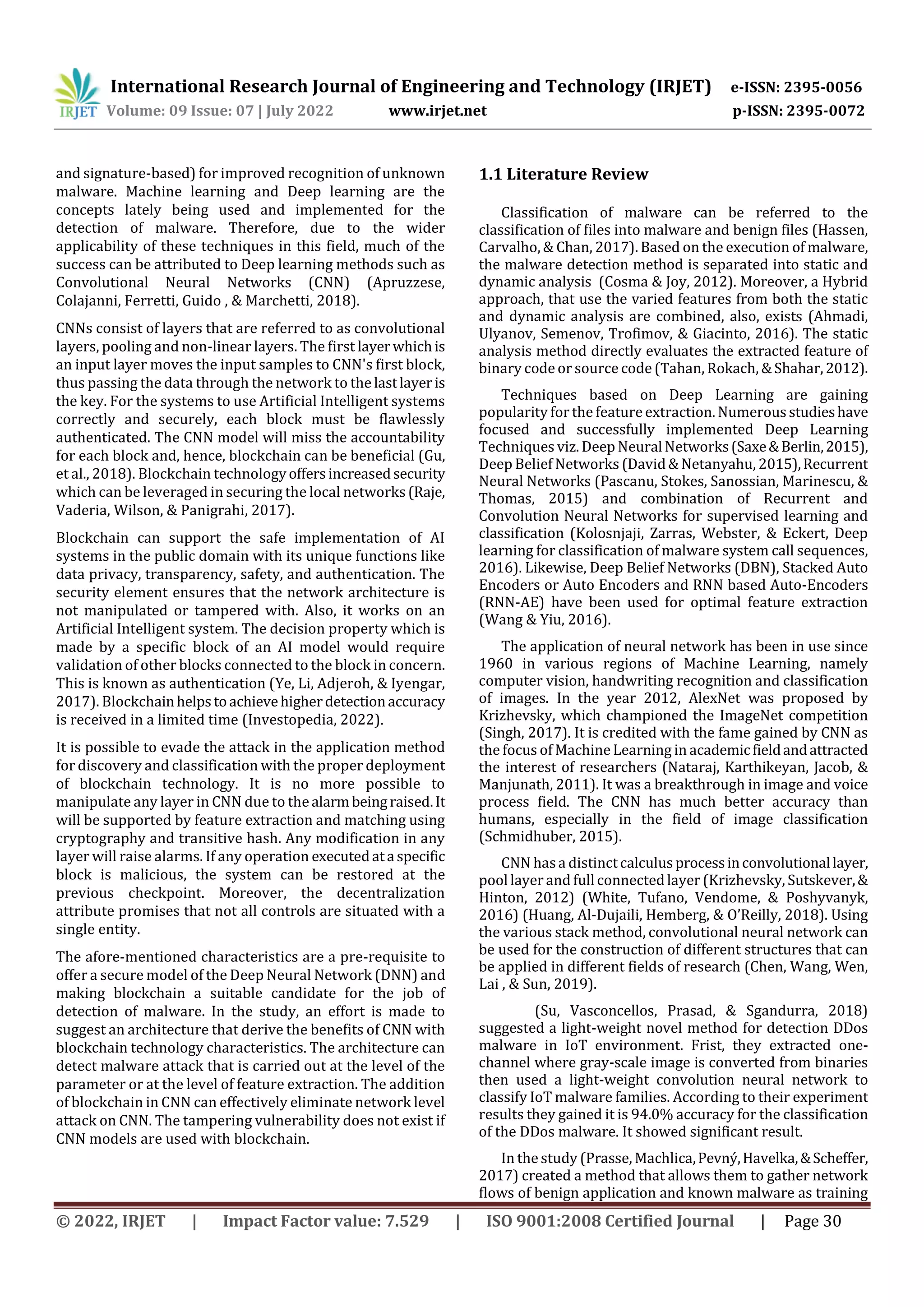
The blockchain structure determined in Fig 3 is described as
follows [11]:
Data: The stored data in blockchain depends on the
application. In this model, the stored data ineachblock isthe
Layer of convolution neural network components such as
convolution and max-pooling function.
International Research Journal of Engineering and Technology (IRJET) e-ISSN: 2395-0056
Volume: 09 Issue: 07 | July 2022 www.irjet.net p-ISSN: 2395-0072
© 2022, IRJET | Impact Factor value: 7.529 | ISO 9001:2008 Certified Journal | Page 32
Hash: A hash function takes any length of input and
generates the output with fixed length and unique. The
output would be different if a single value of input is
modified and no matter the change is big or small, for
instance if someone modified a single character of the
convolution neural network layer which is hashed in the
block then the modified block would have different hash
values completely. This increased and improved the trust of
data saved in
blockchain.
Pervious Hash: this is the hash value of the previous block
which is stored in the current block to make sure the
validation of block is correct. The same process would
continue up to the end of blockchain and each of the
pervious hash value will combine with the current hash
value of block.
Timestamp: It is used to record the time of creating of the
block. This is a method to track the modification or creation
time of the block in a secure way.
E. Convolution Neural Network
The convolutional layer: This layer is the main part of a
CNN. It is extracting the features from the input image and
sending it to the next level, then the extracted features
values will multiply with the original pixel valuesinthefilter
part. Here, we used fifth convolution filters of size
32,64,128,64,32 and the vector size is 5 for eachconvolution
layer.
Rectified linear unit (ReLU) layer: In this layer, all the
negative values will be removed from the filtered image and
will replace it with zero. It will be done to avoid the values
form summing up to zero. Transformed function isactivated
only when a node if the input is above a certain quantity,
while the input is below the zero then the value will be zero.
Pooling layer: Pooling is a non-linear method of down-
sampling. For implementing the pooling layer there are
many non-linear functions like the minimum, maximumand
the average but the maximum is the most common one. In
the maximum pooling function theimagewill partitionintoa
group of non-overlapping rectanglesandthemaximumvalue
is the output of each sub-region and in this algorithm for
reducing the dimensionality of the data, the factor value is5.
Fully Connected layer: The responsibility of this layer is to
classify the image into a label by using the output from the
pooling process layer. The filter of shrunk image would put
into a single list. To identify the most accurate weights, the
fully connected layer goes through its ownback propagation
process. To prioritize the most appropriate label, it is
according to each neuron weights received. The
classification will be done accordinglytowardstheendof the
process. The fully connected layer is a classic multi-layer
resultant in the output layer with a softmax activation
function and after this we used dropout method to prevent
overfitting.
2. Design
The process flow diagram and the architecture for the study
is given below:
Fig-3: SBC Architecture
Fig-4: Blockchain Architecture
1.3 IMPLEMENTATION AND RESULT
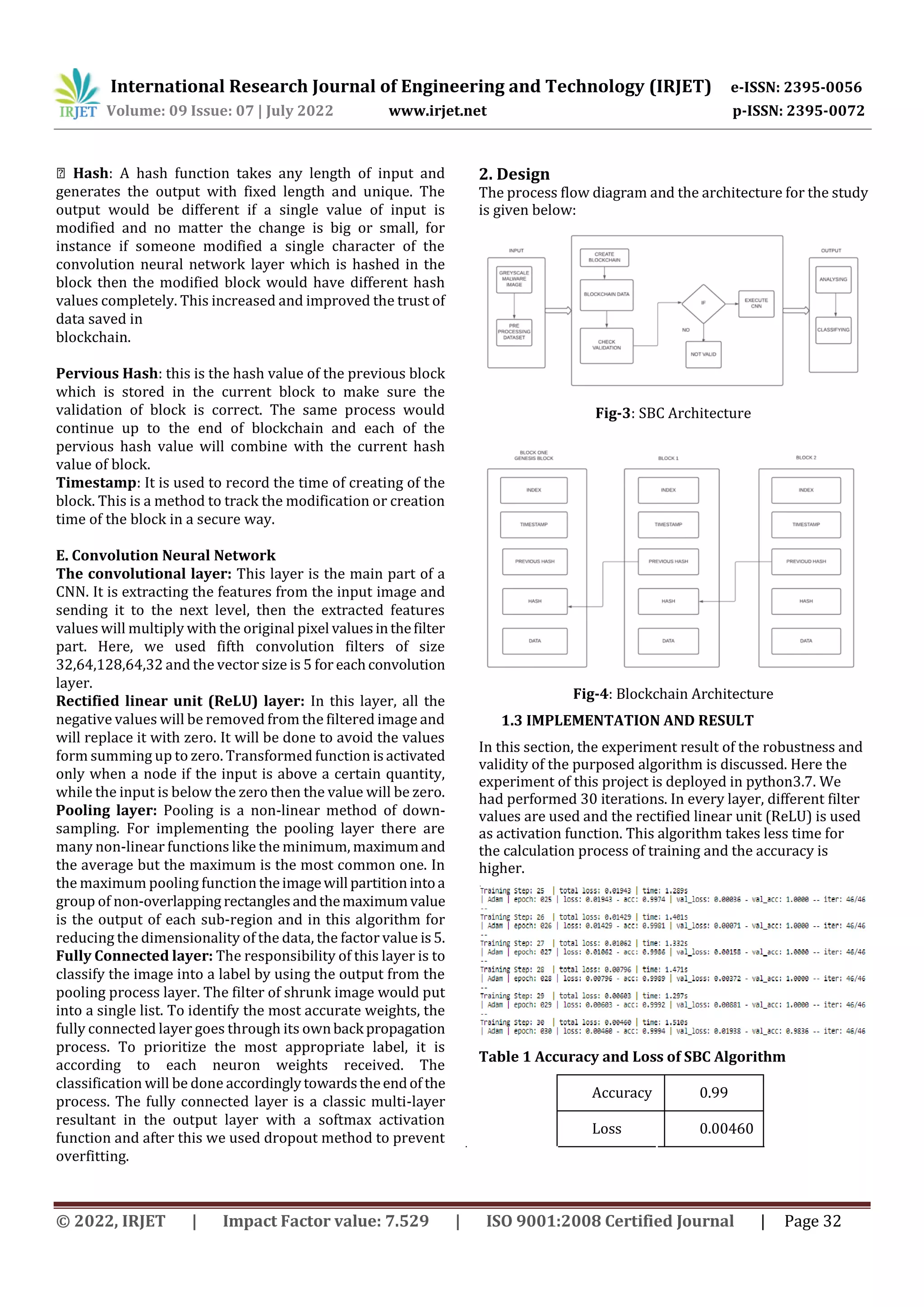
In this section, the experiment result of the robustness and
validity of the purposed algorithm is discussed. Here the
experiment of this project is deployed in python3.7. We
had performed 30 iterations. In every layer, different filter
values are used and the rectified linear unit (ReLU) is used
as activation function. This algorithm takes less time for
the calculation process of training and the accuracy is
higher.
Table 1 Accuracy and Loss of SBC Algorithm
Accuracy 0.99
Loss 0.00460
International Research Journal of Engineering and Technology (IRJET) e-ISSN: 2395-0056
Volume: 09 Issue: 07 | July 2022 www.irjet.net p-ISSN: 2395-0072
© 2022, IRJET | Impact Factor value: 7.529 | ISO 9001:2008 Certified Journal | Page 33
The accuracy is increased in each approach and the final
accuracy is 0.99 as shown in the above table and the loss is
0.00460 in the last iteration.
Fig 8 Loss and Accuracy Result Graph
Fig 9. Malware and Benign image Result
The following output was obtained up
Fig-8: Blockchain Output
3. CONCLUSIONS
The dataset plays a very crucial role for the classification,
object detection and segmentation for the classification of
malware. Preprocessing images is a very crucial task in
image processing since accurate malware identification is
only attainable by detecting background noise.
The proposed project makes use of CNN and blockchain
technology.
REFERENCES
[1] Abdelsalam, M., Krishnan, R., Huang, Y., & Sandhu, R.
(2018). Malware Detection in Cloud Infrastructures
Using Convolutional Neural Networks. 018 IEEE 11th
International Conference on CloudComputing(CLOUD),
(pp. 162-169).
[2] Ahmadi, M., Ulyanov, D., Semenov, S., Trofimov, M., &
Giacinto, G. (2016). Novel feature extraction, selection
and fusion for effective malware family classification.
Proceedings of the Sixth ACM Conference on Data and
Application Security and Privacy, CODASPY '16, 183–
194.
[3] Apruzzese, G., Colajanni, M., Ferretti, L., Guido , A., &
Marchetti, M. (2018). On the effectiveness of machine
and deep learning for cyber security. 2018 10th
International Conferenceon CyberConflict(CyCon),(pp.
371-390). Tallinn.
[4] AV-TEST. (n.d.). Malware. Retrieved March 14, 2022,
from https://www.av-test.org/en/statistics/malware/
[5] Chen, C.-M., Wang, S.-H., Wen, D.-W., Lai , G.-H., & Sun,
M.-K. (2019). Applying Convolutional Neural Network
for Malware Detection. 2019 IEEE 10th International
Conference on Awareness Science and Technology
(iCAST), 1-5.
[6] Cosma, G., & Joy, M. (2012). AnApproachtoSource-Code
Plagiarism Detection and Investigation Using Latent
Semantic Analysis. IEEE Transactions on Computers,
61(3), 379-394.
[7] David, O. E., & Netanyahu, N. S. (2015). DeepSign: Deep
learning for automatic malware signature generation
and classification. 2015 International Joint Conference
on Neural Networks (IJCNN), 1-8.
[8] De Paola, A., Gaglio, S., Re, G. L., & Morana, M. (2018). A
hybrid system for malware detection on big data. IEEE
INFOCOM 2018 - IEEE Conference on Computer
Communications Workshops (INFOCOM, (pp. 45-50).
Honolulu, HI.
[9] Gandotra, E., Bansal, D., & Sofat, S. (2014, April).
Malware Analysis andClassification:ASurvey.Journal of
Information Security, 5(2), 56-64.
[10] Gu, J., Sun, B., Du, X., Wang, J., Zhuang, Y., & Wa,Z.(2018).
Consortium Blockchain-Based Malware Detection in
Mobile Devices. IEEE Access, 6, 12118-12128.
[11] Hassen, M., Carvalho, M. M., & Chan, P. K. (2017).
Malware classification using static analysis based
features. 2017 IEEE Symposium Series on
Computational Intelligence (SSCI), 1-7.
[12] Huang, A., Al-Dujaili, A., Hemberg, E., & O’Reilly, U.-M.
(2018). Adversarial Deep Learning forRobustDetection
of Binary Encoded Malware. 2018 IEEE Security and
Privacy Workshops (SPW), (pp. 76-82).
[13] Investopedia. (2022, March 5). Blockchain Explained.
Retrieved from
https://www.investopedia.com/terms/b/blockchain.as
p
[14] Kolosnjaji, B., Zarras, A., Webster,G.,&Eckert,C.(2016).
Deep Learning for Classification of Malware SystemCall
Sequences. Australasian Joint Conference on Artificial
Intelligence, (pp. 137-149).
[15] Kolosnjaji, B., Zarras, A., Webster, G., & Eckert,C.(2016).
Deep learning for classification of malware system call
sequences. AI 2016: Advances in Artificial Intelligence,
137-149.
[16] Krizhevsky, A., Sutskever, I., & Hinton, G. E. (2012).
Imagenet classification with deep convolutional neural
networks. Proceedings of Advances in Neural
Information Processing Systems (pp. 1106-1114).
Cambridge: MIT Press.
International Research Journal of Engineering and Technology (IRJET) e-ISSN: 2395-0056
Volume: 09 Issue: 07 | July 2022 www.irjet.net p-ISSN: 2395-0072
© 2022, IRJET | Impact Factor value: 7.529 | ISO 9001:2008 Certified Journal | Page 34
[17] Nataraj, L., Karthikeyan, S., Jacob, G., & Manjunath, B. S.
(2011). Malware images: visualization and automatic
classification. International SymposiumonVisualization
for Cyber Security (VizSec), 1-7.
[18] Nawroozi, S., & SaravanaGuru, R. K. (2020, March).
Design of Secure Blockchain Convolution Neural
Network Architecture for Detection Malware Attacks.
International Journal of Recent Technology and
Engineering (IJRTE), 8(6), 3055-3060.
[19] Pascanu, R., Stokes, J. W., Sanossian, H., Marinescu, M., &
Thomas, A. (2015). Malware classification with
recurrent networks. 2015 IEEE International
Conference on Acoustics, Speech and Signal Processing
(ICASSP), 1916-1920.
[20] Prasse, P., Machlica, L., Pevný, T., Havelka, J., & Scheffer,
T. (2017). Malware Detection by Analysing Network
Traffic with Neural Networks. 2017 IEEE Security and
Privacy Workshops (SPW), (pp. 205-210). San Jose, CA.
[21] Raje, S., Vaderia, S., Wilson, N., & Panigrahi, R. (2017,
November). Decentralised firewall for malware
detection. 2017 International Conference on Advances
in Computing, CommunicationandControl (ICAC3),(pp.
1-5).
[22] Saxe, J., & Berlin, K. (2015). Deep neural network based
malware detection using two dimensional binary
program features. 2015 10th International Conference
on Malicious and Unwanted Software (MALWARE), 11-
20.
[23] Schmidhuber, J. (2015). Deep learning in neural
networks: An overview. Neural Networks, 61, 85-117.
[24] Sewak, M., Sahay, S. K., & Rathore, H. (2018, June).
Comparison of Deep Learning and the Classical Machine
Learning Algorithm for the Malware Detection. 2018
19th IEEE/ACIS International Conference on Software
Engineering, Artificial Intelligence, Networking and
Parallel/Distributed Computing (SNPD), 293-296.
[25] Singh, A. (2017). Malware Classification using Image
Representation. Department of Computer Science and
Engineering,Indian Institute of Technology Kanpur.
[26] Statista. (2022, February 3). Security software -
Statistics & Facts. Retrieved March 13, 2022, from
https://www.statista.com/topics/2208/security-
software/
[27] Su, J., Vasconcellos, D. V., Prasad, S., & Sgandurra, D.
(2018). Lightweight ClassificationofIoTMalwareBased
on Image Recognition. 2018 IEEE 42nd Annual
Computer Software and Applications Conference
(COMPSAC), (pp. 664-669). Tokyo.
[28] Tahan, G., Rokach, L., & Shahar, Y. (2012). Mal-ID:
Automatic Malware Detection Using Common Segment
Analysis and Meta-Features. Journal of Machine
Learning Research 13, 13, 949-979.
[29] Wang, X., & Yiu, S. M. (2016). A multi-task learning
model for malware classification with useful file access
pattern from API call sequence.
[30] White, M., Tufano, M., Vendome, C., & Poshyvanyk, D.
(2016). Deep learning code fragments for code clone
detection. Proceedings of the 31st IEEE/ACM
International Conference on Automated Software
Engineering, (pp. 87-98). Singapore.
[31] Ye, Y., Li, T., Adjeroh, D., & Iyengar, S. S. (2017, June). A
survey on malware detection using data mining
techniques. ACM Computing Surveys (CSUR), 50(3), 1-
40.

MALWARE DETECTION AND SUPPRESSION USING BLOCKCHAIN TECHNOLOGY

  • 1.
    International Research Journalof Engineering and Technology (IRJET) e-ISSN: 2395-0056 Volume: 09 Issue: 07 | July 2022 www.irjet.net p-ISSN: 2395-0072 © 2022, IRJET | Impact Factor value: 7.529 | ISO 9001:2008 Certified Journal | Page 29 MALWARE DETECTION AND SUPPRESSION USING BLOCKCHAIN TECHNOLOGY Sweeten Bandodkar1, Ganesh Manerkar2 1Student, Dept. of Information Technology and Engineering, Goa College of Engineering, Farmagudi, Goa, India 2 Assistant Professor, Dept. of Information Technology and Engineering, Goa College of Engineering, Farmagudi, Goa, India ---------------------------------------------------------------------***--------------------------------------------------------------------- Abstract –MaliciousSoftware, also, knownasMalware, can pose serious cybersecurity threats. This can have significant consequences not only for individuals and organisations but, also, for the nation at large. The meteoric surge in malware types and its magnitude dampens the efficacy of traditional techniques, that usefeatureextractionandcomparison, for the detection of cyber threats, thus rendering the identification of malware extremely difficult. Malwaredetectionchallengesare intensified by the sizeable increase in the intricacies, in the type and structure, in recent years, including instructions, settings, source code, binary files, and others. The increased intricacies encourage misjudgement. This study adopts Convolutional Neural Networks (CNN) and Blockchain to enhance the security of cyber networks by increasing the efficiency and accuracy of malware detection under largeand numerous types of malware. The experimentoffersthatCNNis extremely effective with sourcecodeandbinarycode detection and, it can recognize malware that is embedded into benign code, making malware impossible to hide. This research suggests a viable solution for network administrators to identify malware at the very start in the complex network environment, so as to enable information technology personnel to engage in timely protective actions and prepare for potential additional cyberattacks. Key Words: Malware, Blockchain,CNN,Binarycode, Benign, Malign 1.INTRODUCTION In the world where ‘information’ is one of the most prized assets, a significant threat is posed to it by the ever-evolving and sophisticated malwares (Sewak, Sahay, & Rathore, 2018). The malware is an industry with ulterior profit motives, although it was initially created for fun (Statista, 2022). The identified malware, as per AV-Test, greatly increased from 182.90 million in the year 2013 to 1332.56 million in 2022 (AV-TEST). The malware file type and structure also grew in complexity with the increase in volume as well as variety of malware. The malicious source files contain source code files, binary files, shell script files, perl script files, make files and read me files, along with several hierarchical directories. There are many types of malwares such as Adware, Rootkit, Virus, Ransomware, Backdoor, Worm and Trojan (Gandotra, Bansal, & Sofat, 2014). Hybrid malwares are embedded in cyber-attacks to compromise the security of the information system. A wide variety of techniquesareproposedfordetectionofmalwares (Sewak, Sahay, & Rathore, 2018). A wide variety of techniques were employed by the researchers and industries for detection of malwares. This includes heuristic-based methods and signature-based methods (Nawroozi & SaravanaGuru, 2020). The signature- based method, considered the simplest method ofdetection, considers and compares the traffic network or malware for possible attacks with known signature. Antivirus softwares have been used for many years for identification of a particular type of virus. The authors of malware try to dodge the antivirus with the use of metamorphic and polymorphic malware to bypass virus signatures (Nawroozi & SaravanaGuru, 2020). However, this method is not free of drawbacks. Its inefficiency in detection of unknown malwares and security threats compel the antivirus vendors to rely on heuristic methods, which is based on rules determinedbytheexperts. It relies on static and dynamic methods of analysis. The heuristic method for examining the malware before writing the signature is required to analyse whether it is based on the behaviour or by testing the code in a safe environment. The methods employed in the analysis of the malware is based on two methods, namely, Static analysis and Dynamic analysis. Static analysis refers to analysing the malware without its execution, whereas Dynamic analysis analyses the behaviour of a malware program while running or operating on a controlledenvironmentlikea virtual machine or a sandbox. During Static analysis, the pattern will be detected, like opcodes or byte-sequence, string signature, byte-sequence n-gram or opcodes n-grams, etc. Under Dynamic analysis, the behaviour of malware will be observed by utilising tools such as Wireshark, Process Explorer, and Capture BAT, etc. to monitor the function, the network and the flow of data. Although this analysis is more effective, it is both time and resource consuming as compared to the static analysis. Although these methods are able to detect unknown malwares, it produces more amount of false positive than signature-based method (Nawroozi & SaravanaGuru,2020). Various vendors of antivirus, therefore, usea hybridmethod of analysis which includes both the methods (i.e. heuristic
  • 2.
    International Research Journalof Engineering and Technology (IRJET) e-ISSN: 2395-0056 Volume: 09 Issue: 07 | July 2022 www.irjet.net p-ISSN: 2395-0072 © 2022, IRJET | Impact Factor value: 7.529 | ISO 9001:2008 Certified Journal | Page 30 and signature-based) for improved recognition of unknown malware. Machine learning and Deep learning are the concepts lately being used and implemented for the detection of malware. Therefore, due to the wider applicability of these techniques in this field, much of the success can be attributed to Deep learning methods such as Convolutional Neural Networks (CNN) (Apruzzese, Colajanni, Ferretti, Guido , & Marchetti, 2018). CNNs consist of layers that are referred to as convolutional layers, pooling and non-linear layers. The first layerwhichis an input layer moves the input samples to CNN's first block, thus passing the data through the network to the lastlayeris the key. For the systems to use Artificial Intelligent systems correctly and securely, each block must be flawlessly authenticated. The CNN model will miss the accountability for each block and, hence, blockchain can be beneficial (Gu, et al., 2018). Blockchain technologyoffersincreasedsecurity which can be leveraged in securing the local networks(Raje, Vaderia, Wilson, & Panigrahi, 2017). Blockchain can support the safe implementation of AI systems in the public domain with its unique functions like data privacy, transparency, safety, and authentication. The security element ensures that the network architecture is not manipulated or tampered with. Also, it works on an Artificial Intelligent system. The decision property which is made by a specific block of an AI model would require validation of other blocks connected to the block in concern. This is known as authentication (Ye, Li, Adjeroh, & Iyengar, 2017). Blockchainhelpstoachievehigherdetectionaccuracy is received in a limited time (Investopedia, 2022). It is possible to evade the attack in the application method for discovery and classification with the proper deployment of blockchain technology. It is no more possible to manipulate any layer in CNN due to thealarmbeingraised.It will be supported by feature extraction and matching using cryptography and transitive hash. Any modification in any layer will raise alarms. If any operation executedata specific block is malicious, the system can be restored at the previous checkpoint. Moreover, the decentralization attribute promises that not all controls are situated with a single entity. The afore-mentioned characteristics are a pre-requisite to offer a secure model of the Deep Neural Network (DNN) and making blockchain a suitable candidate for the job of detection of malware. In the study, an effort is made to suggest an architecture that derive the benefits of CNN with blockchain technology characteristics. The architecture can detect malware attack that is carried out at the level of the parameter or at the level of feature extraction. The addition of blockchain in CNN can effectively eliminate network level attack on CNN. The tampering vulnerability does not exist if CNN models are used with blockchain. 1.1 Literature Review Classification of malware can be referred to the classification of files into malware and benign files (Hassen, Carvalho, & Chan, 2017). Based on the execution of malware, the malware detection method is separated into static and dynamic analysis (Cosma & Joy, 2012). Moreover, a Hybrid approach, that use the varied features from both the static and dynamic analysis are combined, also, exists (Ahmadi, Ulyanov, Semenov, Trofimov, & Giacinto, 2016). The static analysis method directly evaluates the extracted feature of binary codeor source code(Tahan, Rokach, & Shahar,2012). Techniques based on Deep Learning are gaining popularity forthe featureextraction. Numerousstudieshave focused and successfully implemented Deep Learning Techniques viz. Deep NeuralNetworks(Saxe&Berlin,2015), Deep Belief Networks (David& Netanyahu, 2015),Recurrent Neural Networks (Pascanu, Stokes, Sanossian, Marinescu, & Thomas, 2015) and combination of Recurrent and Convolution Neural Networks for supervised learning and classification (Kolosnjaji, Zarras, Webster, & Eckert, Deep learning for classification of malware system call sequences, 2016). Likewise, Deep Belief Networks (DBN), Stacked Auto Encoders or Auto Encoders and RNN based Auto-Encoders (RNN-AE) have been used for optimal feature extraction (Wang & Yiu, 2016). The application of neural network has been in use since 1960 in various regions of Machine Learning, namely computer vision, handwriting recognition and classification of images. In the year 2012, AlexNet was proposed by Krizhevsky, which championed the ImageNet competition (Singh, 2017). It is credited with the fame gained by CNN as the focus of MachineLearning in academicfieldandattracted the interest of researchers (Nataraj, Karthikeyan, Jacob, & Manjunath, 2011). It was a breakthrough in image and voice process field. The CNN has much better accuracy than humans, especially in the field of image classification (Schmidhuber, 2015). CNN hasa distinctcalculusprocessinconvolutionallayer, poollayer and fullconnectedlayer (Krizhevsky, Sutskever,& Hinton, 2012) (White, Tufano, Vendome, & Poshyvanyk, 2016) (Huang, Al-Dujaili, Hemberg, & O’Reilly, 2018). Using the various stack method, convolutional neural network can be used for the construction of different structures that can be applied in different fields of research (Chen, Wang, Wen, Lai , & Sun, 2019). (Su, Vasconcellos, Prasad, & Sgandurra, 2018) suggested a light-weight novel method for detection DDos malware in IoT environment. Frist, they extracted one- channel where gray-scale image is converted from binaries then used a light-weight convolution neural network to classify IoT malware families. According to their experiment results they gained it is 94.0% accuracy for the classification of the DDos malware. It showed significant result. In the study (Prasse, Machlica,Pevný,Havelka,&Scheffer, 2017) created a method that allows them to gather network flows of benign application and known malware as training
  • 3.
    International Research Journalof Engineering and Technology (IRJET) e-ISSN: 2395-0056 Volume: 09 Issue: 07 | July 2022 www.irjet.net p-ISSN: 2395-0072 © 2022, IRJET | Impact Factor value: 7.529 | ISO 9001:2008 Certified Journal | Page 31 data and then theyappliedamethodfordetectionofmalware which it is based on a neural language method and long short-term memory network (LSTM). The approached method can detect new malware. The authors (De Paola, Gaglio, Re, & Morana, 2018) proposed a novel method based on the deep networks. First, they run malware in the sandbox environment and after this they will convert the log file of sandbox to a long binary bit- string file. It is fed to a deep neural network with eight layered that produced 30 values in the output layer. These values as signature produced by the DBN which is very successful fordetectingofmalware.Andtheadvantageofthis algorithm is that it can be used for the supervised malware classification. In this paper, the proposed method is the cloud-based malware detection system. This method is able to analysis big data which produced on the network. This system provides a fast classificationthatisbasedonthestatic analysis that used deep networks. And when the detection reaches uncertainty exceed a given threshold then it will use dynamic analysis and the result of dynamic analysis is exploited to refine the deep network in the continuous learning loop. And the advantage of this system is that it will be up to date that will detect new malware versions. In the study by (Kolosnjaji, Zarras, Webster, & Eckert , 2016), a method was featured and was implemented based on the CNN and a current network layer, which came out to be one of the best for malware image detection. A full convolution of n-grams was combined as a sequential model in extraction of the model. The average accuracy was from 85.6% to 89.4% (Abdelsalam, Krishnan, Huang, & Sandhu, 2018) in their work, they introduced a malware detection approach for virtual machines based on two dimensional convolution neural networks by utilized performance metrics. The result from the testing dataset showed that they gain accuracy of 79% and they also used 3D CNN model to improve the detection performance which used samples over a time- windows, and after applying 3D dimension to the 2D input matrix the achieved resultwasabove90%thatisasignificant output result 1.2 Methodology A. System Description The process of detection and classification of malware based on SBC algorithm is described in Fig 1. It starts with the input dataset which includesmalignand benigndatasets. The dataset will preprocess and label as malware or benign. The processed data will be forward as input for the convolution neural network then the algorithm would classify to the mentioned classes. As shown in the above diagram, the vulnerability exists in CNN method during filtering the features and shrinking the input that the attacker can easily modify it and it affects the result of detection. Therefore, the blockchain technologyisappliedto avoid it. Each layer of CNN stored in each block and each block would have its own hash value and the pervious hash value of block. Using CNN method each gray scale image of malware will analyze one by one based on the train and test model. B. Dataset The Malimg dataset [6] used inthiswork consistsofimage malware along with the benignimage.The binarymalwareis changed to the grayscale image and there is python script which converts binary malware into the grayscale image using Numpy library. In this work, the gray scale image has used directly as input to CNN model to train the data and to classify it. Fig-1: Process of detection and classification of malware C. Secure Blockchain Convolution Algorithm As it is shown in the Fig 2, it is the architecture of designed algorithm which the input phase is explained already in Fig 1. And after preprocessing the dataset into train and test data. . The next phase is make up of two fold process that it is Blockchian and Convolution Neural Network. Firstly, the blockchain is created and each layer of the CNN is stored as data in blockchain. Each layer of CNN would have same function with different values and a hash value, then the next step is the validation of the hash value which will check if it is valid. If it is invalid there are some changes in the system that would not apply CNN algorithm and it shows the massage which is invalid. On the other hand if it is valid the CNN method for analyzing and classifying the input is applied. The blockchain technology is explained in the upcoming content with CNN algorithm in detail. D. Blockchain Is a distributed model which stores the data between blocks and according to this project each function of CNN stored as data in blocks. The stored data is immutable and permanent that can be easily verified. The blockchain is mostly used in crypto-currencies and basically built from blocks; therefore it is not related directly to CNN in prior. Recently there are many researches in this part of differentfieldssuchashealth care, smart energy and grids that shows blockchain having good potential and significant output. The blockchain structure determined in Fig 3 is described as follows [11]: Data: The stored data in blockchain depends on the application. In this model, the stored data ineachblock isthe Layer of convolution neural network components such as convolution and max-pooling function.
  • 4.
    International Research Journalof Engineering and Technology (IRJET) e-ISSN: 2395-0056 Volume: 09 Issue: 07 | July 2022 www.irjet.net p-ISSN: 2395-0072 © 2022, IRJET | Impact Factor value: 7.529 | ISO 9001:2008 Certified Journal | Page 32 Hash: A hash function takes any length of input and generates the output with fixed length and unique. The output would be different if a single value of input is modified and no matter the change is big or small, for instance if someone modified a single character of the convolution neural network layer which is hashed in the block then the modified block would have different hash values completely. This increased and improved the trust of data saved in blockchain. Pervious Hash: this is the hash value of the previous block which is stored in the current block to make sure the validation of block is correct. The same process would continue up to the end of blockchain and each of the pervious hash value will combine with the current hash value of block. Timestamp: It is used to record the time of creating of the block. This is a method to track the modification or creation time of the block in a secure way. E. Convolution Neural Network The convolutional layer: This layer is the main part of a CNN. It is extracting the features from the input image and sending it to the next level, then the extracted features values will multiply with the original pixel valuesinthefilter part. Here, we used fifth convolution filters of size 32,64,128,64,32 and the vector size is 5 for eachconvolution layer. Rectified linear unit (ReLU) layer: In this layer, all the negative values will be removed from the filtered image and will replace it with zero. It will be done to avoid the values form summing up to zero. Transformed function isactivated only when a node if the input is above a certain quantity, while the input is below the zero then the value will be zero. Pooling layer: Pooling is a non-linear method of down- sampling. For implementing the pooling layer there are many non-linear functions like the minimum, maximumand the average but the maximum is the most common one. In the maximum pooling function theimagewill partitionintoa group of non-overlapping rectanglesandthemaximumvalue is the output of each sub-region and in this algorithm for reducing the dimensionality of the data, the factor value is5. Fully Connected layer: The responsibility of this layer is to classify the image into a label by using the output from the pooling process layer. The filter of shrunk image would put into a single list. To identify the most accurate weights, the fully connected layer goes through its ownback propagation process. To prioritize the most appropriate label, it is according to each neuron weights received. The classification will be done accordinglytowardstheendof the process. The fully connected layer is a classic multi-layer resultant in the output layer with a softmax activation function and after this we used dropout method to prevent overfitting. 2. Design The process flow diagram and the architecture for the study is given below: Fig-3: SBC Architecture Fig-4: Blockchain Architecture 1.3 IMPLEMENTATION AND RESULT In this section, the experiment result of the robustness and validity of the purposed algorithm is discussed. Here the experiment of this project is deployed in python3.7. We had performed 30 iterations. In every layer, different filter values are used and the rectified linear unit (ReLU) is used as activation function. This algorithm takes less time for the calculation process of training and the accuracy is higher. Table 1 Accuracy and Loss of SBC Algorithm Accuracy 0.99 Loss 0.00460
  • 5.
    International Research Journalof Engineering and Technology (IRJET) e-ISSN: 2395-0056 Volume: 09 Issue: 07 | July 2022 www.irjet.net p-ISSN: 2395-0072 © 2022, IRJET | Impact Factor value: 7.529 | ISO 9001:2008 Certified Journal | Page 33 The accuracy is increased in each approach and the final accuracy is 0.99 as shown in the above table and the loss is 0.00460 in the last iteration. Fig 8 Loss and Accuracy Result Graph Fig 9. Malware and Benign image Result The following output was obtained up Fig-8: Blockchain Output 3. CONCLUSIONS The dataset plays a very crucial role for the classification, object detection and segmentation for the classification of malware. Preprocessing images is a very crucial task in image processing since accurate malware identification is only attainable by detecting background noise. The proposed project makes use of CNN and blockchain technology. REFERENCES [1] Abdelsalam, M., Krishnan, R., Huang, Y., & Sandhu, R. (2018). Malware Detection in Cloud Infrastructures Using Convolutional Neural Networks. 018 IEEE 11th International Conference on CloudComputing(CLOUD), (pp. 162-169). [2] Ahmadi, M., Ulyanov, D., Semenov, S., Trofimov, M., & Giacinto, G. (2016). Novel feature extraction, selection and fusion for effective malware family classification. Proceedings of the Sixth ACM Conference on Data and Application Security and Privacy, CODASPY '16, 183– 194. [3] Apruzzese, G., Colajanni, M., Ferretti, L., Guido , A., & Marchetti, M. (2018). On the effectiveness of machine and deep learning for cyber security. 2018 10th International Conferenceon CyberConflict(CyCon),(pp. 371-390). Tallinn. [4] AV-TEST. (n.d.). Malware. Retrieved March 14, 2022, from https://www.av-test.org/en/statistics/malware/ [5] Chen, C.-M., Wang, S.-H., Wen, D.-W., Lai , G.-H., & Sun, M.-K. (2019). Applying Convolutional Neural Network for Malware Detection. 2019 IEEE 10th International Conference on Awareness Science and Technology (iCAST), 1-5. [6] Cosma, G., & Joy, M. (2012). AnApproachtoSource-Code Plagiarism Detection and Investigation Using Latent Semantic Analysis. IEEE Transactions on Computers, 61(3), 379-394. [7] David, O. E., & Netanyahu, N. S. (2015). DeepSign: Deep learning for automatic malware signature generation and classification. 2015 International Joint Conference on Neural Networks (IJCNN), 1-8. [8] De Paola, A., Gaglio, S., Re, G. L., & Morana, M. (2018). A hybrid system for malware detection on big data. IEEE INFOCOM 2018 - IEEE Conference on Computer Communications Workshops (INFOCOM, (pp. 45-50). Honolulu, HI. [9] Gandotra, E., Bansal, D., & Sofat, S. (2014, April). Malware Analysis andClassification:ASurvey.Journal of Information Security, 5(2), 56-64. [10] Gu, J., Sun, B., Du, X., Wang, J., Zhuang, Y., & Wa,Z.(2018). Consortium Blockchain-Based Malware Detection in Mobile Devices. IEEE Access, 6, 12118-12128. [11] Hassen, M., Carvalho, M. M., & Chan, P. K. (2017). Malware classification using static analysis based features. 2017 IEEE Symposium Series on Computational Intelligence (SSCI), 1-7. [12] Huang, A., Al-Dujaili, A., Hemberg, E., & O’Reilly, U.-M. (2018). Adversarial Deep Learning forRobustDetection of Binary Encoded Malware. 2018 IEEE Security and Privacy Workshops (SPW), (pp. 76-82). [13] Investopedia. (2022, March 5). Blockchain Explained. Retrieved from https://www.investopedia.com/terms/b/blockchain.as p [14] Kolosnjaji, B., Zarras, A., Webster,G.,&Eckert,C.(2016). Deep Learning for Classification of Malware SystemCall Sequences. Australasian Joint Conference on Artificial Intelligence, (pp. 137-149). [15] Kolosnjaji, B., Zarras, A., Webster, G., & Eckert,C.(2016). Deep learning for classification of malware system call sequences. AI 2016: Advances in Artificial Intelligence, 137-149. [16] Krizhevsky, A., Sutskever, I., & Hinton, G. E. (2012). Imagenet classification with deep convolutional neural networks. Proceedings of Advances in Neural Information Processing Systems (pp. 1106-1114). Cambridge: MIT Press.
  • 6.
    International Research Journalof Engineering and Technology (IRJET) e-ISSN: 2395-0056 Volume: 09 Issue: 07 | July 2022 www.irjet.net p-ISSN: 2395-0072 © 2022, IRJET | Impact Factor value: 7.529 | ISO 9001:2008 Certified Journal | Page 34 [17] Nataraj, L., Karthikeyan, S., Jacob, G., & Manjunath, B. S. (2011). Malware images: visualization and automatic classification. International SymposiumonVisualization for Cyber Security (VizSec), 1-7. [18] Nawroozi, S., & SaravanaGuru, R. K. (2020, March). Design of Secure Blockchain Convolution Neural Network Architecture for Detection Malware Attacks. International Journal of Recent Technology and Engineering (IJRTE), 8(6), 3055-3060. [19] Pascanu, R., Stokes, J. W., Sanossian, H., Marinescu, M., & Thomas, A. (2015). Malware classification with recurrent networks. 2015 IEEE International Conference on Acoustics, Speech and Signal Processing (ICASSP), 1916-1920. [20] Prasse, P., Machlica, L., Pevný, T., Havelka, J., & Scheffer, T. (2017). Malware Detection by Analysing Network Traffic with Neural Networks. 2017 IEEE Security and Privacy Workshops (SPW), (pp. 205-210). San Jose, CA. [21] Raje, S., Vaderia, S., Wilson, N., & Panigrahi, R. (2017, November). Decentralised firewall for malware detection. 2017 International Conference on Advances in Computing, CommunicationandControl (ICAC3),(pp. 1-5). [22] Saxe, J., & Berlin, K. (2015). Deep neural network based malware detection using two dimensional binary program features. 2015 10th International Conference on Malicious and Unwanted Software (MALWARE), 11- 20. [23] Schmidhuber, J. (2015). Deep learning in neural networks: An overview. Neural Networks, 61, 85-117. [24] Sewak, M., Sahay, S. K., & Rathore, H. (2018, June). Comparison of Deep Learning and the Classical Machine Learning Algorithm for the Malware Detection. 2018 19th IEEE/ACIS International Conference on Software Engineering, Artificial Intelligence, Networking and Parallel/Distributed Computing (SNPD), 293-296. [25] Singh, A. (2017). Malware Classification using Image Representation. Department of Computer Science and Engineering,Indian Institute of Technology Kanpur. [26] Statista. (2022, February 3). Security software - Statistics & Facts. Retrieved March 13, 2022, from https://www.statista.com/topics/2208/security- software/ [27] Su, J., Vasconcellos, D. V., Prasad, S., & Sgandurra, D. (2018). Lightweight ClassificationofIoTMalwareBased on Image Recognition. 2018 IEEE 42nd Annual Computer Software and Applications Conference (COMPSAC), (pp. 664-669). Tokyo. [28] Tahan, G., Rokach, L., & Shahar, Y. (2012). Mal-ID: Automatic Malware Detection Using Common Segment Analysis and Meta-Features. Journal of Machine Learning Research 13, 13, 949-979. [29] Wang, X., & Yiu, S. M. (2016). A multi-task learning model for malware classification with useful file access pattern from API call sequence. [30] White, M., Tufano, M., Vendome, C., & Poshyvanyk, D. (2016). Deep learning code fragments for code clone detection. Proceedings of the 31st IEEE/ACM International Conference on Automated Software Engineering, (pp. 87-98). Singapore. [31] Ye, Y., Li, T., Adjeroh, D., & Iyengar, S. S. (2017, June). A survey on malware detection using data mining techniques. ACM Computing Surveys (CSUR), 50(3), 1- 40.