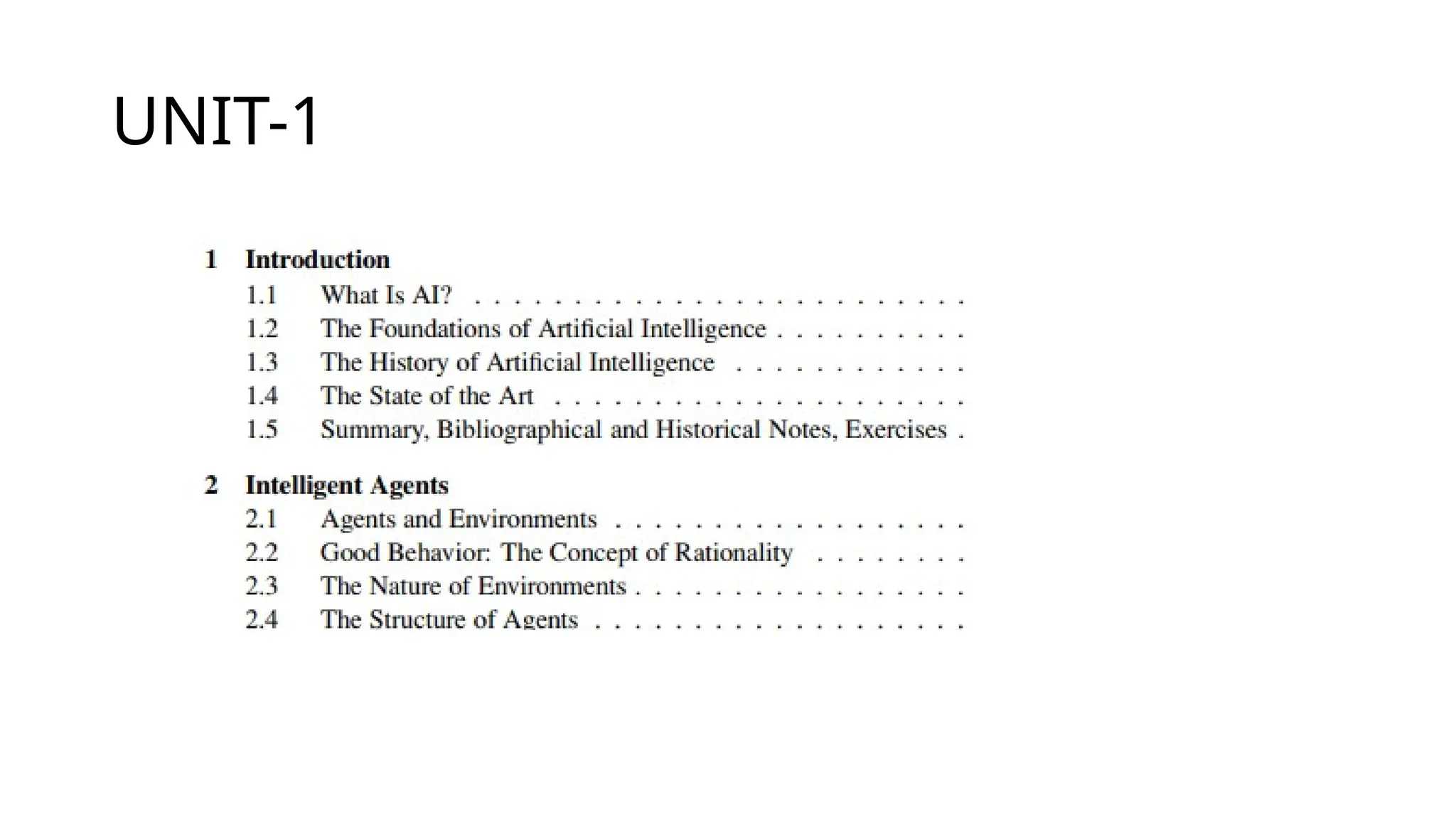
UNIT-1
1.INTRODUCTION
• Homo sapiens—man the wise
• For thousands of years, we have tried to understand how we think; that is, how a
mere handful of matter can perceive, understand, predict, and manipulate a world
far larger and more complicated than itself.
• The field of artificial intelligence, or AI, goes further still: it attempts not just to
understand but also to build intelligent entities.
• AI is one of the newest fields in science and engineering.
• Work started in earnest soon after World War II, and the name itself was coined in
1956.
What is intelligence?
• Capacity for learning, reasoning, understanding, and similar forms of
mental activities.
• Ability to perceive(see)
• Act in world(talk)
• Take decisions
• Understand text and speech etc.
What is a chair? ( any thing with has 4 legs?)
1.1 What is AI
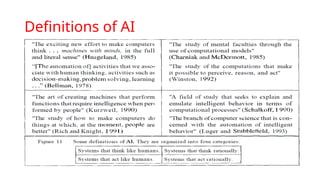
• In Figure 1.1 we see eight definitions of AI, laid out along two dimensions.
• The definitions on top are concerned with thought processes and reasoning, whereas the ones on
the bottom address behavior.
• The definitions on the left measure success in terms of fidelity to human performance, whereas the
ones on the right measure against an ideal performance measure, called rationality.
• A system is rational if it does the “right thing,” given what it knows.
Definitions of AI
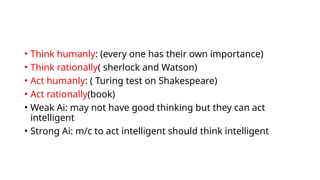
• Think humanly: (every one has their own importance)
• Think rationally( sherlock and Watson)
• Act humanly: ( Turing test on Shakespeare)
• Act rationally(book)
• Weak Ai: may not have good thinking but they can act
intelligent
• Strong Ai: m/c to act intelligent should think intelligent
Acting humanly: The Turing Test approach
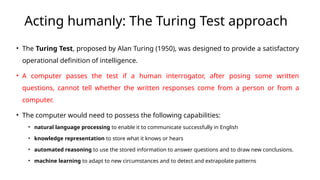
• The Turing Test, proposed by Alan Turing (1950), was designed to provide a satisfactory
operational definition of intelligence.
• A computer passes the test if a human interrogator, after posing some written
questions, cannot tell whether the written responses come from a person or from a
computer.
• The computer would need to possess the following capabilities:
• natural language processing to enable it to communicate successfully in English
• knowledge representation to store what it knows or hears
• automated reasoning to use the stored information to answer questions and to draw new conclusions.
• machine learning to adapt to new circumstances and to detect and extrapolate patterns
Acting humanly:….
• To pass the total Turing Test, the computer will need
• computer vision to perceive objects,
• robotics to manipulate objects and move about
Thinking humanly:
The cognitive modeling approach
• We need to get inside the actual workings of human minds.
There are three ways to do this:
• through introspection—trying to catch our own thoughts as they go by;
• through psychological experiments—observing a person in action;
• through brain imaging—observing the brain in action.
• Once we have a sufficiently precise theory of the mind, it becomes possible to express the
theory as a computer program.
• The interdisciplinary field of cognitive science brings together computer models from AI and
experimental techniques from psychology to construct precise and testable theories of the
human mind.
AI and Cognitive Science
• The main difference between artificial intelligence (AI) and cognitive science is that AI is a technology
that aims to simulate human intelligence, while cognitive science is the study of the human mind:
• Artificial intelligence (AI)
• AI is a technology that allows machines to simulate human intelligence, such as learning, problem
solving, and decision making. AI can be used to create systems that can see and identify objects,
understand human language, and perform specific tasks.
• Cognitive science
• Cognitive science is the study of the human mind and brain, and how it represents and manipulates
knowledge. Cognitive science is an interdisciplinary field that includes philosophy, psychology,
neuroscience, linguistics, and anthropology
Thinking rationally:
The “laws of thought” approach
• The Greek philosopher Aristotle was one of the first to attempt to codify “right thinking,”
that is, irrefutable reasoning processes.
• His syllogisms provided patterns for argument structures that always yielded correct
conclusions when given correct premises—
• for example, “Socrates is a man; all men are mortal; therefore, Socrates is mortal.” These
laws of thought were supposed to govern the operation of the mind;
• Their study initiated the field called logic
Thinking rationally: …
• Logicians in the 19th century developed a precise notation for statements about all
kinds of objects in the world and the relations among them.
• By 1965, programs existed that could, in principle, solve any solvable problem
described in logical notation
• The so-called logicist tradition within artificial intelligence hopes to build on such
programs to create intelligent systems
Acting rationally:
The rational agent approach
• An agent is just something that acts (agent comes from the Latin agere, to do). Of
course, all computer programs do something, but computer agents are expected
to do more: operate autonomously, perceive their environment, persist over a
prolonged time period, adapt to change, and create and pursue goals.
• A rational agent is one that acts so as to achieve the best outcome or, when there is
uncertainty, the best expected outcome.
Acting rationally: …
• In the “laws of thought” approach to AI, the emphasis was on correct inferences.
• Making correct inferences is sometimes part of being a rational agent, because one way to act
rationally is to reason logically to the conclusion that a given action will achieve one’s goals and
then to act on that conclusion.
• On the other hand, correct inference is not all of rationality, in some situations, there is no
provably correct thing to do, but something must still be done.
• There are also ways of acting rationally that cannot be said to involve inference.
• For example, recoiling from a hot stove is a reflex action that is usually more successful than a
slower action taken after careful deliberation
Acting rationally: …
• All the skills needed for the Turing Test also allow an agent
to act rationally.
• Knowledge representation and reasoning enable agents to
reach good decisions.
• We need to be able to generate comprehensible sentences
in natural language to get by in a complex society.
• We need learning not only for erudition, but also because it
improves our ability to generate effective behavior
Acting rationally: …
• The rational-agent approach has two advantages over the other approaches.
• First, it is more general than the “laws of thought” approach because correct inference is just one
of several possible mechanisms for achieving rationality
• Second, it is more amenable to scientific development than are approaches based on human behavior or
human thought.
• The standard of rationality is mathematically well defined and completely general, and can be
“unpacked” to generate agent designs that provably achieve it.
• Human behavior, on the other hand, is well adapted for one specific environment and is defined by, well, the
sum total of all the things that humans do.
• This book therefore concentrates on general principles of rational agents and on components for constructing
them.
1.2 Foundations of AI
These disciplines have all been working toward AI as their ultimate fruition.
• Philosophy
• Mathematics
• Economics
• Neuroscience
• Psychology
• Computer Engineering
• Control theory and cybernetics
• Linguistics
Foundations of AI
1. Philosophy
Philosophy is a systematic study of general and fundamental questions concerning topics like
existence, reason, knowledge, value, mind, and language
• Can formal rules be used to draw valid conclusions?
• How does the mind arise from a physical brain?
• Where does knowledge come from?
• How does knowledge lead to action?
Philosophy..
• Aristotle (384–322 B.C.), was the first to formulate a precise set of laws
governing the rational part of the mind.
• He introduced a system called syllogistic logic, By developing these rules, he
aimed to ensure that the mind’s reasoning process could follow a reliable
path, avoiding errors and producing valid conclusions. (example)
• Thomas Hobbes (1588–1679) proposed that reasoning was like numerical
computation, that “we add and subtract in our silent thoughts.” The
automation of computation itself was already well under way.
Example
• Suppose we apply syllogistic logic to an everyday scenario at a
grocery store:
1.Premise 1: All fresh vegetables are kept in the refrigerated section.
2.Premise 2: Spinach is a fresh vegetable.
3.Conclusion: Therefore, spinach is kept in the refrigerated section.
• This logical structure ensures that if the premises are true, the
conclusion must be true.
• By setting up arguments in this structured way, Aristotle's
syllogistic logic helps avoid reasoning errors, leading to reliable
conclusions.
Philosophy..
• Wilhelm Schickard(1623) and Blaise Pascal’s(1642) early mechanical
calculators showed that physical devices could mimic some logical
operations that the human mind performs.
• Pascal noted that his machine seemed to perform calculations in a
way that felt almost like thought itself—closer to the human mind
than the actions of animals, which follow instinct rather than logic.
Philosophy..
• To act intelligently, an AI must link knowledge to action: it needs to understand how
its actions achieve its goals.
• Aristotle suggested that actions are rational when they logically connect goals to the
expected outcomes.
• For example, if an animal's goal is to find food, its knowledge of where food is
located informs its actions.
• The outcome is that the animal successfully finds and consumes the food, which
satisfies its hunger and fulfills its goal of survival.
• In AI, this means designing agents that act purposefully based on their knowledge,
ensuring their actions are justified and rational.
Mathematics
• What are the formal rules to draw valid conclusions?
• What can be computed?
• How do we reason with uncertain information?
Philosophers staked out some of the fundamental ideas of AI, but the leap to a
formal science
required a level of mathematical formalization in three fundamental areas:
logic,
computation,
and probability.
Mathematics
1.Logic: Ancient Greek philosophers introduced formal logic, which George Boole expanded in the 1800s
with Boolean logic. Gottlob Frege developed first-order logic, and Alfred Tarski created a theory linking
logic to real-world objects. These advancements laid the groundwork for logical reasoning in AI.
2.Computation: The study of algorithms began with Euclid’s algorithm, and al-Khwarizmi formalized
algebra and computation. Alan Turing’s work defined computable functions and the limits of
computation, leading to the Church-Turing thesis.
3.Probability: Gerolamo Cardano, Blaise Pascal, and others developed probability theory, helping
quantify uncertainty. Thomas Bayes introduced Bayes’ rule, essential for updating beliefs based on new
evidence—a critical part of modern AI’s approach to uncertain reasoning.
• These three areas help AI systems make rational decisions, tackle complex computations, and
handle uncertainty.
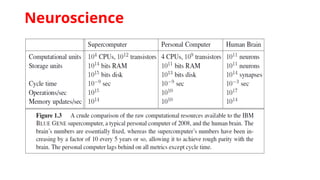
Neuroscience
• How do brains process information?
Neuroscience is the study of the nervous system, particularly the
brain. Although the exact way in which the brain enables thought is
one of the great mysteries of science, the fact that it does enable
thought has been appreciated for thousands of years because of
the evidence that strong blows to the head can lead to mental
incapacitation
Neuroscience
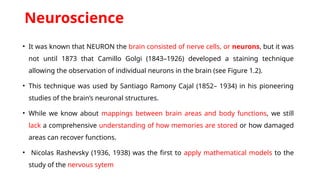
• It was known that NEURON the brain consisted of nerve cells, or neurons, but it was
not until 1873 that Camillo Golgi (1843–1926) developed a staining technique
allowing the observation of individual neurons in the brain (see Figure 1.2).
• This technique was used by Santiago Ramony Cajal (1852– 1934) in his pioneering
studies of the brain’s neuronal structures.
• While we know about mappings between brain areas and body functions, we still
lack a comprehensive understanding of how memories are stored or how damaged
areas can recover functions.
• Nicolas Rashevsky (1936, 1938) was the first to apply mathematical models to the
study of the nervous sytem
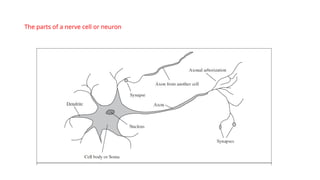
The parts of a nerve cell or neuron
Neuroscience
• John Searle noted that the brain, a collection of simple cells, produces
thoughts and consciousness, contrasting with mystical theories of the
mind.
• While computers operate much faster than the brain, they lack the
complexity and interconnectivity of neural networks, and the path to
replicating human-level intelligence in machines remains uncertain,
despite discussions of a technological singularity.
Neuroscience
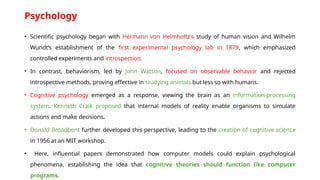
Psychology
• Scientific psychology began with Hermann von Helmholtz's study of human vision and Wilhelm
Wundt’s establishment of the first experimental psychology lab in 1879, which emphasized
controlled experiments and introspection.
• In contrast, behaviorism, led by John Watson, focused on observable behavior and rejected
introspective methods, proving effective in studying animals but less so with humans.
• Cognitive psychology emerged as a response, viewing the brain as an information-processing
system. Kenneth Craik proposed that internal models of reality enable organisms to simulate
actions and make decisions.
• Donald Broadbent further developed this perspective, leading to the creation of cognitive science
in 1956 at an MIT workshop.
• Here, influential papers demonstrated how computer models could explain psychological
phenomena, establishing the idea that cognitive theories should function like computer
programs.
Computer engineering
How can we build an efficient computer?
Artificial intelligence (AI) relies on two main elements: intelligence and an artifact,
• Modern digital computers were developed during World War II, with significant contributions
from Alan Turing’s team and others, such as the ENIAC and the Z-3.
• Innovations in speed and capacity have evolved, especially with multi-core processors
reflecting the brain's parallel processing.
• Prior to electronic computers, devices like the Jacquard loom and Babbage's Analytical Engine
established concepts of programmability.
• Ada Lovelace is recognized as the first programmer for her work on the Analytical Engine.
Additionally,
AI has significantly influenced software development, enhancing operating systems,
programming languages, and various programming paradigms.
Control theory and cybernetics
How can artifacts operate under their own control?
• Ktesibios of Alexandria invented the first self-regulating machine, a water clock,
around 250 B.C., paving the way for feedback systems.
• Control theory emerged in the 19th century, with Norbert Wiener as a key figure,
connecting mechanical control systems to cognition.
• His book Cybernetics popularized the concept of artificial intelligence. W. Ross Ashby
furthered these ideas with homeostatic devices for intelligent behavior.
• While modern control theory focuses on optimizing objective functions, AI diverged to
tackle a broader range of problems, like language and vision, using different
mathematical approaches.
Linguistics
How does language relate to thought?
• In 1957, B. F. Skinner published Verbal Behavior, detailing the behaviorist approach to
language learning.
• However, Noam Chomsky's critical review challenged behaviorism by highlighting its
failure to explain language creativity, such as a child's ability to form novel sentences.
• Chomsky introduced formal syntactic models that could potentially be programmed,
marking the simultaneous emergence of modern linguistics and AI, particularly in the
field of computational linguistics or natural language processing.
• The complexity of understanding language was later recognized to involve not just
sentence structure but also context and subject matter, leading to advances in
knowledge representation informed by linguistic research and philosophical analyses.
1.3 History of Artificial Intelligence
• An overview of the major phases and milestones in the
development of Artificial Intelligence as a field.
The Gestation of AI (1943–1955)
• Key Figures: Warren McCulloch and Walter Pitts
• Contributions: Proposed a model of artificial neurons
inspired by brain function.
• Significance: Demonstrated that any computable function
could be represented by neuron-like networks.
• Hebbian Learning: Donald Hebb introduced a model for
learning in neurons, forming the basis for future neural
network models.
The Birth of AI (1956)
• Dartmouth Conference: Organized by John McCarthy,
Marvin Minsky, Claude Shannon, and Nathaniel Rochester.
• Purpose: Discussed the possibilities of creating machines
capable of 'simulating' aspects of human intelligence.
• Significance: The term 'Artificial Intelligence' was coined,
establishing AI as a formal field of study.
Early enthusiasm, great expectations
(1952–1969)
• Logic Theorist & General Problem Solver (GPS): Programs by
Newell and Simon that showed early AI's potential in
reasoning.
• Physical Symbol System Hypothesis: Proposed by Newell
and Simon, stating that physical symbol manipulation is
essential for intelligent action.
• Checkers Program: Arthur Samuel's checkers program that
learned and improved over time, demonstrating machine
learning potential.
Challenges and Setbacks (1966–1973)
• Machine Translation Issues: Initial optimism faded as
translation lacked context understanding.
• Lighthill Report: Criticized AI research, leading to reduced
funding in the UK.
• Significance: Highlighted the limitations of early AI methods
and led to a reassessment of AI goals.
Knowledge-Based Systems (1969–
1979)
• DENDRAL & MYCIN: Expert systems using specialized
knowledge, demonstrating the power of domain-specific AI.
• MYCIN's Medical Diagnosis: Successfully used in diagnosing
infections, outperforming junior doctors.
• Significance: Showed that integrating expert knowledge was
effective for specific applications.
AI in Industry (1980–present)
• Rise of Expert Systems: R1 at Digital Equipment Corporation
saved millions by configuring computer orders.
• Japanese Fifth Generation Project: Aimed to develop
intelligent computers using AI, led to global investment in
AI.
• AI Winter: AI industry experienced setbacks as expectations
were not fully met, leading to an 'AI Winter'.
The return of neural networks (1986–
present)
• Backpropagation: Reinvented, allowing for training of multi-
layer networks.
• Connectionist Models: These models focused on learning
representations without explicit symbolic manipulation.
• Significance: Led to breakthroughs in pattern recognition
and laid foundations for modern deep learning.
AI adopts the scientific method (1987–
present)
• Shift to Rigorous Testing: AI began to focus on mathematical
rigor and empirical validation.
• Hidden Markov Models (HMMs): Became dominant in
speech recognition due to robust performance.
• Significance: AI research aligned with scientific rigor,
improving reliability and reproducibility.
The emergence of intelligent agents
(1995–present)
• Whole Agent Problem: Research shifted focus to building
complete, autonomous agents.
• Internet Applications: Intelligent agents were increasingly
used in web-based applications, such as chatbots and
recommendation systems.
• Significance: Encouraged integrating multiple AI subfields
for practical applications.
The availability of very large data sets
(2001–present)
• Impact of Large Data Sets: Large data availability allowed for
improvements in accuracy and performance.
• Examples: Word-sense disambiguation, filling photo
backgrounds with high accuracy.
• Significance: Shifted AI focus from algorithm-centric to data-
centric approaches, leveraging vast amounts of available
data.
1.4 State of Art
• A concise answer is difficult due to the wide range of AI
applications across numerous subfields.
• Here we highlight a few key applications of AI in real-world
scenarios.
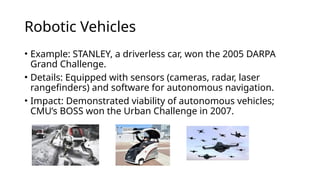
Robotic Vehicles
• Example: STANLEY, a driverless car, won the 2005 DARPA
Grand Challenge.
• Details: Equipped with sensors (cameras, radar, laser
rangefinders) and software for autonomous navigation.
• Impact: Demonstrated viability of autonomous vehicles;
CMU’s BOSS won the Urban Challenge in 2007.
Speech Recognition
• Example: United Airlines automated booking system.
• Details: Uses AI to handle entire conversations, enabling
booking without human intervention.
• Impact: Streamlines customer service and automates
repetitive tasks.
Autonomous Planning and Scheduling
• Example: NASA's Remote Agent program and MAPGEN.
• Details: NASA’s Remote Agent controlled spacecraft
operations, generating plans and diagnosing issues
autonomously.
• Impact: Revolutionized space operations, leading to efficient
planning for Mars Exploration Rovers.
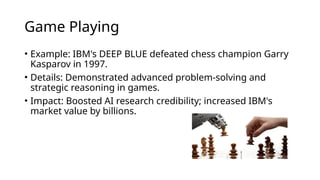
Game Playing
• Example: IBM's DEEP BLUE defeated chess champion Garry
Kasparov in 1997.
• Details: Demonstrated advanced problem-solving and
strategic reasoning in games.
• Impact: Boosted AI research credibility; increased IBM's
market value by billions.
Spam Fighting
• Example: Learning algorithms for spam detection.
• Details: AI algorithms identify and filter over a billion spam
emails daily.
• Impact: Saves users time and enhances email usability by
combating ever-evolving spam tactics.
Logistics Planning
• Example: Dynamic Analysis and Replanning Tool (DART)
used in the 1991 Persian Gulf crisis.
• Details: Handled logistics planning for vast numbers of
vehicles, cargo, and personnel.
• Impact: Generated efficient plans quickly, showcasing AI's
strategic applications in military logistics.
Robotics
• Example: iRobot's Roomba vacuum and PackBot.
• Details: Roomba automates cleaning; PackBot is used in
hazardous situations in Iraq and Afghanistan.
• Impact: Demonstrated AI’s utility in household chores and
critical military operations.
Machine Translation
• Example: Arabic-to-English translation for English headlines.
• Details: Statistical models trained on vast datasets enable
translation without language fluency.
• Impact: Facilitates cross-language communication; exemplifies
data-driven AI applications.
These examples illustrate AI's impact across diverse domains
such as automation, language processing, logistics, and gaming.
AI continues to grow, bridging science, engineering, and
mathematics in practical applications.

FOUNDATIONS OF ARTIFICIAL INTELIGENCE BASICS

  • 1.
  • 2.
    1.INTRODUCTION • Homo sapiens—manthe wise • For thousands of years, we have tried to understand how we think; that is, how a mere handful of matter can perceive, understand, predict, and manipulate a world far larger and more complicated than itself. • The field of artificial intelligence, or AI, goes further still: it attempts not just to understand but also to build intelligent entities. • AI is one of the newest fields in science and engineering. • Work started in earnest soon after World War II, and the name itself was coined in 1956.
  • 3.
    What is intelligence? •Capacity for learning, reasoning, understanding, and similar forms of mental activities. • Ability to perceive(see) • Act in world(talk) • Take decisions • Understand text and speech etc. What is a chair? ( any thing with has 4 legs?)
  • 4.
    1.1 What isAI • In Figure 1.1 we see eight definitions of AI, laid out along two dimensions. • The definitions on top are concerned with thought processes and reasoning, whereas the ones on the bottom address behavior. • The definitions on the left measure success in terms of fidelity to human performance, whereas the ones on the right measure against an ideal performance measure, called rationality. • A system is rational if it does the “right thing,” given what it knows.
  • 5.
  • 6.
    • Think humanly:(every one has their own importance) • Think rationally( sherlock and Watson) • Act humanly: ( Turing test on Shakespeare) • Act rationally(book) • Weak Ai: may not have good thinking but they can act intelligent • Strong Ai: m/c to act intelligent should think intelligent
  • 7.
    Acting humanly: TheTuring Test approach • The Turing Test, proposed by Alan Turing (1950), was designed to provide a satisfactory operational definition of intelligence. • A computer passes the test if a human interrogator, after posing some written questions, cannot tell whether the written responses come from a person or from a computer. • The computer would need to possess the following capabilities: • natural language processing to enable it to communicate successfully in English • knowledge representation to store what it knows or hears • automated reasoning to use the stored information to answer questions and to draw new conclusions. • machine learning to adapt to new circumstances and to detect and extrapolate patterns
  • 8.
    Acting humanly:…. • Topass the total Turing Test, the computer will need • computer vision to perceive objects, • robotics to manipulate objects and move about
  • 9.
    Thinking humanly: The cognitivemodeling approach • We need to get inside the actual workings of human minds. There are three ways to do this: • through introspection—trying to catch our own thoughts as they go by; • through psychological experiments—observing a person in action; • through brain imaging—observing the brain in action. • Once we have a sufficiently precise theory of the mind, it becomes possible to express the theory as a computer program. • The interdisciplinary field of cognitive science brings together computer models from AI and experimental techniques from psychology to construct precise and testable theories of the human mind.
  • 10.
    AI and CognitiveScience • The main difference between artificial intelligence (AI) and cognitive science is that AI is a technology that aims to simulate human intelligence, while cognitive science is the study of the human mind: • Artificial intelligence (AI) • AI is a technology that allows machines to simulate human intelligence, such as learning, problem solving, and decision making. AI can be used to create systems that can see and identify objects, understand human language, and perform specific tasks. • Cognitive science • Cognitive science is the study of the human mind and brain, and how it represents and manipulates knowledge. Cognitive science is an interdisciplinary field that includes philosophy, psychology, neuroscience, linguistics, and anthropology
  • 11.
    Thinking rationally: The “lawsof thought” approach • The Greek philosopher Aristotle was one of the first to attempt to codify “right thinking,” that is, irrefutable reasoning processes. • His syllogisms provided patterns for argument structures that always yielded correct conclusions when given correct premises— • for example, “Socrates is a man; all men are mortal; therefore, Socrates is mortal.” These laws of thought were supposed to govern the operation of the mind; • Their study initiated the field called logic
  • 12.
    Thinking rationally: … •Logicians in the 19th century developed a precise notation for statements about all kinds of objects in the world and the relations among them. • By 1965, programs existed that could, in principle, solve any solvable problem described in logical notation • The so-called logicist tradition within artificial intelligence hopes to build on such programs to create intelligent systems
  • 13.
    Acting rationally: The rationalagent approach • An agent is just something that acts (agent comes from the Latin agere, to do). Of course, all computer programs do something, but computer agents are expected to do more: operate autonomously, perceive their environment, persist over a prolonged time period, adapt to change, and create and pursue goals. • A rational agent is one that acts so as to achieve the best outcome or, when there is uncertainty, the best expected outcome.
  • 14.
    Acting rationally: … •In the “laws of thought” approach to AI, the emphasis was on correct inferences. • Making correct inferences is sometimes part of being a rational agent, because one way to act rationally is to reason logically to the conclusion that a given action will achieve one’s goals and then to act on that conclusion. • On the other hand, correct inference is not all of rationality, in some situations, there is no provably correct thing to do, but something must still be done. • There are also ways of acting rationally that cannot be said to involve inference. • For example, recoiling from a hot stove is a reflex action that is usually more successful than a slower action taken after careful deliberation
  • 15.
    Acting rationally: … •All the skills needed for the Turing Test also allow an agent to act rationally. • Knowledge representation and reasoning enable agents to reach good decisions. • We need to be able to generate comprehensible sentences in natural language to get by in a complex society. • We need learning not only for erudition, but also because it improves our ability to generate effective behavior
  • 16.
    Acting rationally: … •The rational-agent approach has two advantages over the other approaches. • First, it is more general than the “laws of thought” approach because correct inference is just one of several possible mechanisms for achieving rationality • Second, it is more amenable to scientific development than are approaches based on human behavior or human thought. • The standard of rationality is mathematically well defined and completely general, and can be “unpacked” to generate agent designs that provably achieve it. • Human behavior, on the other hand, is well adapted for one specific environment and is defined by, well, the sum total of all the things that humans do. • This book therefore concentrates on general principles of rational agents and on components for constructing them.
  • 17.
    1.2 Foundations ofAI These disciplines have all been working toward AI as their ultimate fruition. • Philosophy • Mathematics • Economics • Neuroscience • Psychology • Computer Engineering • Control theory and cybernetics • Linguistics
  • 18.
    Foundations of AI 1.Philosophy Philosophy is a systematic study of general and fundamental questions concerning topics like existence, reason, knowledge, value, mind, and language • Can formal rules be used to draw valid conclusions? • How does the mind arise from a physical brain? • Where does knowledge come from? • How does knowledge lead to action?
  • 19.
    Philosophy.. • Aristotle (384–322B.C.), was the first to formulate a precise set of laws governing the rational part of the mind. • He introduced a system called syllogistic logic, By developing these rules, he aimed to ensure that the mind’s reasoning process could follow a reliable path, avoiding errors and producing valid conclusions. (example) • Thomas Hobbes (1588–1679) proposed that reasoning was like numerical computation, that “we add and subtract in our silent thoughts.” The automation of computation itself was already well under way.
  • 20.
    Example • Suppose weapply syllogistic logic to an everyday scenario at a grocery store: 1.Premise 1: All fresh vegetables are kept in the refrigerated section. 2.Premise 2: Spinach is a fresh vegetable. 3.Conclusion: Therefore, spinach is kept in the refrigerated section. • This logical structure ensures that if the premises are true, the conclusion must be true. • By setting up arguments in this structured way, Aristotle's syllogistic logic helps avoid reasoning errors, leading to reliable conclusions.
  • 21.
    Philosophy.. • Wilhelm Schickard(1623)and Blaise Pascal’s(1642) early mechanical calculators showed that physical devices could mimic some logical operations that the human mind performs. • Pascal noted that his machine seemed to perform calculations in a way that felt almost like thought itself—closer to the human mind than the actions of animals, which follow instinct rather than logic.
  • 22.
    Philosophy.. • To actintelligently, an AI must link knowledge to action: it needs to understand how its actions achieve its goals. • Aristotle suggested that actions are rational when they logically connect goals to the expected outcomes. • For example, if an animal's goal is to find food, its knowledge of where food is located informs its actions. • The outcome is that the animal successfully finds and consumes the food, which satisfies its hunger and fulfills its goal of survival. • In AI, this means designing agents that act purposefully based on their knowledge, ensuring their actions are justified and rational.
  • 23.
    Mathematics • What arethe formal rules to draw valid conclusions? • What can be computed? • How do we reason with uncertain information? Philosophers staked out some of the fundamental ideas of AI, but the leap to a formal science required a level of mathematical formalization in three fundamental areas: logic, computation, and probability.
  • 24.
    Mathematics 1.Logic: Ancient Greekphilosophers introduced formal logic, which George Boole expanded in the 1800s with Boolean logic. Gottlob Frege developed first-order logic, and Alfred Tarski created a theory linking logic to real-world objects. These advancements laid the groundwork for logical reasoning in AI. 2.Computation: The study of algorithms began with Euclid’s algorithm, and al-Khwarizmi formalized algebra and computation. Alan Turing’s work defined computable functions and the limits of computation, leading to the Church-Turing thesis. 3.Probability: Gerolamo Cardano, Blaise Pascal, and others developed probability theory, helping quantify uncertainty. Thomas Bayes introduced Bayes’ rule, essential for updating beliefs based on new evidence—a critical part of modern AI’s approach to uncertain reasoning. • These three areas help AI systems make rational decisions, tackle complex computations, and handle uncertainty.
  • 25.
    Neuroscience • How dobrains process information? Neuroscience is the study of the nervous system, particularly the brain. Although the exact way in which the brain enables thought is one of the great mysteries of science, the fact that it does enable thought has been appreciated for thousands of years because of the evidence that strong blows to the head can lead to mental incapacitation
  • 26.
    Neuroscience • It wasknown that NEURON the brain consisted of nerve cells, or neurons, but it was not until 1873 that Camillo Golgi (1843–1926) developed a staining technique allowing the observation of individual neurons in the brain (see Figure 1.2). • This technique was used by Santiago Ramony Cajal (1852– 1934) in his pioneering studies of the brain’s neuronal structures. • While we know about mappings between brain areas and body functions, we still lack a comprehensive understanding of how memories are stored or how damaged areas can recover functions. • Nicolas Rashevsky (1936, 1938) was the first to apply mathematical models to the study of the nervous sytem
  • 27.
    The parts ofa nerve cell or neuron
  • 28.
    Neuroscience • John Searlenoted that the brain, a collection of simple cells, produces thoughts and consciousness, contrasting with mystical theories of the mind. • While computers operate much faster than the brain, they lack the complexity and interconnectivity of neural networks, and the path to replicating human-level intelligence in machines remains uncertain, despite discussions of a technological singularity.
  • 29.
  • 30.
    Psychology • Scientific psychologybegan with Hermann von Helmholtz's study of human vision and Wilhelm Wundt’s establishment of the first experimental psychology lab in 1879, which emphasized controlled experiments and introspection. • In contrast, behaviorism, led by John Watson, focused on observable behavior and rejected introspective methods, proving effective in studying animals but less so with humans. • Cognitive psychology emerged as a response, viewing the brain as an information-processing system. Kenneth Craik proposed that internal models of reality enable organisms to simulate actions and make decisions. • Donald Broadbent further developed this perspective, leading to the creation of cognitive science in 1956 at an MIT workshop. • Here, influential papers demonstrated how computer models could explain psychological phenomena, establishing the idea that cognitive theories should function like computer programs.
  • 31.
    Computer engineering How canwe build an efficient computer? Artificial intelligence (AI) relies on two main elements: intelligence and an artifact, • Modern digital computers were developed during World War II, with significant contributions from Alan Turing’s team and others, such as the ENIAC and the Z-3. • Innovations in speed and capacity have evolved, especially with multi-core processors reflecting the brain's parallel processing. • Prior to electronic computers, devices like the Jacquard loom and Babbage's Analytical Engine established concepts of programmability. • Ada Lovelace is recognized as the first programmer for her work on the Analytical Engine. Additionally, AI has significantly influenced software development, enhancing operating systems, programming languages, and various programming paradigms.
  • 32.
    Control theory andcybernetics How can artifacts operate under their own control? • Ktesibios of Alexandria invented the first self-regulating machine, a water clock, around 250 B.C., paving the way for feedback systems. • Control theory emerged in the 19th century, with Norbert Wiener as a key figure, connecting mechanical control systems to cognition. • His book Cybernetics popularized the concept of artificial intelligence. W. Ross Ashby furthered these ideas with homeostatic devices for intelligent behavior. • While modern control theory focuses on optimizing objective functions, AI diverged to tackle a broader range of problems, like language and vision, using different mathematical approaches.
  • 33.
    Linguistics How does languagerelate to thought? • In 1957, B. F. Skinner published Verbal Behavior, detailing the behaviorist approach to language learning. • However, Noam Chomsky's critical review challenged behaviorism by highlighting its failure to explain language creativity, such as a child's ability to form novel sentences. • Chomsky introduced formal syntactic models that could potentially be programmed, marking the simultaneous emergence of modern linguistics and AI, particularly in the field of computational linguistics or natural language processing. • The complexity of understanding language was later recognized to involve not just sentence structure but also context and subject matter, leading to advances in knowledge representation informed by linguistic research and philosophical analyses.
  • 34.
    1.3 History ofArtificial Intelligence • An overview of the major phases and milestones in the development of Artificial Intelligence as a field.
  • 35.
    The Gestation ofAI (1943–1955) • Key Figures: Warren McCulloch and Walter Pitts • Contributions: Proposed a model of artificial neurons inspired by brain function. • Significance: Demonstrated that any computable function could be represented by neuron-like networks. • Hebbian Learning: Donald Hebb introduced a model for learning in neurons, forming the basis for future neural network models.
  • 36.
    The Birth ofAI (1956) • Dartmouth Conference: Organized by John McCarthy, Marvin Minsky, Claude Shannon, and Nathaniel Rochester. • Purpose: Discussed the possibilities of creating machines capable of 'simulating' aspects of human intelligence. • Significance: The term 'Artificial Intelligence' was coined, establishing AI as a formal field of study.
  • 37.
    Early enthusiasm, greatexpectations (1952–1969) • Logic Theorist & General Problem Solver (GPS): Programs by Newell and Simon that showed early AI's potential in reasoning. • Physical Symbol System Hypothesis: Proposed by Newell and Simon, stating that physical symbol manipulation is essential for intelligent action. • Checkers Program: Arthur Samuel's checkers program that learned and improved over time, demonstrating machine learning potential.
  • 38.
    Challenges and Setbacks(1966–1973) • Machine Translation Issues: Initial optimism faded as translation lacked context understanding. • Lighthill Report: Criticized AI research, leading to reduced funding in the UK. • Significance: Highlighted the limitations of early AI methods and led to a reassessment of AI goals.
  • 39.
    Knowledge-Based Systems (1969– 1979) •DENDRAL & MYCIN: Expert systems using specialized knowledge, demonstrating the power of domain-specific AI. • MYCIN's Medical Diagnosis: Successfully used in diagnosing infections, outperforming junior doctors. • Significance: Showed that integrating expert knowledge was effective for specific applications.
  • 40.
    AI in Industry(1980–present) • Rise of Expert Systems: R1 at Digital Equipment Corporation saved millions by configuring computer orders. • Japanese Fifth Generation Project: Aimed to develop intelligent computers using AI, led to global investment in AI. • AI Winter: AI industry experienced setbacks as expectations were not fully met, leading to an 'AI Winter'.
  • 41.
    The return ofneural networks (1986– present) • Backpropagation: Reinvented, allowing for training of multi- layer networks. • Connectionist Models: These models focused on learning representations without explicit symbolic manipulation. • Significance: Led to breakthroughs in pattern recognition and laid foundations for modern deep learning.
  • 42.
    AI adopts thescientific method (1987– present) • Shift to Rigorous Testing: AI began to focus on mathematical rigor and empirical validation. • Hidden Markov Models (HMMs): Became dominant in speech recognition due to robust performance. • Significance: AI research aligned with scientific rigor, improving reliability and reproducibility.
  • 43.
    The emergence ofintelligent agents (1995–present) • Whole Agent Problem: Research shifted focus to building complete, autonomous agents. • Internet Applications: Intelligent agents were increasingly used in web-based applications, such as chatbots and recommendation systems. • Significance: Encouraged integrating multiple AI subfields for practical applications.
  • 44.
    The availability ofvery large data sets (2001–present) • Impact of Large Data Sets: Large data availability allowed for improvements in accuracy and performance. • Examples: Word-sense disambiguation, filling photo backgrounds with high accuracy. • Significance: Shifted AI focus from algorithm-centric to data- centric approaches, leveraging vast amounts of available data.
  • 45.
    1.4 State ofArt • A concise answer is difficult due to the wide range of AI applications across numerous subfields. • Here we highlight a few key applications of AI in real-world scenarios.
  • 46.
    Robotic Vehicles • Example:STANLEY, a driverless car, won the 2005 DARPA Grand Challenge. • Details: Equipped with sensors (cameras, radar, laser rangefinders) and software for autonomous navigation. • Impact: Demonstrated viability of autonomous vehicles; CMU’s BOSS won the Urban Challenge in 2007.
  • 47.
    Speech Recognition • Example:United Airlines automated booking system. • Details: Uses AI to handle entire conversations, enabling booking without human intervention. • Impact: Streamlines customer service and automates repetitive tasks.
  • 48.
    Autonomous Planning andScheduling • Example: NASA's Remote Agent program and MAPGEN. • Details: NASA’s Remote Agent controlled spacecraft operations, generating plans and diagnosing issues autonomously. • Impact: Revolutionized space operations, leading to efficient planning for Mars Exploration Rovers.
  • 49.
    Game Playing • Example:IBM's DEEP BLUE defeated chess champion Garry Kasparov in 1997. • Details: Demonstrated advanced problem-solving and strategic reasoning in games. • Impact: Boosted AI research credibility; increased IBM's market value by billions.
  • 50.
    Spam Fighting • Example:Learning algorithms for spam detection. • Details: AI algorithms identify and filter over a billion spam emails daily. • Impact: Saves users time and enhances email usability by combating ever-evolving spam tactics.
  • 51.
    Logistics Planning • Example:Dynamic Analysis and Replanning Tool (DART) used in the 1991 Persian Gulf crisis. • Details: Handled logistics planning for vast numbers of vehicles, cargo, and personnel. • Impact: Generated efficient plans quickly, showcasing AI's strategic applications in military logistics.
  • 52.
    Robotics • Example: iRobot'sRoomba vacuum and PackBot. • Details: Roomba automates cleaning; PackBot is used in hazardous situations in Iraq and Afghanistan. • Impact: Demonstrated AI’s utility in household chores and critical military operations.
  • 53.
    Machine Translation • Example:Arabic-to-English translation for English headlines. • Details: Statistical models trained on vast datasets enable translation without language fluency. • Impact: Facilitates cross-language communication; exemplifies data-driven AI applications. These examples illustrate AI's impact across diverse domains such as automation, language processing, logistics, and gaming. AI continues to grow, bridging science, engineering, and mathematics in practical applications.