
Flawed Transparency:
Shared Data Collection and
Disclosure Challenges for
Google Glass and Similar
Technologies
Jonathan I. Ezor
Assistant Professor & Director,
Touro Law Center for Innovation in Business, Law & Technology
jezor@tourolaw.edu
2013 CEWIT Conference
October 22, 2013
Paper Available:
http://ezor.org/cewitpaper

jezor@tourolaw.edu
Privacy and
Technology
• Technology frequently connected with privacy
issues
• Construction, finance, transportation
• Brandeis & Warren’s “The Right to Privacy”
• Anonymity & pseudonymity
• Digital storage/transmission a major shift

jezor@tourolaw.edu
Privacy Protected by
Law and Practice
• Privacy protected by both law and practice
• Focus primarily on personal information and
behavior monitoring
• Different cultures have different structures
• Technology can both infringe on and protect
privacy

jezor@tourolaw.edu
U.S. Primarily SelfRegulatory Regime
• In U.S., no general data privacy laws
• Most situations covered by “self-regulation”
• Only statute/regulation for special circumstances
–
–
–
–

COPPA
HIPAA
GLB
Others

• Self-regulation driven by disclosure

jezor@tourolaw.edu
Fair Information
Practice Principles
• Statements of best practices and ideals in data
collection and use
• Multiple versions throughout world
• FTC 1998 version:
–
–
–
–
–

Notice/Awareness
Choice/Consent
Access/Participation
Integrity/Security
Enforcement/Redress

• Standard method is “privacy policy”
jezor@tourolaw.edu
Privacy Policy:
Statement of
Practices
• Statement of organization’s actual:
– Collection
– Use
– Sharing

• Should be prominently available
• CA law requires (PA law punishes knowing
inaccuracy)
• Federal law largely about misstatements or
omissions
• Data security practices also considered
jezor@tourolaw.edu
Challenges of
Privacy Policies
• Accuracy
• Revisions
• Method of delivery
– Form factor
– Transaction process
– Multiple parties involved

• Newer technologies raise problems with privacy
policy methodology

jezor@tourolaw.edu
Google:
Multichannel,
Multiuse

• Google in business of monetizing personal
information collection
• Broad range of businesses within Google sharing
data
• Collection goes far beyond Web sites
• Information collected goes far beyond personally
identifiable information

jezor@tourolaw.edu
Google Street View
and WiFi
• Google Street View cars photographing locations
around world
• Also detecting WiFi routers for location services
• Discovered to be intercepting traffic on open
networks
• Facing legal issues in U.S., elsewhere

jezor@tourolaw.edu
jezor@tourolaw.edu
Google Glass:
Wearable Sensor
Suite
•
•
•
•
•
•

Google Glass new wearable device
Discreet, wireless, and powerful
WiFi-enabled
GPS through paired device
Cameras, microphone
Apps and two-way wireless capabilities

jezor@tourolaw.edu
Privacy Concerns
with Glass
• Many concerned about “voyeurism” of Glass
• Broader question of Google collection/use of
information
• Glass’ form factor, ubiquity makes it different
from smartphones
• Little or no information available about Google
collection processes
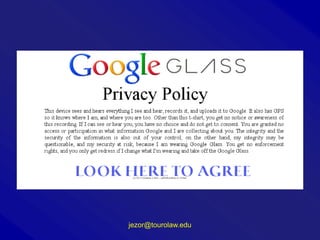
• Even users cannot offer privacy policies for
Glass
jezor@tourolaw.edu
jezor@tourolaw.edu
Proposal: FCC
Approval Process
and Privacy
Disclosure
• Wireless devices already need FCC approval
• FCC separately regulates wireless carriers’
privacy practices
• Proposal: add privacy disclosure to FCC device
approval
• Would mandate public availability, accuracy,
updates
• Would provide better redress, easier
implementation
jezor@tourolaw.edu
QUESTIONS?
Jonathan I. Ezor
Touro Law Center for Innovation in Business, Law
and Technology
jezor@tourolaw.edu
@ProfJonathan on Twitter

jezor@tourolaw.edu

10-22-13 Presentation on Google Glass and Privacy Challenges

  • 1.
    Flawed Transparency: Shared DataCollection and Disclosure Challenges for Google Glass and Similar Technologies Jonathan I. Ezor Assistant Professor & Director, Touro Law Center for Innovation in Business, Law & Technology jezor@tourolaw.edu 2013 CEWIT Conference October 22, 2013
  • 2.
  • 3.
    Privacy and Technology • Technologyfrequently connected with privacy issues • Construction, finance, transportation • Brandeis & Warren’s “The Right to Privacy” • Anonymity & pseudonymity • Digital storage/transmission a major shift jezor@tourolaw.edu
  • 4.
    Privacy Protected by Lawand Practice • Privacy protected by both law and practice • Focus primarily on personal information and behavior monitoring • Different cultures have different structures • Technology can both infringe on and protect privacy jezor@tourolaw.edu
  • 5.
    U.S. Primarily SelfRegulatoryRegime • In U.S., no general data privacy laws • Most situations covered by “self-regulation” • Only statute/regulation for special circumstances – – – – COPPA HIPAA GLB Others • Self-regulation driven by disclosure jezor@tourolaw.edu
  • 6.
    Fair Information Practice Principles •Statements of best practices and ideals in data collection and use • Multiple versions throughout world • FTC 1998 version: – – – – – Notice/Awareness Choice/Consent Access/Participation Integrity/Security Enforcement/Redress • Standard method is “privacy policy” jezor@tourolaw.edu
  • 7.
    Privacy Policy: Statement of Practices •Statement of organization’s actual: – Collection – Use – Sharing • Should be prominently available • CA law requires (PA law punishes knowing inaccuracy) • Federal law largely about misstatements or omissions • Data security practices also considered jezor@tourolaw.edu
  • 8.
    Challenges of Privacy Policies •Accuracy • Revisions • Method of delivery – Form factor – Transaction process – Multiple parties involved • Newer technologies raise problems with privacy policy methodology jezor@tourolaw.edu
  • 9.
    Google: Multichannel, Multiuse • Google inbusiness of monetizing personal information collection • Broad range of businesses within Google sharing data • Collection goes far beyond Web sites • Information collected goes far beyond personally identifiable information jezor@tourolaw.edu
  • 10.
    Google Street View andWiFi • Google Street View cars photographing locations around world • Also detecting WiFi routers for location services • Discovered to be intercepting traffic on open networks • Facing legal issues in U.S., elsewhere jezor@tourolaw.edu
  • 11.
  • 12.
    Google Glass: Wearable Sensor Suite • • • • • • GoogleGlass new wearable device Discreet, wireless, and powerful WiFi-enabled GPS through paired device Cameras, microphone Apps and two-way wireless capabilities jezor@tourolaw.edu
  • 13.
    Privacy Concerns with Glass •Many concerned about “voyeurism” of Glass • Broader question of Google collection/use of information • Glass’ form factor, ubiquity makes it different from smartphones • Little or no information available about Google collection processes • Even users cannot offer privacy policies for Glass jezor@tourolaw.edu
  • 14.
  • 15.
    Proposal: FCC Approval Process andPrivacy Disclosure • Wireless devices already need FCC approval • FCC separately regulates wireless carriers’ privacy practices • Proposal: add privacy disclosure to FCC device approval • Would mandate public availability, accuracy, updates • Would provide better redress, easier implementation jezor@tourolaw.edu
  • 16.
    QUESTIONS? Jonathan I. Ezor TouroLaw Center for Innovation in Business, Law and Technology jezor@tourolaw.edu @ProfJonathan on Twitter jezor@tourolaw.edu