Agenda  Introductions Planning – Some questions to think about as you begin the process? CMS Choices Where’s the Audience SEO & Metrics Social Media On Air Marketing/Partner Marketing Sound – Working with Audio
Introduction Knight International Journalism Fellows, International Committee for Journalists (ICFJ) - South China Morning Post –  www.scmp.com , www.classifiedpost.com - Knight Ridder Digital, US Network of 40 Newspaper Websites  ICFJ includes: - Knight International Fellows + International trainers, consultants + Funded by Knight Foundation, Gates Foundation, MDLF + Media Partners across Asia, Middle East, Africa, Latin America - Independently Funded Projects + Citizen Journalism (Malaysia) + Online Journalism and Story Telling (China, India, Mexico) - IJnet.org – Social Network for journalists and media managers + Available in English, Spanish, Portuguese, Arabic, Farsi, Chinese, Russian
Some Planning Questions to Start: What are your goals for the site?  - Increased audience? - Increased revenue? At the end of 12 months how will you know if you are successful?  How will you measure this success? Who is the audience of the website?  - Domestic online users? - Online users overseas? - Government officials? NGO representatives? What kind of technical and design resources will you have available to work on the project?  What will the content source and workflow be?  - Centralized vs distributed - Original and online only, integrated with another media (radio) What is your timeline to launch the new site?  - 3 months, 6 months, 12 months
CMS: Content Management System CMS is the platform for online publishers to produce, manage, and publish content to the internet.  Most CMS’s include the following key functions: -  Site Administration : configures the functions of the site -  Content Management : creates and manages a content element (story) -  Site Configuration : site design and organization -  User Management : site access controls -  Reporting/Statistics : metrics for the site There dozens of open source (free) CMS’s available in all of the major programming languages. Example  here . Each CMS starts with a basic platform that can be expanded and customized through add-on applications called  -  modules (Drupal)   -  extensions (Joomla) - plug-ins (WordPress)
CMS: Content Management System Three PHP based CMS’s dominate the market for online media publishing: Source: 2010 Open Source Market Share Report, Water & Stone Agency
Big 3 CMS Overview Drupal www.drupal.org Modules = 10,041 Themes = 1,137 CNNgo Economist.com New York Obsever NPR Affiliate Network ____ Joomla www.joomla.org Extensions = 7,653 Templates = >5,000    (mostly commercial) NagarikNews.com Phnom Penh Post Guggenheim Museum KBR68H.com WordPress wordpress.org Plug-ins = 14,728 Themes = 1,385 TechCrunch Arabian Radio Network The Philippine Daily Inquirer The Online Citizen (Singapore) KomunitiKini.com Universe Samples Rep Examples
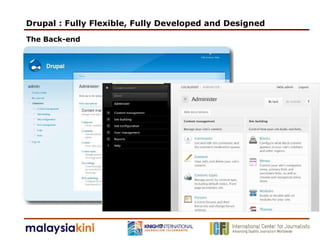
Drupal : Fully Flexible, Fully Developed and Designed The Back-end
Joomla and WordPress: Standard Menu Drive Dashboards
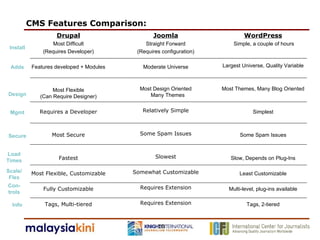
CMS Features Comparison: Drupal Most Difficult (Requires Developer) Features developed + Modules Most Flexible (Can Require Designer) Requires a Developer Most Secure Fastest Most Flexible, Customizable Fully Customizable Tags, Multi-tiered Joomla Straight Forward (Requires configuration) Moderate Universe Most Design Oriented Many Themes Relatively Simple Some Spam Issues Slowest Somewhat Customizable Requires Extension Requires Extension WordPress Simple, a couple of hours Largest Universe, Quality Variable Most Themes, Many Blog Oriented Simplest Some Spam Issues Slow, Depends on Plug-Ins Least Customizable Multi-level, plug-ins available Tags, 2-tiered Install Adds Design Mgmt Secure Load Times Scale/ Flex Con- trols Info
Where’s the Audience? Three Steps to Building an Audience Online 1. Search Engine Traffic 2. Build a Social Media Army 3. Leverage Your Partners - On Air, In Paper Mentions and “Packages” - Network Partners - Regional Partners
Content and Distribution: Search Engines Search engines are your friend – they help you build audience and revenue.  But you have to help them first! Text :  Search engines “read” text, not photos, or videos Do : Use text to label photos and videos – title, caption, tags Notification:  Thousands of new websites are created daily Do:  Verify your site and register with Google and Microsoft (Bing) Do:  If Google News exists, submit your site for inclusion. Focus : Search engines “understand” the content of a blog when content is clearly labelled. Do : Use simple page titles for Google Do : Describe your site in the meta description and meta tags Do:  Create ways to organize your content into themes (geo, tags) 4. Frequency/Volume:  The more you post, the more the search engines will visit. Do : Post as frequently as you can.
Content and Distribution: Search Engines Search engines rank your blog based on how engaged your blog is with other sites.  It’s all about links!   The more links to your blog and from your blog to relevant information, the higher your blog’s importance will be. Do : Develop as many  relevant links  and embeds to your blog as possible A.  Blogrolls : Create a list of blogs that you follow about your topics    or location. B.  Link Exchanges : Encourage “related bloggers or sites” to      exchange links with you. Do : Use links in a text post to your blog. A.  Places or Organizations :  Add a link to their websites B.  People :  Add a link to their blog, resume page, or social media    page (is they have one).
Content and Distribution: Social Media Social media expands your audience and improves your search engine importance.   Short updates from you and your blog, including text, photos, and VERY SHORT (<10 sec) video. Do : Set-up a twitter account and feed for your cotent (twitterfeed.com)   Include your location when you sign up so people can find you. Do : Find and “follow” other related Twitter users (your town, your topics)   If you “follow” them, they are likely to “follow” you. - http://wefollow.com/twitter/nepal -  You can also build distribution for your blog from your Facebook page.  3 Types of Pages (Profile, Page, Group) Can : Set-up a “feed” to automatically send your content to FB.
Multiple approaches to serving audio online and distributing audio to your users. Hosted Directly:  Requires server space to serve the audio file for download. Service – Hosted in the Cloud: Soundcloud  – new service, the YouTube of audio YouTube  – two techniques - Photo slide show combined with audio track (limit 10 – 15 min) - Studio shoot from talk show/discussion show RSS and Podcasting – distributes audio file through RSS feed format to  - Special (mobile) services, iTunes & Blackberry Podcast Directory - RSS Readers with multi-media built in, like Google Reader Sound and Audio
Sound and Audio – SoundCloud
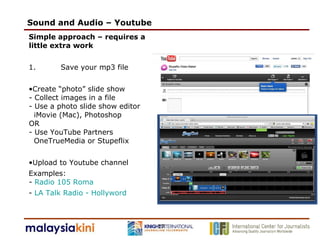
Sound and Audio – Youtube Simple approach – requires a little extra work 1. Save your mp3 file Create “photo” slide show - Collect images in a file - Use a photo slide show editor   iMovie (Mac), Photoshop  OR - Use YouTube Partners    OneTrueMedia or Stupeflix Upload to Youtube channel  Examples:  -  Radio 105 Roma -  LA Talk Radio - Hollyword
Sound and Audio – RSS/Podcasts Requires a multimedia RSS feed. 1. Create multimedia RSS feed - Audio file, text description, … Submit to mobile podcast directories - iTunes - Blackberry Desktop/laptop distribution - Example Google Reader

MalaysiaKini Training

  • 1.
    Agenda IntroductionsPlanning – Some questions to think about as you begin the process? CMS Choices Where’s the Audience SEO & Metrics Social Media On Air Marketing/Partner Marketing Sound – Working with Audio
  • 2.
    Introduction Knight InternationalJournalism Fellows, International Committee for Journalists (ICFJ) - South China Morning Post – www.scmp.com , www.classifiedpost.com - Knight Ridder Digital, US Network of 40 Newspaper Websites ICFJ includes: - Knight International Fellows + International trainers, consultants + Funded by Knight Foundation, Gates Foundation, MDLF + Media Partners across Asia, Middle East, Africa, Latin America - Independently Funded Projects + Citizen Journalism (Malaysia) + Online Journalism and Story Telling (China, India, Mexico) - IJnet.org – Social Network for journalists and media managers + Available in English, Spanish, Portuguese, Arabic, Farsi, Chinese, Russian
  • 3.
    Some Planning Questionsto Start: What are your goals for the site? - Increased audience? - Increased revenue? At the end of 12 months how will you know if you are successful? How will you measure this success? Who is the audience of the website? - Domestic online users? - Online users overseas? - Government officials? NGO representatives? What kind of technical and design resources will you have available to work on the project? What will the content source and workflow be? - Centralized vs distributed - Original and online only, integrated with another media (radio) What is your timeline to launch the new site? - 3 months, 6 months, 12 months
  • 4.
    CMS: Content ManagementSystem CMS is the platform for online publishers to produce, manage, and publish content to the internet. Most CMS’s include the following key functions: - Site Administration : configures the functions of the site - Content Management : creates and manages a content element (story) - Site Configuration : site design and organization - User Management : site access controls - Reporting/Statistics : metrics for the site There dozens of open source (free) CMS’s available in all of the major programming languages. Example here . Each CMS starts with a basic platform that can be expanded and customized through add-on applications called - modules (Drupal) - extensions (Joomla) - plug-ins (WordPress)
  • 5.
    CMS: Content ManagementSystem Three PHP based CMS’s dominate the market for online media publishing: Source: 2010 Open Source Market Share Report, Water & Stone Agency
  • 6.
    Big 3 CMSOverview Drupal www.drupal.org Modules = 10,041 Themes = 1,137 CNNgo Economist.com New York Obsever NPR Affiliate Network ____ Joomla www.joomla.org Extensions = 7,653 Templates = >5,000 (mostly commercial) NagarikNews.com Phnom Penh Post Guggenheim Museum KBR68H.com WordPress wordpress.org Plug-ins = 14,728 Themes = 1,385 TechCrunch Arabian Radio Network The Philippine Daily Inquirer The Online Citizen (Singapore) KomunitiKini.com Universe Samples Rep Examples
  • 7.
    Drupal : FullyFlexible, Fully Developed and Designed The Back-end
  • 8.
    Joomla and WordPress:Standard Menu Drive Dashboards
  • 9.
    Joomla and WordPress:Standard Menu Drive Dashboards
  • 10.
    CMS Features Comparison:Drupal Most Difficult (Requires Developer) Features developed + Modules Most Flexible (Can Require Designer) Requires a Developer Most Secure Fastest Most Flexible, Customizable Fully Customizable Tags, Multi-tiered Joomla Straight Forward (Requires configuration) Moderate Universe Most Design Oriented Many Themes Relatively Simple Some Spam Issues Slowest Somewhat Customizable Requires Extension Requires Extension WordPress Simple, a couple of hours Largest Universe, Quality Variable Most Themes, Many Blog Oriented Simplest Some Spam Issues Slow, Depends on Plug-Ins Least Customizable Multi-level, plug-ins available Tags, 2-tiered Install Adds Design Mgmt Secure Load Times Scale/ Flex Con- trols Info
  • 11.
    Where’s the Audience?Three Steps to Building an Audience Online 1. Search Engine Traffic 2. Build a Social Media Army 3. Leverage Your Partners - On Air, In Paper Mentions and “Packages” - Network Partners - Regional Partners
  • 12.
    Content and Distribution:Search Engines Search engines are your friend – they help you build audience and revenue. But you have to help them first! Text : Search engines “read” text, not photos, or videos Do : Use text to label photos and videos – title, caption, tags Notification: Thousands of new websites are created daily Do: Verify your site and register with Google and Microsoft (Bing) Do: If Google News exists, submit your site for inclusion. Focus : Search engines “understand” the content of a blog when content is clearly labelled. Do : Use simple page titles for Google Do : Describe your site in the meta description and meta tags Do: Create ways to organize your content into themes (geo, tags) 4. Frequency/Volume: The more you post, the more the search engines will visit. Do : Post as frequently as you can.
  • 13.
    Content and Distribution:Search Engines Search engines rank your blog based on how engaged your blog is with other sites. It’s all about links! The more links to your blog and from your blog to relevant information, the higher your blog’s importance will be. Do : Develop as many relevant links and embeds to your blog as possible A. Blogrolls : Create a list of blogs that you follow about your topics or location. B. Link Exchanges : Encourage “related bloggers or sites” to exchange links with you. Do : Use links in a text post to your blog. A. Places or Organizations : Add a link to their websites B. People : Add a link to their blog, resume page, or social media page (is they have one).
  • 14.
    Content and Distribution:Social Media Social media expands your audience and improves your search engine importance. Short updates from you and your blog, including text, photos, and VERY SHORT (<10 sec) video. Do : Set-up a twitter account and feed for your cotent (twitterfeed.com) Include your location when you sign up so people can find you. Do : Find and “follow” other related Twitter users (your town, your topics) If you “follow” them, they are likely to “follow” you. - http://wefollow.com/twitter/nepal - You can also build distribution for your blog from your Facebook page. 3 Types of Pages (Profile, Page, Group) Can : Set-up a “feed” to automatically send your content to FB.
  • 15.
    Multiple approaches toserving audio online and distributing audio to your users. Hosted Directly: Requires server space to serve the audio file for download. Service – Hosted in the Cloud: Soundcloud – new service, the YouTube of audio YouTube – two techniques - Photo slide show combined with audio track (limit 10 – 15 min) - Studio shoot from talk show/discussion show RSS and Podcasting – distributes audio file through RSS feed format to - Special (mobile) services, iTunes & Blackberry Podcast Directory - RSS Readers with multi-media built in, like Google Reader Sound and Audio
  • 16.
    Sound and Audio– SoundCloud
  • 17.
    Sound and Audio– Youtube Simple approach – requires a little extra work 1. Save your mp3 file Create “photo” slide show - Collect images in a file - Use a photo slide show editor iMovie (Mac), Photoshop OR - Use YouTube Partners OneTrueMedia or Stupeflix Upload to Youtube channel Examples: - Radio 105 Roma - LA Talk Radio - Hollyword
  • 18.
    Sound and Audio– RSS/Podcasts Requires a multimedia RSS feed. 1. Create multimedia RSS feed - Audio file, text description, … Submit to mobile podcast directories - iTunes - Blackberry Desktop/laptop distribution - Example Google Reader