Marketing & Product Development
             “Delivering the Goods”

                 Presented 26 July 2010
                 Kuala Lumpur, Malaysia
2


What makes a great product or service?


 What was the best product or service you used in the last year?


 Why do you think it is the best?


 What makes it the best?


 Can you name one well known product developer? Designer? Inventor?
3


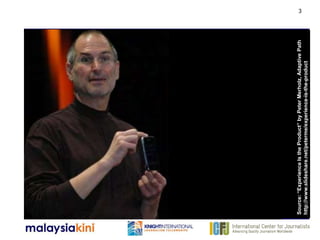
Source: “Experience Is the Product” by Peter Merholz, Adaptive Path
http://www.slideshare.net/peterme/experience-is-the-product
4
5
6


Source: “Experience Is the Product” by Peter Merholz, Adaptive Path
http://www.slideshare.net/peterme/experience-is-the-product
7

Outline
 Goals


 The Process: Where marketing and product development fit?


 Marketing: Doing the homework for product development?


 Product Development: How do you get the product to “WOW”?


 Other Resources
8

Goals
Today’s discussion is designed to give an overview of product
development and answer some key questions.


 Where does product development fit in the overall business?


 What role does marketing play in product development?


 What role does metrics and analysis play in product development?


 How often does a company have to develop a product?


 What guidelines or steps can you follow for product development?


                          Today’s a discussion.
      Help me improve this presentation with your questions, please!
9

Outline
 Goals


 The Process: Where marketing and product development fit?


 Marketing: Doing the homework for product development?


 Product Development: How do you get the product to “WOW”?


 Other Resources
10

                       The Process
                       Marketing and Product Development fit between the “vision”
                       (Strategy) and the “execution” (Technology).

                                                                             Product
                           Strategy              Marketing                 Development             Technology
                       Company ambitions         Define the              Product                Code development
The Requirements


                   •                        •                        •                      •
                   •   Company goals             market:                 functionality      •   Operations
                                                 - Size; Needs       •   Metric models of       planning
                   •   “What business are
                                                 - Revenue model         success
                       we in?”                                                              •   Database design
                                                 - Competitors
                   •   Priority setting                              •   User interface     •   Systems
                                            •    Business Plan           design
                       - What to do AND                                                         architecture
                       - What not to do     •    Priorities for      •   Page types
                                                 development
The Output


                                                                          Product Plan            Technical
                       Strategic Plan           Business Plans           “Wire Frames”          Specifications


                                                At each step some record is kept.
11

The Process
In a start-up the record can be as informal as a room full of screen
designs and post-it notes – The War Room
12

Outline
 Goals


The Process: Where marketing and product development fit?


 Marketing: Doing the homework for product development?


 Product Development: How do you get the product to “WOW”?


 Other Resources
13

Marketing
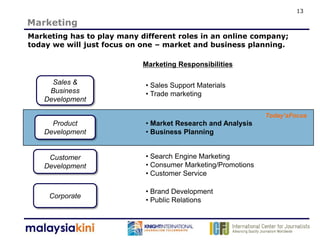
Marketing has to play many different roles in an online company;
today we will just focus on one – market and business planning.

                            Marketing Responsibilities

      Sales &               • Sales Support Materials
     Business               • Trade marketing
    Development

                                                              Today’sFocus
      Product               • Market Research and Analysis
    Development             • Business Planning


     Customer               • Search Engine Marketing
    Development             • Consumer Marketing/Promotions
                            • Customer Service

                            • Brand Development
     Corporate
                            • Public Relations
14

Marketing
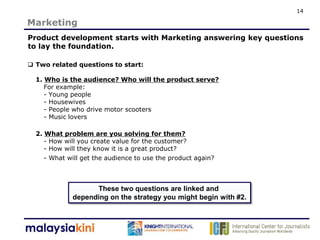
Product development starts with Marketing answering key questions
to lay the foundation.

 Two related questions to start:

  1. Who is the audience? Who will the product serve?
     For example:
     - Young people
     - Housewives
     - People who drive motor scooters
     - Music lovers

  2. What problem are you solving for them?
     - How will you create value for the customer?
     - How will they know it is a great product?
     - What will get the audience to use the product again?


                   These two questions are linked and
             depending on the strategy you might begin with #2.
15

              Marketing
              Marketing creates a framework to describe the unique types of
              customer in the market.

                                     Hypothetical Framework of Dining Enthusiasts
                     Foodie
                   Influencer                 Social Diner                    Couples                   Families

          •   25 to 45 years old          •   18 to 35 years old     •   30 to 50 years old   •   30 to 50 years old
 Demo


          •   Male, mostly                •   Evenly divided         •   Evenly divided       •   Married with kids
          •   Single                          male/female                male/female          •   Evenly divided
                                          •   Single                 •   Married                  male/female


          •   Potentially heavy           •   Frequent user          •   Occasional user      •   Light user
              user                        •   Dining as              •   Once a week or       •   Less than once a
          •   Dines out daily                 dating/social option       more                     week
                                          •   Seeks referrals from   •   Seeks referrals in   •   Seeks referrals from
Behvior


          •   Often provides
              referrals for others            friends                    their neighborhood       others with kids


          •   Has food review blog        •   Heavy SNS user         •   Moderate SNS user    •   Light to no SNS
          •   Heavy SNS user


                                 Heavy users are the usual “go-to market” target.
16

Marketing
The next step is often to look for other companies with the same
goals or companies who might develop similar goals.

3. What other companies are targeting your customer? What can we learn from
   them?
   - Are they successful? Growing?
   - Why are they successful? What do they do well?
   - Where are they un-successful? Why?
   - What can we learn from them? Pricing? Packaging?

Remember!
  - Very rarely are there completely new problems to solve or products to solve them
  - Most new products are really new solutions to old problems
  - Applying new insight about the customer
  - Applying new technology

So, you can always learn from others in the market!
17

Marketing
The next step identifies a plan for how to use your company’s
strengths to develop a better solution to the customer’s needs.

4. What are the unique strengths of my company?
   - Brand awareness?
   - Large pool of active traffic?
   - Strong advertiser support?
   - Technology platform?
   - Ability to offer existing products at a cheaper price

5. How do I apply these to the customer’s needs?
- Unique marketing solution? Build traffic and trial cheaper or faster?
   - Unique benefits to offer from advertisers?
18

Marketing
Marketing produces a general roadmap to guide product
development.

KeyOutputs include:
  •Definition of who and how we compete
  •A first draft of the key needs that we can uniquely fill
  •A description of how we fill these needs
     - These often set-up the initial user cases that drive product development
 • Initial guidelines on revenue model and pricing
 • Initial guidelines on distribution and source of traffic and trial
 • Initial suggestions on KPI’s that will describe success in each user case
     - Example: Low percentage of abandoned searches, total reviews written, …
19

Outline
 Goals


The Process: Where marketing and product development fit?


 Marketing: Doing the homework for product development?


Product Development: How do you get the product to “WOW”?


 Other Resources
20

Product Development
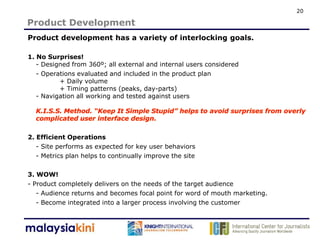
Product development has a variety of interlocking goals.

1. No Surprises!
   - Designed from 360º; all external and internal users considered
   - Operations evaluated and included in the product plan
          + Daily volume
          + Timing patterns (peaks, day-parts)
   - Navigation all working and tested against users


2. Efficient Operations
   - Site performs as expected for key user behaviors
   - Metrics plan helps to continually improve the site

3. WOW!
- Product completely delivers on the needs of the target audience
   - Audience returns and becomes focal point for word of mouth marketing.
   - Become integrated into a larger process involving the customer
21

Product Development
Marketing has given key input for the customer:

Key   Customer Inputs include:
  •   Definition of who and how we compete
  •   A first draft of the key needs that we can uniquely fill
  •   A description of how we fill these needs
  •   Initial guidelines on revenue model and pricing
  •   Initial guidelines on distribution and source of traffic and trial
  •   Initial suggestions on KPI’s that will describe success in each user case

Product development must also determine what other “constituents” will use
the product in order to be successful.
  • Internal Admin Users?
     - Metrics
     - Comment monitoring
  • Advertising users? Self Serve advertising?
  • Partner Users? API users? Search Engine Users?
22

Product Development
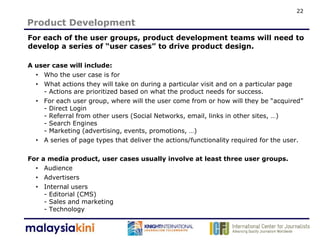
For each of the user groups, product development teams will need to
develop a series of “user cases” to drive product design.

A user case will include:
  • Who the user case is for
  • What actions they will take on during a particular visit and on a particular page
    - Actions are prioritized based on what the product needs for success.
  • For each user group, where will the user come from or how will they be “acquired”
    - Direct Login
    - Referral from other users (Social Networks, email, links in other sites, …)
    - Search Engines
    - Marketing (advertising, events, promotions, …)
  • A series of page types that deliver the actions/functionality required for the user.

For   a media product, user cases usually involve at least three user groups.
  •    Audience
  •    Advertisers
  •    Internal users
       - Editorial (CMS)
       - Sales and marketing
       - Technology
23

Product Development
For each of the user groups, product development teams will need to
develop a series of “user cases” to drive product design.

A user case will include:
  • Who the user case is for
  • What actions they will take on during a particular visit and on a particular page
    - Actions are prioritized based on what the product needs for success.
  • For each user group, where will the user come from or how will they be “acquired”
    - Direct Login
    - Referral from other users (Social Networks, email, links in other sites, …)
    - Search Engines
    - Marketing (advertising, events, promotions, …)
  • A series of page types that deliver the actions/functionality required for the user.

For   a media product, user cases usually involve at least three user groups.
  •    Audience
  •    Advertisers
  •    Internal users
       - Editorial (CMS)
       - Sales and marketing
       - Technology
24

Product Development
For a media site there are a variety of standard page types for the
“general” audience user case.


                                    Content Pages/                     Search/
     Structural Pages                Content Tools               Search Return Pages

 • Pages that point to other   • Pages that contain content    • Pages that access the
   pages                       • Pages that contain tools to     content archive
 • Pages that have limited       use the content               • Search tool pages
   functionality               • Pages that access the         • Internal search engine
 • Pages designed to             content directly                return pages
   maximize SEO

 For example:                  For example:                    For example:
 • Home Pages                  • Content Pages                 • Archive Search Pages
 • Section fronts              • Video Player Pages            • Search engine return pages
 • About us pages              • Photo Gallery Pages             (SERP)
 • SEO pages                   • Tools Pages
                                 - Comments
                                 - Email this
                                 - Print this
25

Product Development
With the page types determined, then pages are built out of
generally four layers.

                                           Page Build
                                                       User Interface
Functionality/Actions            Metrics                  Design              Guidance


  •   Read Story         •   Google Analytics           Navigation        On-site
  •   Comment on story   •   A/B testing                Layout             instructions
  •   See advertising    •   Advertising metrics                           Marketing/Brandin
                                                                            g language
  •   View photos        •   Internal metrics
                                                                           Etc…
  •   etc…               •   …
                                                                           Editorial Guidelines
                                                                            Labels
                                                                            - “Advertisement”
                                                                            - Opinion
                                                                            - etc…
26

Product Development
Almost any page will include all four aspects of the page.


                                                 Navigation

                                                  Guidance
                                                              Metrics


   Functionality
27

Testing
When the product is “finished” but before it is launched, a period of
testing begins.

 Quality Assurance Testing – Technology – includes:
  • Server performance
  • Database performance
  • Capacity testing for other key supporting platforms
    - Email
    - RSS
    - Mobile, …
 User Testing – Product
  • Series of internal and external panels are asked to test the product
  • Panels can be informal, but all asked to perform a series of pre-determined tests
    and report the findings
  • General navigation test to performed
  • Parties responsible for structural pages may be asked to test their own pages
  • Bug list is generated and prioritized to make improvements prior to launch
 Post Launch Testing
  • Monitoring of predetermined metrics as well as customer comments
  • A/B testing on outstanding issues.
28

Launch
The launch of a new product requires careful timing and coordination
with the other aspects of the business.

 Internal users/Editorial
  • Training on any new tools prior to launch
  • Changes in any work flows

 Marketing
  • Launch of marketing efforts to drive new trial at the launch
  • Sales support efforts and events to debut the new product

 Sales and Business Development
  • Preview and “pre-sale” of new product to potential customers/advertisers
  • Notification and coordination with business partners to guarantee the new product
    continues to deliver according to existing agreements or
  • New understandings are created to acknowledge the change in the product

Marketing and Product Development

  • 1.
    Marketing & ProductDevelopment “Delivering the Goods” Presented 26 July 2010 Kuala Lumpur, Malaysia
  • 2.
    2 What makes agreat product or service?  What was the best product or service you used in the last year?  Why do you think it is the best?  What makes it the best?  Can you name one well known product developer? Designer? Inventor?
  • 3.
    3 Source: “Experience Isthe Product” by Peter Merholz, Adaptive Path http://www.slideshare.net/peterme/experience-is-the-product
  • 4.
  • 5.
  • 6.
    6 Source: “Experience Isthe Product” by Peter Merholz, Adaptive Path http://www.slideshare.net/peterme/experience-is-the-product
  • 7.
    7 Outline  Goals  TheProcess: Where marketing and product development fit?  Marketing: Doing the homework for product development?  Product Development: How do you get the product to “WOW”?  Other Resources
  • 8.
    8 Goals Today’s discussion isdesigned to give an overview of product development and answer some key questions.  Where does product development fit in the overall business?  What role does marketing play in product development?  What role does metrics and analysis play in product development?  How often does a company have to develop a product?  What guidelines or steps can you follow for product development? Today’s a discussion. Help me improve this presentation with your questions, please!
  • 9.
    9 Outline  Goals  TheProcess: Where marketing and product development fit?  Marketing: Doing the homework for product development?  Product Development: How do you get the product to “WOW”?  Other Resources
  • 10.
    10 The Process Marketing and Product Development fit between the “vision” (Strategy) and the “execution” (Technology). Product Strategy Marketing Development Technology Company ambitions Define the Product Code development The Requirements • • • • • Company goals market: functionality • Operations - Size; Needs • Metric models of planning • “What business are - Revenue model success we in?” • Database design - Competitors • Priority setting • User interface • Systems • Business Plan design - What to do AND architecture - What not to do • Priorities for • Page types development The Output Product Plan Technical Strategic Plan Business Plans “Wire Frames” Specifications At each step some record is kept.
  • 11.
    11 The Process In astart-up the record can be as informal as a room full of screen designs and post-it notes – The War Room
  • 12.
    12 Outline  Goals The Process:Where marketing and product development fit?  Marketing: Doing the homework for product development?  Product Development: How do you get the product to “WOW”?  Other Resources
  • 13.
    13 Marketing Marketing has toplay many different roles in an online company; today we will just focus on one – market and business planning. Marketing Responsibilities Sales & • Sales Support Materials Business • Trade marketing Development Today’sFocus Product • Market Research and Analysis Development • Business Planning Customer • Search Engine Marketing Development • Consumer Marketing/Promotions • Customer Service • Brand Development Corporate • Public Relations
  • 14.
    14 Marketing Product development startswith Marketing answering key questions to lay the foundation.  Two related questions to start: 1. Who is the audience? Who will the product serve? For example: - Young people - Housewives - People who drive motor scooters - Music lovers 2. What problem are you solving for them? - How will you create value for the customer? - How will they know it is a great product? - What will get the audience to use the product again? These two questions are linked and depending on the strategy you might begin with #2.
  • 15.
    15 Marketing Marketing creates a framework to describe the unique types of customer in the market. Hypothetical Framework of Dining Enthusiasts Foodie Influencer Social Diner Couples Families • 25 to 45 years old • 18 to 35 years old • 30 to 50 years old • 30 to 50 years old Demo • Male, mostly • Evenly divided • Evenly divided • Married with kids • Single male/female male/female • Evenly divided • Single • Married male/female • Potentially heavy • Frequent user • Occasional user • Light user user • Dining as • Once a week or • Less than once a • Dines out daily dating/social option more week • Seeks referrals from • Seeks referrals in • Seeks referrals from Behvior • Often provides referrals for others friends their neighborhood others with kids • Has food review blog • Heavy SNS user • Moderate SNS user • Light to no SNS • Heavy SNS user Heavy users are the usual “go-to market” target.
  • 16.
    16 Marketing The next stepis often to look for other companies with the same goals or companies who might develop similar goals. 3. What other companies are targeting your customer? What can we learn from them? - Are they successful? Growing? - Why are they successful? What do they do well? - Where are they un-successful? Why? - What can we learn from them? Pricing? Packaging? Remember! - Very rarely are there completely new problems to solve or products to solve them - Most new products are really new solutions to old problems - Applying new insight about the customer - Applying new technology So, you can always learn from others in the market!
  • 17.
    17 Marketing The next stepidentifies a plan for how to use your company’s strengths to develop a better solution to the customer’s needs. 4. What are the unique strengths of my company? - Brand awareness? - Large pool of active traffic? - Strong advertiser support? - Technology platform? - Ability to offer existing products at a cheaper price 5. How do I apply these to the customer’s needs? - Unique marketing solution? Build traffic and trial cheaper or faster? - Unique benefits to offer from advertisers?
  • 18.
    18 Marketing Marketing produces ageneral roadmap to guide product development. KeyOutputs include: •Definition of who and how we compete •A first draft of the key needs that we can uniquely fill •A description of how we fill these needs - These often set-up the initial user cases that drive product development • Initial guidelines on revenue model and pricing • Initial guidelines on distribution and source of traffic and trial • Initial suggestions on KPI’s that will describe success in each user case - Example: Low percentage of abandoned searches, total reviews written, …
  • 19.
    19 Outline  Goals The Process:Where marketing and product development fit?  Marketing: Doing the homework for product development? Product Development: How do you get the product to “WOW”?  Other Resources
  • 20.
    20 Product Development Product developmenthas a variety of interlocking goals. 1. No Surprises! - Designed from 360º; all external and internal users considered - Operations evaluated and included in the product plan + Daily volume + Timing patterns (peaks, day-parts) - Navigation all working and tested against users 2. Efficient Operations - Site performs as expected for key user behaviors - Metrics plan helps to continually improve the site 3. WOW! - Product completely delivers on the needs of the target audience - Audience returns and becomes focal point for word of mouth marketing. - Become integrated into a larger process involving the customer
  • 21.
    21 Product Development Marketing hasgiven key input for the customer: Key Customer Inputs include: • Definition of who and how we compete • A first draft of the key needs that we can uniquely fill • A description of how we fill these needs • Initial guidelines on revenue model and pricing • Initial guidelines on distribution and source of traffic and trial • Initial suggestions on KPI’s that will describe success in each user case Product development must also determine what other “constituents” will use the product in order to be successful. • Internal Admin Users? - Metrics - Comment monitoring • Advertising users? Self Serve advertising? • Partner Users? API users? Search Engine Users?
  • 22.
    22 Product Development For eachof the user groups, product development teams will need to develop a series of “user cases” to drive product design. A user case will include: • Who the user case is for • What actions they will take on during a particular visit and on a particular page - Actions are prioritized based on what the product needs for success. • For each user group, where will the user come from or how will they be “acquired” - Direct Login - Referral from other users (Social Networks, email, links in other sites, …) - Search Engines - Marketing (advertising, events, promotions, …) • A series of page types that deliver the actions/functionality required for the user. For a media product, user cases usually involve at least three user groups. • Audience • Advertisers • Internal users - Editorial (CMS) - Sales and marketing - Technology
  • 23.
    23 Product Development For eachof the user groups, product development teams will need to develop a series of “user cases” to drive product design. A user case will include: • Who the user case is for • What actions they will take on during a particular visit and on a particular page - Actions are prioritized based on what the product needs for success. • For each user group, where will the user come from or how will they be “acquired” - Direct Login - Referral from other users (Social Networks, email, links in other sites, …) - Search Engines - Marketing (advertising, events, promotions, …) • A series of page types that deliver the actions/functionality required for the user. For a media product, user cases usually involve at least three user groups. • Audience • Advertisers • Internal users - Editorial (CMS) - Sales and marketing - Technology
  • 24.
    24 Product Development For amedia site there are a variety of standard page types for the “general” audience user case. Content Pages/ Search/ Structural Pages Content Tools Search Return Pages • Pages that point to other • Pages that contain content • Pages that access the pages • Pages that contain tools to content archive • Pages that have limited use the content • Search tool pages functionality • Pages that access the • Internal search engine • Pages designed to content directly return pages maximize SEO For example: For example: For example: • Home Pages • Content Pages • Archive Search Pages • Section fronts • Video Player Pages • Search engine return pages • About us pages • Photo Gallery Pages (SERP) • SEO pages • Tools Pages - Comments - Email this - Print this
  • 25.
    25 Product Development With thepage types determined, then pages are built out of generally four layers. Page Build User Interface Functionality/Actions Metrics Design Guidance • Read Story • Google Analytics  Navigation  On-site • Comment on story • A/B testing  Layout instructions • See advertising • Advertising metrics  Marketing/Brandin g language • View photos • Internal metrics  Etc… • etc… • …  Editorial Guidelines Labels - “Advertisement” - Opinion - etc…
  • 26.
    26 Product Development Almost anypage will include all four aspects of the page. Navigation Guidance Metrics Functionality
  • 27.
    27 Testing When the productis “finished” but before it is launched, a period of testing begins.  Quality Assurance Testing – Technology – includes: • Server performance • Database performance • Capacity testing for other key supporting platforms - Email - RSS - Mobile, …  User Testing – Product • Series of internal and external panels are asked to test the product • Panels can be informal, but all asked to perform a series of pre-determined tests and report the findings • General navigation test to performed • Parties responsible for structural pages may be asked to test their own pages • Bug list is generated and prioritized to make improvements prior to launch  Post Launch Testing • Monitoring of predetermined metrics as well as customer comments • A/B testing on outstanding issues.
  • 28.
    28 Launch The launch ofa new product requires careful timing and coordination with the other aspects of the business.  Internal users/Editorial • Training on any new tools prior to launch • Changes in any work flows  Marketing • Launch of marketing efforts to drive new trial at the launch • Sales support efforts and events to debut the new product  Sales and Business Development • Preview and “pre-sale” of new product to potential customers/advertisers • Notification and coordination with business partners to guarantee the new product continues to deliver according to existing agreements or • New understandings are created to acknowledge the change in the product