Moving beyond the inherent conflict of new collaboration models
technology practices collaboration globalization
trans-disciplinary production is  concurrent, not sequential
New York <--> New Delhi SharePoint (for better or for worse) Google docs, BaseCamp skype, tele conferencing, web conferencing
culture  clash variety of communication styles communication hiccups:  lingual and cultural many insecurities (trigger defensiveness)
 
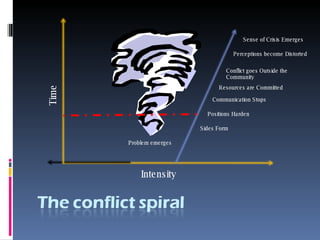
Intensity Time Problem emerges Sides Form Positions Harden Communication Stops Resources are Committed Conflict goes Outside the Community Perceptions become Distorted Sense of Crisis Emerges
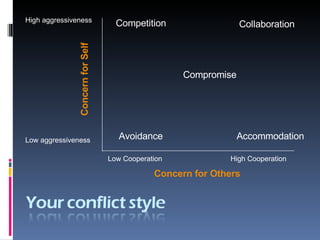
competition collaboration compromise avoidance accommodation Assessment Online: http://www.career-intelligence.com/assessment/tki.asp
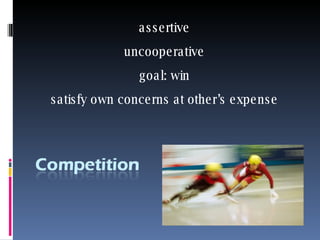
assertive uncooperative goal: win satisfy own concerns at other’s expense
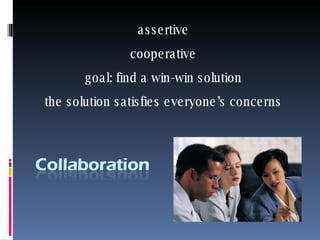
assertive cooperative goal: find a win-win solution the solution satisfies everyone’s concerns
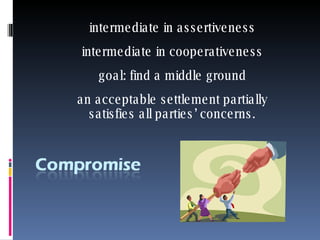
intermediate in assertiveness intermediate in cooperativeness goal: find a middle ground an acceptable settlement partially satisfies all parties’ concerns.
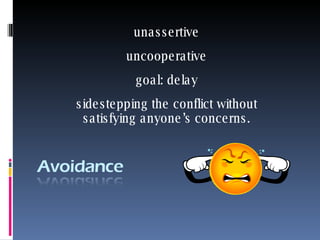
unassertive uncooperative goal: delay sidestepping the conflict without satisfying anyone’s concerns.
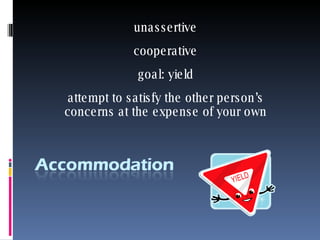
unassertive cooperative goal: yield attempt to satisfy the other person’s concerns at the expense of your own
Competition Collaboration Compromise Avoidance Accommodation High aggressiveness Low aggressiveness Low Cooperation High Cooperation Concern for Self Concern for Others
no one perfect style style appropriateness awareness of others’ styles  taking personal responsibility
Getting ahead of the conflict spiral involves  personal awareness …  of the  situation … and of  yourself.
‘ safe' conversation boundary-setting expectation-setting getting commitment
confront broken promise express disappointment renew commitment identify natural consequence
check ego listen be (self-) aware think, then speak
 
We are … Judy Glick-Smith President/CEO MentorFactor, Inc. 770-633-5582 [email_address] www.mentorfactorinc.com blog:  www.mentorfactor.typepad.com Emma Hamer Principal  - Senior Consultant E. Hamer Associates, Ltd. 604-317-2234 [email_address]   website and blog:   www.hamer-associates.ca

Making Work Work (Final)

Editor's Notes

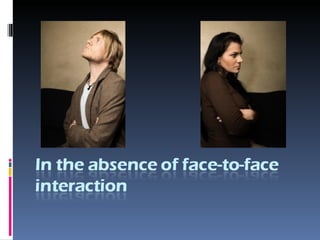
  • #2 Introduction (Judy, Emma) Show of hands ‘ who works in a dispersed / decentralized team’? ‘ who works in a multi- or cross disciplinary team’? ‘ who here has the ‘double whammy’ work experience? Another show of hands Who spends more than 25% of their time communicating with remote co-workers? On average, how often do you feel you need to clarify – or clear up – some sort of misunderstanding? See, here’s the thing. Human beings have evolved to communicate face-to-face. We read body language, subtle changes in expression, where the other person’s eyes move, any facial twitches, and so on. We read them without being aware of it, most of the time. We have simply developed the ‘well, you just know’ attitude around it. All this comes to a screeching halt when you’re not face-to-face. Sure, video conferencing helps a little bit, but if it’s a meeting, you’re usually watching the person doing the talking – not the other people there. And squinting at a screen is not conducive to catching the subtleties of facial expressions, now is it? So can we make it work? Can we make Work – work? Yes, we believe we can – no matter how far apart you are, or how different your native cultures are. You simply need to learn how to ‘read’ the other in a different way. That’s what we’re talking about today, and feel free to jump in at any time if you have an example or an experience that either bears us out, or challenges our ideas.